
Urbanisation What is urbanisation It is an increase
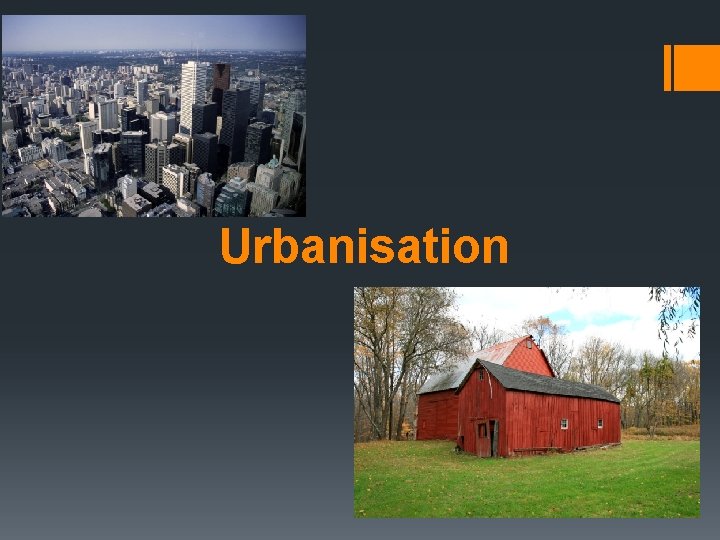
Urbanisation
What is urbanisation? • It is an increase in the proportion of people living in urban areas compared to rural areas.
Urbanisation • An Urban area is a built up area such as a town or city. • A Rural area is an area of countryside.
What is counter-urbanisation? • It is the movement of people (migration) out of urban areas, to the surrounding areas or rural areas. • This trend is quite common in MEDCs as compared to LEDCs.
MEDC & LEDCs • MEDC (More Economically developed Country) – a developed country which has high levels of development based on economic indicators such as gross domestic product (country’s income)

MEDC & LEDCs • LEDC (Less Economically developed Country) – A developing country, also called a less-developed country, is a nation with a low living standard, underdeveloped industrial base, and low Human Development Index relative to other countries
MEDC & LEDCs (indicators) Pair Activity (1) 1. Research as a pair & write in own words the meanings of these terms in your own exercise book o Population density o GDP (Gross Domestic Product) o Life expectancy o Human Development Index (HDI) 2. Using the sheet provided determine using the researched data where each country belong between MEDC and LEDCs. Use the following website for your research https: //www. cia. gov/library/publications/the-worldfactbook/geos/am. html
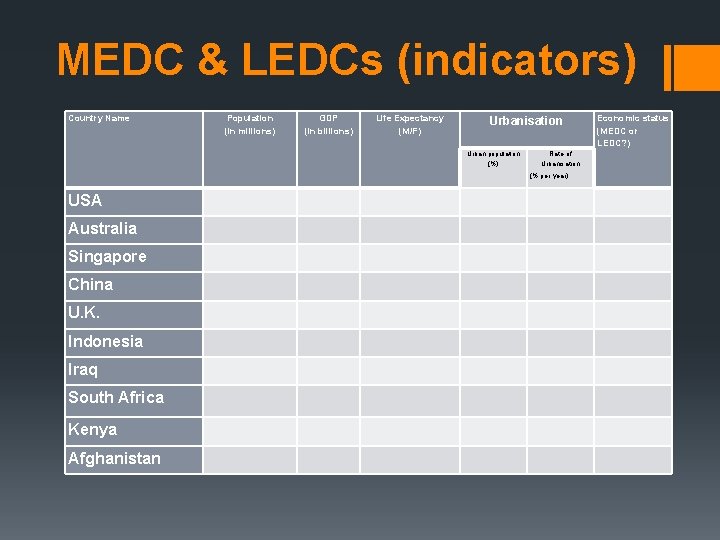
MEDC & LEDCs (indicators) Country Name Population (in millions) GDP (in billions) Life Expectancy (M/F) Urbanisation Urban population (%) Rate of Urbanisation (% per year) USA Australia Singapore China U. K. Indonesia Iraq South Africa Kenya Afghanistan Economic status (MEDC or LEDC? )
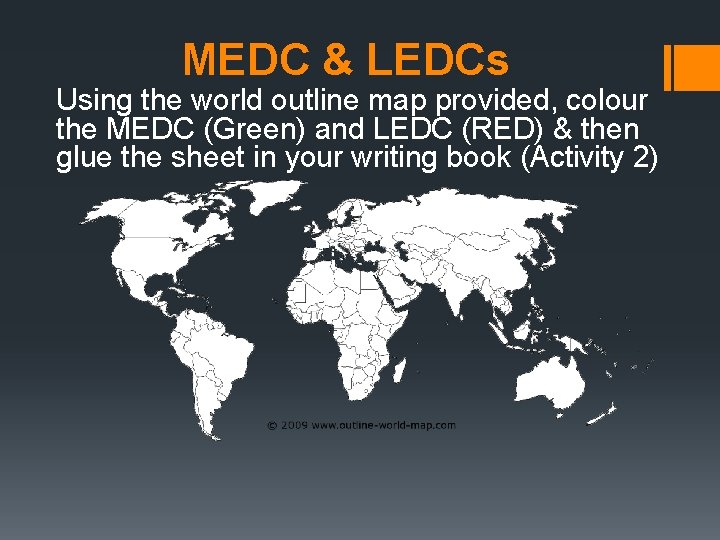
MEDC & LEDCs Using the world outline map provided, colour the MEDC (Green) and LEDC (RED) & then glue the sheet in your writing book (Activity 2)
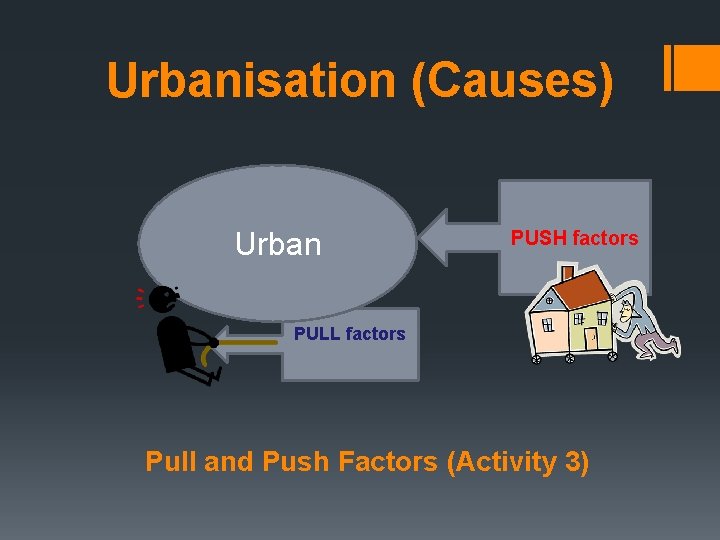
Urbanisation (Causes) Urban PUSH factors PULL factors Pull and Push Factors (Activity 3)
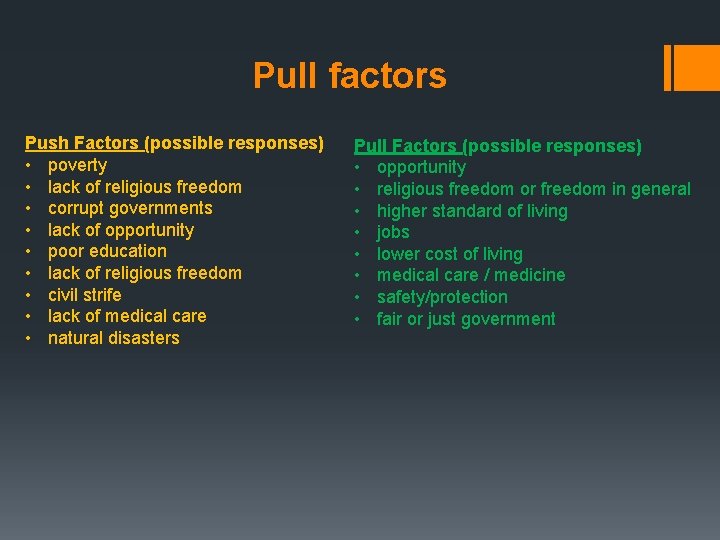
Pull factors Push Factors (possible responses) • poverty • lack of religious freedom • corrupt governments • lack of opportunity • poor education • lack of religious freedom • civil strife • lack of medical care • natural disasters Pull Factors (possible responses) • opportunity • religious freedom or freedom in general • higher standard of living • jobs • lower cost of living • medical care / medicine • safety/protection • fair or just government
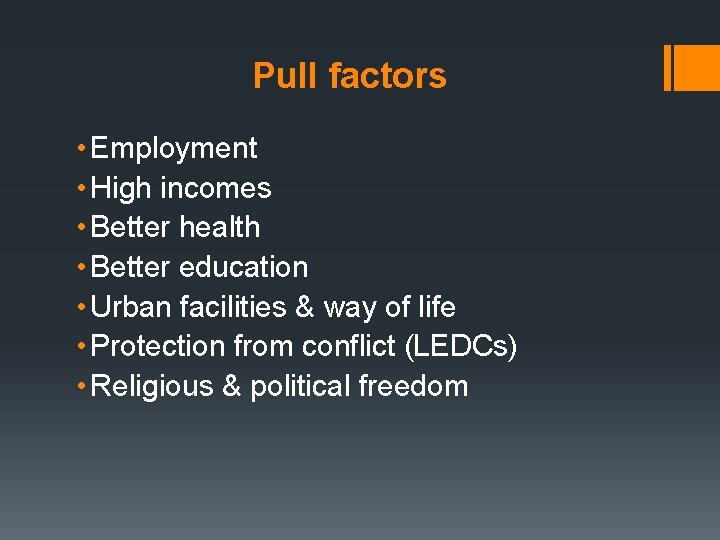
Pull factors • Employment • High incomes • Better health • Better education • Urban facilities & way of life • Protection from conflict (LEDCs) • Religious & political freedom
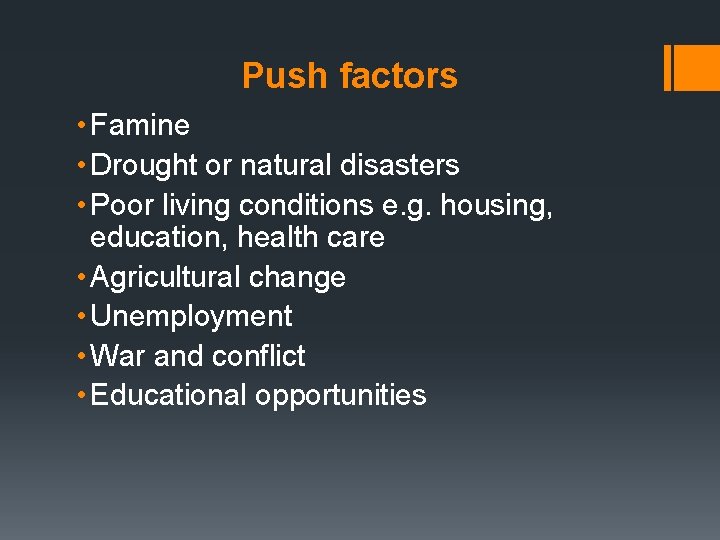
Push factors • Famine • Drought or natural disasters • Poor living conditions e. g. housing, education, health care • Agricultural change • Unemployment • War and conflict • Educational opportunities
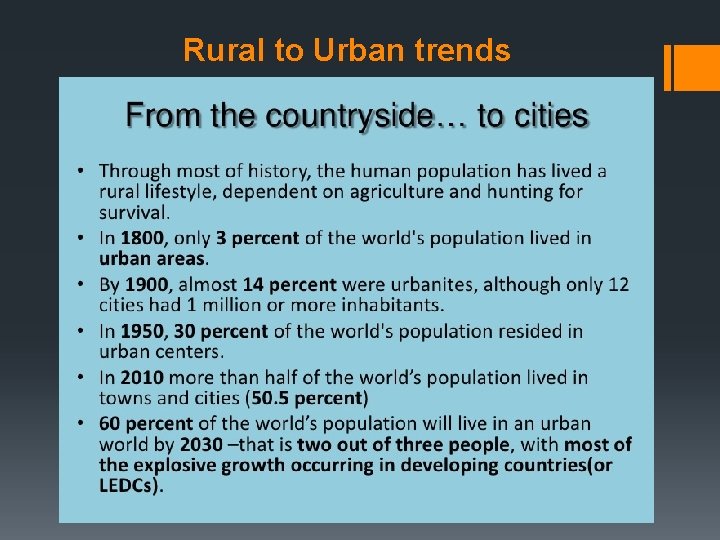
Rural to Urban trends
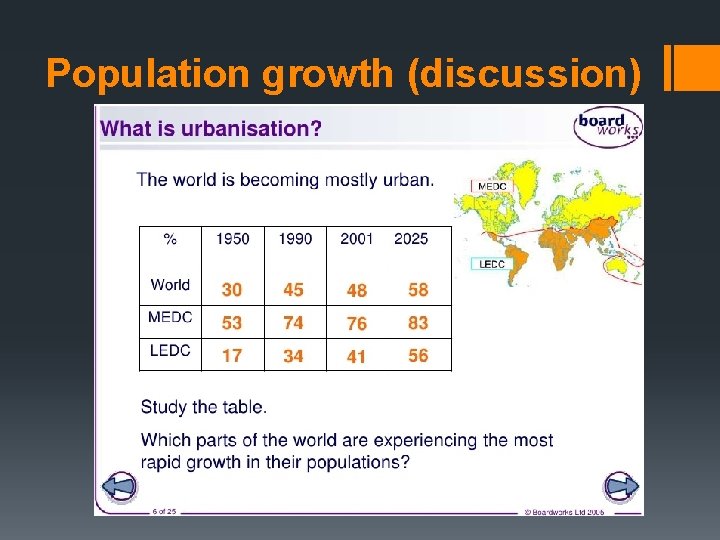
Population growth (discussion)
Urbanisation (Rise of cities) • A city is a large and permanent settlement which has a complex system of transport, land use, utilities such as water, power and sanitation • A megacity is a city with more than 10 million people e. g. New York (USA), Tokyo (Japan), Cairo (Egypt), Rio de Janeiro (Brazil) • Megaregion is a when megacities expand to join each other to form one urban settlement e. g. Hong Kong – Shenzhen - Guangzhou in China(120 million), Nagoya – Osaka – Kyoto – Kobe in Japan (60 million), Rio de Janeiro –Sao Paolo in Brazil (43 million) •

Urbanisation (Rise of cities)
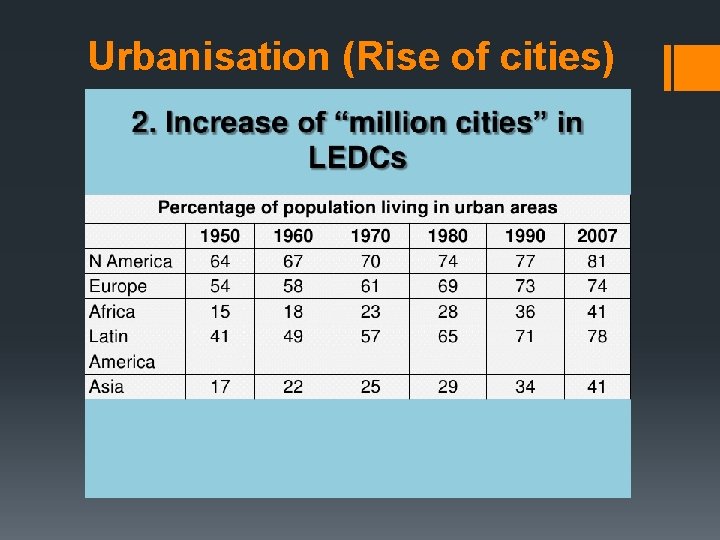
Urbanisation (Rise of cities)
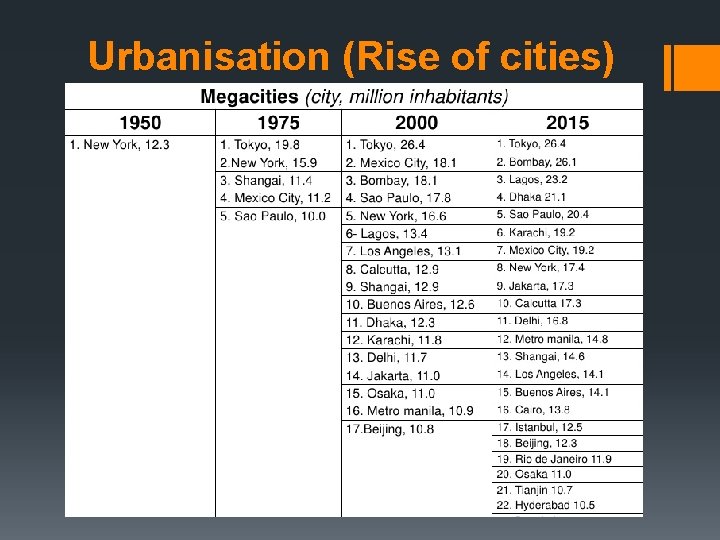
Urbanisation (Rise of cities)
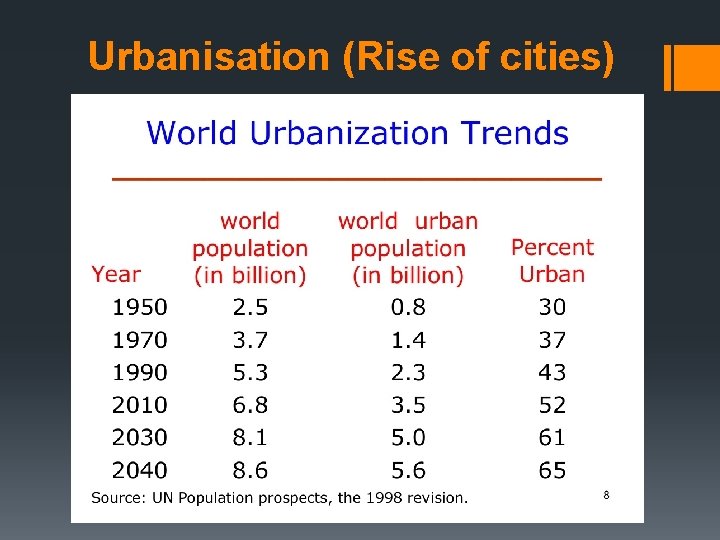
Urbanisation (Rise of cities)
Megacities (Key facts) • Over half the future growth of megacities will be within Asia • 20 largest cities consume 80% of the world’s energy and produce 80% of the global greenhouse gases • Slums in megacities are vulnerable to climate change as they are built on high risk locations e. g. Boneo in Indonesia
Urbanisation Quiz 1
- Slides: 22