
Urban Transportation Land Use and the Environment in
Urban Transportation, Land Use, and the Environment in Latin America: A Case Study Approach Units: 3 -0 -6
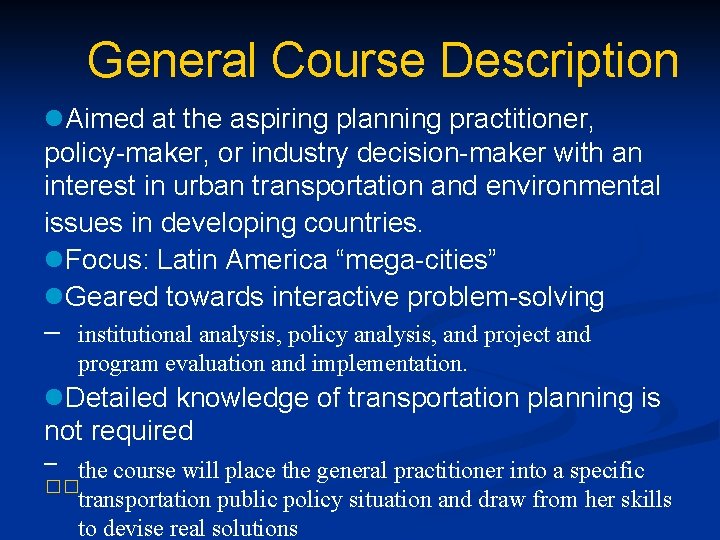
General Course Description l. Aimed at the aspiring planning practitioner, policy-maker, or industry decision-maker with an interest in urban transportation and environmental issues in developing countries. l. Focus: Latin America “mega-cities” l. Geared towards interactive problem-solving – institutional analysis, policy analysis, and project and program evaluation and implementation. l. Detailed knowledge of transportation planning is not required – the course will place the general practitioner into a specific �� transportation public policy situation and draw from her skills to devise real solutions
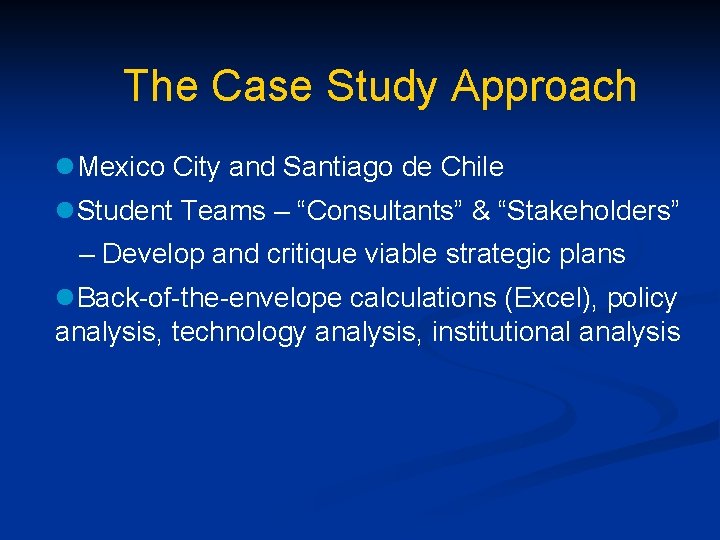
The Case Study Approach l. Mexico City and Santiago de Chile l. Student Teams – “Consultants” & “Stakeholders” – Develop and critique viable strategic plans l. Back-of-the-envelope calculations (Excel), policy analysis, technology analysis, institutional analysis
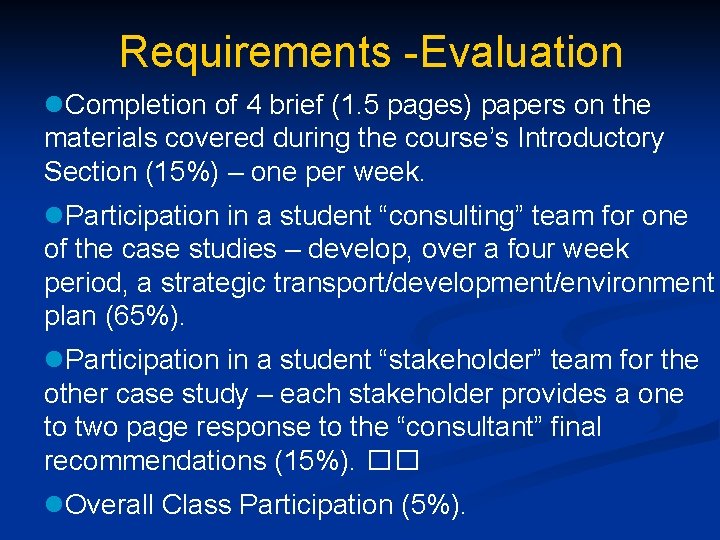
Requirements -Evaluation l. Completion of 4 brief (1. 5 pages) papers on the materials covered during the course’s Introductory Section (15%) – one per week. l. Participation in a student “consulting” team for one of the case studies – develop, over a four week period, a strategic transport/development/environment plan (65%). l. Participation in a student “stakeholder” team for the other case study – each stakeholder provides a one to two page response to the “consultant” final recommendations (15%). �� l. Overall Class Participation (5%).
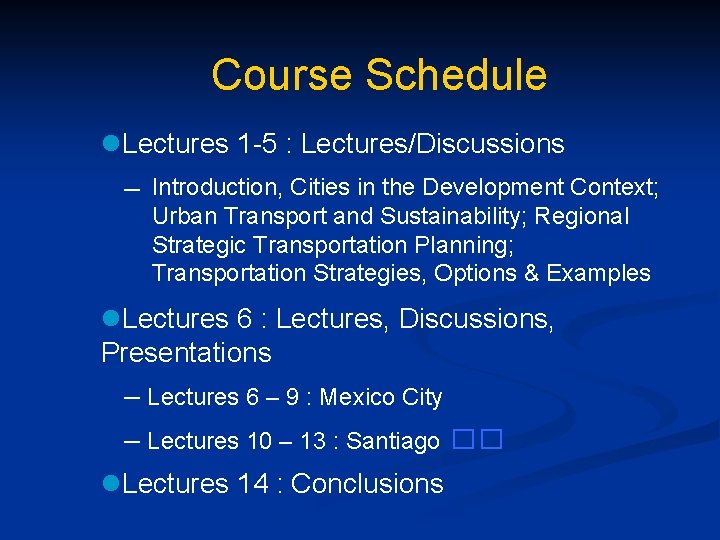
Course Schedule l. Lectures 1 -5 : Lectures/Discussions – Introduction, Cities in the Development Context; Urban Transport and Sustainability; Regional Strategic Transportation Planning; Transportation Strategies, Options & Examples l. Lectures 6 : Lectures, Discussions, Presentations – Lectures 6 – 9 : Mexico City – Lectures 10 – 13 : Santiago �� l. Lectures 14 : Conclusions
Remainder of Today’s Lecture l. Introduction to Analytical and Methodological Concepts �� l. Introduction to the Context – Cities, Development and Transportation with a Latin America Focus
The City in Development – Two Core Phenomena l. Urbanization -strongly correlated with income growth – particularly as countries move from low to middle income levels – Linked to industrialization, economies of scale and agglomeration, educational and social desires, etc. �� l. Suburbanization – spreading out of cities and reduction in population densities – Driven by rich and poor settlements alike, influenced by changes in land use allowances (agricultural conversion), infrastructure investments, consumer desires, economic realities (lower land development costs), motorization – The larger the city, the more sub-centers – “polycentric”
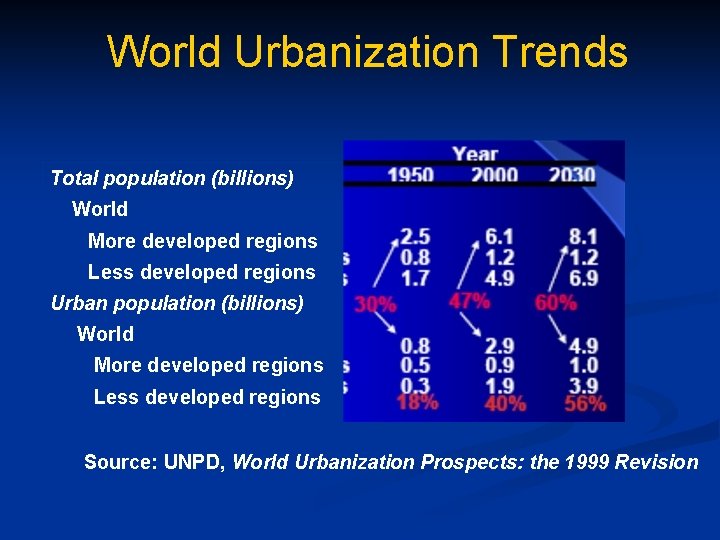
World Urbanization Trends Total population (billions) World More developed regions Less developed regions Urban population (billions) World More developed regions Less developed regions Source: UNPD, World Urbanization Prospects: the 1999 Revision
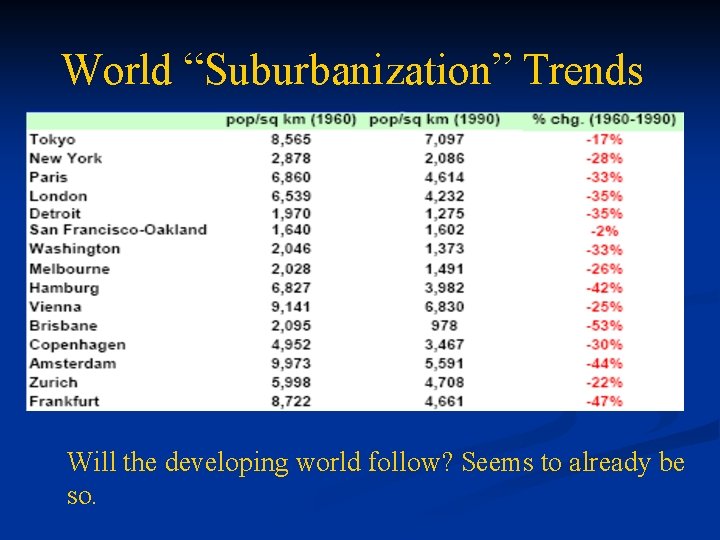
World “Suburbanization” Trends Will the developing world follow? Seems to already be so.
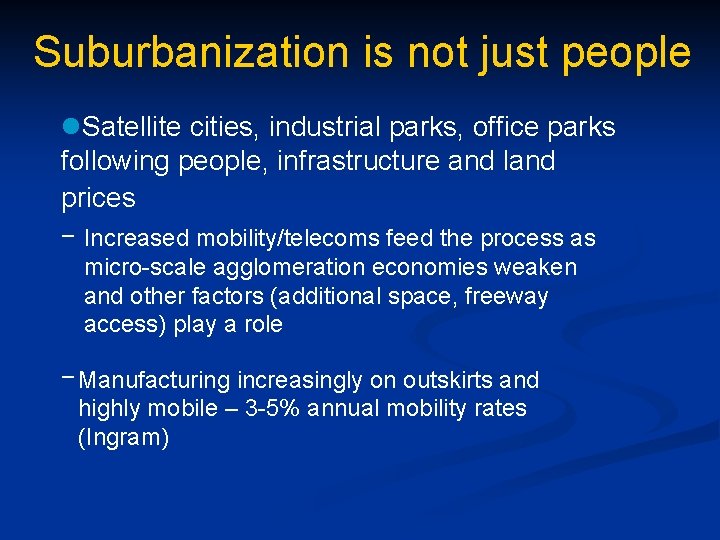
Suburbanization is not just people l. Satellite cities, industrial parks, office parks following people, infrastructure and land prices - Increased mobility/telecoms feed the process as micro-scale agglomeration economies weaken and other factors (additional space, freeway access) play a role - Manufacturing increasingly on outskirts and highly mobile – 3 -5% annual mobility rates (Ingram)
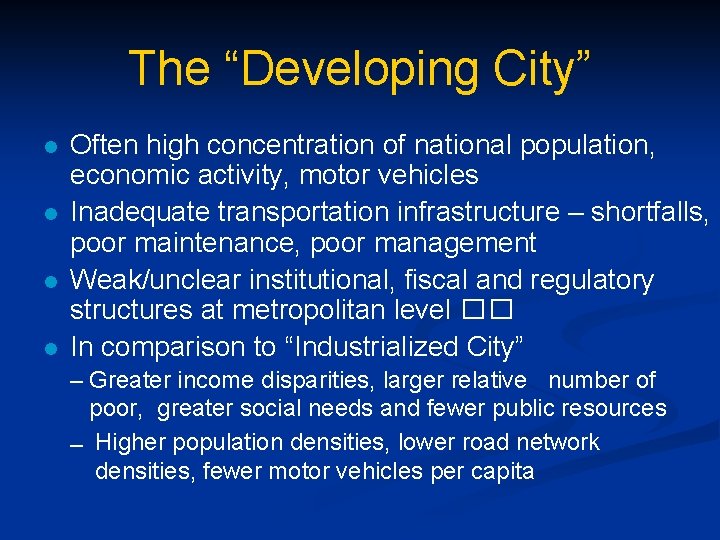
The “Developing City” l l Often high concentration of national population, economic activity, motor vehicles Inadequate transportation infrastructure – shortfalls, poor maintenance, poor management Weak/unclear institutional, fiscal and regulatory structures at metropolitan level �� In comparison to “Industrialized City” – Greater income disparities, larger relative number of poor, greater social needs and fewer public resources – Higher population densities, lower road network densities, fewer motor vehicles per capita
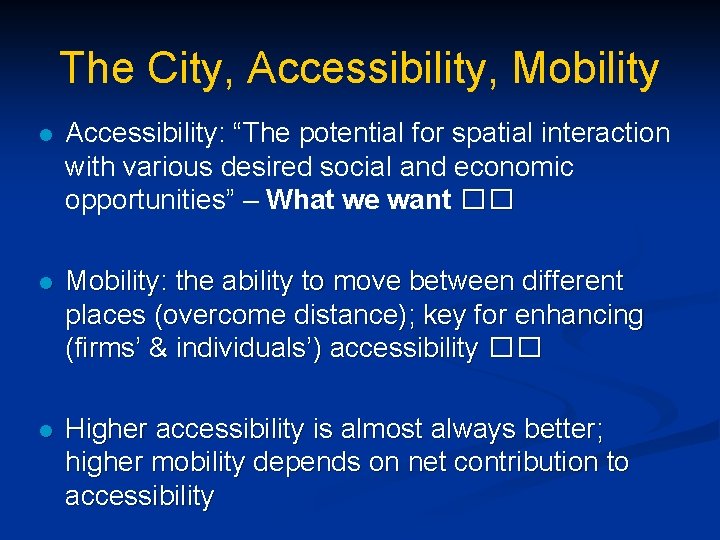
The City, Accessibility, Mobility l Accessibility: “The potential for spatial interaction with various desired social and economic opportunities” – What we want �� l Mobility: the ability to move between different places (overcome distance); key for enhancing (firms’ & individuals’) accessibility �� l Higher accessibility is almost always better; higher mobility depends on net contribution to accessibility

The City, Accessibility, Mobility
Land Use, Transport, Accessibility Distribution of jobs, residences, schools, etc. defines a city’s potential accessibility – Determines virtually all transportation activity – In developing world, particularly crucial, due to lower general levels of individual mobility l “Stylized” developing country traits – Metro level – Historic concentration of trip attractions in city center – High densities – Socio-economic and functional segregation, forcing long trips for poor, often isolated on the urban fringe l
Land Use, Transport, Accessibility l Densities, local distribution of land uses, “design” factors (street design, layout) – Unclear impact on trip frequency, distance, mode �� l Density shown to influence travel (Newman & Kenworthy, Pickrell) – But, difficult to isolate other influencing factors �� l Household size, relative travel costs, socioeconomic factors – Lack of underlying microeconomic behavior theory – Few “generalizable” influences; – Little, if any, work specific to developing country cities
Transport, Land Use, Accessibility l Transport system performance effects an area’s relative accessibility (attractiveness) – Open up new areas for development �� l i. e. , urban fringe highway – Facilitate densification l l i. e. , a center city metro �� Also influences other attractiveness characteristics – Noise, pollution, safety risks l Do “highways cause sprawl”? – Ultimate effects depend on households/firms relative sensitivity to transport costs
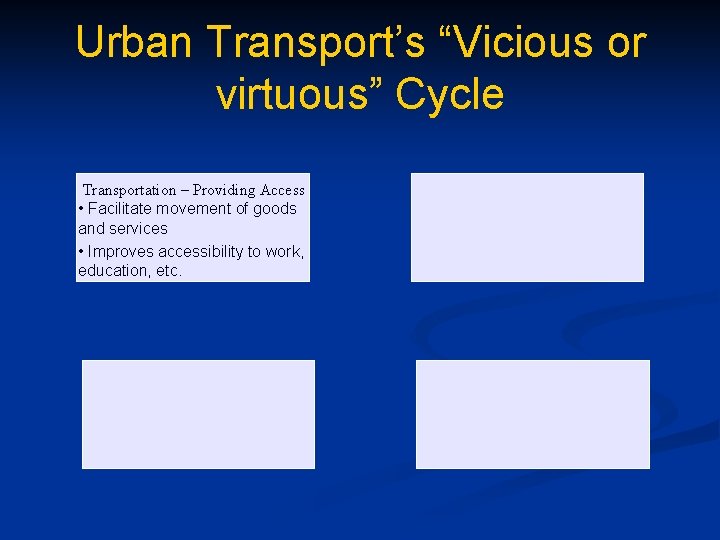
Urban Transport’s “Vicious or virtuous” Cycle Transportation – Providing Access • Facilitate movement of goods and services • Improves accessibility to work, education, etc.
Growth in Motor Vehicle Fleets /Ownership l l Motorization – Growth in Motor Vehicle Fleets ���� Motorization Rate –Motor Vehicles per capita (typically expressed vehicles/1000 population) ― l Gross indicator of vehicle ownership levels �� Both are strongly correlated to income
Motorization Rate & Income l Time-series and cross-section econometric models (i. e. , using income per capita, vehicles per capita, and often other variables) across many countries or one country in time (see, especially, Ingram & Liu) – Income per capita shown to be highly significant (T-stat) – Income shown to account for typically 70 -90% of private vehicle motorization rate (r-squared) – Income elasticities (“stylized” facts): �� l l l Long run (cross-section) elasticities typically greater than 1 �� National level elasticities are higher than urban-level elasticities �� Passenger vehicle elasticities are larger than commercial vehicle elasticities
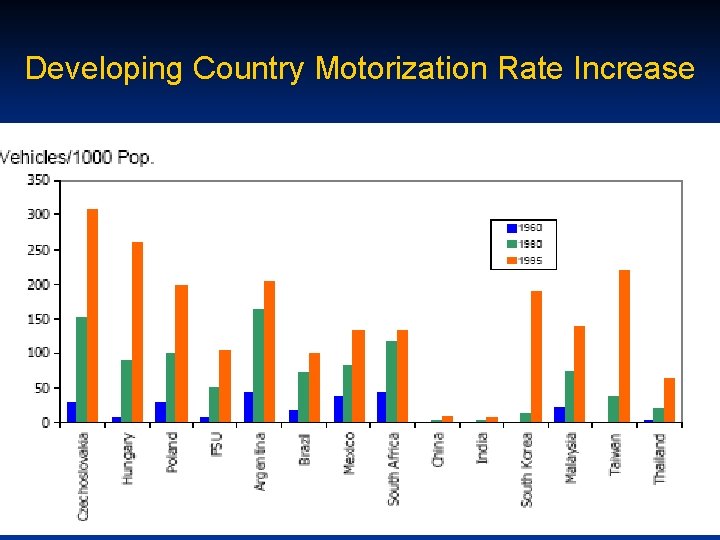
Developing Country Motorization Rate Increase
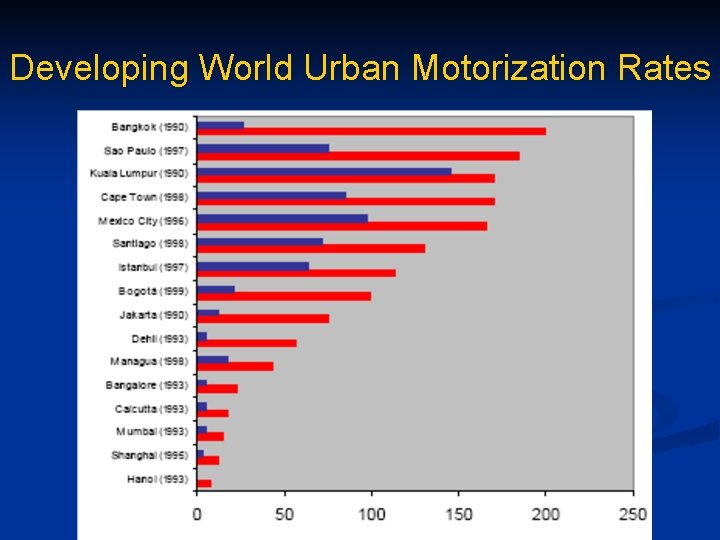
Developing World Urban Motorization Rates
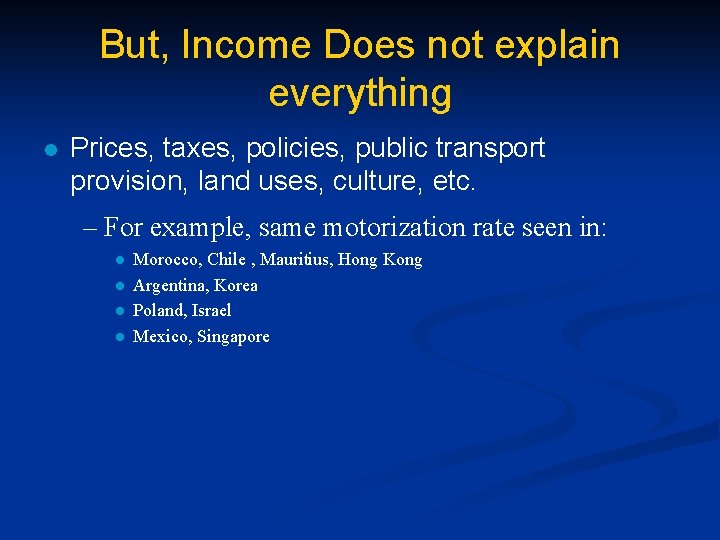
But, Income Does not explain everything l Prices, taxes, policies, public transport provision, land uses, culture, etc. – For example, same motorization rate seen in: l l Morocco, Chile , Mauritius, Hong Kong Argentina, Korea Poland, Israel Mexico, Singapore
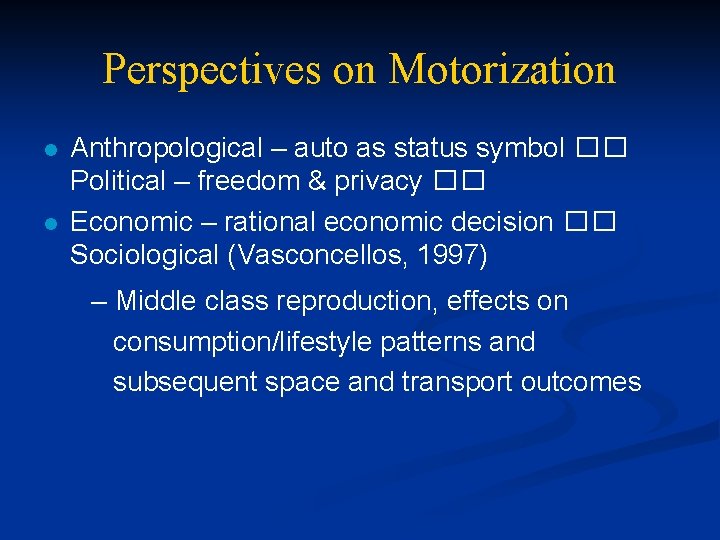
Perspectives on Motorization l l Anthropological – auto as status symbol �� Political – freedom & privacy �� Economic – rational economic decision �� Sociological (Vasconcellos, 1997) – Middle class reproduction, effects on consumption/lifestyle patterns and subsequent space and transport outcomes
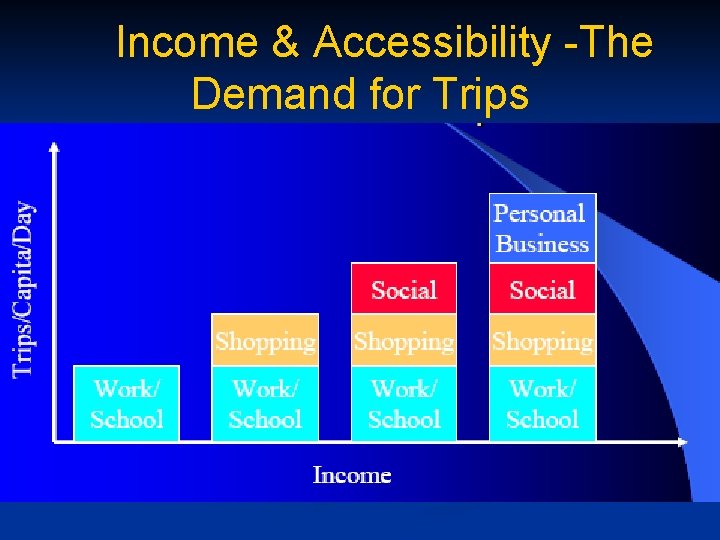
Income & Accessibility -The Demand for Trips
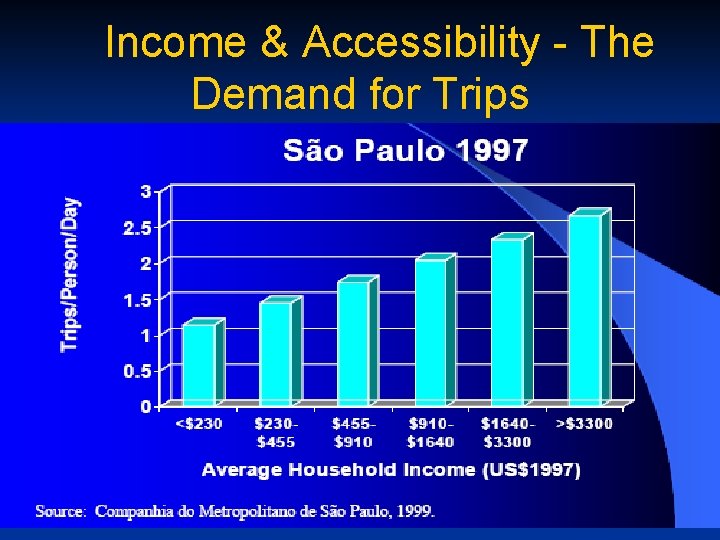
Income & Accessibility - The Demand for Trips
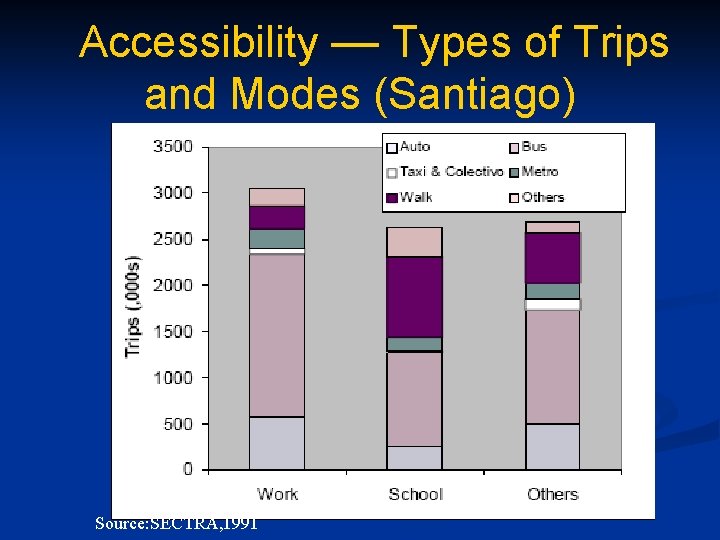
Accessibility –– Types of Trips and Modes (Santiago) Source: SECTRA, 1991
Income and Accessibility: The Demand for Speed, Flexibility l People/households aim to maximize accessibility subject to time and income constraints ― ― l Trade-off b/w activities that can be performed within time and income budgets. Maximize Total Net Benefits (All Benefits minus all costs, including transport time and money costs) obtained from activities at home and elsewhere – theory underlying residential (and business) location choice As incomes increase, the ability to “purchase speed” (and comfort) “frees up” the individual/household to pursue other locational attributes (i. e. , more space) with potentially the same (or higher) levels of total accessibility.
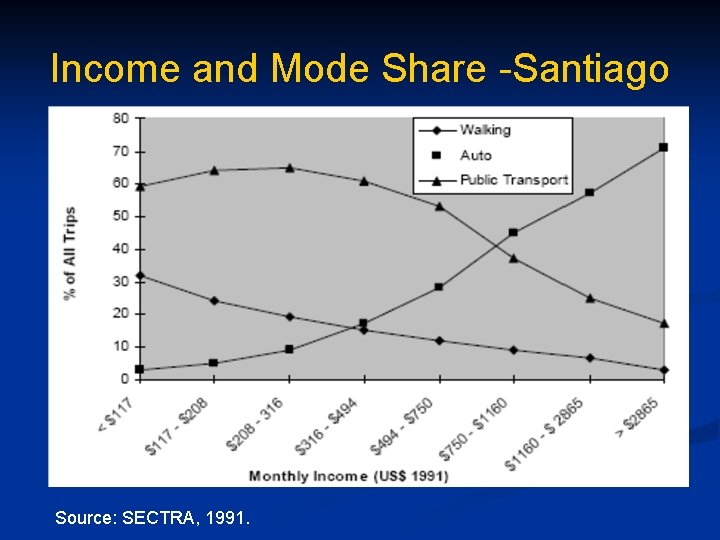
Income and Mode Share -Santiago Source: SECTRA, 1991.
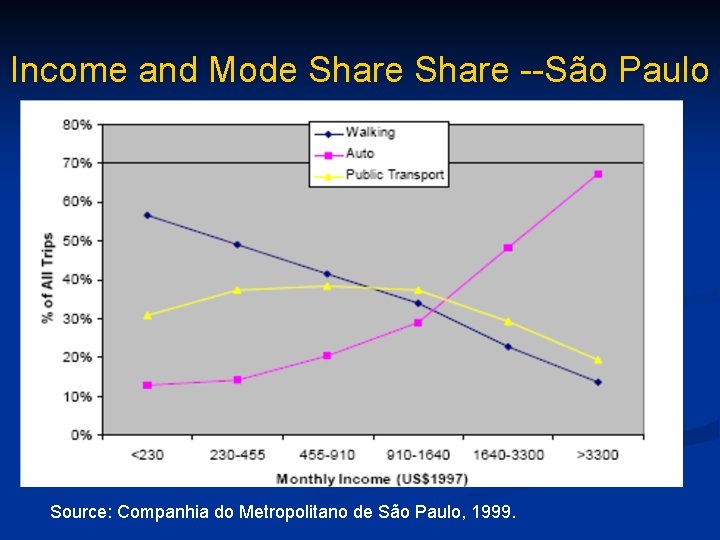
Income and Mode Share --São Paulo Source: Companhia do Metropolitano de São Paulo, 1999.
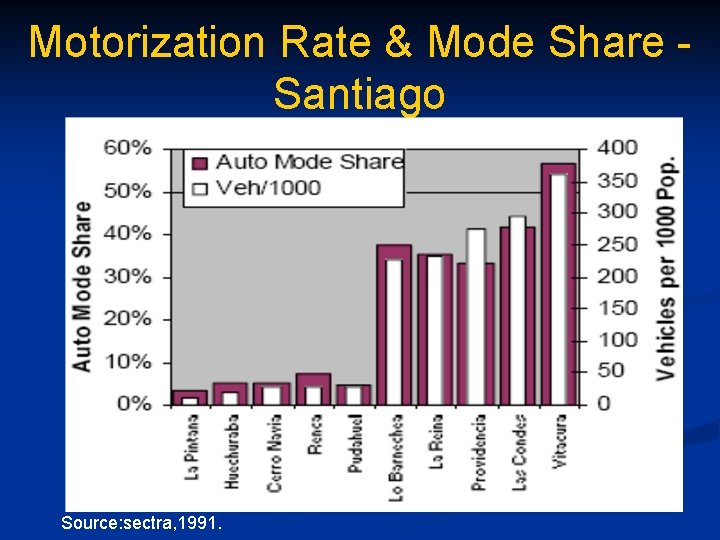
Motorization Rate & Mode Share Santiago Source: sectra, 1991.
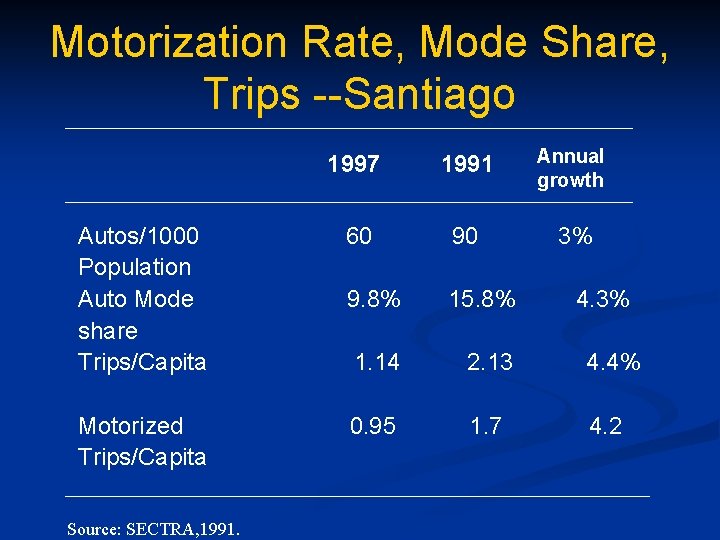
Motorization Rate, Mode Share, Trips --Santiago 1997 1991 Annual growth Autos/1000 Population Auto Mode share Trips/Capita 60 90 3% 9. 8% 15. 8% 1. 14 2. 13 4. 4% Motorized Trips/Capita 0. 95 1. 7 4. 2 Source: SECTRA, 1991. 4. 3%
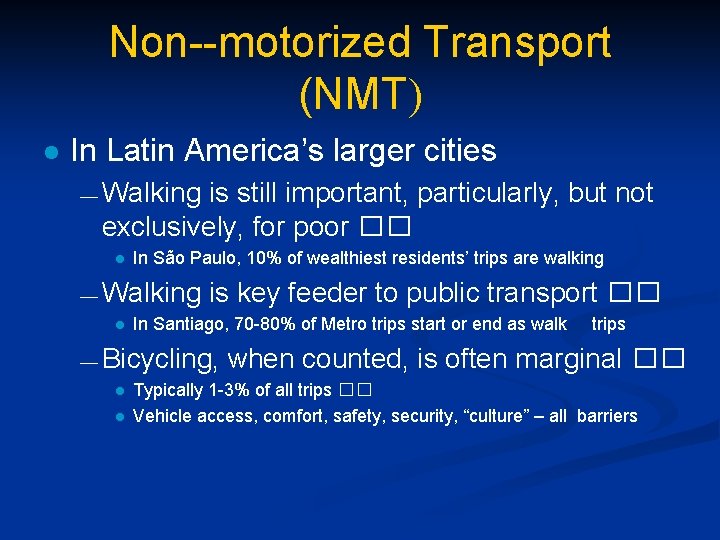
Non--motorized Transport (NMT) l In Latin America’s larger cities ― Walking is still important, particularly, but not exclusively, for poor �� l In São Paulo, 10% of wealthiest residents’ trips are walking ― Walking l is key feeder to public transport �� In Santiago, 70 -80% of Metro trips start or end as walk ― Bicycling, l l trips when counted, is often marginal �� Typically 1 -3% of all trips �� Vehicle access, comfort, safety, security, “culture” – all barriers
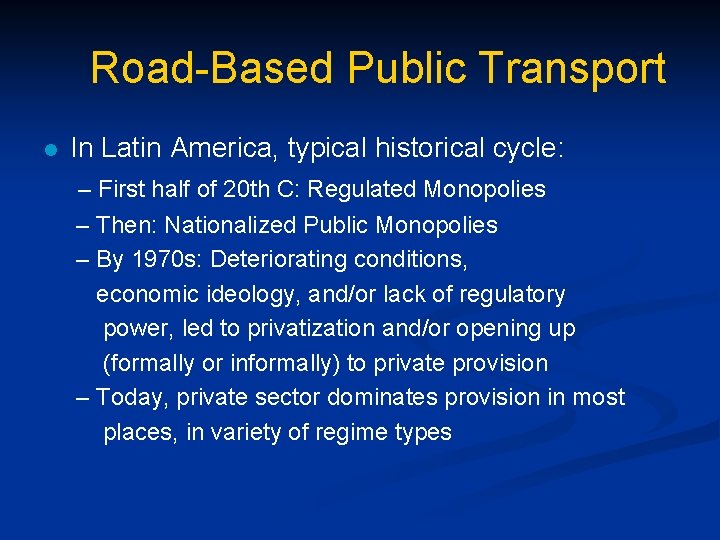
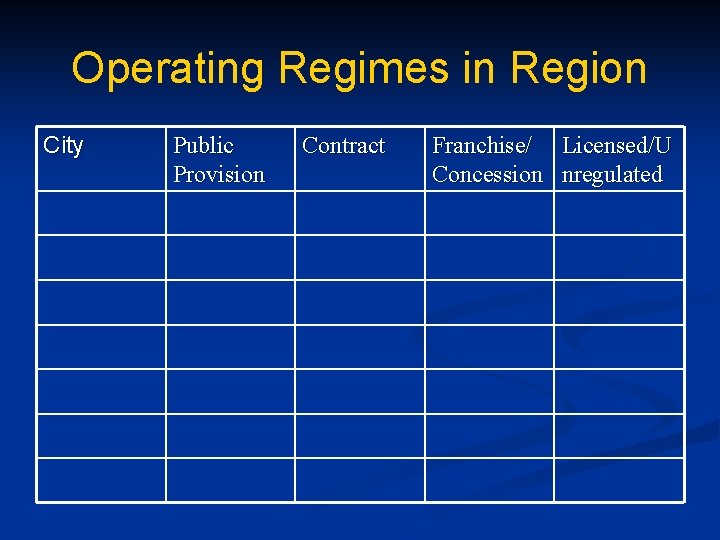
Road-Based Public Transport l In Latin America, typical historical cycle: – First half of 20 th C: Regulated Monopolies – Then: Nationalized Public Monopolies – By 1970 s: Deteriorating conditions, economic ideology, and/or lack of regulatory power, led to privatization and/or opening up (formally or informally) to private provision – Today, private sector dominates provision in most places, in variety of regime types
Operating Regimes in Region City Public Provision Contract Franchise/ Licensed/U Concession nregulated
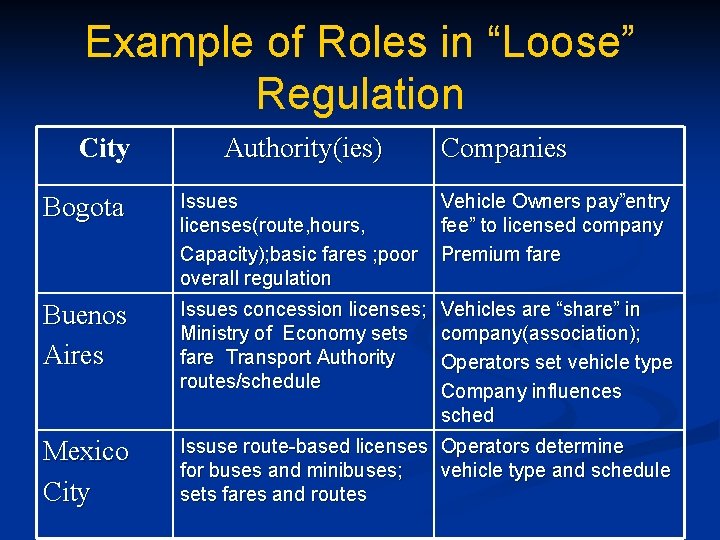
Example of Roles in “Loose” Regulation City Authority(ies) Companies Bogota Issues licenses(route, hours, Capacity); basic fares ; poor overall regulation Vehicle Owners pay”entry fee” to licensed company Premium fare Buenos Aires Issues concession licenses; Ministry of Economy sets fare Transport Authority routes/schedule Vehicles are “share” in company(association); Operators set vehicle type Company influences sched Mexico City Issuse route-based licenses Operators determine for buses and minibuses; vehicle type and schedule sets fares and routes
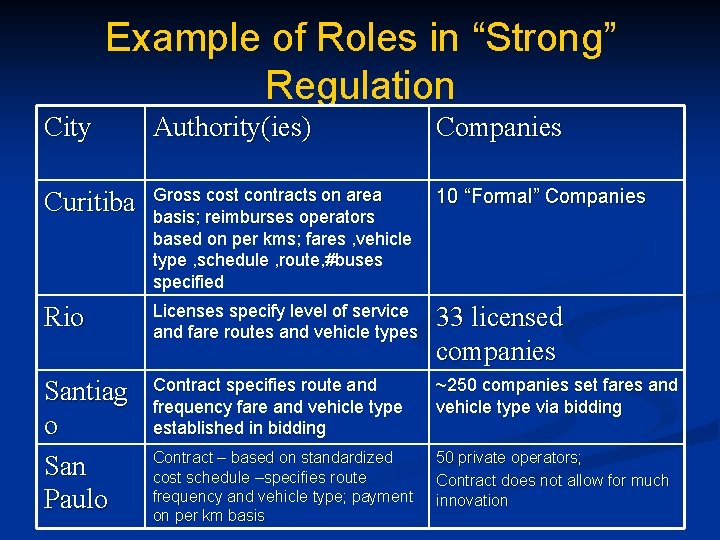
Example of Roles in “Strong” Regulation City Authority(ies) Companies Curitiba Gross cost contracts on area basis; reimburses operators based on per kms; fares , vehicle type , schedule , route, #buses specified 10 “Formal” Companies Rio Licenses specify level of service and fare routes and vehicle types 33 licensed companies Santiag o San Paulo Contract specifies route and frequency fare and vehicle type established in bidding ~250 companies set fares and vehicle type via bidding Contract – based on standardized cost schedule –specifies route frequency and vehicle type; payment on per km basis 50 private operators; Contract does not allow for much innovation
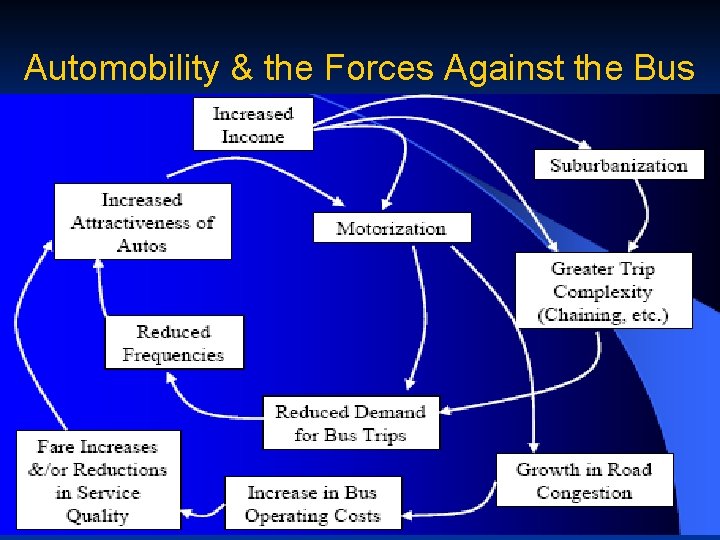
Automobility & the Forces Against the Bus
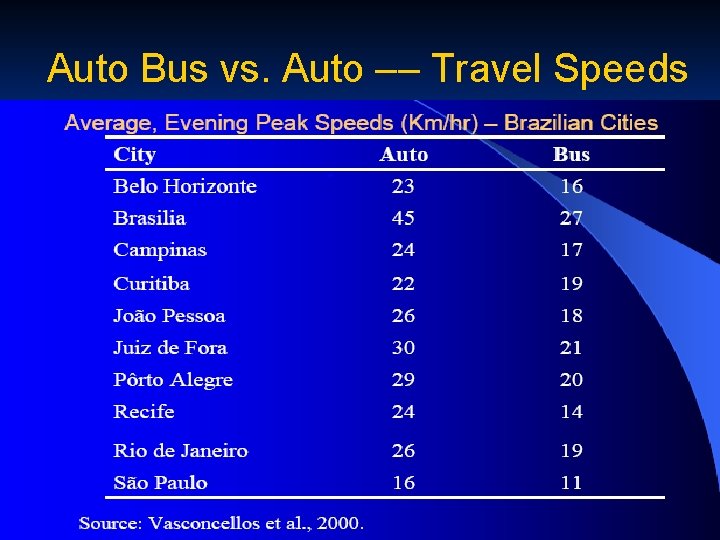
Auto Bus vs. Auto –– Travel Speeds
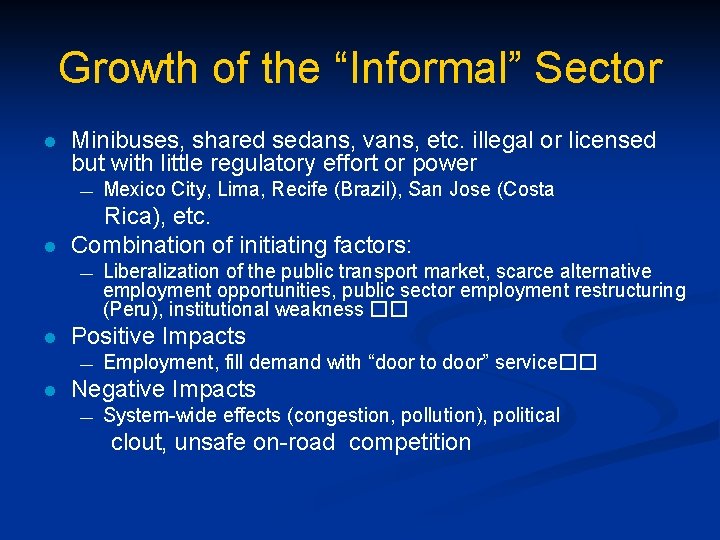
Growth of the “Informal” Sector l Minibuses, shared sedans, vans, etc. illegal or licensed but with little regulatory effort or power ― l Rica), etc. Combination of initiating factors: ― l Liberalization of the public transport market, scarce alternative employment opportunities, public sector employment restructuring (Peru), institutional weakness �� Positive Impacts ― l Mexico City, Lima, Recife (Brazil), San Jose (Costa Employment, fill demand with “door to door” service�� Negative Impacts ― System-wide effects (congestion, pollution), political clout, unsafe on-road competition
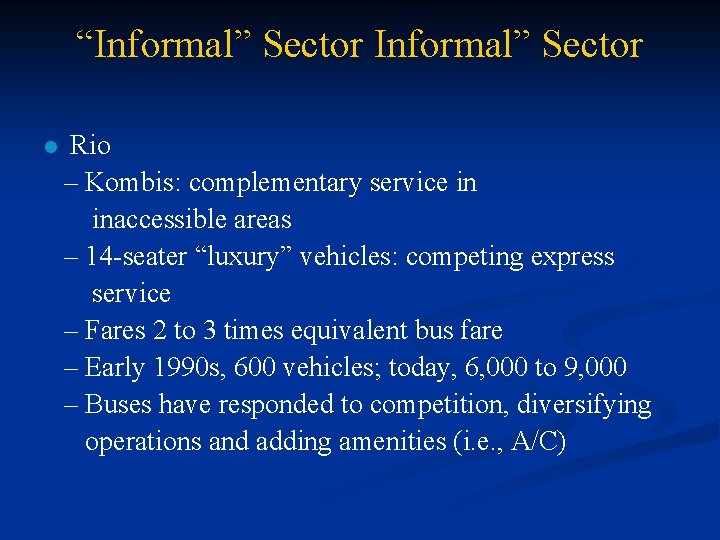
“Informal” Sector l Rio – Kombis: complementary service in inaccessible areas – 14 -seater “luxury” vehicles: competing express service – Fares 2 to 3 times equivalent bus fare – Early 1990 s, 600 vehicles; today, 6, 000 to 9, 000 – Buses have responded to competition, diversifying operations and adding amenities (i. e. , A/C)
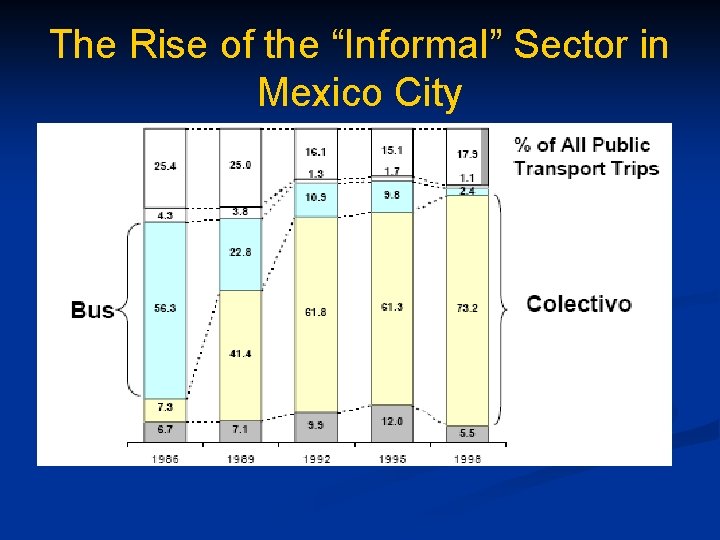
The Rise of the “Informal” Sector in Mexico City
Urban Rail Transit�� l l Metros, suburban rail, light rail �� Typically the exception in developing cities, including Latin America – High capital costs, lack of flexibility in adapting to changing travel patterns, long construction times – Still, often highly prized as visible, “modern” solutions to transport problems
Suburban Rail in Latin America l l l Suburban Rail in Buenos Aires, Santiago, São Paulo, Rio, and several other Brazilian cities �� Buenos Aires – 7 lines, 840 kms, 8% of trips �� Rio – 264 kms, 2% of trips �� São Paulo – 6 lines, 270 kms, 2% of trips �� Santiago – 1 line, 85 kms, <<0. 3% of trips
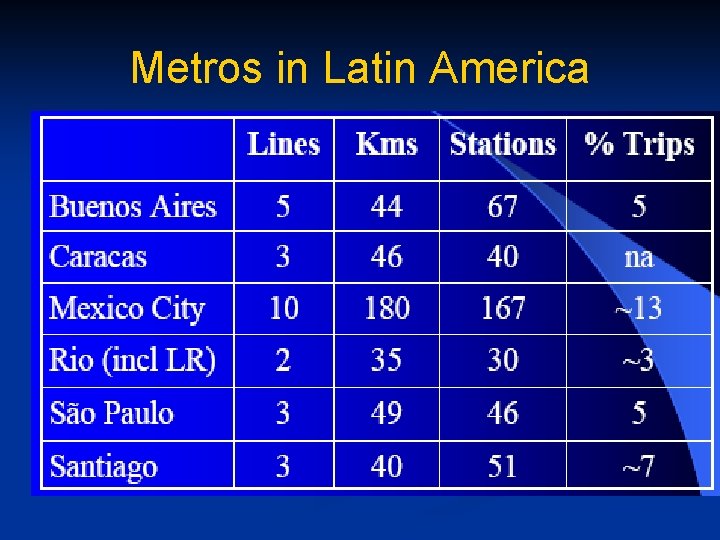
Metros in Latin America
Metros l l High Capacity – 60 Passengers/Hr/Direction High Cost -$40 -$150 mn. /Km �� Capital Costs rarely if ever recovered �� Operating Revenues/Operating costs – “Farebox Ratio” (in 1990) ― Mexico City, Rio, São Paulo < 1 ― Santiago > 1. 5 ― Policy outcome, planning outcome, operations outcome?
- Slides: 45