
Urban Traffic Management URBAN TRAFFIC MANAGEMENT www euportal
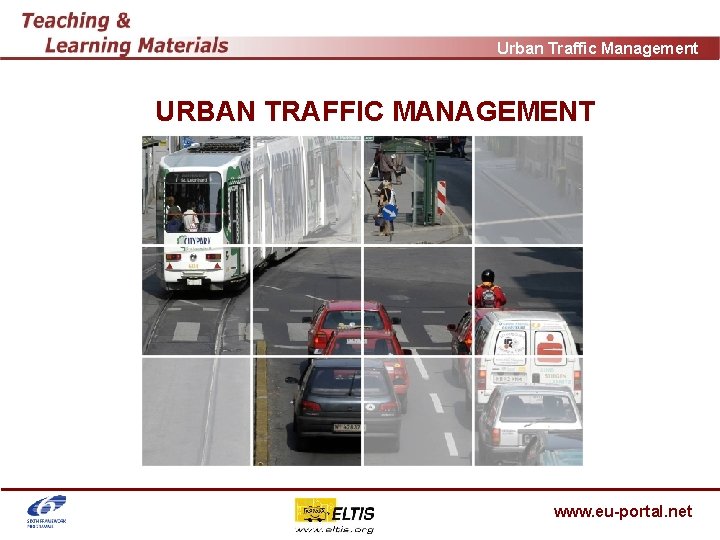
Urban Traffic Management URBAN TRAFFIC MANAGEMENT www. eu-portal. net
Urban Traffic Management What you will (hopefully!) learn in this session What traffic management is Why you do it How you might enforce it What it can achieve What it might cost (Briefly) how you might implement it www. eu-portal. net
Urban Traffic Management Structure of session Introduction and categorisation of traffic management measures Focusing in on certain types Enforcement – exercise More details of different types of traffic management including costs and what they’ve achieved Group exercise based on arterial street www. eu-portal. net
Urban Traffic Management DEFINITION OF TRAFFIC MANAGEMENT Traffic Management is • the process of adjusting or adapting the use of an existing road (system) to meet specified objectives without substantial new road construction. So strong links to other topics in this and other ELTIS workshops: • Cycling • Safety • Parking www. eu-portal. net
Urban Traffic Management So what are some objectives of TM? What do you think? www. eu-portal. net
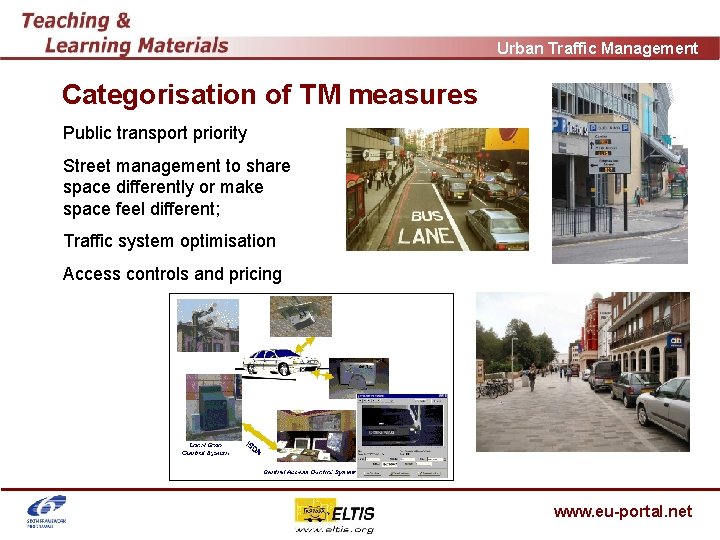
Urban Traffic Management Categorisation of TM measures Public transport priority Street management to share space differently or make space feel different; Traffic system optimisation Access controls and pricing www. eu-portal. net
Urban Traffic Management In this session, we concentrate on: Public transport priority such as • • • bus (or tram) lanes, better bus stops, Public transport (PT) priority at signals, PT-only sections of road, turns that only PT vehicles can make Street management to share space differently or make space feel different such as • • Parking regulations Wider and more comfortable footways, road narrowings, level changes Better crossings Shared space Why only these two categories of measure for this training? www. eu-portal. net
Urban Traffic Management ENFORCEMENT DISCUSSION • Many TM measures work only with proper enforcement – but how does proper enforcement work for you? • In multi-national groups of 5 discuss the following questions: • Think about a traffic management measure in your city that doesn’t work well because drivers don’t comply with (respect) it e. g. a bus lane or a parking regulation • How (well) is the measure enforced? What is the penalty for not complying? • How could you improve compliance with TM measures generally? • Are there any examples of traffic management or parking measures in your towns and cities where compliance with the measures is good and/or has improved recently? How is this achieved? www. eu-portal. net
Urban Traffic Management FIRST OF ALL…. MAKING STREETS FEEL DIFFERENT www. eu-portal. net
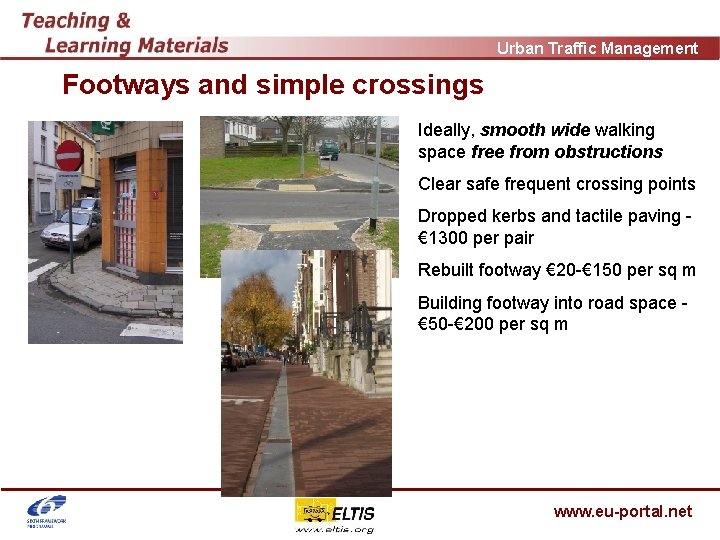
Urban Traffic Management Footways and simple crossings Ideally, smooth wide walking space free from obstructions Clear safe frequent crossing points Dropped kerbs and tactile paving € 1300 per pair Rebuilt footway € 20 -€ 150 per sq m Building footway into road space € 50 -€ 200 per sq m www. eu-portal. net
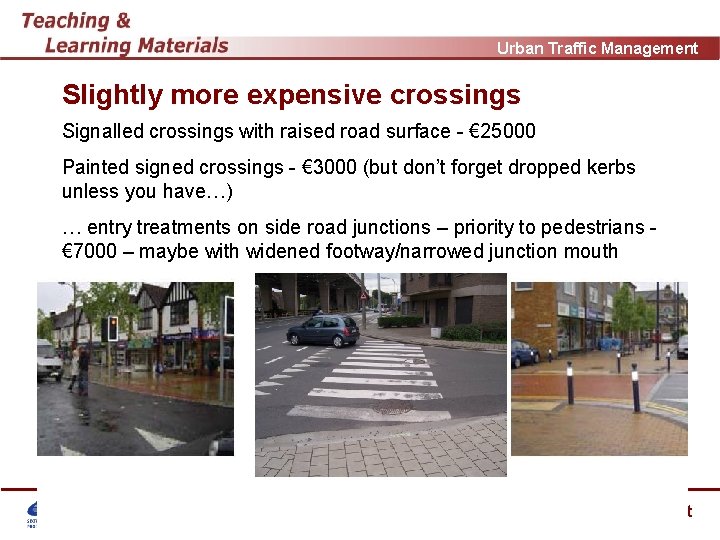
Urban Traffic Management Slightly more expensive crossings Signalled crossings with raised road surface - € 25000 Painted signed crossings - € 3000 (but don’t forget dropped kerbs unless you have…) … entry treatments on side road junctions – priority to pedestrians € 7000 – maybe with widened footway/narrowed junction mouth www. eu-portal. net
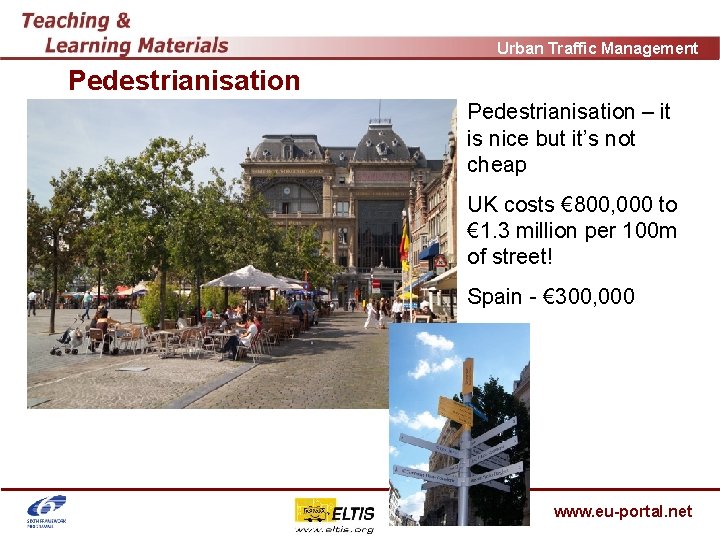
Urban Traffic Management Pedestrianisation – it is nice but it’s not cheap UK costs € 800, 000 to € 1. 3 million per 100 m of street! Spain - € 300, 000 www. eu-portal. net
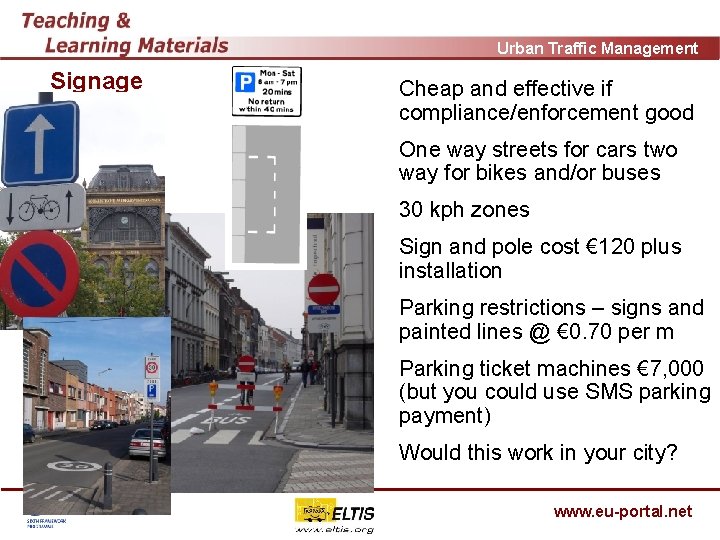
Urban Traffic Management Signage Cheap and effective if compliance/enforcement good One way streets for cars two way for bikes and/or buses 30 kph zones Sign and pole cost € 120 plus installation Parking restrictions – signs and painted lines @ € 0. 70 per m Parking ticket machines € 7, 000 (but you could use SMS parking payment) Would this work in your city? www. eu-portal. net
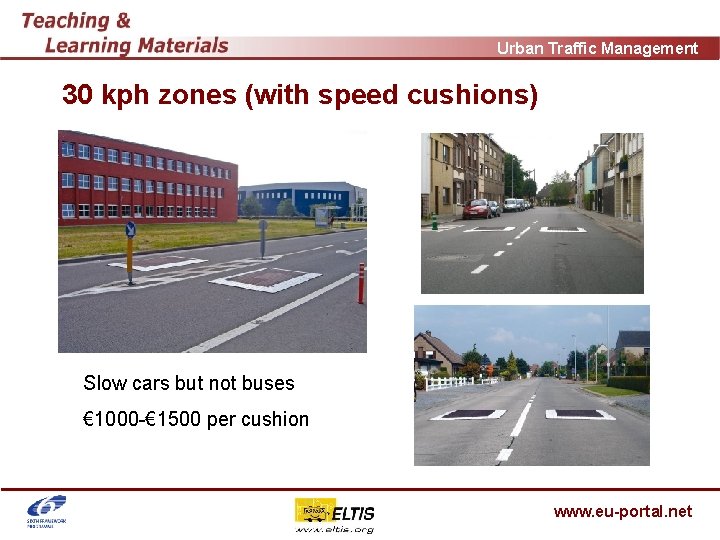
Urban Traffic Management 30 kph zones (with speed cushions) Slow cars but not buses € 1000 -€ 1500 per cushion www. eu-portal. net
Urban Traffic Management Minimum widths (UK) Traffic lane, no parking – 2. 8 m Traffic lane with parking – 4. 5 m Cycle lane on street – 1 m (sometimes 0. 8 m) One-way cycle path off-street – 2. 5 m Two way cycle path off-street – 3. 5 m Footway for pedestrians – depends on flow but absolute minimum 1 m, comfortable minimum in low-flow situations 2. 5 m www. eu-portal. net
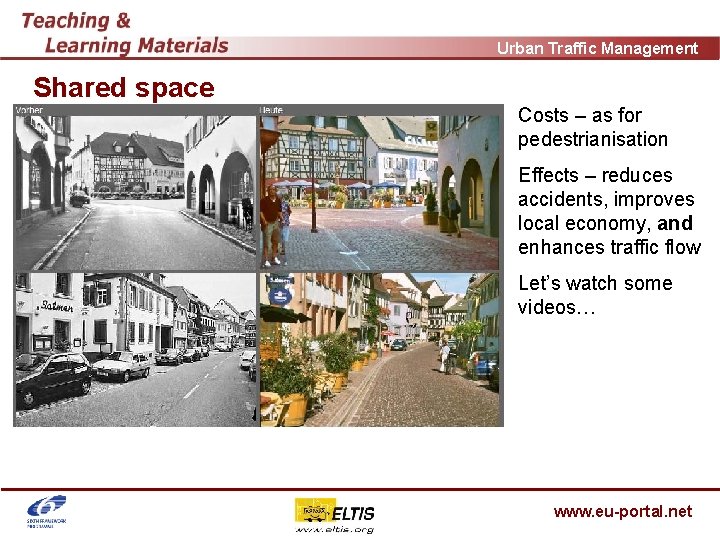
Urban Traffic Management Shared space Costs – as for pedestrianisation Effects – reduces accidents, improves local economy, and enhances traffic flow Let’s watch some videos… www. eu-portal. net
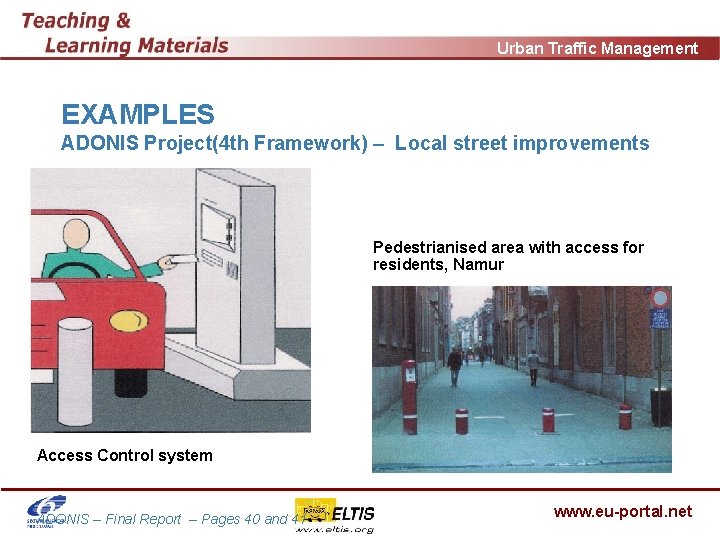
Urban Traffic Management EXAMPLES ADONIS Project(4 th Framework) – Local street improvements Pedestrianised area with access for residents, Namur Access Control system ADONIS – Final Report – Pages 40 and 41 www. eu-portal. net
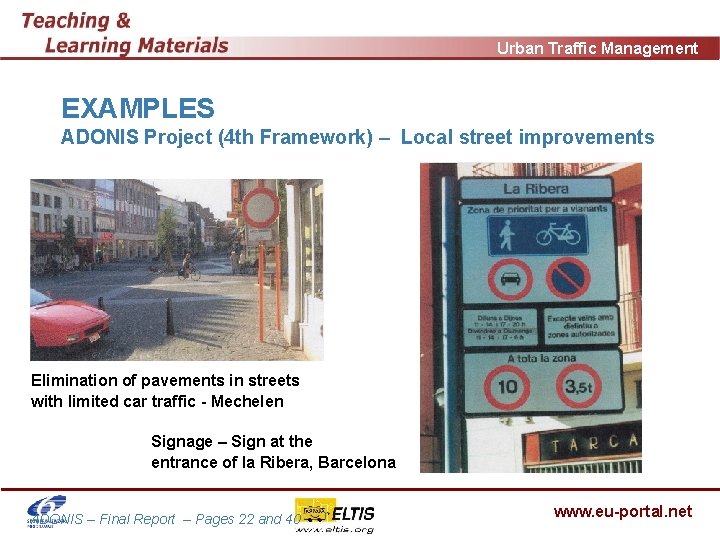
Urban Traffic Management EXAMPLES ADONIS Project (4 th Framework) – Local street improvements Elimination of pavements in streets with limited car traffic - Mechelen Signage – Sign at the entrance of la Ribera, Barcelona ADONIS – Final Report – Pages 22 and 40 www. eu-portal. net
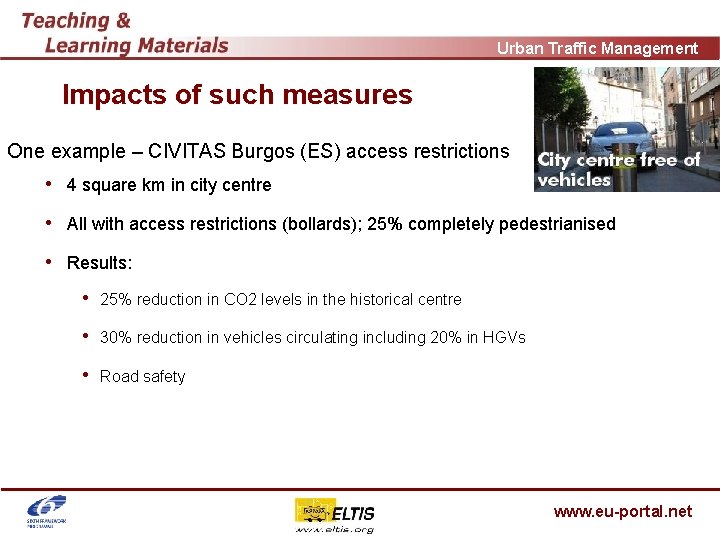
Urban Traffic Management Impacts of such measures One example – CIVITAS Burgos (ES) access restrictions • 4 square km in city centre • All with access restrictions (bollards); 25% completely pedestrianised • Results: • 25% reduction in CO 2 levels in the historical centre • 30% reduction in vehicles circulating including 20% in HGVs • Road safety www. eu-portal. net
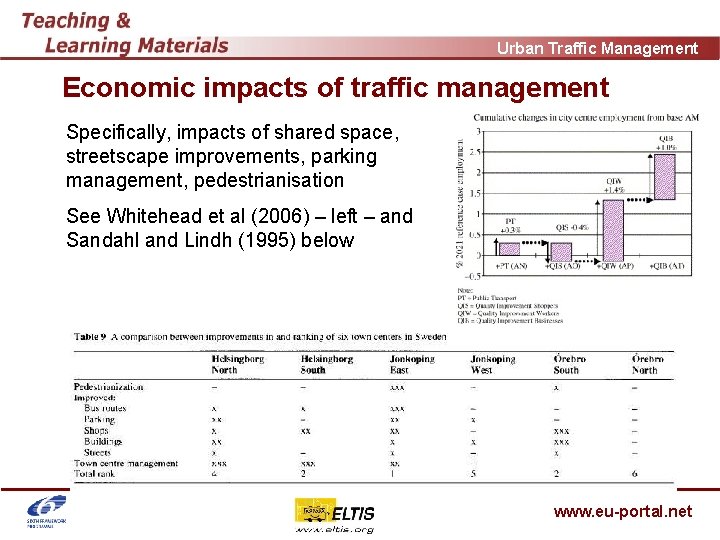
Urban Traffic Management Economic impacts of traffic management Specifically, impacts of shared space, streetscape improvements, parking management, pedestrianisation See Whitehead et al (2006) – left – and Sandahl and Lindh (1995) below www. eu-portal. net
Urban Traffic Management SECONDLY – PRIORITY FOR PUBLIC TRANSPORT www. eu-portal. net
Urban Traffic Management www. eu-portal. net
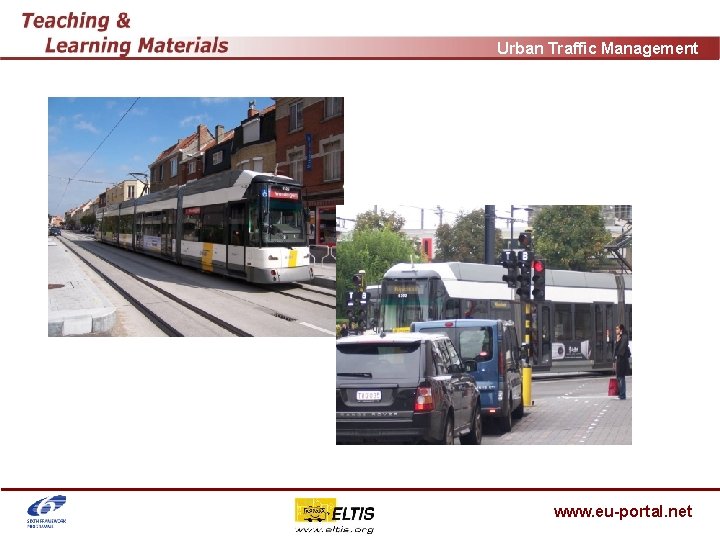
Urban Traffic Management What is PT priority 1 • Any physical measure on the highway which protects PT vehicles from or allows them to bypass congested sections of road • Any physical measure on the road which protects PT vehicles from the effects of parked vehicles • Hierarchy of measures from turning ban exemptions through to full segregation (tram or busway) • Is it giving capacity to public transport? www. eu-portal. net
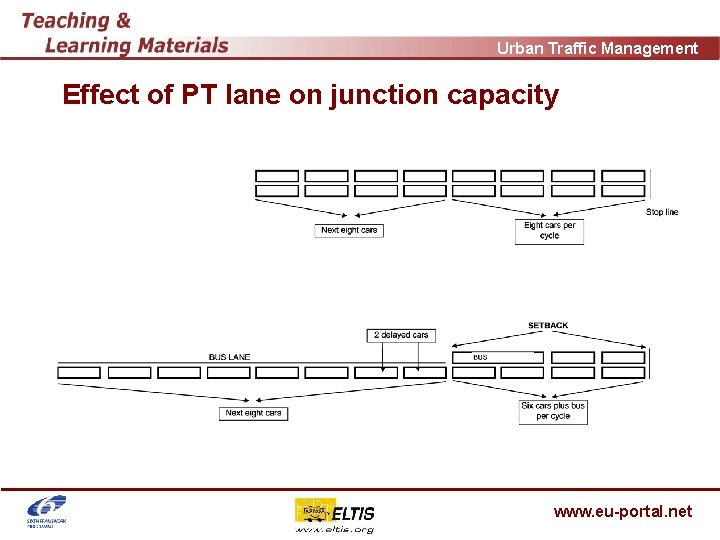
Urban Traffic Management Effect of PT lane on junction capacity www. eu-portal. net
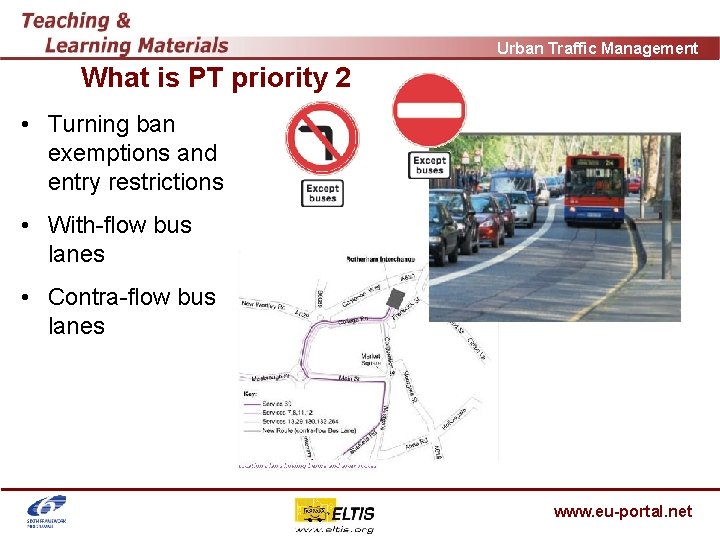
Urban Traffic Management What is PT priority 2 • Turning ban exemptions and entry restrictions • With-flow bus lanes • Contra-flow bus lanes www. eu-portal. net
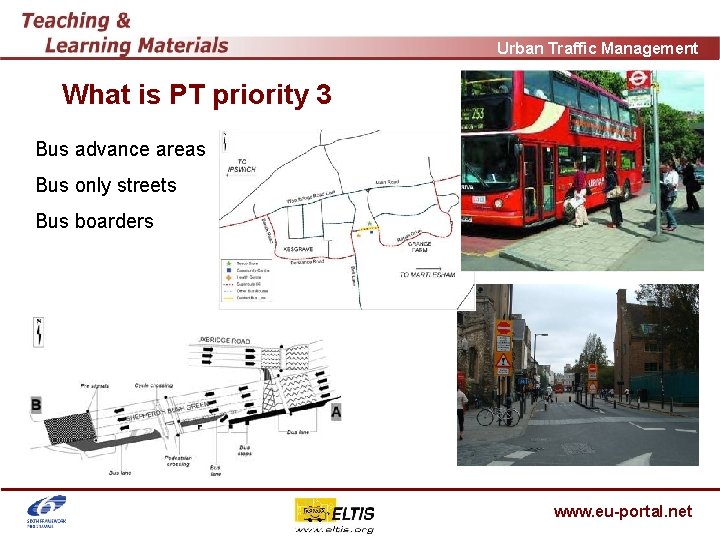
Urban Traffic Management What is PT priority 3 Bus advance areas Bus only streets Bus boarders www. eu-portal. net
Urban Traffic Management Does PT priority work? • Uxbridge Rd, London: • 42 km route 2 -way, of which 6 km bus lane • Excess waiting time down 30% in 3 years 1993 -1996 • Pax numbers up 20% • Burdett Rd, London (bus lane and pre-signals) 1990 to 1995: • SB am peak 411 seconds down to 397 • SB pm peak 735 seconds down to 398 • SB am peak 578 seconds down to 575 • SB am peak 1100 seconds down to 517 www. eu-portal. net
Urban Traffic Management Does PT priority work? • Route 220, London: • 1993 -1995 14. 5% reduction in journey time • Patronage increased by 10% • 3. 7% of new passengers transferred from car • Bath Rd, Bristol, bus lanes 1992 • Before average journey time 21’ 4”, after 12’ 3” • SD down from 5’ 5” to 1’ 38” www. eu-portal. net
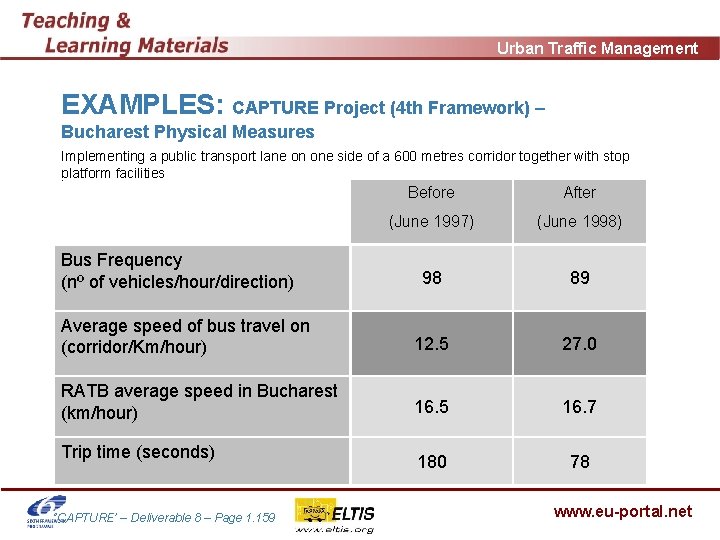
Urban Traffic Management EXAMPLES: CAPTURE Project (4 th Framework) – Bucharest Physical Measures Implementing a public transport lane on one side of a 600 metres corridor together with stop platform facilities Before After (June 1997) (June 1998) 98 89 Average speed of bus travel on (corridor/Km/hour) 12. 5 27. 0 RATB average speed in Bucharest (km/hour) 16. 5 16. 7 180 78 Bus Frequency (nº of vehicles/hour/direction) Trip time (seconds) ‘’CAPTURE’ – Deliverable 8 – Page 1. 159 www. eu-portal. net
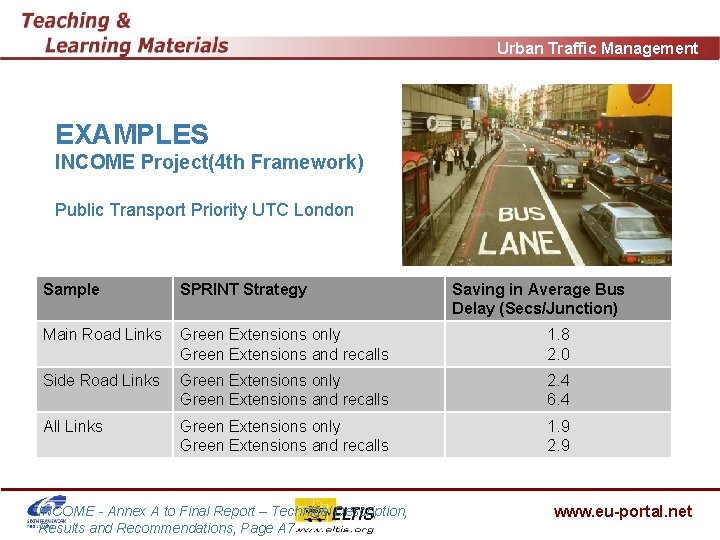
Urban Traffic Management EXAMPLES INCOME Project(4 th Framework) Public Transport Priority UTC London Sample SPRINT Strategy Main Road Links Green Extensions only Green Extensions and recalls 1. 8 2. 0 Side Road Links Green Extensions only Green Extensions and recalls 2. 4 6. 4 All Links Green Extensions only Green Extensions and recalls 1. 9 2. 9 INCOME - Annex A to Final Report – Technical Description, Results and Recommendations, Page A 7 Saving in Average Bus Delay (Secs/Junction) www. eu-portal. net
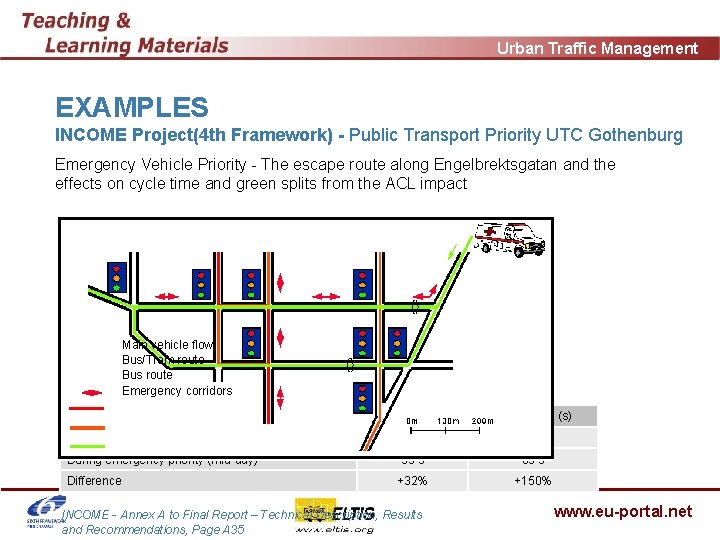
Urban Traffic Management EXAMPLES INCOME Project(4 th Framework) - Public Transport Priority UTC Gothenburg Emergency Vehicle Priority - The escape route along Engelbrektsgatan and the effects on cycle time and green splits from the ACL impact Main vehicle flow Bus/Tram route Bus route Emergency corridors ACL impact at intersection 16 Cycle Time Green Split (s) Before emergency priority (mid-day) 72 s 26 s During emergency priority (mid-day) 95 s 65 s +32% +150% Difference INCOME - Annex A to Final Report – Technical Description, Results and Recommendations, Page A 35 www. eu-portal. net
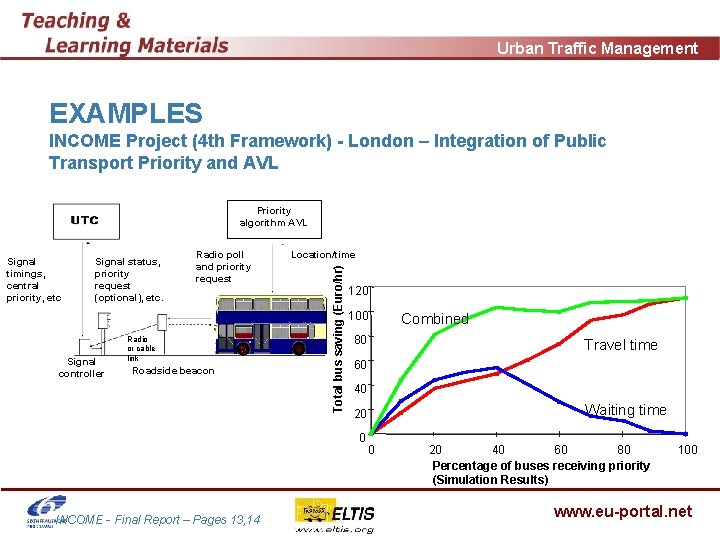
Urban Traffic Management EXAMPLES INCOME Project (4 th Framework) - London – Integration of Public Transport Priority and AVL Priority algorithm AVL Signal status, priority request (optional), etc. Signal controller Radio poll and priority request Radio or cable link Roadside beacon Location/time Total bus saving (Euro/hr) Signal timings, central priority, etc 120 100 80 Travel time 60 40 Waiting time 20 0 INCOME - Final Report – Pages 13, 14 Combined 0 20 40 60 80 Percentage of buses receiving priority (Simulation Results) 100 www. eu-portal. net
Urban Traffic Management Enforcing PT priority Colour bus lanes Use police traffic wardens Automatic enforcement: • Decriminalise • Allow camera enforcement • Roadside CCTV and on-bus used in London • Croydon used CCTV, issued 47175 tickets • Non-compliance down by >90% • Newham down by >74% www. eu-portal. net
Urban Traffic Management Implementing PT priority ID problems • queues, delays, boarding difficulties ID opportunities • wide roads; one-way systems; places to re-route Outline design - consider: • Operating hours • Parking restrictions • Requirements for equipment on buses • Police resources Consultation www. eu-portal. net
Urban Traffic Management Going beyond bus priority Total route treatment e. g. Route 43, London • Nicer buses • Better stops and access to stops • Priority (inc. at signals) • Rationalisation of on-street loading • Better enforcement • Driver training • Decent road surface • Marketing and information • Good operational management Extended to 70 routes over next 3 years - £ 200 million www. eu-portal. net
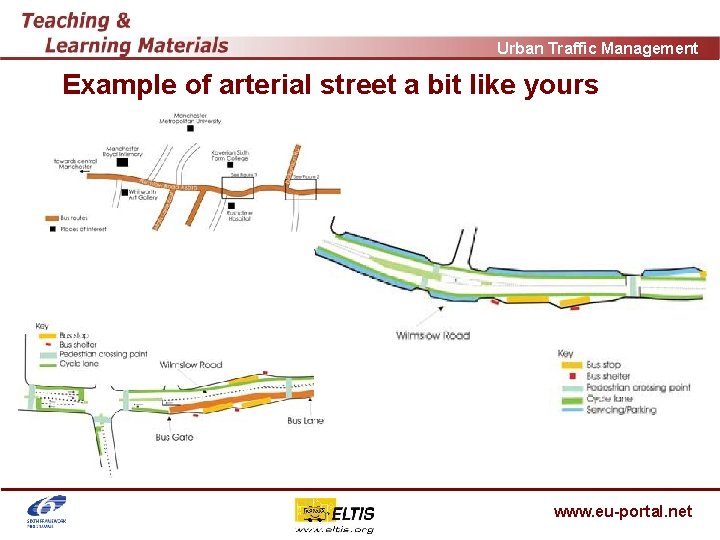
Urban Traffic Management Example of arterial street a bit like yours www. eu-portal. net
- Slides: 36