
URBAN PLANNING SERVICES COST MODEL A tool for
“URBAN PLANNING SERVICES COST MODEL” A tool for estimating “Urban planning costs” AUTHORS: DR. MSAMI (TP) & KAMUGISHA KLM (TP)
BACKGROUND Urban planning is the process that seeks to control the development of cities through local regulations and direct interventions, to fulfill a number of objectives, such as mobility, quality of life and sustainability.
BACKGROUND cont. . • Therefore, Urban Planning must be accompanied by sustainability concept which enables us to carry out the urban development process in the right way to keep up the sustainable environment for future generations. • Urban planning is not a one time event. It’s an everyday process that needs constant attention and management for a better outcome
BACKGROUND cont. • Urban planners are in a business of managing change that results into appreciation of land value • Physical aspects such as buildings and associated infrastructure and community facilities play an important role in urban planning • Social, economic and technological forces should also be considered while planning so that a healthy environment is created in the city/town.

PLANNERS V/S URBAN PLANNING PROCESS • Urban planner is “the Manager” of the urban planning process. • Urban planning process is a platform upon which Stakeholders and the planner meet to address the urban planning challenges for a better shared future. • In Cities constantly there are conflicting interests from different stakeholders. These interests shapes the development of cities.
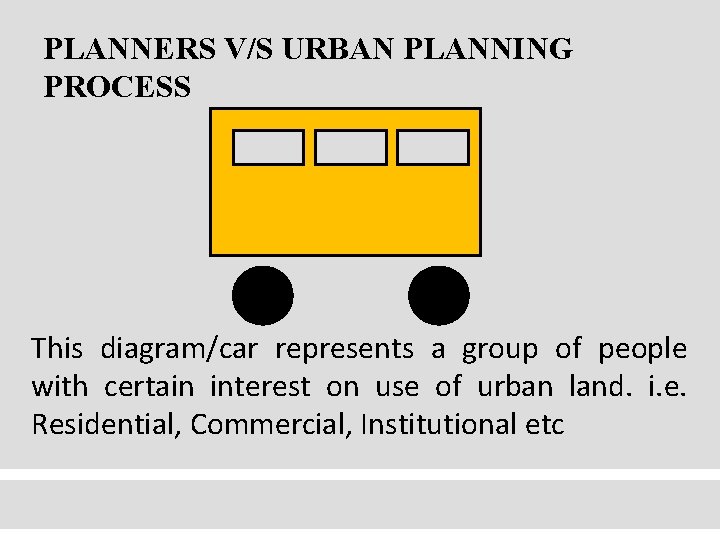
PLANNERS V/S URBAN PLANNING PROCESS This diagram/car represents a group of people with certain interest on use of urban land. i. e. Residential, Commercial, Institutional etc

PLANNERS V/S URBAN PLANNING PROCESS In this illustration the urban planner is “the Manager” of the track and a facilitator in the train; harmonizing the efforts to get from point A-B PART ONE Continues: -
COSTS FOR URBAN PLANNING ACTIVITIES • Urban Planning activities deploys a participatory process • Stakeholders interact with planning team to deliver the desirable future land use plan • Good planning requires up-to-date and Reliable Data • Land Value Appreciated varies from one locality to the other • This situation calls for a tool for estimating urban planning costs
INFLUENCING FACTORS • • • Population Coverage of planning area Complexity of socio-economic activities Good and services; flow of materials Level/status – neighborhood, community, planning district- Towns, municipalities and cities • Non built-up environment • Locations – determine use and land value
WHY DO WE NEED URBAN PLANNING SERVISES COST MODEL • The process of estimating urban planning costs is unclear and that threatens the relationship between people and the urban planner • The engagement of private consultants without a manageable guideline of engagement is amplifying the doubts already existing. • Current guidelines for engagement of planning services are not clearly addressing the meeting point between planners and consumers of planning services
Current situation • Existing Guidelines both by (MLHHSD &TPRB) more emphasizes more on “A Planner” as an Individual as opposed to planner’s link to other stakeholders in “The planning process” • In the existing Guidelines the factors of cost derivatives are somewhat weak and are susceptible to criticism.
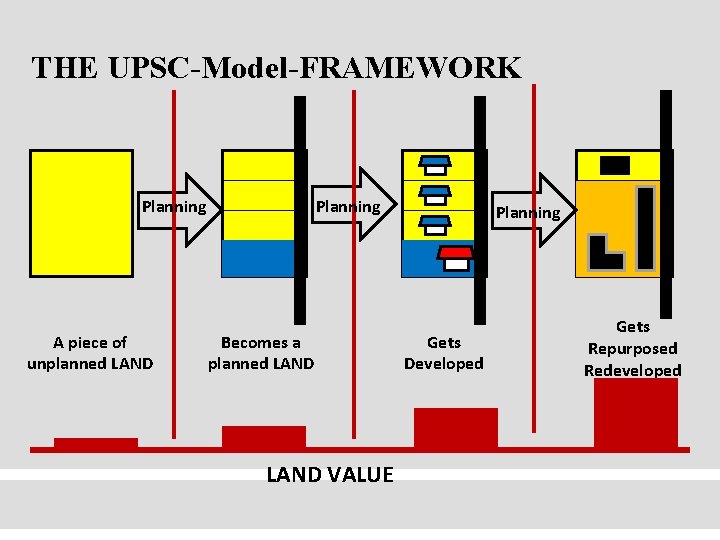
THE UPSC-Model-FRAMEWORK Planning A piece of unplanned LAND Planning Becomes a planned LAND VALUE Planning Gets Developed Gets Repurposed Redeveloped
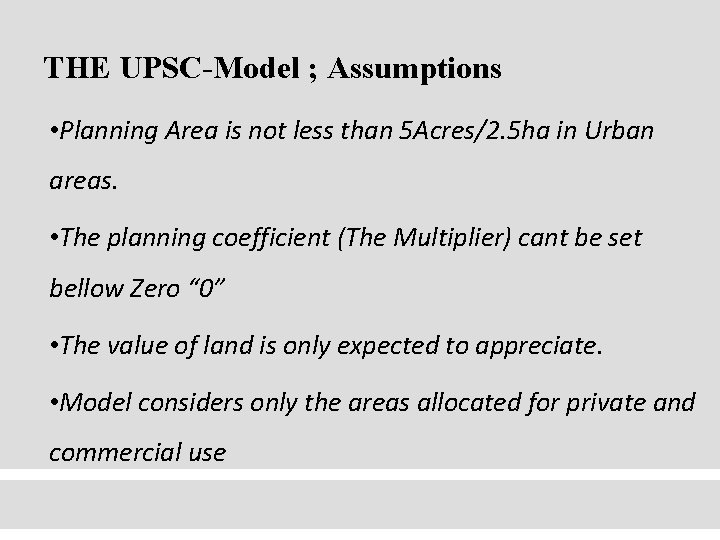
THE UPSC-Model ; Assumptions • Planning Area is not less than 5 Acres/2. 5 ha in Urban areas. • The planning coefficient (The Multiplier) cant be set bellow Zero “ 0” • The value of land is only expected to appreciate. • Model considers only the areas allocated for private and commercial use
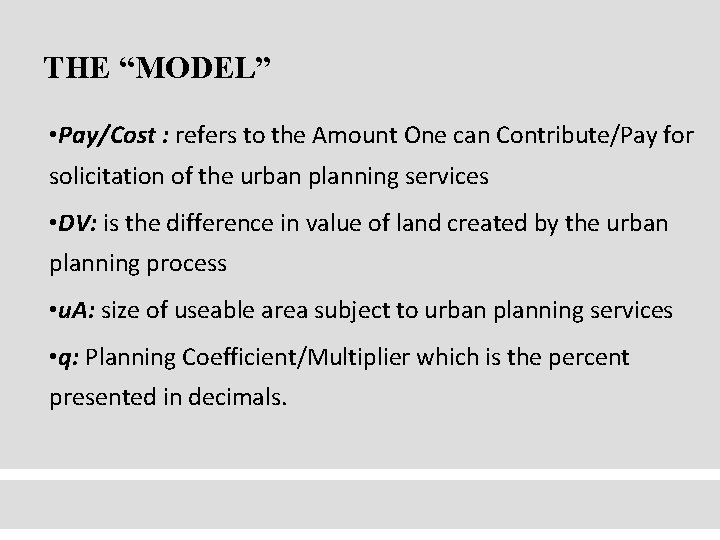
THE “MODEL” • Pay/Cost : refers to the Amount One can Contribute/Pay for solicitation of the urban planning services • DV: is the difference in value of land created by the urban planning process • u. A: size of useable area subject to urban planning services • q: Planning Coefficient/Multiplier which is the percent presented in decimals.
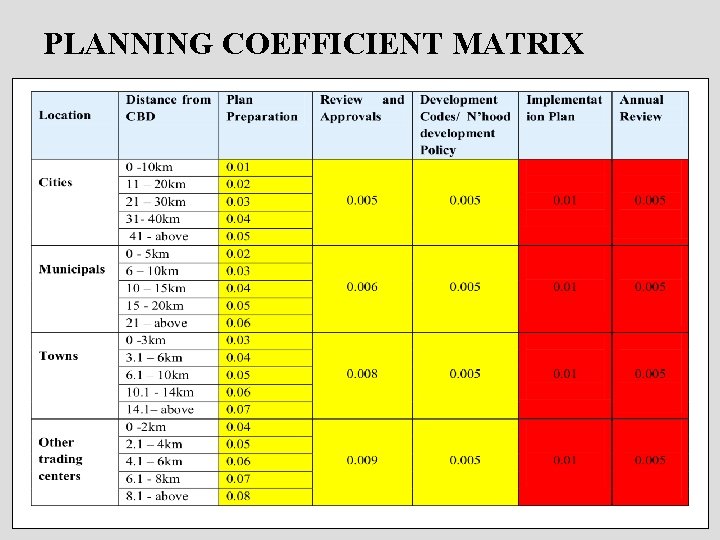
PLANNING COEFFICIENT MATRIX
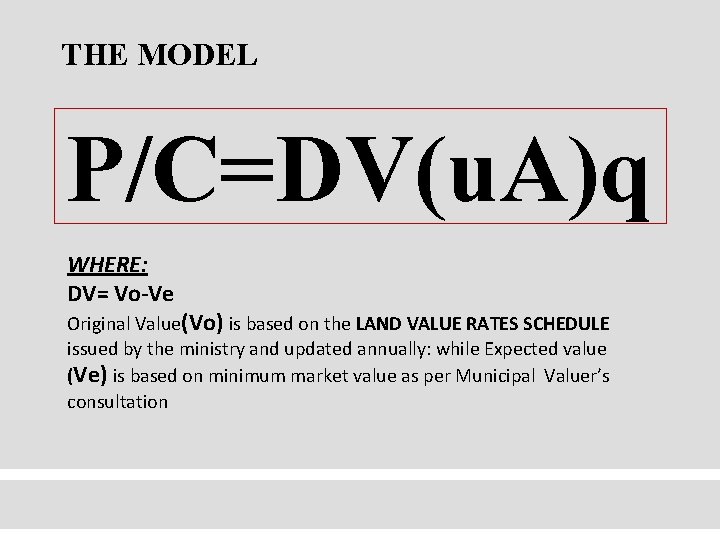
THE MODEL P/C=DV(u. A)q WHERE: DV= Vo-Ve Original Value(Vo) is based on the LAND VALUE RATES SCHEDULE issued by the ministry and updated annually: while Expected value (Ve) is based on minimum market value as per Municipal Valuer’s consultation
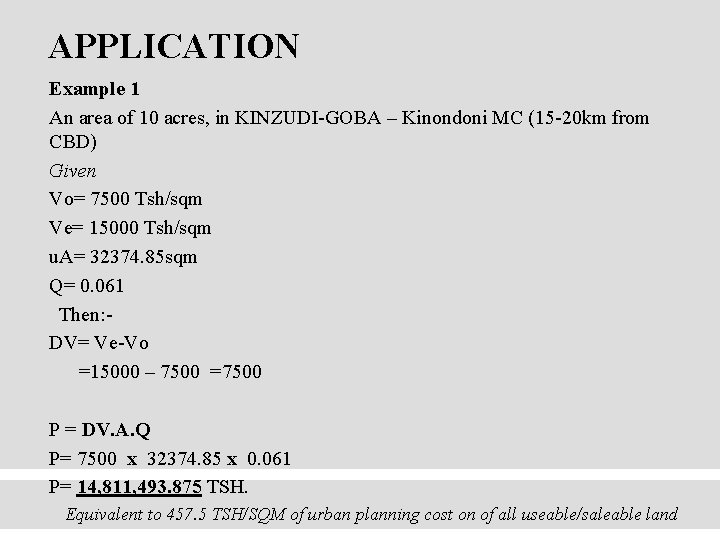
APPLICATION Example 1 An area of 10 acres, in KINZUDI-GOBA – Kinondoni MC (15 -20 km from CBD) Given Vo= 7500 Tsh/sqm Ve= 15000 Tsh/sqm u. A= 32374. 85 sqm Q= 0. 061 Then: DV= Ve-Vo =15000 – 7500 =7500 P = DV. A. Q P= 7500 x 32374. 85 x 0. 061 P= 14, 811, 493. 875 TSH. Equivalent to 457. 5 TSH/SQM of urban planning cost on of all useable/saleable land
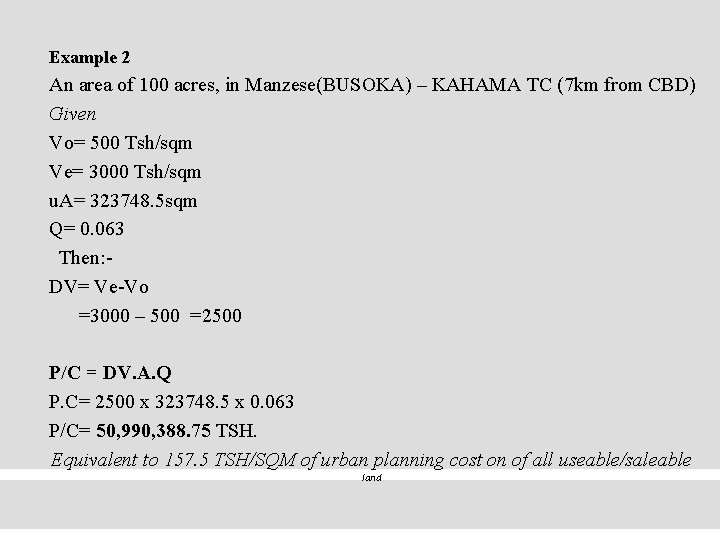
Example 2 An area of 100 acres, in Manzese(BUSOKA) – KAHAMA TC (7 km from CBD) Given Vo= 500 Tsh/sqm Ve= 3000 Tsh/sqm u. A= 323748. 5 sqm Q= 0. 063 Then: DV= Ve-Vo =3000 – 500 =2500 P/C = DV. A. Q P. C= 2500 x 323748. 5 x 0. 063 P/C= 50, 990, 388. 75 TSH. Equivalent to 157. 5 TSH/SQM of urban planning cost on of all useable/saleable land
CONCLUSION • The UPSC-Model tentatively tries to establish a scientific measurable link between key actors OF PLANNING; that has a potential to solve the Urban planning costs dilemma • The world is moving fast into digital space; having a measurable scientific method to establish costing could bring the planning profession one step closer to the market of the future.
“URBAN PLANNING SERVICES COST MODEL” A tool for estimating “Urban planning costs” BY: DR. MSAMI J(TP) & KAMUGISHA KLM (TP) THANK YOU!
- Slides: 20