
Urban Low Impact Development Parking Lot Case Study
Urban Low Impact Development Parking Lot Case Study English + Associates Owner Architect Construction Eco. Services Storm-water Tank Contractor General Contractor T&T Construction Dominion Interests MEP Engineers
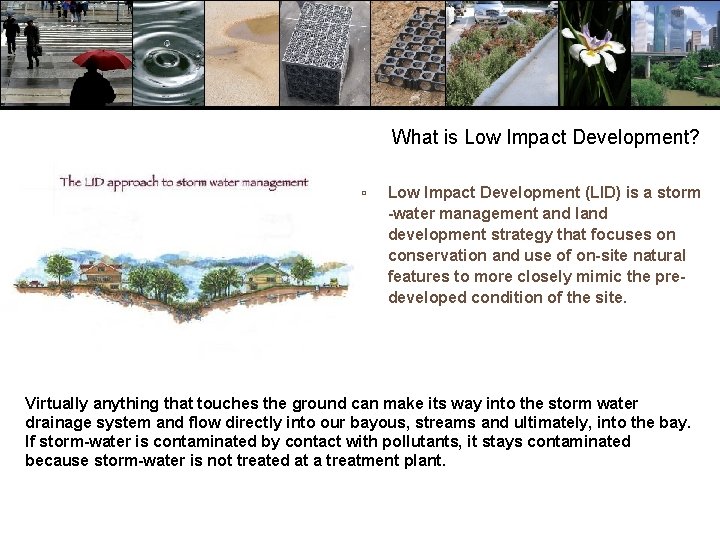
What is Low Impact Development? ▫ Low Impact Development (LID) is a storm -water management and land development strategy that focuses on conservation and use of on-site natural features to more closely mimic the predeveloped condition of the site. Virtually anything that touches the ground can make its way into the storm water drainage system and flow directly into our bayous, streams and ultimately, into the bay. If storm-water is contaminated by contact with pollutants, it stays contaminated because storm-water is not treated at a treatment plant.
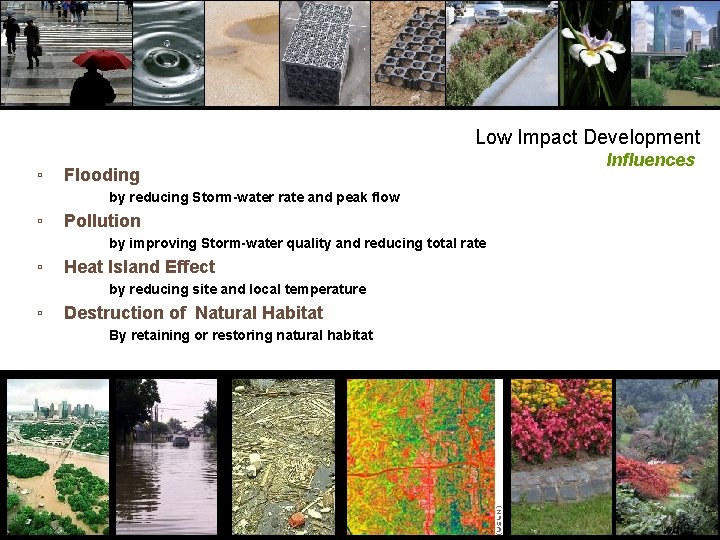
Low Impact Development ▫ Flooding by reducing Storm-water rate and peak flow ▫ Pollution by improving Storm-water quality and reducing total rate ▫ Heat Island Effect by reducing site and local temperature ▫ Destruction of Natural Habitat By retaining or restoring natural habitat Influences

Low Impact Development Benefits Developer Benefits Increase developable land Reduce city flash-flood incidents Less expensive on site storm water cleaning systems Longer retention of water on site reduces flooding of local waterways. More attractive site Increases property values Low maintenance cost Protect downstream water quality Pollutants are filtered before reaching fishing areas. Protect natural habitats More of the natural landscape remains than in traditional parking lot design. Community Benefits
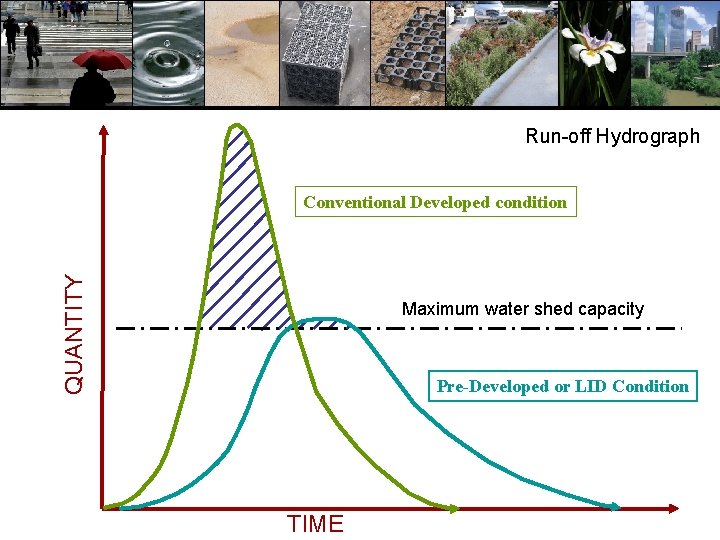
Run-off Hydrograph QUANTITY Conventional Developed condition Maximum water shed capacity Pre-Developed or LID Condition TIME
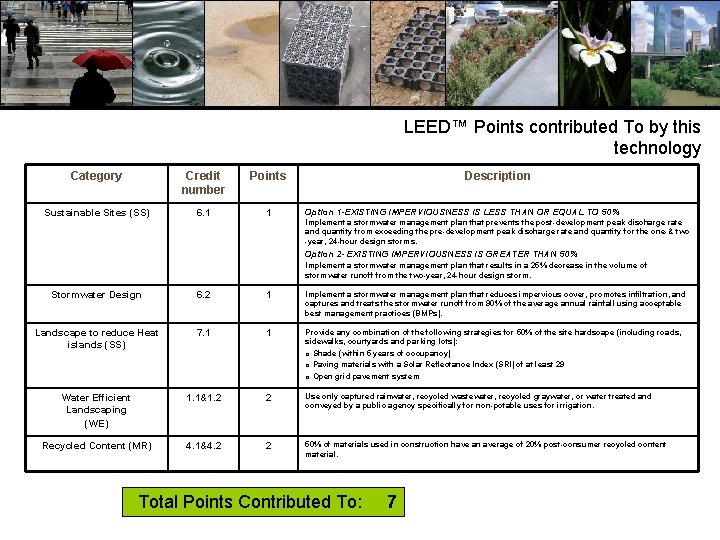
LEED™ Points contributed To by this technology Category Credit number Points Sustainable Sites (SS) 6. 1 1 Description Option 1 -EXISTING IMPERVIOUSNESS IS LESS THAN OR EQUAL TO 50% Implement a stormwater management plan that prevents the post-development peak discharge rate and quantity from exceeding the pre-development peak discharge rate and quantity for the one-& two -year, 24 -hour design storms. Option 2 - EXISTING IMPERVIOUSNESS IS GREATER THAN 50% Implement a stormwater management plan that results in a 25% decrease in the volume of stormwater runoff from the two-year, 24 -hour design storm. Stormwater Design 6. 2 1 Implement a stormwater management plan that reduces impervious cover, promotes infiltration, and captures and treats the stormwater runoff from 90% of the average annual rainfall using acceptable best management practices (BMPs). Landscape to reduce Heat islands (SS) 7. 1 1 Provide any combination of the following strategies for 50% of the site hardscape (including roads, sidewalks, courtyards and parking lots): o Shade (within 5 years of occupancy) o Paving materials with a Solar Reflectance Index (SRI) of at least 29 o Open grid pavement system Water Efficient Landscaping (WE) 1. 1&1. 2 2 Use only captured rainwater, recycled wastewater, recycled graywater, or water treated and conveyed by a public agency specifically for non-potable uses for irrigation. Recycled Content (MR) 4. 1&4. 2 2 50% of materials used in construction have an average of 20% post-consumer recycled content material. Total Points Contributed To: 7
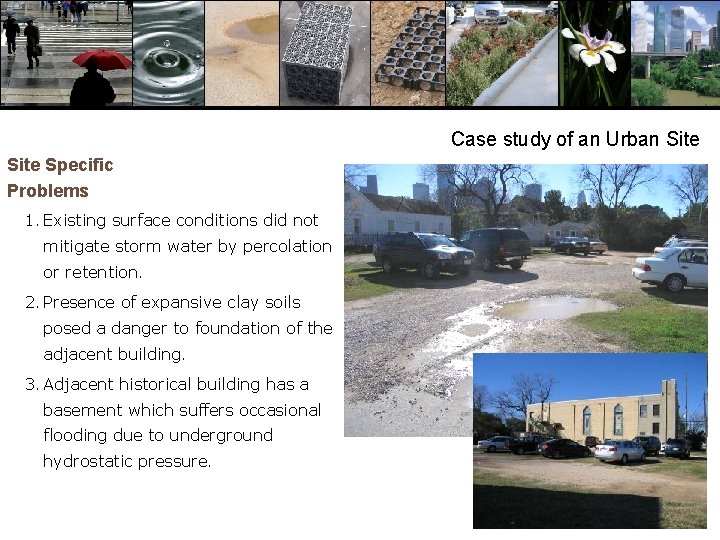
Case study of an Urban Site Specific Problems 1. Existing surface conditions did not mitigate storm water by percolation or retention. 2. Presence of expansive clay soils posed a danger to foundation of the adjacent building. 3. Adjacent historical building has a basement which suffers occasional flooding due to underground hydrostatic pressure.

▫ Parameters ▫ Parking lot with 23 spaces ▫ 100’ x 100’ Lot – 10, 000 SF ▫ Conditions ▫ Crushed gravel Parking lot ▫ Age: 40 -50 yrs ▫ Goals ▫ To provide adequate, smooth parking for office ▫ To mitigate storm water run-off ▫ Provide green space ▫ Retain Storm water for irrigation 1919 Decatur Parking Lot
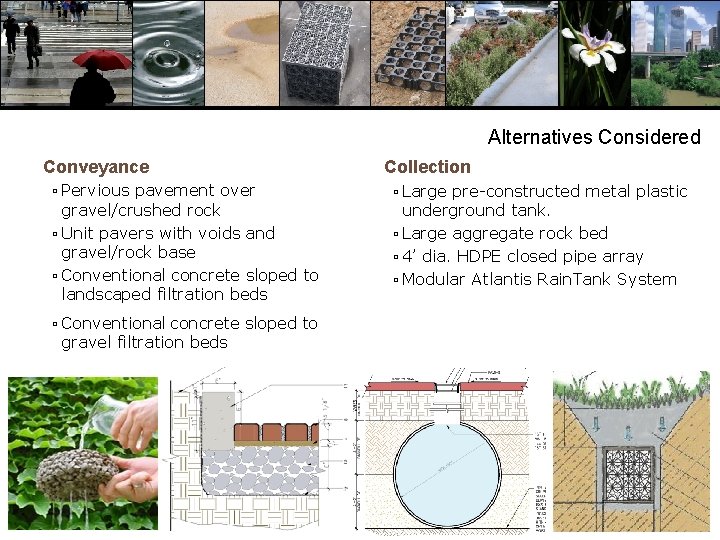
Alternatives Considered Conveyance ▫ Pervious pavement over gravel/crushed rock ▫ Unit pavers with voids and gravel/rock base ▫ Conventional concrete sloped to landscaped filtration beds ▫ Conventional concrete sloped to gravel filtration beds Collection ▫ Large pre-constructed metal plastic underground tank. ▫ Large aggregate rock bed ▫ 4’ dia. HDPE closed pipe array ▫ Modular Atlantis Rain. Tank System
How it Works
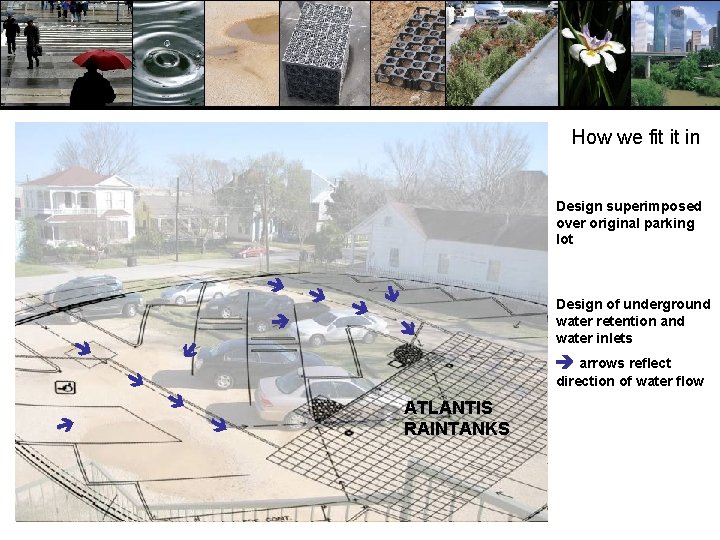
How we fit it in Design superimposed over original parking lot arrows reflect direction of water flow Design of underground water retention and water inlets ATLANTIS RAINTANKS
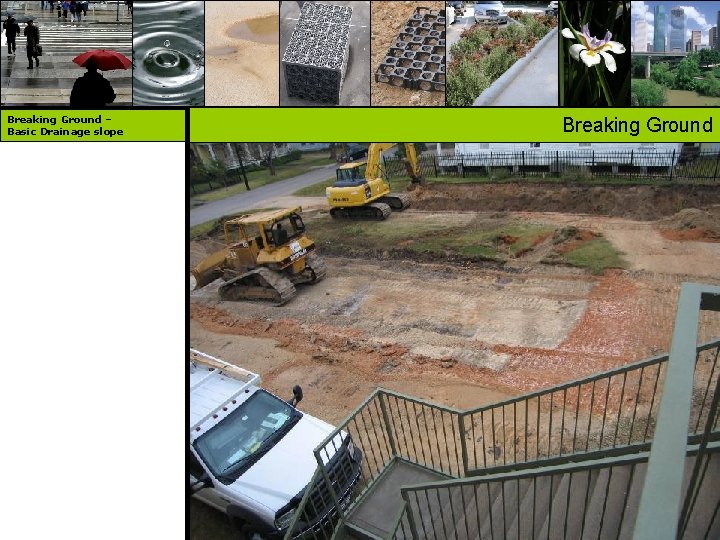
Breaking Ground – Basic Drainage slope Breaking Ground
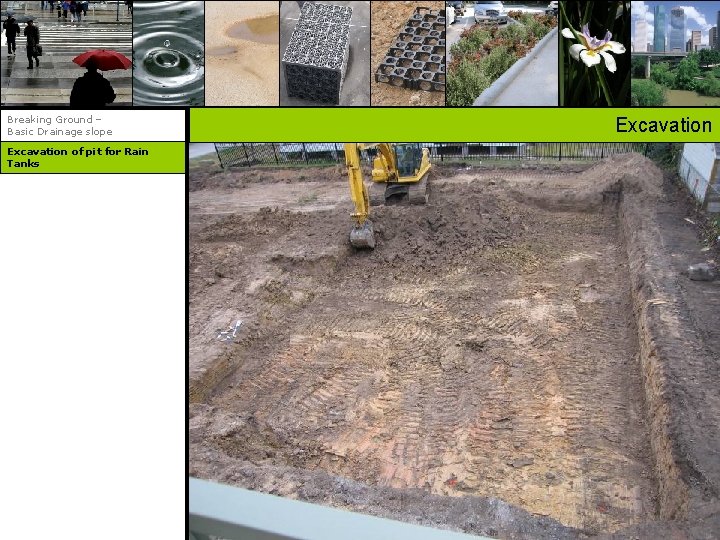
Breaking Ground – Basic Drainage slope Excavation of pit for Rain Tanks Excavation
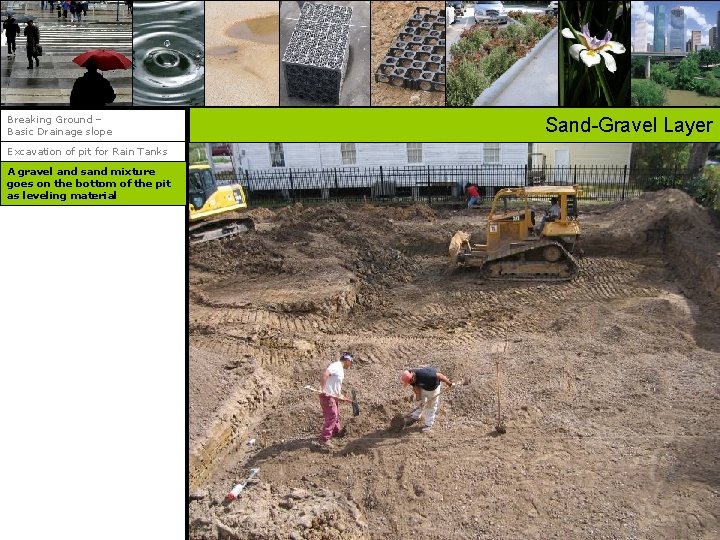
Breaking Ground – Basic Drainage slope Excavation of pit for Rain Tanks A gravel and sand mixture goes on the bottom of the pit as leveling material Sand-Gravel Layer
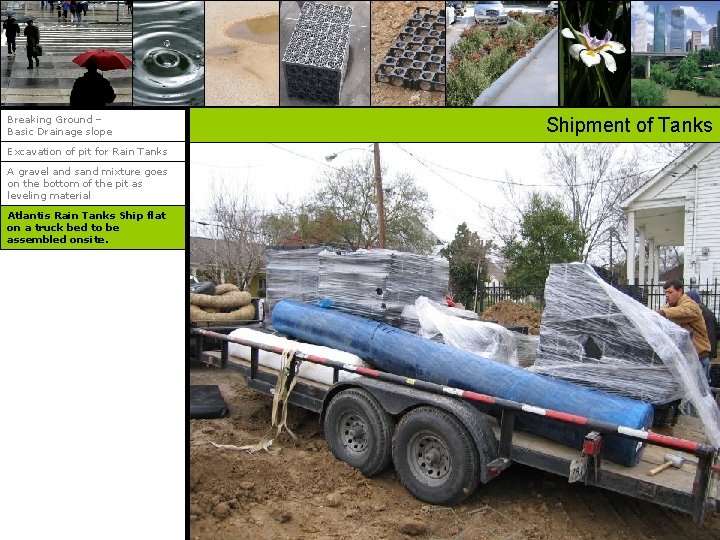
Breaking Ground – Basic Drainage slope Excavation of pit for Rain Tanks A gravel and sand mixture goes on the bottom of the pit as leveling material Atlantis Rain Tanks Ship flat on a truck bed to be assembled onsite. Shipment of Tanks
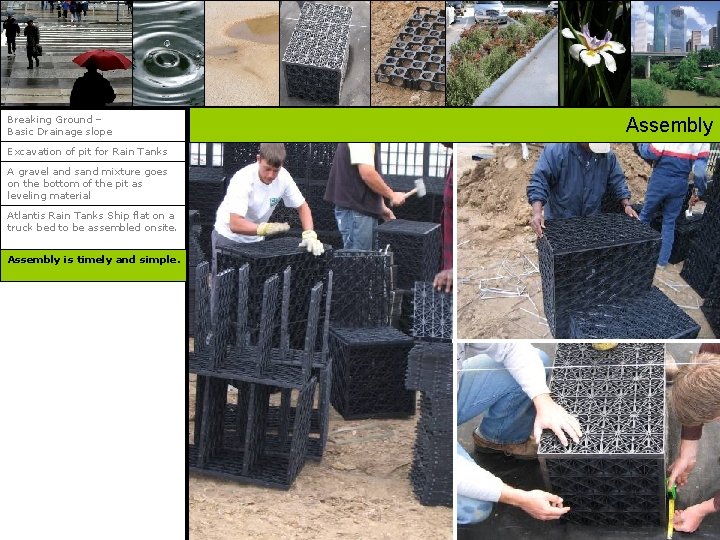
Breaking Ground – Basic Drainage slope Excavation of pit for Rain Tanks A gravel and sand mixture goes on the bottom of the pit as leveling material Atlantis Rain Tanks Ship flat on a truck bed to be assembled onsite. Assembly is timely and simple. Assembly
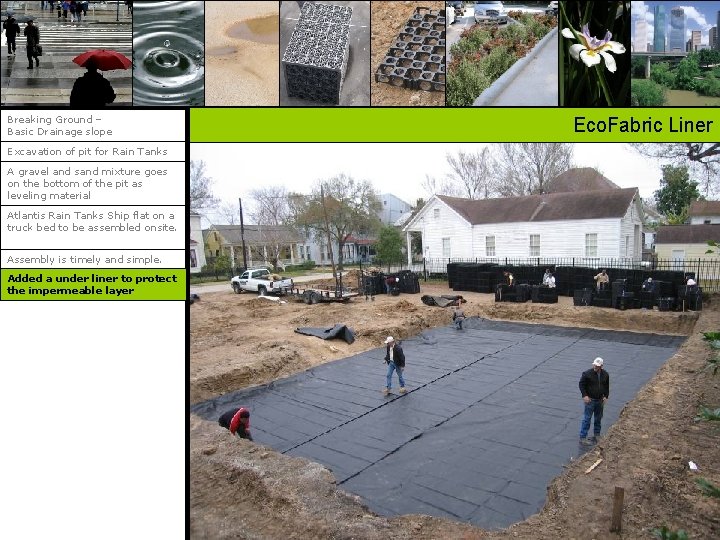
Breaking Ground – Basic Drainage slope Excavation of pit for Rain Tanks A gravel and sand mixture goes on the bottom of the pit as leveling material Atlantis Rain Tanks Ship flat on a truck bed to be assembled onsite. Assembly is timely and simple. Added a under liner to protect the impermeable layer Eco. Fabric Liner
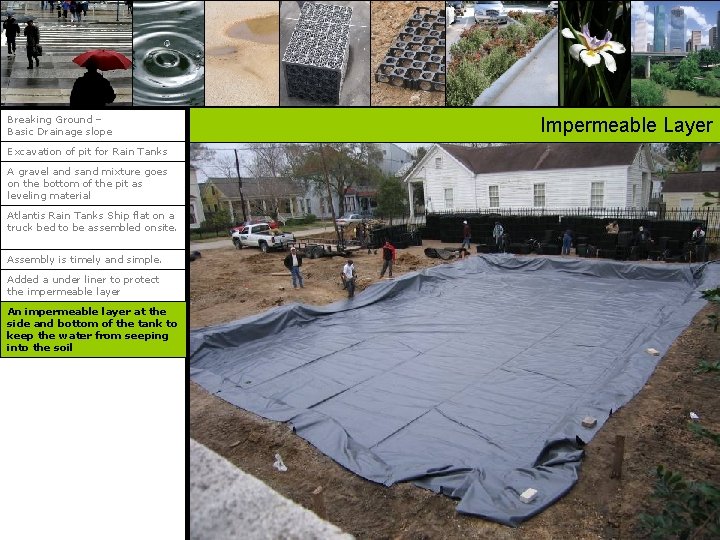
Breaking Ground – Basic Drainage slope Excavation of pit for Rain Tanks A gravel and sand mixture goes on the bottom of the pit as leveling material Atlantis Rain Tanks Ship flat on a truck bed to be assembled onsite. Assembly is timely and simple. Added a under liner to protect the impermeable layer An impermeable layer at the side and bottom of the tank to keep the water from seeping into the soil Impermeable Layer
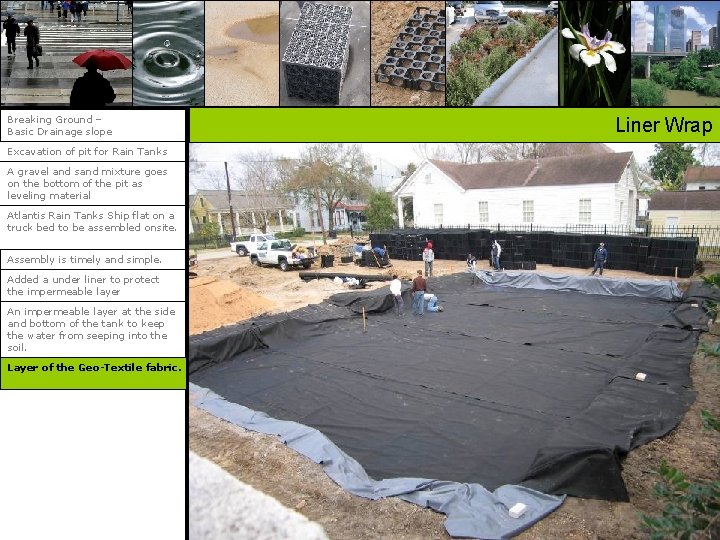
Breaking Ground – Basic Drainage slope Excavation of pit for Rain Tanks A gravel and sand mixture goes on the bottom of the pit as leveling material Atlantis Rain Tanks Ship flat on a truck bed to be assembled onsite. Assembly is timely and simple. Added a under liner to protect the impermeable layer An impermeable layer at the side and bottom of the tank to keep the water from seeping into the soil. Layer of the Geo-Textile fabric. Liner Wrap
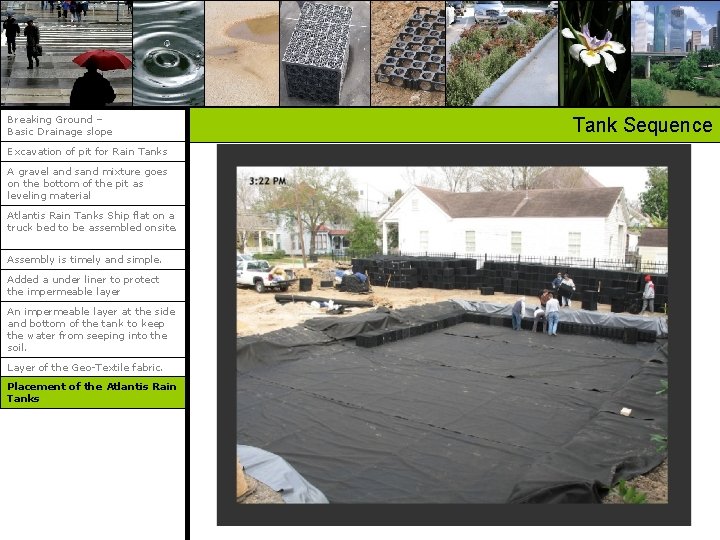
Breaking Ground – Basic Drainage slope Excavation of pit for Rain Tanks A gravel and sand mixture goes on the bottom of the pit as leveling material Atlantis Rain Tanks Ship flat on a truck bed to be assembled onsite. Assembly is timely and simple. Added a under liner to protect the impermeable layer An impermeable layer at the side and bottom of the tank to keep the water from seeping into the soil. Layer of the Geo-Textile fabric. Placement of the Atlantis Rain Tanks Tank Sequence
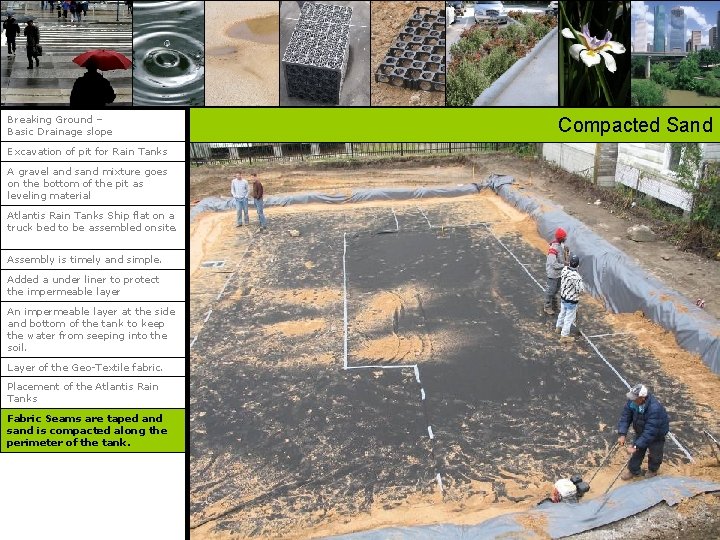
Breaking Ground – Basic Drainage slope Excavation of pit for Rain Tanks A gravel and sand mixture goes on the bottom of the pit as leveling material Atlantis Rain Tanks Ship flat on a truck bed to be assembled onsite. Assembly is timely and simple. Added a under liner to protect the impermeable layer An impermeable layer at the side and bottom of the tank to keep the water from seeping into the soil. Layer of the Geo-Textile fabric. Placement of the Atlantis Rain Tanks Fabric Seams are taped and sand is compacted along the perimeter of the tank. Compacted Sand
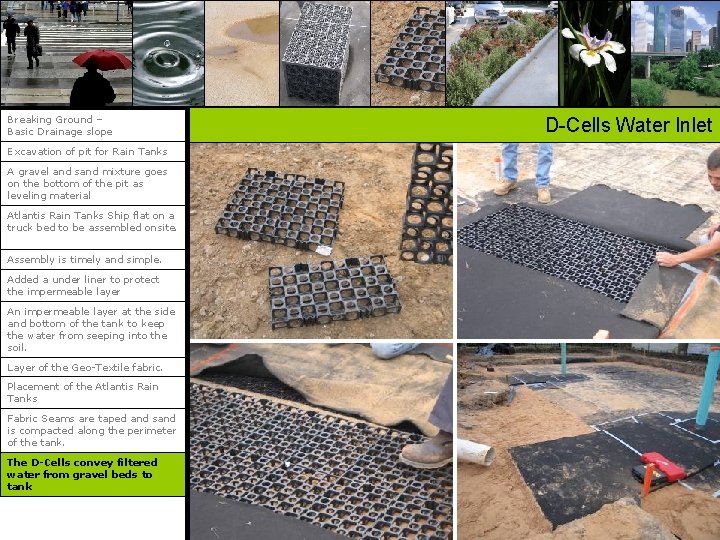
Breaking Ground – Basic Drainage slope Excavation of pit for Rain Tanks A gravel and sand mixture goes on the bottom of the pit as leveling material Atlantis Rain Tanks Ship flat on a truck bed to be assembled onsite. Assembly is timely and simple. Added a under liner to protect the impermeable layer An impermeable layer at the side and bottom of the tank to keep the water from seeping into the soil. Layer of the Geo-Textile fabric. Placement of the Atlantis Rain Tanks Fabric Seams are taped and sand is compacted along the perimeter of the tank. The D-Cells convey filtered water from gravel beds to tank D-Cells Water Inlet
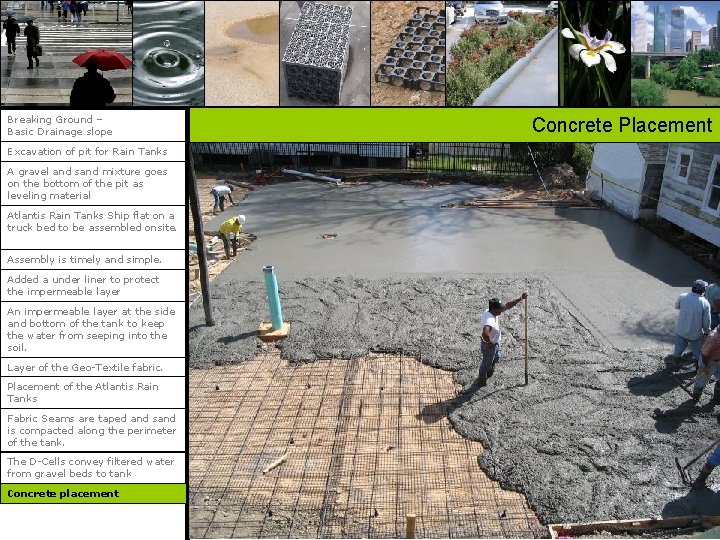
Breaking Ground – Basic Drainage slope Excavation of pit for Rain Tanks A gravel and sand mixture goes on the bottom of the pit as leveling material Atlantis Rain Tanks Ship flat on a truck bed to be assembled onsite. Assembly is timely and simple. Added a under liner to protect the impermeable layer An impermeable layer at the side and bottom of the tank to keep the water from seeping into the soil. Layer of the Geo-Textile fabric. Placement of the Atlantis Rain Tanks Fabric Seams are taped and sand is compacted along the perimeter of the tank. The D-Cells convey filtered water from gravel beds to tank Concrete placement Concrete Placement
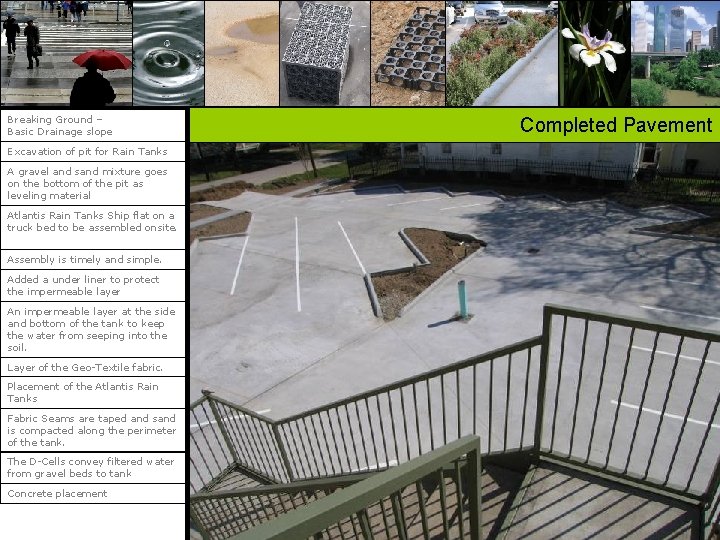
Breaking Ground – Basic Drainage slope Excavation of pit for Rain Tanks A gravel and sand mixture goes on the bottom of the pit as leveling material Atlantis Rain Tanks Ship flat on a truck bed to be assembled onsite. Assembly is timely and simple. Added a under liner to protect the impermeable layer An impermeable layer at the side and bottom of the tank to keep the water from seeping into the soil. Layer of the Geo-Textile fabric. Placement of the Atlantis Rain Tanks Fabric Seams are taped and sand is compacted along the perimeter of the tank. The D-Cells convey filtered water from gravel beds to tank Concrete placement Completed Pavement
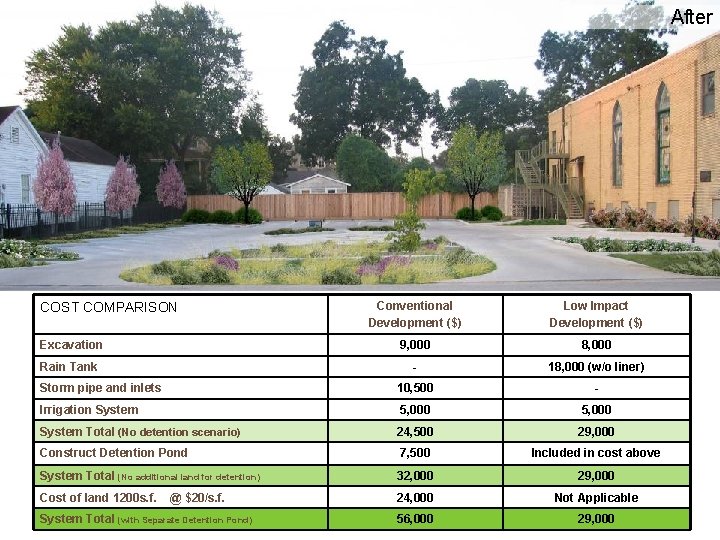
After Before Conventional Development ($) Low Impact Development ($) Excavation 9, 000 8, 000 Rain Tank - 18, 000 (w/o liner) Storm pipe and inlets 10, 500 - Irrigation System 5, 000 System Total (No detention scenario) 24, 500 29, 000 Construct Detention Pond 7, 500 Included in cost above System Total (No additional land for detention) 32, 000 29, 000 Cost of land 1200 s. f. 24, 000 Not Applicable 56, 000 29, 000 COST COMPARISON @ $20/s. f. System Total (with Separate Detention Pond)
- Slides: 25