
Urban Earthquakes 1 Faults are fractures in the
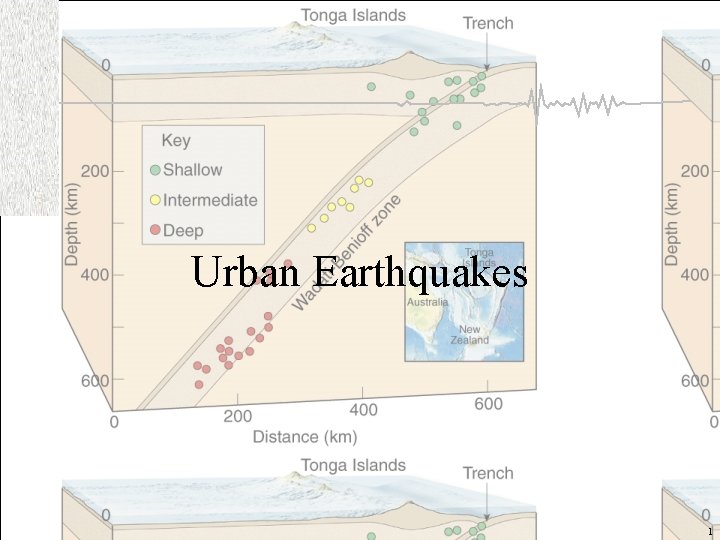
Urban Earthquakes 1
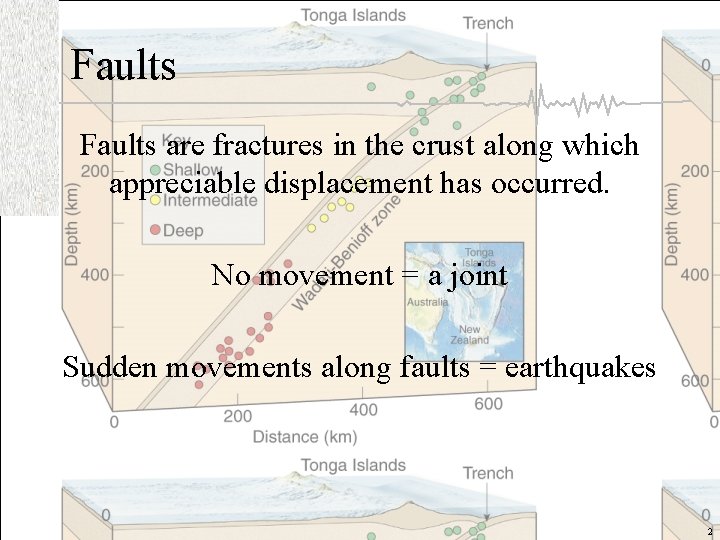
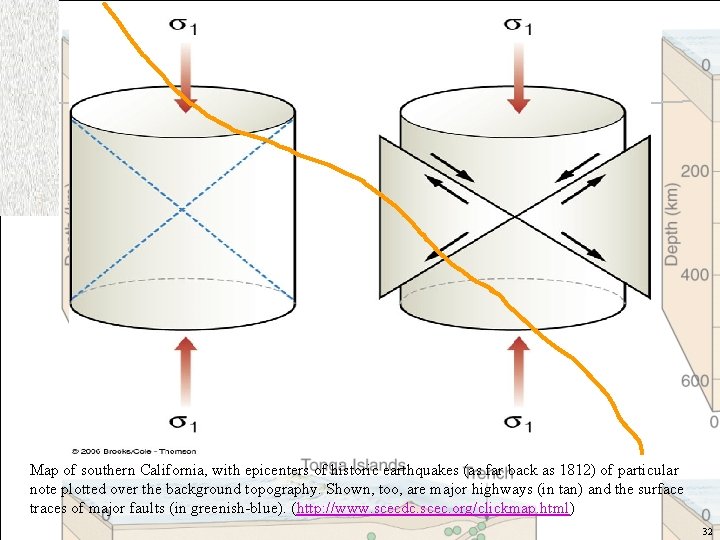
Faults are fractures in the crust along which appreciable displacement has occurred. No movement = a joint Sudden movements along faults = earthquakes 2
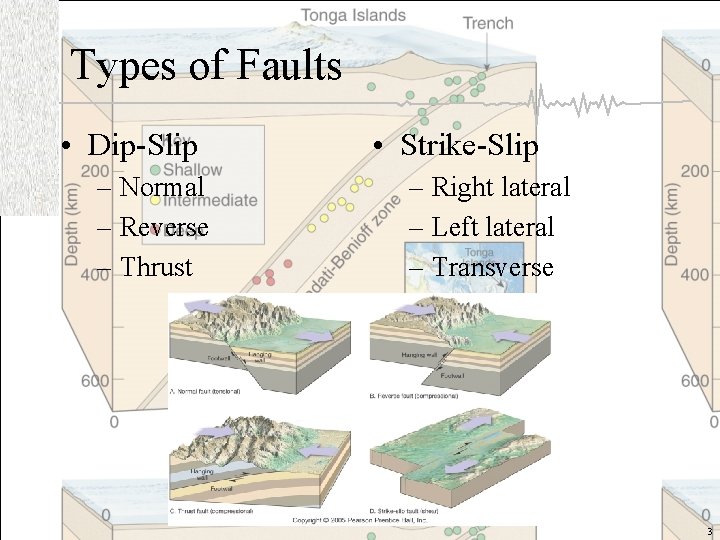
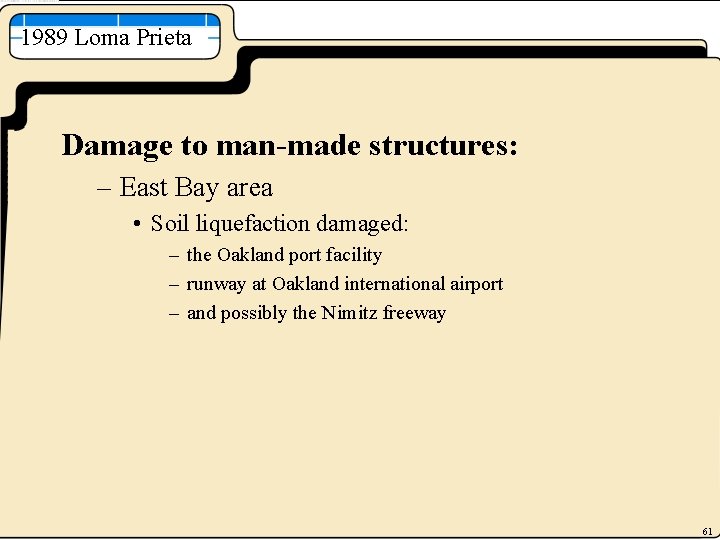
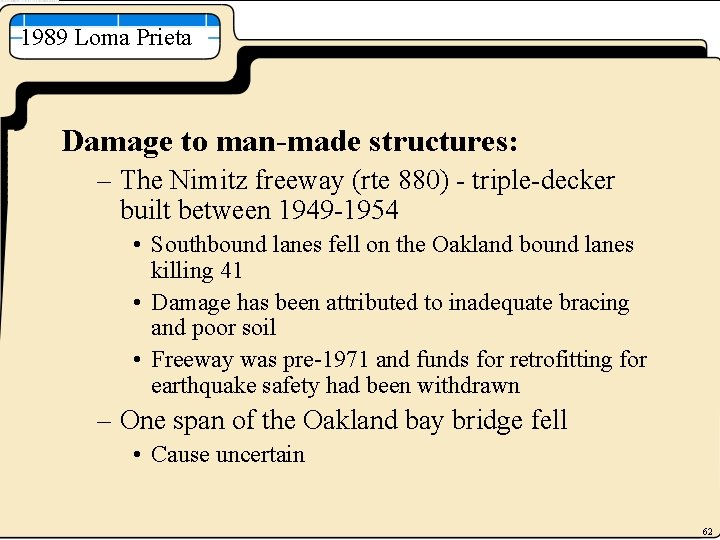
Types of Faults • Dip-Slip – Normal – Reverse – Thrust • Strike-Slip – Right lateral – Left lateral – Transverse 3
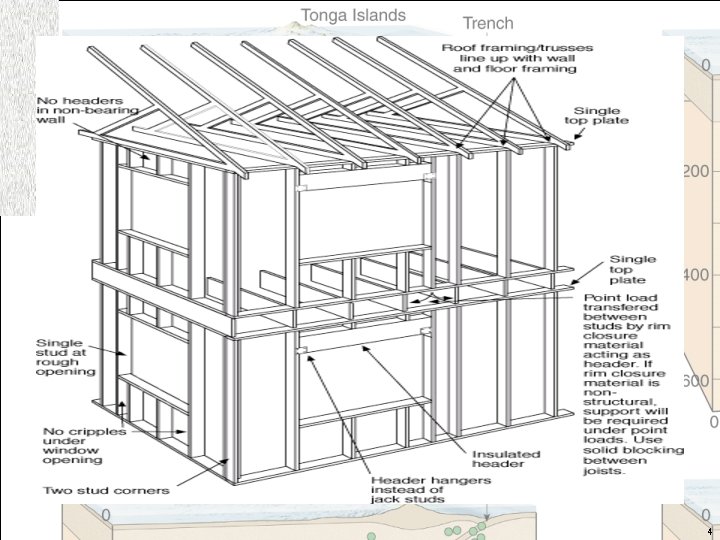
Faults 4

Dip Slip Faults • Movement is primarily vertical and parallel to the fault plane • May produce long, low cliffs called fault scarps • Parts – Hanging wall (rock surface above the fault) – Footwall (rock surface below the fault) 5
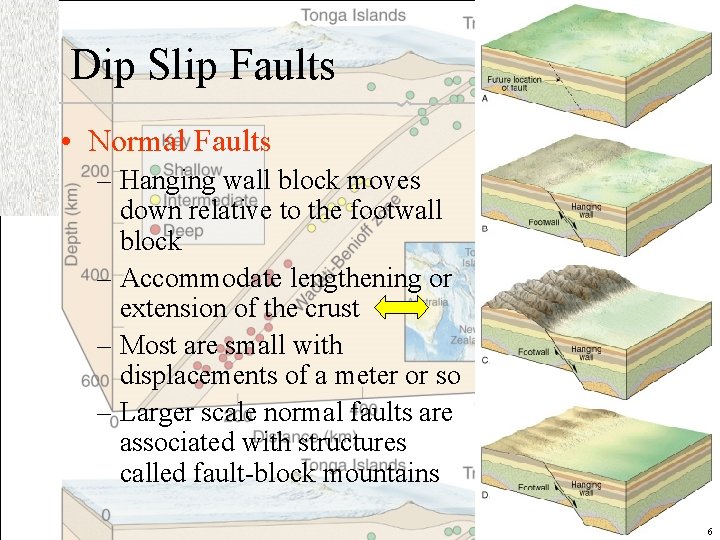
Dip Slip Faults • Normal Faults – Hanging wall block moves down relative to the footwall block – Accommodate lengthening or extension of the crust – Most are small with displacements of a meter or so – Larger scale normal faults are associated with structures called fault-block mountains 6
Dip Slip Faults • Normal Faults – Sierra Nevada fault • March 27, 1872 Owens valley earthquake • 8. 5 M - California’s greatest • 29 killed – Cities on normal faults • Bishop, Reno, Carson City 7
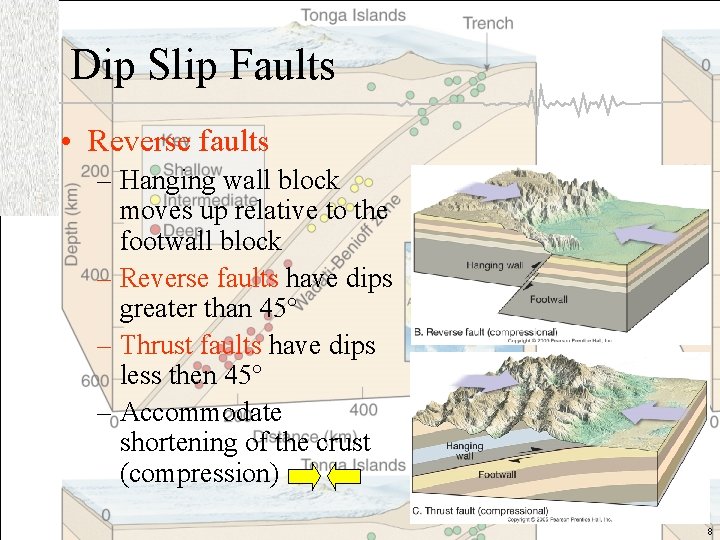
Dip Slip Faults • Reverse faults – Hanging wall block moves up relative to the footwall block – Reverse faults have dips greater than 45° – Thrust faults have dips less then 45° – Accommodate shortening of the crust (compression) 8
Thrust faults • The southern boundary of the transverse range is a series of east trending thrust faults – Santa Monica fault system – Sierra Madre fault system • These faults may be characterized by very high horizontal acceleration 9
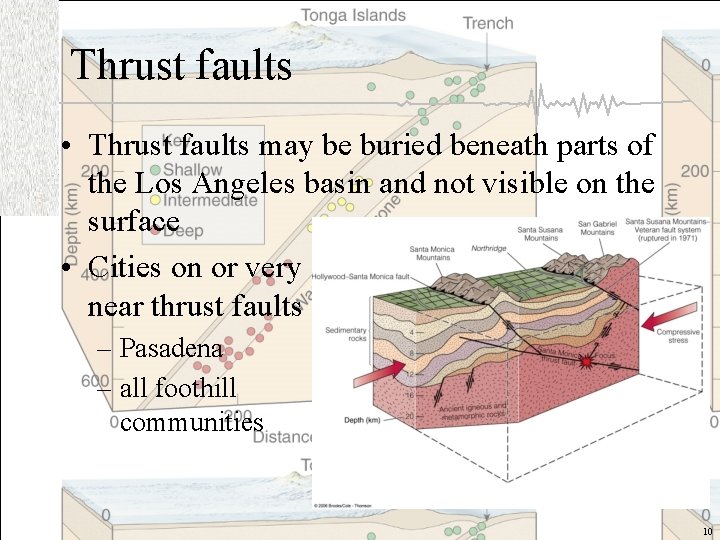
Thrust faults • Thrust faults may be buried beneath parts of the Los Angeles basin and not visible on the surface • Cities on or very near thrust faults – Pasadena – all foothill communities 10
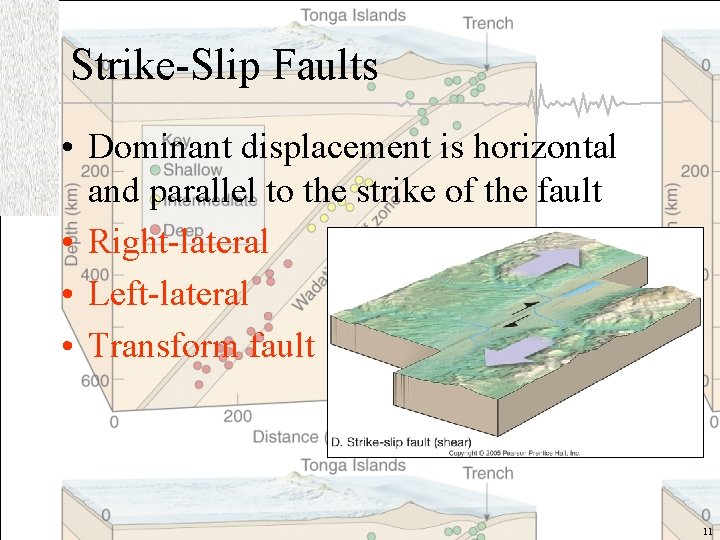
Strike-Slip Faults • Dominant displacement is horizontal and parallel to the strike of the fault • Right-lateral • Left-lateral • Transform fault 11

Strike-Slip Faults • These faults dominate the geology of California – Active for 30 m. y. – 10's to 100's of miles of displacement • These are the most active faults in California – 6 out of 10 earthquakes occur on these faults 12
Strike-Slip Faults • Right lateral faults are most common – They dominate the peninsular range and coast range – They trend NW-SE – Mostly active 13
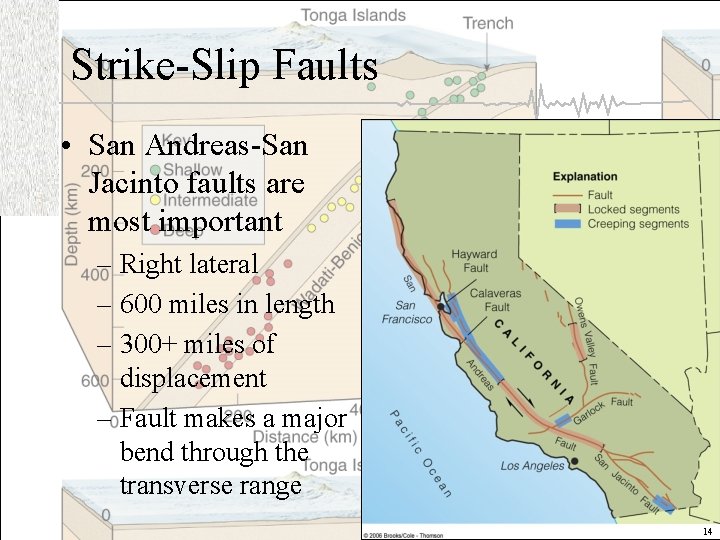
Strike-Slip Faults • San Andreas-San Jacinto faults are most important – Right lateral – 600 miles in length – 300+ miles of displacement – Fault makes a major bend through the transverse range 14
Strike-Slip Faults • San Andreas-San Jacinto faults are most important – Studies by Caltech indicate 9 major San Andreas earthquakes since the 6 th century • Past events ~ 575, 665, 860, 965, 1190, 1245, 1470, 1745, 1857 • Average repeat interval of 160 years – 2 major historic earthquakes • (1) 1857 Fort Tejon - 8 M • (2) 1906 San Francisco - 8. 3 M 15
Recognition of faults • Earthquakes • Geological observation – Offset of the ground surface – Linear fault scarps – Sag ponds, offset drainages – Fracture with different rocks on opposite sides – Zones of crushed rocks • Get professional help. . . the geological kind! 16
What are earthquakes? • An earthquake is the vibration of Earth produced by the rapid release of energy • Earthquakes most often occur along existing faults whenever the frictional forces on the fault surfaces are overcome 17
Earthquake Locations Depths range from 5 to nearly 700 km 18
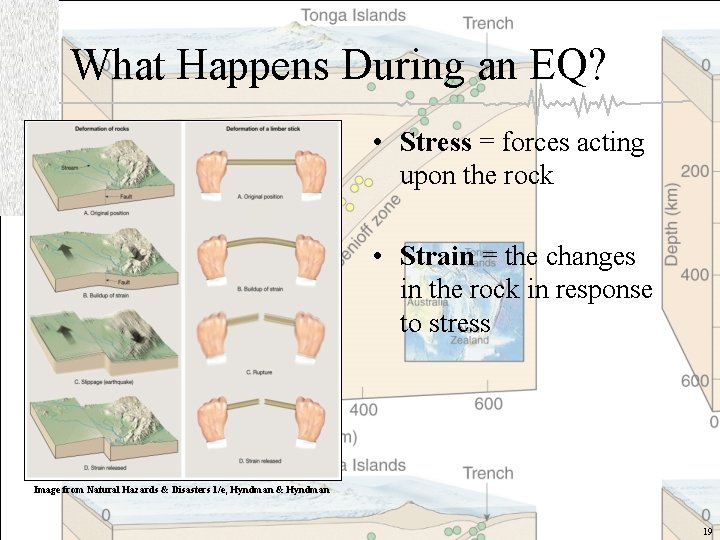
What Happens During an EQ? • Stress = forces acting upon the rock • Strain = the changes in the rock in response to stress Image from Natural Hazards & Disasters 1/e, Hyndman & Hyndman 19
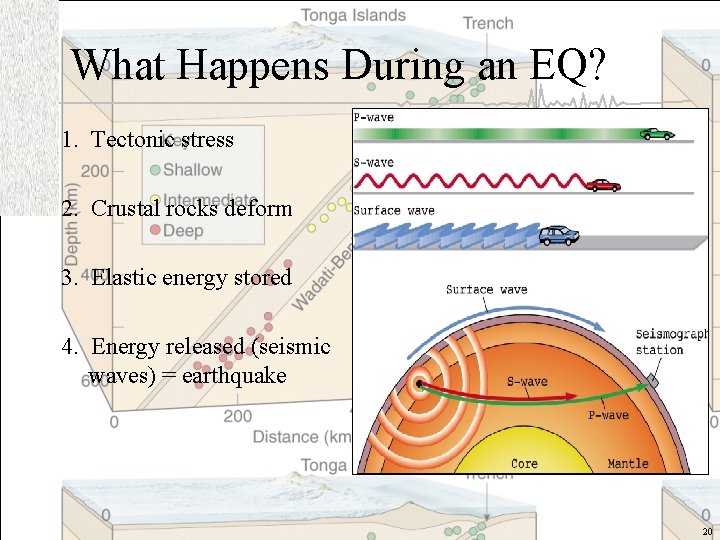
What Happens During an EQ? 1. Tectonic stress 2. Crustal rocks deform 3. Elastic energy stored 4. Energy released (seismic waves) = earthquake 20
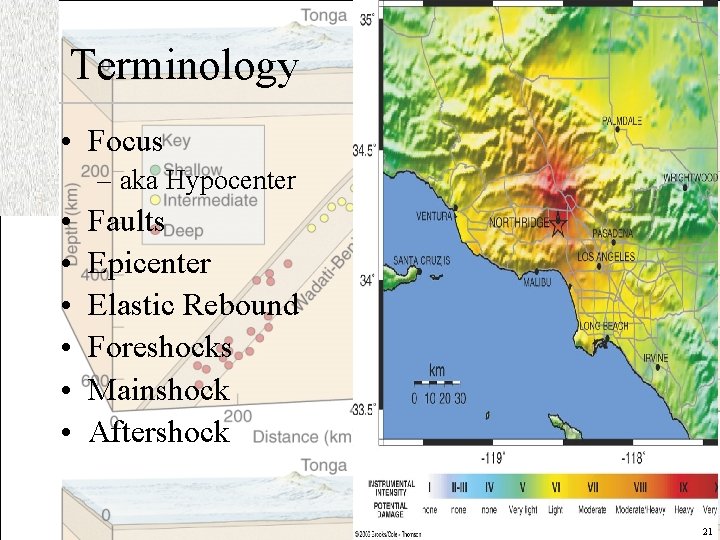
Terminology • Focus – aka Hypocenter • • • Faults Epicenter Elastic Rebound Foreshocks Mainshock Aftershock 21
Seismic Waves • Two main types of seismic waves – Surface waves – Body waves 22
Earthquake Waves 23

Seismographs 24
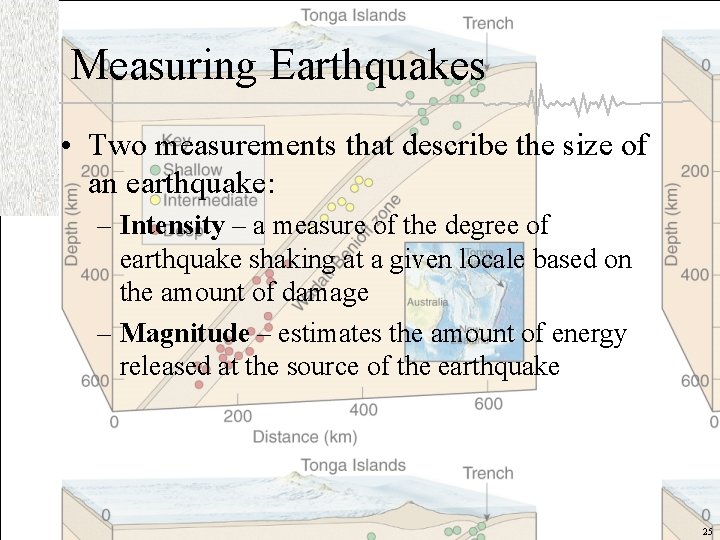
Measuring Earthquakes • Two measurements that describe the size of an earthquake: – Intensity – a measure of the degree of earthquake shaking at a given locale based on the amount of damage – Magnitude – estimates the amount of energy released at the source of the earthquake 25
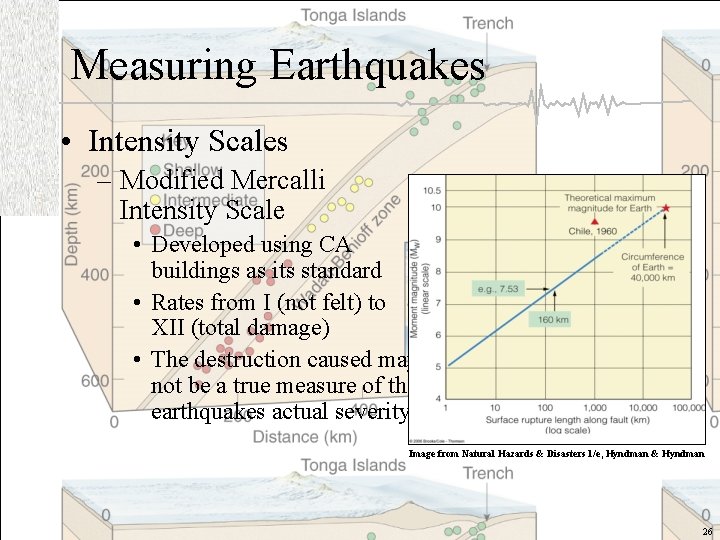
Measuring Earthquakes • Intensity Scales – Modified Mercalli Intensity Scale • Developed using CA buildings as its standard • Rates from I (not felt) to XII (total damage) • The destruction caused may not be a true measure of the earthquakes actual severity Image from Natural Hazards & Disasters 1/e, Hyndman & Hyndman 26
Measuring Earthquakes • Magnitude Scales – Richter magnitude - concept introduced by Charles Richter in 1935 • Based on the amplitude of the largest seismic wave recorded • Accounts for the decrease in wave amplitude with increased distance • Used primarily for local/nearby earthquakes • ML 27
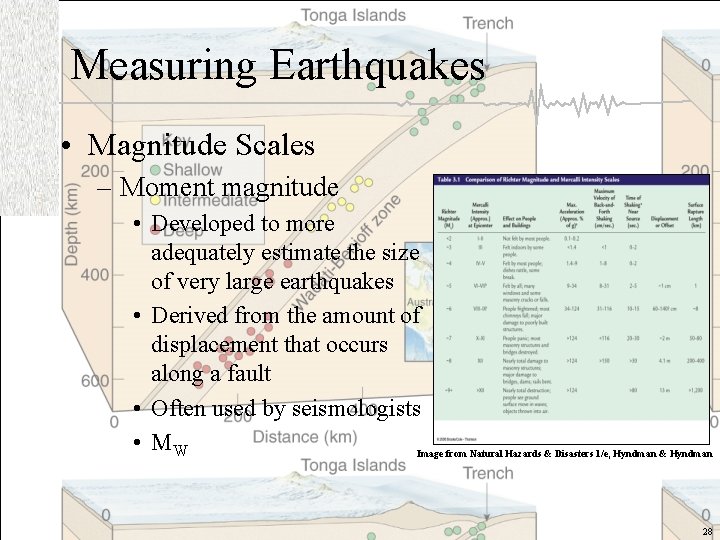
Measuring Earthquakes • Magnitude Scales – Moment magnitude • Developed to more adequately estimate the size of very large earthquakes • Derived from the amount of displacement that occurs along a fault • Often used by seismologists • MW Image from Natural Hazards & Disasters 1/e, Hyndman & Hyndman 28
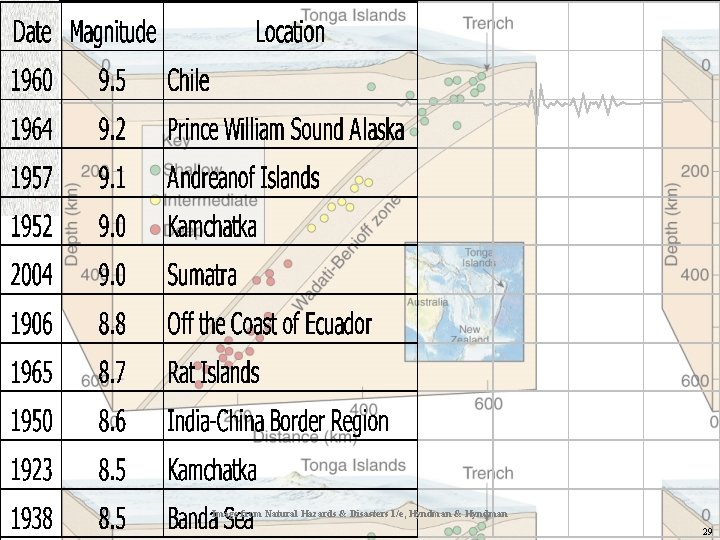
Image from Natural Hazards & Disasters 1/e, Hyndman & Hyndman 29
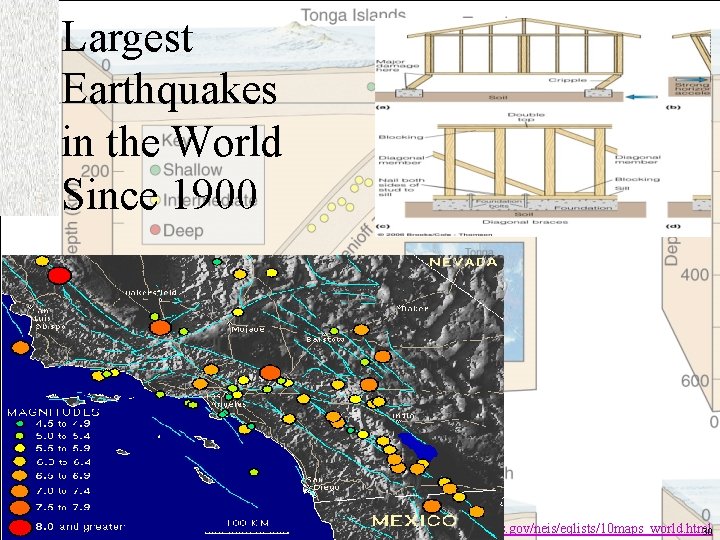
Largest Earthquakes in the World Since 1900 http: //wwwneic. cr. usgs. gov/neis/eqlists/10 maps_world. html 30
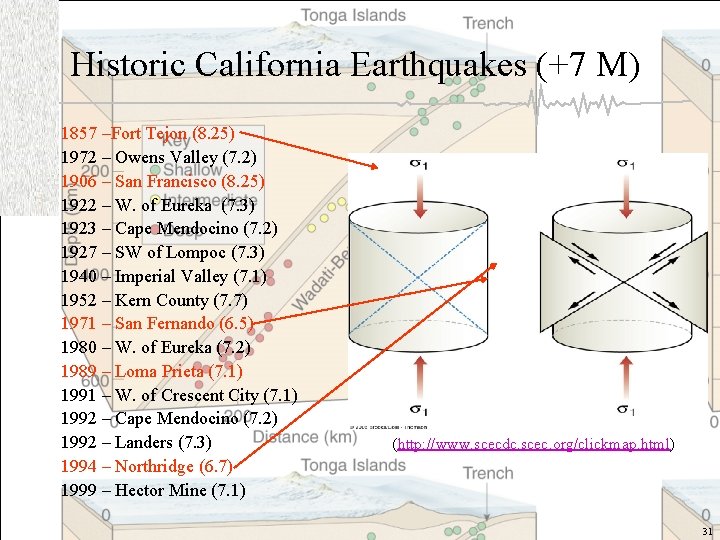
Historic California Earthquakes (+7 M) 1857 –Fort Tejon (8. 25) 1972 – Owens Valley (7. 2) 1906 – San Francisco (8. 25) 1922 – W. of Eureka (7. 3) 1923 – Cape Mendocino (7. 2) 1927 – SW of Lompoc (7. 3) 1940 – Imperial Valley (7. 1) 1952 – Kern County (7. 7) 1971 – San Fernando (6. 5) 1980 – W. of Eureka (7. 2) 1989 – Loma Prieta (7. 1) 1991 – W. of Crescent City (7. 1) 1992 – Cape Mendocino (7. 2) 1992 – Landers (7. 3) 1994 – Northridge (6. 7) 1999 – Hector Mine (7. 1) (http: //www. scecdc. scec. org/clickmap. html) 31
Map of southern California, with epicenters of historic earthquakes (as far back as 1812) of particular note plotted over the background topography. Shown, too, are major highways (in tan) and the surface traces of major faults (in greenish-blue). (http: //www. scecdc. scec. org/clickmap. html) 32
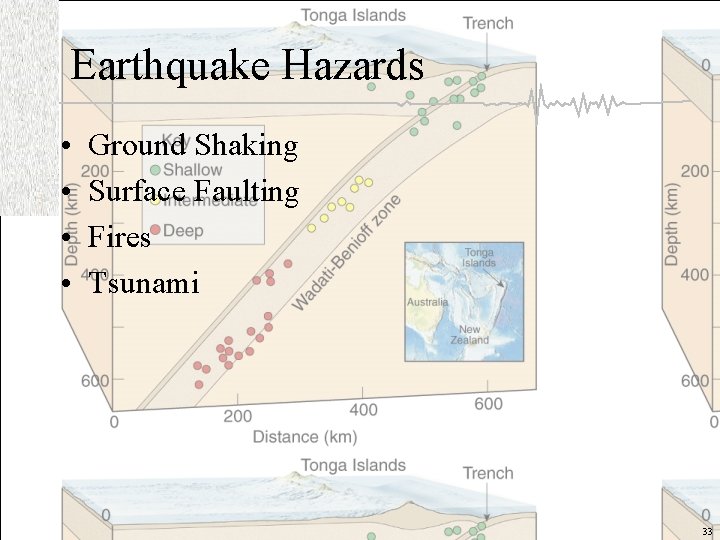
Earthquake Hazards • • Ground Shaking Surface Faulting Fires Tsunami 33
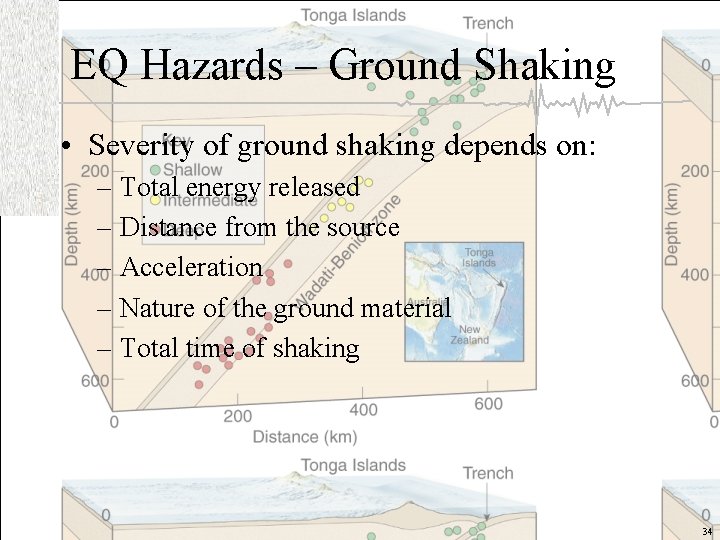
EQ Hazards – Ground Shaking • Severity of ground shaking depends on: – Total energy released – Distance from the source – Acceleration – Nature of the ground material – Total time of shaking 34
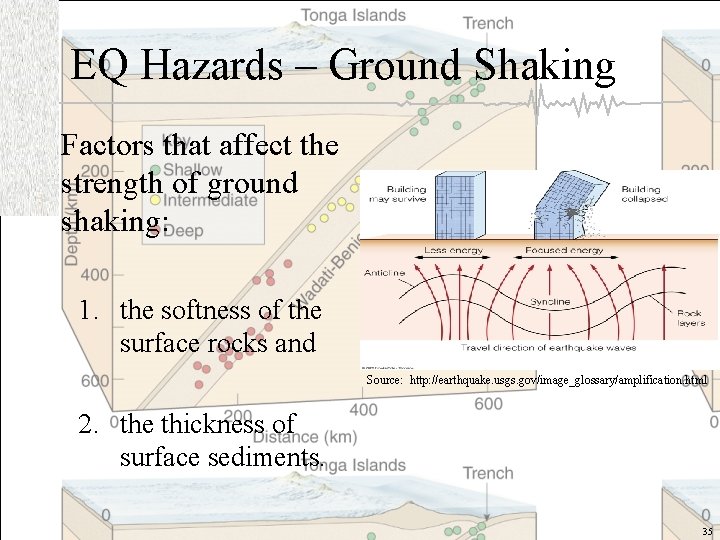
EQ Hazards – Ground Shaking Factors that affect the strength of ground shaking: 1. the softness of the surface rocks and Source: http: //earthquake. usgs. gov/image_glossary/amplification. html 2. the thickness of surface sediments. 35
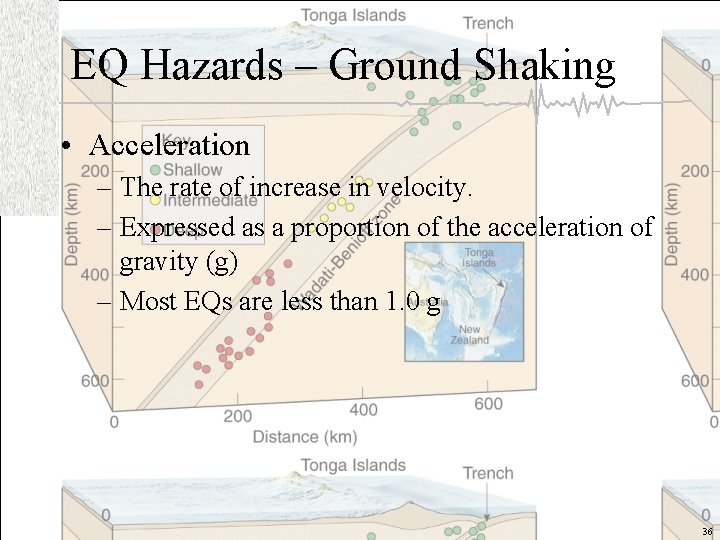
EQ Hazards – Ground Shaking • Acceleration – The rate of increase in velocity. – Expressed as a proportion of the acceleration of gravity (g) – Most EQs are less than 1. 0 g 36
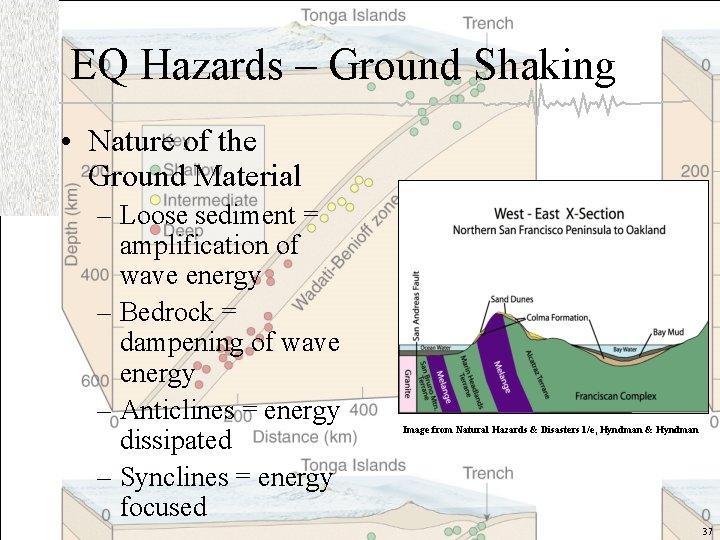
EQ Hazards – Ground Shaking • Nature of the Ground Material – Loose sediment = amplification of wave energy – Bedrock = dampening of wave energy – Anticlines = energy dissipated – Synclines = energy focused Image from Natural Hazards & Disasters 1/e, Hyndman & Hyndman 37
EQ Hazards – Ground Shaking • Results: – Liquefaction – Landslides – Ground Subsidence – Building Collapse 38
EQ Hazards – Ground Shaking • Building Collapse Factors: – Intensity of the earthquake – Duration of the vibrations – Nature of the material upon which the structure rests – The design of the structure – National Geographic’s Make Your Own EQ 39
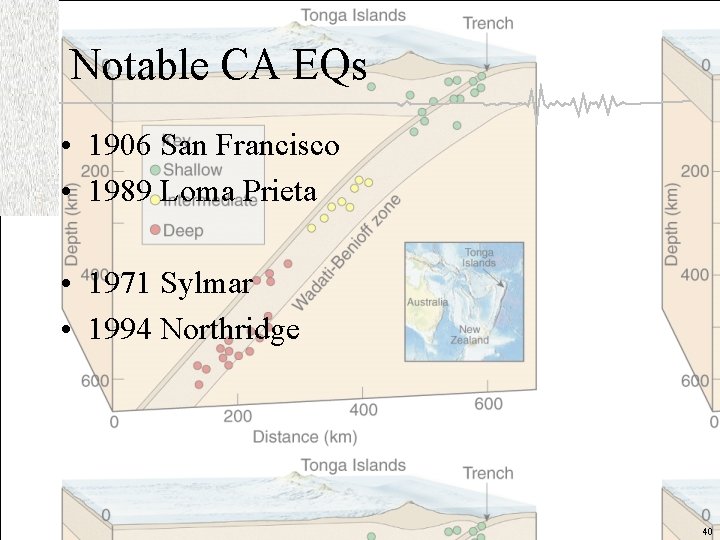
Notable CA EQs • 1906 San Francisco • 1989 Loma Prieta • 1971 Sylmar • 1994 Northridge 40
1906 San Francisco When: April 18, 1906 Fault: San Andreas Epicenter: 27 miles north of San Francisco Magnitude: 8. 3 (estimated) Duration of Shaking: 50 seconds of extreme shaking 41
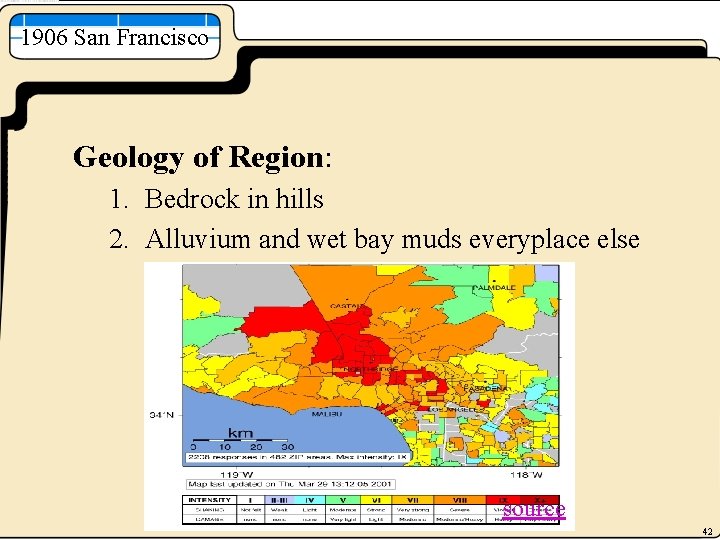
1906 San Francisco Geology of Region: 1. Bedrock in hills 2. Alluvium and wet bay muds everyplace else source 42
1906 San Francisco Damages directly caused by earthquake: 1. Surface rupture 270 miles long extended north and south of San Francisco 2. Surface offsets of 20 feet (Right-lateral displacement) 3. Extensive ground shaking 4. Liquefaction, mainly in San Francisco 43
1906 San Francisco 44
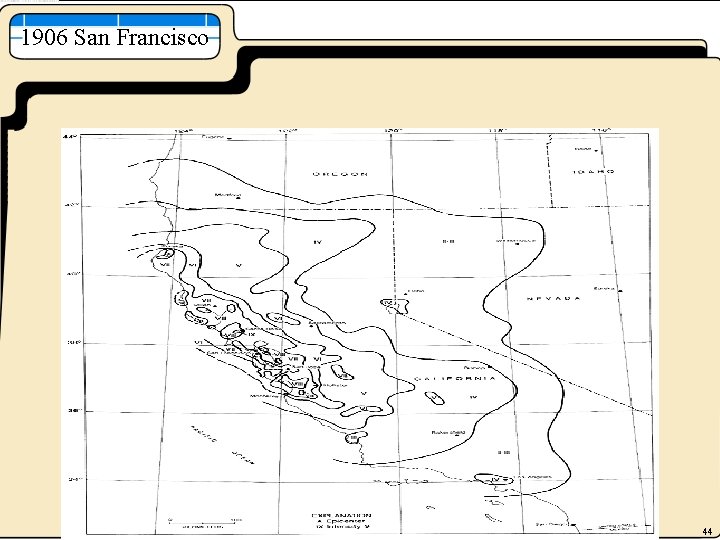
1906 San Francisco Isoseismal map for the San Francisco, California, earthquake of April 18, 1906. Isoseismals are based on MM intensity estimates from data. source 45
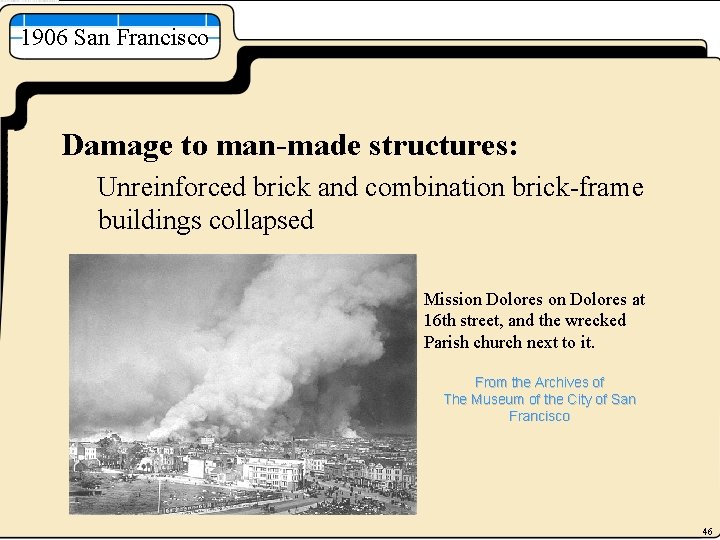
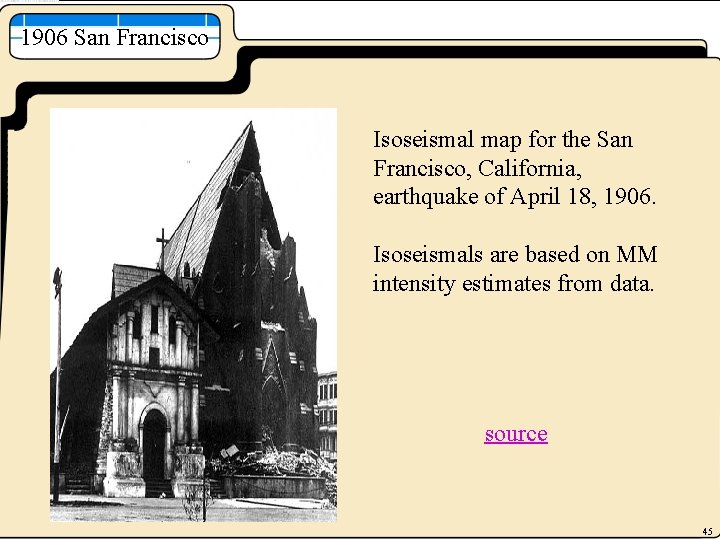
1906 San Francisco Damage to man-made structures: Unreinforced brick and combination brick-frame buildings collapsed Mission Dolores at 16 th street, and the wrecked Parish church next to it. From the Archives of The Museum of the City of San Francisco 46
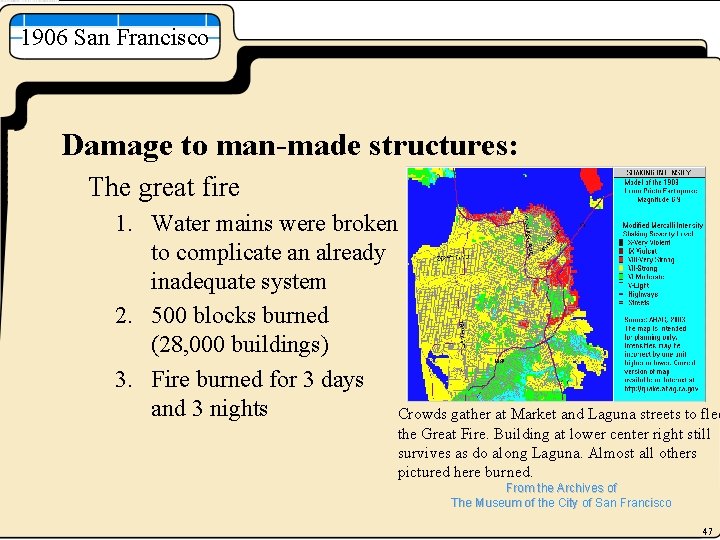
1906 San Francisco Damage to man-made structures: The great fire 1. Water mains were broken to complicate an already inadequate system 2. 500 blocks burned (28, 000 buildings) 3. Fire burned for 3 days and 3 nights Crowds gather at Market and Laguna streets to flee the Great Fire. Building at lower center right still survives as do along Laguna. Almost all others pictured here burned. From the Archives of The Museum of the City of San Francisco 47
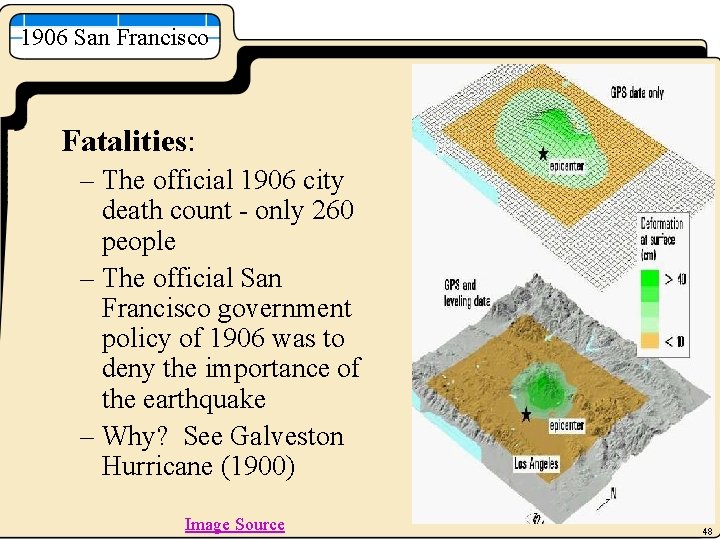
1906 San Francisco Fatalities: – The official 1906 city death count - only 260 people – The official San Francisco government policy of 1906 was to deny the importance of the earthquake – Why? See Galveston Hurricane (1900) Image Source 48
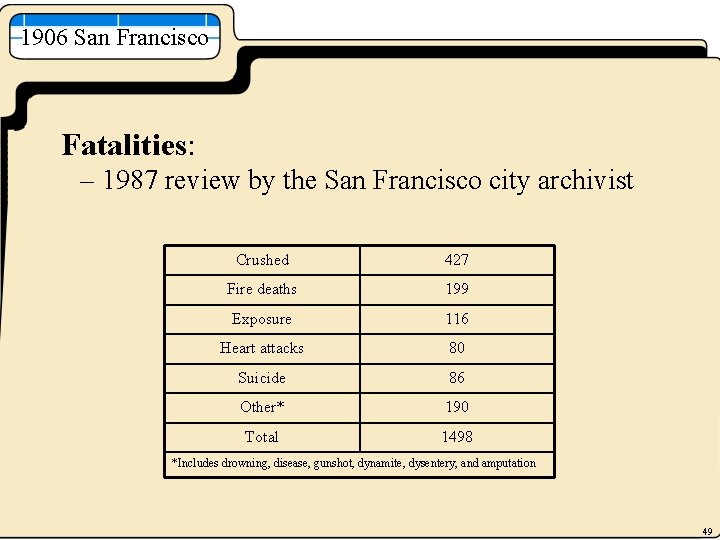
1906 San Francisco Fatalities: – 1987 review by the San Francisco city archivist Crushed 427 Fire deaths 199 Exposure 116 Heart attacks 80 Suicide 86 Other* 190 Total 1498 *Includes drowning, disease, gunshot, dynamite, dysentery, and amputation 49
1906 San Francisco • Excellent book on the 1906 earthquake “The San Francisco earthquake” by Thomas Gordon • Also visit: Museum of the City of San Francisco - 1906 Earthquake and Fire • 16 Views of the Great Earthquake and Fire (in Power. Point) 50
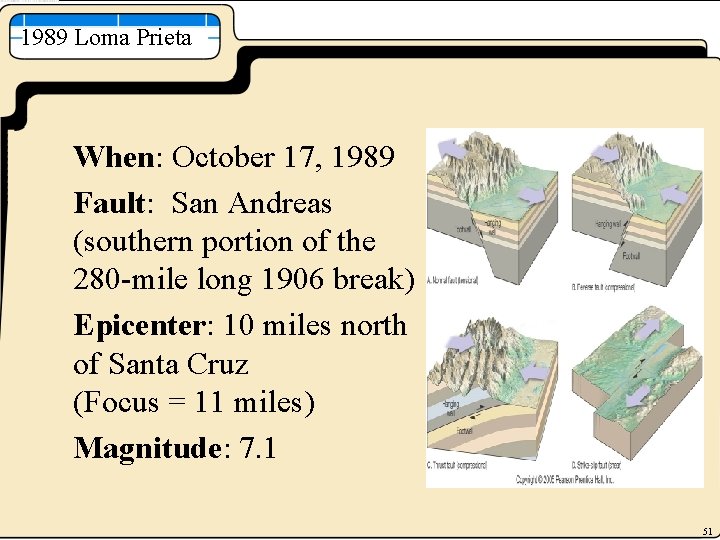
1989 Loma Prieta When: October 17, 1989 Fault: San Andreas (southern portion of the 280 -mile long 1906 break) Epicenter: 10 miles north of Santa Cruz (Focus = 11 miles) Magnitude: 7. 1 51
1989 Loma Prieta Damages directly caused by earthquake: – Horizontal displacement = to the right 6. 5 feet – Vertical displacement = 4. 5 feet up (on the southwest side) – Maximum horizontal acceleration was 0. 45 0. 55 g's near the epicenter – Mercalli intensity depended greatly on the firmness of the earth 52
1989 Loma Prieta 53
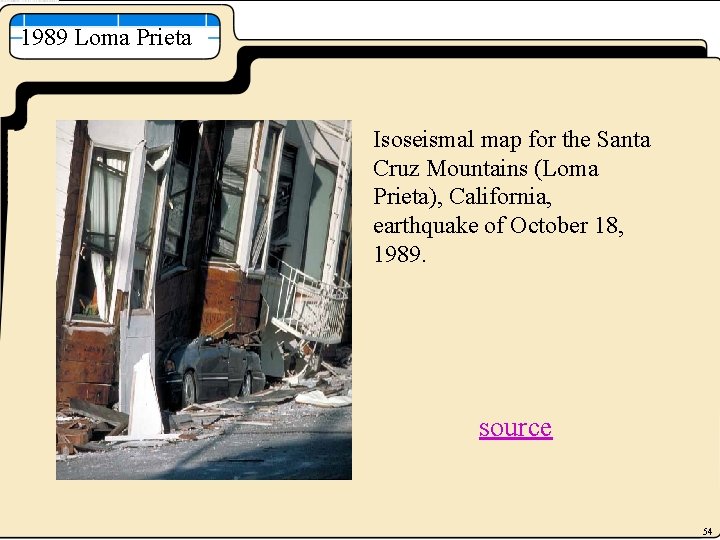
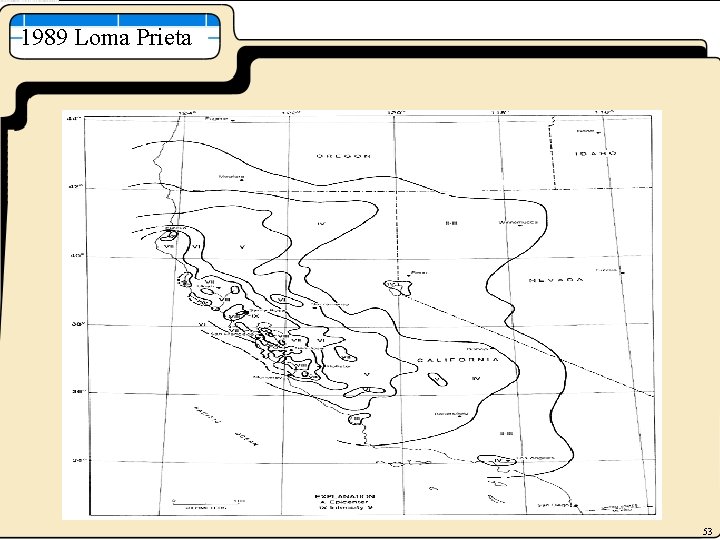
1989 Loma Prieta Isoseismal map for the Santa Cruz Mountains (Loma Prieta), California, earthquake of October 18, 1989. source 54
1989 Loma Prieta Damages directly caused by earthquake: – No surface rupture (all subsurface) – Lurch cracks • Abundant in an area about 3 miles wide near the epicenter – Regional stress • Weak, unconsolidated tertiary sedimentary rocks not being able to respond elastically to severe shaking • Cracks damaged pavement, sidewalks, buildings etc. 55
1989 Loma Prieta Damages directly caused by earthquake: – Landsliding • Many landslides occurred in the mountains south of S. F. • Many are old landslides that were reactivated • Some roads were closed 56
1989 Loma Prieta Damages directly caused by earthquake: – Soil liquefaction • Liquefaction is caused by increased pore water pressure • This is an especially severe problem around the San Francisco bay • Large parts of the bay have either: – Soft, water-saturated natural sediment deposited by rivers – Soft sandy man-made fills partly from the 1906 earthquake 57
1989 Loma Prieta Damage to man-made structures: – No building constructed to code collapsed – Buildings on solid ground in the epicentral area did well if they were built to code – Buildings 50 miles away in San Francisco on weak fill did poorly 58
1989 Loma Prieta Damage to man-made structures: – The marina of San Francisco • Located 50 miles from the epicenter and still had a IX intensity • A lagoon was filled with 1906 debris to form today's Marina district • Damage included fires, collapsed buildings, broken utilities 59
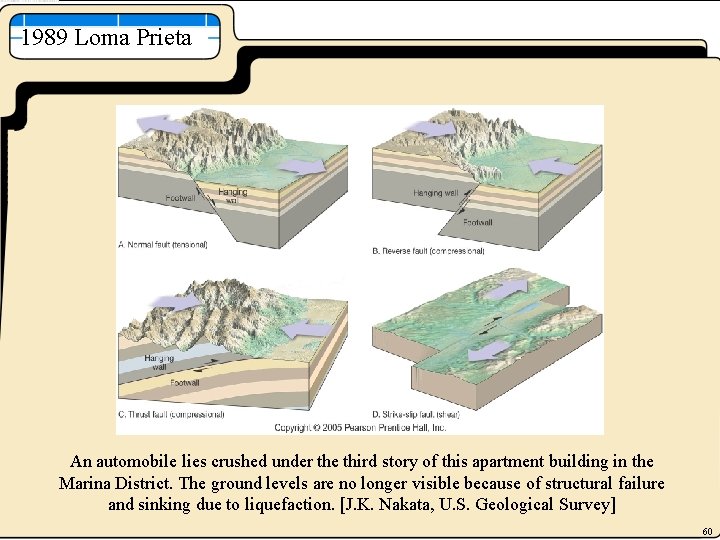
1989 Loma Prieta An automobile lies crushed under the third story of this apartment building in the Marina District. The ground levels are no longer visible because of structural failure and sinking due to liquefaction. [J. K. Nakata, U. S. Geological Survey] 60
1989 Loma Prieta Damage to man-made structures: – East Bay area • Soil liquefaction damaged: – the Oakland port facility – runway at Oakland international airport – and possibly the Nimitz freeway 61
1989 Loma Prieta Damage to man-made structures: – The Nimitz freeway (rte 880) - triple-decker built between 1949 -1954 • Southbound lanes fell on the Oakland bound lanes killing 41 • Damage has been attributed to inadequate bracing and poor soil • Freeway was pre-1971 and funds for retrofitting for earthquake safety had been withdrawn – One span of the Oakland bay bridge fell • Cause uncertain 62
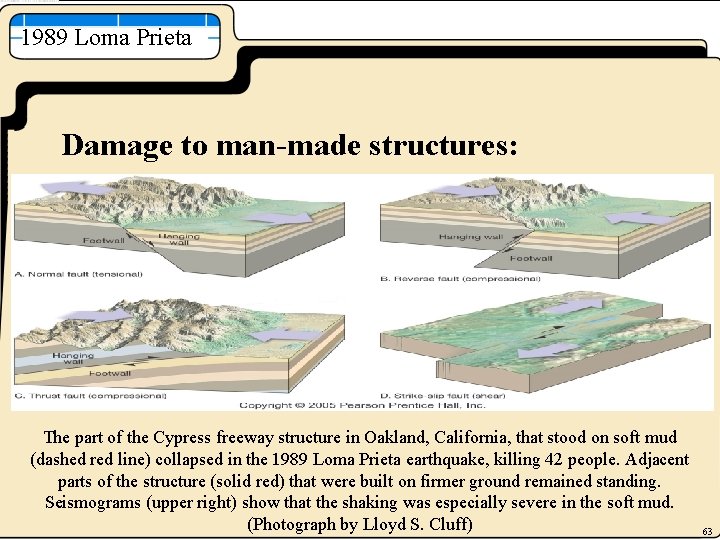
1989 Loma Prieta Damage to man-made structures: The part of the Cypress freeway structure in Oakland, California, that stood on soft mud (dashed red line) collapsed in the 1989 Loma Prieta earthquake, killing 42 people. Adjacent parts of the structure (solid red) that were built on firmer ground remained standing. Seismograms (upper right) show that the shaking was especially severe in the soft mud. (Photograph by Lloyd S. Cluff) 63
1989 Loma Prieta Damage to man-made structures: Aerial view of the collapsed section of the San Francisco. Oakland Bay Bridge. View westward. [C. E. Meyer, U. S. Geological Survey] 64
1989 Loma Prieta Damage to man-made structures: – Comparison with 1906 • Areas that liquefied in 1906 also did so in 1989 • Water mains needed to fight fires that broke in 1906 did so in 1989 • Maps of damage and intensity for 1906 are similar to 1989 65
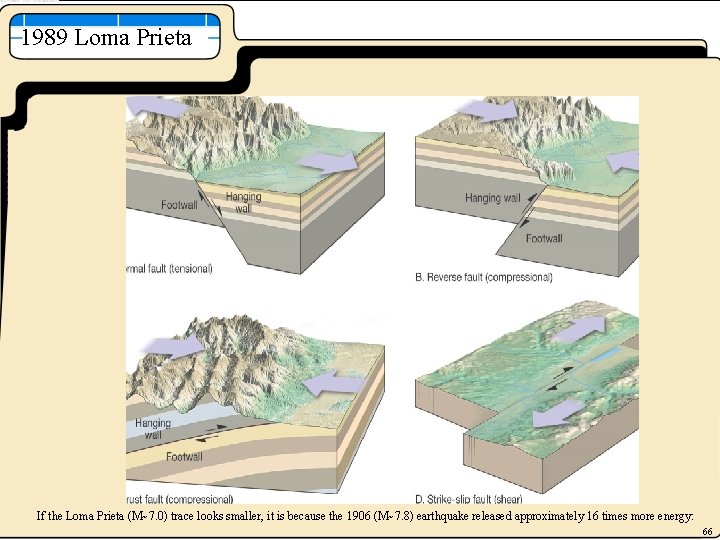
1989 Loma Prieta If the Loma Prieta (M~7. 0) trace looks smaller, it is because the 1906 (M~7. 8) earthquake released approximately 16 times more energy: 66
1989 Loma Prieta Human damage: – Injuries • • 62 deaths 3, 757 injuries 12, 000 homeless $6 billion in property damage 67
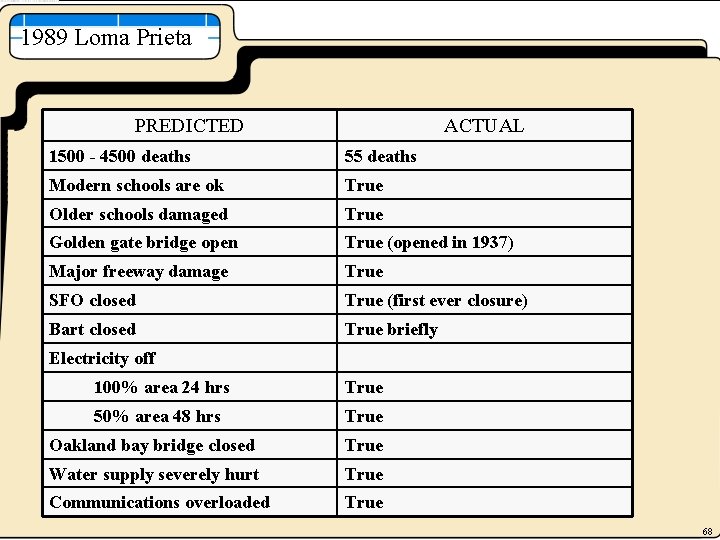
1989 Loma Prieta PREDICTED ACTUAL 1500 - 4500 deaths 55 deaths Modern schools are ok True Older schools damaged True Golden gate bridge open True (opened in 1937) Major freeway damage True SFO closed True (first ever closure) Bart closed True briefly Electricity off 100% area 24 hrs True 50% area 48 hrs True Oakland bay bridge closed True Water supply severely hurt True Communications overloaded True 68
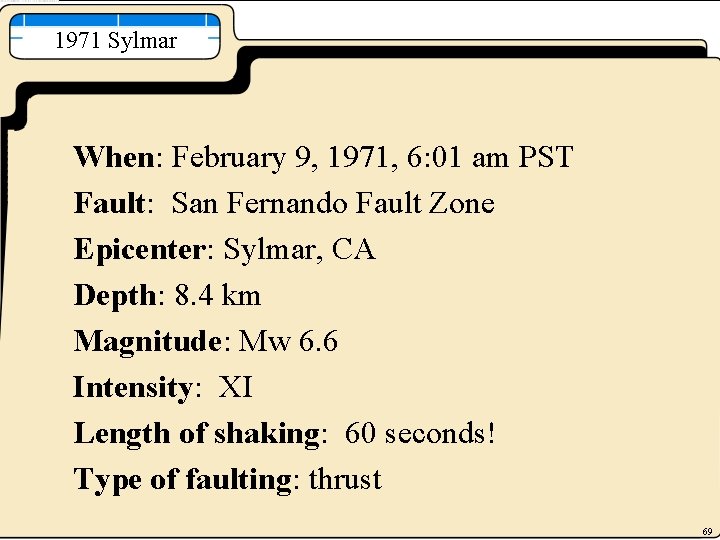
1971 Sylmar When: February 9, 1971, 6: 01 am PST Fault: San Fernando Fault Zone Epicenter: Sylmar, CA Depth: 8. 4 km Magnitude: Mw 6. 6 Intensity: XI Length of shaking: 60 seconds! Type of faulting: thrust 69
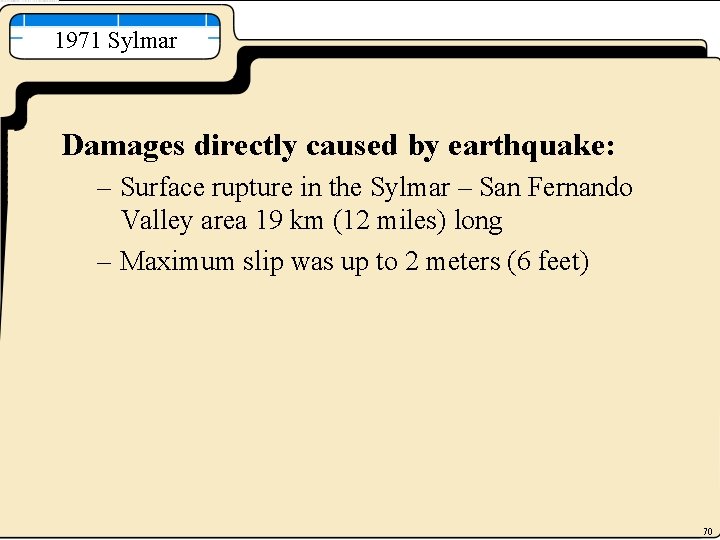
1971 Sylmar Damages directly caused by earthquake: – Surface rupture in the Sylmar – San Fernando Valley area 19 km (12 miles) long – Maximum slip was up to 2 meters (6 feet) 70
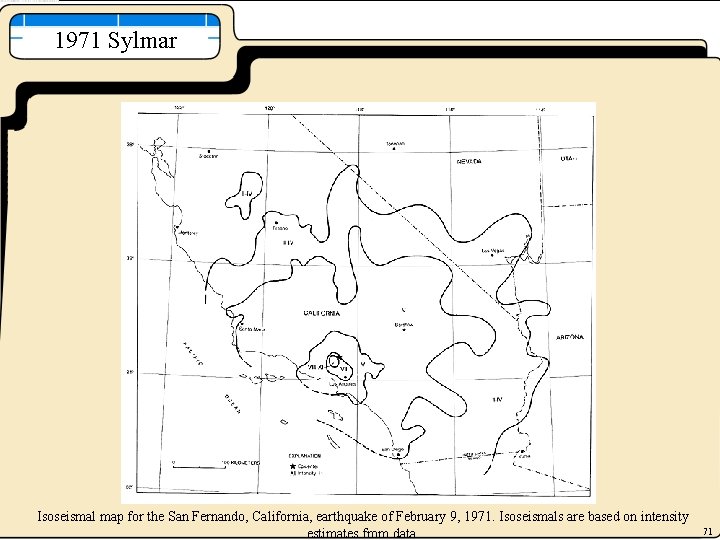
1971 Sylmar Isoseismal map for the San Fernando, California, earthquake of February 9, 1971. Isoseismals are based on intensity estimates from data. 71
1971 Sylmar Damages to structures & fatalities: • Over $500 million in property damage • Several hospitals suffered severe damage • Newly constructed freeway overpasses also collapsed • 65 deaths - Loss of life would have been greater had the EQ struck later in the day 72
1971 Sylmar Results: 1. Building codes were strengthened 2. Alquist Priolo Special Studies Zone Act was passed in 1972. The purpose of this act is to prohibit the location of most structures for human occupancy across the traces of active faults and to mitigate thereby the hazard of fault rupture. 73
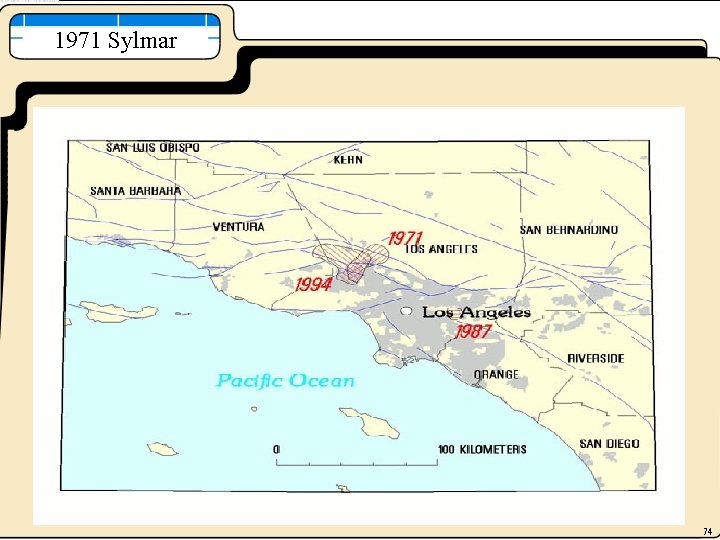
1971 Sylmar 74
1994 Northridge When: January 17, 1994, 4: 30: 55 Am PST Fault: Northridge Thrust Epicenter: 20 Miles WNW of Los Angeles, 1 Mile SSW of Northridge Depth: 18. 4 Km Magnitude: Mw 6. 7 Length of shaking: 10 - 20 seconds Type of faulting: blind thrust 75
1994 Northridge 76
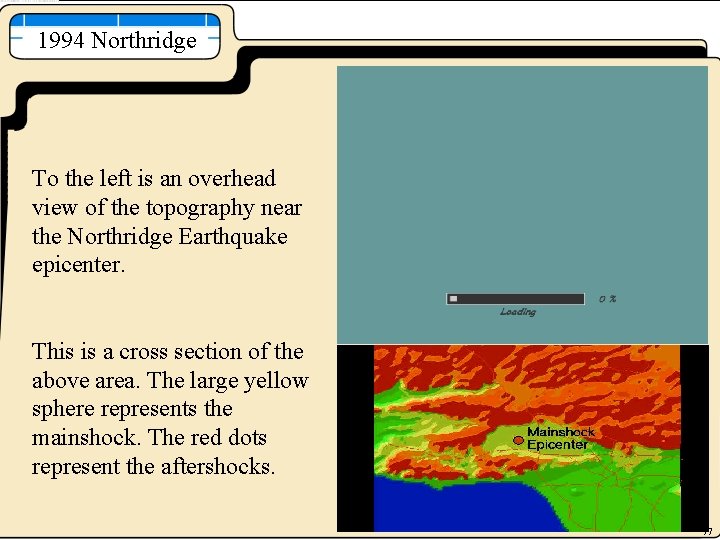
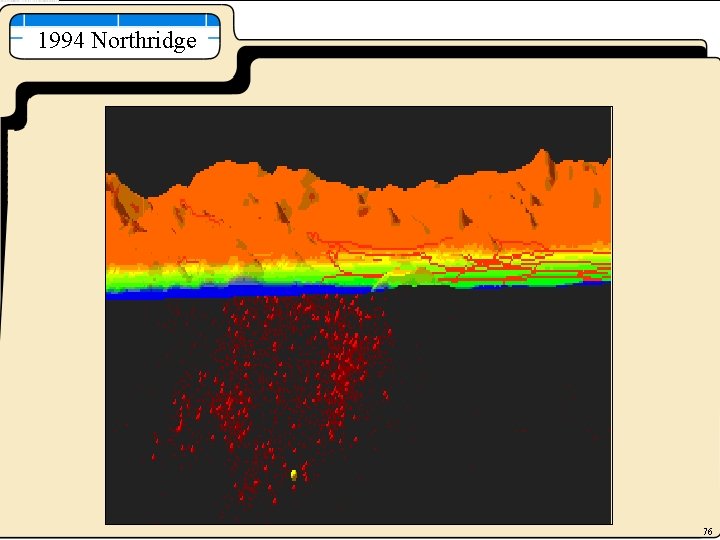
1994 Northridge To the left is an overhead view of the topography near the Northridge Earthquake epicenter. This is a cross section of the above area. The large yellow sphere represents the mainshock. The red dots represent the aftershocks. 77
1994 Northridge 78
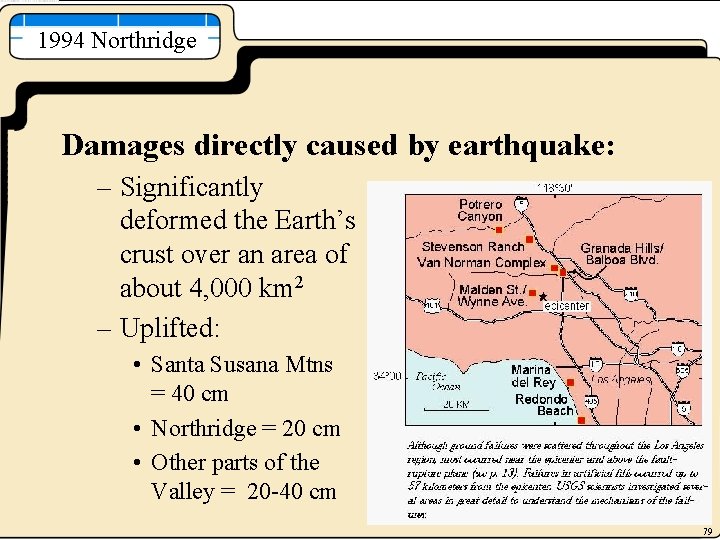
1994 Northridge Damages directly caused by earthquake: – Significantly deformed the Earth’s crust over an area of about 4, 000 km 2 – Uplifted: • Santa Susana Mtns = 40 cm • Northridge = 20 cm • Other parts of the Valley = 20 -40 cm 79
1994 Northridge Damages directly caused by earthquake: – Ground failures of many types at distances up to about 90 kilometers from the epicenter – Include: • Surface Ruptures • Landsliding • Soil Liquefaction 80
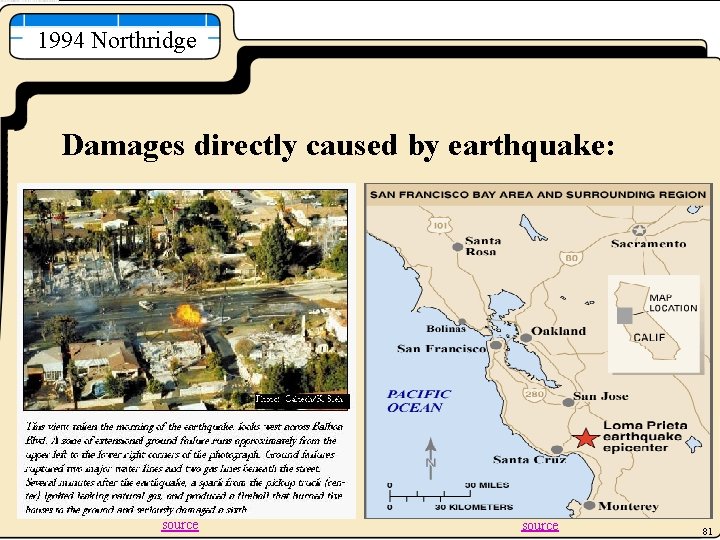
1994 Northridge Damages directly caused by earthquake: source 81
1994 Northridge Damages to structures: • Severe damage to buildings, freeways and gas lines due to location • Thousands of buildings were significantly damaged – +1, 600 were later “red-tagged” – 7, 300 buildings were “yellow-tagged” – Many thousands of other structures incurred at least minor damage. • Estimated losses of 15 - 20 billion dollars 82
1994 Northridge Human damage: – Fifty-seven people died – +9, 000 were injured – +20, 000 were displaced from their homes by the effects of the quake 83
1994 Northridge Results: – EQ had an immense impact because it was centered directly beneath a heavily populated and built-up urban region. – The early morning timing of the earthquake spared many lives that otherwise might have been lost in collapsed parking buildings and on failed freeway structures. 84
Buildings and Earthquakes 85

Types of home construction • Wood frame buildings – By far the most desirable small property investment • Light weight • Flexible Image: http: //www. woodengineering. com Image: http: //www. toolbase. org 86
Types of home construction • Wood frame buildings – Why wood frame houses are damaged in earthquakes • Soft, unstable ground • A weak or inadequately located foundation • Old, poorly maintained or a new poorly constructed building • Insufficient lateral bracing or inadequate number of bearing walls and columns • Inadequate stilts for hillside homes • Heavy roofing such as clay tiles 87
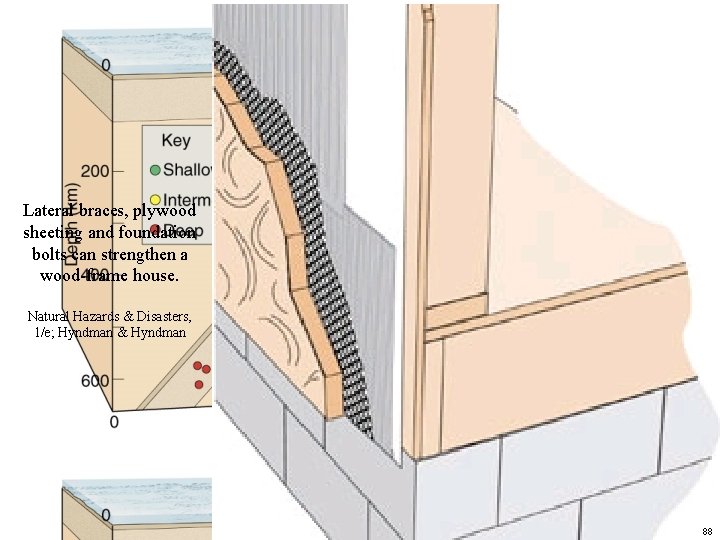
Lateral braces, plywood sheeting and foundation bolts can strengthen a wood-frame house. Natural Hazards & Disasters, 1/e; Hyndman & Hyndman 88
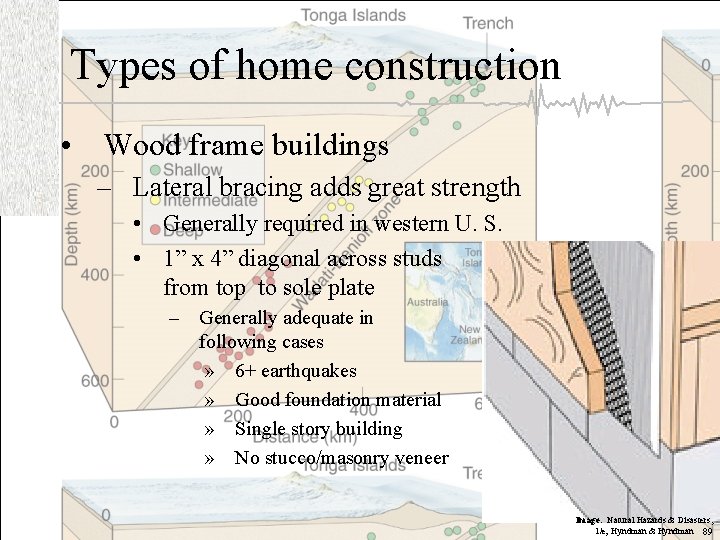
Types of home construction • Wood frame buildings – Lateral bracing adds great strength • Generally required in western U. S. • 1” x 4” diagonal across studs from top to sole plate – Generally adequate in following cases » 6+ earthquakes » Good foundation material » Single story building » No stucco/masonry veneer Image: Natural Hazards & Disasters, 1/e; Hyndman & Hyndman 89
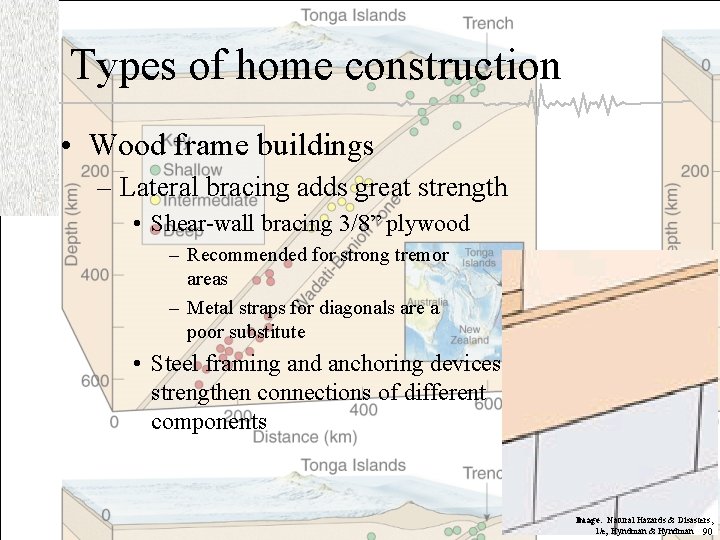
Types of home construction • Wood frame buildings – Lateral bracing adds great strength • Shear-wall bracing 3/8” plywood – Recommended for strong tremor areas – Metal straps for diagonals are a poor substitute • Steel framing and anchoring devices strengthen connections of different components Image: Natural Hazards & Disasters, 1/e; Hyndman & Hyndman 90
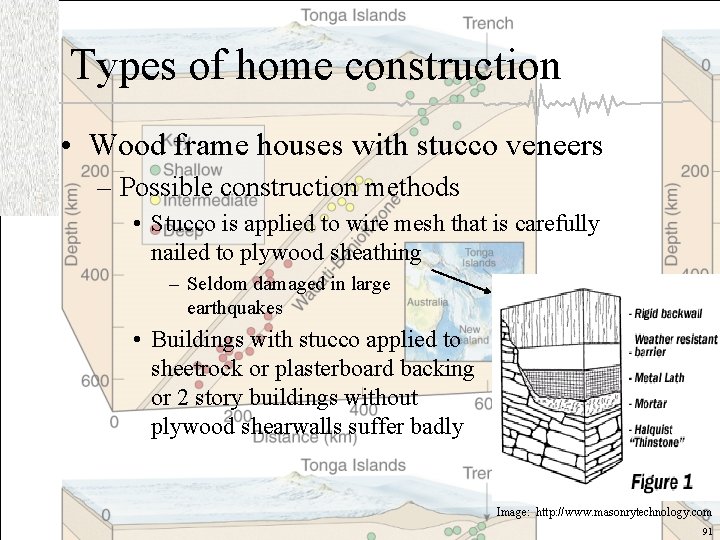
Types of home construction • Wood frame houses with stucco veneers – Possible construction methods • Stucco is applied to wire mesh that is carefully nailed to plywood sheathing – Seldom damaged in large earthquakes • Buildings with stucco applied to sheetrock or plasterboard backing or 2 story buildings without plywood shearwalls suffer badly Image: http: //www. masonrytechnology. com 91
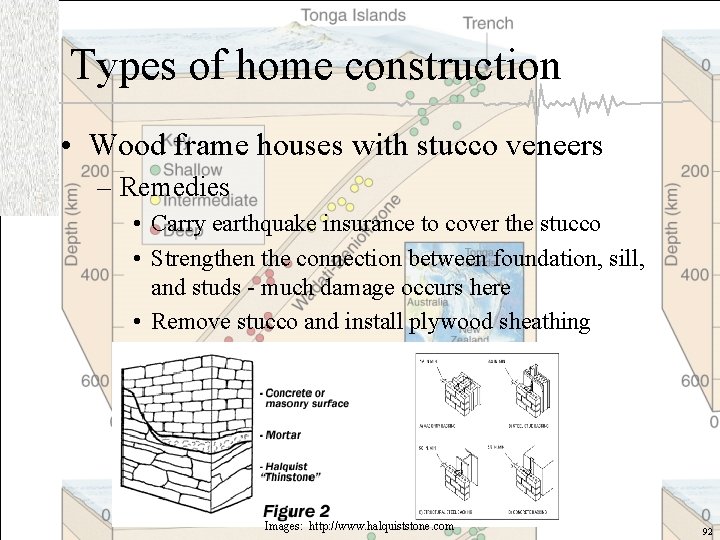
Types of home construction • Wood frame houses with stucco veneers – Remedies • Carry earthquake insurance to cover the stucco • Strengthen the connection between foundation, sill, and studs - much damage occurs here • Remove stucco and install plywood sheathing Images: http: //www. halquiststone. com 92
Types of home construction • Wood frame with masonry veneer – Considerably more dangerous – Extra weight means extra inertia – Poor connection between veneer and building – Poor quality mortar 93
Types of home construction • Unreinforced brick buildings – Consistently suffer severe damage – Brick is heavy and inflexible & can't withstand lateral force – Only a wood frame interior can prevent total collapse – Quality of the mortar is particularly important 94
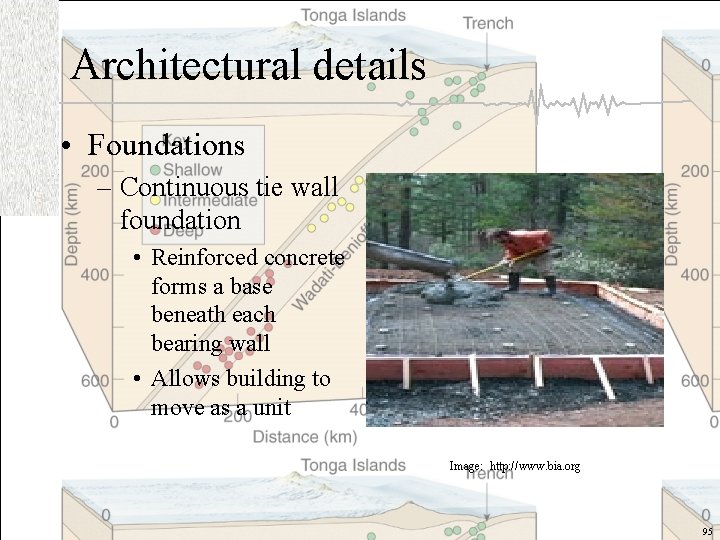
Architectural details • Foundations – Continuous tie wall foundation • Reinforced concrete forms a base beneath each bearing wall • Allows building to move as a unit Image: http: //www. bia. org 95
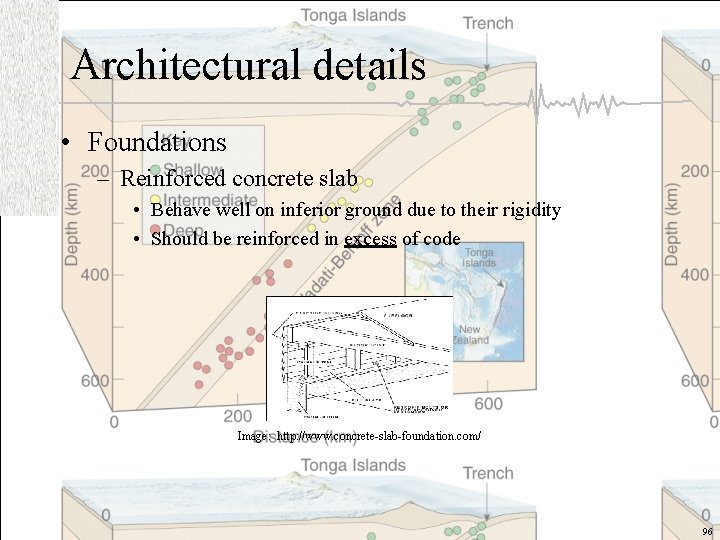
Architectural details • Foundations – Reinforced concrete slab • Behave well on inferior ground due to their rigidity • Should be reinforced in excess of code Image: http: //www. concrete-slab-foundation. com/ 96
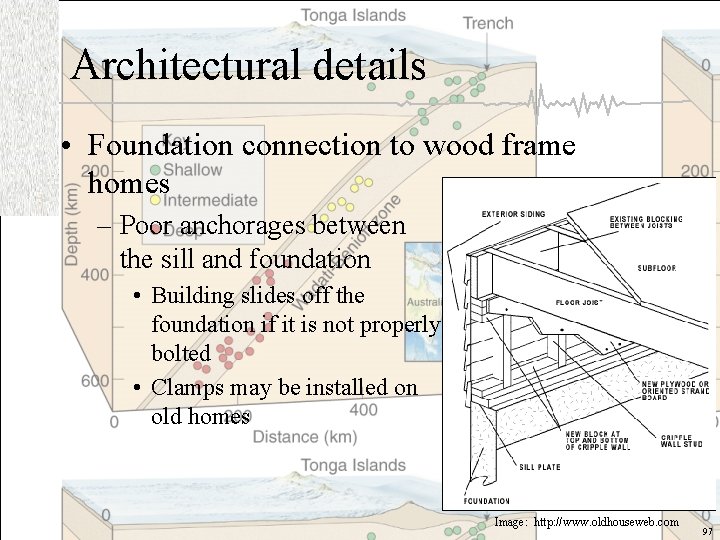
Architectural details • Foundation connection to wood frame homes – Poor anchorages between the sill and foundation • Building slides off the foundation if it is not properly bolted • Clamps may be installed on old homes Image: http: //www. oldhouseweb. com 97
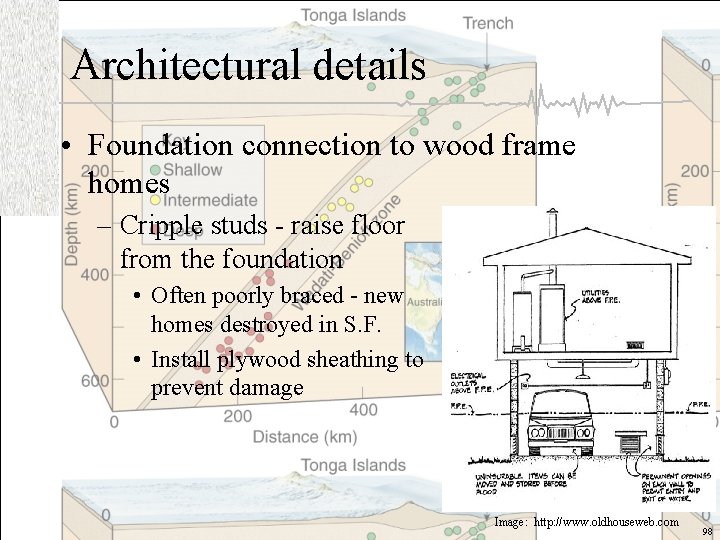
Architectural details • Foundation connection to wood frame homes – Cripple studs - raise floor from the foundation • Often poorly braced - new homes destroyed in S. F. • Install plywood sheathing to prevent damage Image: http: //www. oldhouseweb. com 98
Architectural details • Foundation connection to wood frame homes – Foundation damage existing • Rotten wood or termites are common • Wide cracks in foundation concrete 99
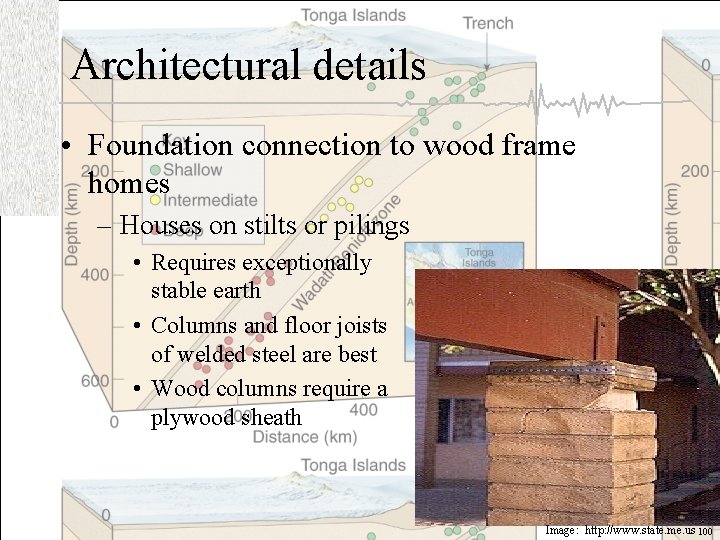
Architectural details • Foundation connection to wood frame homes – Houses on stilts or pilings • Requires exceptionally stable earth • Columns and floor joists of welded steel are best • Wood columns require a plywood sheath Image: http: //www. state. me. us 100
Architectural details • Columns and walls – Wood columns may fail because: • • Rotting due to poor drainage along the top of the sill Termite damage Column not continuous from sill to roof Horizontal members improperly connected to columns – Extremely common yet easily corrected 101
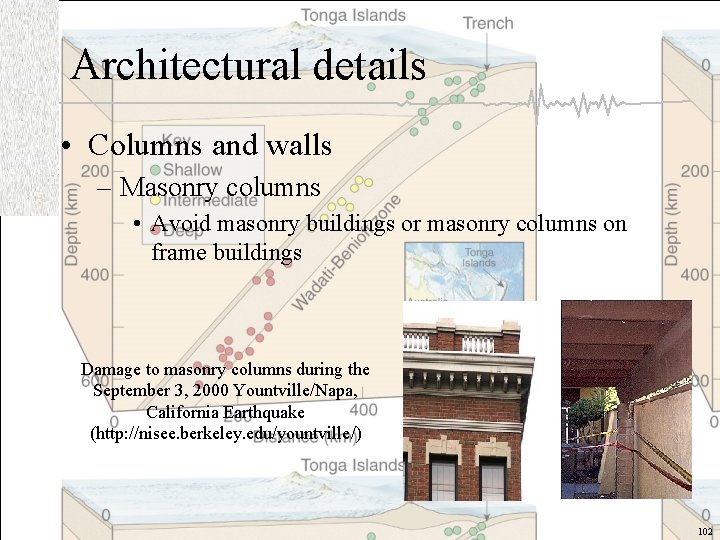
Architectural details • Columns and walls – Masonry columns • Avoid masonry buildings or masonry columns on frame buildings Damage to masonry columns during the September 3, 2000 Yountville/Napa, California Earthquake (http: //nisee. berkeley. edu/yountville/) 102
Architectural details • Roofs – Generally hold up well except: • Poor connections with vertical members • Too heavy a roof – Traditional clay tile is 1200 lbs/100 sq ft or 9 tons for 1500 sq ft 103
Architectural details • Large windows and doors – Damage is often concentrated in these areas – Plywood sheathing and interior paneling will help 104
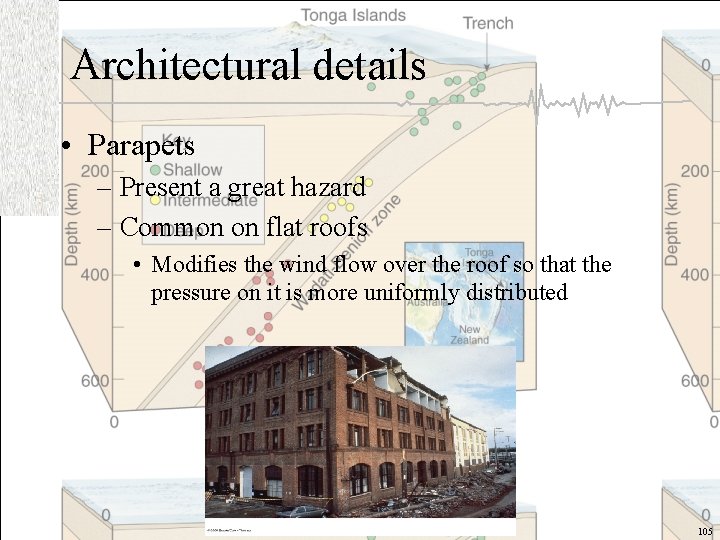
Architectural details • Parapets – Present a great hazard – Common on flat roofs • Modifies the wind flow over the roof so that the pressure on it is more uniformly distributed 105
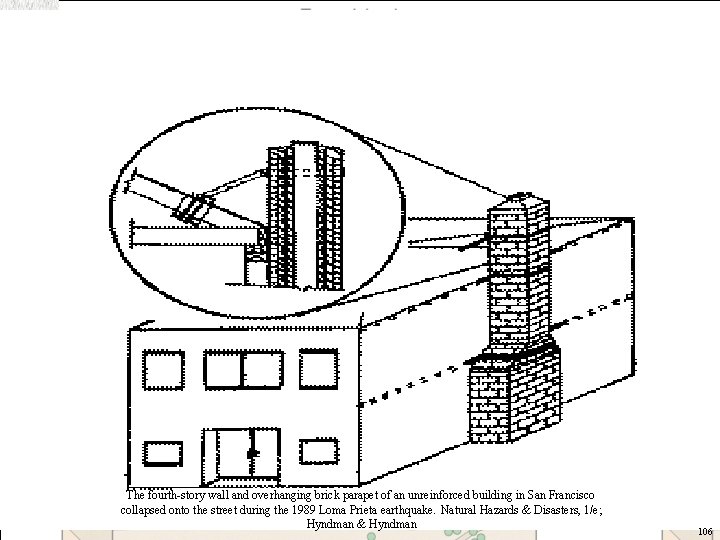
The fourth-story wall and overhanging brick parapet of an unreinforced building in San Francisco collapsed onto the street during the 1989 Loma Prieta earthquake. Natural Hazards & Disasters, 1/e; Hyndman & Hyndman 106
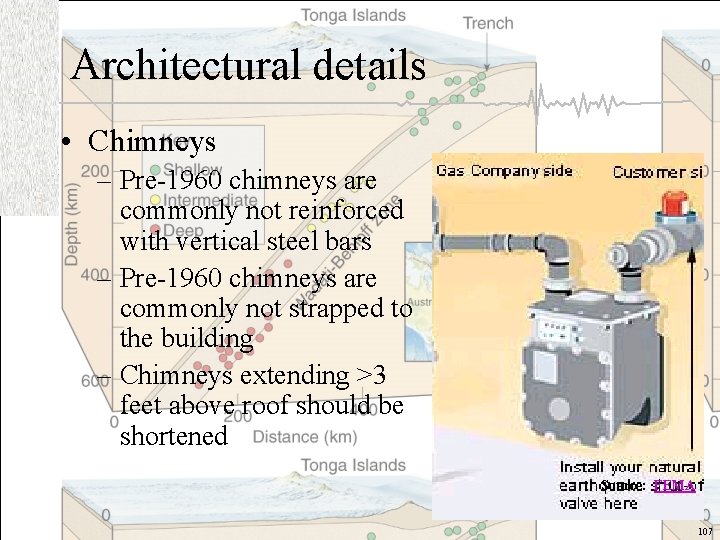
Architectural details • Chimneys – Pre-1960 chimneys are commonly not reinforced with vertical steel bars – Pre-1960 chimneys are commonly not strapped to the building – Chimneys extending >3 feet above roof should be shortened Source: FEMA 107

Architectural details • Utilities – Gas • Know where the main feeder valve is • Install a gas shut off valve Image: http: //www. townparkconstruction. com Image: http: //www. socalgas. com 108
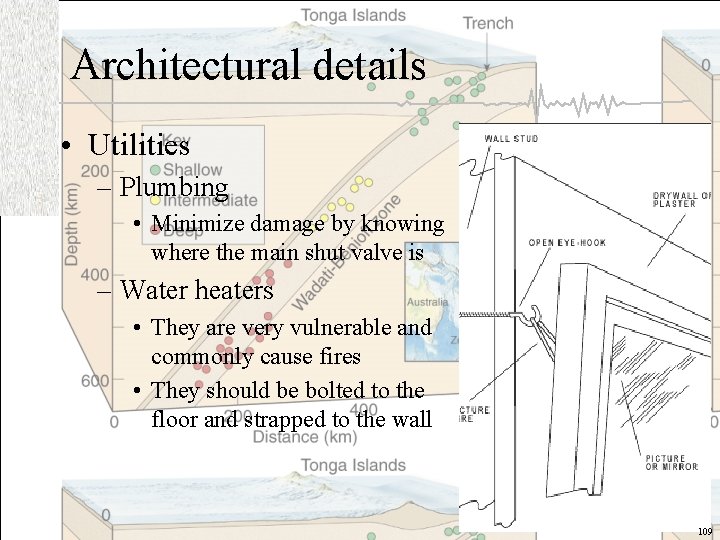
Architectural details • Utilities – Plumbing • Minimize damage by knowing where the main shut valve is – Water heaters • They are very vulnerable and commonly cause fires • They should be bolted to the floor and strapped to the wall 109

Architectural details • Furnishings – Hanging lamps and pictures – Free standing bookcases – Cabinets for food, drink, and glassware – Beds Image: http: //www. oldhouseweb. com 110
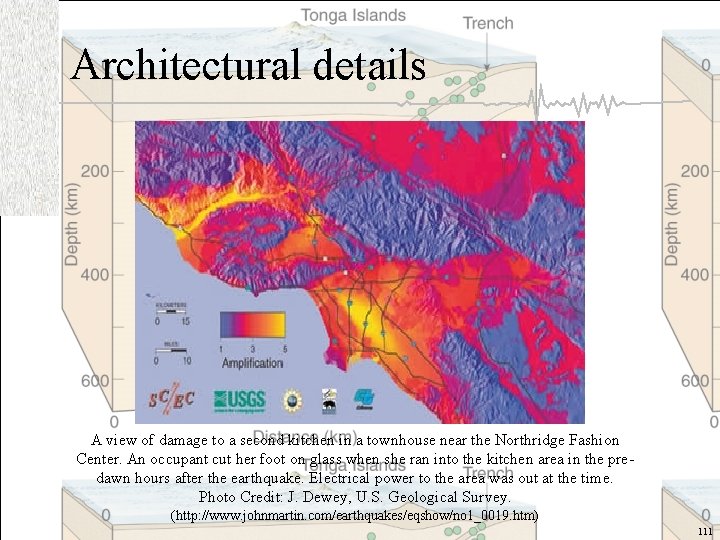
Architectural details A view of damage to a second kitchen in a townhouse near the Northridge Fashion Center. An occupant cut her foot on glass when she ran into the kitchen area in the predawn hours after the earthquake. Electrical power to the area was out at the time. Photo Credit: J. Dewey, U. S. Geological Survey. (http: //www. johnmartin. com/earthquakes/eqshow/no 1_0019. htm) 111
Conclusions • Similar events will occur repeatedly in southern California – The 1994 Northridge earthquake is an example • Richter magnitude 6. 7; approximately 60 killed • Severe lurching and cracking occurred • CSUN $300 million damage – Apartment buildings collapsed – Unreinforced buildings collapsed or heavily damaged 112
Conclusions • Similar events will occur repeatedly in southern California – A future San Andreas or Newport Inglewood fault earthquake may produce widespread soil liquefaction • The Newport Inglewood could produce a 7. 2 M earthquake nearly centered on LA • Liquefaction along river channels and much of Orange County is expected 113
Conclusions • Geological conditions strongly influence damage – Geology determines: • • Where fault rupture will occur How hard the ground will shake Where soil liquefaction will occur Where landslides occur 114
Conclusions • Geological conditions strongly influence damage – We know: • A large earthquake is expected in S. California within our lifetime • Shaking levels and geologic response can be predicted • Preparation will greatly reduce the impact – “Those who cannot remember the past are condemned to repeat it” - George Santayana - philosopher & poet – Make an earthquake kit for your home, your car and your office! 115
~ End ~ 116
- Slides: 116