
Upstream Natural Gas Some Considerations in Accelerating Exploration

- Slides: 35
Upstream Natural Gas Some Considerations in Accelerating Exploration
Objectives 1. Strategies for Increasing Natural Gas Reserves 2. Balancing Country Perspective with the Need to Attract Investors 3. Role of Natural Gas in National Development 4. Approaches used (Examples from Other Countries) 1. Petroleum Agreements 2. Fiscal Regimes
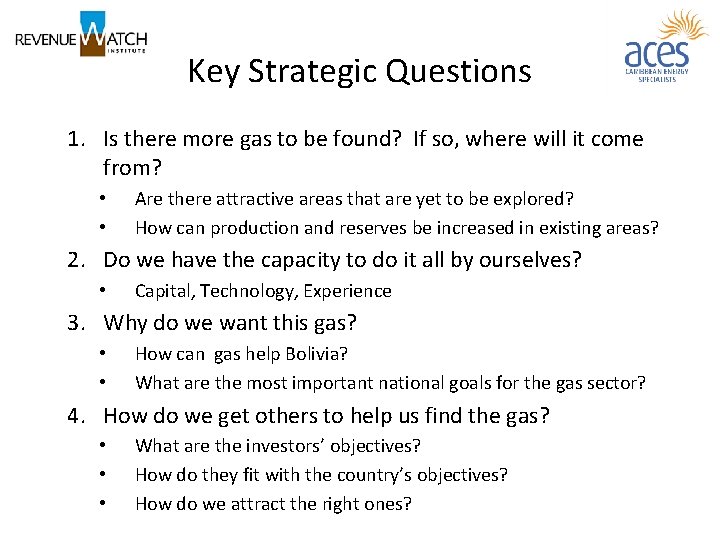
Key Strategic Questions 1. Is there more gas to be found? If so, where will it come from? • • Are there attractive areas that are yet to be explored? How can production and reserves be increased in existing areas? 2. Do we have the capacity to do it all by ourselves? • Capital, Technology, Experience 3. Why do we want this gas? • • How can gas help Bolivia? What are the most important national goals for the gas sector? 4. How do we get others to help us find the gas? • • • What are the investors’ objectives? How do they fit with the country’s objectives? How do we attract the right ones?
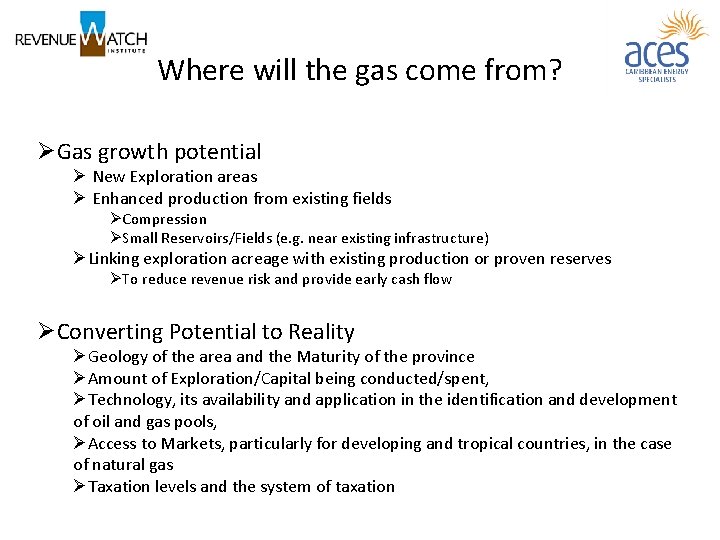
Where will the gas come from? ØGas growth potential Ø New Exploration areas Ø Enhanced production from existing fields ØCompression ØSmall Reservoirs/Fields (e. g. near existing infrastructure) ØLinking exploration acreage with existing production or proven reserves ØTo reduce revenue risk and provide early cash flow ØConverting Potential to Reality ØGeology of the area and the Maturity of the province ØAmount of Exploration/Capital being conducted/spent, ØTechnology, its availability and application in the identification and development of oil and gas pools, ØAccess to Markets, particularly for developing and tropical countries, in the case of natural gas ØTaxation levels and the system of taxation
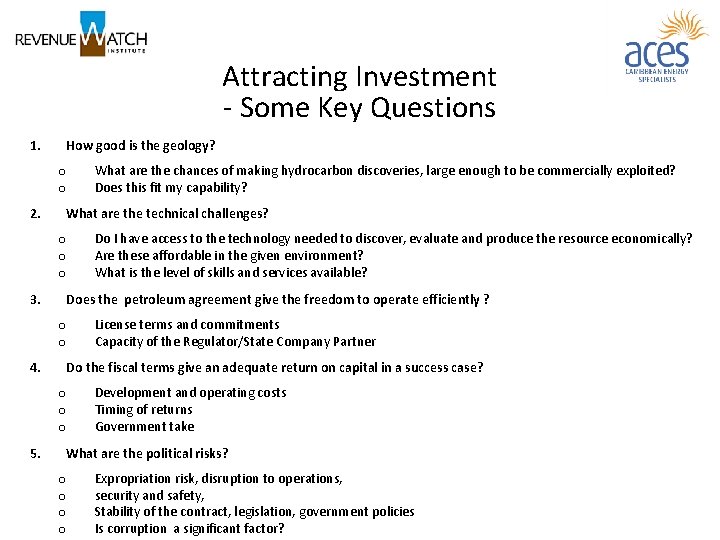
Attracting Investment - Some Key Questions 1. How good is the geology? o o 2. What are the technical challenges? o o o 3. License terms and commitments Capacity of the Regulator/State Company Partner Do the fiscal terms give an adequate return on capital in a success case? o o o 5. Do I have access to the technology needed to discover, evaluate and produce the resource economically? Are these affordable in the given environment? What is the level of skills and services available? Does the petroleum agreement give the freedom to operate efficiently ? o o 4. What are the chances of making hydrocarbon discoveries, large enough to be commercially exploited? Does this fit my capability? Development and operating costs Timing of returns Government take What are the political risks? o o Expropriation risk, disruption to operations, security and safety, Stability of the contract, legislation, government policies Is corruption a significant factor?
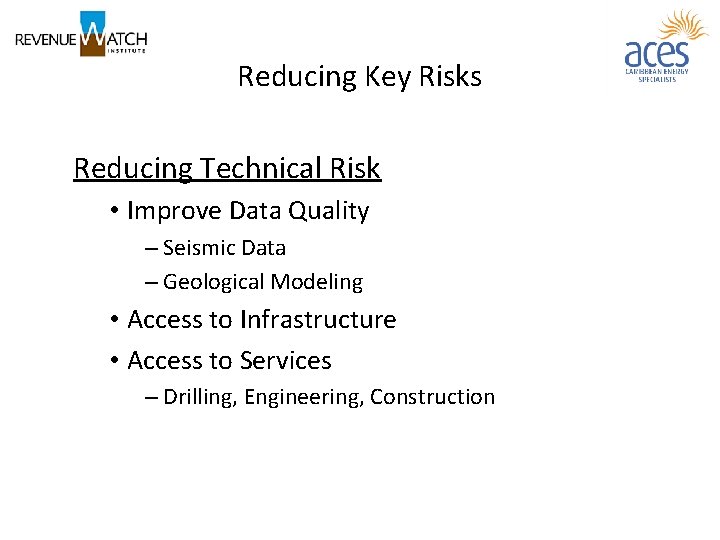
Reducing Key Risks Reducing Technical Risk • Improve Data Quality – Seismic Data – Geological Modeling • Access to Infrastructure • Access to Services – Drilling, Engineering, Construction
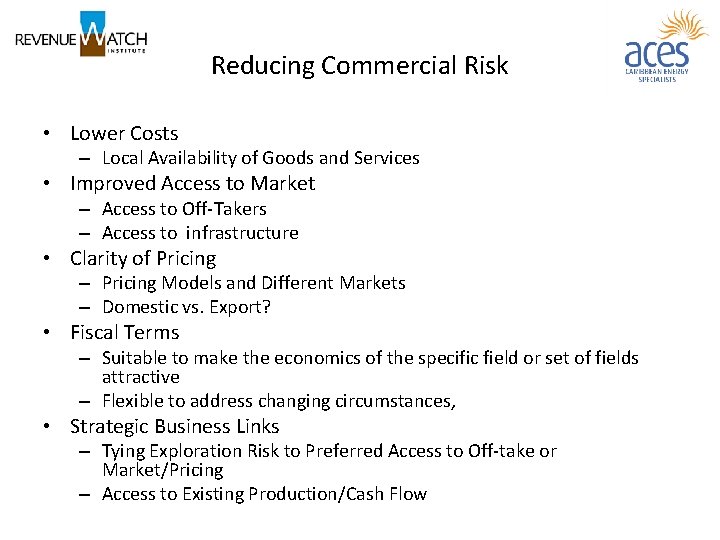
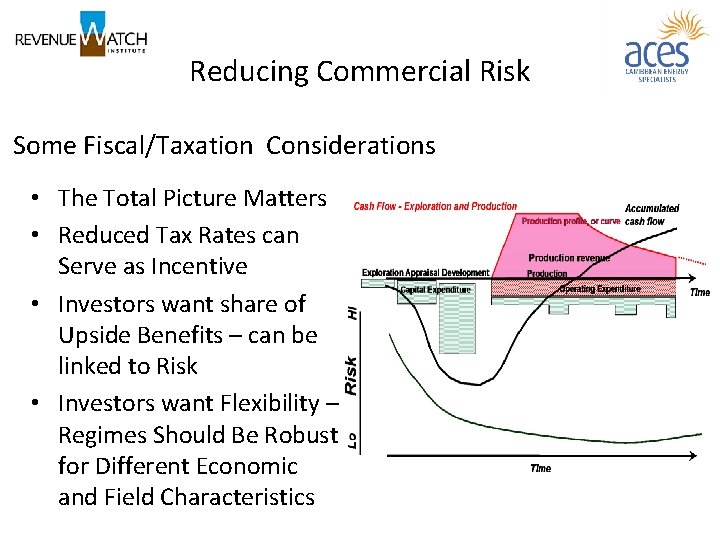
Reducing Commercial Risk • Lower Costs – Local Availability of Goods and Services • Improved Access to Market – Access to Off-Takers – Access to infrastructure • Clarity of Pricing – Pricing Models and Different Markets – Domestic vs. Export? • Fiscal Terms – Suitable to make the economics of the specific field or set of fields attractive – Flexible to address changing circumstances, • Strategic Business Links – Tying Exploration Risk to Preferred Access to Off-take or Market/Pricing – Access to Existing Production/Cash Flow
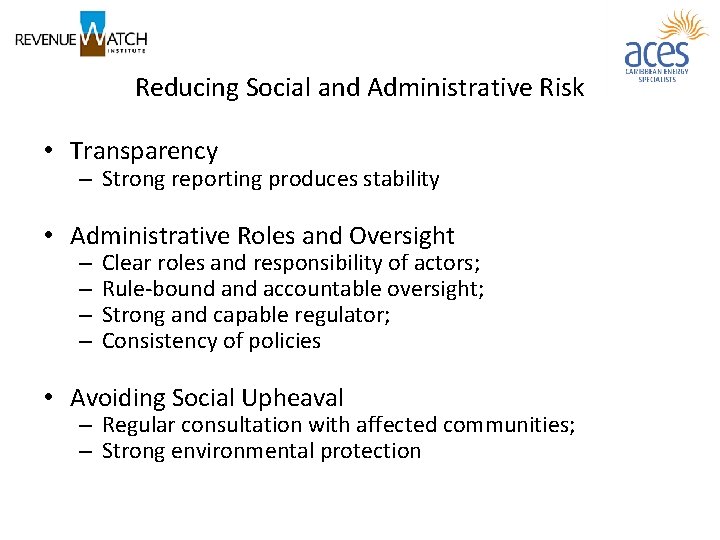
Reducing Social and Administrative Risk • Transparency – Strong reporting produces stability • Administrative Roles and Oversight – – Clear roles and responsibility of actors; Rule-bound accountable oversight; Strong and capable regulator; Consistency of policies • Avoiding Social Upheaval – Regular consultation with affected communities; – Strong environmental protection
Why does Bolivia want this gas? • Meeting Current Needs – Satisfying Contractual Agreements – Budgetary Needs • Growth – Increasing reserves and production – Maximizing Value from Existing Infrastructure and Assets • National Development – Revenue for Development and Poverty Reduction – Technology and Capacity Development – Industrialization • Get more value out of the resource
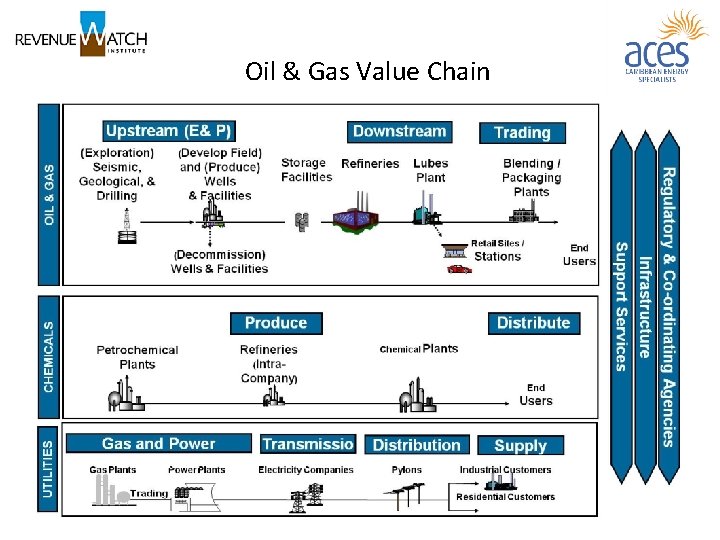
Oil & Gas Value Chain 10
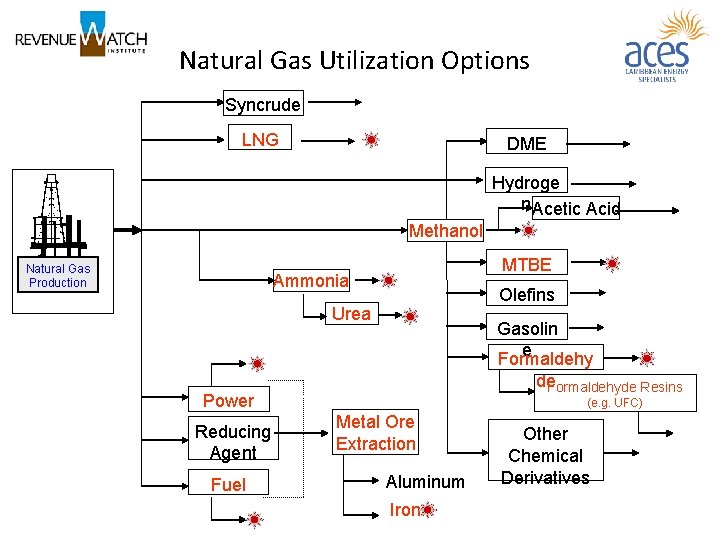
Natural Gas Utilization Options Syncrude LNG DME Hydroge n. Acetic Acid Methanol Natural Gas Production MTBE Ammonia Olefins Urea Gasolin e Formaldehy de. Formaldehyde Resins Power Reducing Agent Fuel (e. g. UFC) Metal Ore Extraction Aluminum Iron Other Chemical Derivatives
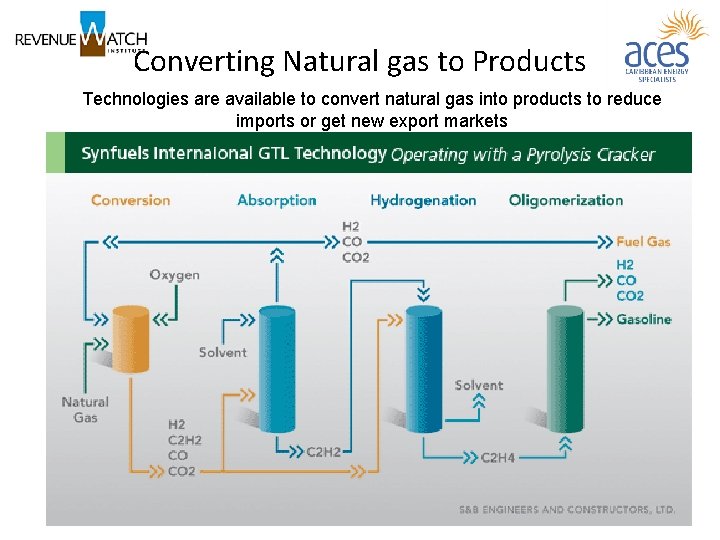
Converting Natural gas to Products Technologies are available to convert natural gas into products to reduce imports or get new export markets
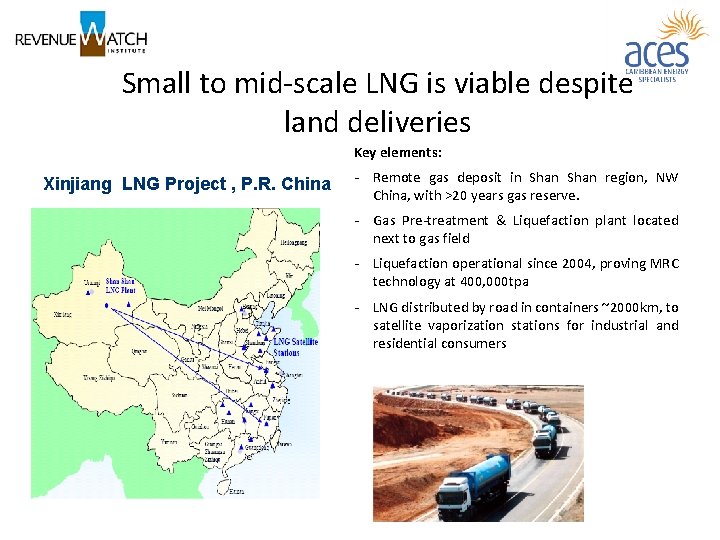
Small to mid-scale LNG is viable despite land deliveries Key elements: Xinjiang LNG Project , P. R. China - Remote gas deposit in Shan region, NW China, with >20 years gas reserve. - Gas Pre-treatment & Liquefaction plant located next to gas field - Liquefaction operational since 2004, proving MRC technology at 400, 000 tpa - LNG distributed by road in containers ~2000 km, to satellite vaporization stations for industrial and residential consumers
Selecting the Right Partner - Some considerations 1. 2. Companies who operate in: – Similar geological basins – In country or region Companies who want access to product • For mid- or downstream use, including power • To service existing markets • To grow existing or new markets, including locally 3. Companies who want to deploy new technologies or approaches: • Exploration or production (upstream) • Downstream 4. Companies for one of many strategic reasons, such as: • they have lots of cash • They want to diversify into a new country/region • They have a strategy to add natural gas to their portfolio
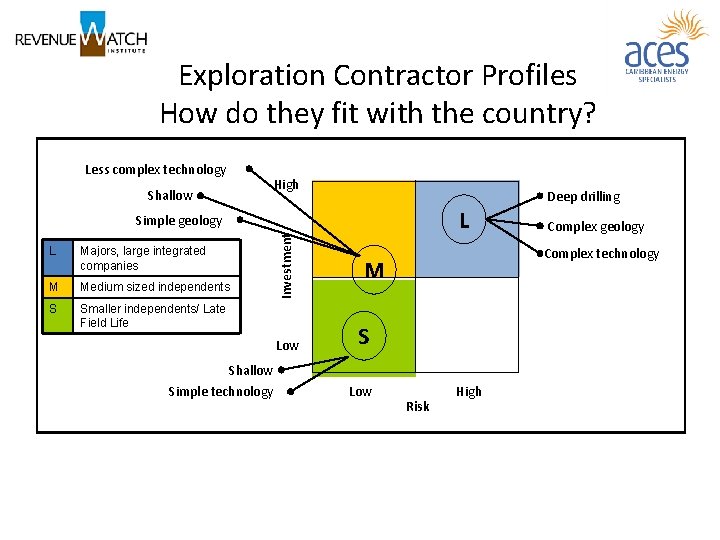
Exploration Contractor Profiles How do they fit with the country? Less complex technology High Shallow Deep drilling L L Majors, large integrated companies M Medium sized independents S Smaller independents/ Late Field Life Investment Simple geology Low Complex technology M S Shallow Simple technology Low Complex geology Risk High
Attracting Investors - Critical Consideration In attracting investors, there always trade-offs, and the choice of incentives offered should be linked to the primary national goals for the sector. This requires a strategic look at the entire industry value chain.
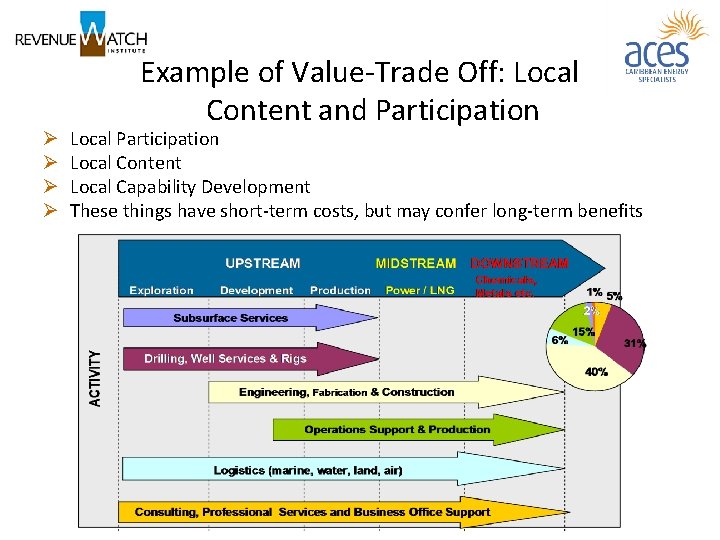
Ø Ø Example of Value-Trade Off: Local Content and Participation Local Content Local Capability Development These things have short-term costs, but may confer long-term benefits
Petroleum Agreements & Fiscal Regimes
The Purpose of a Petroleum Agreement • A petroleum agreement is the instrument by which the State grants the right to exploit oil and gas and codifies the rights and responsibilities of the parties to the agreement. • Forms part of the legal framework including laws, regulations and sometimes court decisions. • In countries with parliamentary approval and oversight of petroleum agreements, they form part of the legislative framework • In countries with a strong executive, i. e. Peru, much of the legal framework comes from executive orders.
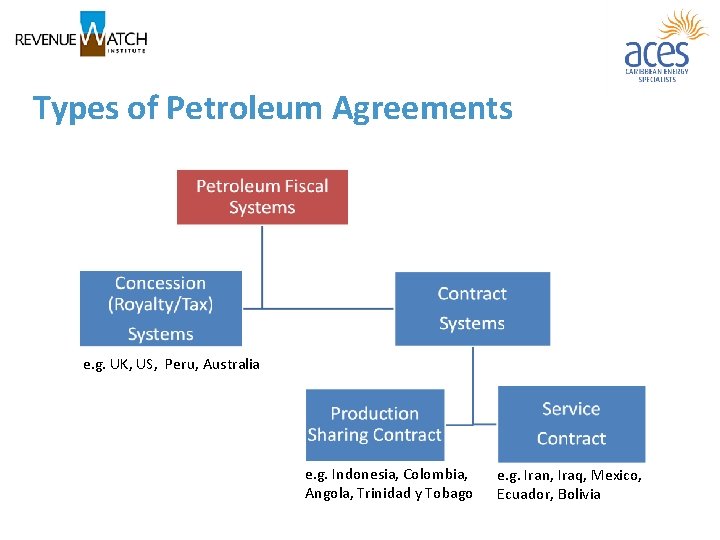
Types of Petroleum Agreements e. g. UK, US, Peru, Australia e. g. Indonesia, Colombia, Angola, Trinidad y Tobago e. g. Iran, Iraq, Mexico, Ecuador, Bolivia
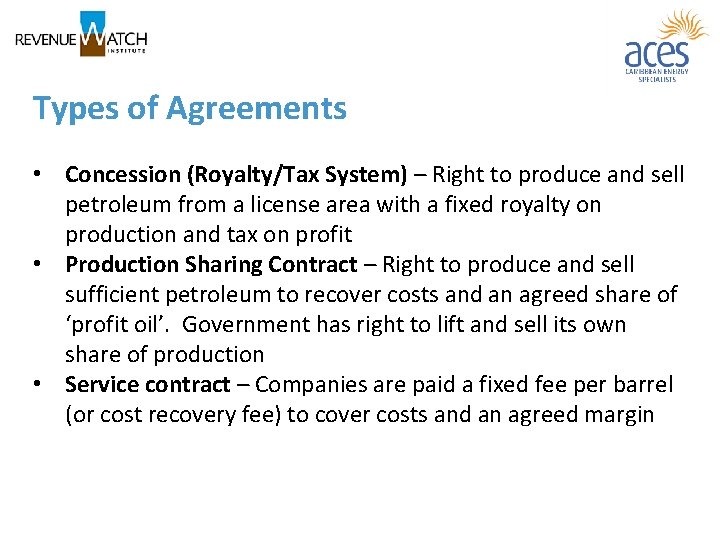
Types of Agreements • Concession (Royalty/Tax System) – Right to produce and sell petroleum from a license area with a fixed royalty on production and tax on profit • Production Sharing Contract – Right to produce and sell sufficient petroleum to recover costs and an agreed share of ‘profit oil’. Government has right to lift and sell its own share of production • Service contract – Companies are paid a fixed fee per barrel (or cost recovery fee) to cover costs and an agreed margin
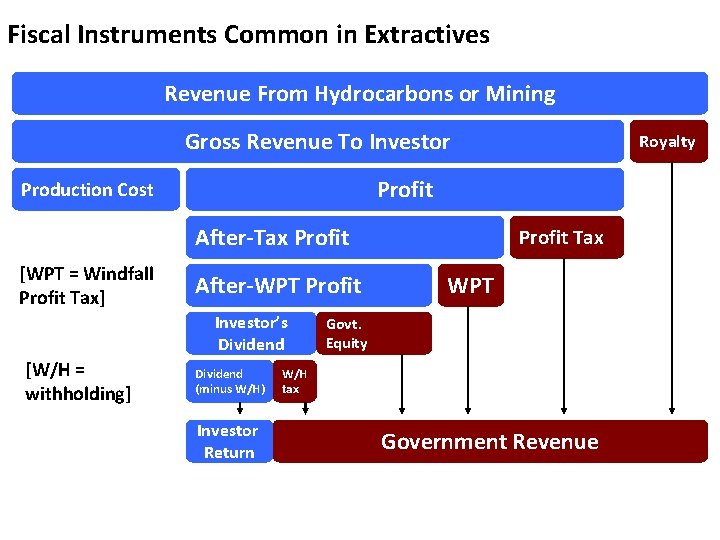
Fiscal Instruments Common in Extractives Revenue From Hydrocarbons or Mining Gross Revenue To Investor Profit Production Cost After-Tax Profit [WPT = Windfall Profit Tax] After-WPT Profit Investor’s Dividend [W/H = withholding] Royalty Dividend (minus W/H) Investor Return Profit Tax WPT Govt. Equity W/H tax Government Revenue
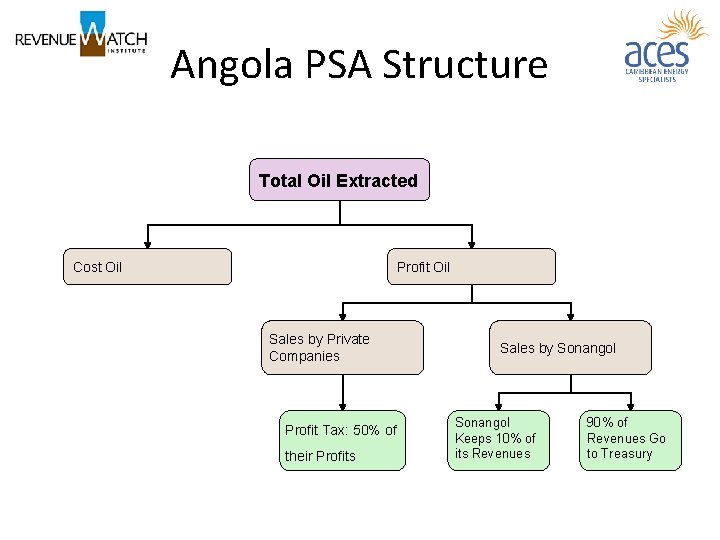
Angola PSA Structure Total Oil Extracted Cost Oil Profit Oil Sales by Private Companies Profit Tax: 50% of their Profits Sales by Sonangol Keeps 10% of its Revenues 90% of Revenues Go to Treasury
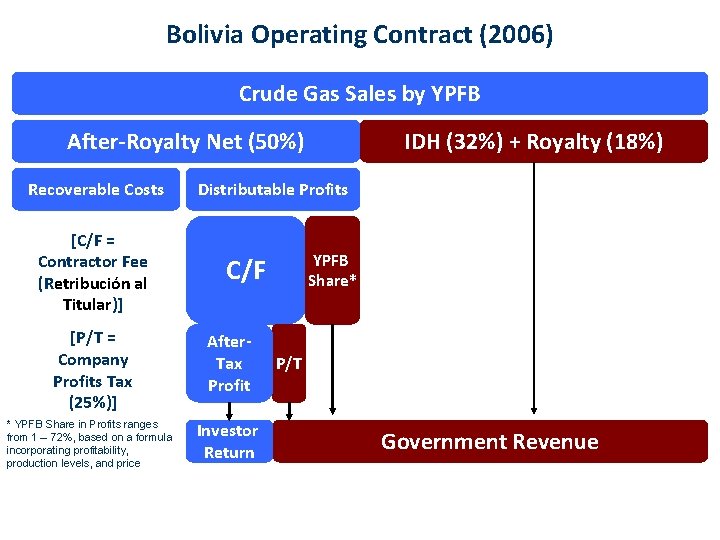
Bolivia Operating Contract (2006) Crude Gas Sales by YPFB After-Royalty Net (50%) Recoverable Costs [C/F = Contractor Fee (Retribución al Titular)] IDH (32%) + Royalty (18%) Distributable Profits YPFB Share* C/F [P/T = Company Profits Tax (25%)] After. Tax Profit * YPFB Share in Profits ranges from 1 – 72%, based on a formula incorporating profitability, production levels, and price Investor Return P/T Government Revenue
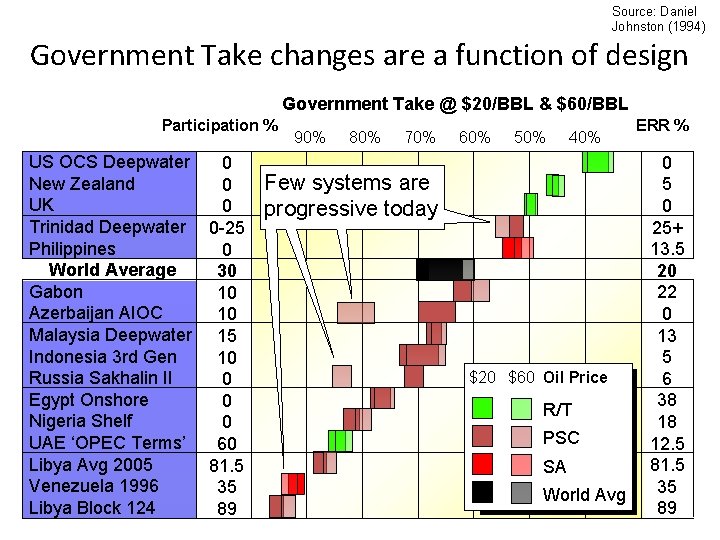
Source: Daniel Johnston (1994) Government Take changes are a function of design Government Take @ $20/BBL & $60/BBL Participation % US OCS Deepwater 0 New Zealand 0 UK 0 Trinidad Deepwater 0 -25 Philippines 0 World Average 30 Gabon 10 Azerbaijan AIOC 10 Malaysia Deepwater 15 Indonesia 3 rd Gen 10 Russia Sakhalin II 0 Egypt Onshore 0 Nigeria Shelf 0 UAE ‘OPEC Terms’ 60 Libya Avg 2005 81. 5 Venezuela 1996 35 Libya Block 124 89 90% 80% 70% 60% 50% 40% Few systems are progressive today $20 $60 Oil Price R/T PSC SA World Avg ERR % 0 5 0 25+ 13. 5 20 22 0 13 5 6 38 18 12. 5 81. 5 35 89
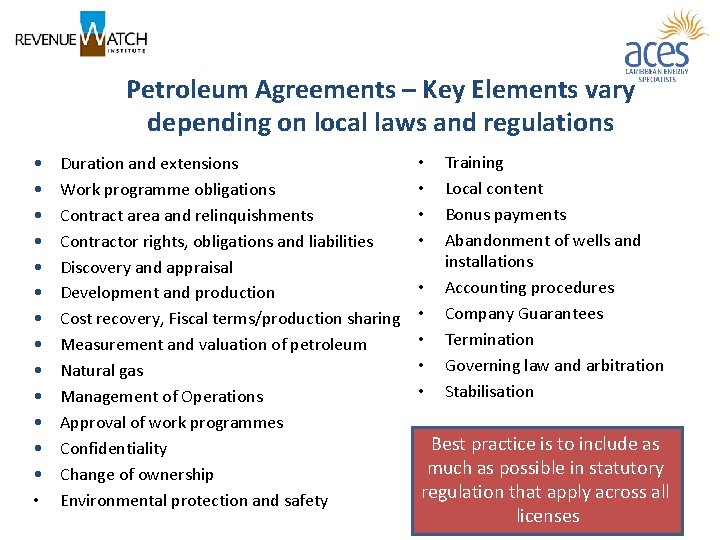
Petroleum Agreements – Key Elements vary depending on local laws and regulations • • • • Duration and extensions Work programme obligations Contract area and relinquishments Contractor rights, obligations and liabilities Discovery and appraisal Development and production Cost recovery, Fiscal terms/production sharing Measurement and valuation of petroleum Natural gas Management of Operations Approval of work programmes Confidentiality Change of ownership Environmental protection and safety • • • Training Local content Bonus payments Abandonment of wells and installations Accounting procedures Company Guarantees Termination Governing law and arbitration Stabilisation Best practice is to include as much as possible in statutory regulation that apply across all licenses
Incentives & Disincentives
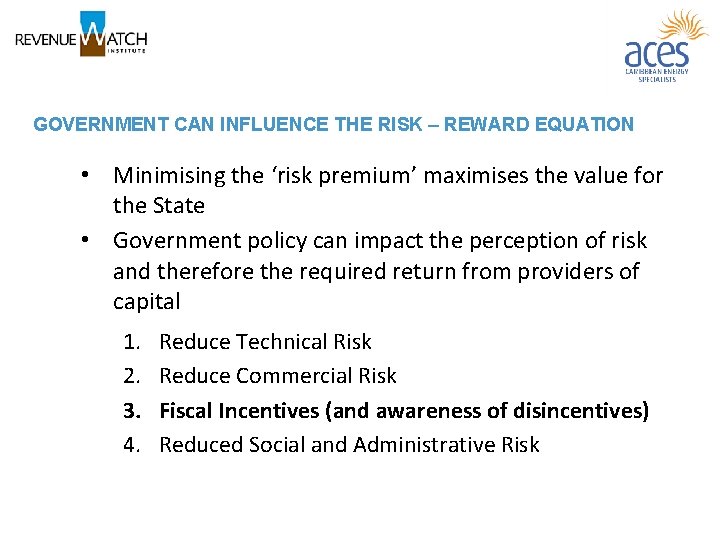
GOVERNMENT CAN INFLUENCE THE RISK – REWARD EQUATION • Minimising the ‘risk premium’ maximises the value for the State • Government policy can impact the perception of risk and therefore the required return from providers of capital 1. 2. 3. 4. Reduce Technical Risk Reduce Commercial Risk Fiscal Incentives (and awareness of disincentives) Reduced Social and Administrative Risk
Reducing Commercial Risk Some Fiscal/Taxation Considerations • The Total Picture Matters • Reduced Tax Rates can Serve as Incentive • Investors want share of Upside Benefits – can be linked to Risk • Investors want Flexibility – Regimes Should Be Robust for Different Economic and Field Characteristics
Service Contract Incentives in International Comparison–
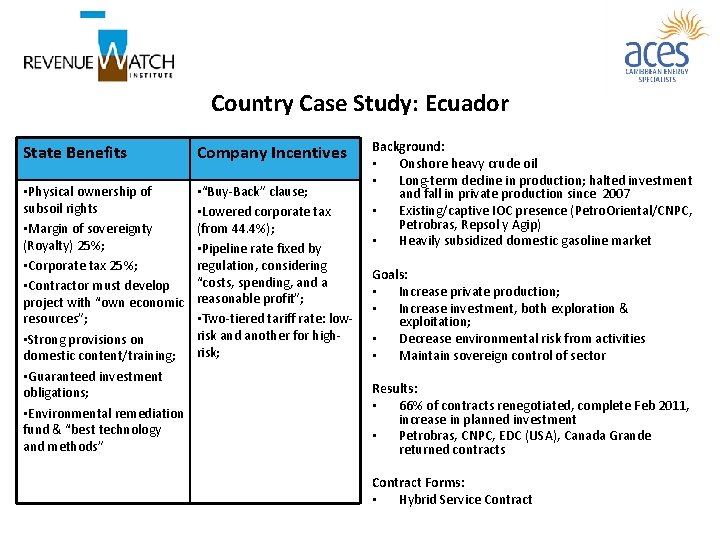
Country Case Study: Ecuador State Benefits Company Incentives • Physical ownership of subsoil rights • Margin of sovereignty (Royalty) 25%; • Corporate tax 25%; • Contractor must develop project with “own economic resources”; • Strong provisions on domestic content/training; • Guaranteed investment obligations; • Environmental remediation fund & “best technology and methods” • “Buy-Back” clause; • Lowered corporate tax (from 44. 4%); • Pipeline rate fixed by regulation, considering “costs, spending, and a reasonable profit”; • Two-tiered tariff rate: lowrisk and another for highrisk; Background: • Onshore heavy crude oil • Long-term decline in production; halted investment and fall in private production since 2007 • Existing/captive IOC presence (Petro. Oriental/CNPC, Petrobras, Repsol y Agip) • Heavily subsidized domestic gasoline market Goals: • Increase private production; • Increase investment, both exploration & exploitation; • Decrease environmental risk from activities • Maintain sovereign control of sector Results: • 66% of contracts renegotiated, complete Feb 2011, increase in planned investment • Petrobras, CNPC, EDC (USA), Canada Grande returned contracts Contract Forms: • Hybrid Service Contract
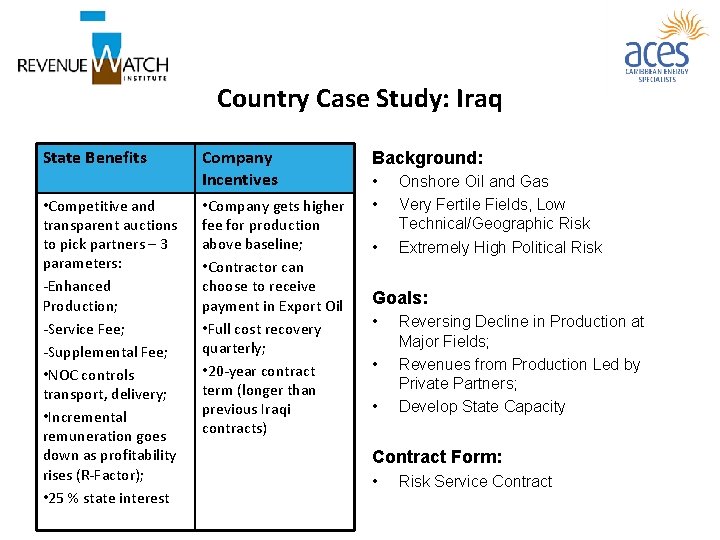
Country Case Study: Iraq State Benefits • Competitive and transparent auctions to pick partners – 3 parameters: -Enhanced Production; -Service Fee; -Supplemental Fee; • NOC controls transport, delivery; • Incremental remuneration goes down as profitability rises (R-Factor); • 25 % state interest Company Incentives • Company gets higher fee for production above baseline; • Contractor can choose to receive payment in Export Oil • Full cost recovery quarterly; • 20 -year contract term (longer than previous Iraqi contracts) Background: • • • Onshore Oil and Gas Very Fertile Fields, Low Technical/Geographic Risk Extremely High Political Risk Goals: • • • Reversing Decline in Production at Major Fields; Revenues from Production Led by Private Partners; Develop State Capacity Contract Form: • Risk Service Contract
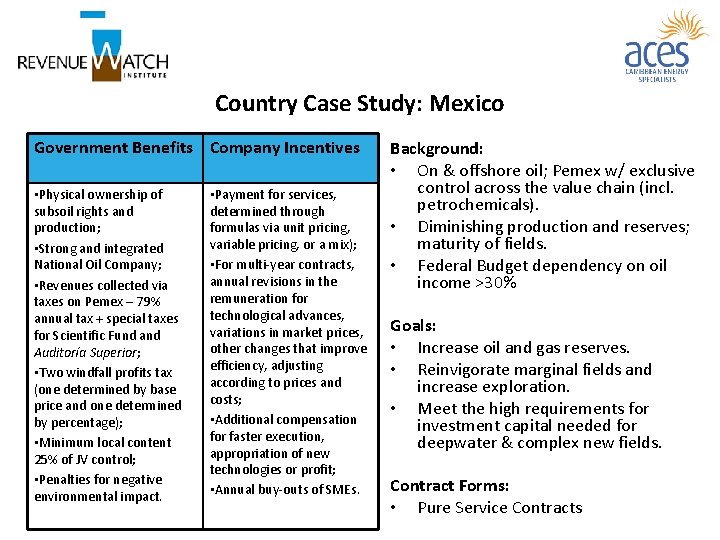
Country Case Study: Mexico Government Benefits Company Incentives • Physical ownership of subsoil rights and production; • Strong and integrated National Oil Company; • Revenues collected via taxes on Pemex – 79% annual tax + special taxes for Scientific Fund and Auditoría Superior; • Two windfall profits tax (one determined by base price and one determined by percentage); • Minimum local content 25% of JV control; • Penalties for negative environmental impact. • Payment for services, determined through formulas via unit pricing, variable pricing, or a mix); • For multi-year contracts, annual revisions in the remuneration for technological advances, variations in market prices, other changes that improve efficiency, adjusting according to prices and costs; • Additional compensation for faster execution, appropriation of new technologies or profit; • Annual buy-outs of SMEs. Background: • On & offshore oil; Pemex w/ exclusive control across the value chain (incl. petrochemicals). • Diminishing production and reserves; maturity of fields. • Federal Budget dependency on oil income >30% Goals: • Increase oil and gas reserves. • Reinvigorate marginal fields and increase exploration. • Meet the high requirements for investment capital needed for deepwater & complex new fields. Contract Forms: • Pure Service Contracts
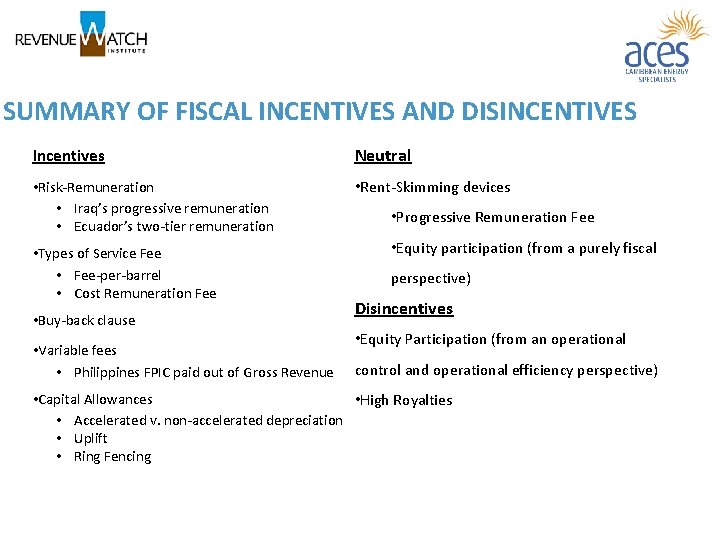
SUMMARY OF FISCAL INCENTIVES AND DISINCENTIVES Incentives Neutral • Risk-Remuneration • Iraq’s progressive remuneration • Ecuador’s two-tier remuneration • Rent-Skimming devices • Types of Service Fee • Fee-per-barrel • Cost Remuneration Fee • Buy-back clause • Variable fees • Philippines FPIC paid out of Gross Revenue • Progressive Remuneration Fee • Equity participation (from a purely fiscal perspective) Disincentives • Equity Participation (from an operational control and operational efficiency perspective) • Capital Allowances • High Royalties • Accelerated v. non-accelerated depreciation • Uplift • Ring Fencing
Preguntas Muchas Gracias Tony Paul tony 1 paul@gmail. com Todd Arena tarena@revenuewatch. org Arena. todd@gmail. com Patrick Heller pheller@revenuewatch. org