
UPSCALING PROJECT FASTRAM Upscaling of FAST sintering processes
- Slides: 29
UPSCALING PROJECT: FASTRAM: Upscaling of FAST sintering processes for the substitution of critical materials: W and Co M. A. Lagos 1, I. Agote 1 1. TECNALIA Research & Innovation, Mikeletegi Pasealekua, 2 20009 San Sebastian, Spain.
INDEX: • INTRODUCTION: FASTRAM PROJECT • DESCRIPTION OF THE TECHNOLOGIES • PREVIOUS EXPERIMENTAL ACHIEVEMENTS 2 ▌
INDEX: • INTRODUCTION: FASTRAM PROJECT • DESCRIPTION OF THE TECHNOLOGIES • PREVIOUS EXPERIMENTAL ACHIEVEMENTS 3 ▌
EIT RAW MATERIALSAND TARGET MARKET • The European Institute of Innovation and Technology (EIT) is an independent EU body that is strengthening Europe’s ability to innovate. • The EIT and supports new ideas, bringing together the ‘knowledge triangle’ of leading companies, universities and research centers to form dynamic cross-border partnerships (KIC- Knowledge and Innovation Community). • EIT Raw. Materials is the largest and strongest consortium in the raw materials sector worldwide. • Its mission is to boost competitiveness, growth and attractiveness of the European raw materials sector via radical innovation and guided entrepreneurship. • EIT Raw. Materials unites more than 100 partners – academic and research institutions as well as businesses – from more than 20 EU countries.
EIT RAW MATERIALS: Up-scaling project. AND TARGET MARKE The aim of EIT Raw. Materials Upscaling Projects is to launch new products, services or processes (=solution) to the market. Upscaling projects are innovation projects based on validated technologies that need additional step(s) for up-scaling, demonstration or implementation. The objective is to bring the technology to market, as a product, service or process. This implies paying attention not only to the technology but also to market, IP, value/customer proposition, competitors etc. that are important factors for the feasibility of the project. From Validated Technology to Prototype Demonstration
OBJECTIVE, STATEGIC IMPORTANCE AND TARGET MARKET The main objective of the project FASTRAM is the up-scaling of FAST sintering techniques for the production of sustainable hard materials, for the substitution of existing hard metals (WC-Co) in the targeted applications (mining sector). Tungsten W and cobalt Co are listed as critical metals by the EU. • Tungsten : the most important critical metal with a high supply risk within the EU. • Cobalt: supply risk and health risk (possible carcinogenic by the International Agency for Research on Cancer) Tungsten carbide cobalt hard metals (WC-Co) are dominating in applications where high wear resistance is needed. The research challenge is to achieve the same or even better functionality with substituting materials. Target market is the mining and construction sector (drilling and crushing wear resistant components are critical for this sector)
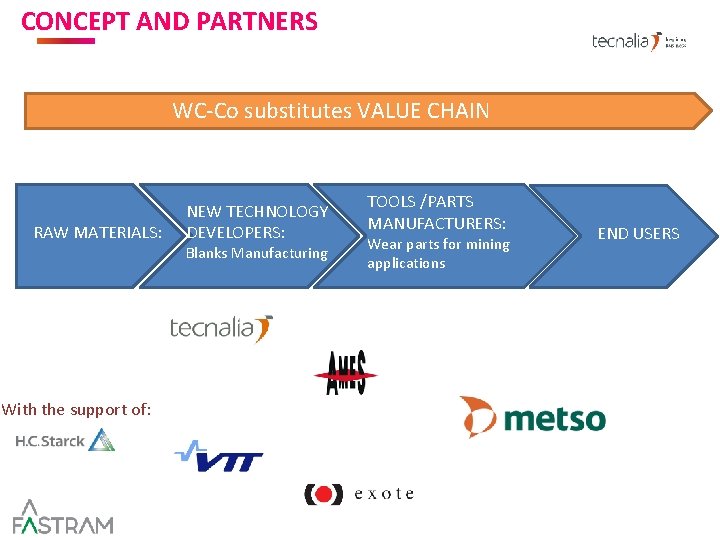
CONCEPT AND PARTNERS AND TARGET MARKET WC-Co substitutes VALUE CHAIN RAW MATERIALS: With the support of: NEW TECHNOLOGY DEVELOPERS: Blanks Manufacturing TOOLS /PARTS MANUFACTURERS: Wear parts for mining applications END USERS
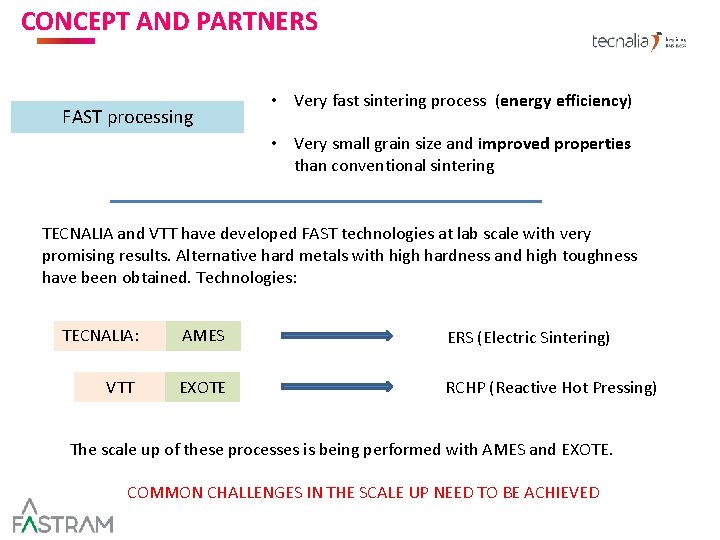
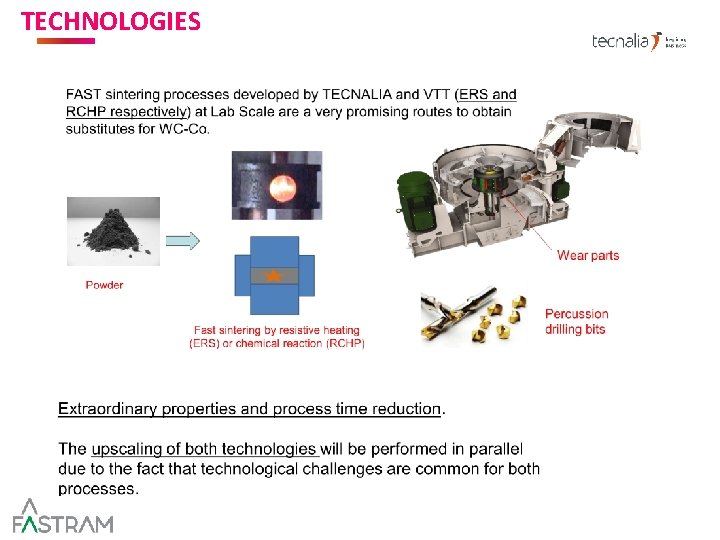
CONCEPT AND PARTNERS AND TARGET MARKET FAST processing • Very fast sintering process (energy efficiency) • Very small grain size and improved properties than conventional sintering TECNALIA and VTT have developed FAST technologies at lab scale with very promising results. Alternative hard metals with high hardness and high toughness have been obtained. Technologies: TECNALIA: AMES ERS (Electric Sintering) VTT EXOTE RCHP (Reactive Hot Pressing) The scale up of these processes is being performed with AMES and EXOTE. COMMON CHALLENGES IN THE SCALE UP NEED TO BE ACHIEVED
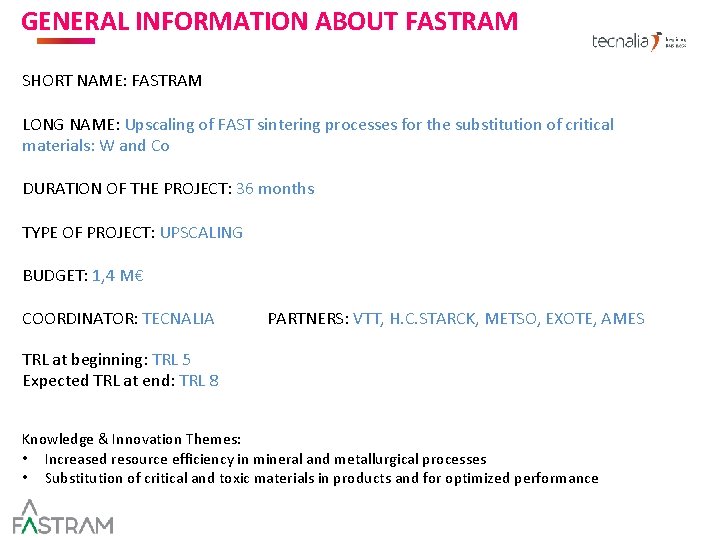
GENERAL INFORMATION ABOUT FASTRAM AND TARGET MARKET SHORT NAME: FASTRAM LONG NAME: Upscaling of FAST sintering processes for the substitution of critical materials: W and Co DURATION OF THE PROJECT: 36 months TYPE OF PROJECT: UPSCALING BUDGET: 1, 4 M€ COORDINATOR: TECNALIA PARTNERS: VTT, H. C. STARCK, METSO, EXOTE, AMES TRL at beginning: TRL 5 Expected TRL at end: TRL 8 Knowledge & Innovation Themes: • Increased resource efficiency in mineral and metallurgical processes • Substitution of critical and toxic materials in products and for optimized performance
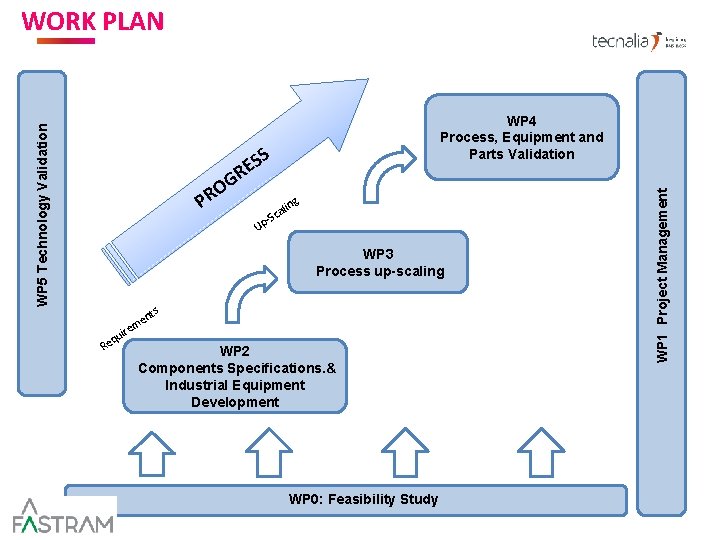
WP 4 Process, Equipment and Parts Validation SS E R G O R P g lin ca p-S U WP 3 Process up-scaling i qu Re nts e rem WP 2 Components Specifications. & Industrial Equipment Development WP 0: Feasibility Study WP 1 Project Management WP 5 Technology Validation WORK PLAN AND TARGET MARKET
INDEX: • INTRODUCTION: FASTRAM PROJECT • DESCRIPTION OF THE TECHNOLOGIES • PREVIOUS EXPERIMENTAL ACHIEVEMENTS 11 ▌
TECHNOLOGIES AND TARGET MARKET
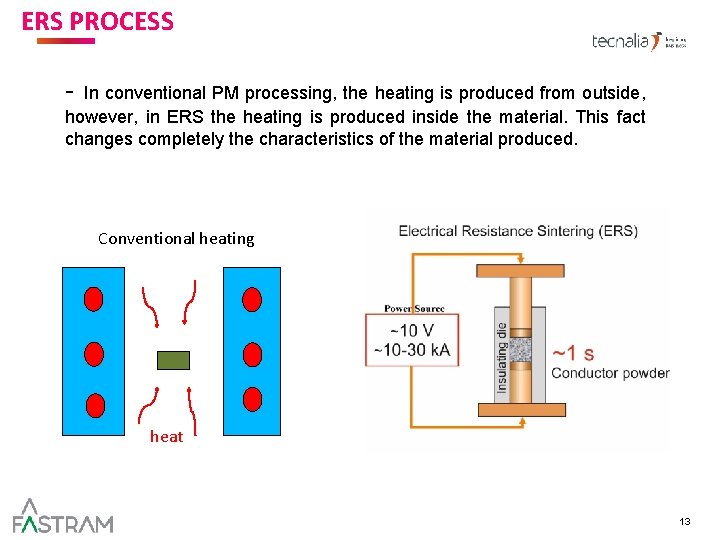
ERS PROCESS AND TARGET MARKET - In conventional PM processing, the heating is produced from outside, however, in ERS the heating is produced inside the material. This fact changes completely the characteristics of the material produced. Conventional heating heat 13
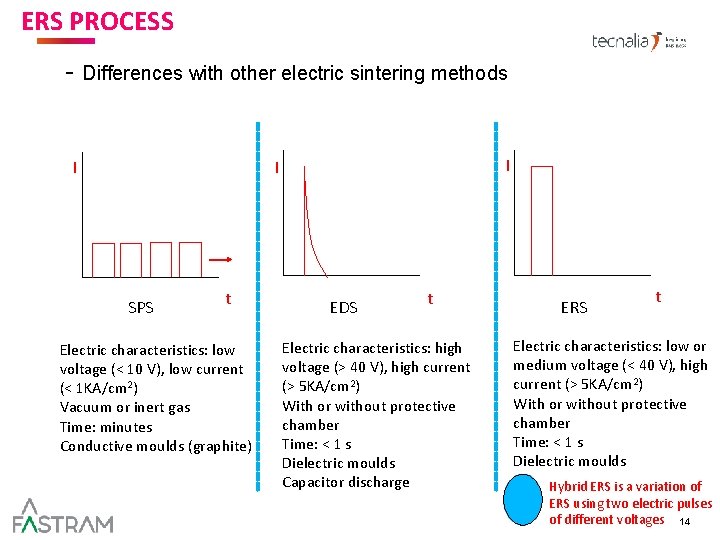
ERS PROCESS AND TARGET MARKET - Differences with other electric sintering methods I I I SPS t Electric characteristics: low voltage (< 10 V), low current (< 1 KA/cm 2) Vacuum or inert gas Time: minutes Conductive moulds (graphite) EDS t Electric characteristics: high voltage (> 40 V), high current (> 5 KA/cm 2) With or without protective chamber Time: < 1 s Dielectric moulds Capacitor discharge ERS t Electric characteristics: low or medium voltage (< 40 V), high current (> 5 KA/cm 2) With or without protective chamber Time: < 1 s Dielectric moulds Hybrid ERS is a variation of ERS using two electric pulses of different voltages 14
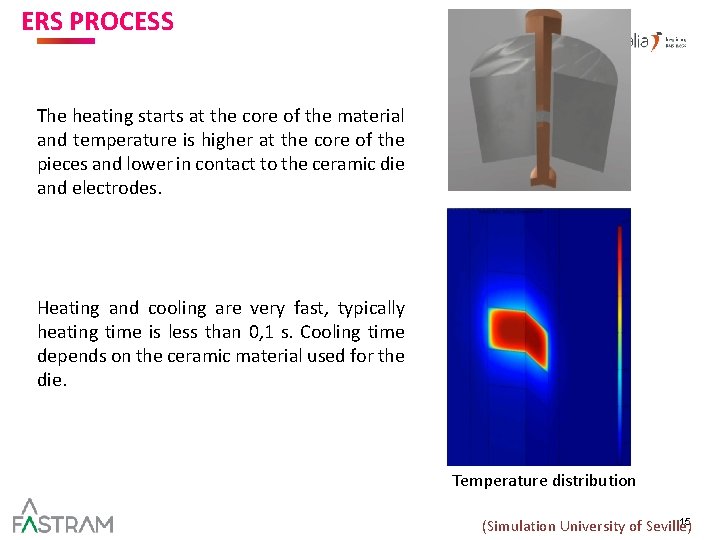
ERS PROCESS AND TARGET MARKET The heating starts at the core of the material and temperature is higher at the core of the pieces and lower in contact to the ceramic die and electrodes. Heating and cooling are very fast, typically heating time is less than 0, 1 s. Cooling time depends on the ceramic material used for the die. Temperature distribution 15 (Simulation University of Seville)
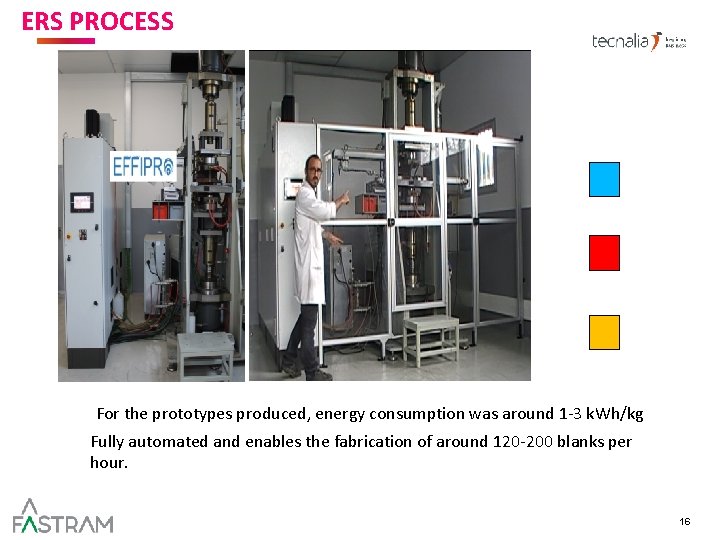
ERS PROCESS AND TARGET MARKET For the prototypes produced, energy consumption was around 1 -3 k. Wh/kg Fully automated and enables the fabrication of around 120 -200 blanks per hour. 16
INDEX: • INTRODUCTION: FASTRAM PROJECT • DESCRIPTION OF THE TECHNOLOGIES • PREVIOUS EXPERIMENTAL ACHIEVEMENTS 17 ▌
PREVIOUS ACHIEVEMENTS AND TARGET MARKET • RESULTS WITH WC-Co • RESULTS WITH WC-Other binders • RESULTS WITH OTHER CERAMIC PHASES
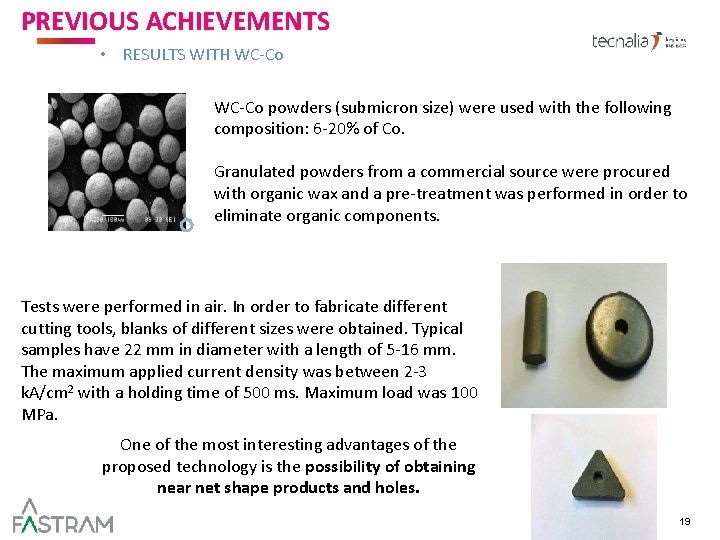
PREVIOUS ACHIEVEMENTS AND TARGET MARKET • RESULTS WITH WC-Co powders (submicron size) were used with the following composition: 6 -20% of Co. Granulated powders from a commercial source were procured with organic wax and a pre-treatment was performed in order to eliminate organic components. Tests were performed in air. In order to fabricate different cutting tools, blanks of different sizes were obtained. Typical samples have 22 mm in diameter with a length of 5 -16 mm. The maximum applied current density was between 2 -3 k. A/cm 2 with a holding time of 500 ms. Maximum load was 100 MPa. One of the most interesting advantages of the proposed technology is the possibility of obtaining near net shape products and holes. 19
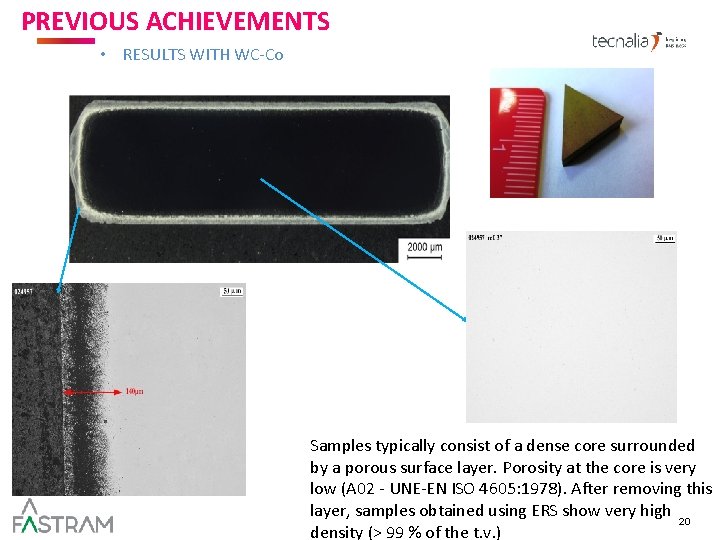
PREVIOUS ACHIEVEMENTS AND TARGET MARKET • RESULTS WITH WC-Co Samples typically consist of a dense core surrounded by a porous surface layer. Porosity at the core is very low (A 02 - UNE-EN ISO 4605: 1978). After removing this layer, samples obtained using ERS show very high 20 density (> 99 % of the t. v. )
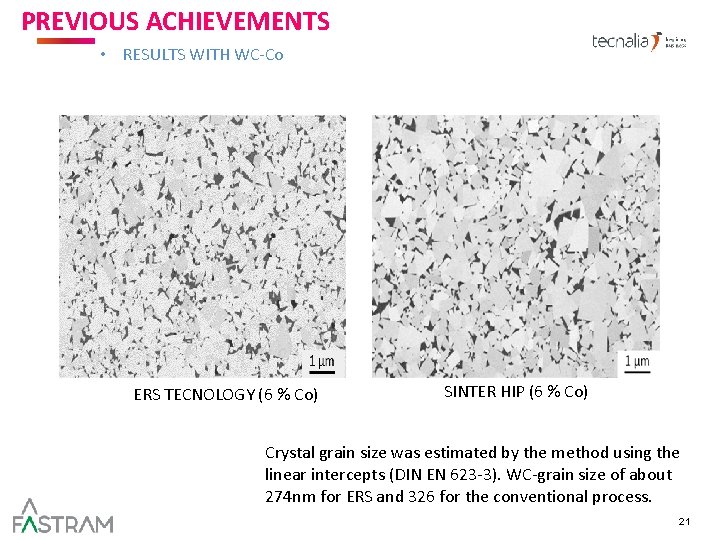
PREVIOUS ACHIEVEMENTS AND TARGET MARKET • RESULTS WITH WC-Co ERS TECNOLOGY (6 % Co) SINTER HIP (6 % Co) Crystal grain size was estimated by the method using the linear intercepts (DIN EN 623 -3). WC-grain size of about 274 nm for ERS and 326 for the conventional process. 21
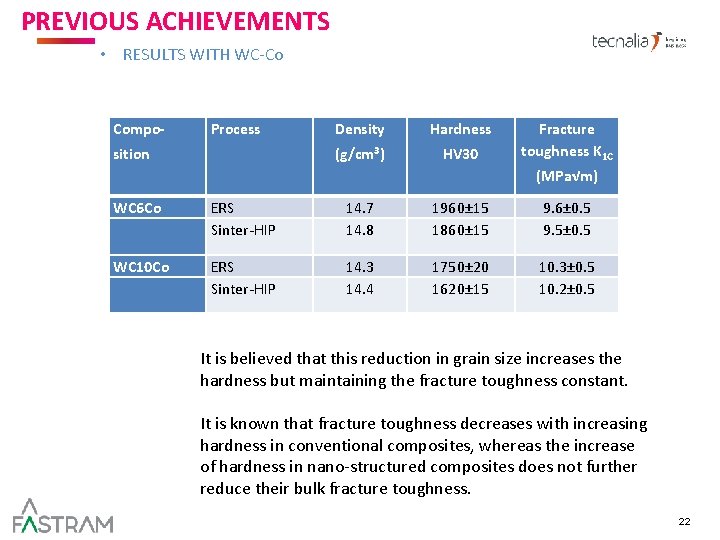
PREVIOUS ACHIEVEMENTS AND TARGET MARKET • RESULTS WITH WC-Co Compo- Process sition Density Hardness (g/cm 3) HV 30 Fracture toughness K 1 C (MPa√m) WC 6 Co ERS Sinter-HIP 14. 7 14. 8 1960± 15 1860± 15 9. 6± 0. 5 9. 5± 0. 5 WC 10 Co ERS Sinter-HIP 14. 3 14. 4 1750± 20 1620± 15 10. 3± 0. 5 10. 2± 0. 5 It is believed that this reduction in grain size increases the hardness but maintaining the fracture toughness constant. It is known that fracture toughness decreases with increasing hardness in conventional composites, whereas the increase of hardness in nano-structured composites does not further reduce their bulk fracture toughness. 22
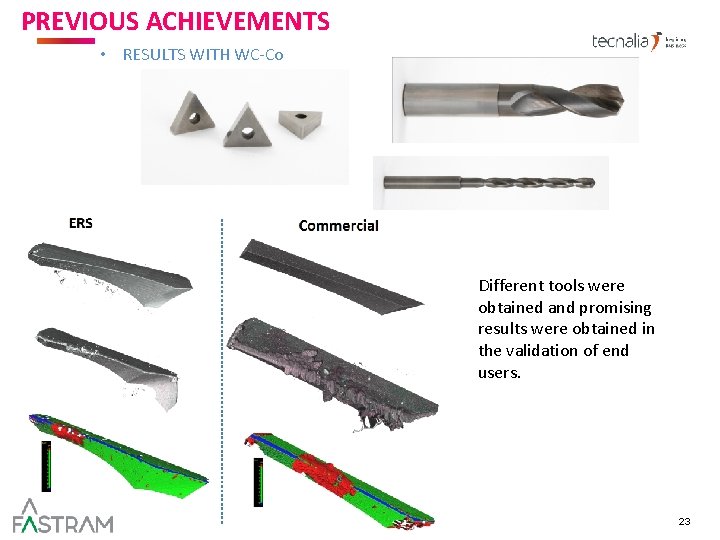
PREVIOUS ACHIEVEMENTS AND TARGET MARKET • RESULTS WITH WC-Co Different tools were obtained and promising results were obtained in the validation of end users. 23
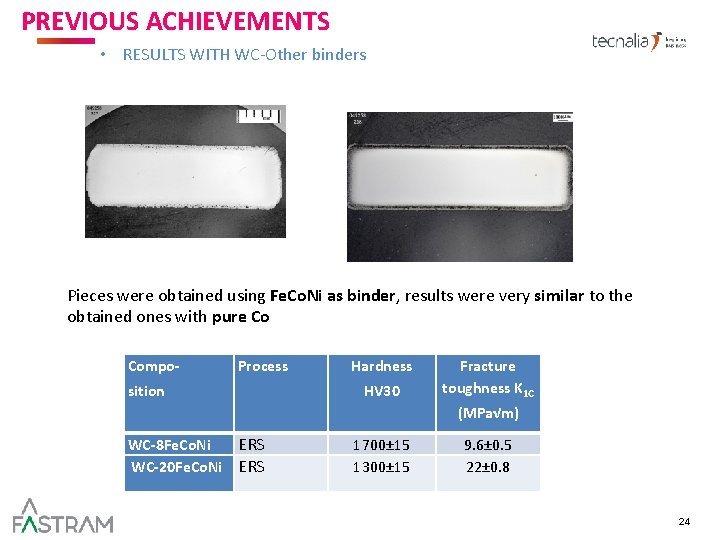
PREVIOUS ACHIEVEMENTS AND TARGET MARKET • RESULTS WITH WC-Other binders Pieces were obtained using Fe. Co. Ni as binder, results were very similar to the obtained ones with pure Co Compo- Process sition Hardness HV 30 Fracture toughness K 1 C (MPa√m) ERS WC-8 Fe. Co. Ni WC-20 Fe. Co. Ni ERS 1700± 15 1300± 15 9. 6± 0. 5 22± 0. 8 24
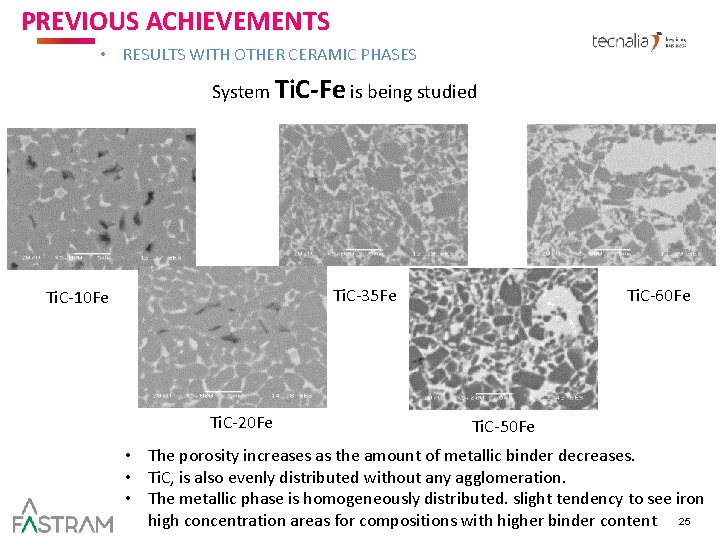
PREVIOUS ACHIEVEMENTS AND TARGET MARKET • RESULTS WITH OTHER CERAMIC PHASES System Ti. C-Fe is being studied Ti. C-35 Fe Ti. C-10 Fe Ti. C-20 Fe Ti. C-60 Fe Ti. C-50 Fe • The porosity increases as the amount of metallic binder decreases. • Ti. C, is also evenly distributed without any agglomeration. • The metallic phase is homogeneously distributed. slight tendency to see iron high concentration areas for compositions with higher binder content 25
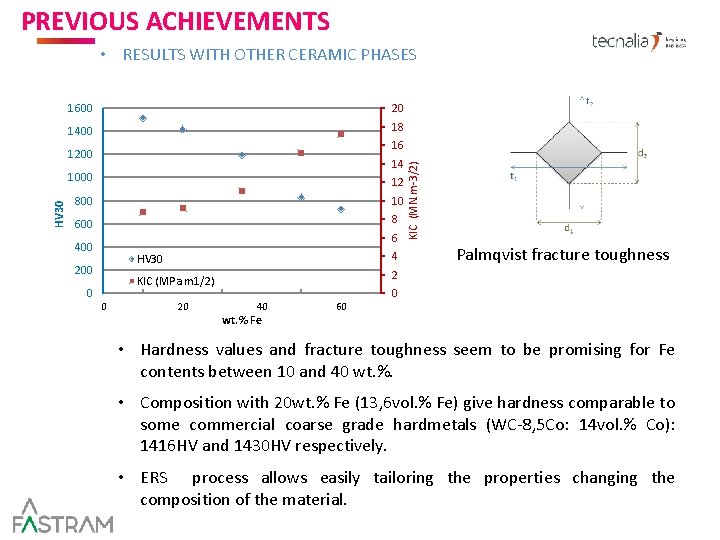
PREVIOUS ACHIEVEMENTS AND TARGET MARKET • RESULTS WITH OTHER CERAMIC PHASES 1600 20 1400 18 14 HV 30 1000 12 800 10 600 8 6 400 0 4 HV 30 20 Palmqvist fracture toughness 2 KIC (MPa. m 1/2) 0 KIC (MN. m-3/2) 16 1200 40 wt. % Fe 60 0 • Hardness values and fracture toughness seem to be promising for Fe contents between 10 and 40 wt. %. • Composition with 20 wt. % Fe (13, 6 vol. % Fe) give hardness comparable to some commercial coarse grade hardmetals (WC-8, 5 Co: 14 vol. % Co): 1416 HV and 1430 HV respectively. • ERS process allows easily tailoring the properties changing the composition of the material.
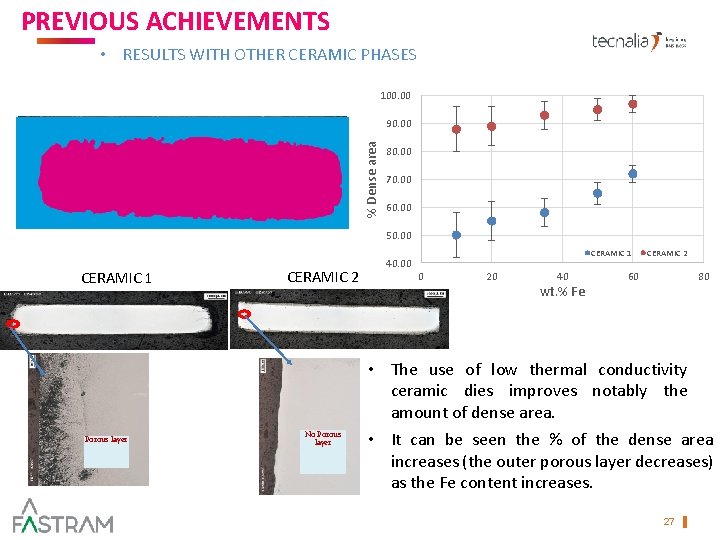
PREVIOUS ACHIEVEMENTS AND TARGET MARKET • RESULTS WITH OTHER CERAMIC PHASES 100. 00 % Dense area 90. 00 80. 00 70. 00 60. 00 50. 00 CERAMIC 1 Porous layer CERAMIC 2 No Porous layer CERAMIC 1 40. 00 0 20 40 wt. % Fe CERAMIC 2 60 80 • The use of low thermal conductivity ceramic dies improves notably the amount of dense area. • It can be seen the % of the dense area increases (the outer porous layer decreases) as the Fe content increases. 27 ▌
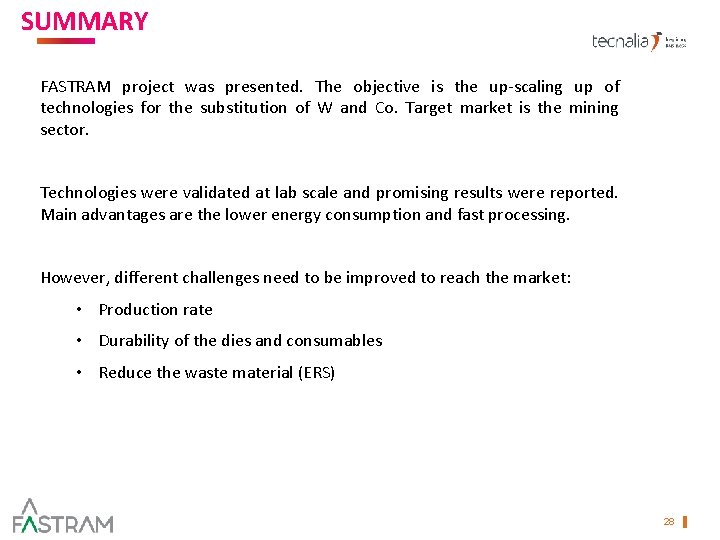
SUMMARY AND TARGET MARKET FASTRAM project was presented. The objective is the up-scaling up of technologies for the substitution of W and Co. Target market is the mining sector. Technologies were validated at lab scale and promising results were reported. Main advantages are the lower energy consumption and fast processing. However, different challenges need to be improved to reach the market: • Production rate • Durability of the dies and consumables • Reduce the waste material (ERS) 28 ▌
Thank you very much! miguel. lagos@tecnalia. com Visit our blog: http: //blogs. tecnalia. com/inspiring-blog/ www. tecnalia. com