
UPPER WEST REGIONAL SECRETARIAT OUTLINE BACKGROUNDGENERAL INTRODUCTION METHODOLOGY

UPPER WEST REGIONAL SECRETARIAT
OUTLINE • • BACKGROUND/GENERAL INTRODUCTION METHODOLOGY ACTIVITIES FINDINGS RECOMMEDATION CONCLUSION APENDIX
BACKGROUND/GENERAL INTRODUCTION For an organization to develop its ability to handle its internal & external functions and relationships, it needs a Dynamic team to support its vision. The organization Capacity Assignment (OCA) carried out at the REGIONAL OFFICE OF NATIONAL YOUTH AUTHORITY on the 22 ND November, 2016. With the accord of the management, the tools were used to teach the staff members on team building to enable them improve on relationship, leadership, performance and efficiency in the organization.
PROBLEM STATEMENT It is out of the Organization Capacity recommendations below were raised; Assignment that these • The structure of the National Youth Authority should be understood throughout the organization; • The vision and mission statements should be well displayed, • Implanted leadership should be comprehensive by most of the workers • The relationship should be worked upon sincerely to avoid conflict of interest or interpersonal conflict. Management and Consultants in Training agreed to facilitate Dynamic Team Building intervention for the formation of an effective team to propel the corporation towards realizing its goals and objectives.
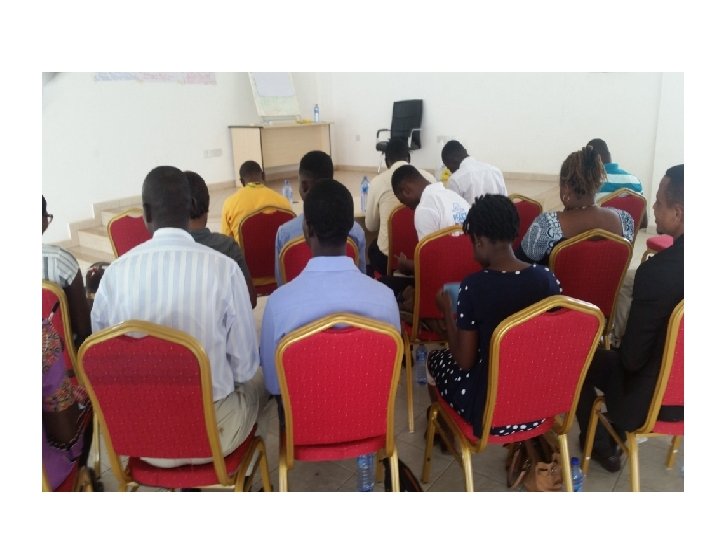
JUSTIFICATION OF THE STUDY The team building skills and its exercises will help; • Harmonize the pool of experiences, • Improve the competency and talents. To help them appreciate the importance of team work, there was the need to empower them with some basic and important team building’s skills. About 24 workers of the organization were taking through various ways of enhancing team work
RESEARCH OBJECTIVES • To understand that team work takes presidency over each individual to reach the objectives. • To make use of the contribution of everyone for the efficiency of the whole • To keep in mind the importance of the organization as a second family and behave as such • To give training on team building for effectiveness and efficiency of the organization • To help people identify the talents, competencies and experiences of individual workers • To boost the confidence and experience of OD consultants in training
MEHTODOLOGY • CASE STUDIES • DEMONSTRATIONS • STRUCTURED ACTIVITIES • PRESENTATIONS/ FACILITATIONS • GROUP DISCUSSION • FEEDBACK SESSION
ACTIVITIES FORMING STAGE • ANIMAL LIKENESS • SELF-PRESENTATION • THE AGE CONTINUUM EXERCISE • SOCIOGRAM 1
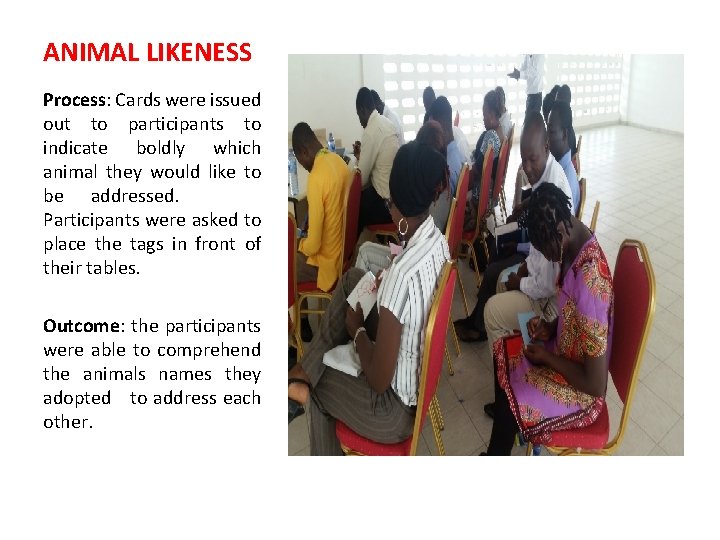
ANIMAL LIKENESS Process: Cards were issued out to participants to indicate boldly which animal they would like to be addressed. Participants were asked to place the tags in front of their tables. Outcome: the participants were able to comprehend the animals names they adopted to address each other.
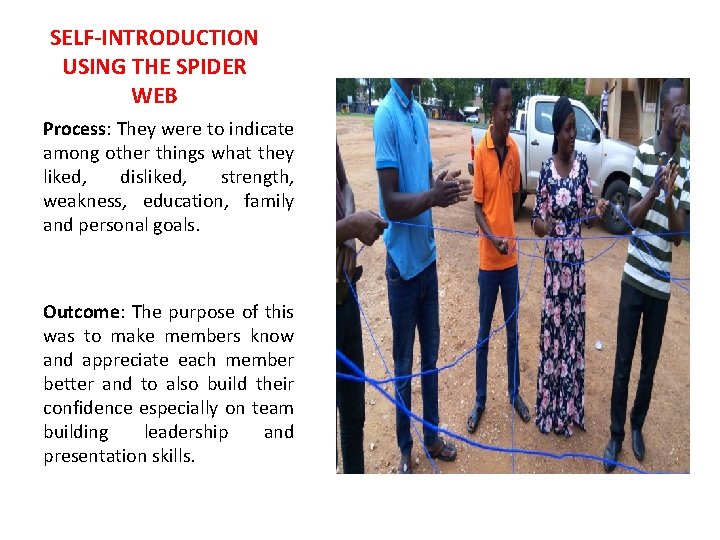
SELF-INTRODUCTION USING THE SPIDER WEB Process: They were to indicate among other things what they liked, disliked, strength, weakness, education, family and personal goals. Outcome: The purpose of this was to make members know and appreciate each member better and to also build their confidence especially on team building leadership and presentation skills.
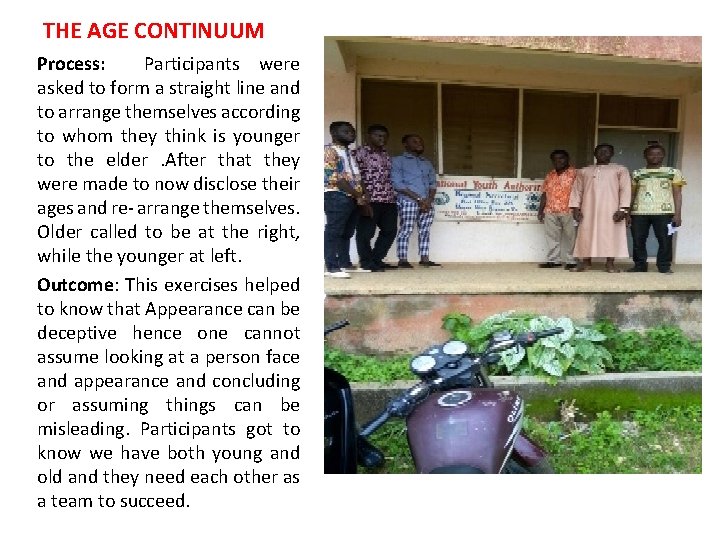
THE AGE CONTINUUM Process: Participants were asked to form a straight line and to arrange themselves according to whom they think is younger to the elder. After that they were made to now disclose their ages and re- arrange themselves. Older called to be at the right, while the younger at left. Outcome: This exercises helped to know that Appearance can be deceptive hence one cannot assume looking at a person face and appearance and concluding or assuming things can be misleading. Participants got to know we have both young and old and they need each other as a team to succeed.
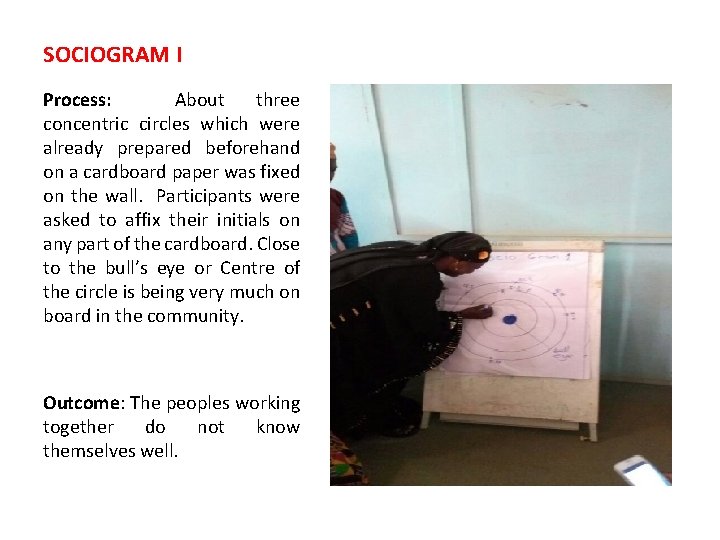
SOCIOGRAM I Process: About three concentric circles which were already prepared beforehand on a cardboard paper was fixed on the wall. Participants were asked to affix their initials on any part of the cardboard. Close to the bull’s eye or Centre of the circle is being very much on board in the community. Outcome: The peoples working together do not know themselves well.
SETTING GROUND RULES PROCESS Participants suggested the following; • Punctuality/Respect for time OUTCOME All participants agreed to observe and be guided by the set rules. The reason behind • Active participation the ground rules was to • All mobile phones should be off or in maintain orderliness. total silence • Mutual respect • No Meetings Within Meetings
STORMING STAGE PROCESS OUTCOME This exercise was done with the aid of a ball of yarn. Their Task was commencing the training session in a sharing way by tossing the ball of yarn to each participant and forming a web. At the end of the exercise, the participants realized that it is a way of networking. They understood the importance of each individual in the group and that breaking any of the links in the web can amount to the destruction of the whole web.
PERSONAL REFLECTION PROCESS OUTCOME This exercise consisted the daily morning individual reflection which made every individual to get understanding of the daily activities. The purpose is to help consultant get the feedback of the previous daily exercises. The participants were able to follow the process and are always ready to learn from each other.

NORMING STAGE ANIMAL LIKENESS EXERCISE PROCESS • Participants were asked to draw any animal they are attracted to and give reasons why they relate themselves to such animals. • This was to enable participants tell their behaviors by likening themselves to some particular animals. • Each participant showed and mentioned and explained the characteristics of the animal to others members.
ANIMAL LIKENESS EXERCISE CON’T The participants with their corresponding characteristics choice the following animals: • HEN – caring and protecting of the young ones from prey. Sometimes hurts the chicks but still cares for them • CHAMELEON – Friendly and pet for some people Slow in movement but sure of its destination, not predictable, adaptive to its environment and any situation • DOG – helpful, affectionate loyal, generous, honest, sporting • EAGLE – wild, likes freedom, it does not like, ambitious. • SHEEP: it is humble, calm and patient. They move together.
ANIMAL LIKENESS EXERCISE CON’T • CAT: Calm in pursuit of its prey, friendly, affectionate, observant. It does not attack unless threatened. • GOAT: wise and intelligent, smart, stubborn and determined. • TORTOISE - moves slowly towards its destination, patient, does not complain • PARROT –talkative, honest, perseverance and friendly. • RAT - searches for food, depends on whatever is available. • SNAKE- Calm but dangerous OUTCOME Participants appreciate the individual’s character of members in the group.
HOW TO GIVE AND RECEIVE FEEDBACK • The team was taking through a power point presentation on how to give and receive feedback. • A copy of that is attached to this report on the appendix page. For the purpose of feedback and evaluation, facilitator’s assessment forms were given to participants to evaluate the whole exercise. Find copy in appendix page.
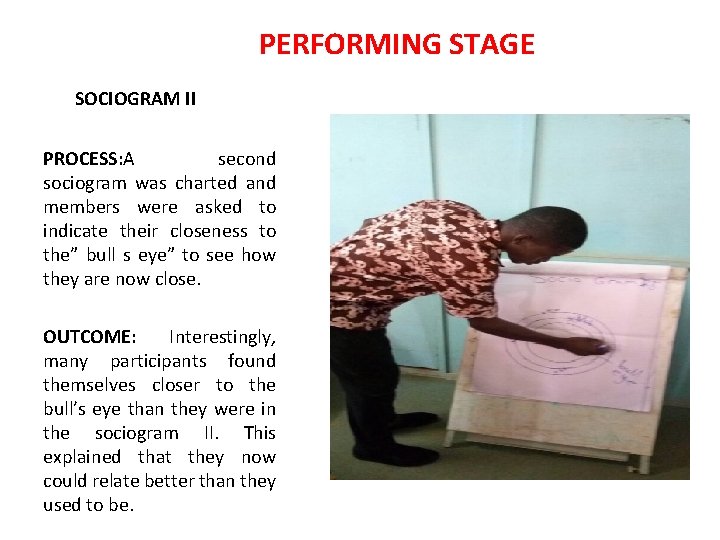
PERFORMING STAGE SOCIOGRAM II PROCESS: A second sociogram was charted and members were asked to indicate their closeness to the” bull s eye” to see how they are now close. OUTCOME: Interestingly, many participants found themselves closer to the bull’s eye than they were in the sociogram II. This explained that they now could relate better than they used to be.
OUTPUT Those activities were made for various outputs: • Know one another and provide opportunity for great discovery in the group • Show close participants can see themselves in a group. • Help members to have a set of norms to guide them and regulate their behavior, as well as to ensure active participation and compliance by all group members. • Appreciate and give feedback with the aim to encourage selfdevelopment and build a constructive relationship in the organization.
FEEDBACK • The consultant used different methods to get feedback from the participants. Example the daily reflection exercise whereby they shared their feelings on what went on well, what did not go well, what do they do to contribute and the insight they gained thereafter. This was followed by some Evaluation exercise. • The reason for the exercise was to ascertain the understanding of the participants concerning the concept of team building and to measure the impact it has on the participants in relation to their work. They were invited to consider the feedback in their relationship.
OUTCOMES/IMMEDIATE IMPACT At the end of the exercise, • The participants were able to know each other very well, their feelings and how to approach one another. • The alleviation of the prejudgment and the appearance which can be deceptive hence one cannot assume. • The disclosure of the participants permits them to relate better with one another as the sociogram I and II show. • They discovered the importance to work under their own rules and regulations. • The participants were able to understand appreciate the individual characters of members in the group and therefore tolerate each other’s views at their workplace. • Each participant realized how important they are in the organization.
FINDINGS • The participants realized that being a team player in an organization will help you achieve better results than working as individuals. • After the team building exercise, using the spider web, participants see the importance of each person in the organization. • Sociogram I and II exercises help participants to become close and know themselves well. • Animal likeness exercise helps participants to understand appreciate the individual character of members in the group and therefore tolerate each other’s view at the workplace.
RECOMMENDATIONS • Regular refresher training on Team and Capacity building workshop for the staff • Planning and Organizing in service training workshop on the job for workers • Training a staff in OD to serve as an internal change agent for the organization
CONCLUSION The team building intervention in the estimation of the OD consultants in training has helped participants • To be exposed to the various processes of team development and activities. • To work together as a team and boosted their knowledge and capacity on the importance of working together in an organization. • To further boosted their knowledge capacity on the importance of team work in an organization. • Participants have therefore seen the need to work as a team bringing their expertise and rich experience to bear for an effective change in the organization through mutual understanding and effective communication. The OD consultants in training are of the firm belief that with the knowledge and skills imparted on the participants, if carried out or implemented in their day to day activities It will propel the organization on the path of sustainability which will eventually translate into realizing its goals. Feedback (feed forward) would be given to the organization for further interventions.
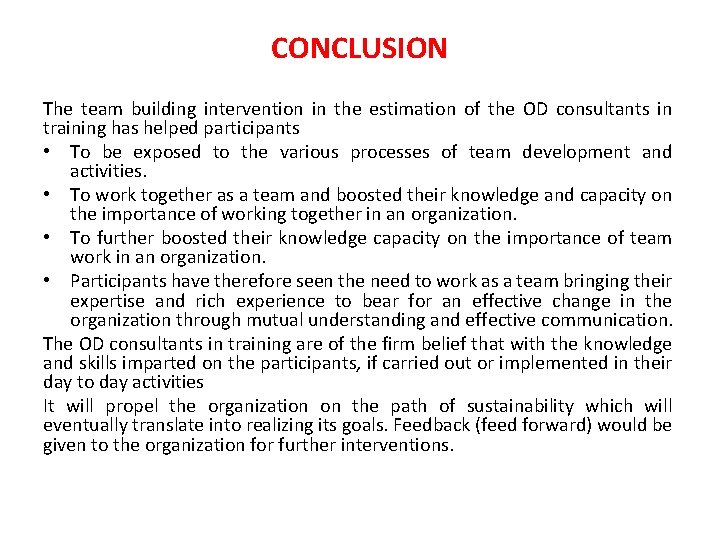
APENDIX GALLERY PICTURE 1 & 2: OD CONSULTANT IN TRAINING
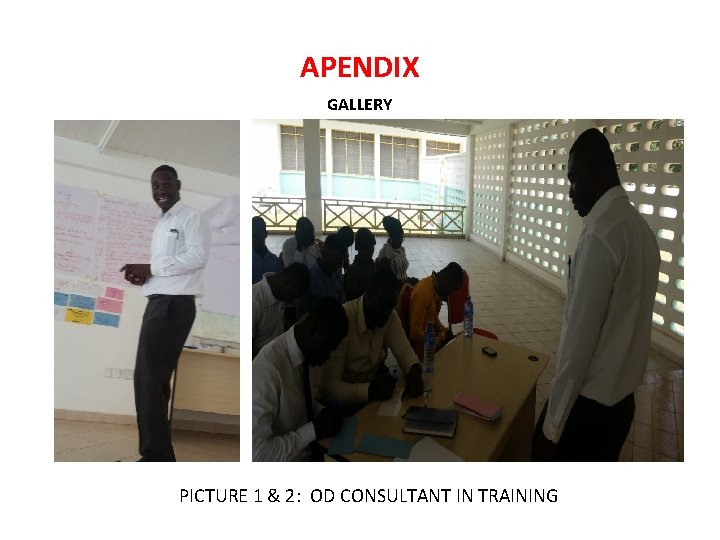
PICTURE 3 & 4 PARTICIPANTS BUSY SKETCHING ANIMALS
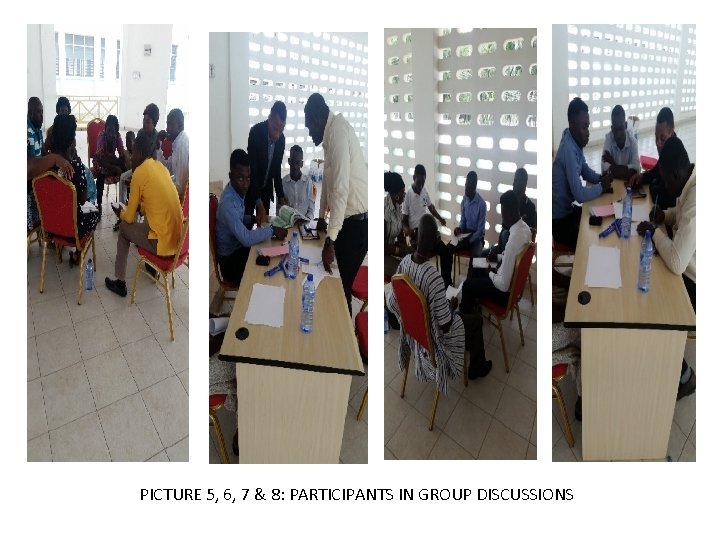
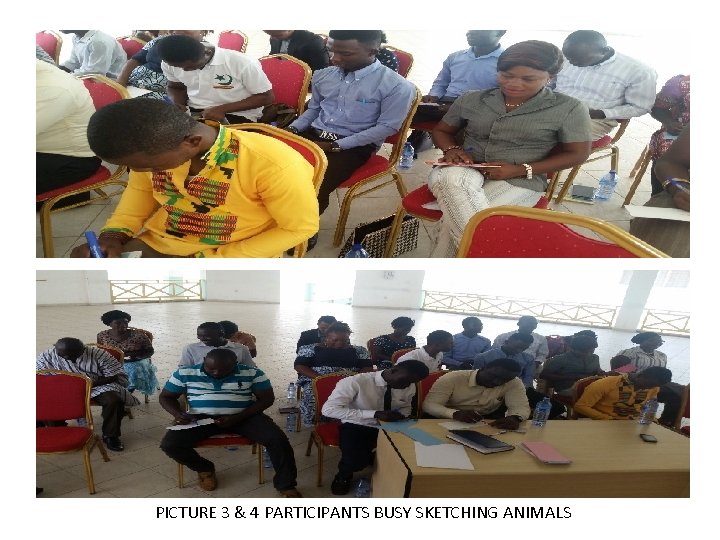
PICTURE 5, 6, 7 & 8: PARTICIPANTS IN GROUP DISCUSSIONS
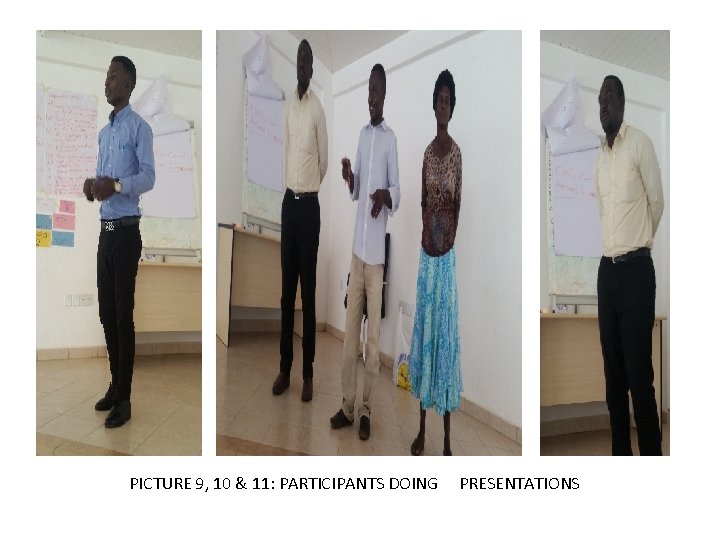
PICTURE 9, 10 & 11: PARTICIPANTS DOING PRESENTATIONS
PICTURE 12, 13, 14 & 15: LUNCH TIME FOR PARTICIPANTS
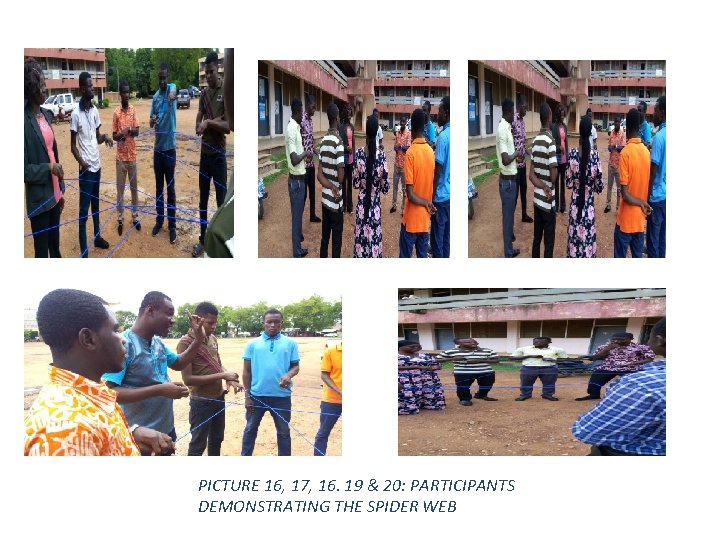
PICTURE 16, 17, 16. 19 & 20: PARTICIPANTS DEMONSTRATING THE SPIDER WEB
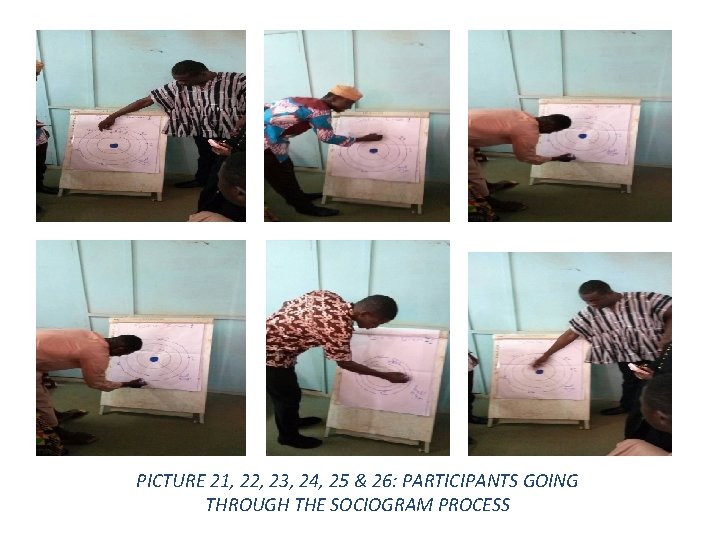
PICTURE 21, 22, 23, 24, 25 & 26: PARTICIPANTS GOING THROUGH THE SOCIOGRAM PROCESS
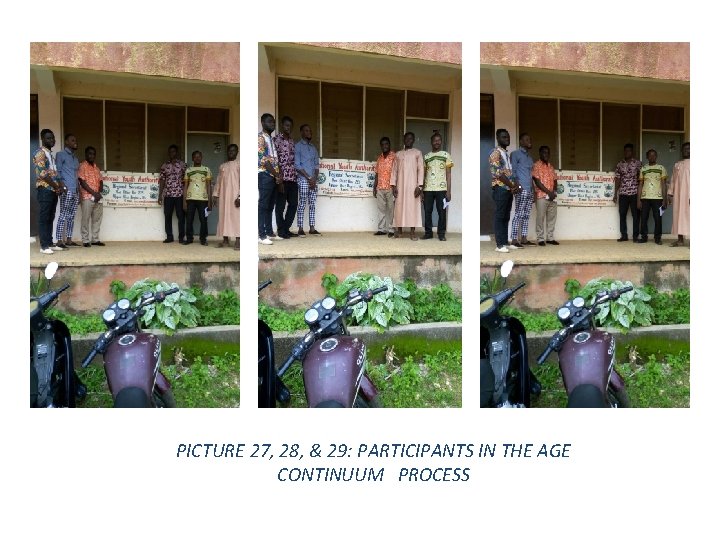
PICTURE 27, 28, & 29: PARTICIPANTS IN THE AGE CONTINUUM PROCESS
ii. REFERENCES 1. Field Observation and report by students ( March 2015) 2. Thamhain, H. J. (1988). Team Building in Project Management, Project Management Handbook, Second Edition, eds. 3. Report on Dynamic Team Building Intervention for Classic FM, Techiman-Ghana (Benarkuu Gbiel Gabriel &Yeboah Yaw, Batch 17, May 2009) 4. Ref thamhain, H. J. (2004). Linkages of Project Environment to Performance: Lessons for Team Leadership. International Journal of Project Management, 22(7), 533 -544. 5. Verma, V. K. (1997). Managing the Project Team. Project Management Institute. Newtown Square, pa. Pp. 72. 6. Robinson, g. & Robinson, s. (1994). Notes and Handouts for Project Management Course Sponsored by the School of Engineering Science and Presented by the Department of Continuing Studies, Simon Fraser University, pp. 6 -14.
7. A Group Assignment by batch three of University College for Community and Organizational Development (UCCOD) of Team Building. 8. The Manual of OD Certificate Program, Fourth Edition (2014), Participant’s Guide of University College for Community and Organizational Development (UCCOD) 9. Thamhain, H. J. (2004). Linkages of Project Environment to Performance: Lessons for Team Leadership. International Journal of Project Management, 22(7), 533 -544.
- Slides: 37