
Upper rate behaviour in dual chamber pacemaker Dr
Upper rate behaviour in dual chamber pacemaker Dr Shreetal Rajan Nair Senior resident , Department of Cardiology MCH, Calicut.

DDD pacemaker- 4 rhythm scenarios

Dual Chamber Timing Cycle � • Lower rate interval (LRI) � • Upper rate interval (URI) – Maximum tracking rate (MTR) – Maximum sensor rate � • AV and VA interval � • Refractory period � • Blanking period

Dual-chamber Timing Intervals Ap AV Interval V-Blanking PVARP A-Blanking TARP VA Interval VRP URI/MTR LRI Vp Ap Vp

Upper rate behavior �Upper rate behavior refers to how a dual-chamber pacemaker will behave when the atrial rate exceeds the programmed maximum tracking rate �There are three types of upper rate behavior � 1: 1 Tracking �Pacemaker Wenckebach � 2: 1 Block �The key to upper rate behavior is in the atrium �Observed only when the device is tracking intrinsic P waves (A sense/V pace)

Normal 1: 1 tracking
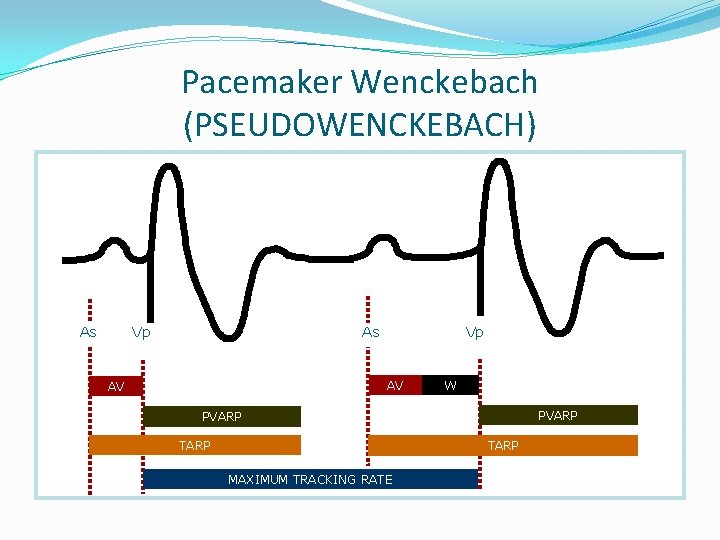
Pacemaker Wenckebach (PSEUDOWENCKEBACH) As Vp AV AV W PVARP TARP MAXIMUM TRACKING RATE

Upper Rate Pacing Characteristics Wenckebach (4: 3 Block) As Vp TARP AV Delay VA Interval MTR As Vp (As) As Vp
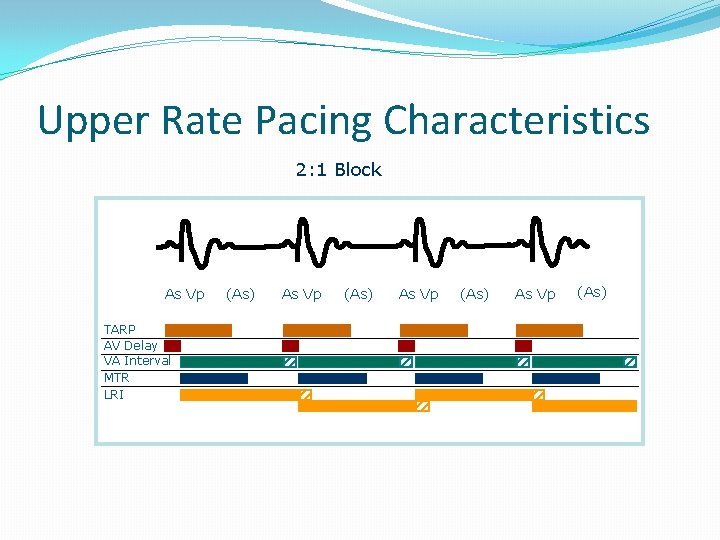
Upper Rate Pacing Characteristics 2: 1 Block As Vp TARP AV Delay VA Interval MTR LRI (As) As Vp (As)
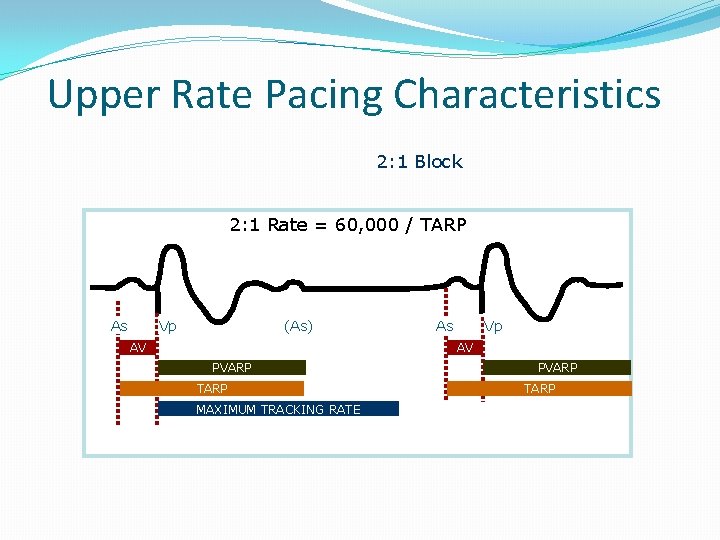
Upper Rate Pacing Characteristics 2: 1 Block 2: 1 Rate = 60, 000 / TARP As Vp (As) AV As Vp AV PVARP TARP MAXIMUM TRACKING RATE PVARP TARP
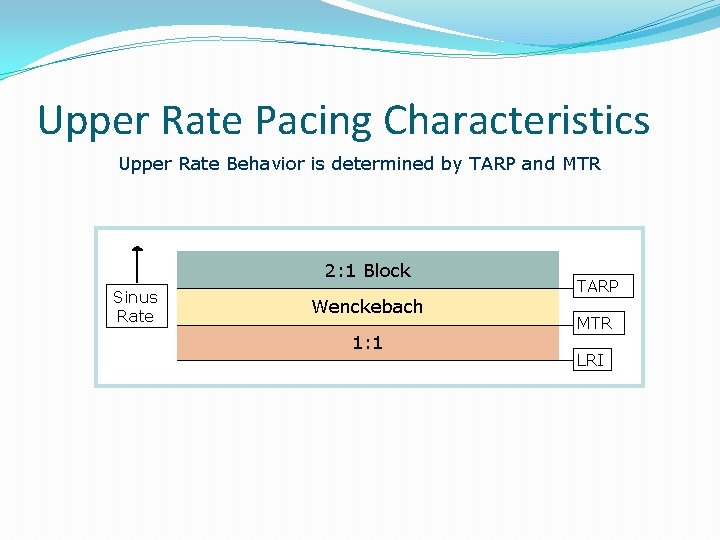
Upper Rate Pacing Characteristics Upper Rate Behavior is determined by TARP and MTR 2: 1 Block Sinus Rate Wenckebach 1: 1 TARP MTR LRI

How to deal with this?
Solution �In young patients, the upper rate of the pacemaker to be programmed to faster rates corrected for the patient's age to prevent Wenckebach behavior of the pacemaker during exercise. �Programming dynamic AV interval and dynamic PVARP allows the TARP to be shorter at higher pacing rates and avoid sudden slowing of ventricular pacing rates. �Sensor driven pacing : a separately programmable sensor rate allows the pacemaker to continue to pace at the sensor-driven rate during exercise

Dynamic AVI and PVARP § Programmed AV Delay shortens with increasing rate § Allows programming a higher MTR for higher 1: 1 P-synchronous tracking
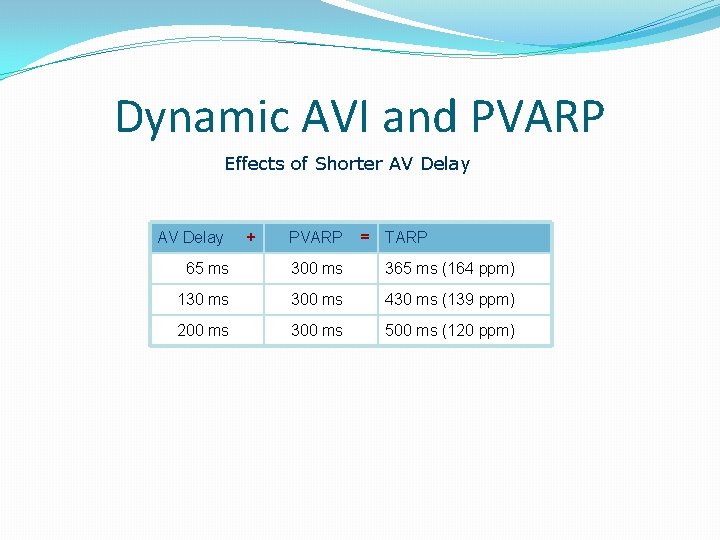
Dynamic AVI and PVARP Effects of Shorter AV Delay + PVARP = TARP 65 ms 300 ms 365 ms (164 ppm) 130 ms 300 ms 430 ms (139 ppm) 200 ms 300 ms 500 ms (120 ppm)
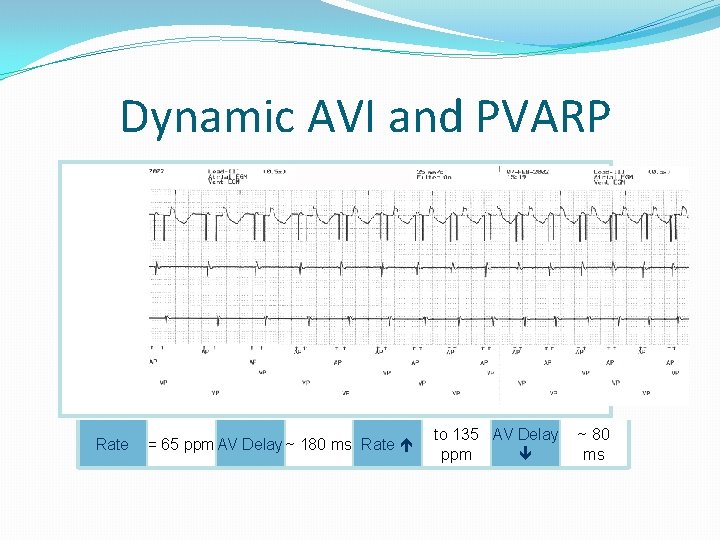
Dynamic AVI and PVARP Rate = 65 ppm AV Delay ~ 180 ms Rate to 135 AV Delay ppm ~ 80 ms

Rate-responsive Pacing Sensor driven (DDDR) pacing promotes a more regular rhythm if the sinus rate exceeds the MTR. It is not dependent on the PVARP DDD - Wenckebach DDDR

Thank you
- Slides: 18