
Upper limb problems What to refer and what
Upper limb problems What to refer and what not to Roland Pratt Consultant Orthopaedic Surgeon North Tyneside General
What can I deal with in primary care? vs What is best treated in hospital?

Introduction • Hexham audit • What to send in and what to manage in primary care • Common conditions with • Some examples • Questions
Hexham audit • Discharged after one visit • Ganglia • Low back pain • Knee pain
Send these in: • • • Tendon ruptures Masses Neurology (Dislocations / Fractures) Exhausted primary care options Diagnosis unclear
Initial management in Primary Care • • Adhesive capsulitis Subacromial impingement Tendinopathy – tennis / golfers Osteoarthritis Carpal tunnel / cubital Ganglia Dupuytrens
Tendon ruptures • Have variable window of opportunity to treat surgically – Eg flexor tendon rupture / biceps <4/52 – Rotator cuff – 12 months
Rotator cuff tears • Acute traumatic, rare under 25 years • Chronic degenerative, often on background of impingement • Pain features similar to impingement • Complains of weakness • Jobe’s test, External/ Internal rotation lag sign, belly press test
Rotator cuff tears • If acute – treat pain first, reassess once pain settled at 3 -4 weeks • If symptoms settle and function improves – compensated tear • Refer if not – cuff atrophy with time • Beware weakness in multiple injections • Beware dislocation in older patients • Surgery is for pain
Literature evidence • With kinematic magnetic resonance imaging, Bonutti et al showed that the tense subscapularis kept the capsule in contact with the underlying bone structures in external rotation, whereas in internal rotation the subscapularis became redundant and the labrum and the capsule folded into the joint in some unstable shoulders. Kinematic MRI of the shoulder. Bonutti PM, Norfray JF, Friedman RJ, Genez BM. J Comput Assist Tomogr. 1993 Jul -Aug; 17(4): 666 -9.

External rotation splint • Position of external rotation of about 10 degrees with arm in adduction • Worn for 23 hours a day for 3 -4 weeks • Can remove it for shower purposes
Audit results • 31 males, 5 females @ min 1 yr <20 yrs -16 21 -30 yrs -10 31 -40 yrs -10 • 2 non-compliant dislcn group • 4 non-complaint no dislcn group recurrent 4 1
Neurology • C-spine – radicular • Brachial neuritis • Peripheral nerves – – – Carpal tunnel Cubital tunnel Suprascapular nerve PIN Guyons Wartenbergs
Tumours • • • Greater than about 5 cm in diameter Deep to fascia, fixed or immobile Increasing in size Painful Recurrence after previous excision
Ganglions / Lumps • • • 95% hand tumours are benign Incidences unknown Many can be diagnosed clinically Enlarging and shrinking – benign Insidious onset, pain, enlarging ? malignant
Common lumps / swellings • • • Ganglia / Mucous cyst PVNS / GCT of tendon sheath Enchondroma Glomus Dermoids, fibroma, schwannomas, Heberdens nodes etc • Trigger finger • De Quervains / Intersection syndrome
Ganglia wrist • Cosmesis / pain / fear of cancer • Diagnosis – transillumination • 50% spontaneous resolution (80% children) • Aspiration – reassuring (60% recur, 75% satisfied) • Excision – 14 -40% recur. 15 -30% complications
Ganglia - Hand • Flexor sheath • Interferes with grip • 70% resolve with 2 aspirations • Surgery • Mucous cysts • OA DIPJ • Can drain / trophic nail changes / pain • Aspiration 40% recurrence • Surgery
PVNS / GCT of tendon sheath • Second most common • Firm lobulated digital fibroblastic mass • Occasionally erosions on XR • Locally recurrent 10 -20%
Enchondroma • Most common bony lump • Usually present with fracture • Single lesion benign • Ollier’s • 2% recur after BG
Glomus tumour • Uncommon unusual • Very tender • Cold sensitive ++
Initial management in primary care • Subacromial impingement vs adhesive capsulitis • Osteoarthritis • Tennis / golfers • Trigger digits • Carpal tunnel / cubital • Dupuytrens
Impingement • Middle age onwards • Onset variable • Anterolateral shoulder pain / night pain • Overhead activities / elbow away from side • Painful arc, Neers, Hawkins vs crossed adduction
Impingement Treatment • Activity modification: avoid activity with elbow away from side – work, computer etc • Stretching • NSAIDs • Steroid Injection – short term • Physical Therapy – effective in up to 70% • Surgery
Adhesive Capsulitis • Dupuytrens like capsular tightness • Idiopathic assoc diabetes, thyroid • Secondary trauma • Diffential – infection/GH arthritis/mets or ca
Adhesive Capsulitis • • • 40 -70 years 3 phases Shoulder pain radiating, dull Sharp exacerbations with movement Global loss of ROM – check external rotation
Adhesive Capsulitis • Symptomatic treatment • Many modalities – poor evidence for all • MUA under GA is UK norm
Dupuytren’s • Males, 50+ yrs, genetic • Diathesis younger, male, bilateral, +ve FHx • History – rate progression • ‘table-top’ test
Treatment – ? Injection of collagenase – Fasciotomy (cut the cord) • for MCPJ contracture, elderly – Limited fasciectomy (cord excision) • if PIPJ involved (1. 5% chance digital nerve injury) +/- FTSG
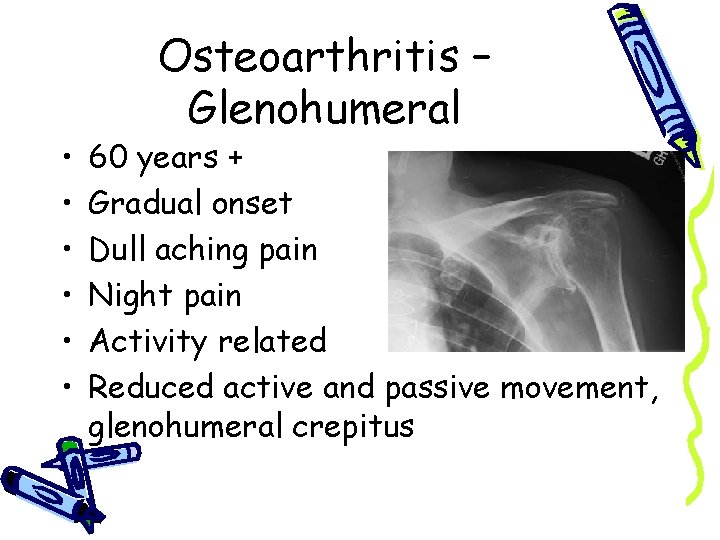
• • • Osteoarthritis – Glenohumeral 60 years + Gradual onset Dull aching pain Night pain Activity related Reduced active and passive movement, glenohumeral crepitus
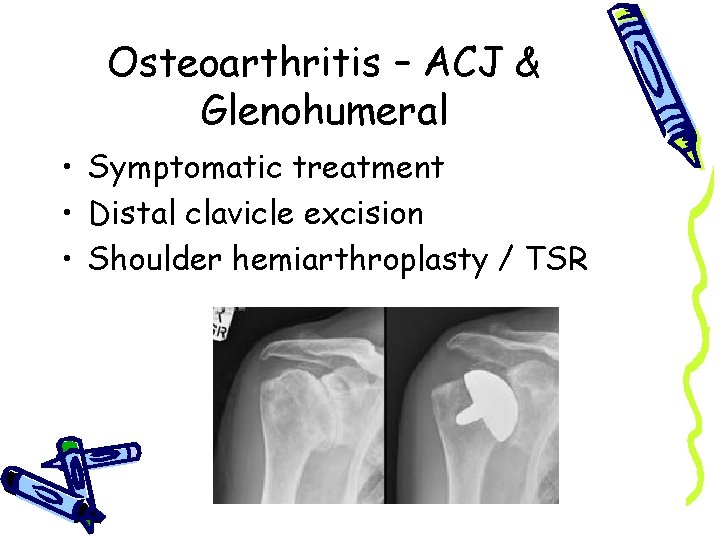
Osteoarthritis – ACJ & Glenohumeral • Symptomatic treatment • Distal clavicle excision • Shoulder hemiarthroplasty / TSR
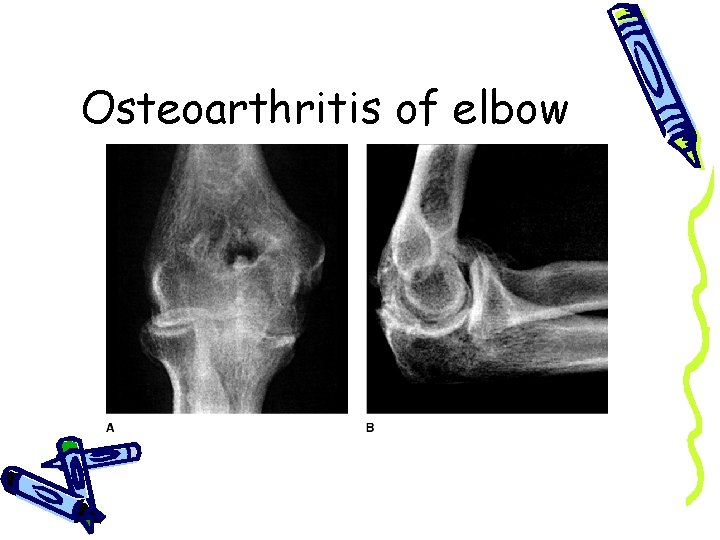
Osteoarthritis of elbow
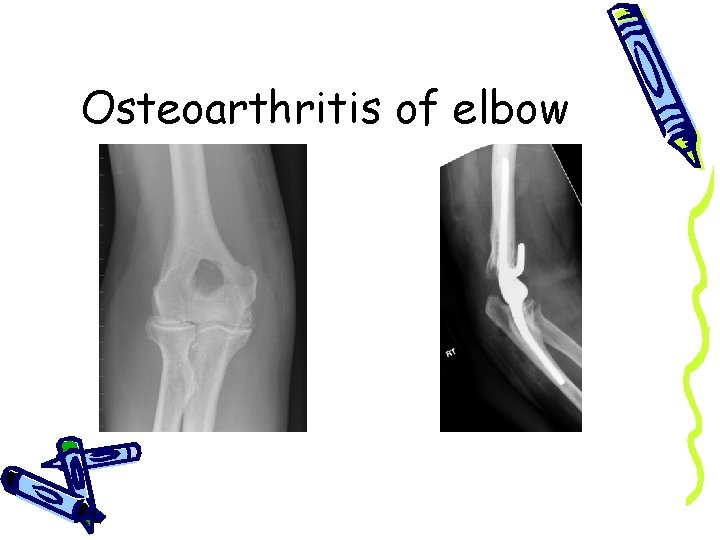
Osteoarthritis of elbow
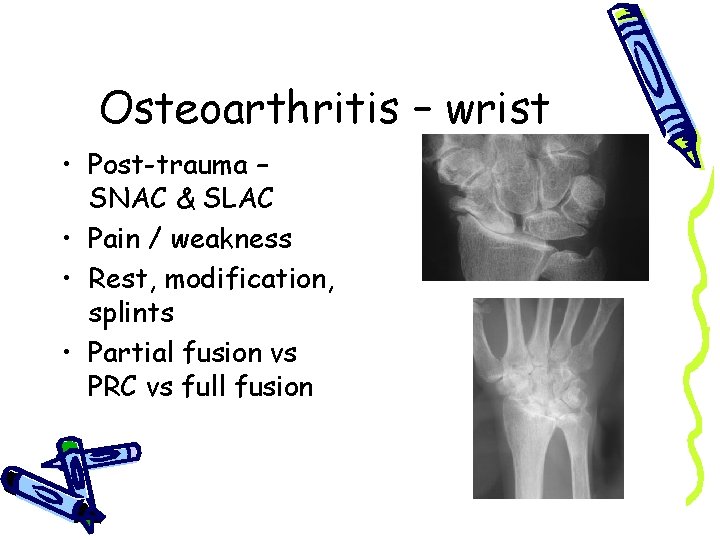
Osteoarthritis – wrist • Post-trauma – SNAC & SLAC • Pain / weakness • Rest, modification, splints • Partial fusion vs PRC vs full fusion
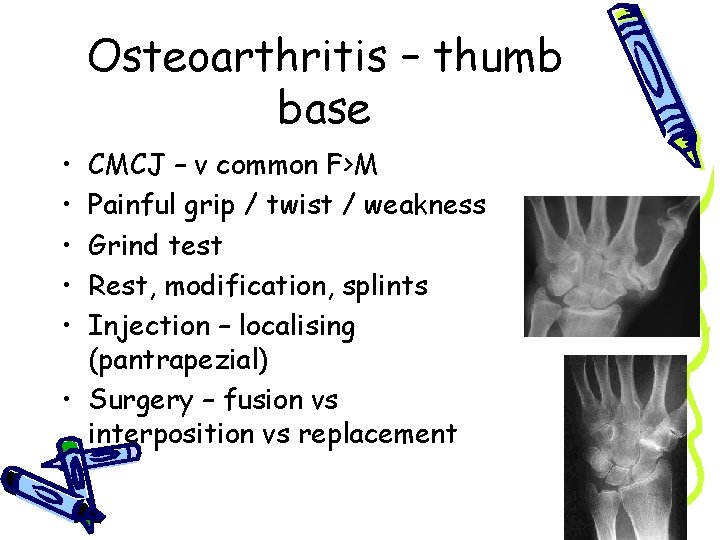
Osteoarthritis – thumb base • • • CMCJ – v common F>M Painful grip / twist / weakness Grind test Rest, modification, splints Injection – localising (pantrapezial) • Surgery – fusion vs interposition vs replacement
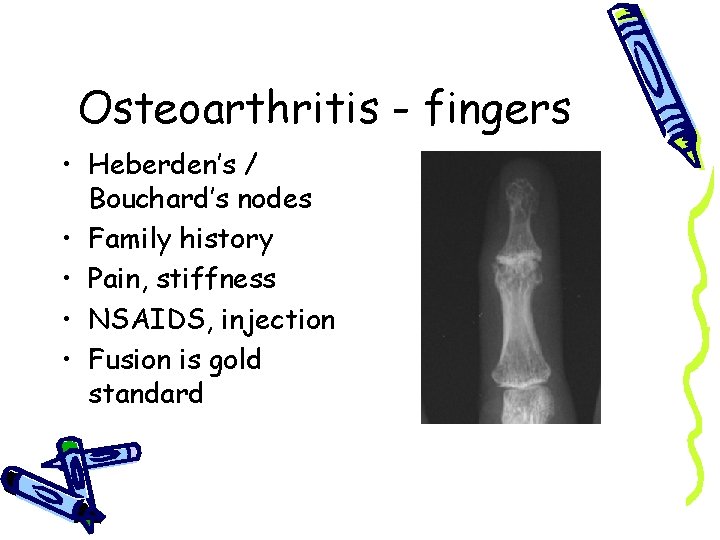
Osteoarthritis - fingers • Heberden’s / Bouchard’s nodes • Family history • Pain, stiffness • NSAIDS, injection • Fusion is gold standard
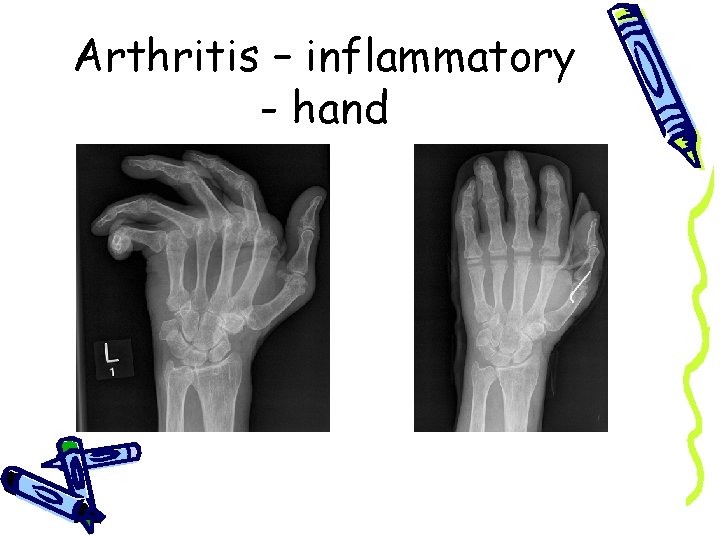
Arthritis – inflammatory - hand
Tennis elbow (lateral epicondylitis) • What is it? • Differential – lateral compartment OA – radial tunnel syndrome • Tests – tender over extensor origin – pain passive wrist flexion / active extension – Thomson’s test (ERCB)
Treatment • Rest / ice / activity modification • physio – stretching / ultrasound / acupuncture • Steroid injection – Max 3 • Surgery – open – 70% successful • Epiclasp www. gnulc. com
Carpal Tunnel Syndrome • F (25 -40; 60+)> M • 50% bilateral • Pregnancy, thyroid, AI, Colles’ Symptoms • Pain - night • Pins and needles • Clumsiness
Carpal Tunnel Syndrome examination • Sensation (2 point) • Wasting / weakness • Tinels • Phalens NB can be negative in advanced CTS
Carpal Tunnel Syndrome Nerve Conduction tests • Mild (sensory slowing) • Moderate (motor slowing) • Severe (axon drop out)
CTS treatment • Splintage • Steroid injection – 50% respond but drops off (POEMS) – Technique – Avoid intraneural injection • Surgery
Cubital tunnel syndrome • Most common site entrapment ulnar nerve • numbness ulnar 1 1/2 digits AND dorsum hand • muscle wasting • examine elbow • Tinels • Differential – T 1 nerve root entrapment – cervical rib – low entrapment (Guyon’s canal)
Trigger finger / thumb • 40 -60 years • Repetitive work • Rh. A, gout, hypothyroidism • Symptomatic Tx • Injections • Surgery
De Quervain’s Disease • • F>M Mothers Repetitive movt Finkelstein’s test Symptomatic Tx Injections Surgery
Intersection syndrome • • Proximal to De Quervain’s Direct trauma/repetitive movt Anatomy Usually responsive to conservative measures
Management in Primary Care summary • • Activity modification Analgesia is safer than Surgery Physiotherapy Aspirations / injections
Refer in – delay may alter prognosis • Tendon / ligament disruption • Tumours • Certain Neurology • ……just had enough
Sources of information • • http: //ebmg. wiley. com http: //www. cochrane. org/ http: //www. prodigy. nhs. uk http: //www. jr 2. ox. ac. uk/bandolier
- Slides: 50