
Upper GI Bleed Clinical Case Presentation Lisa Philipose
Upper GI Bleed: Clinical Case Presentation Lisa Philipose 4 / 25/ 06
History • CC: 79 y. o. white male presents via EMS to the Bayview E. D. with two days of loose black tarry stools. • HPI: On the morning PTA, patient felt weak and light-headed, so wife called EMS. VS in the field were: HR: 136; BP: 82/48; RR: 18; O 2 sat: 98% on RA; D-stick: 150. • 600 cc bolus was administered by EMS and BP increased to 107/61 and HR decreased to 96.
History • ROS: Pt denies N/V/D/C, and denies chest/abdominal/ back/flank/rectal pain. • PMH: HTN, DM, no h/o bleeding d/o; no h/o GI disorders – Last colonoscopy 3 yrs ago reported normal per patient. • PSH: None • Meds: Lisinopril, Metformin, Glucophage, HCTZ, ASA • All: NKDA • SH: No h/o tobacco/alcohol/illicits
Physical • Vital Signs: T: 98. 8 HR: 104 RR: 18 BP: 127/89 O 2 Sat: 98%, RA • Gen: Pale, smiling, NAD • HEENT: Moist mucus membranes • Lungs: CTAB • CV: RRR, no M/R/G • Abdomen: Nontender, nondistended, +BS • Rectal: Grossly heme positive with black tarry foul smelling stool, one small external hemorrhoid-not ruptured, inflamed, or bleeding • Extremities: No swelling/tenderness, 2+DP pulses • Neuro: Alert and oriented, nonfocal
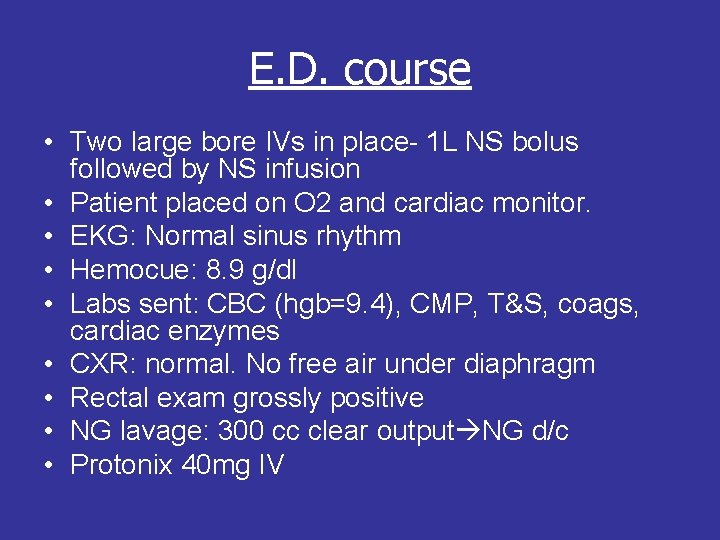
E. D. course • Two large bore IVs in place- 1 L NS bolus followed by NS infusion • Patient placed on O 2 and cardiac monitor. • EKG: Normal sinus rhythm • Hemocue: 8. 9 g/dl • Labs sent: CBC (hgb=9. 4), CMP, T&S, coags, cardiac enzymes • CXR: normal. No free air under diaphragm • Rectal exam grossly positive • NG lavage: 300 cc clear output NG d/c • Protonix 40 mg IV
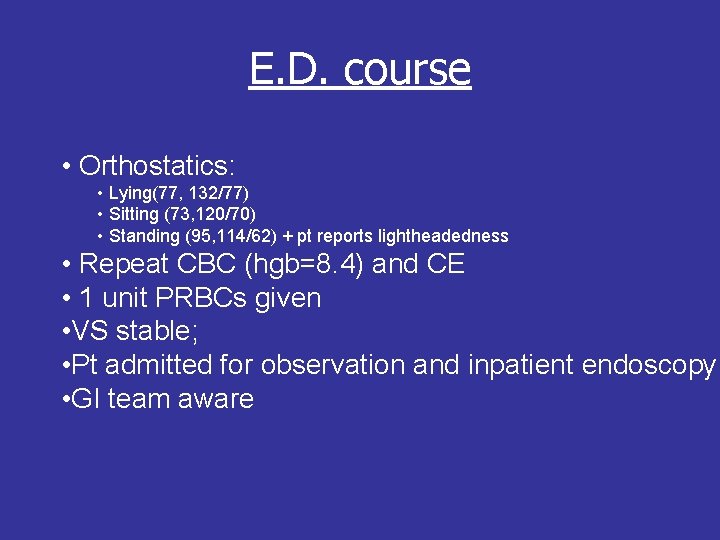
E. D. course • Orthostatics: • Lying(77, 132/77) • Sitting (73, 120/70) • Standing (95, 114/62) + pt reports lightheadedness • Repeat CBC (hgb=8. 4) and CE • 1 unit PRBCs given • VS stable; • Pt admitted for observation and inpatient endoscopy • GI team aware
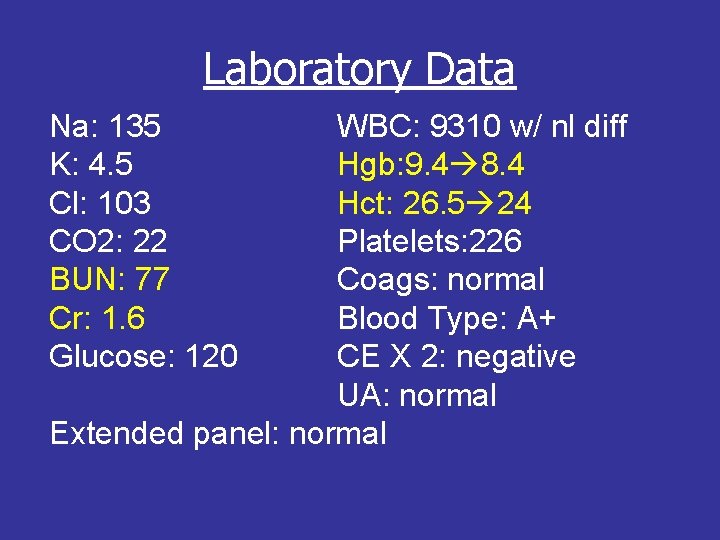
Laboratory Data Na: 135 K: 4. 5 Cl: 103 CO 2: 22 BUN: 77 Cr: 1. 6 Glucose: 120 WBC: 9310 w/ nl diff Hgb: 9. 4 8. 4 Hct: 26. 5 24 Platelets: 226 Coags: normal Blood Type: A+ CE X 2: negative UA: normal Extended panel: normal
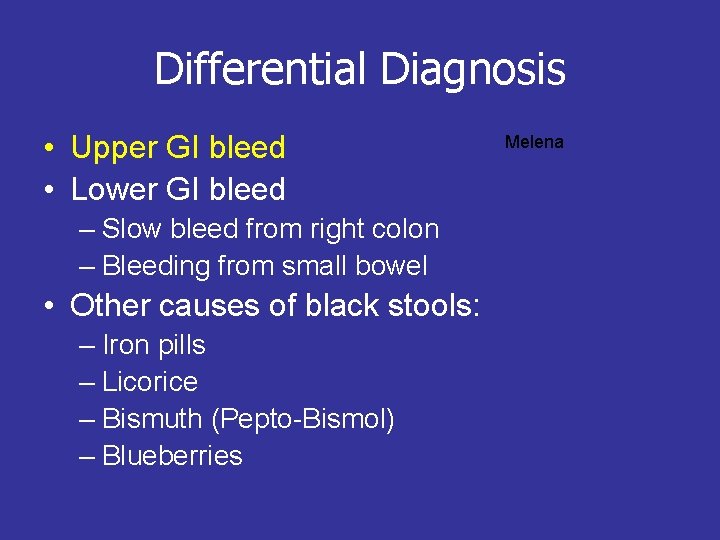
Differential Diagnosis • Upper GI bleed • Lower GI bleed – Slow bleed from right colon – Bleeding from small bowel • Other causes of black stools: – Iron pills – Licorice – Bismuth (Pepto-Bismol) – Blueberries Melena
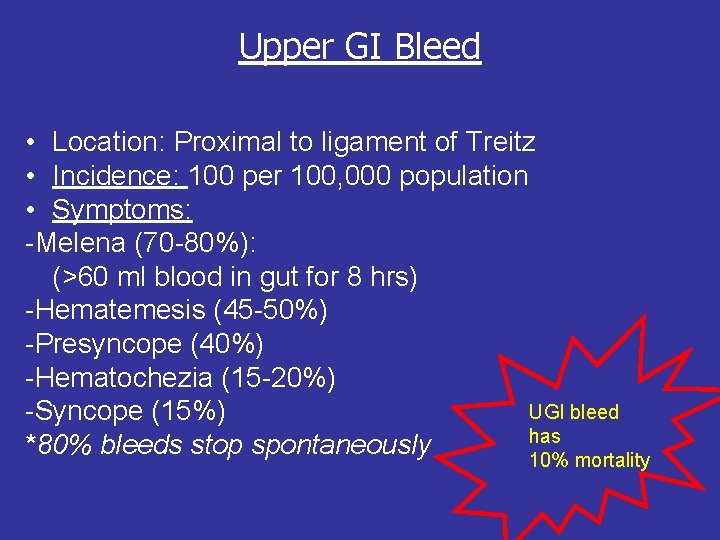
Upper GI Bleed • Location: Proximal to ligament of Treitz • Incidence: 100 per 100, 000 population • Symptoms: -Melena (70 -80%): (>60 ml blood in gut for 8 hrs) -Hematemesis (45 -50%) -Presyncope (40%) -Hematochezia (15 -20%) UGI bleed -Syncope (15%) has *80% bleeds stop spontaneously 10% mortality
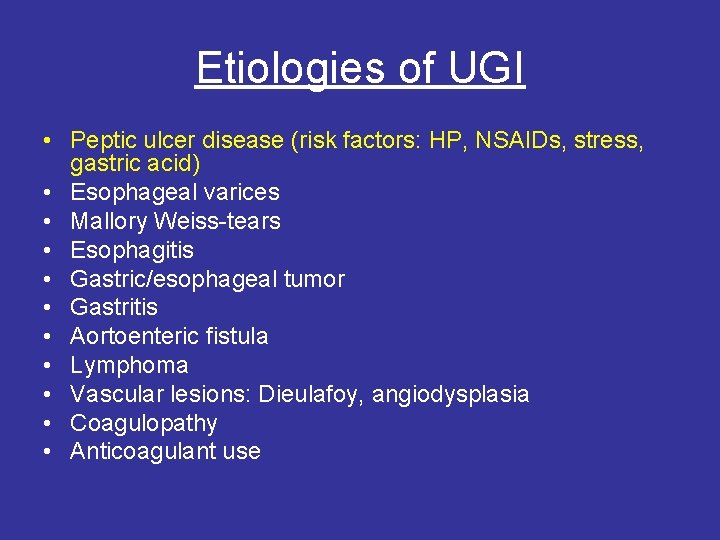
Etiologies of UGI • Peptic ulcer disease (risk factors: HP, NSAIDs, stress, gastric acid) • Esophageal varices • Mallory Weiss-tears • Esophagitis • Gastric/esophageal tumor • Gastritis • Aortoenteric fistula • Lymphoma • Vascular lesions: Dieulafoy, angiodysplasia • Coagulopathy • Anticoagulant use
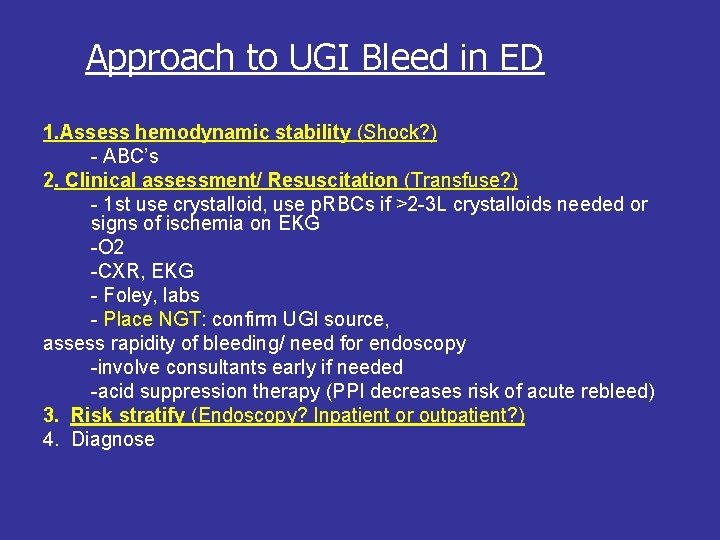
Approach to UGI Bleed in ED 1. Assess hemodynamic stability (Shock? ) - ABC’s 2. Clinical assessment/ Resuscitation (Transfuse? ) - 1 st use crystalloid, use p. RBCs if >2 -3 L crystalloids needed or signs of ischemia on EKG -O 2 -CXR, EKG - Foley, labs - Place NGT: confirm UGI source, assess rapidity of bleeding/ need for endoscopy -involve consultants early if needed -acid suppression therapy (PPI decreases risk of acute rebleed) 3. Risk stratify (Endoscopy? Inpatient or outpatient? ) 4. Diagnose
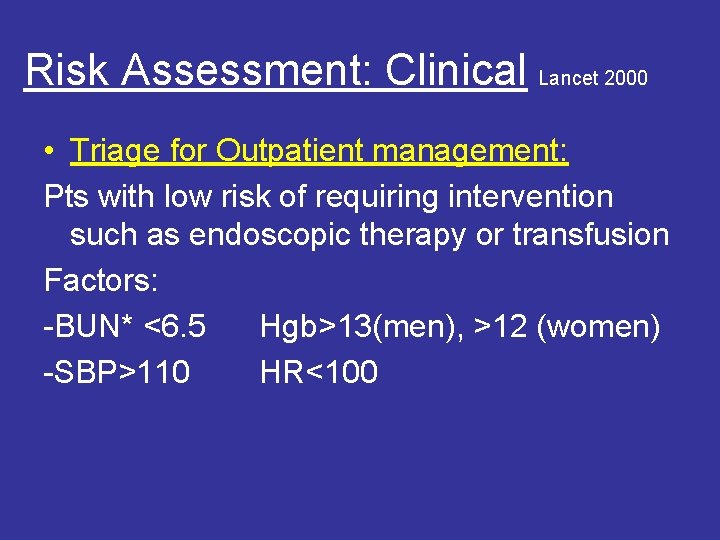
Risk Assessment: Clinical Lancet 2000 • Triage for Outpatient management: Pts with low risk of requiring intervention such as endoscopic therapy or transfusion Factors: -BUN* <6. 5 Hgb>13(men), >12 (women) -SBP>110 HR<100
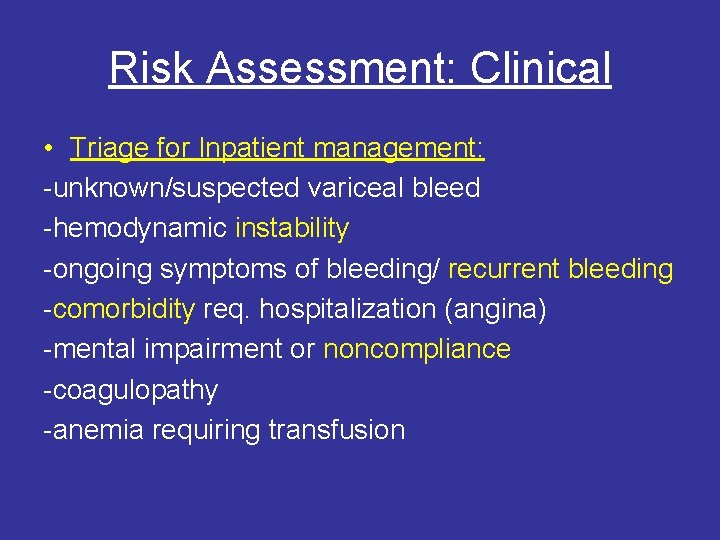
Risk Assessment: Clinical • Triage for Inpatient management: -unknown/suspected variceal bleed -hemodynamic instability -ongoing symptoms of bleeding/ recurrent bleeding -comorbidity req. hospitalization (angina) -mental impairment or noncompliance -coagulopathy -anemia requiring transfusion
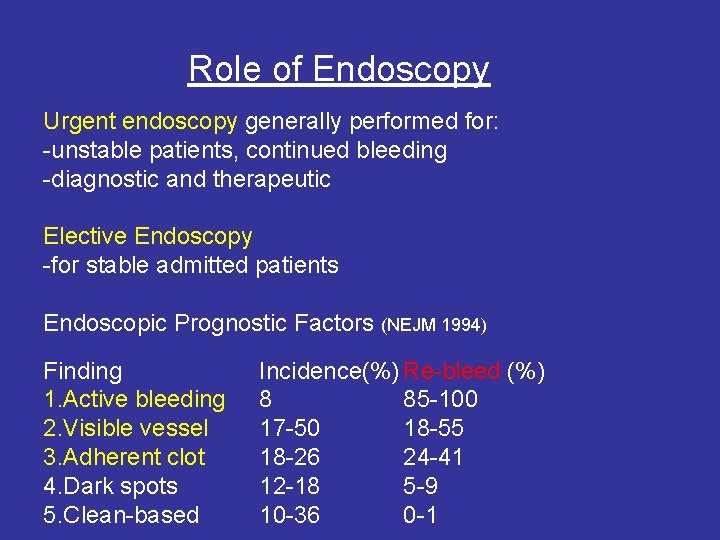
Role of Endoscopy Urgent endoscopy generally performed for: -unstable patients, continued bleeding -diagnostic and therapeutic Elective Endoscopy -for stable admitted patients Endoscopic Prognostic Factors (NEJM 1994) Finding 1. Active bleeding 2. Visible vessel 3. Adherent clot 4. Dark spots 5. Clean-based Incidence(%) Re-bleed (%) 8 85 -100 17 -50 18 -55 18 -26 24 -41 12 -18 5 -9 10 -36 0 -1
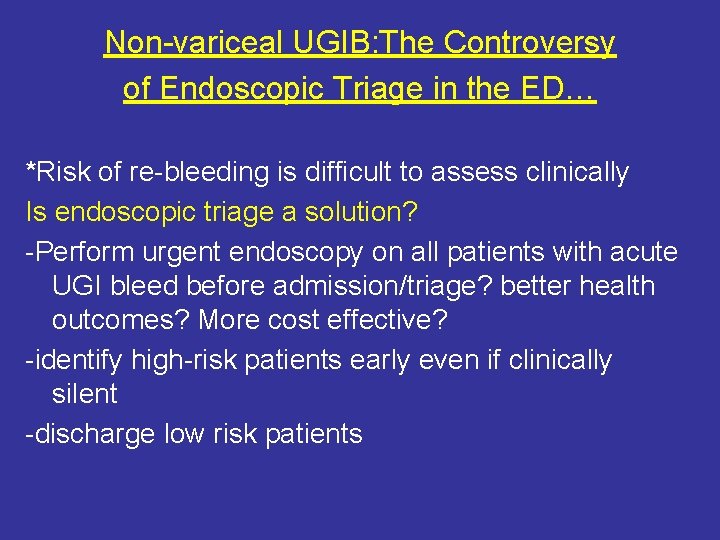
Non-variceal UGIB: The Controversy of Endoscopic Triage in the ED… *Risk of re-bleeding is difficult to assess clinically Is endoscopic triage a solution? -Perform urgent endoscopy on all patients with acute UGI bleed before admission/triage? better health outcomes? More cost effective? -identify high-risk patients early even if clinically silent -discharge low risk patients
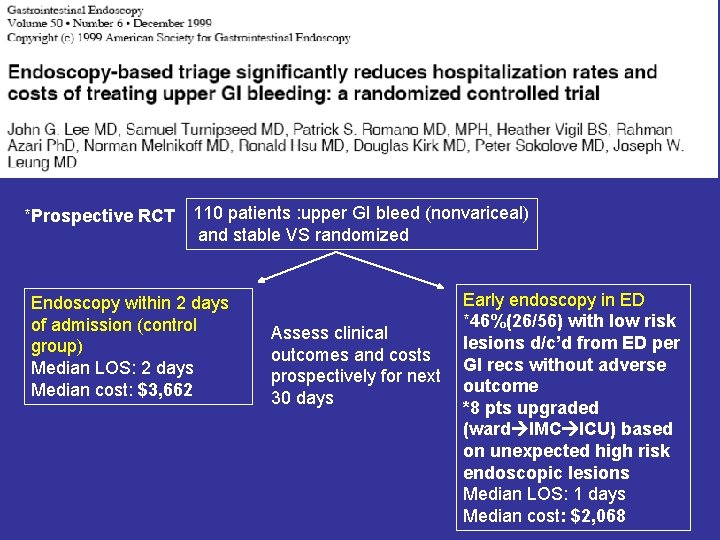
*Prospective RCT 110 patients : upper GI bleed (nonvariceal) and stable VS randomized Endoscopy within 2 days of admission (control group) Median LOS: 2 days Median cost: $3, 662 Assess clinical outcomes and costs prospectively for next 30 days Early endoscopy in ED *46%(26/56) with low risk lesions d/c’d from ED per GI recs without adverse outcome *8 pts upgraded (ward IMC ICU) based on unexpected high risk endoscopic lesions Median LOS: 1 days Median cost: $2, 068
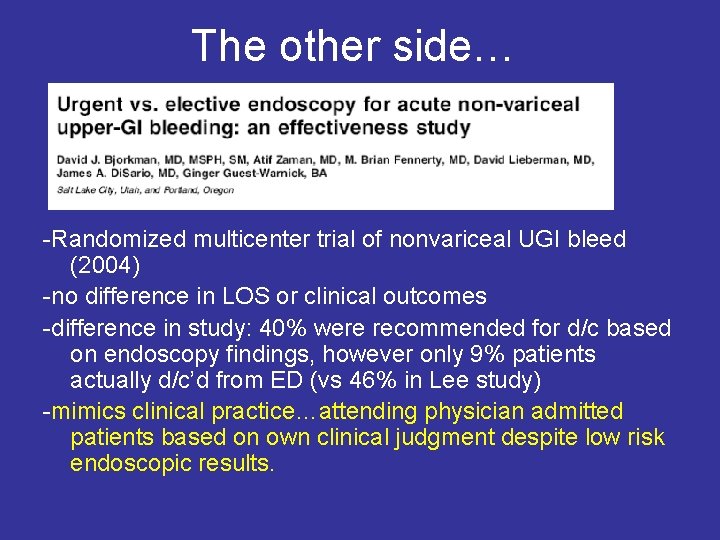
The other side… -Randomized multicenter trial of nonvariceal UGI bleed (2004) -no difference in LOS or clinical outcomes -difference in study: 40% were recommended for d/c based on endoscopy findings, however only 9% patients actually d/c’d from ED (vs 46% in Lee study) -mimics clinical practice…attending physician admitted patients based on own clinical judgment despite low risk endoscopic results.
Conclusion. . • Endoscopic triage is effective in avoiding hospitalization and reducing costs of lowrisk patients • However, if findings of endoscopy do not affect clinical practice by nonendoscopists (ED docs), endoscopic triage is not an effective tool
Back to our patient…. Post-ED Course: Patient admitted on a Friday had another episode of melena over the weekend Slight drops in hct, managed with fluids EGD on Tuesday showed: 1) antral erosions 2) healing Mallory Weiss ulcer Pt d/c’d with following recs per GI: -check HP Ab and tx with triple tx if + -continue PPI -outpatient colonoscopy
Summary • • • Assess hemodynamic stability Resuscitate History/physical: risk factors? Re-assess need for resuscitation often NG lavage Endoscopy? • All bleeding stops…eventually
References • Bjorkman DJ. Endoscopic triage for nonvariceal upper gastrointestinal bleeding: the optimal approach in 2001? ASGE wesbite, 2001. • Bjorkman DJ et al. , Urgent vs elective endoscopy for acute nonvariceal upper GI bleeding: an effectiveness study. Gastrointest endosc 2004; 60: 94 -95. • Blatchford O et al. , A risk score to predict need for treatment for uppergastrointestinal hemorrhage. Lancet 2000; 356: 1318 -21. • Eisen GM et al. , Guidelines: An annotated algorithmic approach to gastrointestinal bleeding. Gastro Endo 2001; 53: 853. • Jutabha R, Jensen D. Approach to the Adult patient with upper gastrointestinal bleeding In: Up. To. Date, Wellesley, MA, 2006. • Laine L, Peterson WL. Bleeding peptic ulcer. NEJM 1994; 331: 717 -27. • Lee JG, et al. , Endoscopy-based traige significantly reduces hospitalization rates and costs of upper GI bleeding: a randomized controlled trial. Gastrointest Endosc 1999; 50: 755 -61. • Peter DJ and Daughtery JM, Evaluation of the patient with gastrointestinal bleeding: An evidence-based approach. Emerg Med Clin NA 17: 239, 1999.
- Slides: 21