
Upper Extremity Injury Evaluation Anatomy n Shoulder n

- Slides: 34
Upper Extremity Injury Evaluation
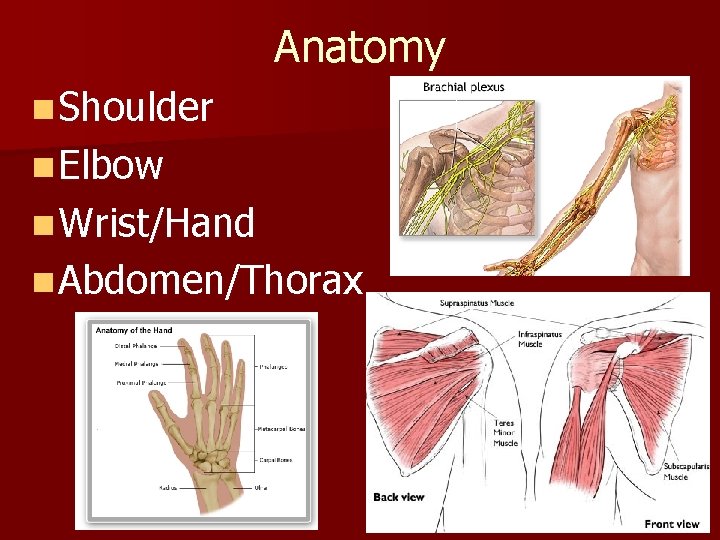
Anatomy n Shoulder n Elbow n Wrist/Hand n Abdomen/Thorax
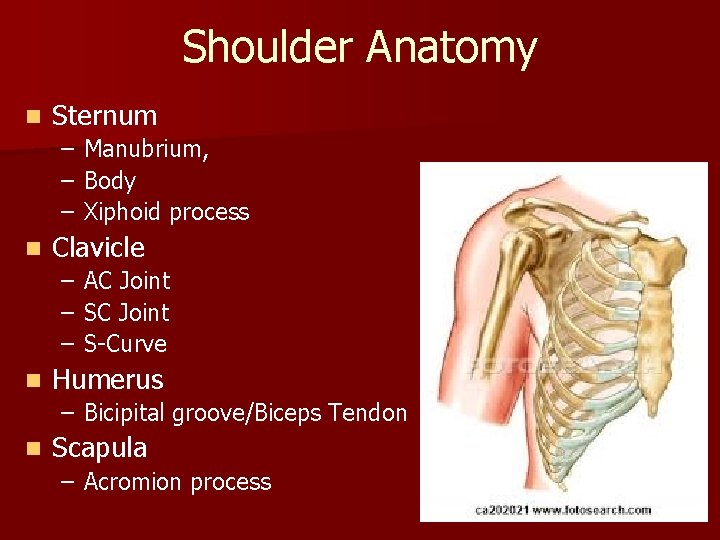
Shoulder Anatomy n Sternum – Manubrium, – Body – Xiphoid process n Clavicle – AC Joint – S-Curve n Humerus – Bicipital groove/Biceps Tendon n Scapula – Acromion process
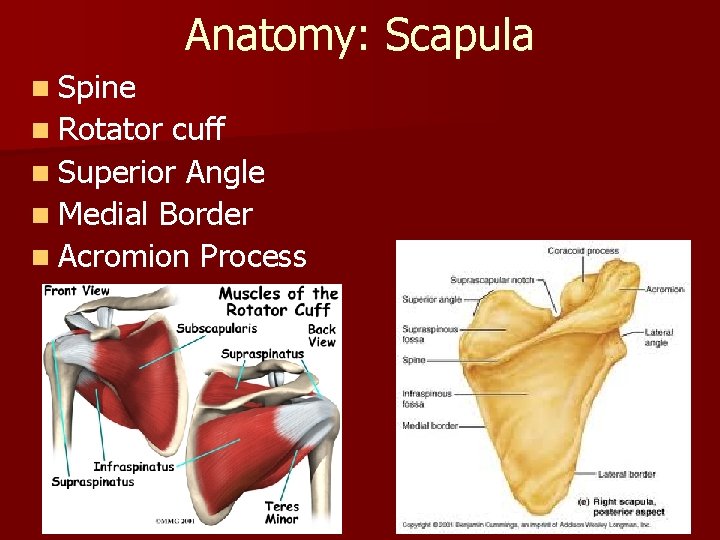
Anatomy: Scapula n Spine n Rotator cuff n Superior Angle n Medial Border n Acromion Process
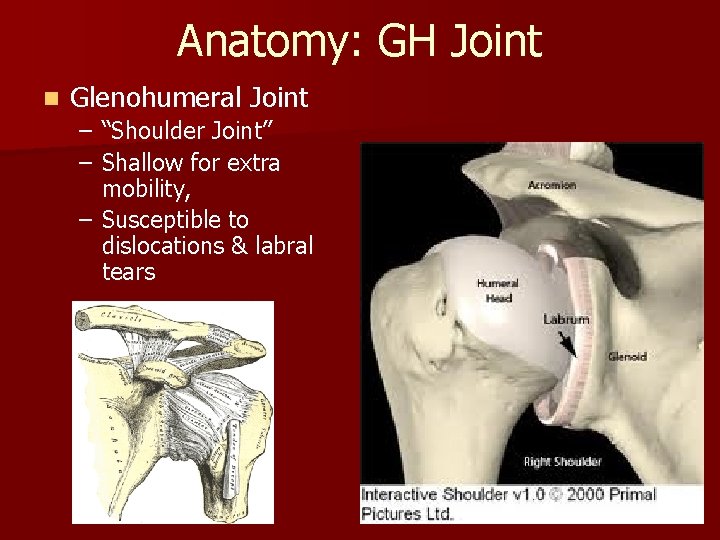
Anatomy: GH Joint n Glenohumeral Joint – “Shoulder Joint” – Shallow for extra mobility, – Susceptible to dislocations & labral tears
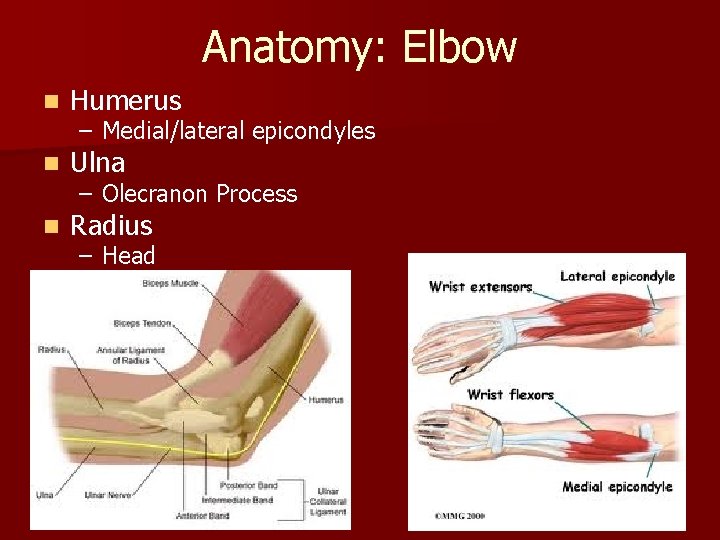
Anatomy: Elbow n Humerus n Ulna n Radius – Medial/lateral epicondyles – Olecranon Process – Head
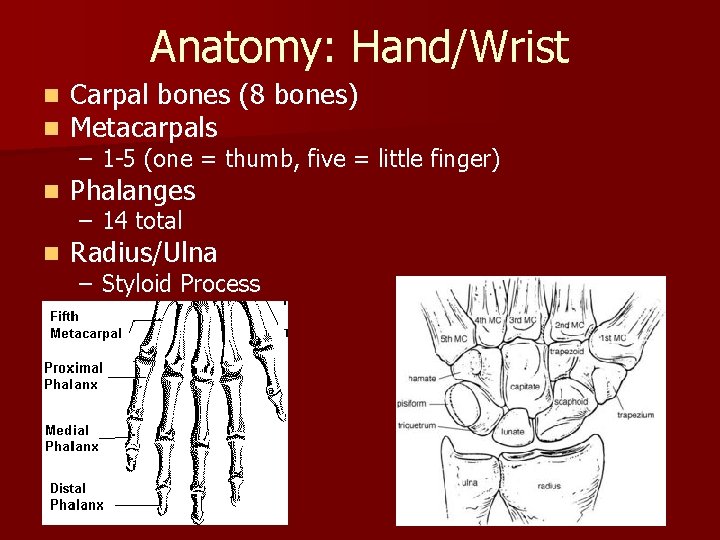
Anatomy: Hand/Wrist n n Carpal bones (8 bones) Metacarpals n Phalanges n Radius/Ulna – 1 -5 (one = thumb, five = little finger) – 14 total – Styloid Process
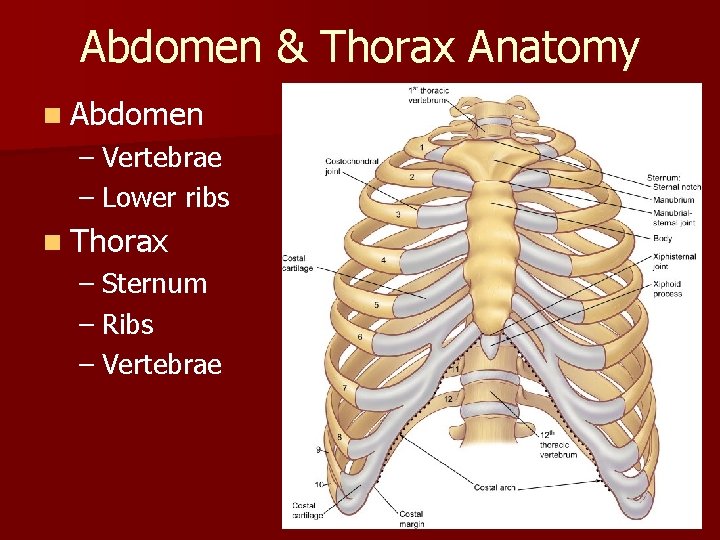
Abdomen & Thorax Anatomy n Abdomen – Vertebrae – Lower ribs n Thorax – Sternum – Ribs – Vertebrae
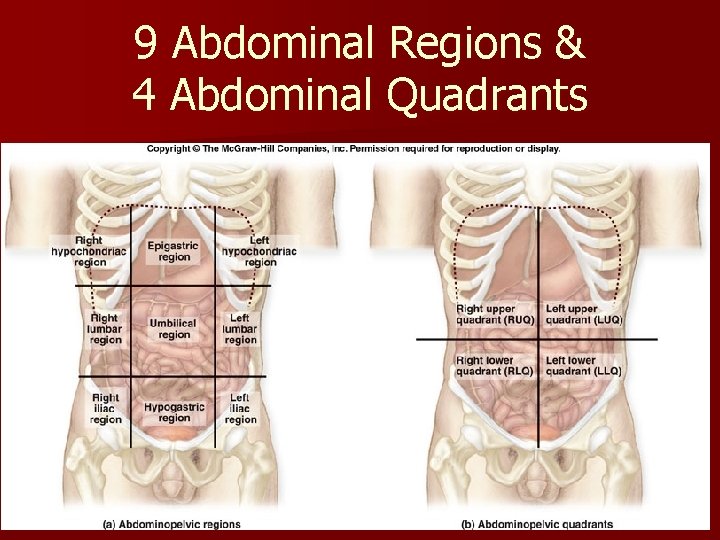
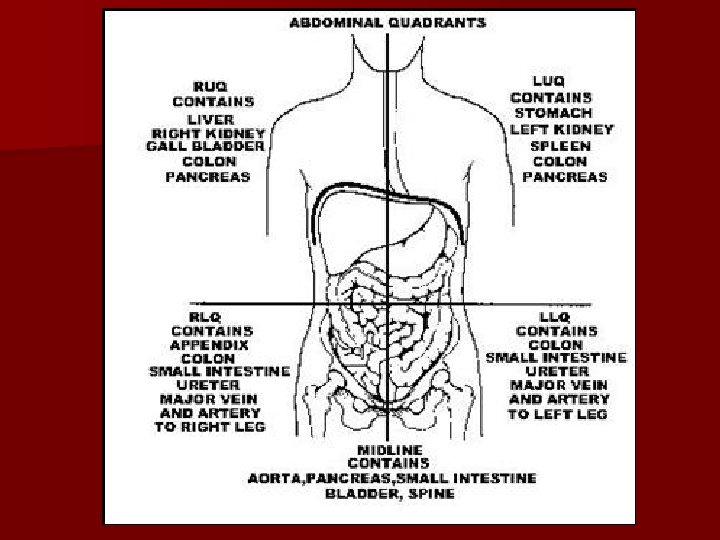
9 Abdominal Regions & 4 Abdominal Quadrants
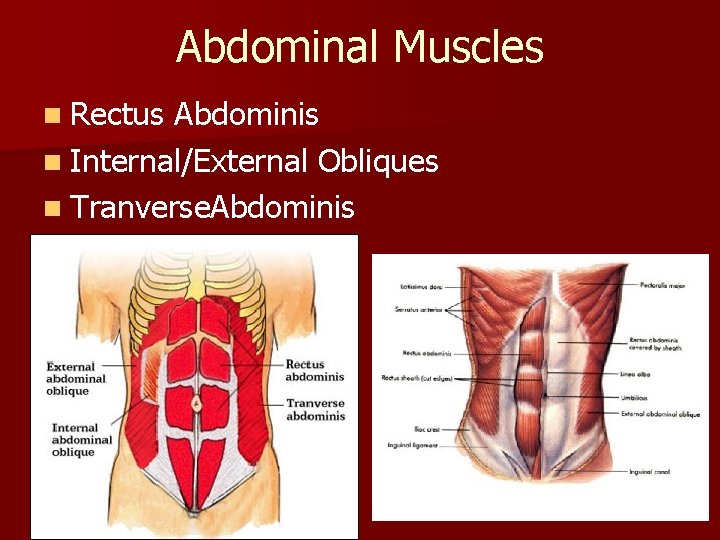
Abdominal Muscles n Rectus Abdominis n Internal/External Obliques n Tranverse. Abdominis
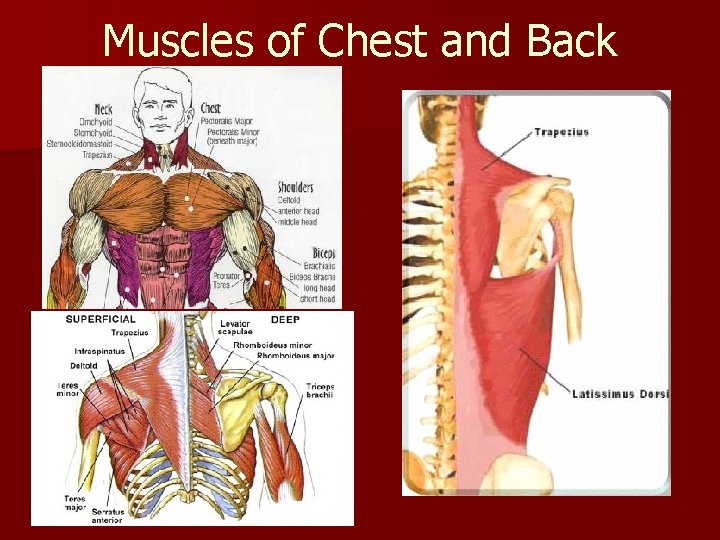
Muscles of Chest and Back
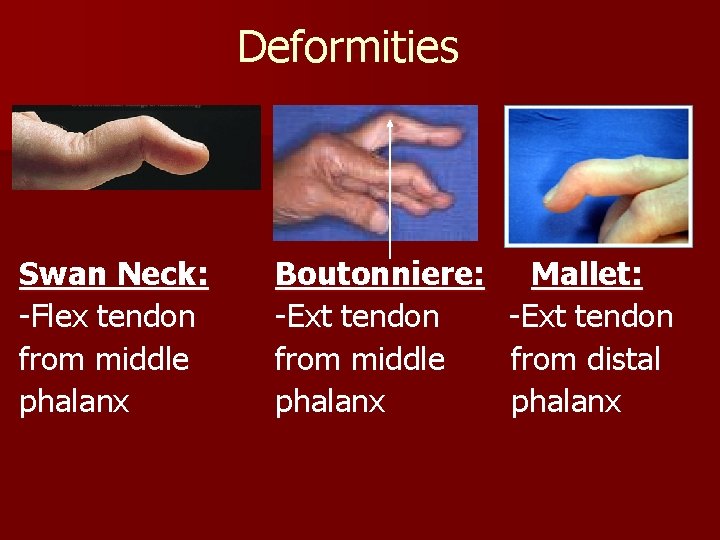
Deformities Swan Neck: -Flex tendon from middle phalanx Boutonniere: -Ext tendon from middle phalanx Mallet: -Ext tendon from distal phalanx
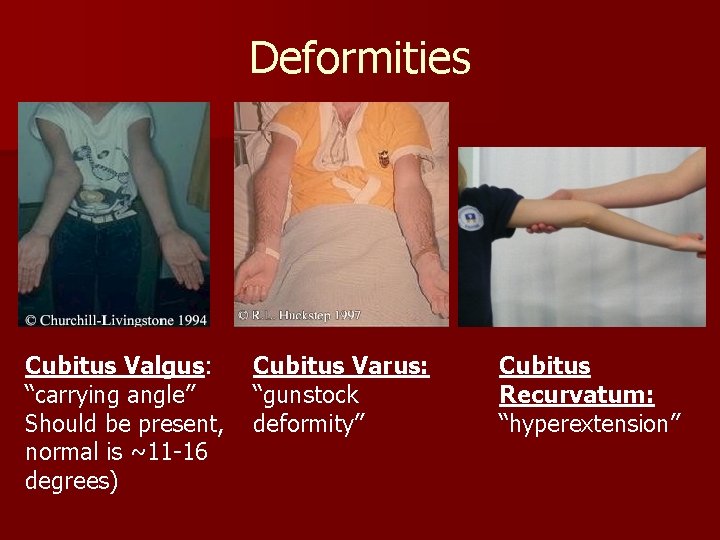
Deformities Cubitus Valgus: “carrying angle” Should be present, normal is ~11 -16 degrees) Cubitus Varus: “gunstock deformity” Cubitus Recurvatum: “hyperextension”
Range of Motion n Shoulder: Flexion, Abduction, Adduction, Extension, Int. & Ext. Rotation n Elbow: Flexion, Extension, Pronation, Supination n Wrist & Hand: Flexion, Extension, Ab- & Ad-duction (fingers & thumb), Ulnar & Radial Deviation n Trunk: Flexion, Extension, Lateral Flexion/Bending
UE Injury Evaluation
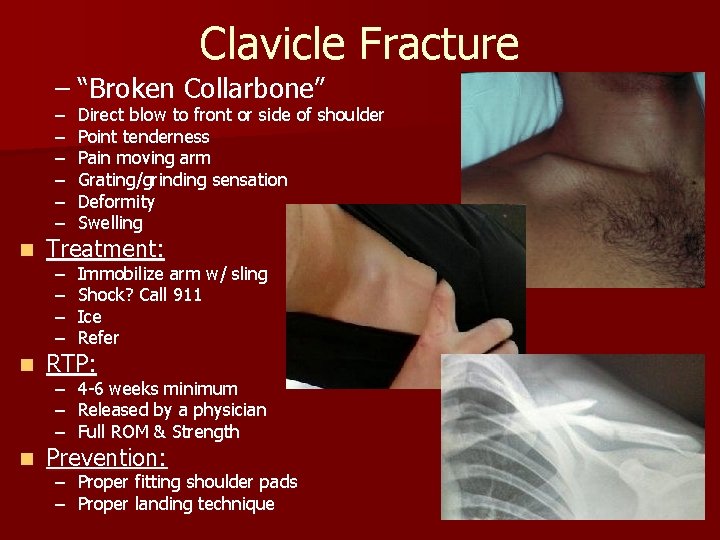
Clavicle Fracture – “Broken Collarbone” – – – Direct blow to front or side of shoulder Point tenderness Pain moving arm Grating/grinding sensation Deformity Swelling – – Immobilize arm w/ sling Shock? Call 911 Ice Refer n Treatment: n RTP: n Prevention: – 4 -6 weeks minimum – Released by a physician – Full ROM & Strength – Proper fitting shoulder pads – Proper landing technique
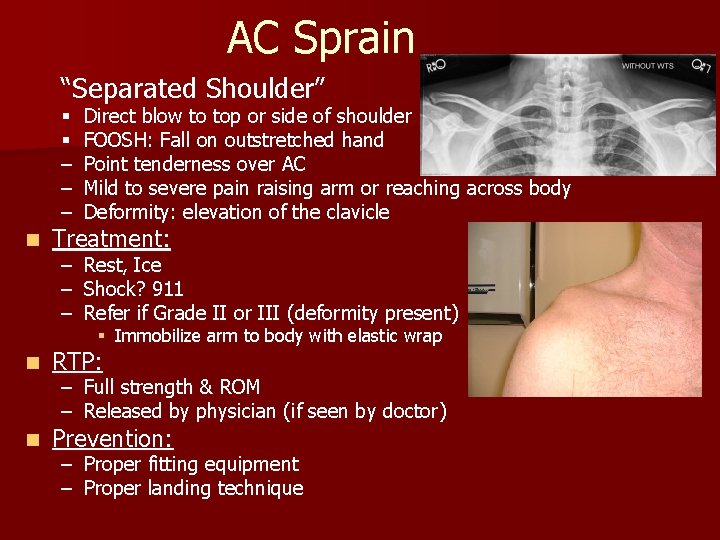
AC Sprain “Separated Shoulder” n § § – – – Direct blow to top or side of shoulder FOOSH: Fall on outstretched hand Point tenderness over AC Mild to severe pain raising arm or reaching across body Deformity: elevation of the clavicle – – – Rest, Ice Shock? 911 Refer if Grade II or III (deformity present) Treatment: § Immobilize arm to body with elastic wrap n RTP: n Prevention: – Full strength & ROM – Released by physician (if seen by doctor) – – Proper fitting equipment Proper landing technique
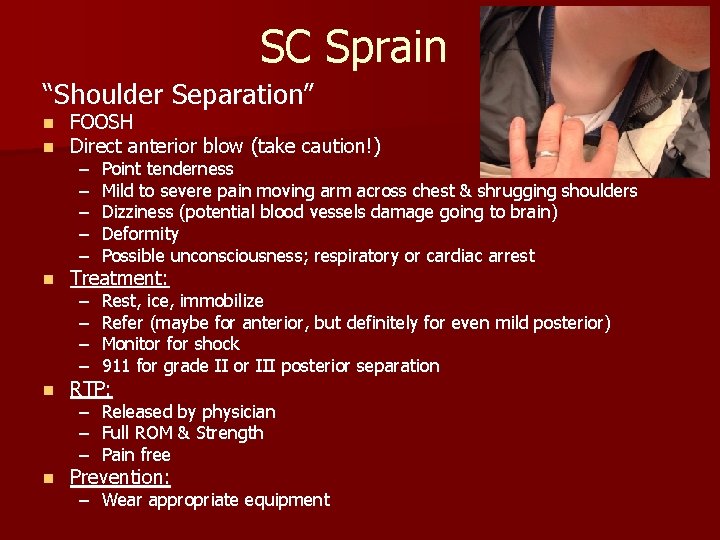
SC Sprain “Shoulder Separation” n n FOOSH Direct anterior blow (take caution!) n Treatment: n RTP: n Prevention: – – – Point tenderness Mild to severe pain moving arm across chest & shrugging shoulders Dizziness (potential blood vessels damage going to brain) Deformity Possible unconsciousness; respiratory or cardiac arrest – – Rest, ice, immobilize Refer (maybe for anterior, but definitely for even mild posterior) Monitor for shock 911 for grade II or III posterior separation – Released by physician – Full ROM & Strength – Pain free – Wear appropriate equipment
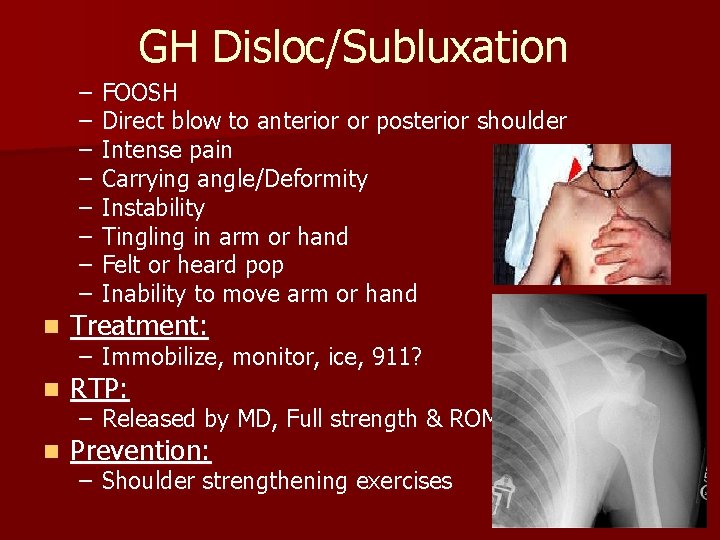
GH Disloc/Subluxation – – – – FOOSH Direct blow to anterior or posterior shoulder Intense pain Carrying angle/Deformity Instability Tingling in arm or hand Felt or heard pop Inability to move arm or hand n Treatment: n RTP: n Prevention: – Immobilize, monitor, ice, 911? – Released by MD, Full strength & ROM – Shoulder strengthening exercises
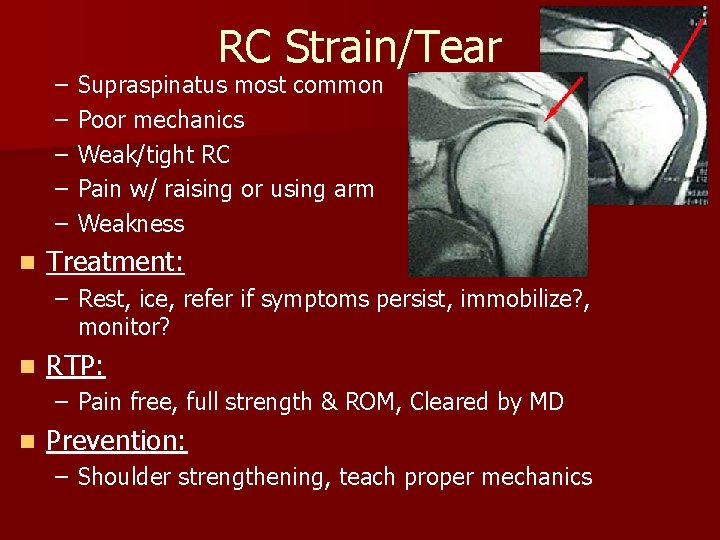
– – – n RC Strain/Tear Supraspinatus most common Poor mechanics Weak/tight RC Pain w/ raising or using arm Weakness Treatment: – Rest, ice, refer if symptoms persist, immobilize? , monitor? n RTP: – Pain free, full strength & ROM, Cleared by MD n Prevention: – Shoulder strengthening, teach proper mechanics
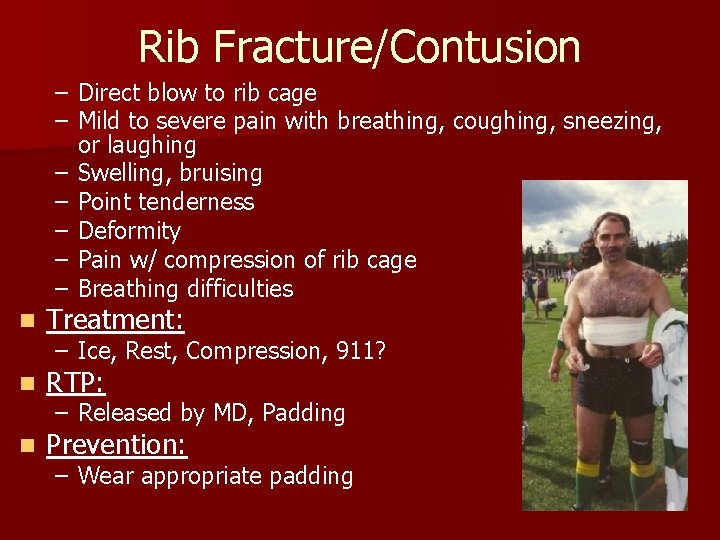
Rib Fracture/Contusion – Direct blow to rib cage – Mild to severe pain with breathing, coughing, sneezing, or laughing – Swelling, bruising – Point tenderness – Deformity – Pain w/ compression of rib cage – Breathing difficulties n Treatment: n RTP: n Prevention: – Ice, Rest, Compression, 911? – Released by MD, Padding – Wear appropriate padding
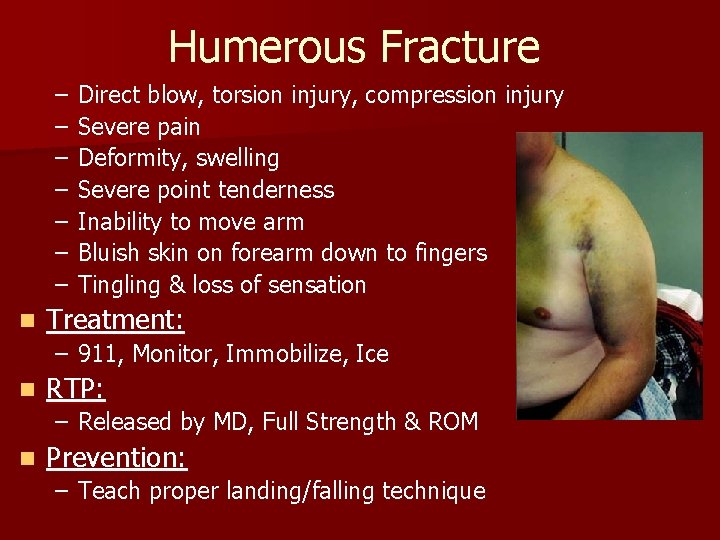
Humerous Fracture – – – – n Direct blow, torsion injury, compression injury Severe pain Deformity, swelling Severe point tenderness Inability to move arm Bluish skin on forearm down to fingers Tingling & loss of sensation Treatment: – 911, Monitor, Immobilize, Ice n RTP: – Released by MD, Full Strength & ROM n Prevention: – Teach proper landing/falling technique
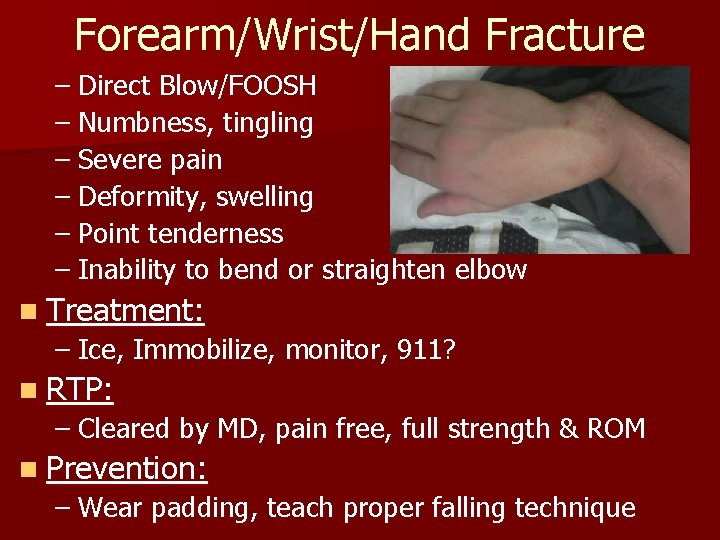
Forearm/Wrist/Hand Fracture – Direct Blow/FOOSH – Numbness, tingling – Severe pain – Deformity, swelling – Point tenderness – Inability to bend or straighten elbow n Treatment: – Ice, Immobilize, monitor, 911? n RTP: – Cleared by MD, pain free, full strength & ROM n Prevention: – Wear padding, teach proper falling technique
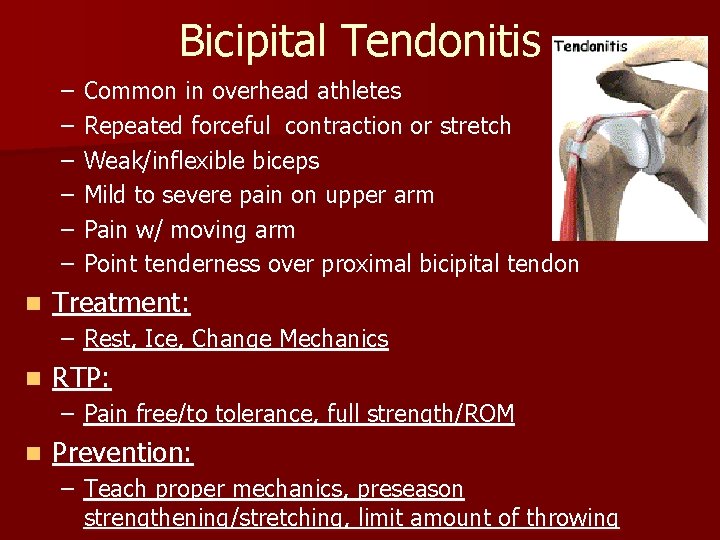
Bicipital Tendonitis – – – n Common in overhead athletes Repeated forceful contraction or stretch Weak/inflexible biceps Mild to severe pain on upper arm Pain w/ moving arm Point tenderness over proximal bicipital tendon Treatment: – Rest, Ice, Change Mechanics n RTP: – Pain free/to tolerance, full strength/ROM n Prevention: – Teach proper mechanics, preseason strengthening/stretching, limit amount of throwing
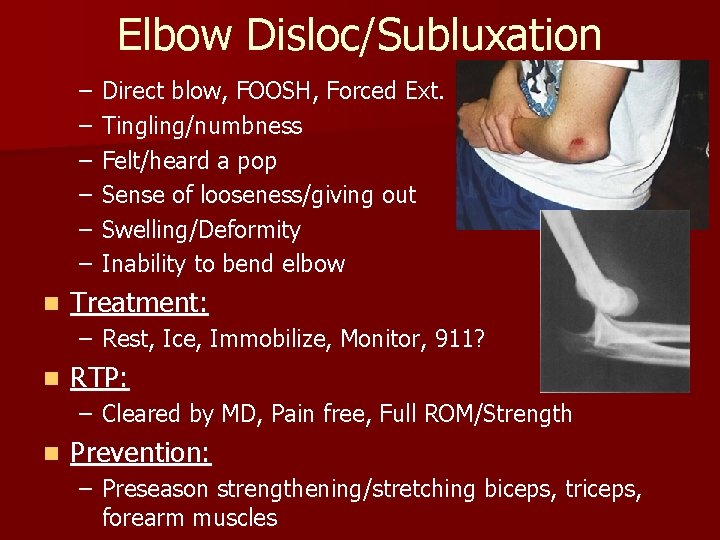
Elbow Disloc/Subluxation – – – n Direct blow, FOOSH, Forced Ext. Tingling/numbness Felt/heard a pop Sense of looseness/giving out Swelling/Deformity Inability to bend elbow Treatment: – Rest, Ice, Immobilize, Monitor, 911? n RTP: – Cleared by MD, Pain free, Full ROM/Strength n Prevention: – Preseason strengthening/stretching biceps, triceps, forearm muscles
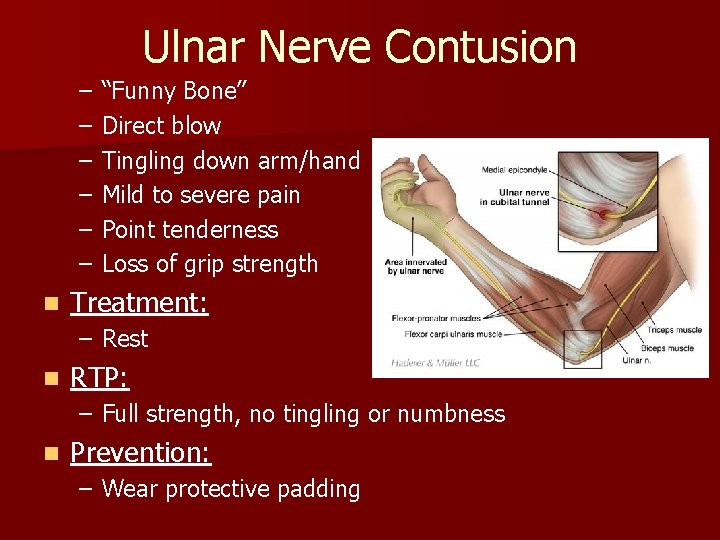
Ulnar Nerve Contusion – – – n “Funny Bone” Direct blow Tingling down arm/hand Mild to severe pain Point tenderness Loss of grip strength Treatment: – Rest n RTP: – Full strength, no tingling or numbness n Prevention: – Wear protective padding
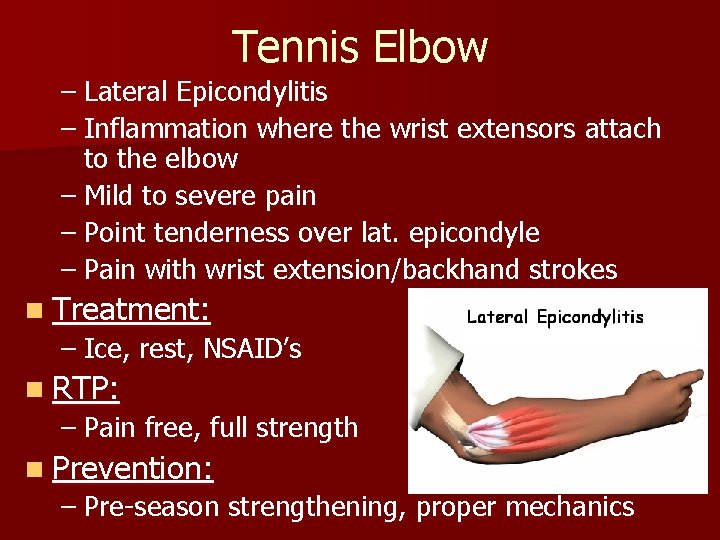
Tennis Elbow – Lateral Epicondylitis – Inflammation where the wrist extensors attach to the elbow – Mild to severe pain – Point tenderness over lat. epicondyle – Pain with wrist extension/backhand strokes n Treatment: – Ice, rest, NSAID’s n RTP: – Pain free, full strength n Prevention: – Pre-season strengthening, proper mechanics
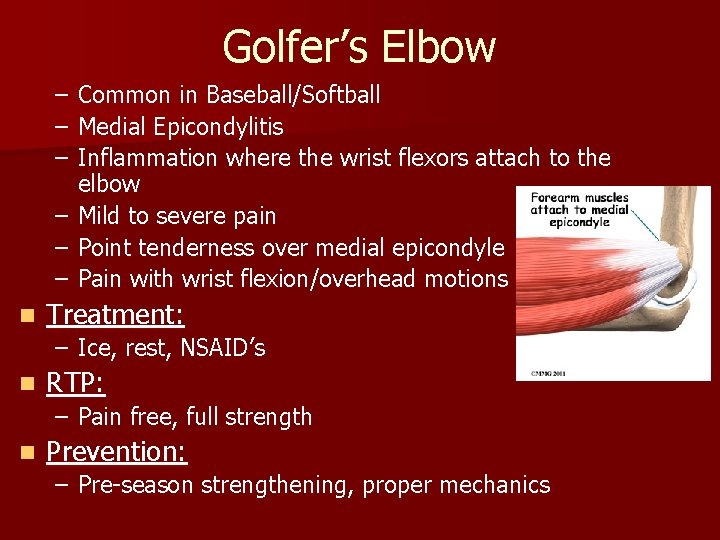
Golfer’s Elbow – – – n Common in Baseball/Softball Medial Epicondylitis Inflammation where the wrist flexors attach to the elbow Mild to severe pain Point tenderness over medial epicondyle Pain with wrist flexion/overhead motions Treatment: – Ice, rest, NSAID’s n RTP: – Pain free, full strength n Prevention: – Pre-season strengthening, proper mechanics
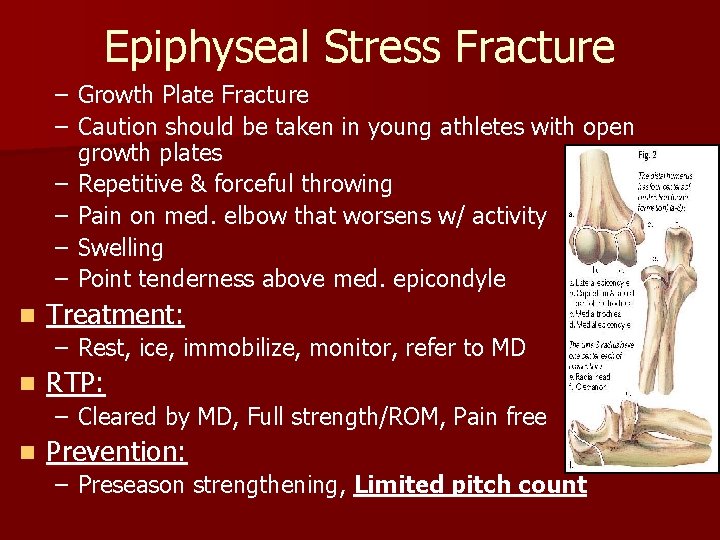
Epiphyseal Stress Fracture – Growth Plate Fracture – Caution should be taken in young athletes with open growth plates – Repetitive & forceful throwing – Pain on med. elbow that worsens w/ activity – Swelling – Point tenderness above med. epicondyle n Treatment: – Rest, ice, immobilize, monitor, refer to MD n RTP: – Cleared by MD, Full strength/ROM, Pain free n Prevention: – Preseason strengthening, Limited pitch count
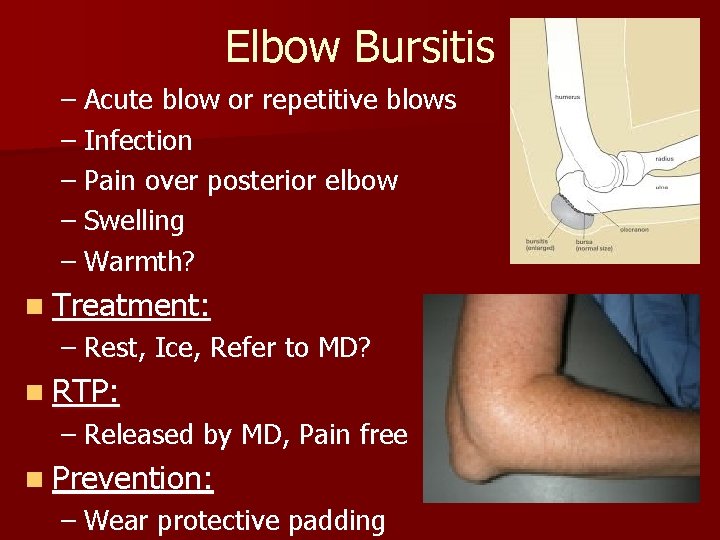
Elbow Bursitis – Acute blow or repetitive blows – Infection – Pain over posterior elbow – Swelling – Warmth? n Treatment: – Rest, Ice, Refer to MD? n RTP: – Released by MD, Pain free n Prevention: – Wear protective padding
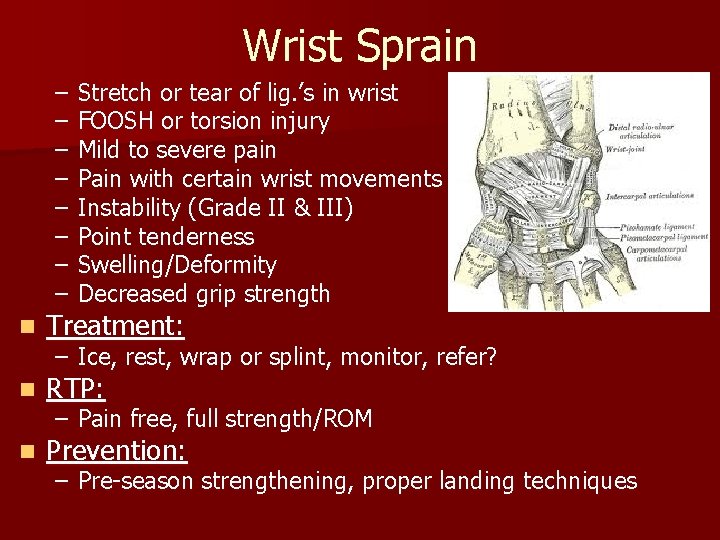
Wrist Sprain – – – – Stretch or tear of lig. ’s in wrist FOOSH or torsion injury Mild to severe pain Pain with certain wrist movements Instability (Grade II & III) Point tenderness Swelling/Deformity Decreased grip strength n Treatment: n RTP: n Prevention: – Ice, rest, wrap or splint, monitor, refer? – Pain free, full strength/ROM – Pre-season strengthening, proper landing techniques
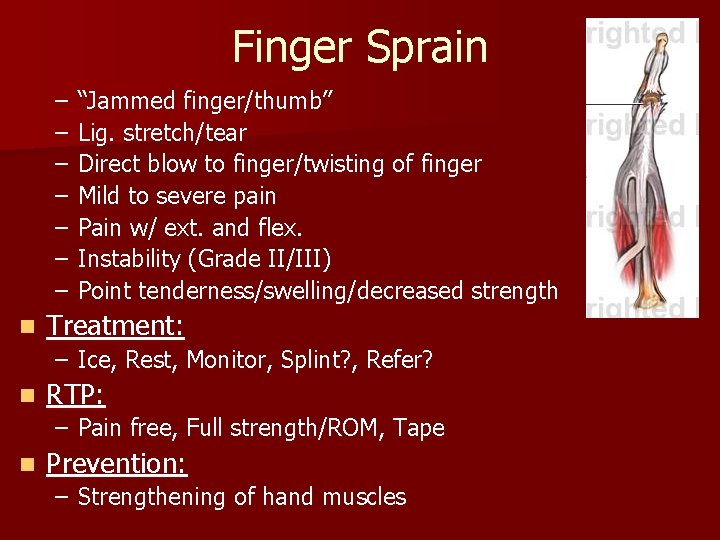
Finger Sprain – – – – n “Jammed finger/thumb” Lig. stretch/tear Direct blow to finger/twisting of finger Mild to severe pain Pain w/ ext. and flex. Instability (Grade II/III) Point tenderness/swelling/decreased strength Treatment: – Ice, Rest, Monitor, Splint? , Refer? n RTP: – Pain free, Full strength/ROM, Tape n Prevention: – Strengthening of hand muscles
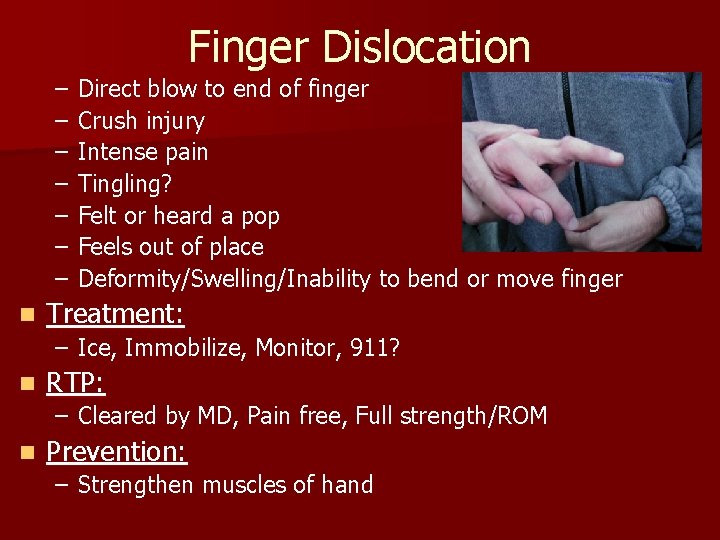
– – – – n Finger Dislocation Direct blow to end of finger Crush injury Intense pain Tingling? Felt or heard a pop Feels out of place Deformity/Swelling/Inability to bend or move finger Treatment: – Ice, Immobilize, Monitor, 911? n RTP: – Cleared by MD, Pain free, Full strength/ROM n Prevention: – Strengthen muscles of hand