
Upper Class E Traffic Management ETM Future Operational
- Slides: 6
Upper Class E Traffic Management (ETM) Future Operational Environment above FL 600 • New types of operations − Hypersonic flight, reintroduction of supersonic passenger flights, and very slow or -station long endurance flights on • ATM scalability − Current manner of ATM service delivery cannot cost-effectively scale to meet the needs of the envisioned ETM environment − Current ATM services may not be desired in the ETM environment • Solutions are needed that − Scale beyond current ATM infrastructure and manpower resources − Promote shared situation awareness among Operators − Include Cooperative Separation and Provided Separation by ATC (where required) 1
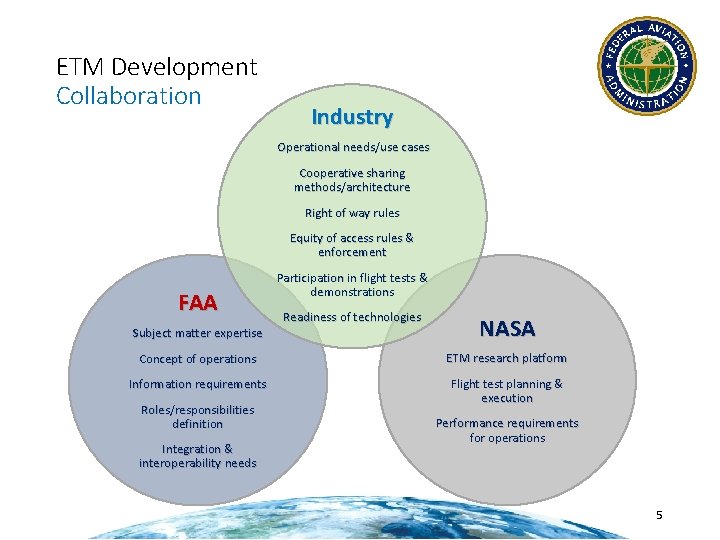
Upper Class E Traffic Management (ETM) Cooperative Separation Development • ETM concept development requires FAA, NASA, industry, State agency, and stakeholder collaboration to evolve the current service mechanisms and realize solutions • NASA hosted two ETM Tabletops with FAA, industry, and government stakeholder Space Act partners to inform concept development o Tabletop #1 (April 2019) focused on understanding planned operations above FL 600 and began discussions around a concept of operations for ETM • Established ETM foundational principles and assumptions for the cooperative environment • Established clear ETM development responsibilities for Industry, FAA, and NASA o Tabletop #2 (Dec 2019) explored ETM concept considerations associated with ATC/ETM interactions • Identified operational issues/considerations and data impacts associated with operations transitioning to/from ETM environment, operations that occur both above and below FL 600, contingency operations, and other topics that impact air traffic control operations • Informed FAA ETM Concept of Operations document development • Informed engineering plans and considerations 2
Upper Class E Traffic Management (ETM) Principles & Assumptions • The ETM environment is notionally defined as Upper Class E airspace above FL 600. • ETM Operators include - but are not limited to – commercial, public/government, and research entities operating both manned and unmanned vehicles. • Operations can move across multiple Flight Information Regions (FIRs). • The ETM supporting architecture and associated services are scalable to meet the needs of market forces. • Safe separation and demand capacity balancing are enabled through harmonized ETM airspace user interactions, established procedures, and compatible technology. • FAA retains its authority and responsibility over the airspace. • The ETM concept will be developed with consideration to international application. 3
Cooperative Separation Overview • Traffic management systems utilizing cooperative separation are community-based, where Operators are responsible for the coordination, execution and management of their operations, with community rules of the road approved by the FAA. • Operators within cooperative separation environments are responsible for maintaining separation from one another. • Cooperative separation utilizes a separate, collaborative set of separation services from those provided by ATC. • This federated set of services enables coordination between vehicle Operators, facilitated by thirdparty support providers, through networked information exchanges. • Access to the airspace must be equitable. Operators cannot optimize their own operations at the expense of sub-optimizing the ETM environment as a whole. 4
ETM Development Collaboration Industry Operational needs/use cases Cooperative sharing methods/architecture Right of way rules Equity of access rules & enforcement FAA Subject matter expertise Participation in flight tests & demonstrations Readiness of technologies NASA Concept of operations ETM research platform Information requirements Flight test planning & execution Roles/responsibilities definition Integration & interoperability needs Performance requirements for operations 55
Moving forward… • Proceed with development of ETM Concept of Operations to mature and refine the concept through use cases, roles and responsibilities allocation, and high-level operational and technical requirements • Perform engineering analyses to highlight opportunities and challenges in the current infrastructure, technology, policies, and rules with regard to their applicability to support future operations • Build simulation environment and conduct simulations to derive and validate requirements 6