
Uplink Resource Unit Performance Comparison Document Number IEEE
Uplink Resource Unit Performance Comparison Document Number: IEEE C 802. 16 m-08/857 r 1 Date Submitted: 2008 -07 -14 Source: Frank Hsieh, Fan Wang, Bishwarup Mondal, Fred Vook, Mark, Cudak, Amitava Ghosh E-mail: fanw@motorola. com Motorola *<http: //standards. ieee. org/faqs/affiliation. FAQ. html> Venue: TGm – UL PHY Base Contribution: IEEE C 802. 16 m-08/857 r 1 Abstract: Proposal for 16 m UL PHY pilot pattern. Purpose: Adoption of proposed text/content for 802. 16 m System Description Document Notice: This document does not represent the agreed views of the IEEE 802. 16 Working Group or any of its subgroups. It represents only the views of the participants listed in the “Source(s)” field above. It is offered as a basis for discussion. It is not binding on the contributor(s), who reserve(s) the right to add, amend or withdraw material contained herein. Release: The contributor grants a free, irrevocable license to the IEEE to incorporate material contained in this contribution, and any modifications thereof, in the creation of an IEEE Standards publication; to copyright in the IEEE’s name any IEEE Standards publication even though it may include portions of this contribution; and at the IEEE’s sole discretion to permit others to reproduce in whole or in part the resulting IEEE Standards publication. The contributor also acknowledges and accepts that this contribution may be made public by IEEE 802. 16. Patent Policy: The contributor is familiar with the IEEE-SA Patent Policy and Procedures: <http: //standards. ieee. org/guides/bylaws/sect 6 -7. html#6> and <http: //standards. ieee. org/guides/opman/sect 6. html#6. 3>. Further information is located at <http: //standards. ieee. org/board/pat-material. html> and <http: //standards. ieee. org/board/pat >.
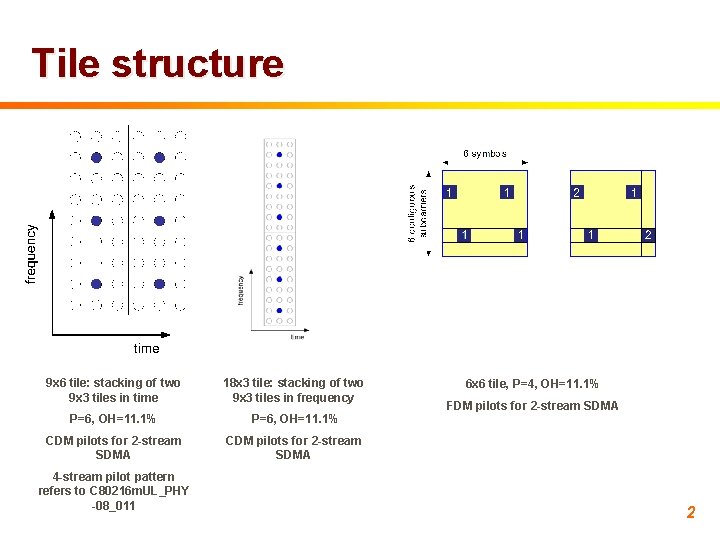
Tile structure 9 x 6 tile: stacking of two 9 x 3 tiles in time 18 x 3 tile: stacking of two 9 x 3 tiles in frequency P=6, OH=11. 1% CDM pilots for 2 -stream SDMA 4 -stream pilot pattern refers to C 80216 m. UL_PHY -08_011 6 x 6 tile, P=4, OH=11. 1% FDM pilots for 2 -stream SDMA 2
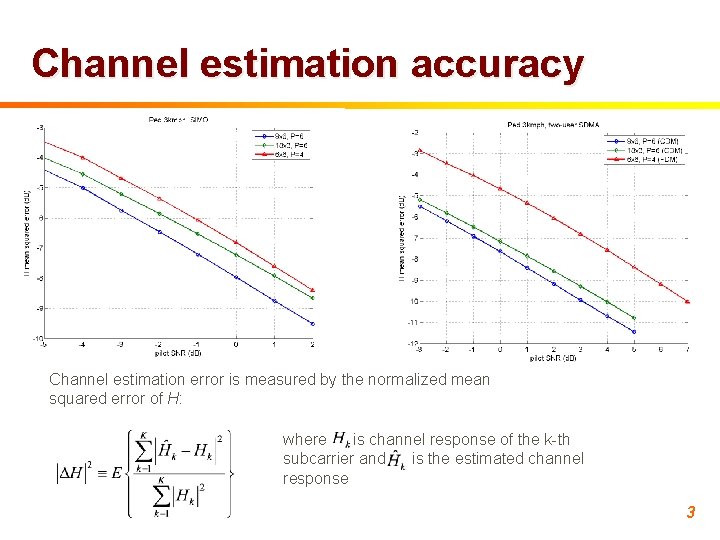
Channel estimation accuracy Channel estimation error is measured by the normalized mean squared error of H: where is channel response of the k-th subcarrier and is the estimated channel response 3
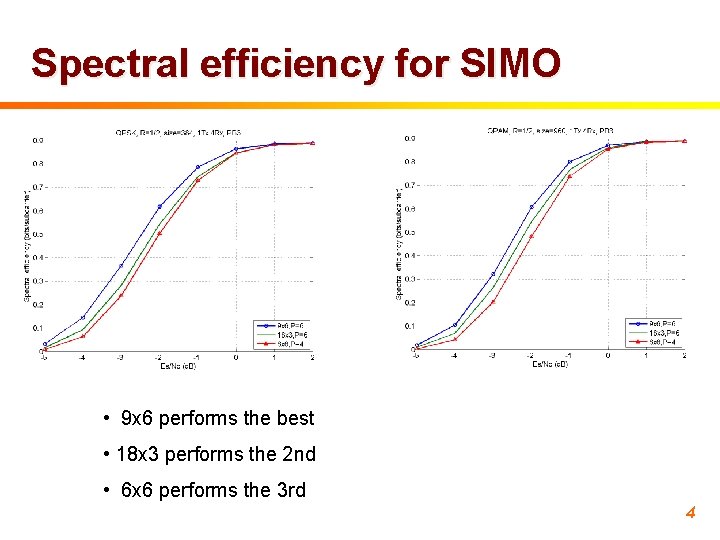
Spectral efficiency for SIMO • 9 x 6 performs the best • 18 x 3 performs the 2 nd • 6 x 6 performs the 3 rd 4
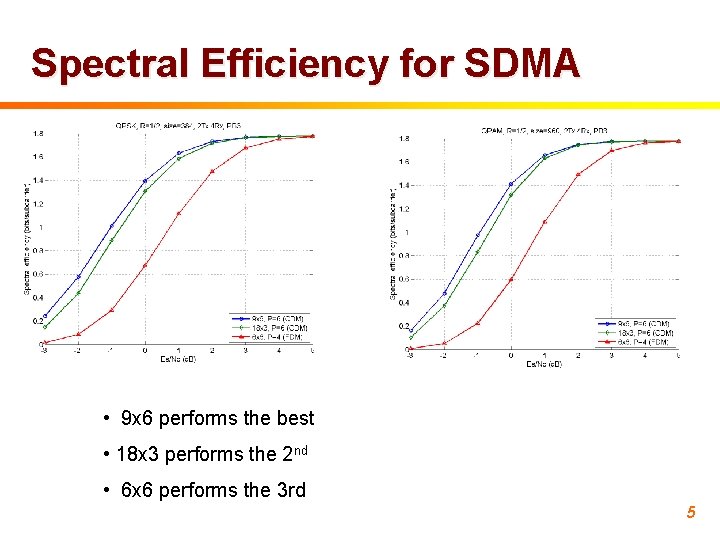
Spectral Efficiency for SDMA • 9 x 6 performs the best • 18 x 3 performs the 2 nd • 6 x 6 performs the 3 rd 5
Conclusion q q Simulations have been conducted to compare the performance of 9 x 6, 18 x 3, and 6 x 6 tiles with same pilot density (pilot overhead 11. 1%) Results show § § § 9 x 6 tile has the highest spectral efficiency 18 x 3 has similar but slightly worse performance than 9 x 6 6 x 6 has the lowest spectral efficiency, especially with SDMA 6
Simulation Assumption q q q Wi. MAX numerology with 10 MHz bandwidth OFDM waveform with frequency hopping between subframes (3 or 6 OFDM symbols) Antenna configurations § § § q q q 1 Tx antenna per MS 4 Rx antennas per BS MMSE receiver (no interference cancellation) at BS 2 -stream SDMA Channel estimator: per tile MMSE 2 D multi-source channel estimation Channel model: Ped-B 3 kmph (no correlation among Rx antennas) MCS: QPSK, r=1/2 CTC Packet size § § Case-1: 384 bits/subframe (614 kbps) 4 PDU/subframe Case-2: 960 bits/subframe (1. 536 Mbps) 10 PDU/subframe 7
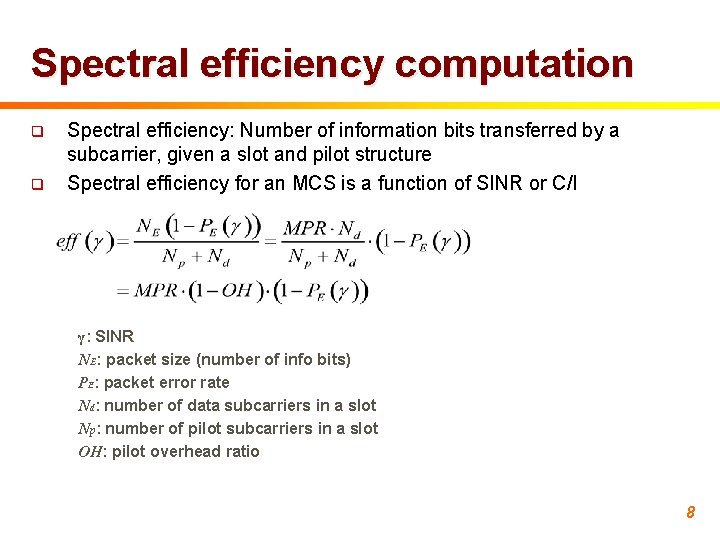
Spectral efficiency computation q q Spectral efficiency: Number of information bits transferred by a subcarrier, given a slot and pilot structure Spectral efficiency for an MCS is a function of SINR or C/I γ: SINR NE: packet size (number of info bits) PE: packet error rate Nd: number of data subcarriers in a slot Np: number of pilot subcarriers in a slot OH: pilot overhead ratio 8
- Slides: 8