
Updating the Power Converter Control Software Victor J
- Slides: 1
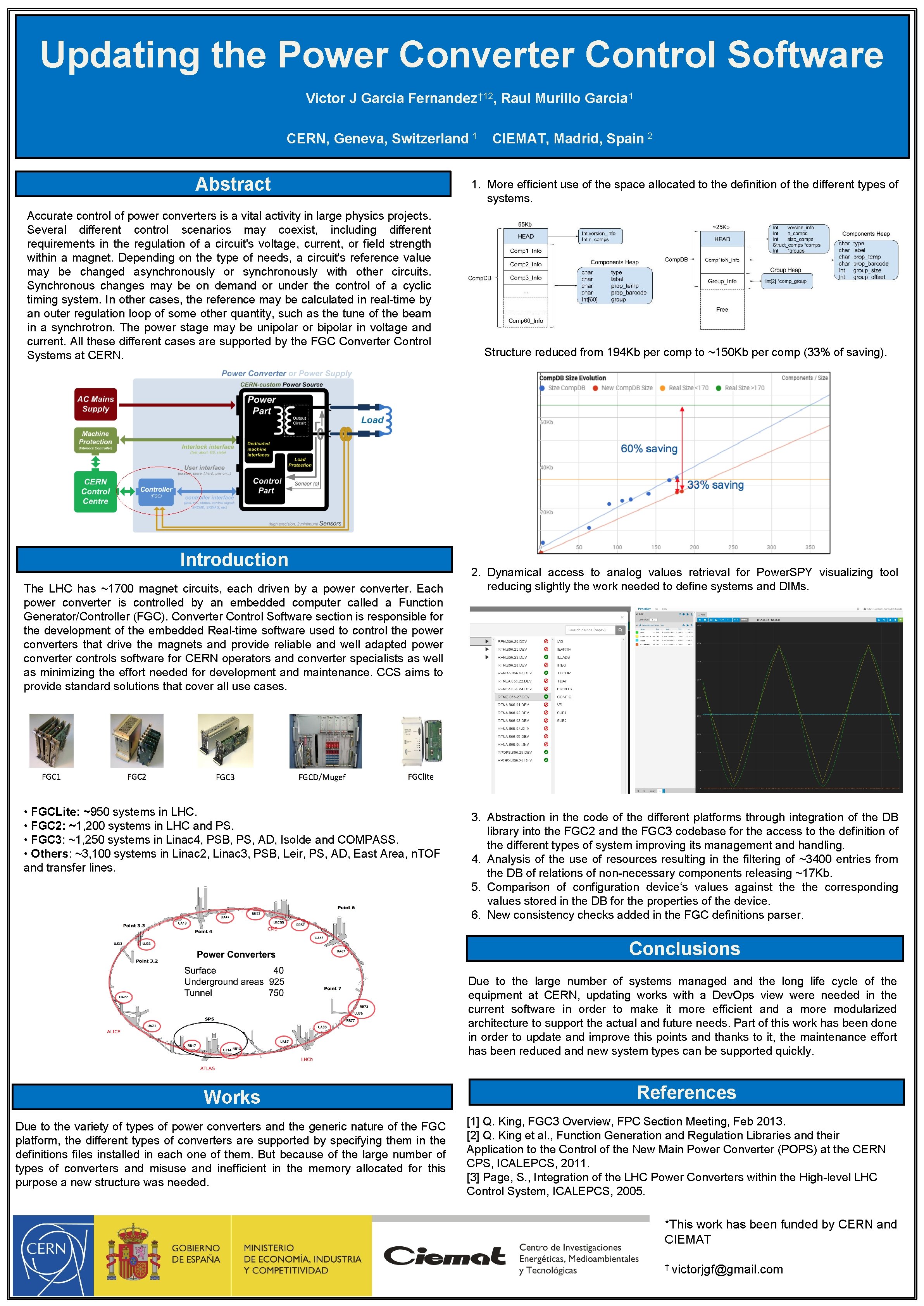
Updating the Power Converter Control Software Victor J Garcia Fernandez† 12, Raul Murillo Garcia 1 CERN, Geneva, Switzerland 1 Abstract Accurate control of power converters is a vital activity in large physics projects. Several different control scenarios may coexist, including different requirements in the regulation of a circuit's voltage, current, or field strength within a magnet. Depending on the type of needs, a circuit's reference value may be changed asynchronously or synchronously with other circuits. Synchronous changes may be on demand or under the control of a cyclic timing system. In other cases, the reference may be calculated in real-time by an outer regulation loop of some other quantity, such as the tune of the beam in a synchrotron. The power stage may be unipolar or bipolar in voltage and current. All these different cases are supported by the FGC Converter Control Systems at CERN. Introduction The LHC has ~1700 magnet circuits, each driven by a power converter. Each power converter is controlled by an embedded computer called a Function Generator/Controller (FGC). Converter Control Software section is responsible for the development of the embedded Real-time software used to control the power converters that drive the magnets and provide reliable and well adapted power converter controls software for CERN operators and converter specialists as well as minimizing the effort needed for development and maintenance. CCS aims to provide standard solutions that cover all use cases. • FGCLite: ~950 systems in LHC. • FGC 2: ~1, 200 systems in LHC and PS. • FGC 3: ~1, 250 systems in Linac 4, PSB, PS, AD, Isolde and COMPASS. • Others: ~3, 100 systems in Linac 2, Linac 3, PSB, Leir, PS, AD, East Area, n. TOF and transfer lines. CIEMAT, Madrid, Spain 2 1. More efficient use of the space allocated to the definition of the different types of systems. Structure reduced from 194 Kb per comp to ~150 Kb per comp (33% of saving). 2. Dynamical access to analog values retrieval for Power. SPY visualizing tool reducing slightly the work needed to define systems and DIMs. 3. Abstraction in the code of the different platforms through integration of the DB library into the FGC 2 and the FGC 3 codebase for the access to the definition of the different types of system improving its management and handling. 4. Analysis of the use of resources resulting in the filtering of ~3400 entries from the DB of relations of non-necessary components releasing ~17 Kb. 5. Comparison of configuration device‘s values against the corresponding values stored in the DB for the properties of the device. 6. New consistency checks added in the FGC definitions parser. Conclusions Due to the large number of systems managed and the long life cycle of the equipment at CERN, updating works with a Dev. Ops view were needed in the current software in order to make it more efficient and a more modularized architecture to support the actual and future needs. Part of this work has been done in order to update and improve this points and thanks to it, the maintenance effort has been reduced and new system types can be supported quickly. Works Due to the variety of types of power converters and the generic nature of the FGC platform, the different types of converters are supported by specifying them in the definitions files installed in each one of them. But because of the large number of types of converters and misuse and inefficient in the memory allocated for this purpose a new structure was needed. References [1] Q. King, FGC 3 Overview, FPC Section Meeting, Feb 2013. [2] Q. King et al. , Function Generation and Regulation Libraries and their Application to the Control of the New Main Power Converter (POPS) at the CERN CPS, ICALEPCS, 2011. [3] Page, S. , Integration of the LHC Power Converters within the High-level LHC Control System, ICALEPCS, 2005. *This work has been funded by CERN and CIEMAT † victorjgf@gmail. com