
Updates on National Rabies Control Programme Dr Simmi
Updates on National Rabies Control Programme Dr. Simmi Tiwari Deputy Director & OIC (Division of Zoonotic Diseases Programs) National Centre for Disease Control Directorate General of Health Services Ministry of Health and Family welfare Government of India
Rabies- The Killer Disease • Rabies most furious diseases known to the man kind ever. • Causes most painful death, Children are mostly at high risk • Vaccine preventable , Death could be averted easily with timely intervention Global Scenario • Estimated human deaths globally due to dog-mediated rabies - 59 000 every year, with an associated loss of 3. 7 million DALYs. • majority of deaths - in Asia (59. 6%) and Africa (36. 4%). • estimated economic cost of dog-mediated rabies -US$ 8. 6 billion. • Million Deaths Study (2012) estimated 12700 deaths due to furious rabies in India.

Burden of Rabies in India • Rabies is a “Neglected Tropical Zoonotic Diseases” transmitted through bite of rabid animal mostly dogs • 100 % fatal but 100 % vaccine preventable , children at highest risk • Global Call For Rabies Elimination i. e. zero by 2030 • Countries like Western Europe, Canada, US, Mexico, Japan & Latin America eliminated dog mediated Rabies Challenges : Rabies control & elimination requires coordinated efforts by health and veterinary sector with One Health Vision. • ARV not accessible – Not all health facilities have Anti Rabies Clinic across the States • Globally there are 59000 human deaths due to Dog Mediated Rabies. Source- WHO • Availability : Frequent Stocks-out positions in Public Health facilities • India has 20, 000 human rabies deaths and 17. 5 million animal bites per annum as per WHO estimates. This contributes to 2/3 rd of rabies burden in SEA Region and I/3 rd of total Global burden due to Rabies. Source WHO-APCRI 2004 Survey. • Inadequate action and response by Vet Sector/ Municipal corporation • SDG Goals and National Health Policy 2017 highlights strengthening of NRCP • India is the highest contributor to the rabies burden in the world (33% Global 59% in SE Region) Rabies Mortality NRCP data – 600 to 800 deaths per year (Clinical suspected rabies) CBHI Data – 70 -100 death per year (underreported) WHO- APCRI (Year 2004) - Estimated magnitude -20, 000 annual deaths MDS study (year 2012) – Estimated 12000 death per year. • Lack of Inter-sectoral Coordination • Lack of manpower support at the state and district especially for Rabies
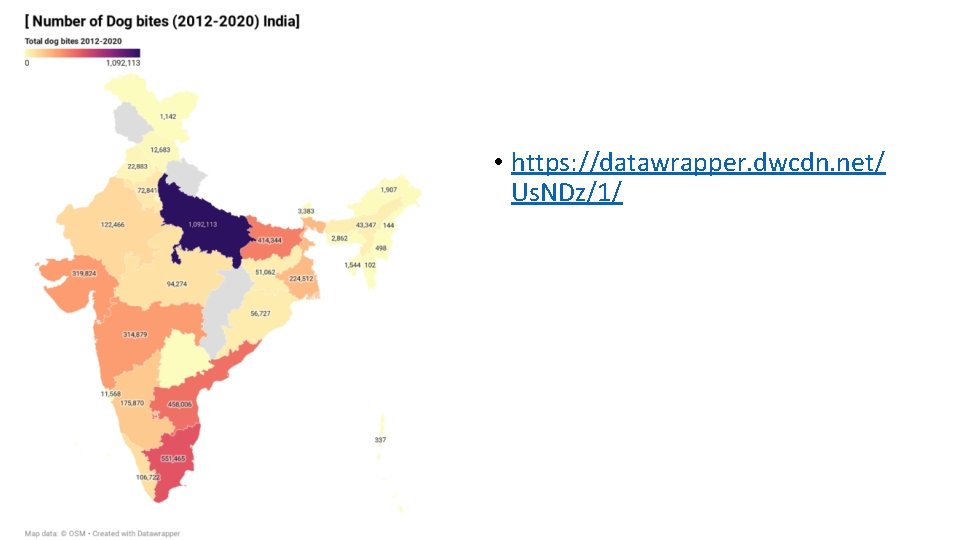
• https: //datawrapper. dwcdn. net/ Us. NDz/1/

Trend for Animal bite Cases (2012 - Nov 2020) No. of Animal Bites as reported under IDSP (2012 - Nov 2020)
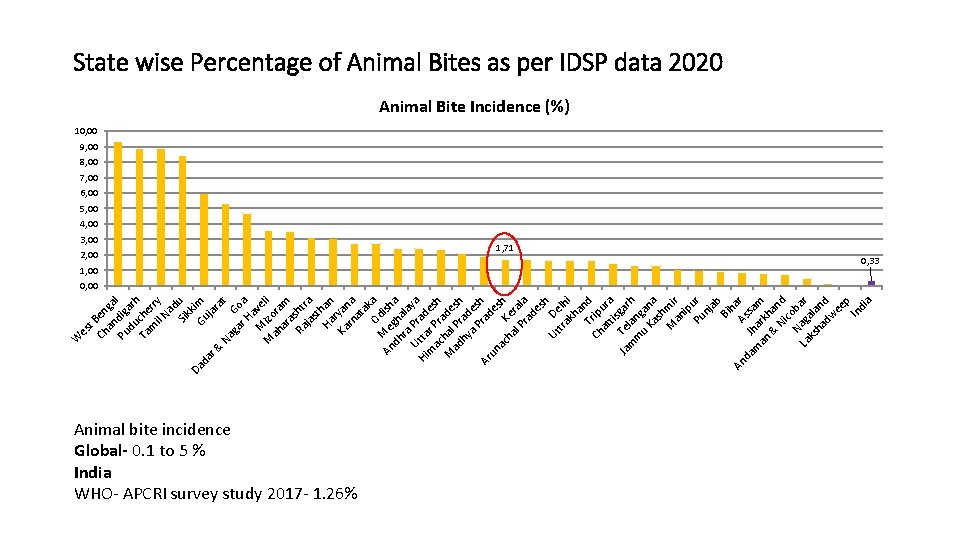
W es t Ch Ben an ga Pu dig l du arh Ta che m rry il N ad Sik u k Da Gu im da ja r& ra t Na ga Go r. H a a M vel i M zo i ah ra ar m a Ra shtr ja a st Ha han r Ka yan rn a at a Od ka An Me ish dh gh a ra ala Ut Pra ya Hi ta d m r P es ac r h M hal ade ad Pr sh hy ad a P es ra h Ar de un sh ac ha Ker l P al ra a de sh Ut De tra lh kh i a Tr nd Ch ip at ura tis Ja Te gar m lan h m g u an Ka a sh M mir an ip Pu ur nj ab Bi ha An r A da J ss m ha am an rk & han Ni d c Na oba La g r ks ala ha n dw d ee p In di a State wise Percentage of Animal Bites as per IDSP data 2020 Animal Bite Incidence (%) 10, 00 9, 00 8, 00 7, 00 6, 00 5, 00 4, 00 3, 00 2, 00 1, 00 Animal bite incidence Global- 0. 1 to 5 % India WHO- APCRI survey study 2017 - 1. 26% 1, 71 0, 33 0, 00

Status of suspected Rabies cases, and reported Rabies Deaths in Hospital (India 2012 -19) 900 739 800 700 835 764 706 829 601 600 411 500 325 400 300 200 129 151 180 207 170 165 136 171 100 0 2012 2013 2014 Sum of No. of rabies deaths 2015 2016 2017 2018 Sum of No. of clinically suspect rabies cases 2019 Number of States reported Status of suspected Rabies cases and reported Rabies Deaths 2017 - 8 States Reported Zero Suspected Cases for rabies and 19 States Reported Status of Suspected Rabies Cases 11 States Reported Zero Deaths due to Rabies 2018 - 5 States Reported Zero Suspected Cases for rabies and 14 States Reported Status of Suspected Rabies Cases 8 States Reported Zero Deaths due to Rabies 2019 - 13 States Reported Zero Suspected Cases for rabies and 13 States Reported Status of Suspected Rabies Cases 13 States Reported Zero Deaths due to Rabies Total rabies deaths reported in hospital from 2012 -2019 = 1309* Total no of patients, clinically suspected of rabies = 5210* Few states yet to submit data

State wise distributed Reported Rabies cases Year 2019 120 No. of Clinically Suspected Human Rabies cases in year 2019 100 98 No of Clinically Suspected Deaths due to Human Rabies in year 2019 80 Number of laboratory confirmed Human Rabies case/Deaths in year 2019 74 60 38 38 40 22 22 22 21 21 an kh Jh ra l. P ha ac m Hi ar de sh ge an t. B es d 4 0 l d na W Ut tra ra r. P 0 0 0 kh sh 0 0 0 de ur ip Ut ta Tr er ich 0 0 0 a 0 0 0 ry m Po nd kk i Si sg tti ha 1 1 0 Pu n ar h at ja r 2 2 0 ja 3 1 0 0 0 Ch ip an M 4 0 Gu ur 5 5 b 13 13 5 la 4 9 9 ra Na m il ad Pr a hy du h es m sa As ht as ah ar rn M M ad a at ak r Ka De lh i 0 11 10 3 2 0 0 ra 0 11 Ke 12 9 Ta 10 Bi ha 20

State wise distributed Reported Rabies cases Year 2020 60 No. of Clinically Suspected Human Rabies cases in year 2020 51 50 No of Clinically Suspected Deaths due to Human Rabies in year 2020 40 Number of laboratory confirmed Human Rabies case/Deaths in year 2020 36 30 17 ha ac m Hi ar kh an sh de ra l. P t. B es Jh l ge an na W d 0 kh sh 0 Ut tra er ich 0 de ry b ja Po nd Pu n M an ip ur at ja r Gu la ra sg tti ha Ch Ke ar h m sa As h es ad Pr a M ad hy m il Na ht Ta as M ah ar rn Ka du ra a at ak r Bi ha i De lh 0 ra 0 0 a 1 r. P 2 ur 3 ip 4 Ut ta 7 Tr 7 m 9 kk i 10 10 Si 17 20
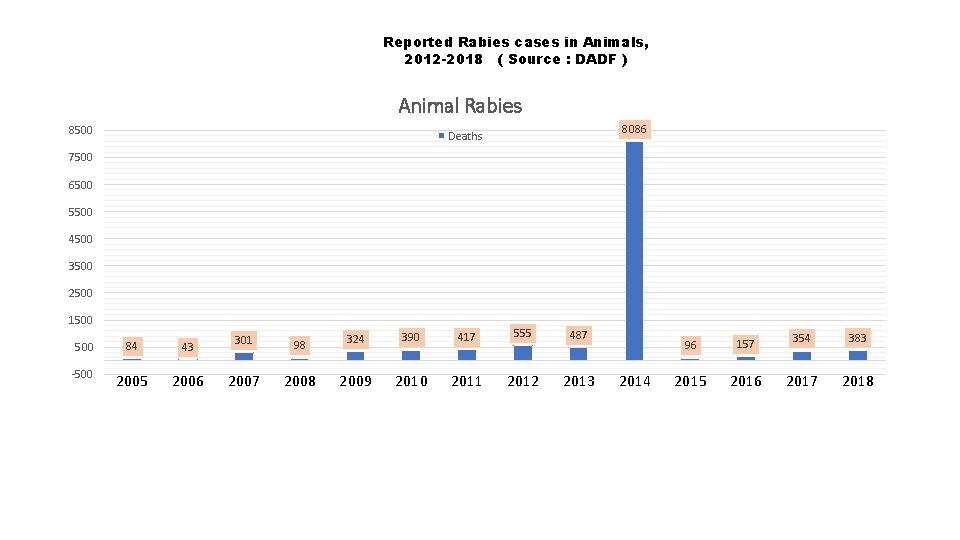
Reported Rabies cases in Animals, 2012 -2018 ( Source : DADF ) Animal Rabies 8500 8086 Deaths 7500 6500 5500 4500 3500 2500 1500 84 43 -500 2005 2006 301 98 2007 2008 324 390 417 555 487 2009 2010 2011 2012 2013 2014 96 157 354 383 2015 2016 2017 2018

Rabies : A journey from Neglected to priority Zoonoses Zoonosis division of NCDC has dedicated Laboratory on Rabies since last 7 decades. NCDC Designated WHO collaborating Centre for Rabies since 1988. Nerve Tissue Vaccine phased out and Cell culture Vaccine introduced. 2006 : DCGI approved ID route for rabies prophylaxis. 2007 : Control of Human Rabies Programme Pilot tested in 11 th FYP (5 Cities) 2012 : National Rabies Control Program approved in 12 th FYP.

National Rabies Control Program Goal To prevent deaths due to Human Rabies Objectives Improved Coverage and compliance of post exposure prophylaxis in ABV To build awareness in general community “ONE HEALTH” Strategies Capacity Building Promote of cost effective Intra-dermal rabies vaccines for Rabies Post Exposure Prophylaxis. Strengthen rabies diagnostics Strengthening Surveillance of animal bites and rabies cases Information, Education & Communication Intersectional coordination Operational Research

Program Progress Strengthening Surveillance • Animal Bite Surveillance & Human Rabies Surveillance in all states/UTs • Through IHIP, IDSP & Program Data- formats being incorported IHIP Capacity Building • Management of Animal Bite & Human Rabies • 26 States Covered, 3 National Trainings held in 8 State Level training Conducted in 2018 -2019 Strengthening Rabies Diagnosis • 4 regional Laboratories Strengthened; NIMHANS, AIIMS Jodhpur, Veterinary Laboratory Goa, NCDC • Hands on Training of Rabies Diagnosis held 10 States Covered IEC Strengthening PEP Coverage Operational research • Media Spots Created & Disseminated • Promotion of ID Route for PEP Coverage • Monitoring of ARV & ARS Coverage In Collaboration with ICMR & NIE Chennai and APCRI on Rabies burden under progress. SARE Workshop- 1. 5 Score –India

Program progress 199 Model Anti-rabies Clinic” proposed or Identified In India Till date Anti Rabies Vaccine and Anti Rabies Serum is freely available in government clinics under National Free Drug Initiative Scheme Training modules developed for Health care workers Revised Rabies post exposure guidelines National World Rabies day is being organized regularly National Action Plan For Dog Mediated Rabies From India drafted Advocacy & IEC material developed for Rabies (Billboard, Booklet, Audio and video) 77 Infectious Disease Hospital Identified

MODEL ANTI RABIES CLINIC ØAnti-Rabies Clinics / Centers are the health facilities manned by trained doctor/s and nurse/s where individuals with rabies exposure are evaluated and managed. ØThe existing resources of district hospitals will be strengthened as Model Animal Anti Rabies Clinics as per proposed IPHS standards. ØOver a period of five years (60 -100 Model Anti rabies Clinic each year), 300 district hospitals will be having designated Model Anti Rabies Clinic. These centers will be providing Animal Bite Management facilities, Counseling of Animal Bite victims, and referral, services for suspected Rabies patients, Surveillance activities and Intersectoral Coordination with other stakeholders. PHC CHC Sub Divisional Hospitals Selected District Hospitals/Medical Colleges/Tertiary Hospitals Anti Rabies Clinic Model Anti Rabies Clinic

Program progress -Update on Prioritization of Rabies by Key stakeholders In the last few years key changes have been observed in main stakeholders of for Rabies control. Ministry of Fisheries, Animal Husbandry and Dairying is newly formed ministry in May 2019 by the government Planning is underway to include dog and cats in the mandate of Department of Animal Husbandry and Dairying Recently, Prime Minister had publically advocated about the resilience of Indian dogs and the induction of several indigenous breeds into the Armed Forces Now A joint National Action Plan for Elimination Of Dog Mediated Rabies from India” has been drafted with inputs from Mo. FAHD, Mo. AFW, ICAR, Mo. PRI, Mo. ST, NITI AAYOG and other stakeholders. NAPRE would be launched in 2021 Animal Welfare Board of India, a key governing body in the animal health sector is transferred from Ministry of Environment, Forests and Climate change to Ministry of Fisheries, Animal Husbandry and Dairying Go. I One health approach for NAPRE
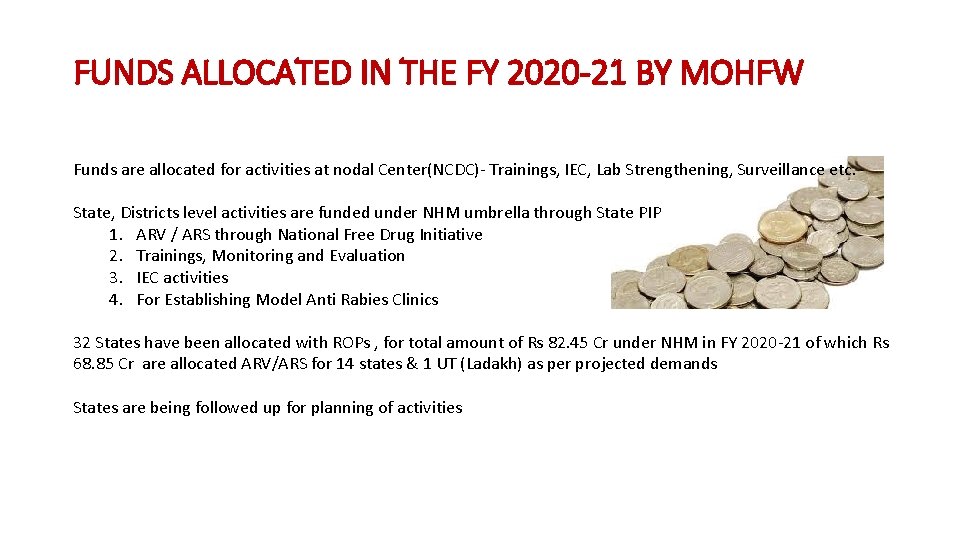
FUNDS ALLOCATED IN THE FY 2020 -21 BY MOHFW Funds are allocated for activities at nodal Center(NCDC)- Trainings, IEC, Lab Strengthening, Surveillance etc. State, Districts level activities are funded under NHM umbrella through State PIP 1. ARV / ARS through National Free Drug Initiative 2. Trainings, Monitoring and Evaluation 3. IEC activities 4. For Establishing Model Anti Rabies Clinics 32 States have been allocated with ROPs , for total amount of Rs 82. 45 Cr under NHM in FY 2020 -21 of which Rs 68. 85 Cr are allocated ARV/ARS for 14 states & 1 UT (Ladakh) as per projected demands States are being followed up for planning of activities

National Action Plan for Elimination of Dog Mediated Rabies in India A Step towards to Rabies free World
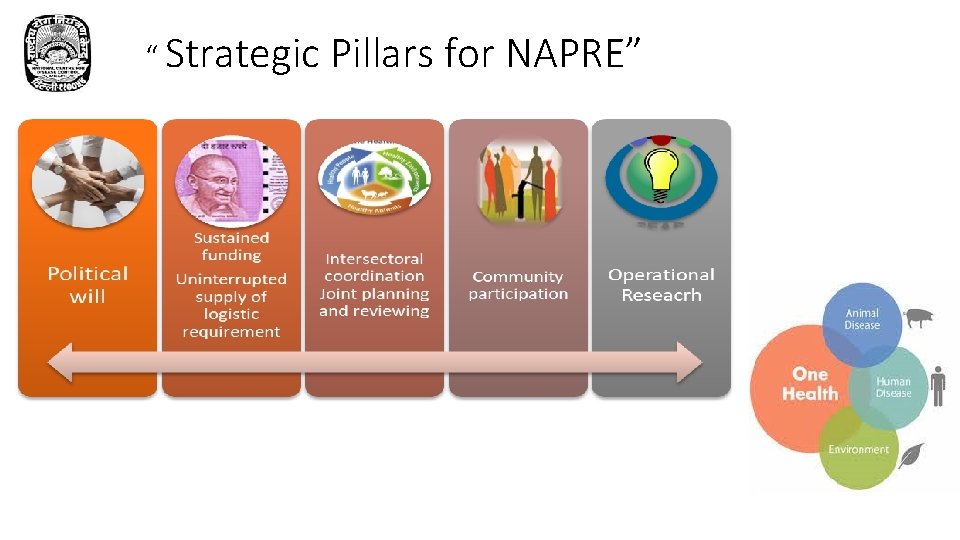
“ Strategic Pillars for NAPRE”
Need for NAPRE For successful Rabies control , involvement of different departments at all levels ( National, State, District, block ) is essential Animal reservoir involved and mortality and morbidity mainly affect humans Currently Rabies control activities in India are fragmented and uncoordinated across various stakeholders in India Global Call for RE by 2030 and India said to be major contributor of rabies mortality in SEA Region - Need to address Rabies through “One Health Approach”
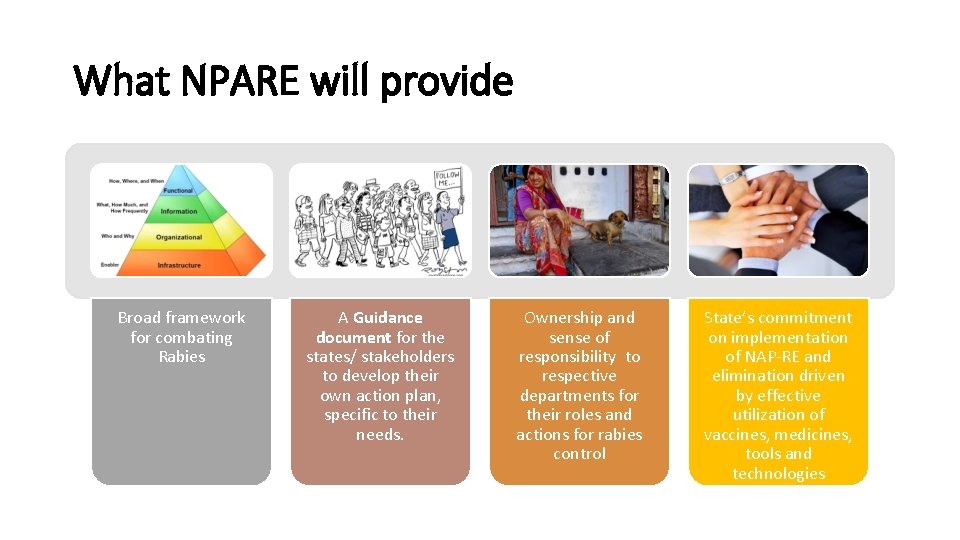
What NPARE will provide Broad framework for combating Rabies A Guidance document for the states/ stakeholders to develop their own action plan, specific to their needs. Ownership and sense of responsibility to respective departments for their roles and actions for rabies control State’s commitment on implementation of NAP-RE and elimination driven by effective utilization of vaccines, medicines, tools and technologies

What NPARE will provide Broad framework for combating Rabies A Guidance document for the states/ stakeholders to develop their own action plan, specific to their needs. Ownership and sense of responsibility to respective departments for their roles and actions for rabies control State’s commitment on implementation of NAPRE and elimination driven by effective utilization of vaccines, medicines, tools and technologies
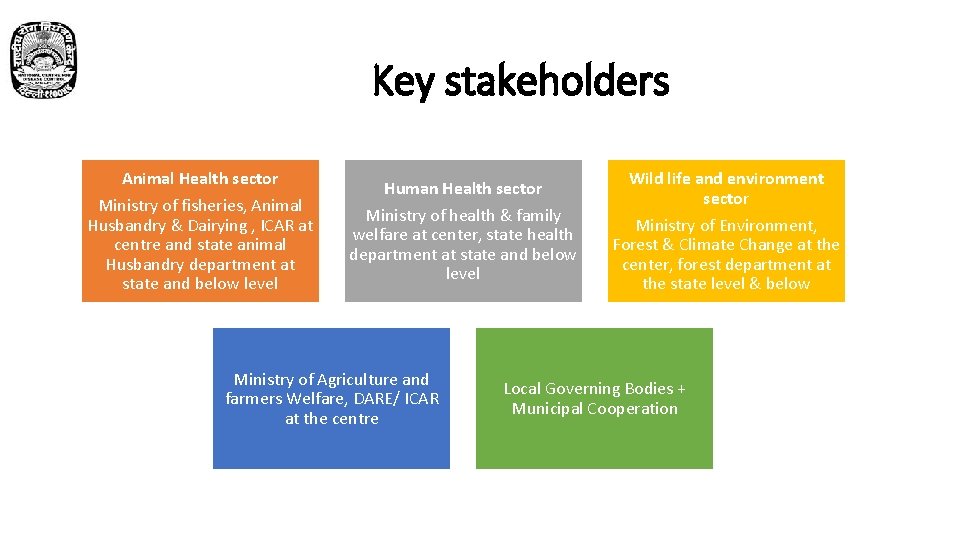
Key stakeholders Animal Health sector Ministry of fisheries, Animal Husbandry & Dairying , ICAR at centre and state animal Husbandry department at state and below level Human Health sector Ministry of health & family welfare at center, state health department at state and below level Ministry of Agriculture and farmers Welfare, DARE/ ICAR at the centre Wild life and environment sector Ministry of Environment, Forest & Climate Change at the center, forest department at the state level & below Local Governing Bodies + Municipal Cooperation
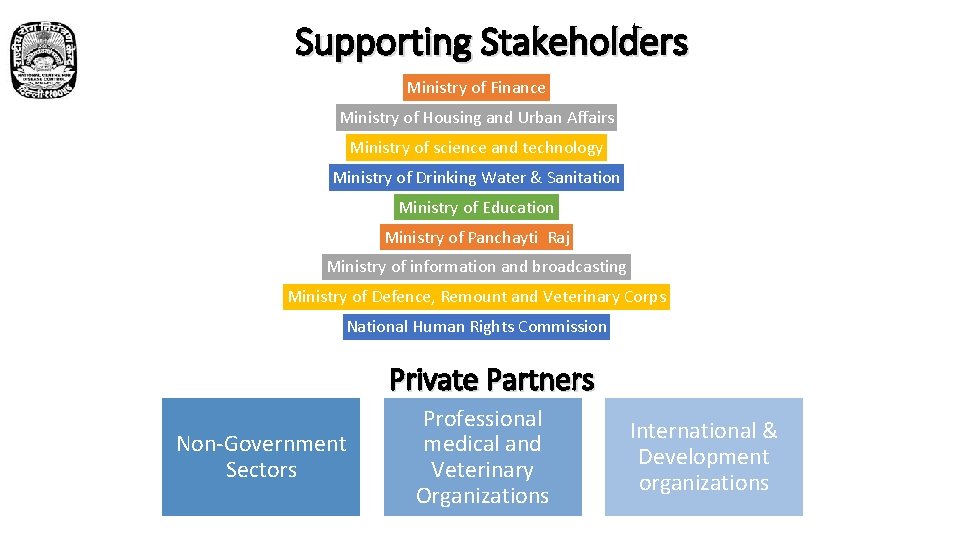
Supporting Stakeholders Ministry of Finance Ministry of Housing and Urban Affairs Ministry of science and technology Ministry of Drinking Water & Sanitation Ministry of Education Ministry of Panchayti Raj Ministry of information and broadcasting Ministry of Defence, Remount and Veterinary Corps National Human Rights Commission Private Partners Non-Government Sectors Professional medical and Veterinary Organizations International & Development organizations
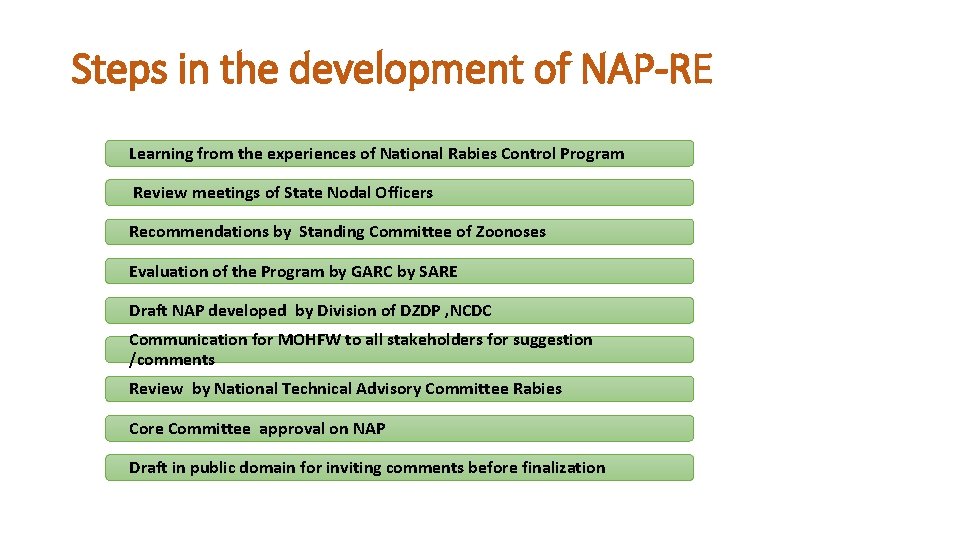
Steps in the development of NAP-RE Learning from the experiences of National Rabies Control Program Review meetings of State Nodal Officers Recommendations by Standing Committee of Zoonoses Evaluation of the Program by GARC by SARE Draft NAP developed by Division of DZDP , NCDC Communication for MOHFW to all stakeholders for suggestion /comments Review by National Technical Advisory Committee Rabies Core Committee approval on NAP Draft in public domain for inviting comments before finalization

Strategic Components of NAP -RE Animal health component Human health component • 70 % of vaccination coverage among dogs in a defined geographical area targeted for Rabies Elimination in a phase wise manner • To prevent human deaths due to rabies by ensuring timely access for post exposure prophylaxis for the animal bite victims

Activities envisaged under Human Health under NAPRE Ensuring PEP for all Animal Bite Victims • Ensure availability of ARV /ARS at all levels of health facilities ( PHCs, CHCs, District Hospital , Medical Colleges etc. ) • Quality care through Model Anti- Rabies Clinics at all district hospitals • Ensure uninterrupted supply of ARV/ARS and close • Financial assistance to states for ARV/ARS procurement under NHM • Monitoring ARV/ARS demand supply positions Capacity building of professionals • Training of health professional and paramedical on Rabies pre & post exposure prophylaxis • Training of all involved personnel on program management’s aspects. • Training of laboratory professionals on rabies diagnostics • Training on Animal Bites and Rabies Case investigations and Notification.
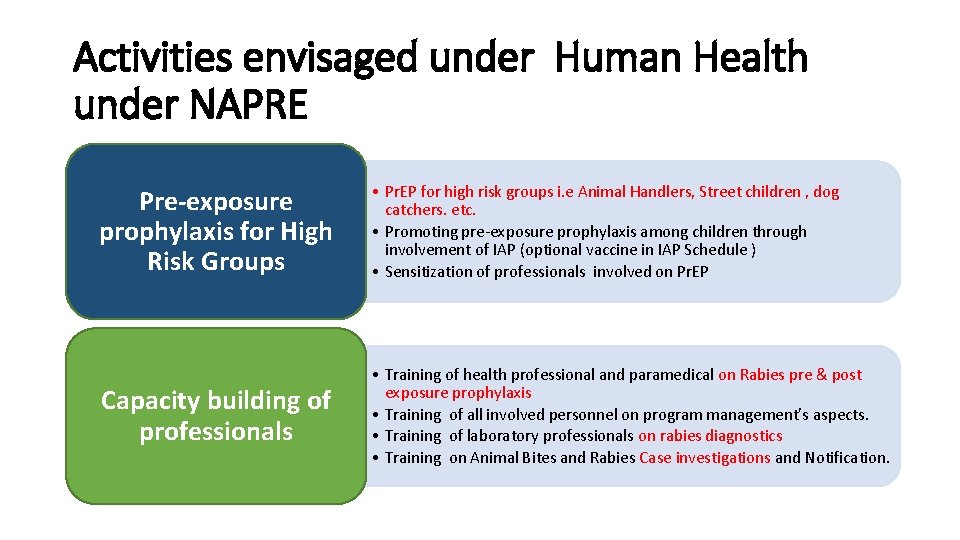
Activities envisaged under Human Health under NAPRE Pre-exposure prophylaxis for High Risk Groups • Pr. EP for high risk groups i. e Animal Handlers, Street children , dog catchers. etc. • Promoting pre-exposure prophylaxis among children through involvement of IAP (optional vaccine in IAP Schedule ) • Sensitization of professionals involved on Pr. EP Capacity building of professionals • Training of health professional and paramedical on Rabies pre & post exposure prophylaxis • Training of all involved personnel on program management’s aspects. • Training of laboratory professionals on rabies diagnostics • Training on Animal Bites and Rabies Case investigations and Notification.
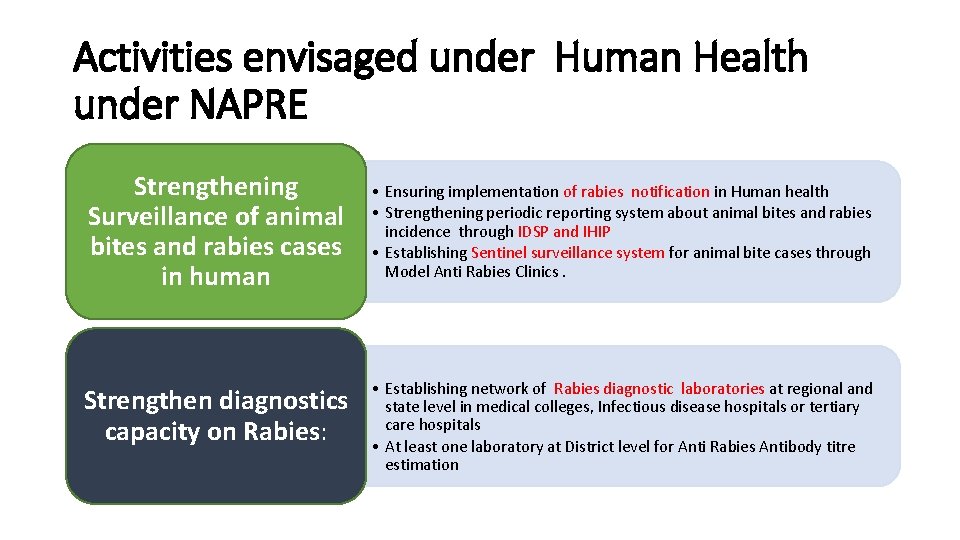
Activities envisaged under Human Health under NAPRE Strengthening Surveillance of animal bites and rabies cases in human Strengthen diagnostics capacity on Rabies: • Ensuring implementation of rabies notification in Human health • Strengthening periodic reporting system about animal bites and rabies incidence through IDSP and IHIP • Establishing Sentinel surveillance system for animal bite cases through Model Anti Rabies Clinics. • Establishing network of Rabies diagnostic laboratories at regional and state level in medical colleges, Infectious disease hospitals or tertiary care hospitals • At least one laboratory at District level for Anti Rabies Antibody titre estimation
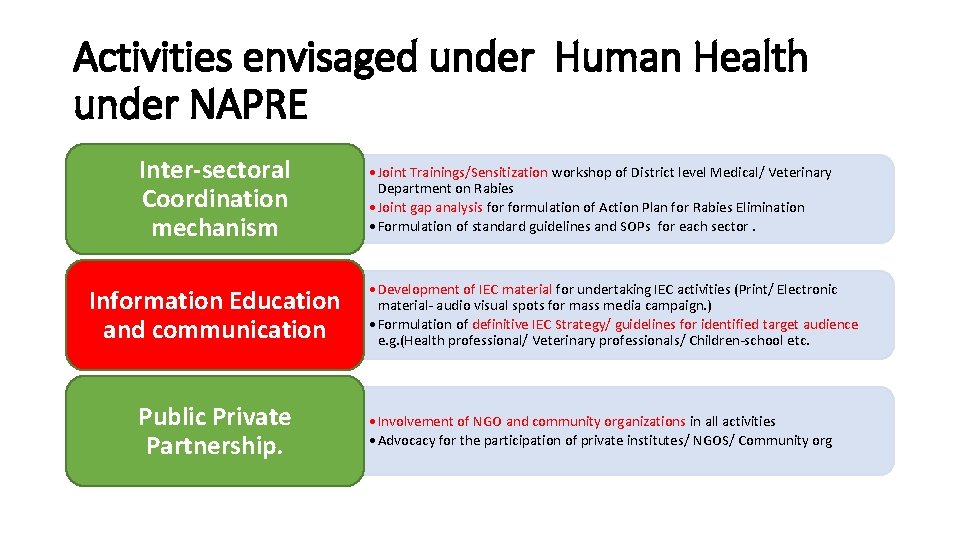
Activities envisaged under Human Health under NAPRE Inter-sectoral Coordination mechanism Information Education and communication Public Private Partnership. • Joint Trainings/Sensitization workshop of District level Medical/ Veterinary Department on Rabies • Joint gap analysis formulation of Action Plan for Rabies Elimination • Formulation of standard guidelines and SOPs for each sector. • Development of IEC material for undertaking IEC activities (Print/ Electronic material- audio visual spots for mass media campaign. ) • Formulation of definitive IEC Strategy/ guidelines for identified target audience e. g. (Health professional/ Veterinary professionals/ Children-school etc. • Involvement of NGO and community organizations in all activities • Advocacy for the participation of private institutes/ NGOS/ Community org

Steps for development of State Action Plan for Rabies Elimination Joint Gap analysis by each stakeholder Identification of earmarked funds by each stakeholder Identify the stakeholders involved, and define roles and responsibilities Submission of the State action plan Joint review of the action plan submitted by the state by NCDC and DAHD Implementation of the program by the state from next financial year Preparation of action plan with activities to be undertaken at each level for the next 10 years. -
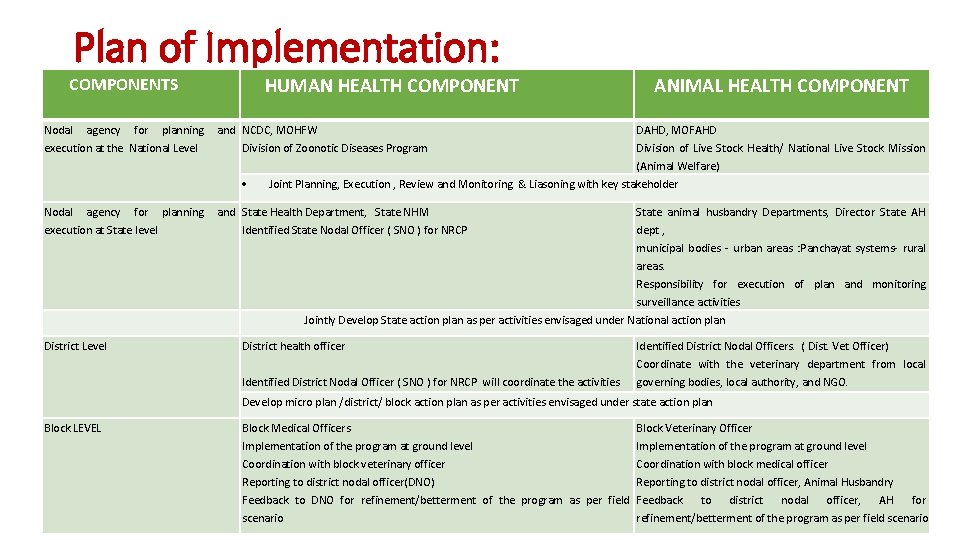
Plan of Implementation: COMPONENTS Nodal agency for planning execution at the National Level HUMAN HEALTH COMPONENT and NCDC, MOHFW agency for planning DAHD, MOFAHD Division of Zoonotic Diseases Program Nodal ANIMAL HEALTH COMPONENT Division of Live Stock Health/ National Live Stock Mission (Animal Welfare) Joint Planning, Execution , Review and Monitoring & Liasoning with key stakeholder and State Health Department, State NHM State animal husbandry Departments, Director State AH execution at State level Identified State Nodal Officer ( SNO ) for NRCP dept , municipal bodies - urban areas : Panchayat systems- rural areas. Responsibility for execution of plan and monitoring surveillance activities Jointly Develop State action plan as per activities envisaged under National action plan District Level District health officer Identified District Nodal Officers. ( Dist. Vet Officer) Identified District Nodal Officer ( SNO ) for NRCP will coordinate the activities Coordinate with the veterinary department from local governing bodies, local authority, and NGO. Develop micro plan /district/ block action plan as per activities envisaged under state action plan Block LEVEL Block Medical Officers Block Veterinary Officer Implementation of the program at ground level Coordination with block veterinary officer Coordination with block medical officer Reporting to district nodal officer(DNO) Reporting to district nodal officer, Animal Husbandry Feedback to DNO for refinement/betterment of the program as per field Feedback to district nodal officer, AH for scenario refinement/betterment of the program as per field scenario

matrix and Road Map for Rabies Zero by 2030 – Human Health component
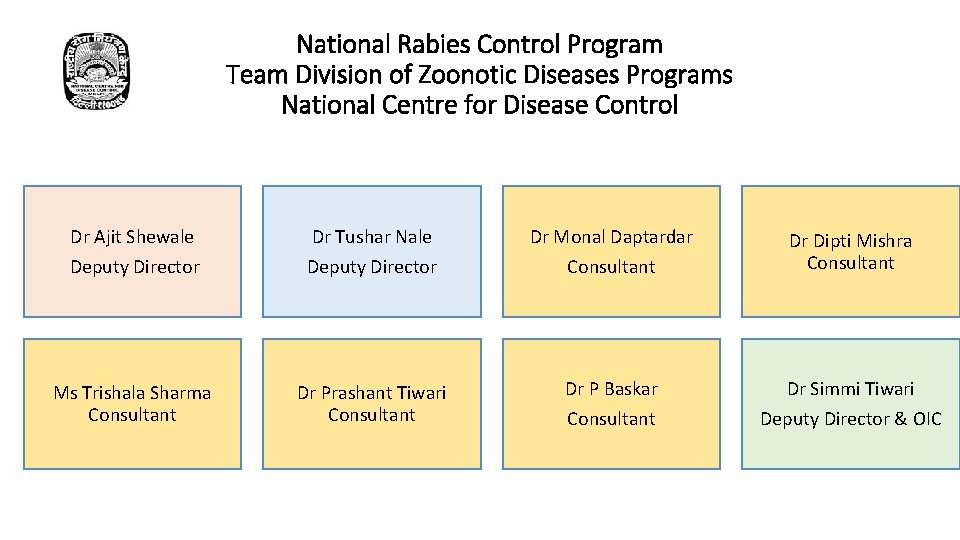
National Rabies Control Program Team Division of Zoonotic Diseases Programs National Centre for Disease Control Dr Ajit Shewale Deputy Director Dr Tushar Nale Deputy Director Dr Monal Daptardar Consultant Dr Dipti Mishra Consultant Ms Trishala Sharma Consultant Dr Prashant Tiwari Consultant Dr P Baskar Consultant Dr Simmi Tiwari Deputy Director & OIC
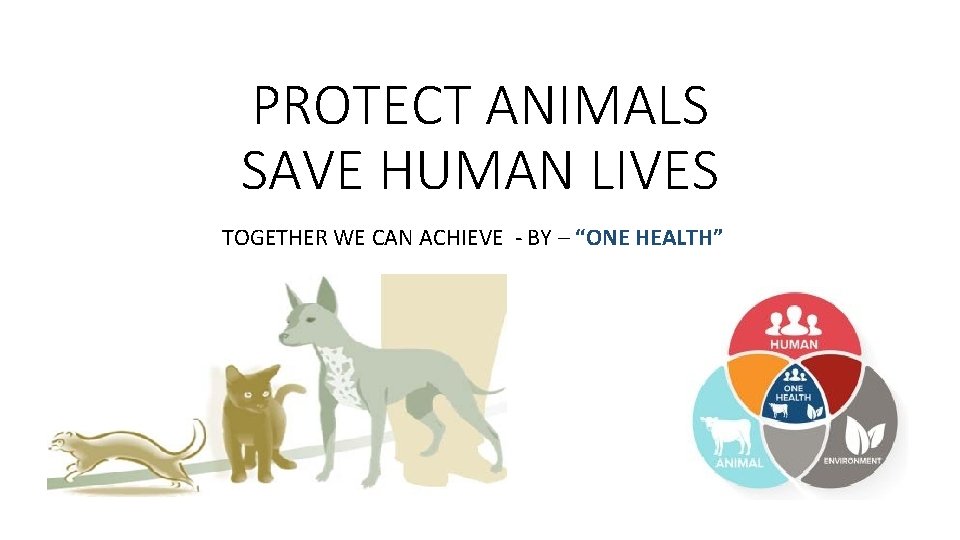
PROTECT ANIMALS SAVE HUMAN LIVES TOGETHER WE CAN ACHIEVE - BY – “ONE HEALTH”
- Slides: 35