
UPDATES ON MANAGEMENT OF ACHALASIA Hung Sze Wing


- Slides: 28
UPDATES ON MANAGEMENT OF ACHALASIA Hung Sze Wing Dorothy
Achalasia ■ Achalasia is a primary esophageal motility disorder characterised by absence of esophageal peristalsis, impaired lower esophageal sphincter response ■ Peak incidence 30 -60 years old ■ Equally common among men and women ■ 1 in 100, 000 incidence per year ACG Clinical Guideline: Diagnosis and Management of Achalasia Michael F. Vaezi , MD, Ph. D, MSc, FACG 1 , John E. Pandolfi no , MD, MSCI 2 and Marcelo F. Vela , MD, MSCR 3
Presenting symptoms: – – Dysphagia (most common) Regurgitation Chest pain Weight loss
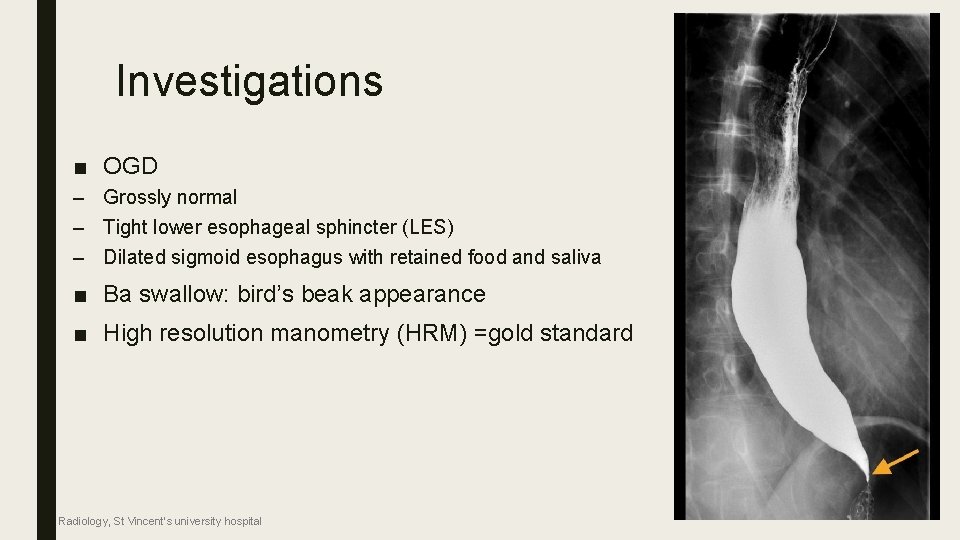
Investigations ■ OGD – Grossly normal – Tight lower esophageal sphincter (LES) – Dilated sigmoid esophagus with retained food and saliva ■ Ba swallow: bird’s beak appearance ■ High resolution manometry (HRM) =gold standard Radiology, St Vincent’s university hospital
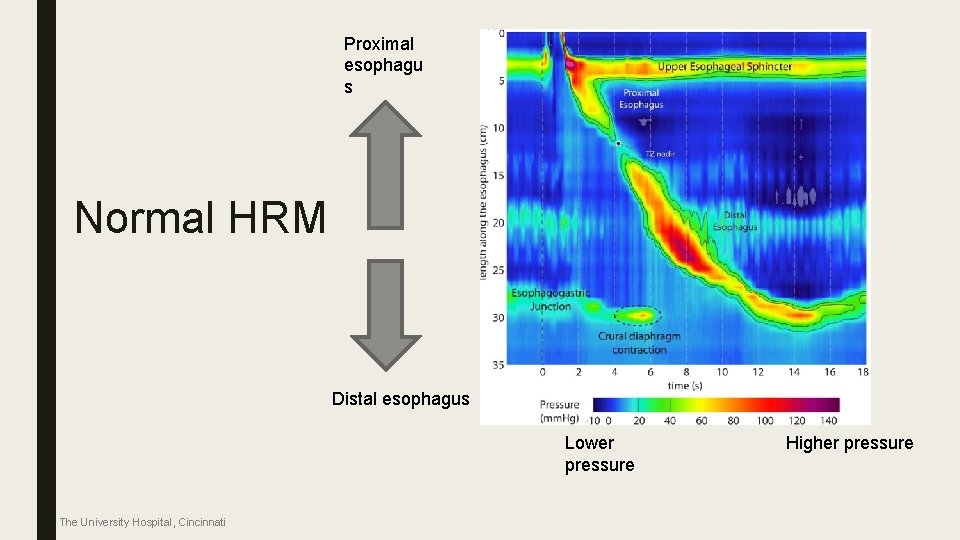
Proximal esophagu s Normal HRM Distal esophagus Lower pressure The University Hospital, Cincinnati Higher pressure
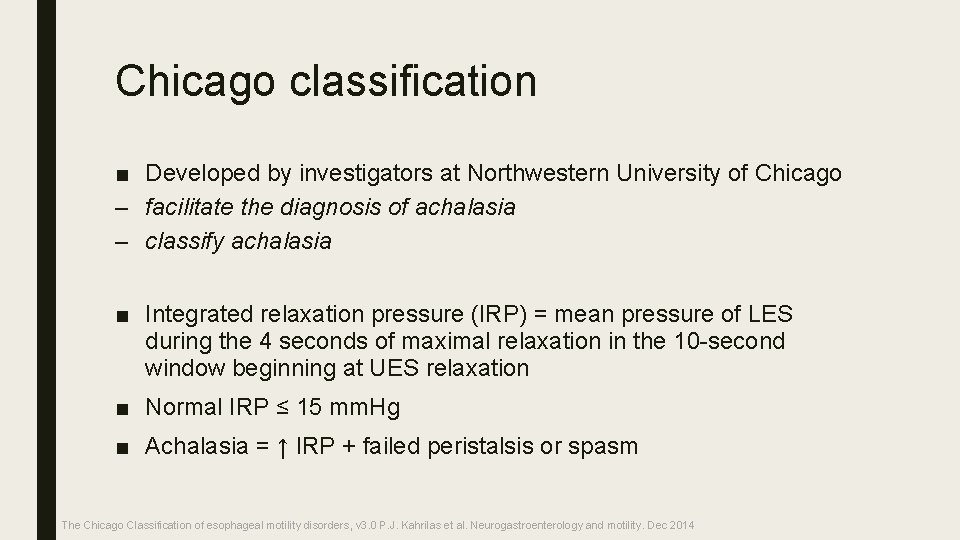
Chicago classification ■ Developed by investigators at Northwestern University of Chicago – facilitate the diagnosis of achalasia – classify achalasia ■ Integrated relaxation pressure (IRP) = mean pressure of LES during the 4 seconds of maximal relaxation in the 10 -second window beginning at UES relaxation ■ Normal IRP ≤ 15 mm. Hg ■ Achalasia = ↑ IRP + failed peristalsis or spasm The Chicago Classification of esophageal motility disorders, v 3. 0 P. J. Kahrilas et al. Neurogastroenterology and motility. Dec 2014
Chicago classification ■ Type I (“classic achalasia”): minimal pressure in esophagus ■ Type II: pan-esophageal pressurization (most common) Type II Type I ■ Type III: Spasm. At least 20% of swallows reveal rapidly propagating or spastic simultaneous contraction Per oral endoscopic myotomy (POEM) for all spastic esophageal disorders? Endosc Int Open 2015 Jun; 3(3): E 202– E 204. Type III
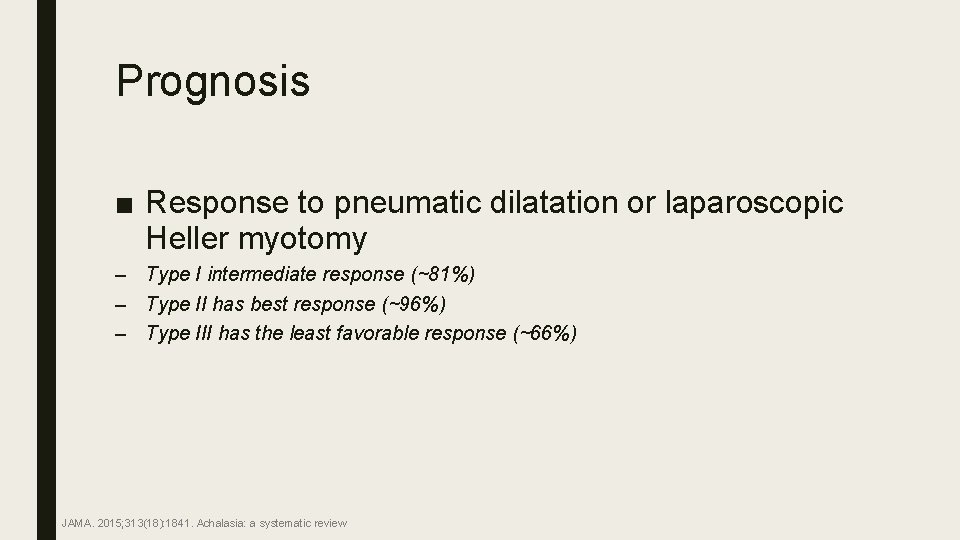
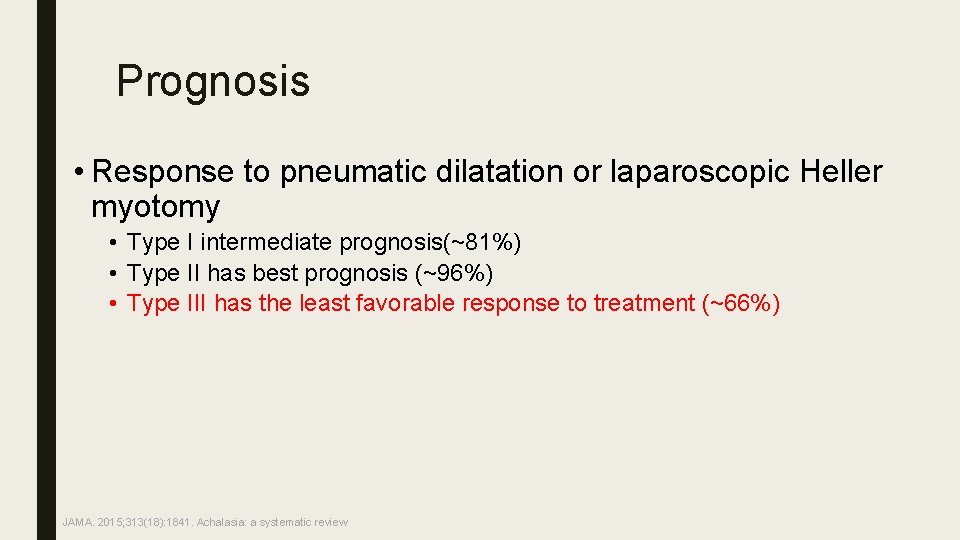
Prognosis ■ Response to pneumatic dilatation or laparoscopic Heller myotomy – Type I intermediate response (~81%) – Type II has best response (~96%) – Type III has the least favorable response (~66%) JAMA. 2015; 313(18): 1841. Achalasia: a systematic review
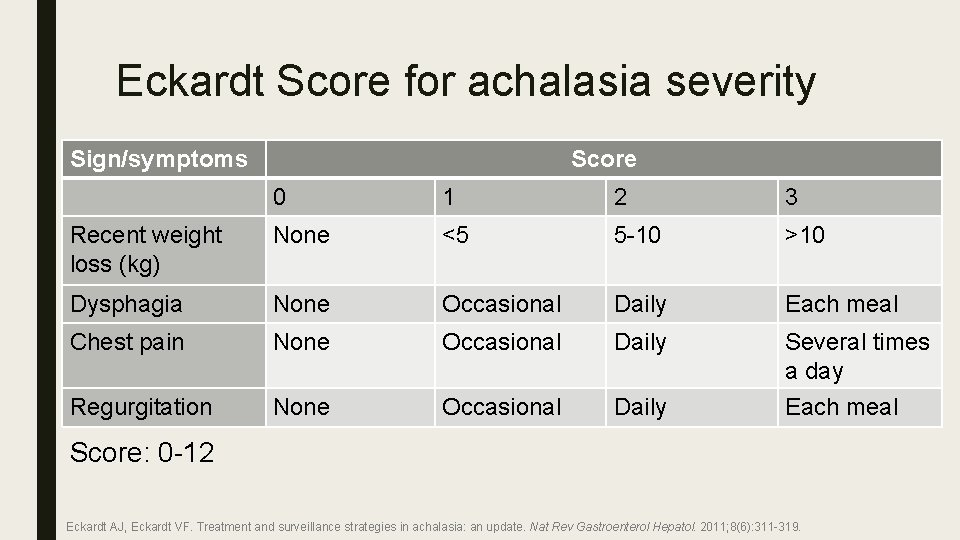
Eckardt Score for achalasia severity Sign/symptoms Score 0 1 2 3 Recent weight loss (kg) None <5 5 -10 >10 Dysphagia None Occasional Daily Each meal Chest pain None Occasional Daily Several times a day Regurgitation None Occasional Daily Each meal Score: 0 -12 Eckardt AJ, Eckardt VF. Treatment and surveillance strategies in achalasia: an update. Nat Rev Gastroenterol Hepatol. 2011; 8(6): 311 -319.
Treatment options ■ Pharmacological ■ Endoscopic ■ Surgical
Pharmacological options ■ Calcium channel blockers and nitrates – Least effective – Side effects e. g. dizziness, headache – Symptomatic improvement 53 to 87% Achalasia: a new clinically relevant classification by high-resolution manometry. Pandolfino JE, Kwiatek MA, Nealis T, Bulsiewicz W, Post J, Kahrilas PJ. Gastroenterology. 2008 Nov; 135(5): 1526 -33.
Endoscopic ■ Botulinum toxin – Durability 6 -12 months – 1 month response rate >75% ■ Pneumatic dilatation Annese V, Bassotti G, Coccia G et al. A multicentre randomised study of intrasphincteric botulinum toxin in patients with oesophageal achalasia. GISMAD Achalasia Study Group. Gut 2000; 46: 597– 600
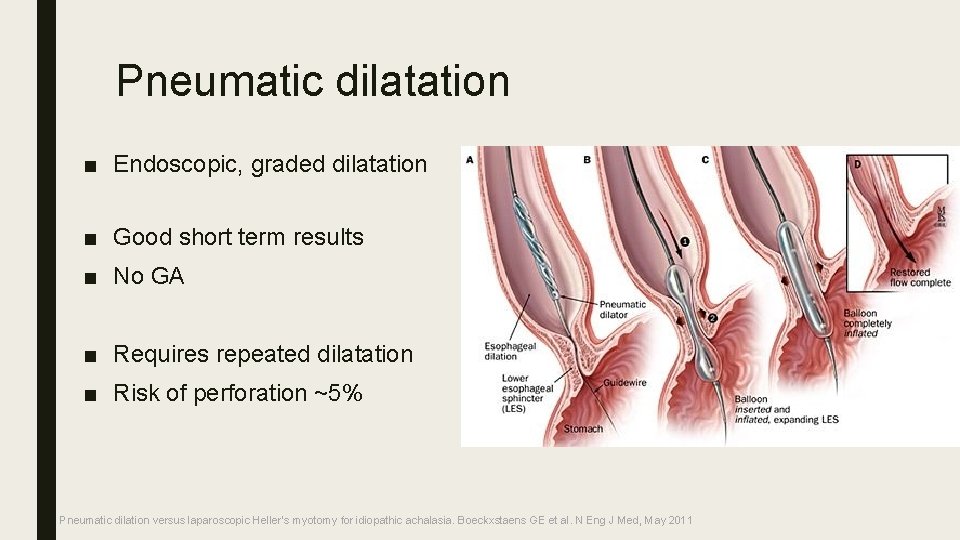
Pneumatic dilatation ■ Endoscopic, graded dilatation ■ Good short term results ■ No GA ■ Requires repeated dilatation ■ Risk of perforation ~5% Pneumatic dilation versus laparoscopic Heller’s myotomy for idiopathic achalasia. Boeckxstaens GE et al. N Eng J Med, May 2011
Surgical options ■ Laparoscopic Heller myotomy New options ■ Per-oral endoscopic myotomy (POEM)
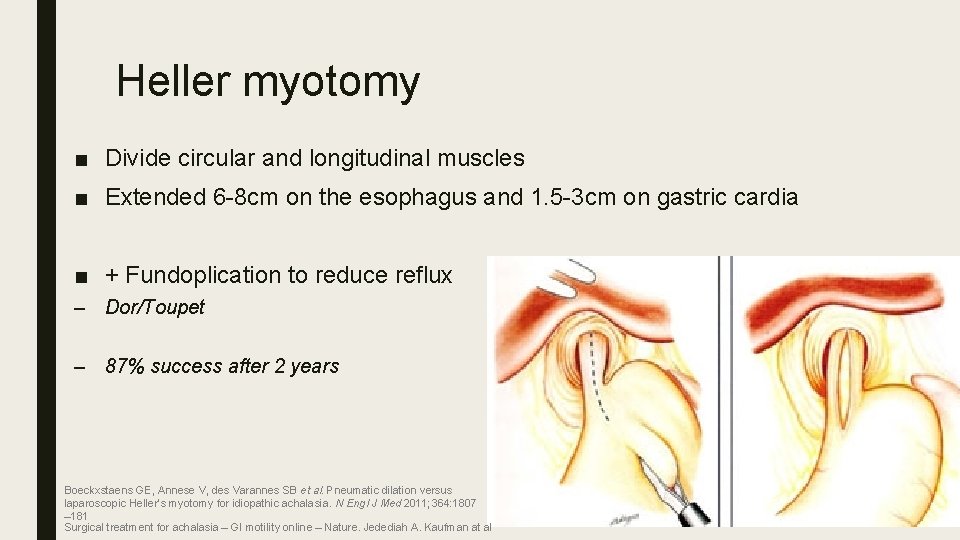
Heller myotomy ■ Divide circular and longitudinal muscles ■ Extended 6 -8 cm on the esophagus and 1. 5 -3 cm on gastric cardia ■ + Fundoplication to reduce reflux – Dor/Toupet – 87% success after 2 years Boeckxstaens GE, Annese V, des Varannes SB et al. Pneumatic dilation versus laparoscopic Heller’s myotomy for idiopathic achalasia. N Engl J Med 2011; 364: 1807 – 181 Surgical treatment for achalasia – GI motility online – Nature. Jedediah A. Kaufman at al
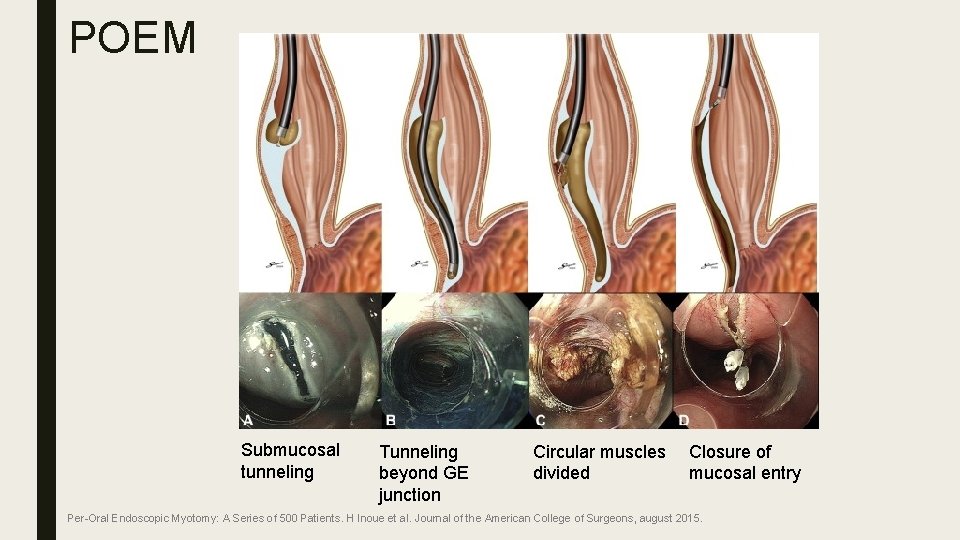
POEM Submucosal tunneling Tunneling beyond GE junction Circular muscles divided Closure of mucosal entry Per-Oral Endoscopic Myotomy: A Series of 500 Patients. H Inoue et al. Journal of the American College of Surgeons, august 2015.
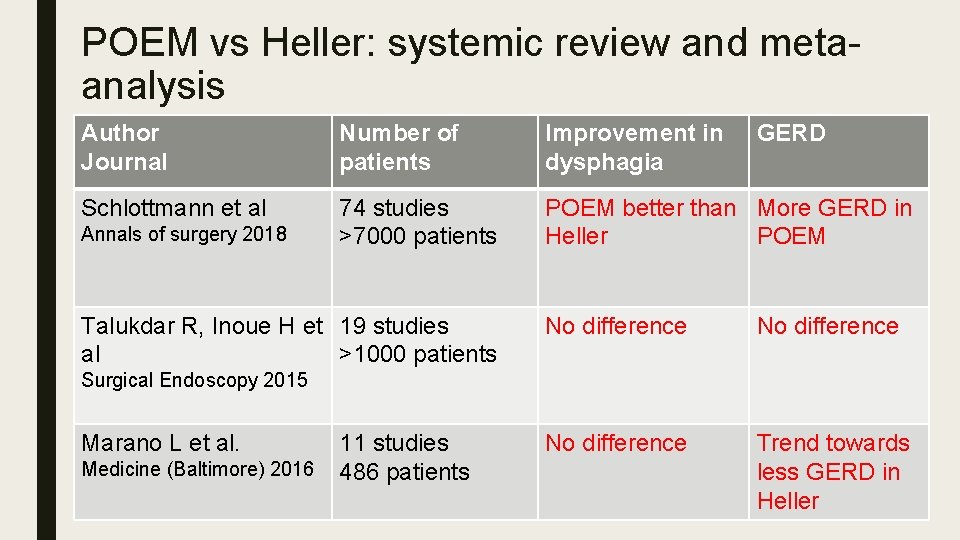
POEM vs Heller: systemic review and metaanalysis Author Journal Number of patients Improvement in dysphagia Schlottmann et al 74 studies >7000 patients POEM better than More GERD in Heller POEM Annals of surgery 2018 Talukdar R, Inoue H et 19 studies al >1000 patients GERD No difference Trend towards less GERD in Heller Surgical Endoscopy 2015 Marano L et al. Medicine (Baltimore) 2016 11 studies 486 patients
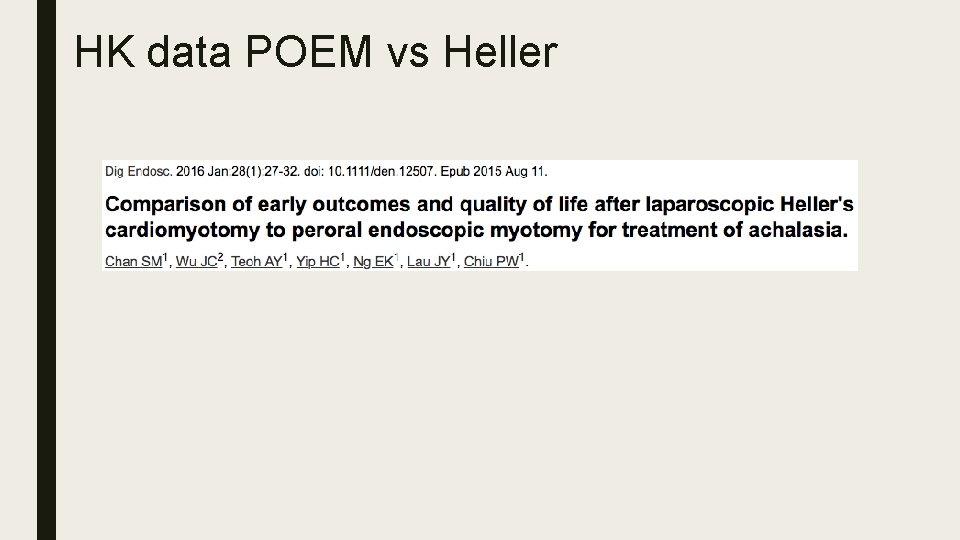
HK data POEM vs Heller
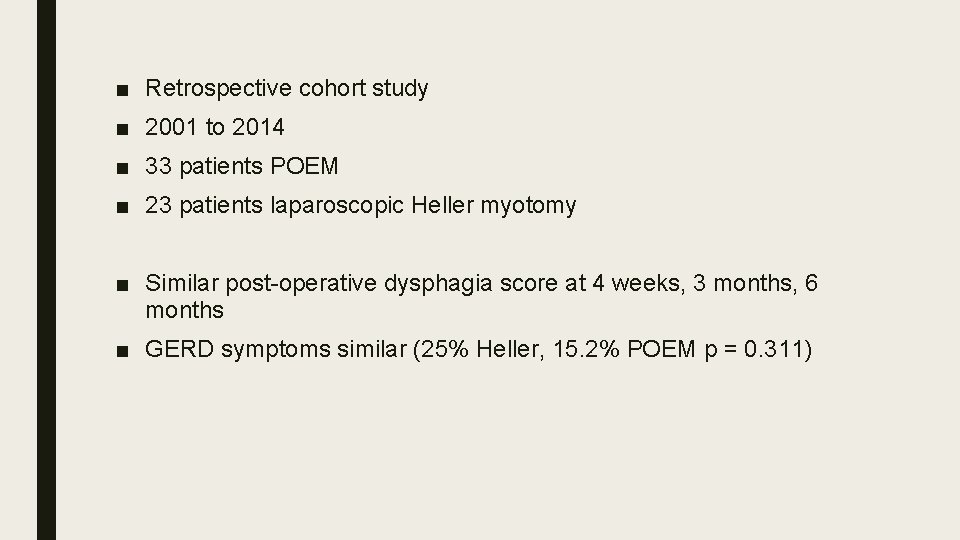
■ Retrospective cohort study ■ 2001 to 2014 ■ 33 patients POEM ■ 23 patients laparoscopic Heller myotomy ■ Similar post-operative dysphagia score at 4 weeks, 3 months, 6 months ■ GERD symptoms similar (25% Heller, 15. 2% POEM p = 0. 311)
POEM vs Heller ■ Similar efficacy ■ ? more GERD post-op in POEM patients
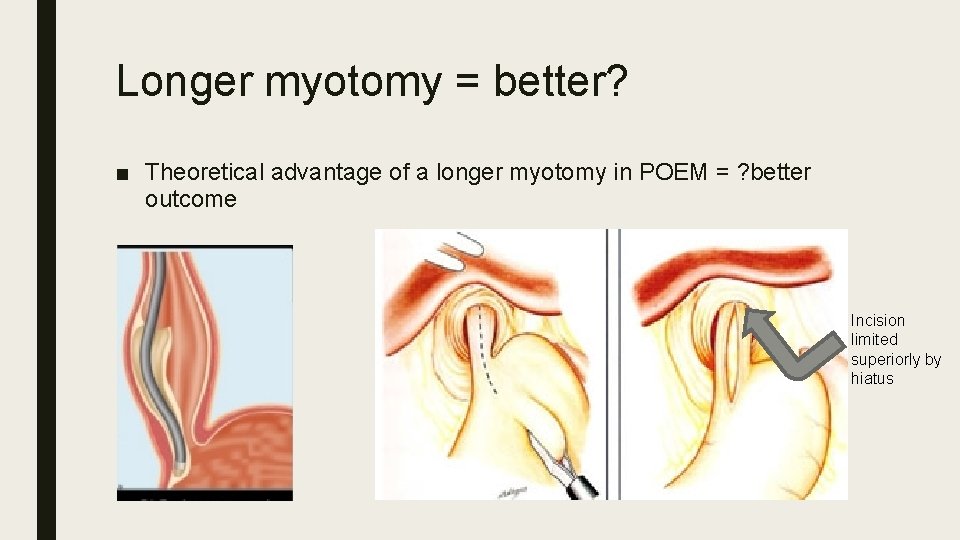
Longer myotomy = better? ■ Theoretical advantage of a longer myotomy in POEM = ? better outcome Incision limited superiorly by hiatus
Prognosis • Response to pneumatic dilatation or laparoscopic Heller myotomy • Type I intermediate prognosis(~81%) • Type II has best prognosis (~96%) • Type III has the least favorable response to treatment (~66%) JAMA. 2015; 313(18): 1841. Achalasia: a systematic review
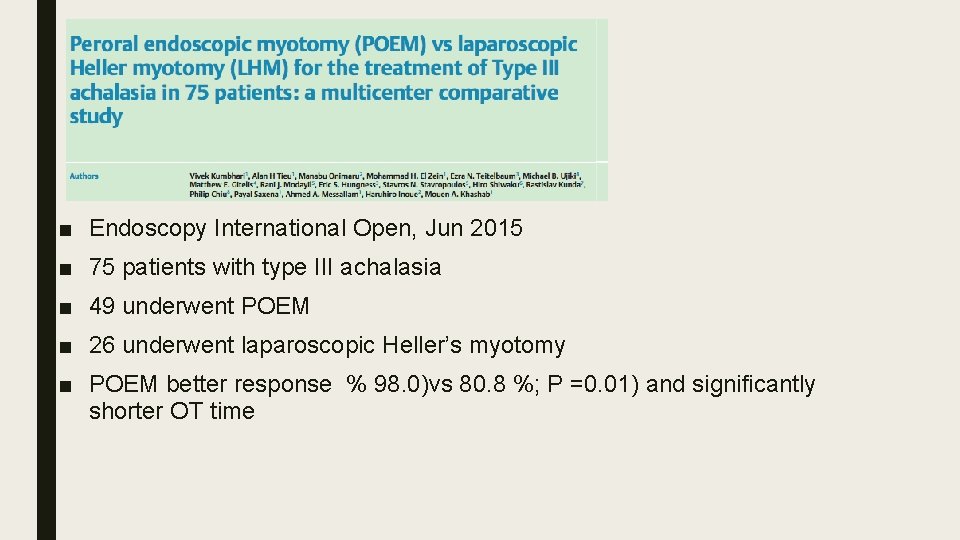
■ Endoscopy International Open, Jun 2015 ■ 75 patients with type III achalasia ■ 49 underwent POEM ■ 26 underwent laparoscopic Heller’s myotomy ■ POEM better response % 98. 0)vs 80. 8 %; P =0. 01) and significantly shorter OT time
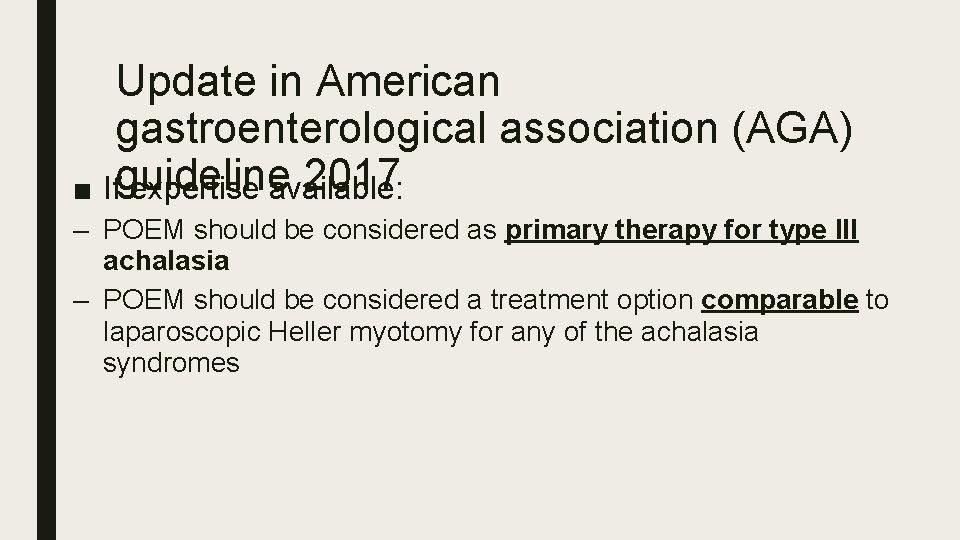
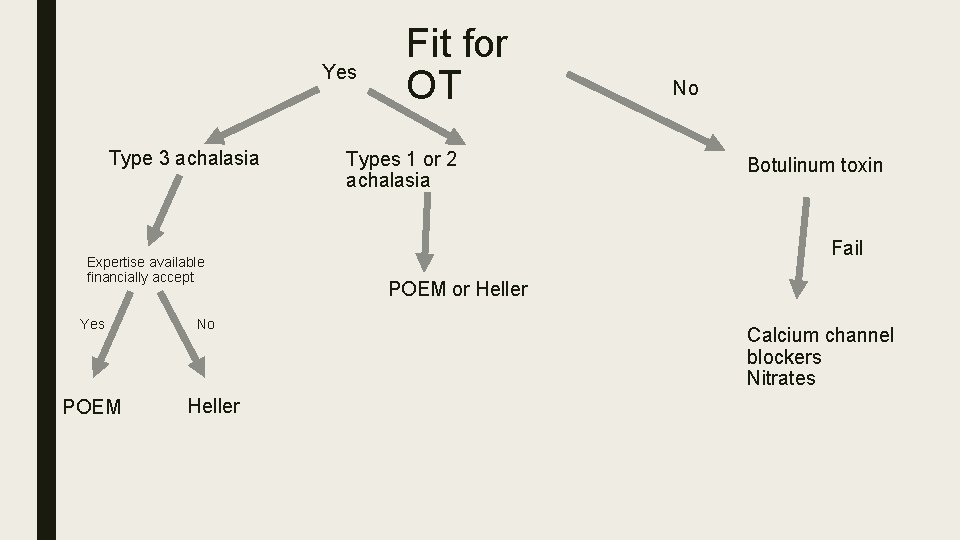
Update in American gastroenterological association (AGA) 2017 ■ Ifguideline expertise available: – POEM should be considered as primary therapy for type III achalasia – POEM should be considered a treatment option comparable to laparoscopic Heller myotomy for any of the achalasia syndromes
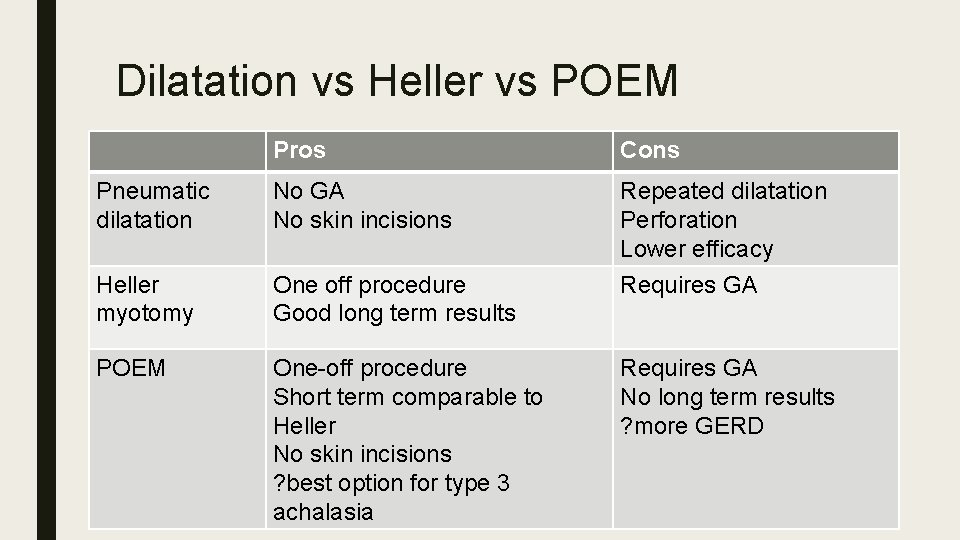
Dilatation vs Heller vs POEM Pros Cons Pneumatic dilatation No GA No skin incisions Repeated dilatation Perforation Lower efficacy Heller myotomy One off procedure Good long term results Requires GA POEM One-off procedure Short term comparable to Heller No skin incisions ? best option for type 3 achalasia Requires GA No long term results ? more GERD
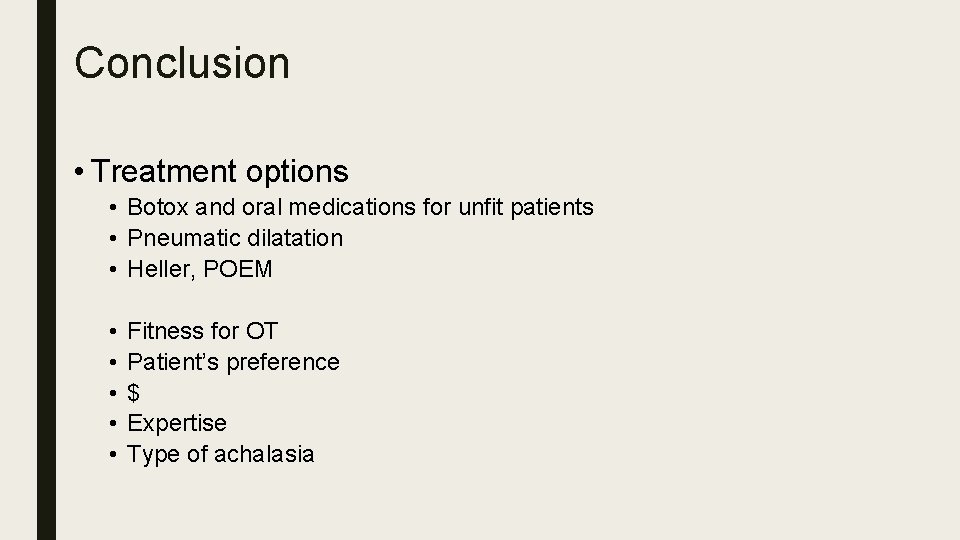
Conclusion • Treatment options • Botox and oral medications for unfit patients • Pneumatic dilatation • Heller, POEM • • • Fitness for OT Patient’s preference $ Expertise Type of achalasia
Thank you
Yes Type 3 achalasia Expertise available financially accept Yes POEM No Heller Fit for OT Types 1 or 2 achalasia No Botulinum toxin Fail POEM or Heller Calcium channel blockers Nitrates