
Updates on Caribou WG vertex and tracking detector
Updates on Caribou WG vertex and tracking detector technology meeting 27 March 2020 Tomas Vanat tomas. vanat@cern. ch 27 March 2020 WG vertex and tracking detector technology meeting, tomas. vanat@cern. ch 1
Outline • Firmware modules • • Pattern generator Test pulse generator Timestamp generator Data buffer/merger • New CLICpix 2 FW • Wi. P: SW upgrage • Peary modifications • Upgrade to latest Poky • Wi. P: HW upgrade 27 March 2020 WG vertex and tracking detector technology meeting, tomas. vanat@cern. ch 2
New Firmware modules • Whole firmware is chip-specific. • Different speeds, protocols, control/status signals, … • Similar tasks/control sequences are performed • Two basic approaches: • Frame-based / triggered (CLICpix 2, CLICTD) • Continuous (data-driven) readout (ATLASPix) • Firmware can be built from configurable and reusable blocks + a little of a custom logic • • 27 March 2020 Timestamp generator Data buffer Output pattern generator … WG vertex and tracking detector technology meeting, tomas. vanat@cern. ch 3
Pattern generator • Inspired by original CLICpix 2 wave generator by Adrian Fiergolski • With a few new features added • Can generate an output sequence (waveform) on multiple channels • Transitions between output states can be executed • After a defined time • After a logic condition is met • Combination of both • Outputs and trigger inputs are fixed in FW • Sequence and transition conditions are defined in SW • Can run in an infinite loop or for a defined number of cycles (SW config. ) 27 March 2020 WG vertex and tracking detector technology meeting, tomas. vanat@cern. ch 4
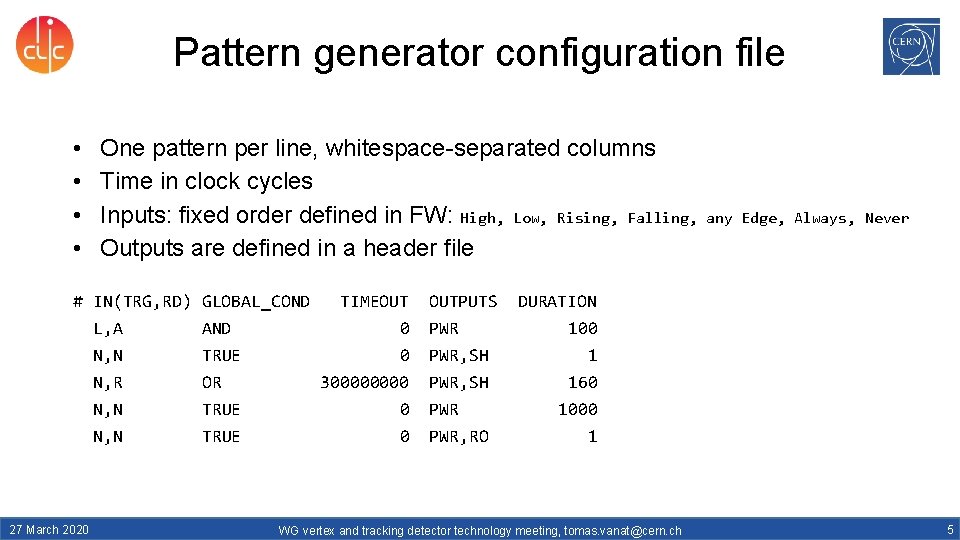
Pattern generator configuration file • • One pattern per line, whitespace-separated columns Time in clock cycles Inputs: fixed order defined in FW: High, Low, Rising, Falling, Outputs are defined in a header file # IN(TRG, RD) L, A N, N N, R N, N 27 March 2020 GLOBAL_COND TIMEOUT AND 0 TRUE 0 OR 30000 TRUE 0 OUTPUTS PWR, SH PWR PWR, RO any Edge, Always, Never DURATION 100 1 160 1000 1 WG vertex and tracking detector technology meeting, tomas. vanat@cern. ch 5
Test pulse generator • Can control an on-Ca. R-board analog pulser or generate a digital output only, e. g. for CLIC(pix 2|TD) with on-chip pulser • Defined in SW: • • Time of pulse active Time of pulse idle Number of repetitions Idle state high or low (output invert) • Can be started e. g. from SW or by a pattern generator 27 March 2020 WG vertex and tracking detector technology meeting, tomas. vanat@cern. ch 6
Timestamp generator • • 27 March 2020 Counts clock cycles Has programmable number of inputs (defined in FW) SW can set active edge on each input that generates a trigger Counter value and input states are stored to FIFO when trigger occurs WG vertex and tracking detector technology meeting, tomas. vanat@cern. ch 7
Data buffer/merger • For frame-based chips • Prepares a data frame package and stores it to a FIFO so the DAQ can keep going and does not need to wait for SW to read the data. • After a trigger (e. g. readout end), it stores to a FIFO: 1. 2. 3. 4. A header with total number of data bytes in data buffer A header with number of timestamp bytes in timestamp buffer Timestamp data Readout data • SW can read frames asynchronously from the FIFO: • First header tells the total number of bytes to be read for a frame • Reads the number of bytes • Next frame follows 27 March 2020 WG vertex and tracking detector technology meeting, tomas. vanat@cern. ch 8
New CLICpix 2 FW • Replaced pattern generator with the new one • We needed a trigger for closing the shutter at DESY II testbeam • New CP 2 slow control interface • Before: a std. complex SPI core with Linux drivers for a non-std. CP 2 SPI-like iface • Hacks (patches) were needed in both FW and drivers to fit the non-standard behavior • Patches needed updates with each new version of SPI core (Vivado) and Linux kernel (Poky) • Now: a simple SPI core controlled by memory-mapped AXI registers: • SPI address + data to be send (R/W) • Received SPI data (R) • Control register: start-read, start-write, reset, start-readout (W) • New SPI core can generate a readout command in FW • Pattern generator can trigger a readout without SW intervention • Data buffer for asynchronous readout / continuous DAQ is implemented • Not beam-tested yet 27 March 2020 WG vertex and tracking detector technology meeting, tomas. vanat@cern. ch 9
Work in progress: Peary modifications • New commercial user/contributer: Fastree 3 d (A. Fiergolski) • Separation of Ca. R board specific features in HAL • Easier adjusting of Peary for different hardware • by Simon Spannagel + Adrian Fiergolski • Memory-mapped (FPGA FW) registers should be accessed in a same way as any other interface • Currently we use a different approach for FW registers • Multiple interfaces in HAL • Current implementation allows only one interface to a device (e. g. I 2 C) • Caribou. Device may need multiple interfaces • e. g. firmware registers and internal registers 27 March 2020 WG vertex and tracking detector technology meeting, tomas. vanat@cern. ch 10
Work in progress: Upgrade to latest Poky • Latest Poky version is Zeus • meta-openembedded and meta-xilinx are available for Zeus • Changes in libraries/headers and recipes structure • i 2 c-dev-user. h no longer available • Changes in device tree building (meta-xilinx) • Changes in output files structure • Some scripts (e. g. prepare_sd) do not work anymore • New I 2 C kernel drivers • We may not need the patches anymore (T. B. C. ) • Kernel panic error due to a race condition may be fixed (T. B. C. ) 27 March 2020 WG vertex and tracking detector technology meeting, tomas. vanat@cern. ch 11
Work in progress: New Ca. R board (v 1. 2) • PCB design by BNL (Hongbin Liu, Elena Zhivun, Hucheng Chen) • Voltage levels of TXB 0304 will be set by a DAC from software • No more (solder) jumpers needed • Ca. R board will be more versatile • A new power management circuit • Will allow to set an electronic fuse on the power supplies • Protects chips prone to latch-ups • Will require software modifications – breaks backward compatibility • Automated identification of the board version via on-board EEPROM • Mechanical dimensions stay the same 27 March 2020 WG vertex and tracking detector technology meeting, tomas. vanat@cern. ch 12
- Slides: 12