
Updates on Apprenticeship Funding Rules and Key Areas
- Slides: 13
Updates on Apprenticeship Funding Rules and Key Areas of Recent Clarification March 2019 www. srfconsultancy. co. uk info@srfconsultancy. co. uk
Who are SRF? • Experts in Funding Rules Compliance & System Development • Identification of not only funding error but where funds have not been claimed or under claimed. • Record of First Class Performance at ESFA Audit • Knowledge of Rules and of what works in the field • Monitoring, Internal Audit, Strategic Advisory, PDSAT Analysis
Which are the Key Documents? • Apprenticeship funding and performance-management rules for training providers August 2018 to July 2019 (V 1 July 18) • Apprenticeship off-the-job training (version 2 March 2019) Where are they found? • ESFA Section of the Gov. uk website
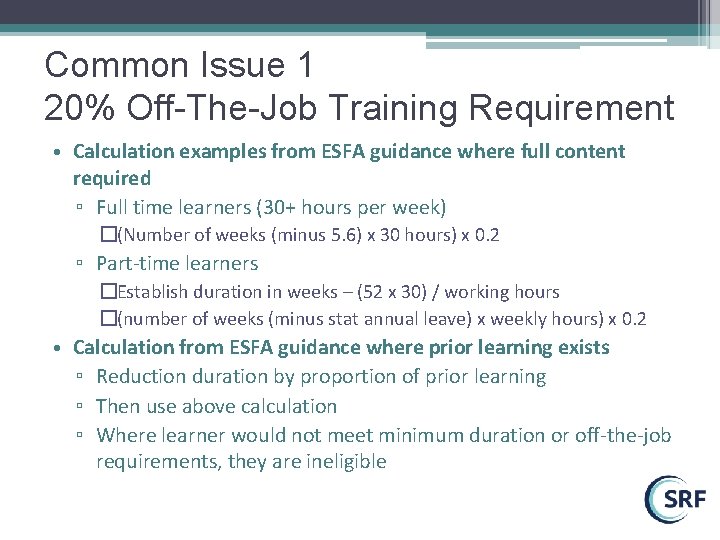
Common Issue 1 20% Off-The-Job Training Requirement • What is off-the-job training? ▫ Occupational training directly related to requirements of programme ▫ Teaching of new knowledge, skills and behaviours ▫ Delivered within learner’s contracted hours ▫ IA required to evidence that learner requires 20% off-the-job training for achievement, through assessment of prior learning. • Calculating off-the-job training ▫ Relevant timeframes – frameworks from start to planned end date, and standards from start to ‘final day’ ▫ Statutory annual leave can be deducted – 28 days / 5. 6 weeks is maximum which can be included, and must be adjusted for part-time working ▫ 30 hours represents full-time role, and measured over the typical duration of the programme.
Common Issue 1 20% Off-The-Job Training Requirement • Calculation examples from ESFA guidance where full content required ▫ Full time learners (30+ hours per week) �(Number of weeks (minus 5. 6) x 30 hours) x 0. 2 ▫ Part-time learners �Establish duration in weeks – (52 x 30) / working hours �(number of weeks (minus stat annual leave) x weekly hours) x 0. 2 • Calculation from ESFA guidance where prior learning exists ▫ Reduction duration by proportion of prior learning ▫ Then use above calculation ▫ Where learner would not meet minimum duration or off-the-job requirements, they are ineligible
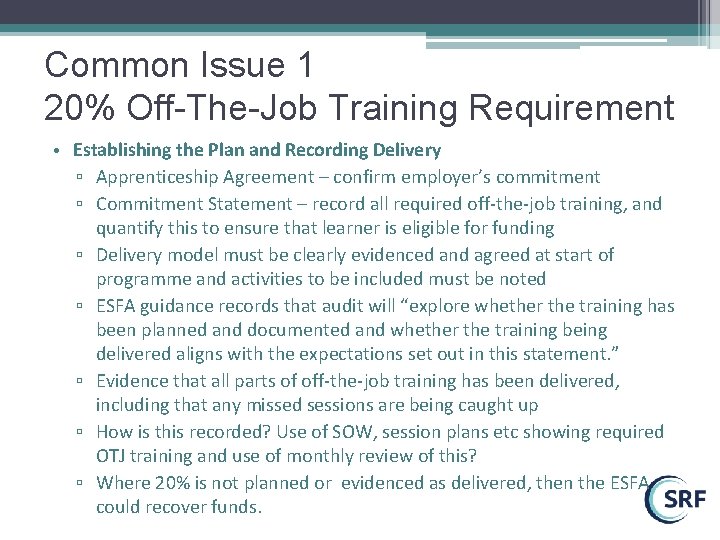
Common Issue 1 20% Off-The-Job Training Requirement • Establishing the Plan and Recording Delivery ▫ Apprenticeship Agreement – confirm employer’s commitment ▫ Commitment Statement – record all required off-the-job training, and quantify this to ensure that learner is eligible for funding ▫ Delivery model must be clearly evidenced and agreed at start of programme and activities to be included must be noted ▫ ESFA guidance records that audit will “explore whether the training has been planned and documented and whether the training being delivered aligns with the expectations set out in this statement. ” ▫ Evidence that all parts of off-the-job training has been delivered, including that any missed sessions are being caught up ▫ How is this recorded? Use of SOW, session plans etc showing required OTJ training and use of monthly review of this? ▫ Where 20% is not planned or evidenced as delivered, then the ESFA could recover funds.
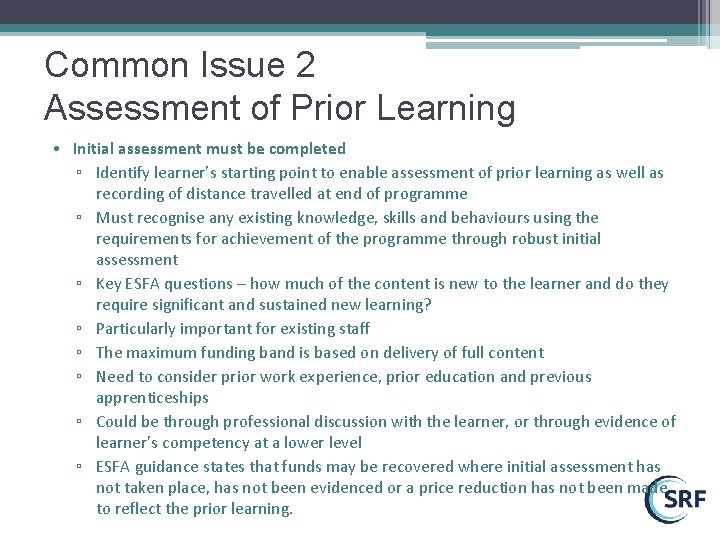
Common Issue 2 Assessment of Prior Learning • Initial assessment must be completed ▫ Identify learner’s starting point to enable assessment of prior learning as well as recording of distance travelled at end of programme ▫ Must recognise any existing knowledge, skills and behaviours using the requirements for achievement of the programme through robust initial assessment ▫ Key ESFA questions – how much of the content is new to the learner and do they require significant and sustained new learning? ▫ Particularly important for existing staff ▫ The maximum funding band is based on delivery of full content ▫ Need to consider prior work experience, prior education and previous apprenticeships ▫ Could be through professional discussion with the learner, or through evidence of learner’s competency at a lower level ▫ ESFA guidance states that funds may be recovered where initial assessment has not taken place, has not been evidenced or a price reduction has not been made to reflect the prior learning.
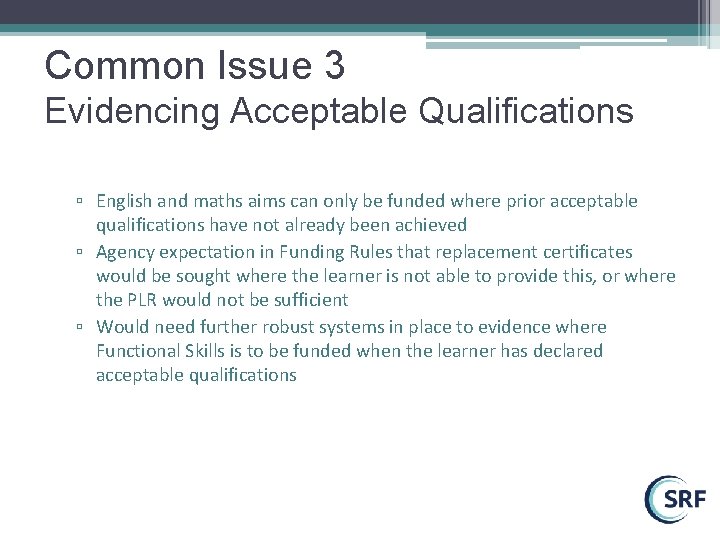
Common Issue 3 Evidencing Acceptable Qualifications ▫ English and maths aims can only be funded where prior acceptable qualifications have not already been achieved ▫ Agency expectation in Funding Rules that replacement certificates would be sought where the learner is not able to provide this, or where the PLR would not be sufficient ▫ Would need further robust systems in place to evidence where Functional Skills is to be funded when the learner has declared acceptable qualifications
Common Issue 4 Establishing and Reporting of EPA Price ▫ Where the EPA cost has been reported before the actual cost being known, potential funding issues will arise once the ILR data is updated. ▫ Potential over claims of funding will exist where the actual EPA cost is lower than the amount reported on the ILR data, as the training cost has already been agreed with the employer, and the Agency would not expect this to increase
Common Issue 5 Lower Level Functional Skills Aims ▫ Where learners are targeting level 1 Functional Skills aims or below, this would need to be at a level above their initial assessment and diagnostics ▫ There is the potential to deliver down to entry level 1 Functional Skills aims within the programme, though the learners would still need to progress to level 2, and take the test for this, within the programme ▫ Need to ensure that the planned end dates for Functional Skills aims allow for progression to level 2, or for undertaking level 1 assessment where level 2 is targeted with no prior attainment ▫ Need to take care if delivering lower level Functional Skills and Learning Support due to the low initial assessment results
Additional Areas • ESFA have confirmed Apprenticeship Agreement is not to be incorporated into the Commitment Statement and should be separate document agreed by the employer and learner. ESFA still expect for evidence that this is held to be in place. • Supporting start of learning for programme, as well as English and maths aims • Reporting and negotiation of total price (including where delivering to own employees) • Obtaining and reporting employer co-investment, including split between training and EPA PMRs on the ILR data • Learning Support • Employer agreement to break in learning • Not using funding and funding monitoring reports from HUB • Not utilising PDSAT reports
In Summary • The ESFA is still providing further clarification / guidance on funding rules and providers need to be able to adapt to these and ensure systems and processes are robust. You need to ensure that systems are working and you are compliant What else can SRF do? • Programme Audit and monitoring / Funding Compliance “Health check” • Data Analysis – Over and Under claim identification • Additional Seminars available: Changes to the Rules, PDSAT • Learning Support Development Consultancy
Questions? Note: For SRF’s Internal audit services and other products see www. srfconsultancy. co. uk