
UPDATES ON APPLE INSECT MANAGEMENT Rick Weinzierl Fruit

- Slides: 30
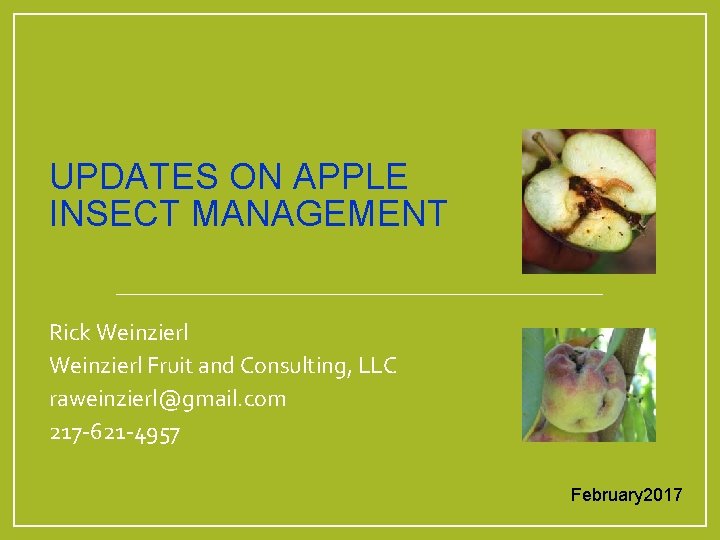
UPDATES ON APPLE INSECT MANAGEMENT Rick Weinzierl Fruit and Consulting, LLC raweinzierl@gmail. com 217 -621 -4957 February 2017
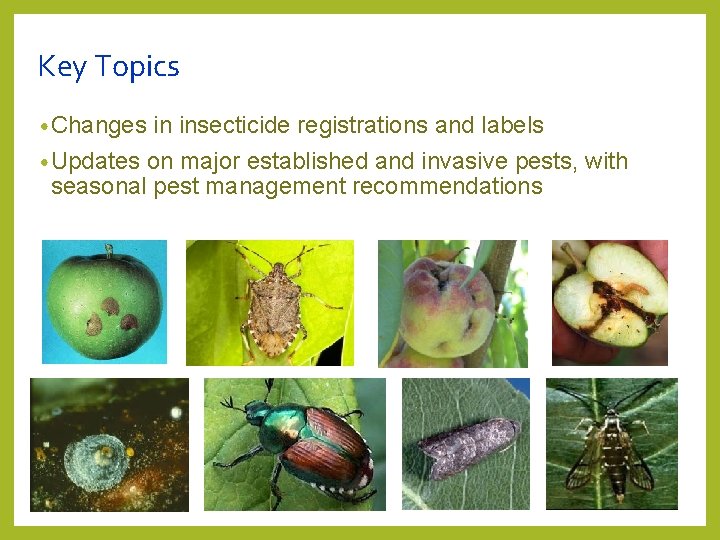
Key Topics • Changes in insecticide registrations and labels • Updates on major established and invasive pests, with seasonal pest management recommendations
Changes in Insecticide Recommendations • Cancellations, etc. • Belt for Lepidopteran control • Calypso for Lepidopteran control • Renounce (a. i. cyfluthrin still available as Baythroid) • Additions • Sivanto … a neonicotinoid rated “Good” against rosy apple aphid and “green” aphids in apples. • Pending • Harvanta … registration slated for spring • For control of plum curculio and Leps in apples and peaches • Same mode of action as Altacor and Exirel • Fairly low toxicity to bees (important for small fruit uses for spotted wing Drosophila control)
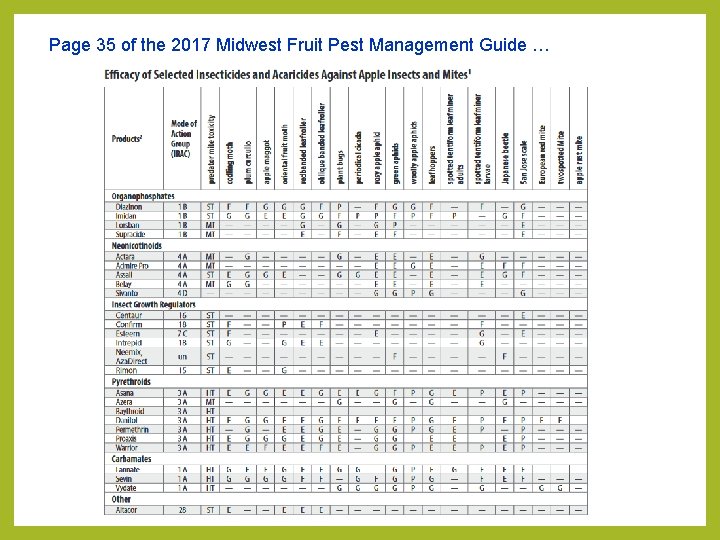
Page 35 of the 2017 Midwest Fruit Pest Management Guide …
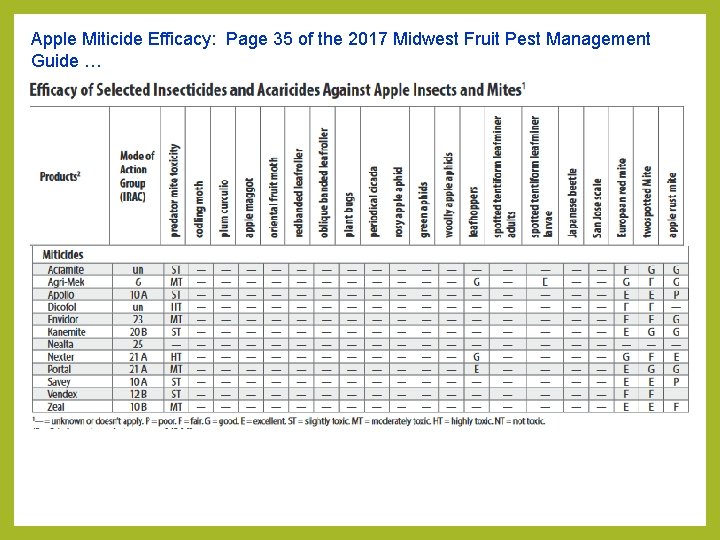
Apple Miticide Efficacy: Page 35 of the 2017 Midwest Fruit Pest Management Guide …
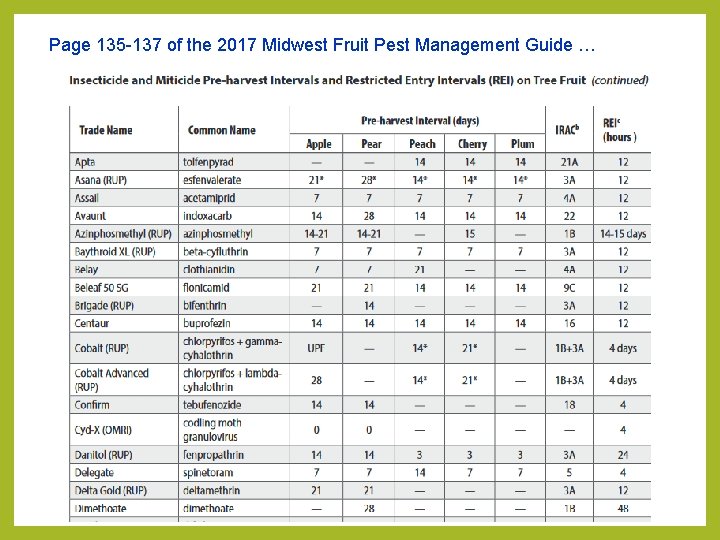
Page 135 -137 of the 2017 Midwest Fruit Pest Management Guide …
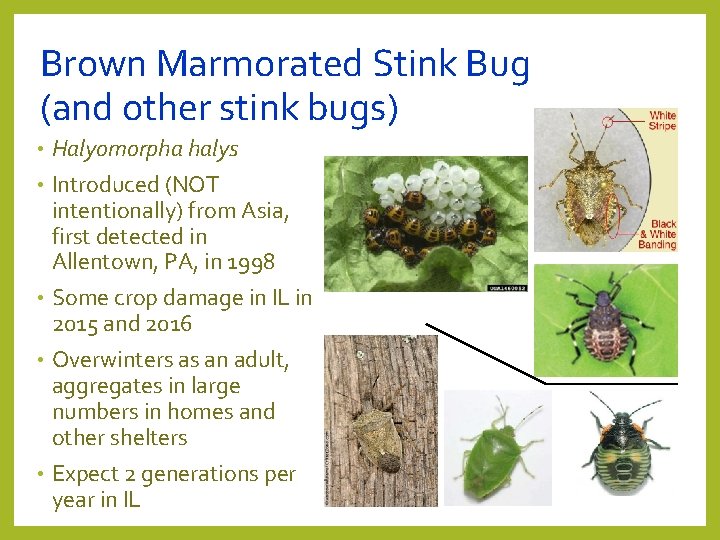
Brown Marmorated Stink Bug (and other stink bugs) • • • Halyomorpha halys Introduced (NOT intentionally) from Asia, first detected in Allentown, PA, in 1998 Some crop damage in IL in 2015 and 2016 Overwinters as an adult, aggregates in large numbers in homes and other shelters Expect 2 generations per year in IL
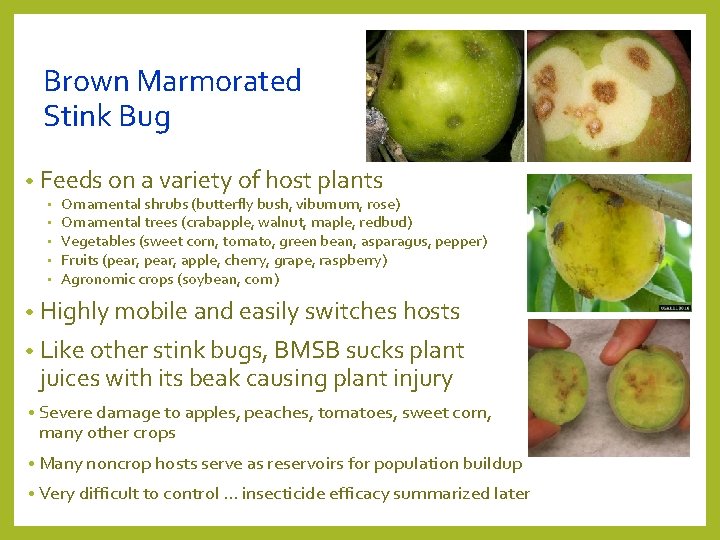
Brown Marmorated Stink Bug • Feeds on a variety of host plants • • • Ornamental shrubs (butterfly bush, viburnum, rose) Ornamental trees (crabapple, walnut, maple, redbud) Vegetables (sweet corn, tomato, green bean, asparagus, pepper) Fruits (pear, apple, cherry, grape, raspberry) Agronomic crops (soybean, corn) • Highly mobile and easily switches hosts • Like other stink bugs, BMSB sucks plant juices with its beak causing plant injury • Severe damage to apples, peaches, tomatoes, sweet corn, many other crops • Many noncrop hosts serve as reservoirs for population buildup • Very difficult to control … insecticide efficacy summarized later
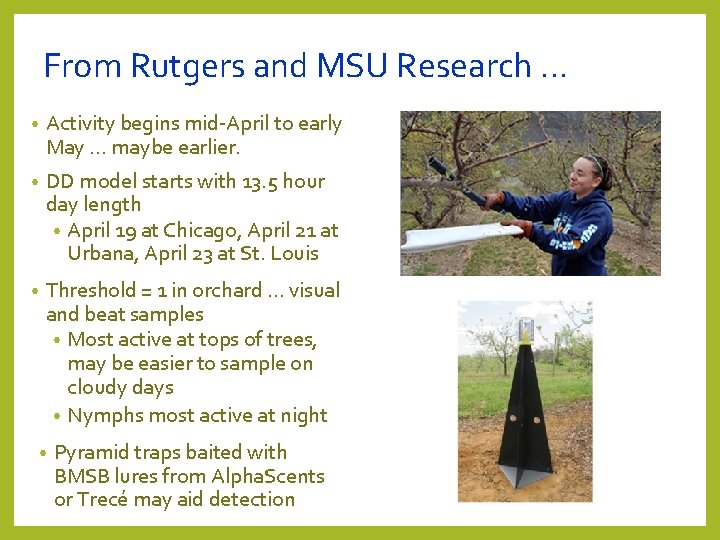
From Rutgers and MSU Research … • Activity begins mid-April to early May … maybe earlier. • DD model starts with 13. 5 hour day length • April 19 at Chicago, April 21 at Urbana, April 23 at St. Louis • Threshold = 1 in orchard … visual and beat samples • Most active at tops of trees, may be easier to sample on cloudy days • Nymphs most active at night • Pyramid traps baited with BMSB lures from Alpha. Scents or Trecé may aid detection
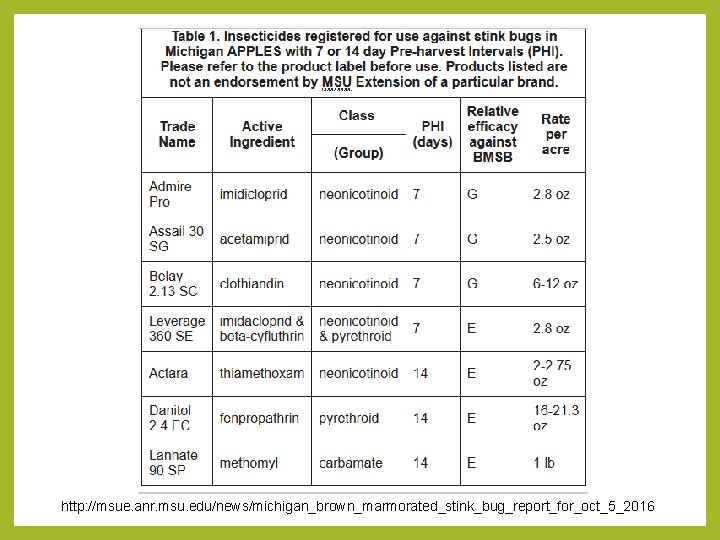
http: //msue. anr. msu. edu/news/michigan_brown_marmorated_stink_bug_report_for_oct_5_2016
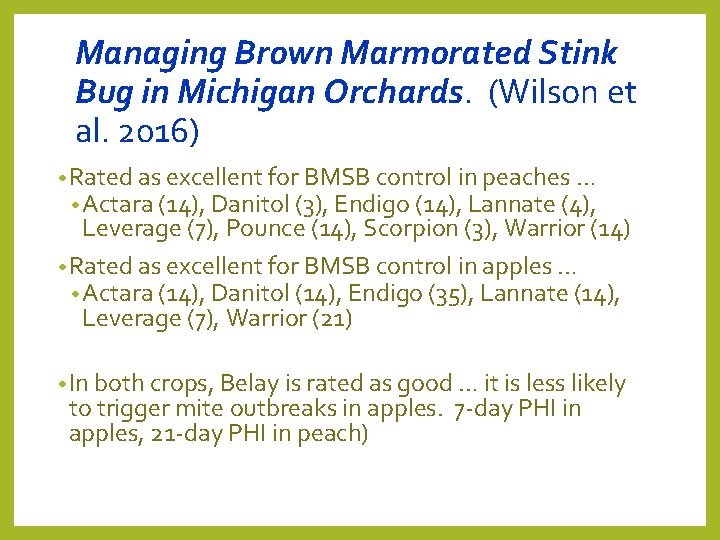
Managing Brown Marmorated Stink Bug in Michigan Orchards. (Wilson et al. 2016) • Rated as excellent for BMSB control in peaches … • Actara (14), Danitol (3), Endigo (14), Lannate (4), Leverage (7), Pounce (14), Scorpion (3), Warrior (14) • Rated as excellent for BMSB control in apples … • Actara (14), Danitol (14), Endigo (35), Lannate (14), Leverage (7), Warrior (21) • In both crops, Belay is rated as good … it is less likely to trigger mite outbreaks in apples. 7 -day PHI in apples, 21 -day PHI in peach)
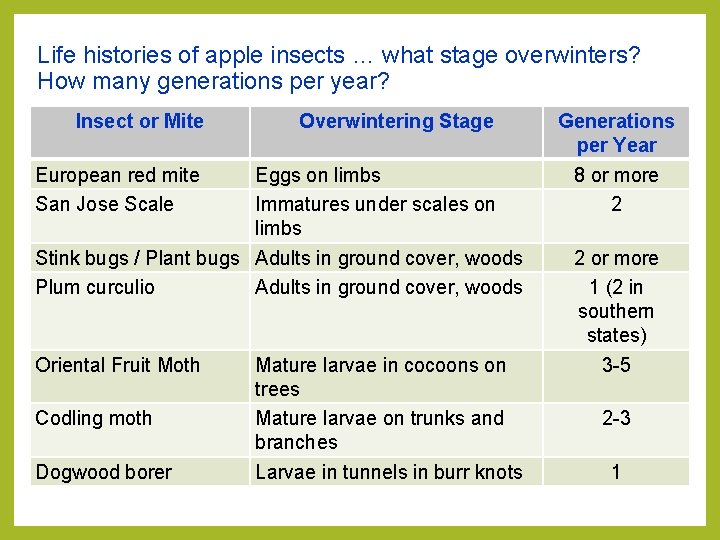
Life histories of apple insects … what stage overwinters? How many generations per year? Insect or Mite Overwintering Stage European red mite San Jose Scale Generations per Year 8 or more 2 Oriental Fruit Moth 2 or more 1 (2 in southern states) 3 -5 Eggs on limbs Immatures under scales on limbs Stink bugs / Plant bugs Adults in ground cover, woods Plum curculio Adults in ground cover, woods Codling moth Dogwood borer Mature larvae in cocoons on trees Mature larvae on trunks and branches Larvae in tunnels in burr knots 2 -3 1
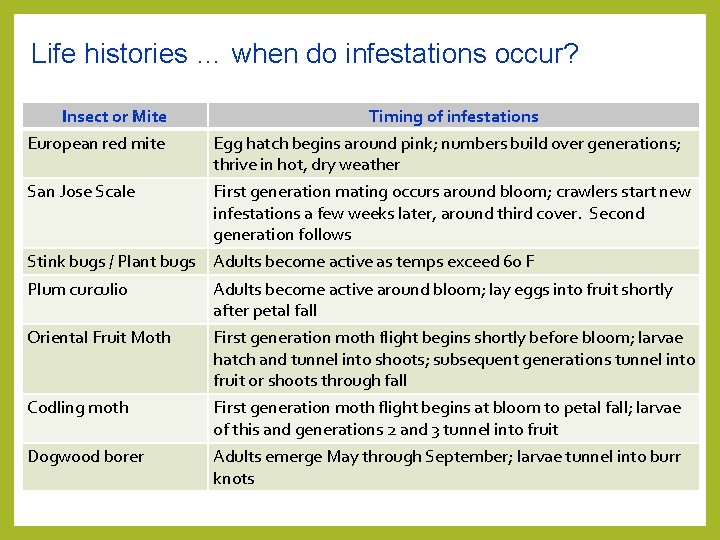
Life histories … when do infestations occur? Insect or Mite European red mite San Jose Scale Timing of infestations Egg hatch begins around pink; numbers build over generations; thrive in hot, dry weather First generation mating occurs around bloom; crawlers start new infestations a few weeks later, around third cover. Second generation follows Stink bugs / Plant bugs Adults become active as temps exceed 60 F Plum curculio Oriental Fruit Moth Adults become active around bloom; lay eggs into fruit shortly after petal fall First generation moth flight begins shortly before bloom; larvae hatch and tunnel into shoots; subsequent generations tunnel into fruit or shoots through fall Codling moth First generation moth flight begins at bloom to petal fall; larvae of this and generations 2 and 3 tunnel into fruit Dogwood borer Adults emerge May through September; larvae tunnel into burr knots
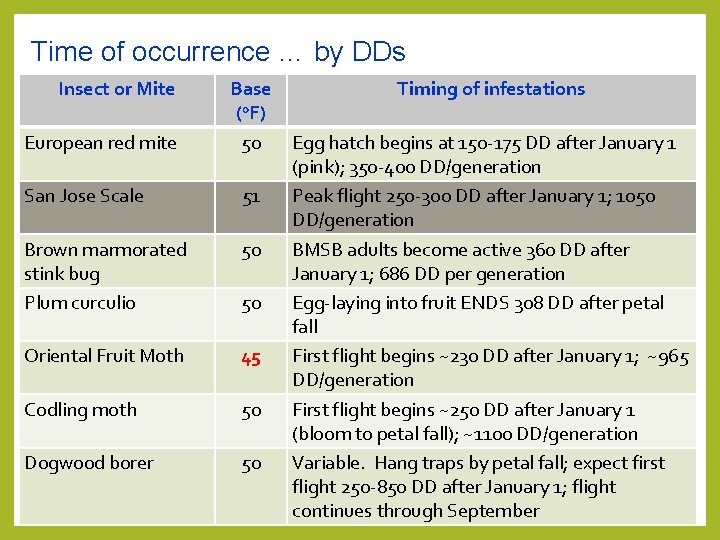
Time of occurrence … by DDs Insect or Mite European red mite Base (o. F) 50 San Jose Scale 51 Brown marmorated stink bug Plum curculio 50 Oriental Fruit Moth 45 Codling moth 50 Dogwood borer 50 50 Timing of infestations Egg hatch begins at 150 -175 DD after January 1 (pink); 350 -400 DD/generation Peak flight 250 -300 DD after January 1; 1050 DD/generation BMSB adults become active 360 DD after January 1; 686 DD per generation Egg-laying into fruit ENDS 308 DD after petal fall First flight begins ~230 DD after January 1; ~965 DD/generation First flight begins ~250 DD after January 1 (bloom to petal fall); ~1100 DD/generation Variable. Hang traps by petal fall; expect first flight 250 -850 DD after January 1; flight continues through September
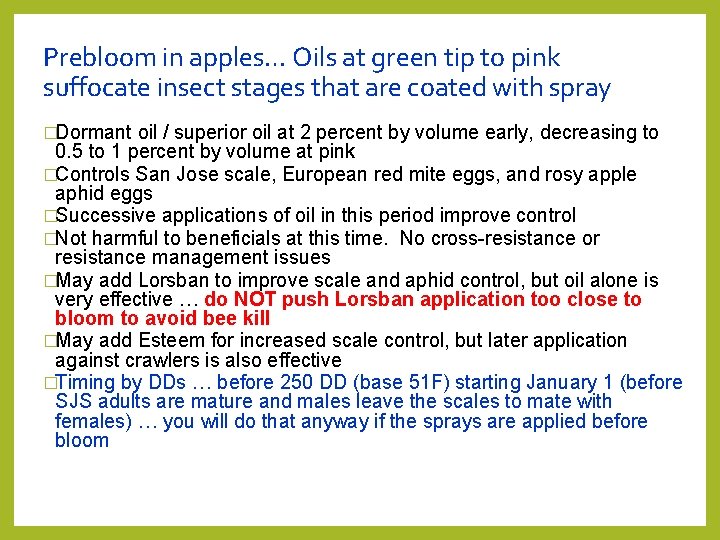
Prebloom in apples… Oils at green tip to pink suffocate insect stages that are coated with spray �Dormant oil / superior oil at 2 percent by volume early, decreasing to 0. 5 to 1 percent by volume at pink �Controls San Jose scale, European red mite eggs, and rosy apple aphid eggs �Successive applications of oil in this period improve control �Not harmful to beneficials at this time. No cross-resistance or resistance management issues �May add Lorsban to improve scale and aphid control, but oil alone is very effective … do NOT push Lorsban application too close to bloom to avoid bee kill �May add Esteem for increased scale control, but later application against crawlers is also effective �Timing by DDs … before 250 DD (base 51 F) starting January 1 (before SJS adults are mature and males leave the scales to mate with females) … you will do that anyway if the sprays are applied before bloom
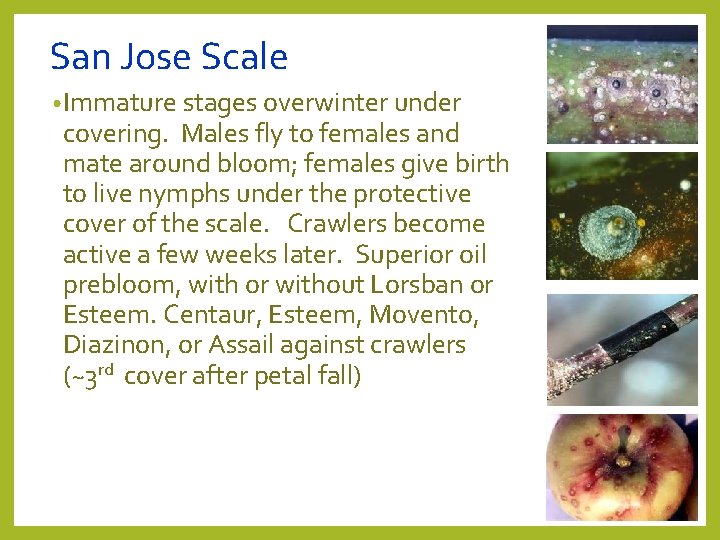
San Jose Scale • Immature stages overwinter under covering. Males fly to females and mate around bloom; females give birth to live nymphs under the protective cover of the scale. Crawlers become active a few weeks later. Superior oil prebloom, with or without Lorsban or Esteem. Centaur, Esteem, Movento, Diazinon, or Assail against crawlers (~3 rd cover after petal fall)
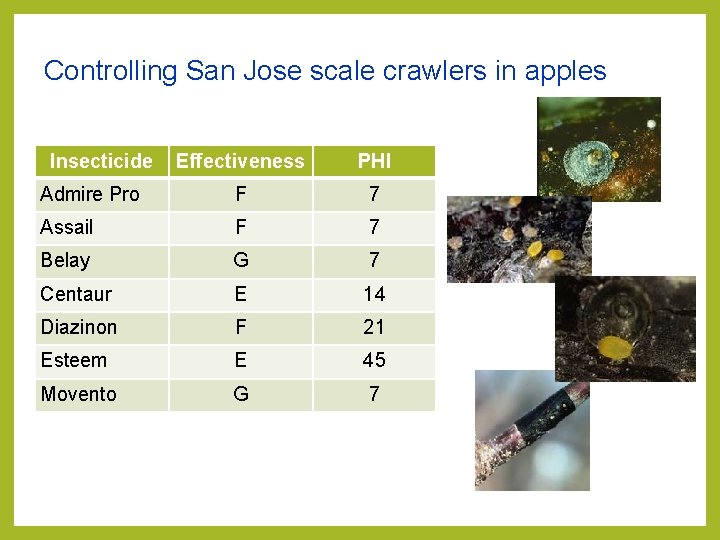
Controlling San Jose scale crawlers in apples Insecticide Effectiveness PHI Admire Pro F 7 Assail F 7 Belay G 7 Centaur E 14 Diazinon F 21 Esteem E 45 Movento G 7
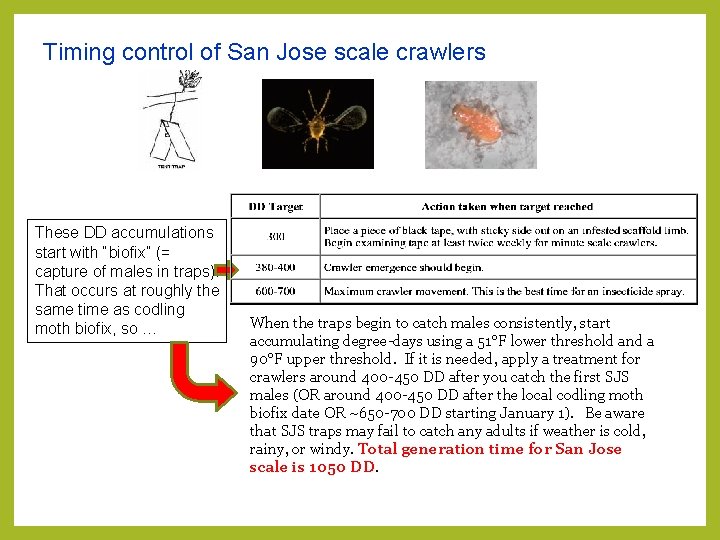
Timing control of San Jose scale crawlers These DD accumulations start with “biofix” (= capture of males in traps). That occurs at roughly the same time as codling moth biofix, so … When the traps begin to catch males consistently, start accumulating degree-days using a 51°F lower threshold and a 90°F upper threshold. If it is needed, apply a treatment for crawlers around 400 -450 DD after you catch the first SJS males (OR around 400 -450 DD after the local codling moth biofix date OR ~650 -700 DD starting January 1). Be aware that SJS traps may fail to catch any adults if weather is cold, rainy, or windy. Total generation time for San Jose scale is 1050 DD.
Plum Curculio Assail, Avaunt, and Imidan are products of choice for PC control at petal fall (and sometimes first cover) but not very effective against stink bugs and plant bugs; avoid pyrethroids in apples because they trigger mite outbreaks.
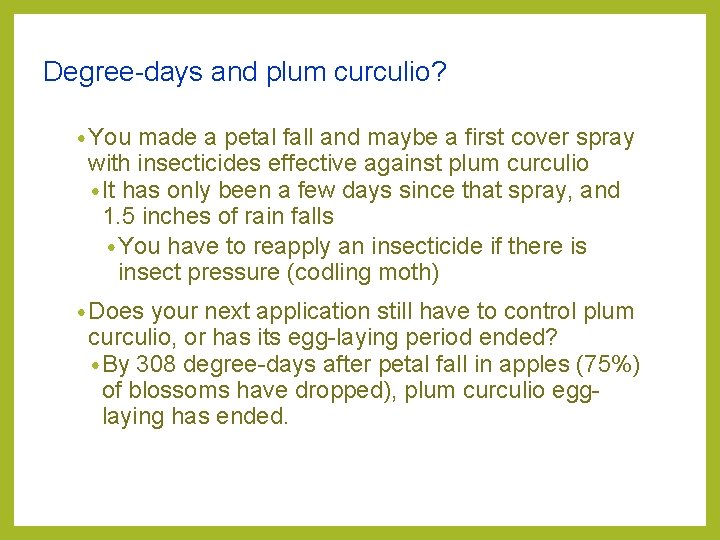
Degree-days and plum curculio? • You made a petal fall and maybe a first cover spray with insecticides effective against plum curculio • It has only been a few days since that spray, and 1. 5 inches of rain falls • You have to reapply an insecticide if there is insect pressure (codling moth) • Does your next application still have to control plum curculio, or has its egg-laying period ended? • By 308 degree-days after petal fall in apples (75%) of blossoms have dropped), plum curculio egglaying has ended.
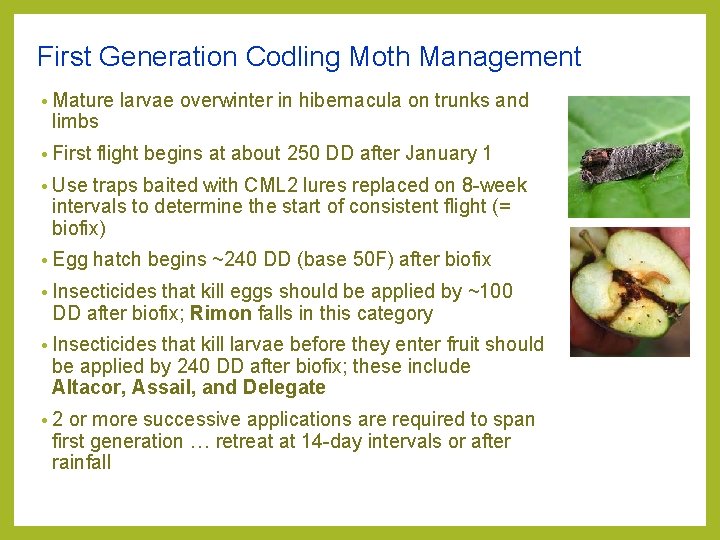
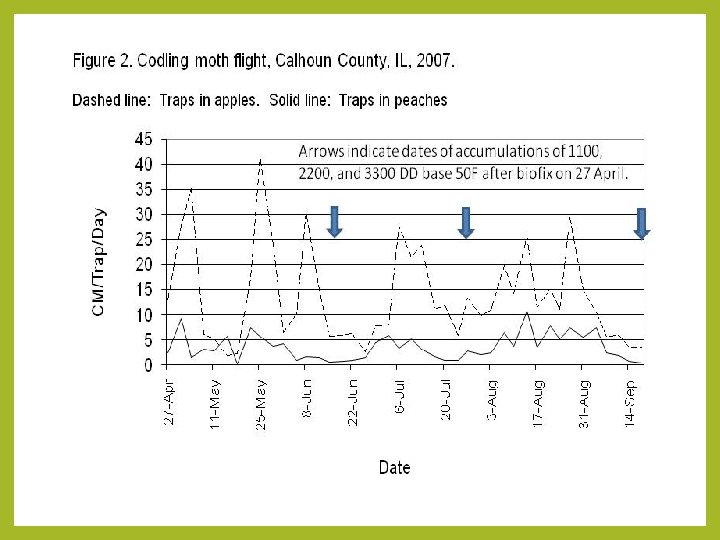
First Generation Codling Moth Management • Mature limbs • First larvae overwinter in hibernacula on trunks and flight begins at about 250 DD after January 1 • Use traps baited with CML 2 lures replaced on 8 -week intervals to determine the start of consistent flight (= biofix) • Egg hatch begins ~240 DD (base 50 F) after biofix • Insecticides that kill eggs should be applied by ~100 DD after biofix; Rimon falls in this category • Insecticides that kill larvae before they enter fruit should be applied by 240 DD after biofix; these include Altacor, Assail, and Delegate • 2 or more successive applications are required to span first generation … retreat at 14 -day intervals or after rainfall
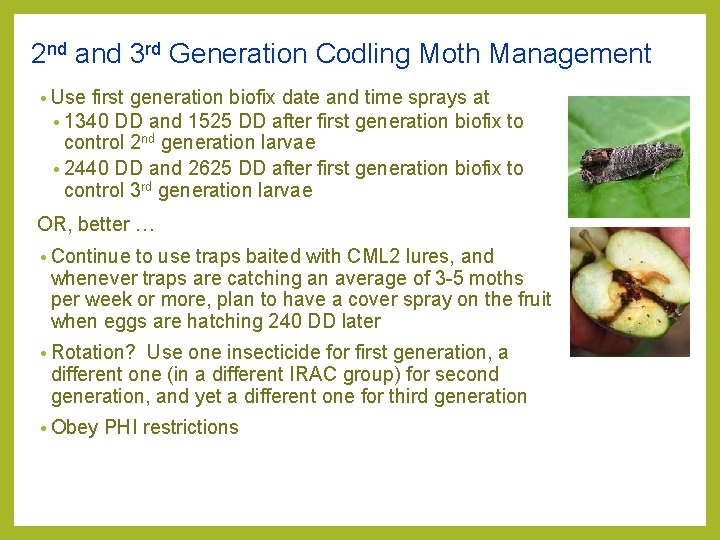
2 nd and 3 rd Generation Codling Moth Management • Use first generation biofix date and time sprays at • 1340 DD and 1525 DD after first generation biofix to control 2 nd generation larvae • 2440 DD and 2625 DD after first generation biofix to control 3 rd generation larvae OR, better … • Continue to use traps baited with CML 2 lures, and whenever traps are catching an average of 3 -5 moths per week or more, plan to have a cover spray on the fruit when eggs are hatching 240 DD later • Rotation? Use one insecticide for first generation, a different one (in a different IRAC group) for second generation, and yet a different one for third generation • Obey PHI restrictions
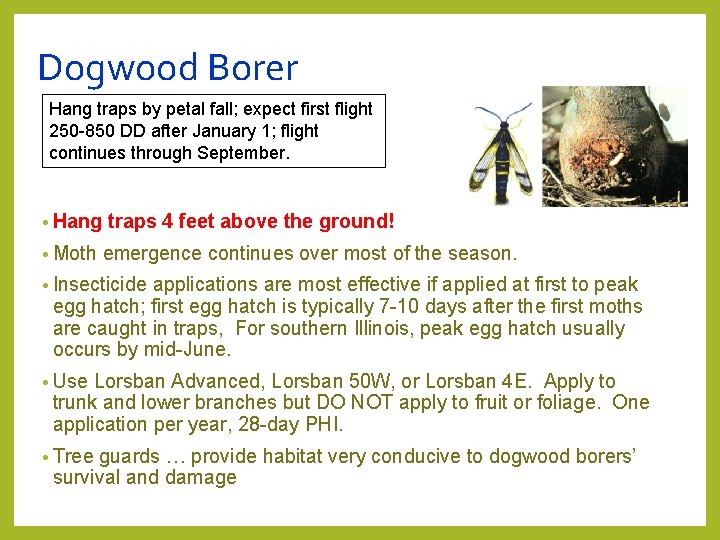
Dogwood Borer Hang traps by petal fall; expect first flight 250 -850 DD after January 1; flight continues through September. • Hang • Moth traps 4 feet above the ground! emergence continues over most of the season. • Insecticide applications are most effective if applied at first to peak egg hatch; first egg hatch is typically 7 -10 days after the first moths are caught in traps, For southern Illinois, peak egg hatch usually occurs by mid-June. • Use Lorsban Advanced, Lorsban 50 W, or Lorsban 4 E. Apply to trunk and lower branches but DO NOT apply to fruit or foliage. One application per year, 28 -day PHI. • Tree guards … provide habitat very conducive to dogwood borers’ survival and damage
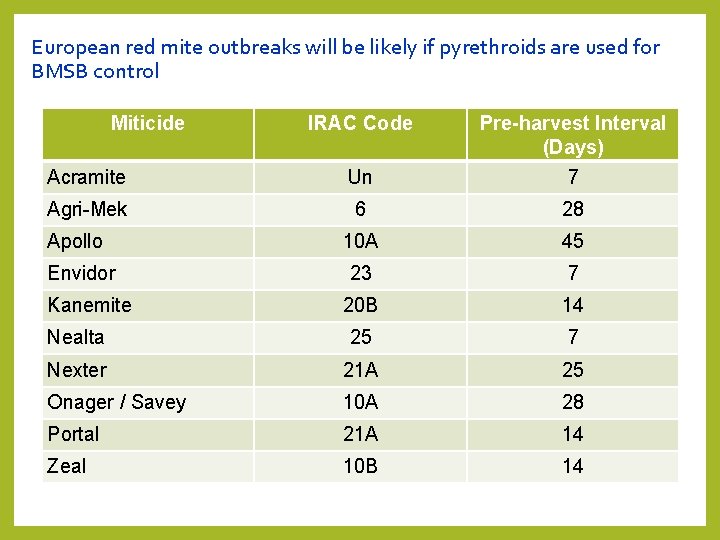
European red mite outbreaks will be likely if pyrethroids are used for BMSB control Miticide Acramite Un Pre-harvest Interval (Days) 7 Agri-Mek 6 28 10 A 45 23 7 20 B 14 Nealta 25 7 Nexter 21 A 25 Onager / Savey 10 A 28 Portal 21 A 14 Zeal 10 B 14 Apollo Envidor Kanemite IRAC Code
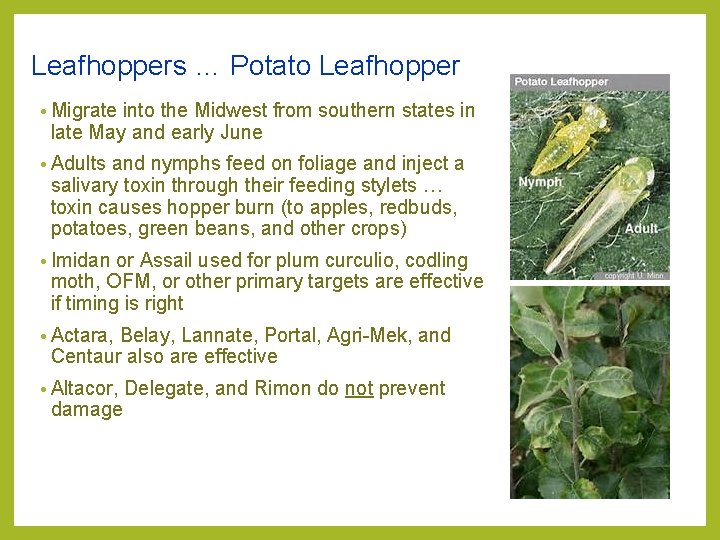
Leafhoppers … Potato Leafhopper • Migrate into the Midwest from southern states in late May and early June • Adults and nymphs feed on foliage and inject a salivary toxin through their feeding stylets … toxin causes hopper burn (to apples, redbuds, potatoes, green beans, and other crops) • Imidan or Assail used for plum curculio, codling moth, OFM, or other primary targets are effective if timing is right • Actara, Belay, Lannate, Portal, Agri-Mek, and Centaur also are effective • Altacor, damage Delegate, and Rimon do not prevent
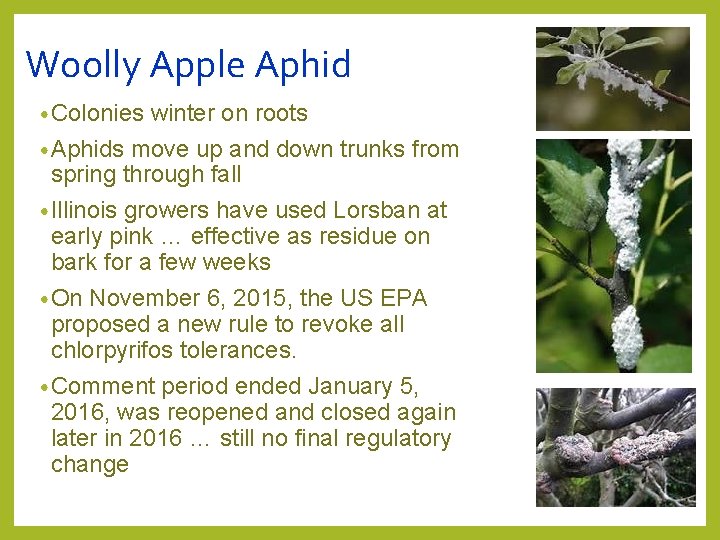
Woolly Apple Aphid • Colonies winter on roots • Aphids move up and down trunks from spring through fall • Illinois growers have used Lorsban at early pink … effective as residue on bark for a few weeks • On November 6, 2015, the US EPA proposed a new rule to revoke all chlorpyrifos tolerances. • Comment period ended January 5, 2016, was reopened and closed again later in 2016 … still no final regulatory change
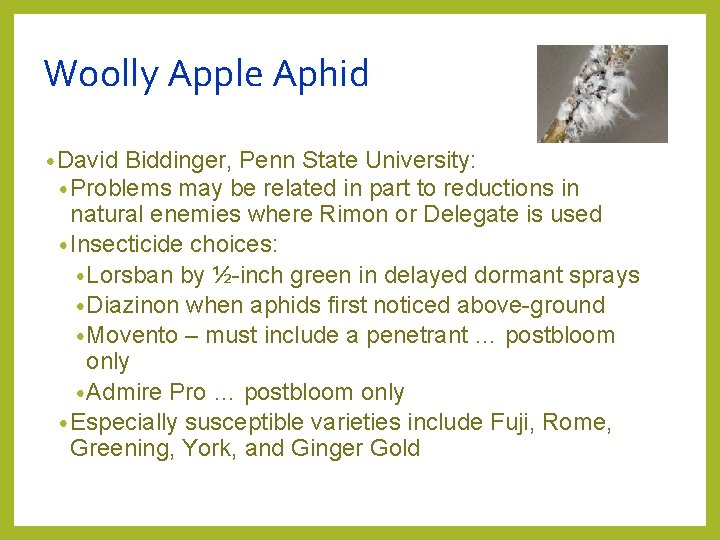
Woolly Apple Aphid • David Biddinger, Penn State University: • Problems may be related in part to reductions in natural enemies where Rimon or Delegate is used • Insecticide choices: • Lorsban by ½-inch green in delayed dormant sprays • Diazinon when aphids first noticed above-ground • Movento – must include a penetrant … postbloom only • Admire Pro … postbloom only • Especially susceptible varieties include Fuji, Rome, Greening, York, and Ginger Gold
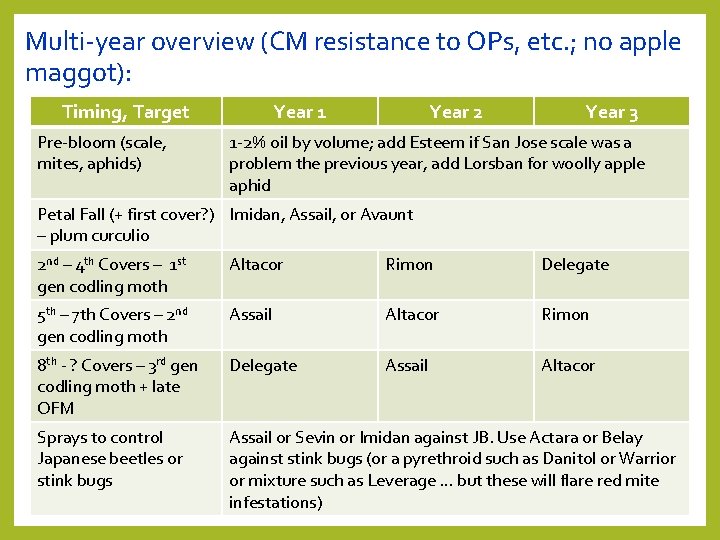
Multi-year overview (CM resistance to OPs, etc. ; no apple maggot): Timing, Target Pre-bloom (scale, mites, aphids) Year 1 Year 2 Year 3 1 -2% oil by volume; add Esteem if San Jose scale was a problem the previous year, add Lorsban for woolly apple aphid Petal Fall (+ first cover? ) Imidan, Assail, or Avaunt – plum curculio 2 nd – 4 th Covers – 1 st gen codling moth Altacor Rimon Delegate 5 th – 7 th Covers – 2 nd gen codling moth Assail Altacor Rimon 8 th - ? Covers – 3 rd gen codling moth + late OFM Delegate Assail Altacor Sprays to control Japanese beetles or stink bugs Assail or Sevin or Imidan against JB. Use Actara or Belay against stink bugs (or a pyrethroid such as Danitol or Warrior or mixture such as Leverage … but these will flare red mite infestations)
References, resources • 2017 Midwest Fruit Pest Management Guide • https: //ag. purdue. edu/hla/Hort/Pages/s fg_sprayguide. aspx • Illinois Fruit and Vegetable News • http: //ipm. illinois. edu/ifvn/ • Purdue’s Facts for Fancy Fruit • http: //www. hort. purdue. edu/fff. shtml • Great Lakes IPM • http: //www. greatlakesipm. com/