
Updates from the Virginia Department of Education Regions
- Slides: 30
Updates from the Virginia Department of Education Regions 6 and 7 Drive-In Salem, Virginia November 6, 2007 Dr. Linda M. Wallinger Assistant Superintendent for Instruction (804) 225 -2034 Linda. Wallinger@doe. virginia. gov
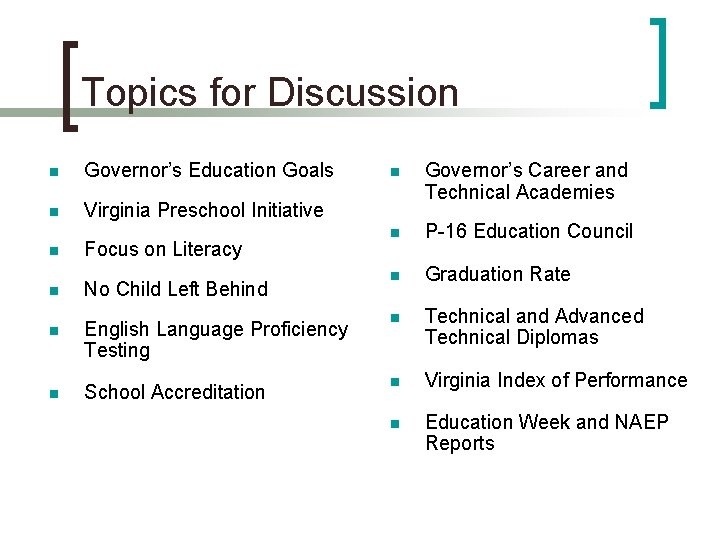
Topics for Discussion n Governor’s Education Goals n Virginia Preschool Initiative n Focus on Literacy n No Child Left Behind n English Language Proficiency Testing n School Accreditation n Governor’s Career and Technical Academies n P-16 Education Council n Graduation Rate n Technical and Advanced Technical Diplomas n Virginia Index of Performance n Education Week and NAEP Reports
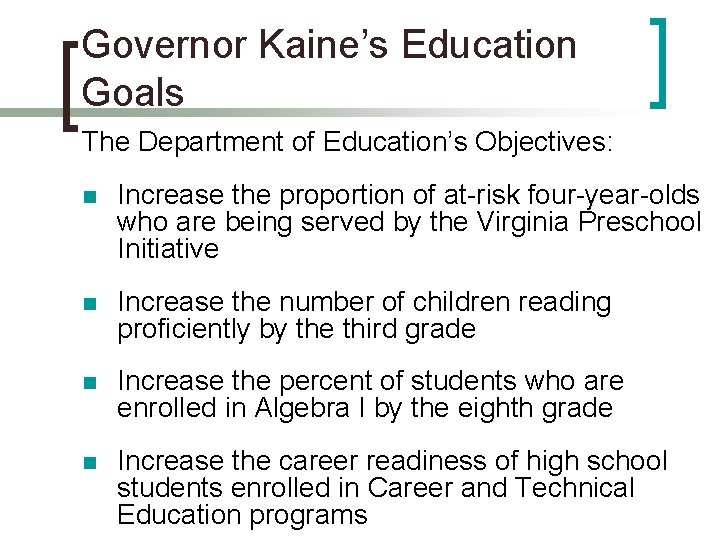
Governor Kaine’s Education Goals The Department of Education’s Objectives: n Increase the proportion of at-risk four-year-olds who are being served by the Virginia Preschool Initiative n Increase the number of children reading proficiently by the third grade n Increase the percent of students who are enrolled in Algebra I by the eighth grade n Increase the career readiness of high school students enrolled in Career and Technical Education programs
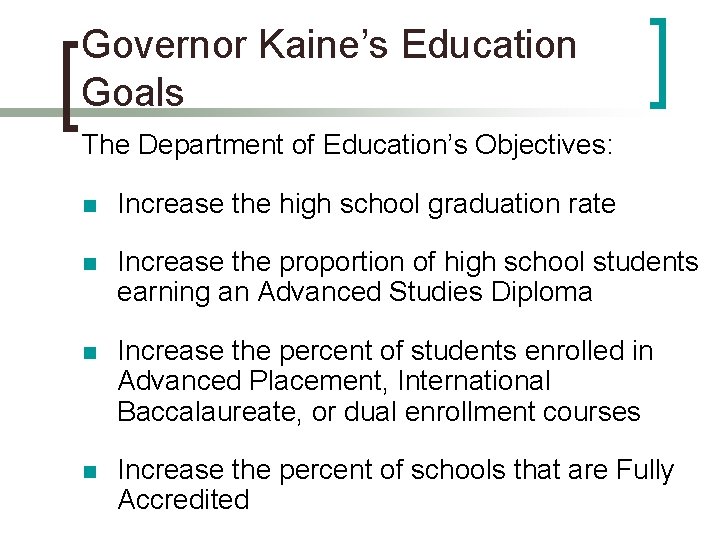
Governor Kaine’s Education Goals The Department of Education’s Objectives: n Increase the high school graduation rate n Increase the proportion of high school students earning an Advanced Studies Diploma n Increase the percent of students enrolled in Advanced Placement, International Baccalaureate, or dual enrollment courses n Increase the percent of schools that are Fully Accredited
Virginia Preschool Initiative Pilots n Extension of Virginia Preschool Initiative for at-risk 4 -yearolds n Expanded access to high-quality pre-kindergarten for Virginia’s four-year-olds n Related to focus on reading on grade level by Grade 3 n Based in research that shows that 90% of brain development occurs before a child turns 5 n Findings that children who attend high-quality preschool are more likely to finish school, find good jobs, less likely to commit a crime
Virginia Preschool Initiative Pilots n Pilots in 10 school divisions that had existing partnerships with private and/or non-profit providers as of the 2006 -2007 school year Albemarle County Alexandria City Alleghany County Bath County Chesapeake City Fairfax County Hampton City Highland County Richmond County Virginia Beach City n Expand availability of preschool education programs for atrisk students not served in those school divisions n Testing strategies to increase access to and quality of preschool Blended funding streams: state funds, Head Start, Title I, Special Ed, parent tuition Partnerships with private providers to expand opportunity and access Piloting a quality rating system
Focus on Literacy n Two focus areas n Reading on grade level by Grade 3 Adolescent literacy 2006 -2007 statewide achievement in reading Overall – 85% of Virginia students passed reading tests (up 1 point) Grade 3 – 80% (down 4 points) Gr. 5 : Reading – 87% (no change); Writing – 89% (no change) Gr. 8: Reading – 80% (up 2 points); Writing – 86% (down 5 points End-of-course: Reading – 94% (up 4 points); Writing – 92% (up 4 points)
Focus on Literacy n Board of Education’s Literacy Committee n Difference between “reading” and “literacy” n Adolescent Literacy Policy Summit Literacy specific to each content area Meaning of “literacy” in today’s digital society Instructional focus on literacy Title I summer institutes Middle school pilot Strategic Instruction Model pilot
Focus on Literacy n Governor Kaine’s role in adolescent literacy n Chair of an SREB Committee to improve reading and writing in middle and high schools Will develop proposed policies for SREB states to help students develop higher-level reading and writing skills in the middle grades and high school
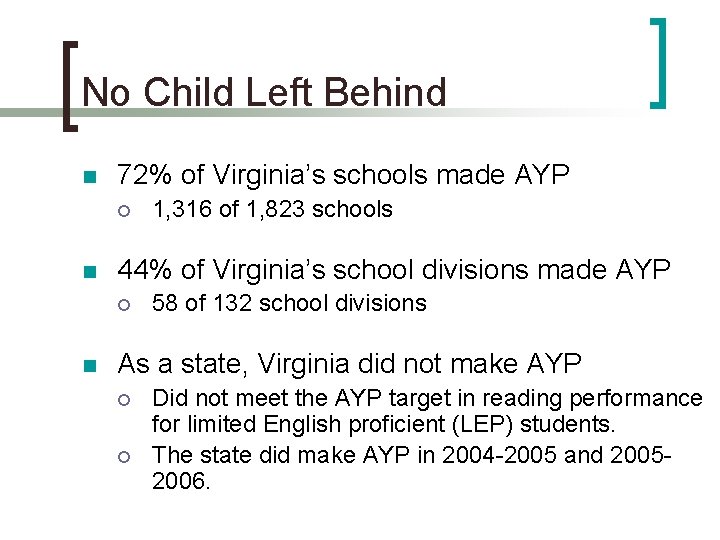
No Child Left Behind n 72% of Virginia’s schools made AYP n 44% of Virginia’s school divisions made AYP n 1, 316 of 1, 823 schools 58 of 132 school divisions As a state, Virginia did not make AYP Did not meet the AYP target in reading performance for limited English proficient (LEP) students. The state did make AYP in 2004 -2005 and 20052006.
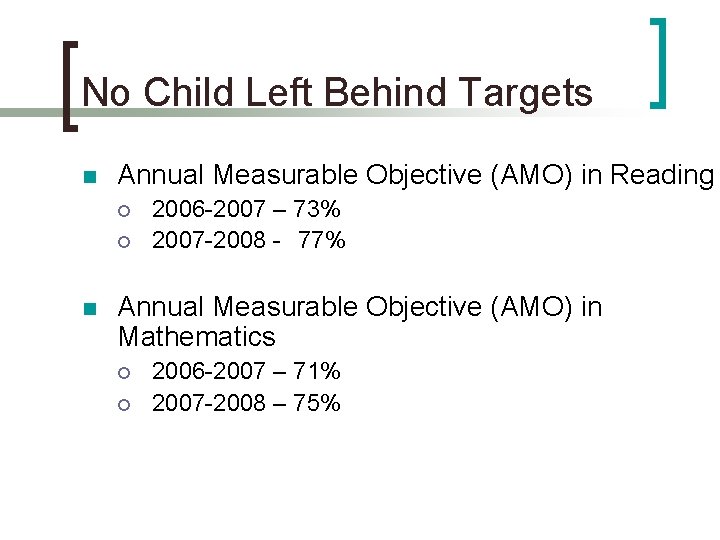
No Child Left Behind Targets n Annual Measurable Objective (AMO) in Reading n 2006 -2007 – 73% 2007 -2008 - 77% Annual Measurable Objective (AMO) in Mathematics 2006 -2007 – 71% 2007 -2008 – 75%
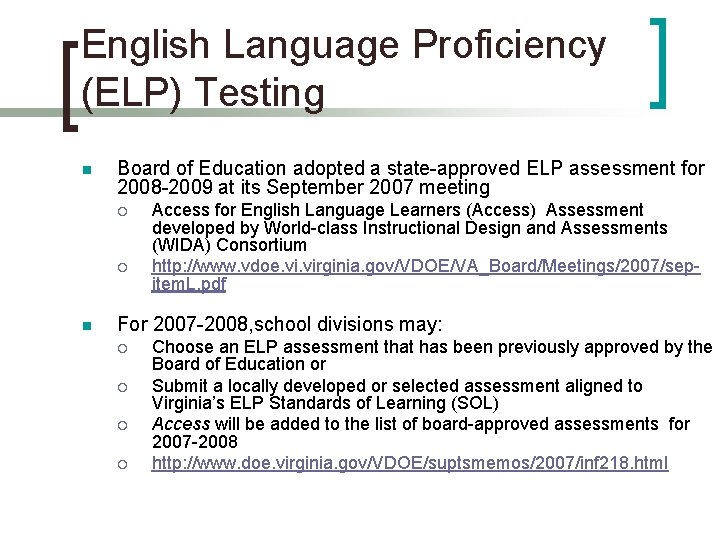
English Language Proficiency (ELP) Testing n n Virginia no longer able to use the Stanford English Language Proficiency (SELP) test for dual purpose for Level I and II LEP students must take both English Language Proficiency Test SOL Reading Test (Regular or VGLA)
English Language Proficiency (ELP) Testing n Board of Education adopted a state-approved ELP assessment for 2008 -2009 at its September 2007 meeting n Access for English Language Learners (Access) Assessment developed by World-class Instructional Design and Assessments (WIDA) Consortium http: //www. vdoe. virginia. gov/VDOE/VA_Board/Meetings/2007/sepitem. L. pdf For 2007 -2008, school divisions may: Choose an ELP assessment that has been previously approved by the Board of Education or Submit a locally developed or selected assessment aligned to Virginia’s ELP Standards of Learning (SOL) Access will be added to the list of board-approved assessments for 2007 -2008 http: //www. doe. virginia. gov/VDOE/suptsmemos/2007/inf 218. html
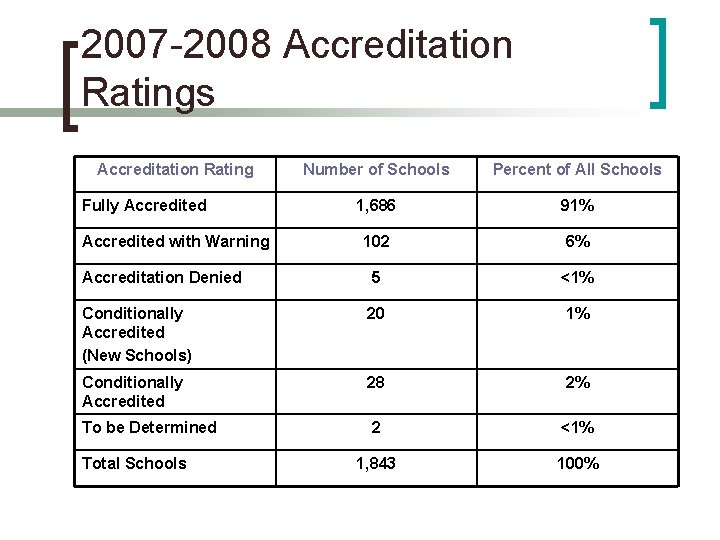
2007 -2008 Accreditation Ratings Accreditation Rating Number of Schools Percent of All Schools 1, 686 91% 102 6% Accreditation Denied 5 <1% Conditionally Accredited (New Schools) 20 1% Conditionally Accredited 28 2% To be Determined 2 <1% 1, 843 100% Fully Accredited with Warning Total Schools
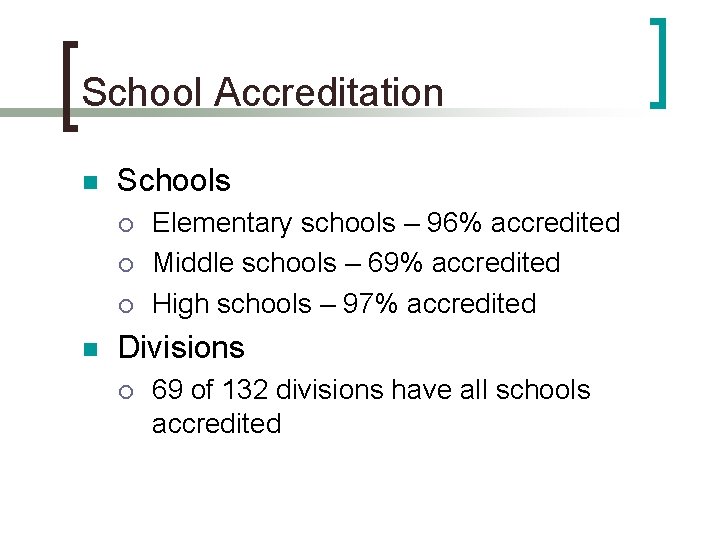
School Accreditation n Schools n Elementary schools – 96% accredited Middle schools – 69% accredited High schools – 97% accredited Divisions 69 of 132 divisions have all schools accredited
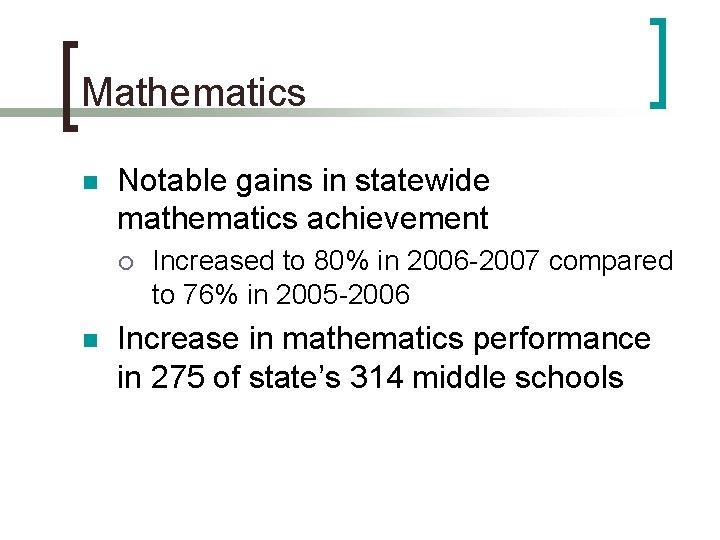
Mathematics n Notable gains in statewide mathematics achievement n Increased to 80% in 2006 -2007 compared to 76% in 2005 -2006 Increase in mathematics performance in 275 of state’s 314 middle schools
Middle School Mathematics n 19 middle schools are now fully accredited that last year were warned only in mathematics n State focused on providing professional development in middle school mathematics Algebra Readiness Initiative http: //www. doe. virginia. gov/VDOE/Instruction/Math/ARI/index. shtml ARI Curriculum Companion - http: //www. doe. virginia. gov/VDOE/Instruction/Math/ARI/ari-currcompanion. shtml Middle math video modules - http: //www. doe. virginia. gov/VDOE/middle-math-strategies/
Virginia’s Two Grants from the National Governors Association n Grant to “Redesign America’s High Schools” In Virginia, focused on n n 9 th-grade retention postsecondary readiness college access policy implications
Virginia’s Two Grants from the National Governors Association n Worked with 30 high schools that developed strategies to: n Ease transition from middle to high school Decrease 9 th-grade retention rate Increase graduation rate Decrease dropout rate Policy forum Results of two studies n n Community College study on academic weaknesses of recent high school graduates International Center for Leadership in Education study on effective practices of effective high schools
Virginia’s Two Grants from the National Governors Association n Grant to develop Science, Technology, Engineering and Math (STEM) Centers n Grant competition to award funds to partnerships of school divisions, business and industry, and postsecondary education to jumpstart Governor’s Career and Technical Academies Model programs in career and technical education (CTE) that will expand options for the general population of students to acquire STEM literacy and other critical knowledge, skills and credentials to prepare them for high-demand, high-skill and high-wage careers in Virginia Board of Education criteria for Governor’s Career and Technical Academies
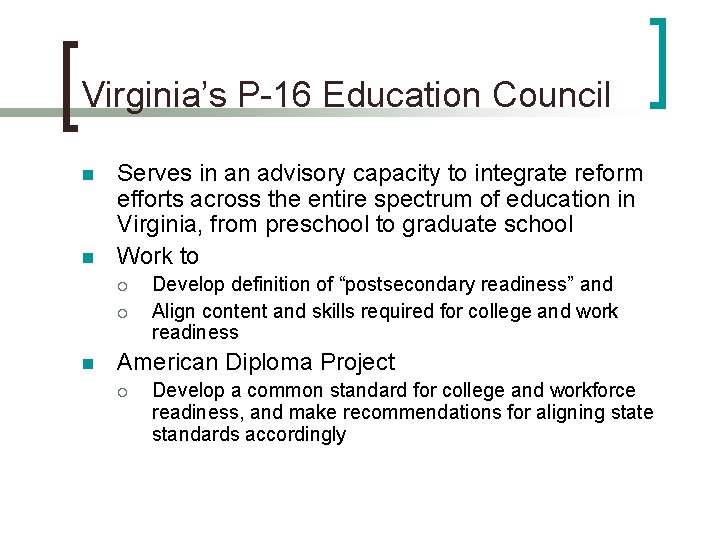
Virginia’s P-16 Education Council n n Serves in an advisory capacity to integrate reform efforts across the entire spectrum of education in Virginia, from preschool to graduate school Work to n Develop definition of “postsecondary readiness” and Align content and skills required for college and work readiness American Diploma Project Develop a common standard for college and workforce readiness, and make recommendations for aligning state standards accordingly
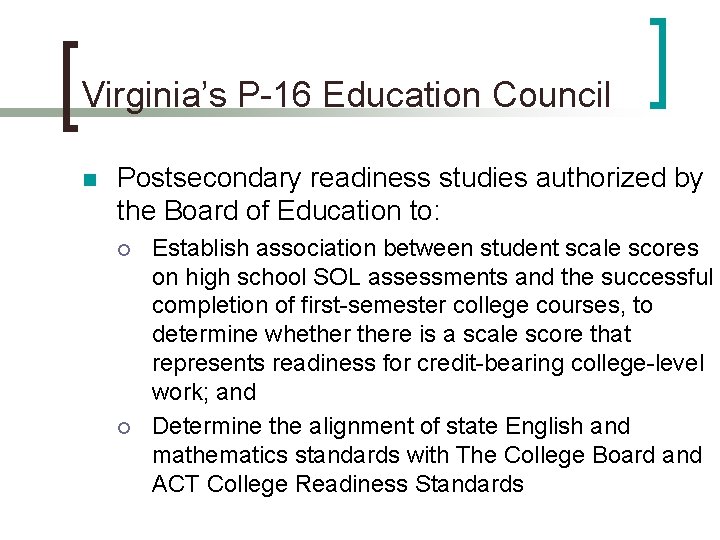
Virginia’s P-16 Education Council n Postsecondary readiness studies authorized by the Board of Education to: Establish association between student scale scores on high school SOL assessments and the successful completion of first-semester college courses, to determine whethere is a scale score that represents readiness for credit-bearing college-level work; and Determine the alignment of state English and mathematics standards with The College Board and ACT College Readiness Standards
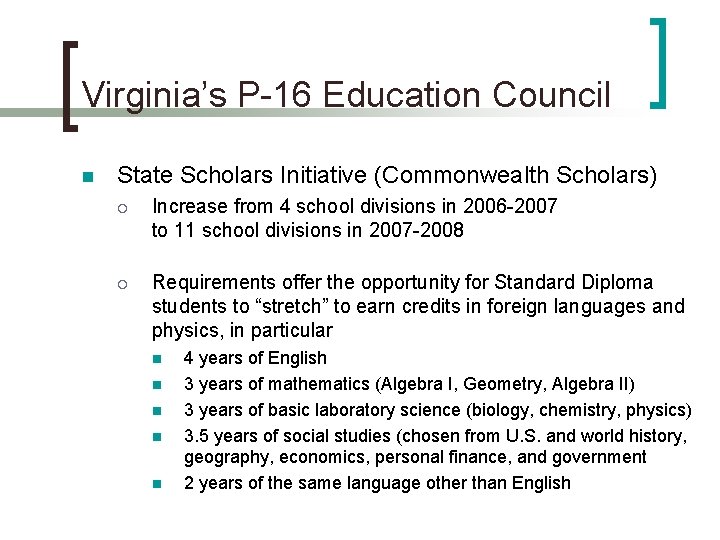
Virginia’s P-16 Education Council n State Scholars Initiative (Commonwealth Scholars) Increase from 4 school divisions in 2006 -2007 to 11 school divisions in 2007 -2008 Requirements offer the opportunity for Standard Diploma students to “stretch” to earn credits in foreign languages and physics, in particular n n n 4 years of English 3 years of mathematics (Algebra I, Geometry, Algebra II) 3 years of basic laboratory science (biology, chemistry, physics) 3. 5 years of social studies (chosen from U. S. and world history, geography, economics, personal finance, and government 2 years of the same language other than English
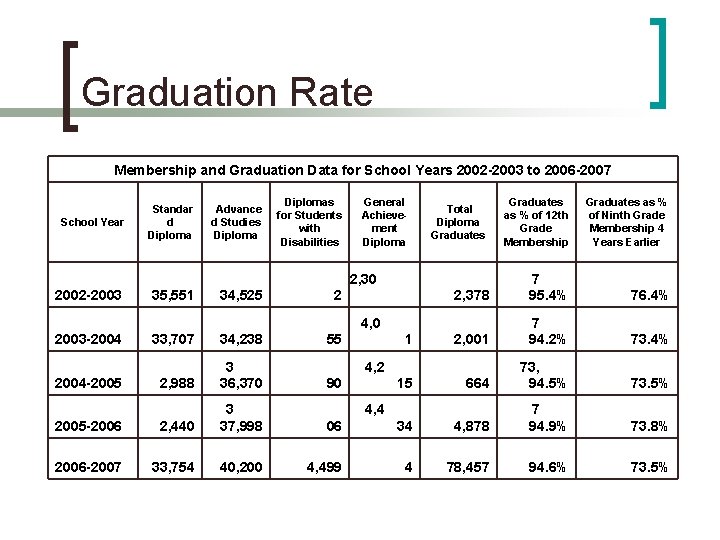
Graduation Rate Membership and Graduation Data for School Years 2002 -2003 to 2006 -2007 School Year Standar d Diploma Advance d Studies Diplomas for Students with Disabilities General Achievement Diploma Graduates as % of 12 th Grade Membership Graduates as % of Ninth Grade Membership 4 Years Earlier 2, 378 7 95. 4% 76. 4% 2, 001 7 94. 2% 73. 4% 664 73, 94. 5% 73. 8% 73. 5% Total Diploma Graduates 2, 30 2002 -2003 35, 551 34, 525 2 4, 0 2003 -2004 33, 707 34, 238 2, 988 3 36, 370 2005 -2006 2, 440 3 37, 998 06 34 4, 878 7 94. 9% 2006 -2007 33, 754 40, 200 4, 499 4 78, 457 94. 6% 2004 -2005 55 1 4, 2 90 15 4, 4
Technical and Advanced Technical Diplomas n 2007 General Assembly required the Board of Education to establish the requirements for a Technical Diploma n Shall meet or exceed the requirements of a Standard Diploma Will include a concentration in career and technical education, as established in Board regulations. As well as an Advanced Career and Technical Diploma Meets the requirement for the Advanced Studies Diploma and Also fulfills a concentration in career and technical education shall receive an advanced technical diploma. Standard 4 of the Standards of Quality Code of Virginia, § 22. 1 -253. 13: 4
Virginia Index of Performance (VIP) n Incentive program to reward and recognize fully accredited schools and school divisions making significant progress toward academic excellence n Awards points to schools and divisions based on the percentage of students achieving at the advanced level on Standards of Learning (SOL) assessments and progress made toward educational goals advocated by Governor Kaine n Further details: http: //www. doe. virginia. gov/VDOE/suptsmemos/2007/inf 145. html
Education Week: 2007 “Quality Counts” n n Students in Virginia enjoy “higher achievement and [are] more likely to finish high school and continue on to college than in other states. ” January 4, 2007 http: //www. edweek. org/ew/toc/2007/01/04 /index. html
National Assessment of Educational Progress (NAEP) n In 2005, Virginia students led the nation in science achievement, exceeding the national average by: n 12 points in 4 th grade science 8 points in 8 th grade science In 2007, Virginia’s students scored higher than students nationwide in reading and mathematics Reading – Grade 4: 7 points higher Grade 8: 6 points higher Mathematics – Grade 8: Grade 4: 5 points higher 8 points higher
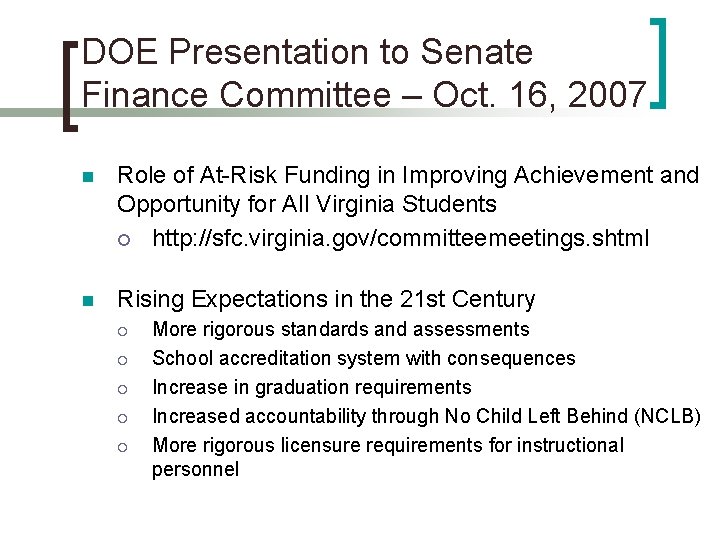
DOE Presentation to Senate Finance Committee – Oct. 16, 2007 n Role of At-Risk Funding in Improving Achievement and Opportunity for All Virginia Students http: //sfc. virginia. gov/committeemeetings. shtml n Rising Expectations in the 21 st Century More rigorous standards and assessments School accreditation system with consequences Increase in graduation requirements Increased accountability through No Child Left Behind (NCLB) More rigorous licensure requirements for instructional personnel
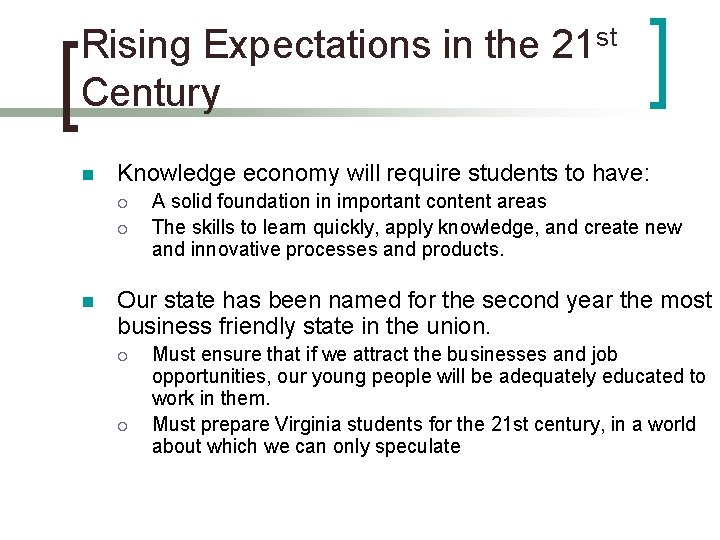
Rising Expectations in the 21 st Century n Knowledge economy will require students to have: n A solid foundation in important content areas The skills to learn quickly, apply knowledge, and create new and innovative processes and products. Our state has been named for the second year the most business friendly state in the union. Must ensure that if we attract the businesses and job opportunities, our young people will be adequately educated to work in them. Must prepare Virginia students for the 21 st century, in a world about which we can only speculate