
Updates Assignment 06 is due today in class

- Slides: 29
Updates • Assignment 06 is due today (in class) • Midterm 2 is THIS Thurs. , March 15 and will cover Chapters 16 & 17 – Huggins 10, 7 -8 pm – For conflicts: ELL 221, 6 -7 pm (must arrange at least one week in advance)
Acid-Base Equilibria and Solubility Equilibria Chapter 17
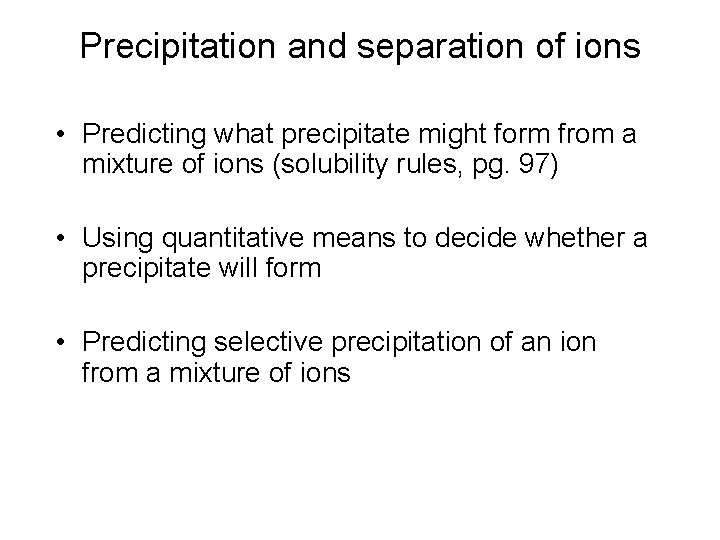
Precipitation and separation of ions • Predicting what precipitate might form from a mixture of ions (solubility rules, pg. 97) • Using quantitative means to decide whether a precipitate will form • Predicting selective precipitation of an ion from a mixture of ions
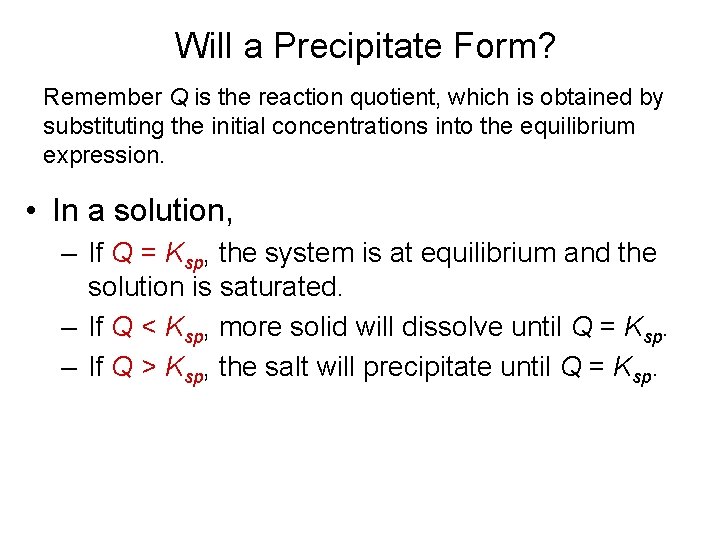
Will a Precipitate Form? Remember Q is the reaction quotient, which is obtained by substituting the initial concentrations into the equilibrium expression. • In a solution, – If Q = Ksp, the system is at equilibrium and the solution is saturated. – If Q < Ksp, more solid will dissolve until Q = Ksp. – If Q > Ksp, the salt will precipitate until Q = Ksp.
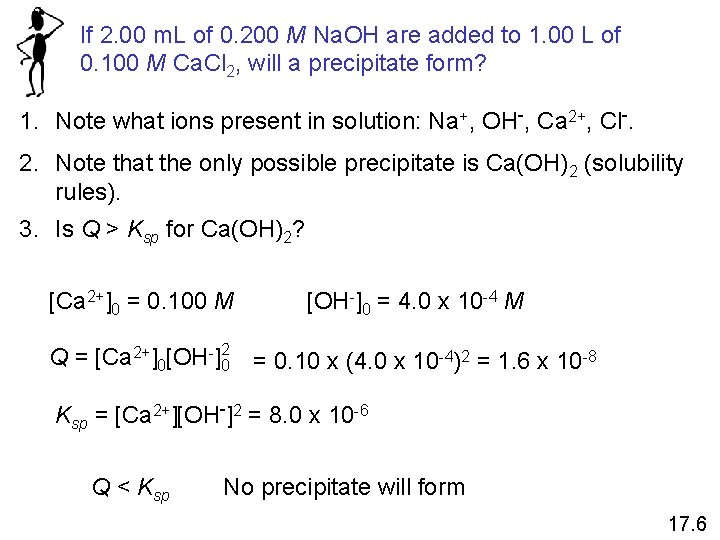
If 2. 00 m. L of 0. 200 M Na. OH are added to 1. 00 L of 0. 100 M Ca. Cl 2, will a precipitate form? 1. Note what ions present in solution: Na+, OH-, Ca 2+, Cl-. 2. Note that the only possible precipitate is Ca(OH)2 (solubility rules). 3. Is Q > Ksp for Ca(OH)2? [Ca 2+]0 = 0. 100 M [OH-]0 = 4. 0 x 10 -4 M Q = [Ca 2+]0[OH-]02 = 0. 10 x (4. 0 x 10 -4)2 = 1. 6 x 10 -8 Ksp = [Ca 2+][OH-]2 = 8. 0 x 10 -6 Q < Ksp No precipitate will form 17. 6
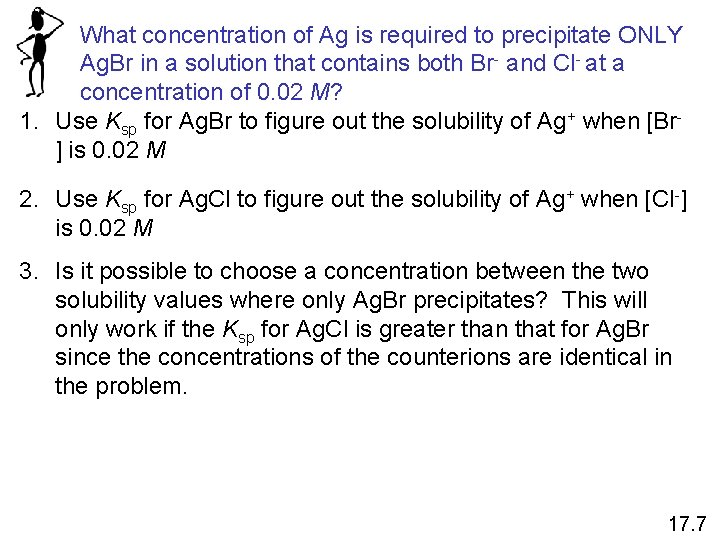
What concentration of Ag is required to precipitate ONLY Ag. Br in a solution that contains both Br- and Cl- at a concentration of 0. 02 M? 1. Use Ksp for Ag. Br to figure out the solubility of Ag+ when [Br] is 0. 02 M 2. Use Ksp for Ag. Cl to figure out the solubility of Ag+ when [Cl-] is 0. 02 M 3. Is it possible to choose a concentration between the two solubility values where only Ag. Br precipitates? This will only work if the Ksp for Ag. Cl is greater than that for Ag. Br since the concentrations of the counterions are identical in the problem. 17. 7
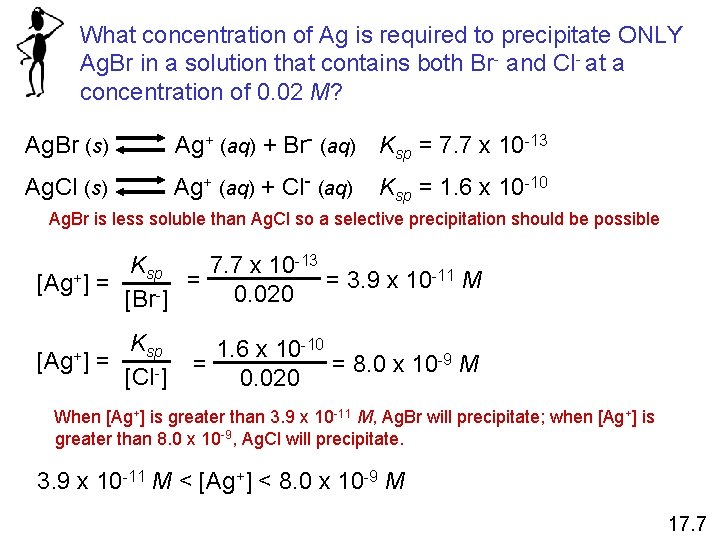
What concentration of Ag is required to precipitate ONLY Ag. Br in a solution that contains both Br- and Cl- at a concentration of 0. 02 M? Ag. Br (s) Ag+ (aq) + Br- (aq) Ksp = 7. 7 x 10 -13 Ag. Cl (s) Ag+ (aq) + Cl- (aq) Ksp = 1. 6 x 10 -10 Ag. Br is less soluble than Ag. Cl so a selective precipitation should be possible -13 K 7. 7 x 10 sp -11 M = = 3. 9 x 10 [Ag+] = 0. 020 [Br-] [Ag+] Ksp = [Cl-] 1. 6 x 10 -10 = = 8. 0 x 10 -9 M 0. 020 When [Ag+] is greater than 3. 9 x 10 -11 M, Ag. Br will precipitate; when [Ag+] is greater than 8. 0 x 10 -9, Ag. Cl will precipitate. 3. 9 x 10 -11 M < [Ag+] < 8. 0 x 10 -9 M 17. 7
Factors that affect solubility • We have considered the solubility of ionic compounds in pure water; we noted that temperature and ionic strength has an effect, but we did not discuss these influences further • We will now examine three factors that affect the solubility of ionic compounds in water – Presence of common ions – p. H of solution – Presence of complexing agents
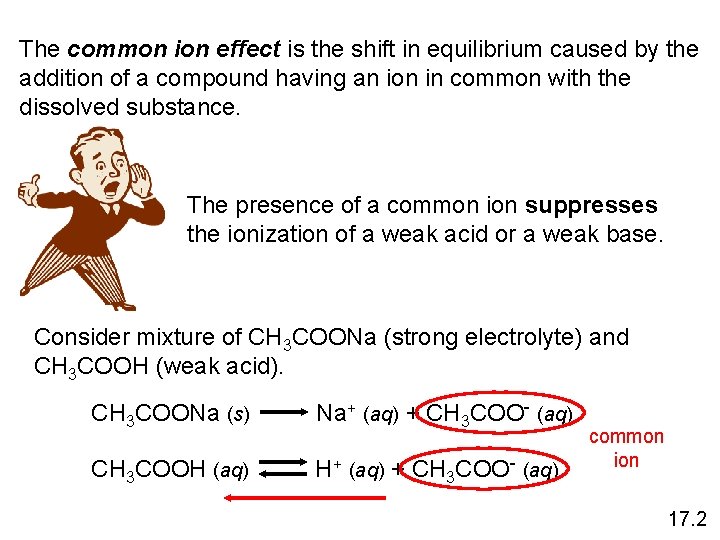
The common ion effect is the shift in equilibrium caused by the addition of a compound having an ion in common with the dissolved substance. The presence of a common ion suppresses the ionization of a weak acid or a weak base. Consider mixture of CH 3 COONa (strong electrolyte) and CH 3 COOH (weak acid). CH 3 COONa (s) Na+ (aq) + CH 3 COO- (aq) CH 3 COOH (aq) H+ (aq) + CH 3 COO- (aq) common ion 17. 2
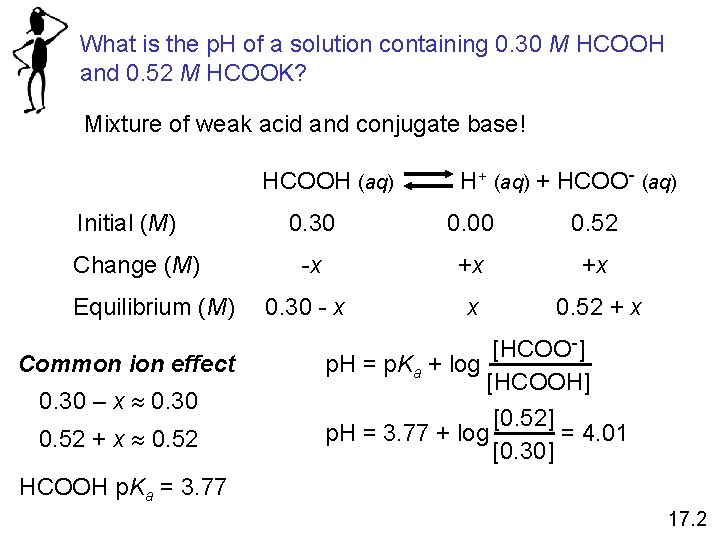
What is the p. H of a solution containing 0. 30 M HCOOH and 0. 52 M HCOOK? Mixture of weak acid and conjugate base! HCOOH (aq) Initial (M) Change (M) Equilibrium (M) Common ion effect 0. 30 – x 0. 30 0. 52 + x 0. 52 H+ (aq) + HCOO- (aq) 0. 30 0. 00 0. 52 -x +x +x 0. 30 - x x 0. 52 + x [HCOO-] p. H = p. Ka + log [HCOOH] [0. 52] = 4. 01 p. H = 3. 77 + log [0. 30] HCOOH p. Ka = 3. 77 17. 2
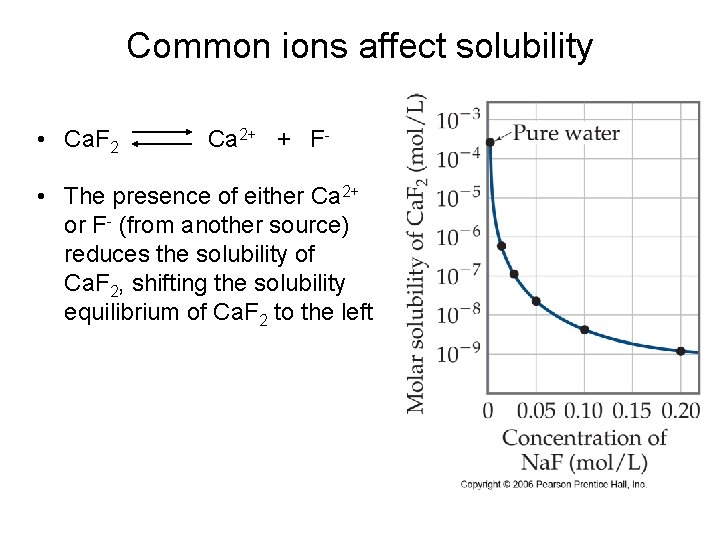
Common ions affect solubility • Ca. F 2 Ca 2+ + F- • The presence of either Ca 2+ or F- (from another source) reduces the solubility of Ca. F 2, shifting the solubility equilibrium of Ca. F 2 to the left
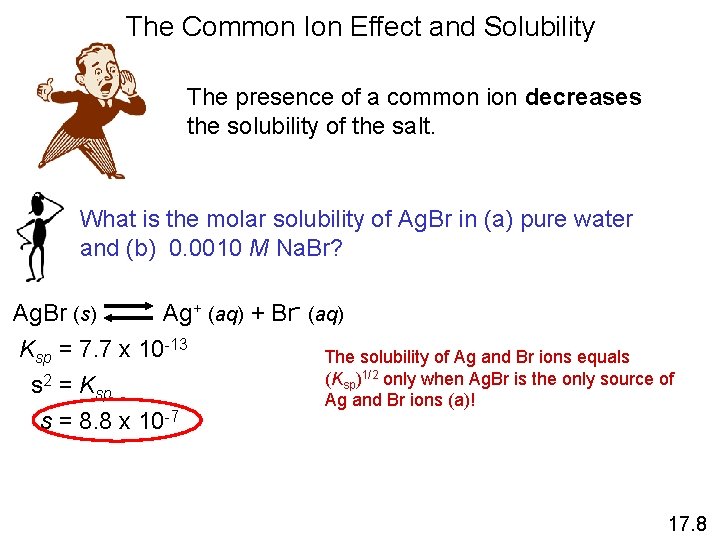
The Common Ion Effect and Solubility The presence of a common ion decreases the solubility of the salt. What is the molar solubility of Ag. Br in (a) pure water and (b) 0. 0010 M Na. Br? Ag. Br (s) Ag+ (aq) + Br- (aq) Ksp = 7. 7 x 10 -13 The solubility of Ag and Br ions equals 1/2 only when Ag. Br is the only source of (K ) 2 sp s = Ksp Ag and Br ions (a)! s = 8. 8 x 10 -7 17. 8
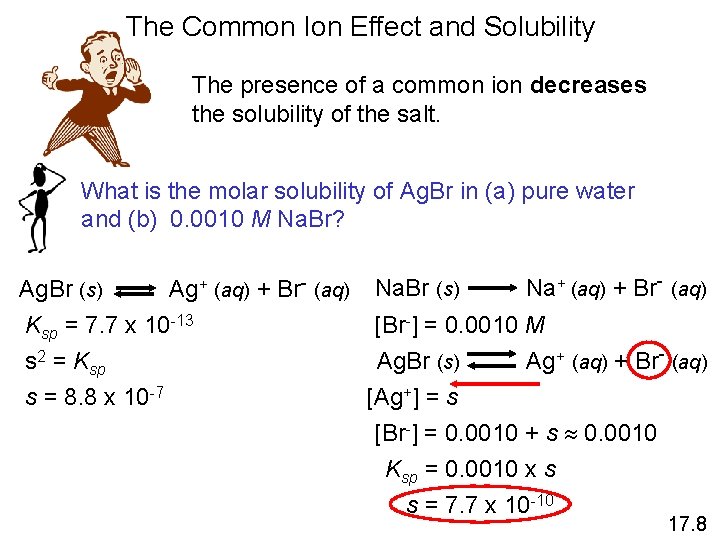
The Common Ion Effect and Solubility The presence of a common ion decreases the solubility of the salt. What is the molar solubility of Ag. Br in (a) pure water and (b) 0. 0010 M Na. Br? Na+ (aq) + Br- (aq) Ag. Br (s) Ag+ (aq) + Br- (aq) Na. Br (s) [Br-] = 0. 0010 M Ksp = 7. 7 x 10 -13 Ag. Br (s) Ag+ (aq) + Br- (aq) s 2 = Ksp [Ag+] = s s = 8. 8 x 10 -7 [Br-] = 0. 0010 + s 0. 0010 Ksp = 0. 0010 x s s = 7. 7 x 10 -10 17. 8
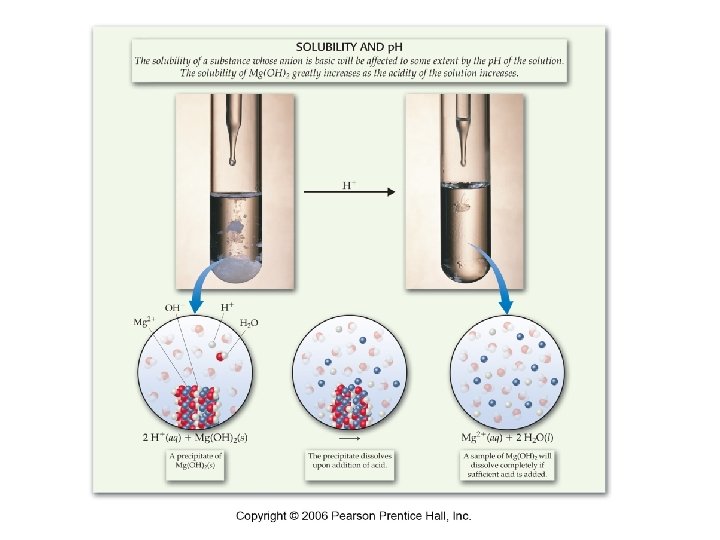
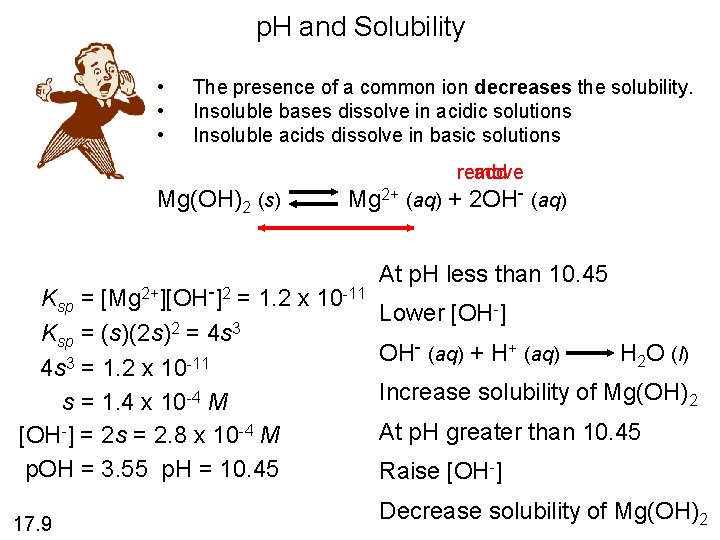
p. H and Solubility • • • The presence of a common ion decreases the solubility. Insoluble bases dissolve in acidic solutions Insoluble acids dissolve in basic solutions add remove Mg(OH)2 (s) Mg 2+ (aq) + 2 OH- (aq) Ksp = [Mg 2+][OH-]2 = 1. 2 x 10 -11 Ksp = (s)(2 s)2 = 4 s 3 = 1. 2 x 10 -11 s = 1. 4 x 10 -4 M [OH-] = 2 s = 2. 8 x 10 -4 M p. OH = 3. 55 p. H = 10. 45 17. 9 At p. H less than 10. 45 Lower [OH-] OH- (aq) + H+ (aq) H 2 O (l) Increase solubility of Mg(OH)2 At p. H greater than 10. 45 Raise [OH-] Decrease solubility of Mg(OH)2
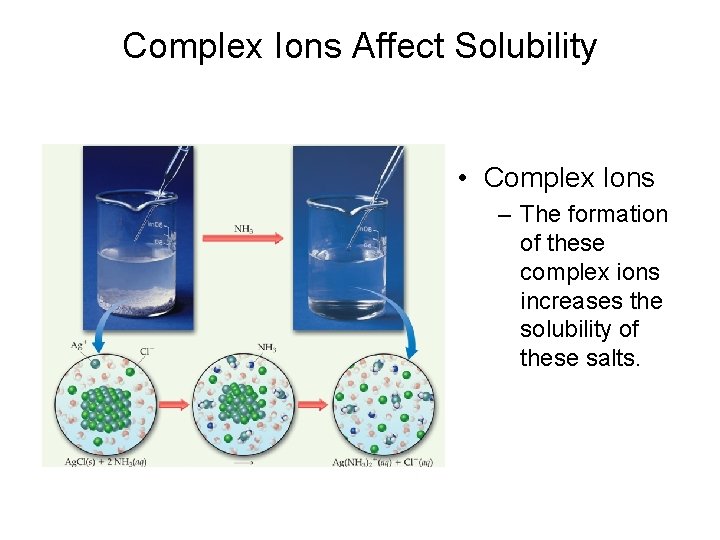
Complex Ions Affect Solubility • Complex Ions – The formation of these complex ions increases the solubility of these salts.
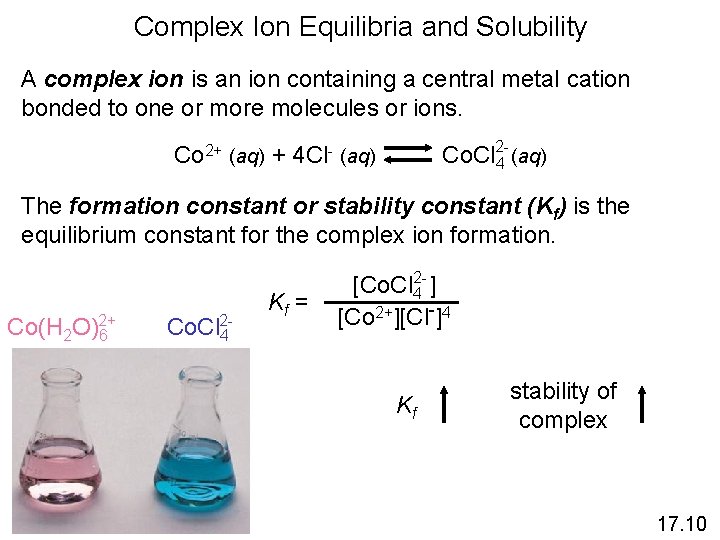
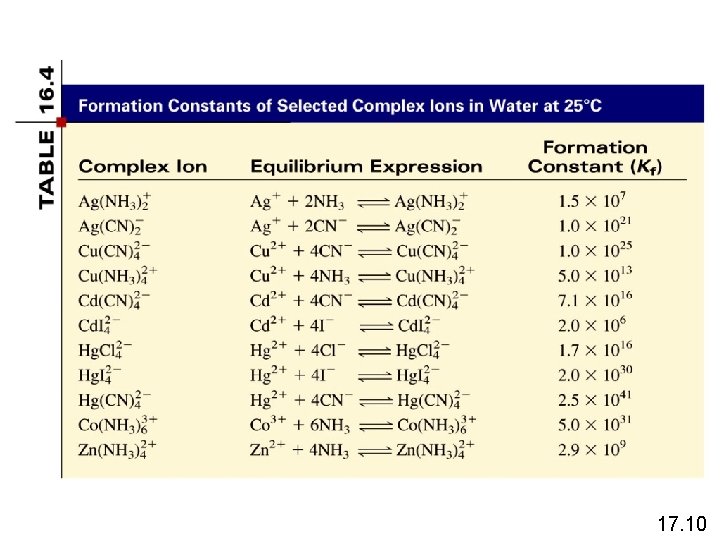
Complex Ion Equilibria and Solubility A complex ion is an ion containing a central metal cation bonded to one or more molecules or ions. Co. Cl 24 (aq) Co 2+ (aq) + 4 Cl- (aq) The formation constant or stability constant (Kf) is the equilibrium constant for the complex ion formation. Co(H 2 O)2+ 6 Co. Cl 24 Kf = [Co. Cl 42 - ] [Co 2+][Cl-]4 Kf stability of complex 17. 10
17. 10
17. 11
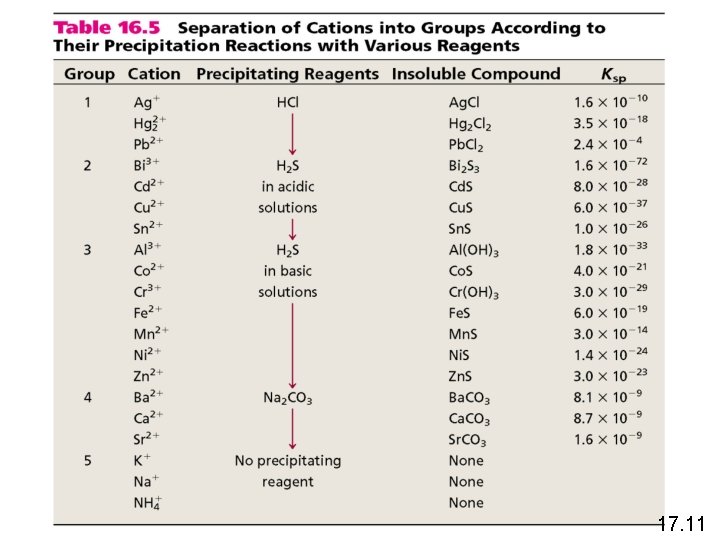
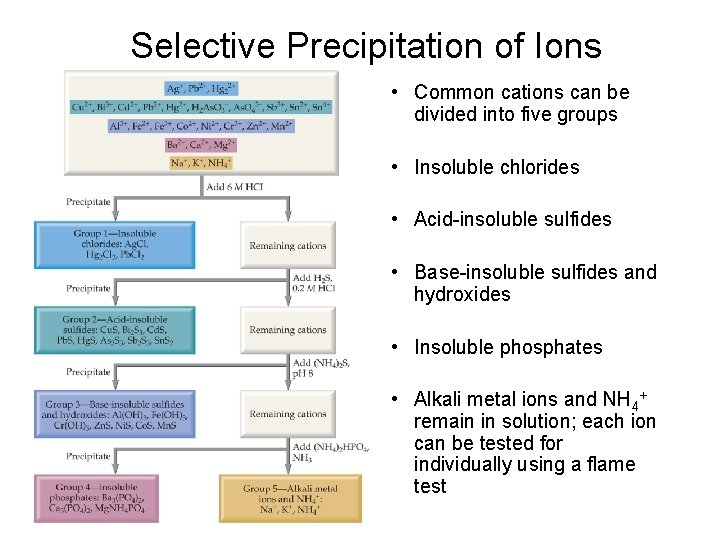
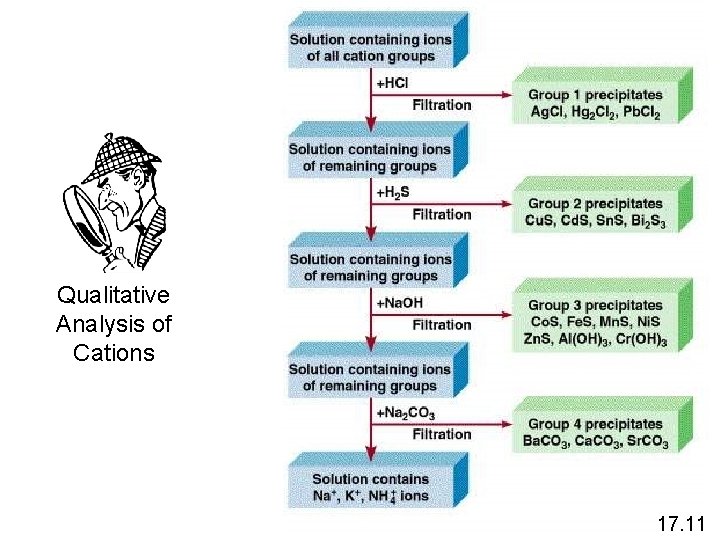
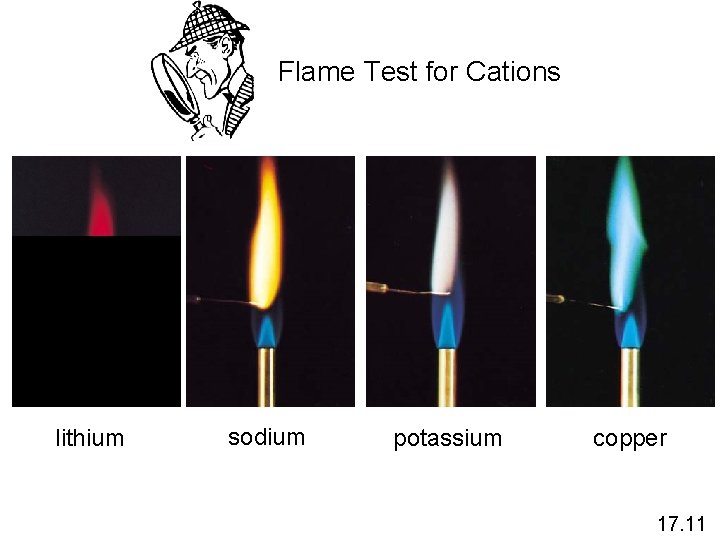
Selective Precipitation of Ions • Common cations can be divided into five groups • Insoluble chlorides • Acid-insoluble sulfides • Base-insoluble sulfides and hydroxides • Insoluble phosphates • Alkali metal ions and NH 4+ remain in solution; each ion can be tested for individually using a flame test
Qualitative Analysis of Cations 17. 11
Flame Test for Cations lithium sodium potassium copper 17. 11
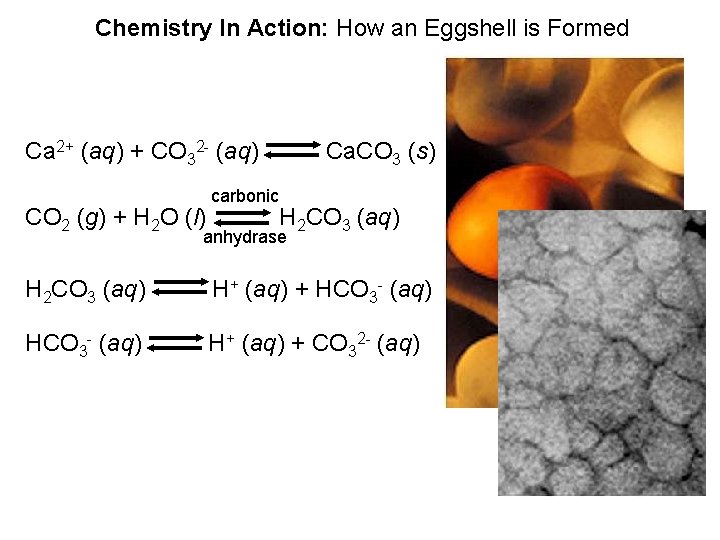
Chemistry In Action: How an Eggshell is Formed Ca 2+ (aq) + CO 32 - (aq) CO 2 (g) + H 2 O (l) carbonic Ca. CO 3 (s) H 2 CO 3 (aq) anhydrase H 2 CO 3 (aq) H+ (aq) + HCO 3 - (aq) H+ (aq) + CO 32 - (aq)
…explain why “as the polarity of H-X bonding increases, the acid strength increases”? …especially the section involving oxoacids
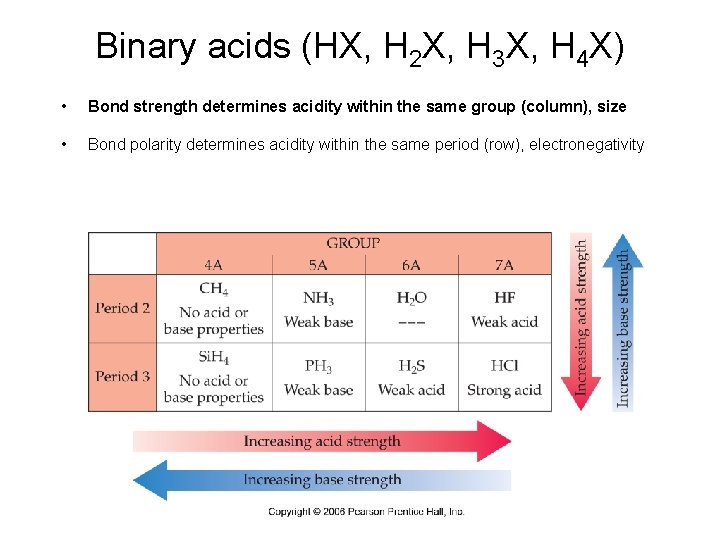
Binary acids (HX, H 2 X, H 3 X, H 4 X) • Bond strength determines acidity within the same group (column), size • Bond polarity determines acidity within the same period (row), electronegativity
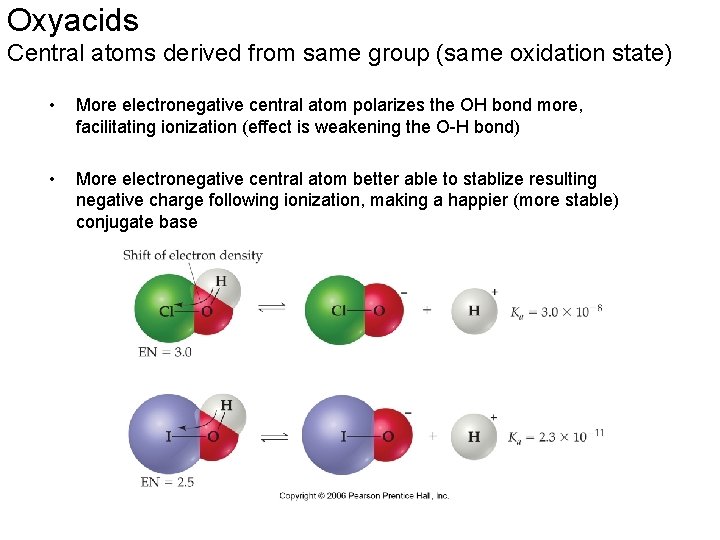
Oxyacids Central atoms derived from same group (same oxidation state) • More electronegative central atom polarizes the OH bond more, facilitating ionization (effect is weakening the O-H bond) • More electronegative central atom better able to stablize resulting negative charge following ionization, making a happier (more stable) conjugate base
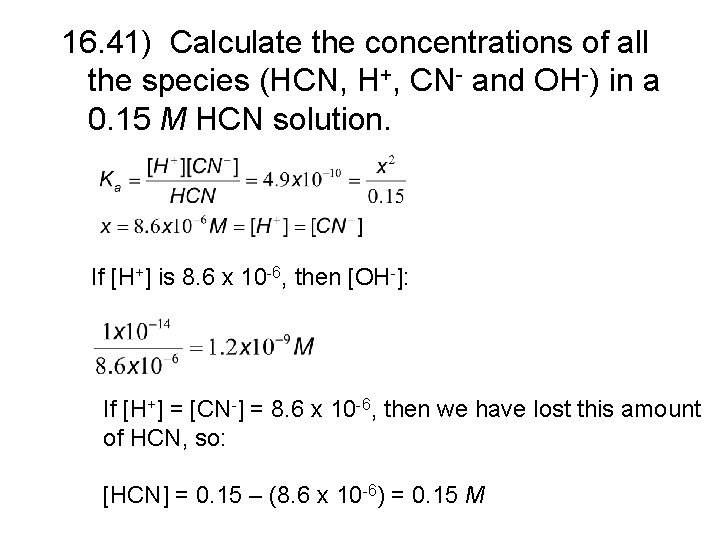
16. 41) Calculate the concentrations of all the species (HCN, H+, CN- and OH-) in a 0. 15 M HCN solution. If [H+] is 8. 6 x 10 -6, then [OH-]: If [H+] = [CN-] = 8. 6 x 10 -6, then we have lost this amount of HCN, so: [HCN] = 0. 15 – (8. 6 x 10 -6) = 0. 15 M
16. 97) Henry’s law constant for CO 2 at 38 o. C is 2. 28 x 10 -3 mol/L. atm. Calculate the p. H of a solution of CO 2 at 38 o. C in equilibrium with the gas at a partial pressure of 3. 20 atm. Remember that Henry’s law describes the effect of pressure on the solubility of gases. The solubility of CO 2 can be calculated from Henry’s law: 2. 28 x 10 -3 mol/L. atm x 3. 20 atm = 7. 30 x 10 -3 mol/L. Remember that CO 2 dissolves in water to form H 2 CO 3. Therefore, the p. H will depend on the extent of ionization of H 2 CO 3, which can be found from Ka (4. 2 x 10 -7): 4. 2 x 10 -7 = x 2/(7. 30 x 10 -3 M) = 5. 54 x 10 -5 M; p. H = -log x, p. H = 4. 26.
17. 47) insert