
Updated Version 526 Testing of EPAS MOVES Model
- Slides: 11
Updated Version 5/26 Testing of EPA’S MOVES Model Travel Management Subcommittee May 26, 2009 MOVES: Motor Vehicle Emission Simulator COG DTP/DEP Staff Eulalie Lucas and Erin Morrow DTP Sunil Kumar DEP
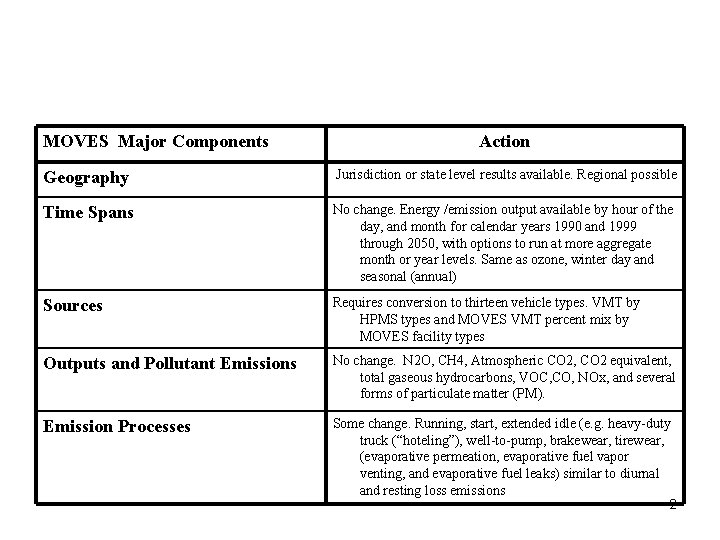
MOVES Major Components Action Geography Jurisdiction or state level results available. Regional possible Time Spans No change. Energy /emission output available by hour of the day, and month for calendar years 1990 and 1999 through 2050, with options to run at more aggregate month or year levels. Same as ozone, winter day and seasonal (annual) Sources Requires conversion to thirteen vehicle types. VMT by HPMS types and MOVES VMT percent mix by MOVES facility types Outputs and Pollutant Emissions No change. N 2 O, CH 4, Atmospheric CO 2, CO 2 equivalent, total gaseous hydrocarbons, VOC, CO, NOx, and several forms of particulate matter (PM). Emission Processes Some change. Running, start, extended idle (e. g. heavy-duty truck (“hoteling”), well-to-pump, brakewear, tirewear, (evaporative permeation, evaporative fuel vapor venting, and evaporative fuel leaks) similar to diurnal and resting loss emissions 2
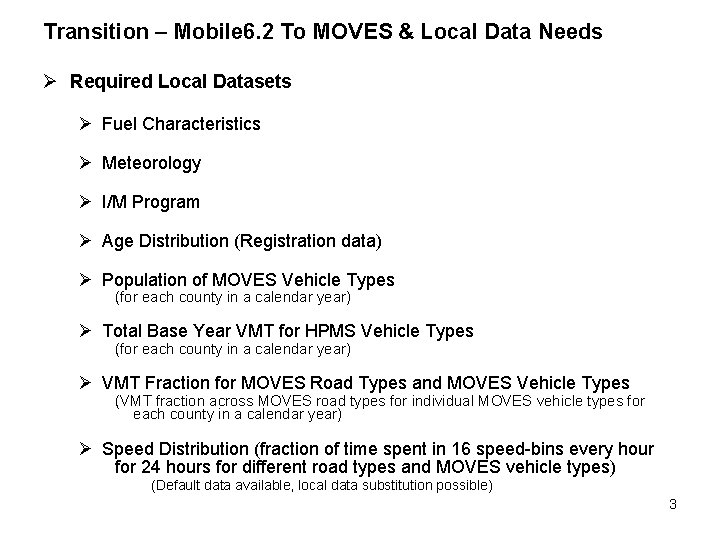
Transition – Mobile 6. 2 To MOVES & Local Data Needs Ø Required Local Datasets Ø Fuel Characteristics Ø Meteorology Ø I/M Program Ø Age Distribution (Registration data) Ø Population of MOVES Vehicle Types (for each county in a calendar year) Ø Total Base Year VMT for HPMS Vehicle Types (for each county in a calendar year) Ø VMT Fraction for MOVES Road Types and MOVES Vehicle Types (VMT fraction across MOVES road types for individual MOVES vehicle types for each county in a calendar year) Ø Speed Distribution (fraction of time spent in 16 speed-bins every hour for 24 hours for different road types and MOVES vehicle types) (Default data available, local data substitution possible) 3
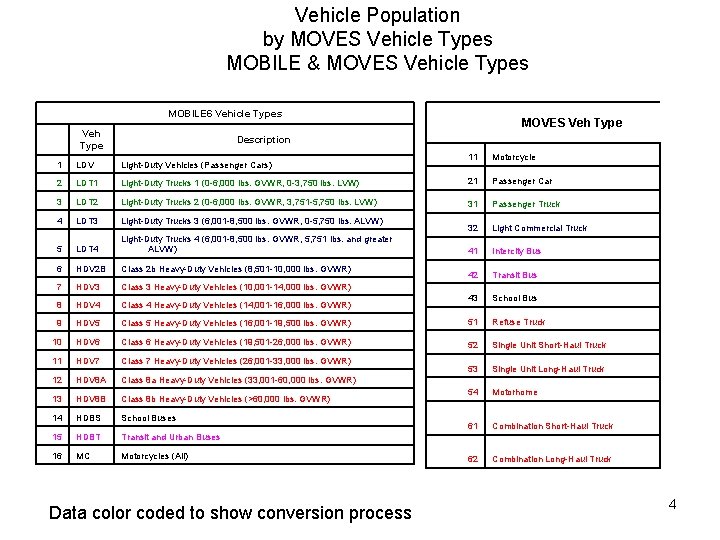
Vehicle Population by MOVES Vehicle Types MOBILE & MOVES Vehicle Types MOBILE 6 Vehicle Types Veh Type MOVES Veh Type Description 11 Motorcycle Light-Duty Trucks 1 (0 -6, 000 lbs. GVWR, 0 -3, 750 lbs. LVW) 21 Passenger Car LDT 2 Light-Duty Trucks 2 (0 -6, 000 lbs. GVWR, 3, 751 -5, 750 lbs. LVW) 31 Passenger Truck LDT 3 Light-Duty Trucks 3 (6, 001 -8, 500 lbs. GVWR, 0 -5, 750 lbs. ALVW) 32 Light Commercial Truck 5 LDT 4 Light-Duty Trucks 4 (6, 001 -8, 500 lbs. GVWR, 5, 751 lbs. and greater ALVW) 41 Intercity Bus 6 HDV 2 B Class 2 b Heavy-Duty Vehicles (8, 501 -10, 000 lbs. GVWR) 42 Transit Bus 7 HDV 3 Class 3 Heavy-Duty Vehicles (10, 001 -14, 000 lbs. GVWR) 8 HDV 4 Class 4 Heavy-Duty Vehicles (14, 001 -16, 000 lbs. GVWR) 43 School Bus 9 HDV 5 Class 5 Heavy-Duty Vehicles (16, 001 -19, 500 lbs. GVWR) 51 Refuse Truck 10 HDV 6 Class 6 Heavy-Duty Vehicles (19, 501 -26, 000 lbs. GVWR) 52 Single Unit Short-Haul Truck 11 HDV 7 Class 7 Heavy-Duty Vehicles (26, 001 -33, 000 lbs. GVWR) 53 Single Unit Long-Haul Truck 12 HDV 8 A Class 8 a Heavy-Duty Vehicles (33, 001 -60, 000 lbs. GVWR) 13 HDV 8 B Class 8 b Heavy-Duty Vehicles (>60, 000 lbs. GVWR) 54 Motorhome 14 HDBS School Buses 61 Combination Short-Haul Truck 15 HDBT Transit and Urban Buses 16 MC Motorcycles (All) 62 Combination Long-Haul Truck 1 LDV Light-Duty Vehicles (Passenger Cars) 2 LDT 1 3 4 Data color coded to show conversion process 4
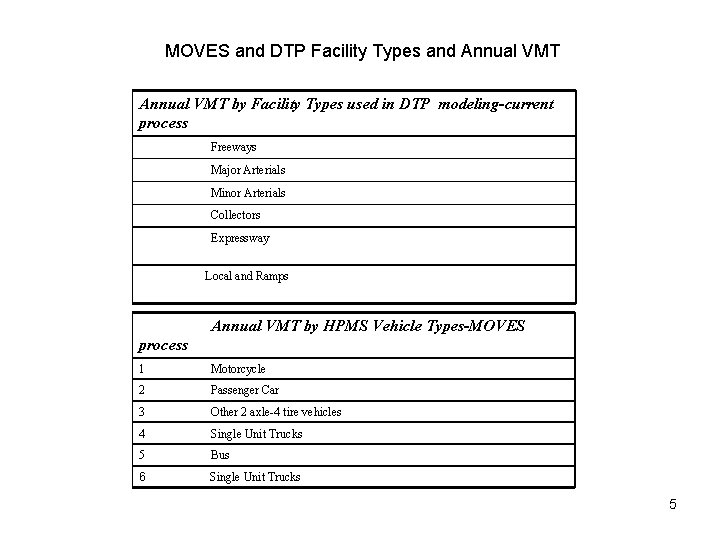
MOVES and DTP Facility Types and Annual VMT by Facility Types used in DTP modeling-current process Freeways Major Arterials Minor Arterials Collectors Expressway Local and Ramps Annual VMT by HPMS Vehicle Types-MOVES process 1 Motorcycle 2 Passenger Car 3 Other 2 axle-4 tire vehicles 4 Single Unit Trucks 5 Bus 6 Single Unit Trucks 5
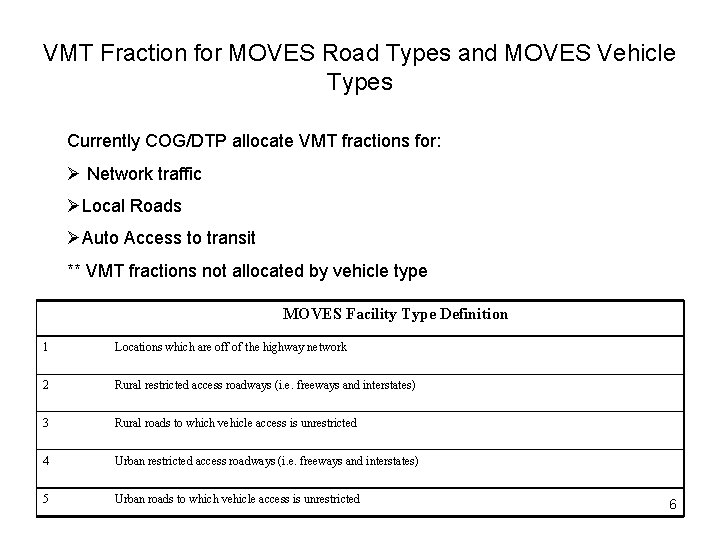
VMT Fraction for MOVES Road Types and MOVES Vehicle Types Currently COG/DTP allocate VMT fractions for: Ø Network traffic ØLocal Roads ØAuto Access to transit ** VMT fractions not allocated by vehicle type MOVES Facility Type Definition 1 Locations which are off of the highway network 2 Rural restricted access roadways (i. e. freeways and interstates) 3 Rural roads to which vehicle access is unrestricted 4 Urban restricted access roadways (i. e. freeways and interstates) 5 Urban roads to which vehicle access is unrestricted 6
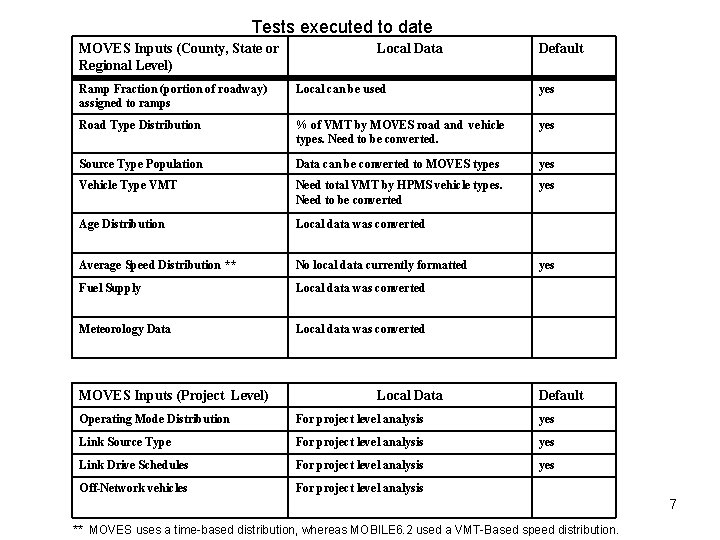
Tests executed to date MOVES Inputs (County, State or Regional Level) Local Data Default Ramp Fraction (portion of roadway) assigned to ramps Local can be used yes Road Type Distribution % of VMT by MOVES road and vehicle types. Need to be converted. yes Source Type Population Data can be converted to MOVES types yes Vehicle Type VMT Need total VMT by HPMS vehicle types. Need to be converted yes Age Distribution Local data was converted Average Speed Distribution ** No local data currently formatted Fuel Supply Local data was converted Meteorology Data Local data was converted MOVES Inputs (Project Level) Local Data yes Default Operating Mode Distribution For project level analysis yes Link Source Type For project level analysis yes Link Drive Schedules For project level analysis yes Off-Network vehicles For project level analysis 7 ** MOVES uses a time-based distribution, whereas MOBILE 6. 2 used a VMT-Based speed distribution.
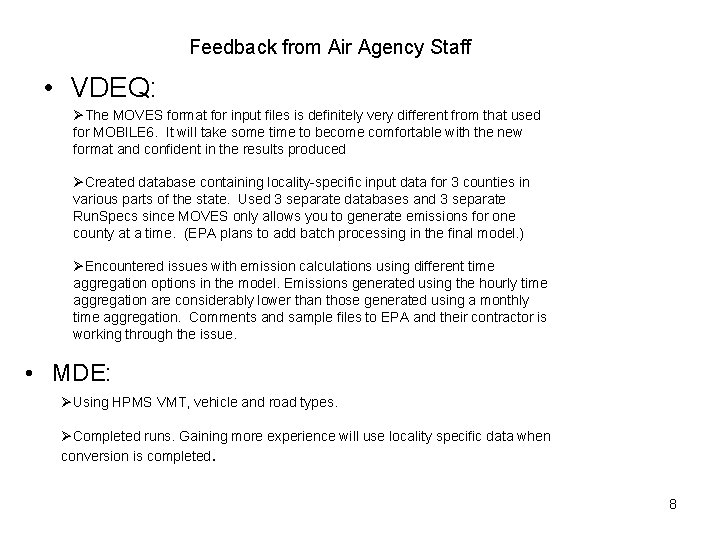
Feedback from Air Agency Staff • VDEQ: ØThe MOVES format for input files is definitely very different from that used for MOBILE 6. It will take some time to become comfortable with the new format and confident in the results produced ØCreated database containing locality-specific input data for 3 counties in various parts of the state. Used 3 separate databases and 3 separate Run. Specs since MOVES only allows you to generate emissions for one county at a time. (EPA plans to add batch processing in the final model. ) ØEncountered issues with emission calculations using different time aggregation options in the model. Emissions generated using the hourly time aggregation are considerably lower than those generated using a monthly time aggregation. Comments and sample files to EPA and their contractor is working through the issue. • MDE: ØUsing HPMS VMT, vehicle and road types. ØCompleted runs. Gaining more experience will use locality specific data when conversion is completed. 8
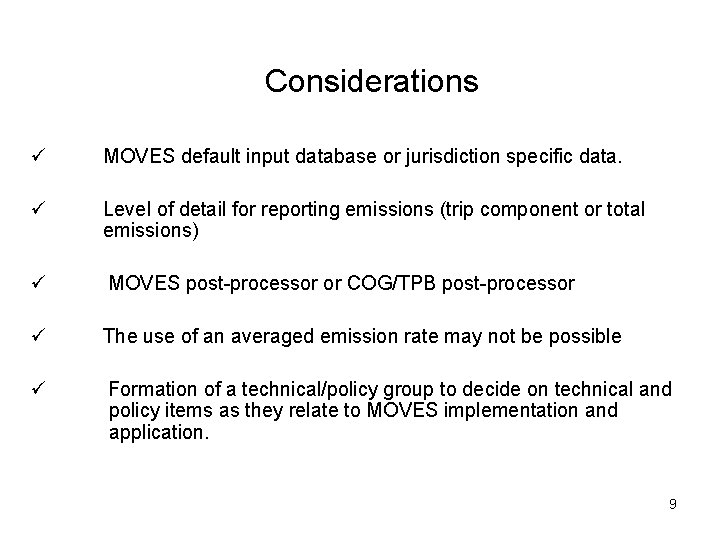
Considerations ü MOVES default input database or jurisdiction specific data. ü Level of detail for reporting emissions (trip component or total emissions) ü MOVES post-processor or COG/TPB post-processor ü The use of an averaged emission rate may not be possible ü Formation of a technical/policy group to decide on technical and policy items as they relate to MOVES implementation and application. 9
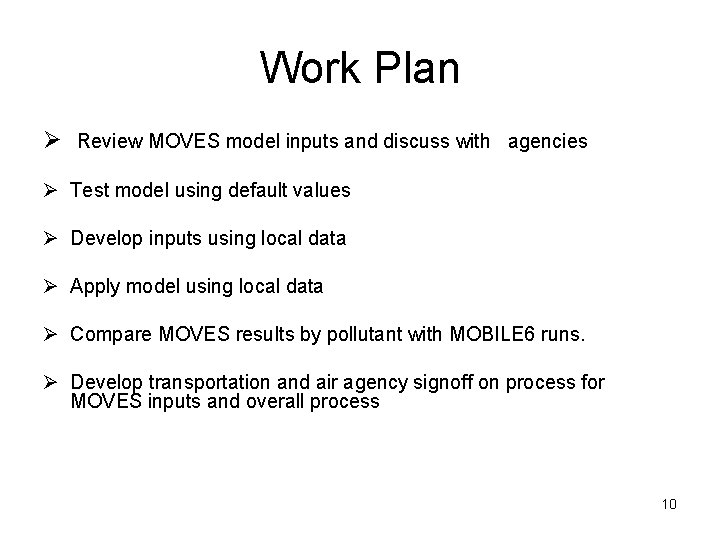
Work Plan Ø Review MOVES model inputs and discuss with agencies Ø Test model using default values Ø Develop inputs using local data Ø Apply model using local data Ø Compare MOVES results by pollutant with MOBILE 6 runs. Ø Develop transportation and air agency signoff on process for MOVES inputs and overall process 10
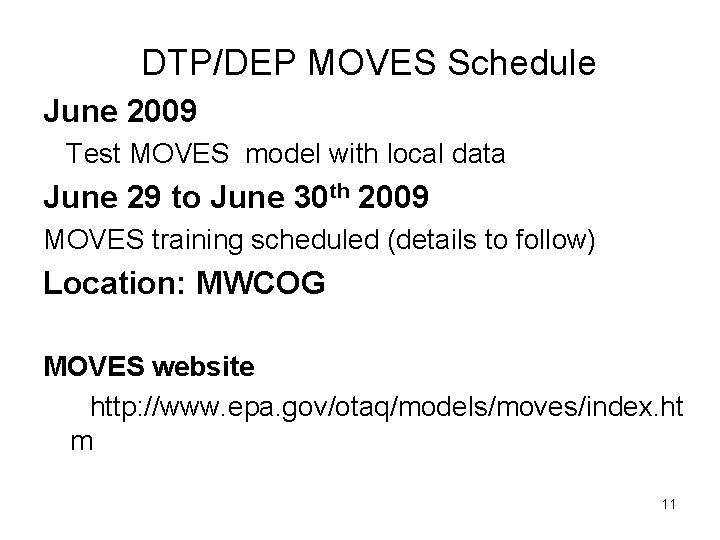
DTP/DEP MOVES Schedule June 2009 Test MOVES model with local data June 29 to June 30 th 2009 MOVES training scheduled (details to follow) Location: MWCOG MOVES website http: //www. epa. gov/otaq/models/moves/index. ht m 11