
Updated 03 2021 CurriculumDriven Assessment CDA How we









- Slides: 19
Updated 03. 2021 Curriculum-Driven Assessment (CDA) How we could develop an approach to ‘Assessment Without Levels’ at KS 3
Potential pitfalls 1. Recreating Levels using other words to describe them. 2. Trying to assess Attainment Targets before all the component parts have been taught. 3. Seeking to boil down a large range of learning attributes into just one number. 4. Using a ‘Working At’ approach where pupils effectively start from a ‘fail’ grade. 5. Assuming that attainment in year 6 is a good predictor of attainment in year 11. 6. An assumption that progress advances neatly, like climbing the steps of a ladder. 7. A view that a pupil is ‘on target’ if they attain their predicted grade – even if that grade is unacceptably low. 8. A lack of detail in showing how the teaching will cover all of the Subject Content statements. 9. A lack of clarity about what pupils should learn after being taught each unit of work. 10. Not taking the opportunity to implement a ‘Mastery’ approach to learning.
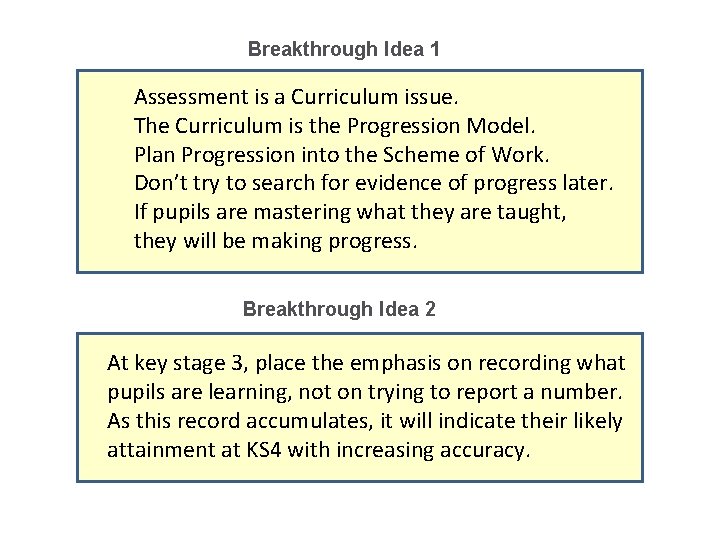
Breakthrough Idea 1 Assessment is a Curriculum issue. The Curriculum is the Progression Model. Plan Progression into the Scheme of Work. Don’t try to search for evidence of progress later. If pupils are mastering what they are taught, they will be making progress. Breakthrough Idea 2 At key stage 3, place the emphasis on recording what pupils are learning, not on trying to report a number. As this record accumulates, it will indicate their likely attainment at KS 4 with increasing accuracy.
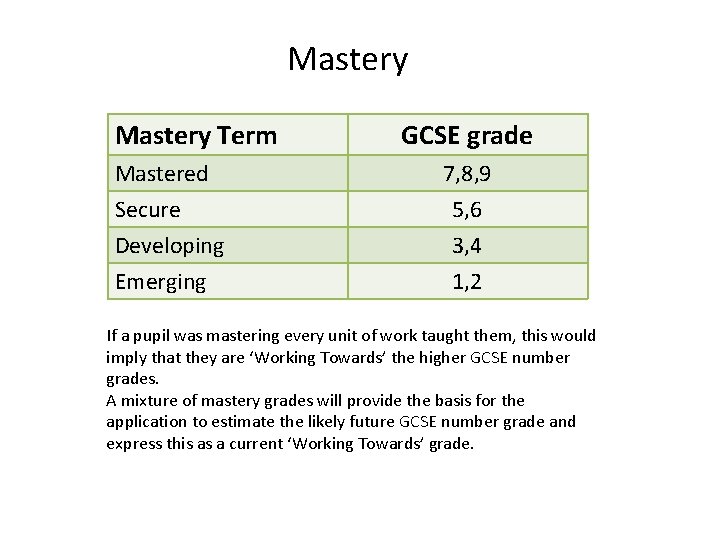
Mastery Term Mastered Secure Developing Emerging GCSE grade 7, 8, 9 5, 6 3, 4 1, 2 If a pupil was mastering every unit of work taught them, this would imply that they are ‘Working Towards’ the higher GCSE number grades. A mixture of mastery grades will provide the basis for the application to estimate the likely future GCSE number grade and express this as a current ‘Working Towards’ grade.
From Component Learning to Holistic Learning ● Key stage 3 is largely about building foundation knowledge to support studies at key stage 4. ● A subject at KS 3 may not be continued into KS 4 – so the course should provide a rounded experience of the subject. ● Assessment in year 9 should provide increasing opportunities to demonstrate learning across the whole attainment target, i. e. from component learning to holistic learning. ● In key stage 4, GCSE Assessment Objectives will govern the approach to assessment. We will move from ‘Working Towards’ at KS 3 to ‘Working At’ at KS 4. ● A range of evidence at KS 3 will indicate future attainment including Prior Attainment, Attainment 8, ‘Working Towards’ estimates and standardised assessments.
Planning a sensible approach to assessment at Key Stage 3 ● Ensure that the Scheme of Work covers the components of the Subject Content statements, and includes planned progression in learning. ● The criteria for assessment should be a manageable number of Learning Objectives for each unit of work ● Make the focus an emphasis on reporting what pupils are learning. Ignore all numbers or symbols. Let the IT system do the sums. ● Use a Mastery approach to record simply the extent to which pupils are mastering what they are taught. ● Base estimates of attainment by Year 11 on current progress – not using targets derived from En and Ma scores at KS 2 ● Use a ‘Working Towards’ approach which signals future attainment. Add an occasional standardised assessment to cross-reference. ● Let the IT system worry about the numbers as it forecasts future attainment, plots Progress Graphs, and produces diagnostic reports
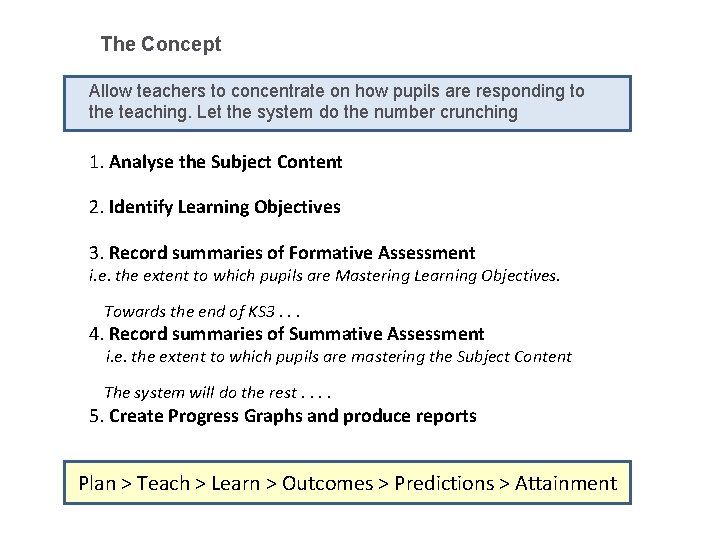
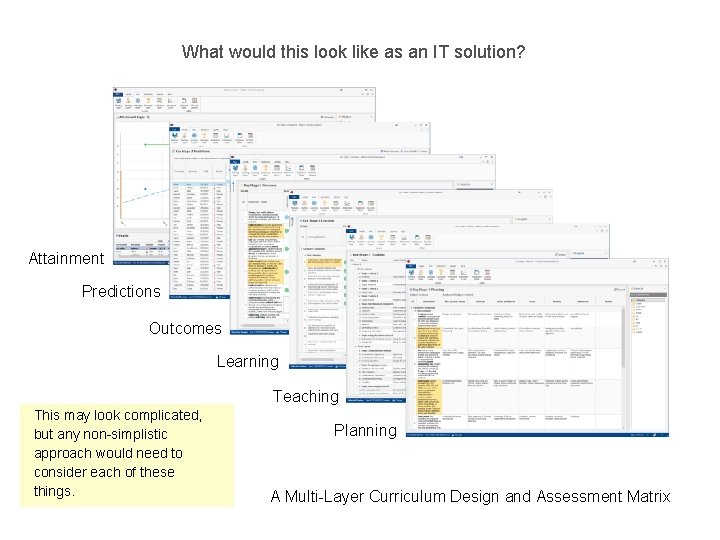
The Concept Allow teachers to concentrate on how pupils are responding to the teaching. Let the system do the number crunching 1. Analyse the Subject Content 2. Identify Learning Objectives 3. Record summaries of Formative Assessment i. e. the extent to which pupils are Mastering Learning Objectives. Towards the end of KS 3. . . 4. Record summaries of Summative Assessment i. e. the extent to which pupils are mastering the Subject Content The system will do the rest. . 5. Create Progress Graphs and produce reports Plan > Teach > Learn > Outcomes > Predictions > Attainment
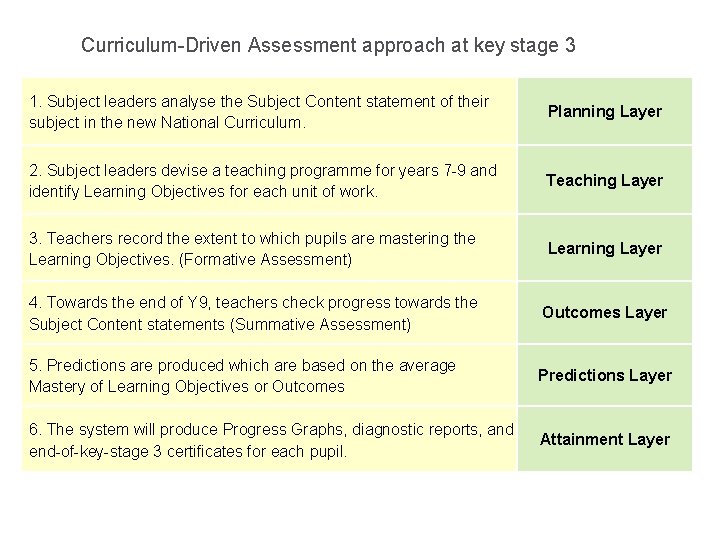
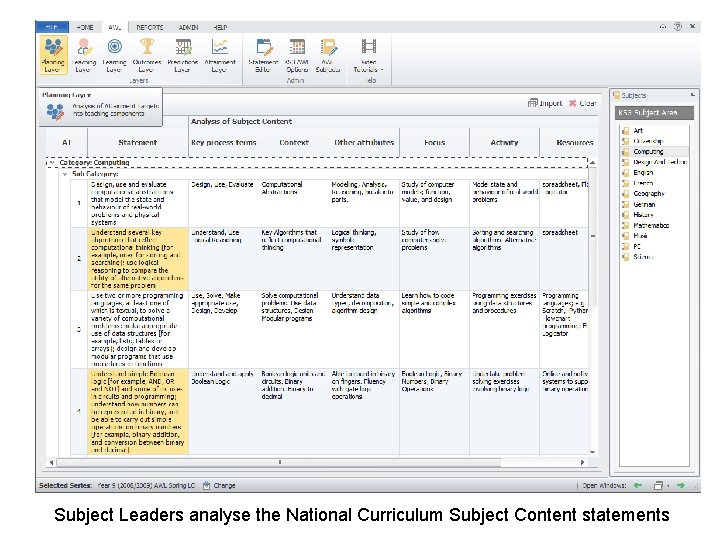
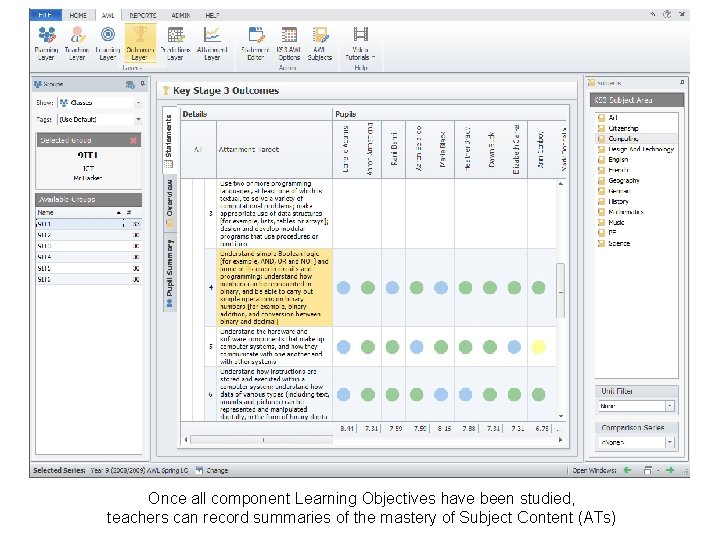
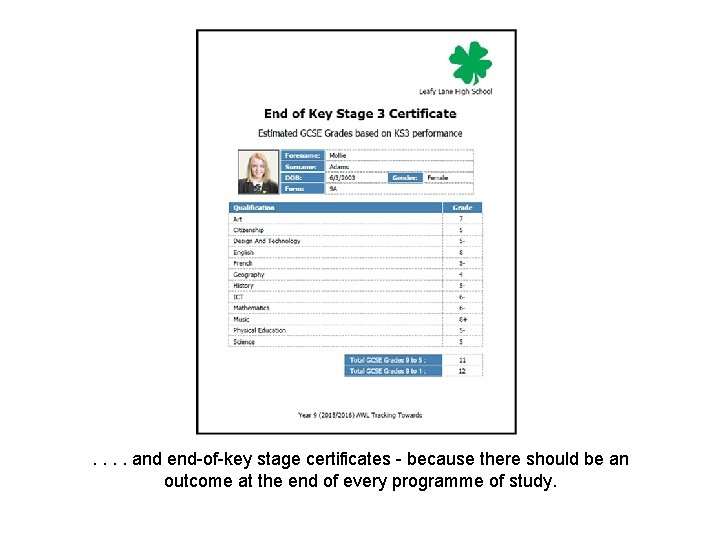
Curriculum-Driven Assessment approach at key stage 3 1. Subject leaders analyse the Subject Content statement of their subject in the new National Curriculum. Planning Layer 2. Subject leaders devise a teaching programme for years 7 -9 and identify Learning Objectives for each unit of work. Teaching Layer 3. Teachers record the extent to which pupils are mastering the Learning Objectives. (Formative Assessment) Learning Layer 4. Towards the end of Y 9, teachers check progress towards the Subject Content statements (Summative Assessment) Outcomes Layer 5. Predictions are produced which are based on the average Mastery of Learning Objectives or Outcomes Predictions Layer 6. The system will produce Progress Graphs, diagnostic reports, and end-of-key-stage 3 certificates for each pupil. Attainment Layer
What would this look like as an IT solution? Attainment Predictions Outcomes Learning Teaching This may look complicated, but any non-simplistic approach would need to consider each of these things. Planning A Multi-Layer Curriculum Design and Assessment Matrix
Subject Leaders analyse the National Curriculum Subject Content statements
Subject Leaders create a scheme of work
Teachers record summaries of the mastery of Learning Objectives for each unit of work
Once all component Learning Objectives have been studied, teachers can record summaries of the mastery of Subject Content (ATs)
The system then produces predictions from Subject Content mastery grading
Progress Graphs - we can use a range of evidence to record pupils’ progress and to predict their attainment by the end of year 11. Question: Why is a ‘Progress Graph’ a useful device compared with a ‘Flight Path’ based on predictions from KS 2?
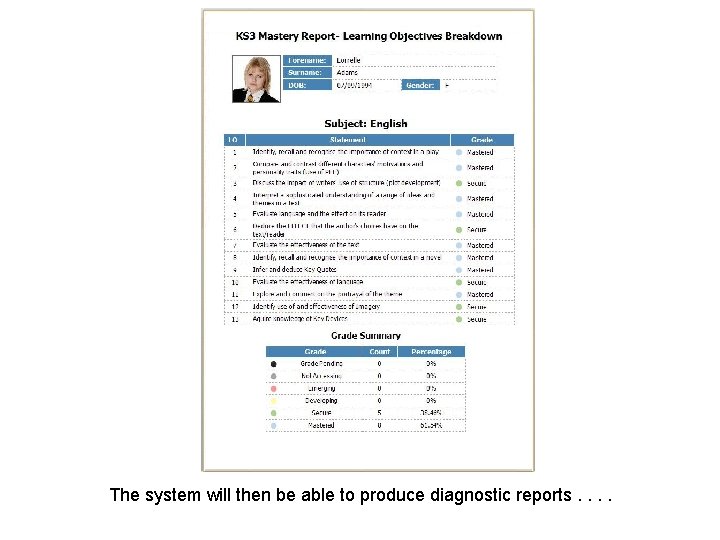
The system will then be able to produce diagnostic reports. .
… and summaries of pupils’ mastery of their subjects.
. . and end-of-key stage certificates - because there should be an outcome at the end of every programme of study.
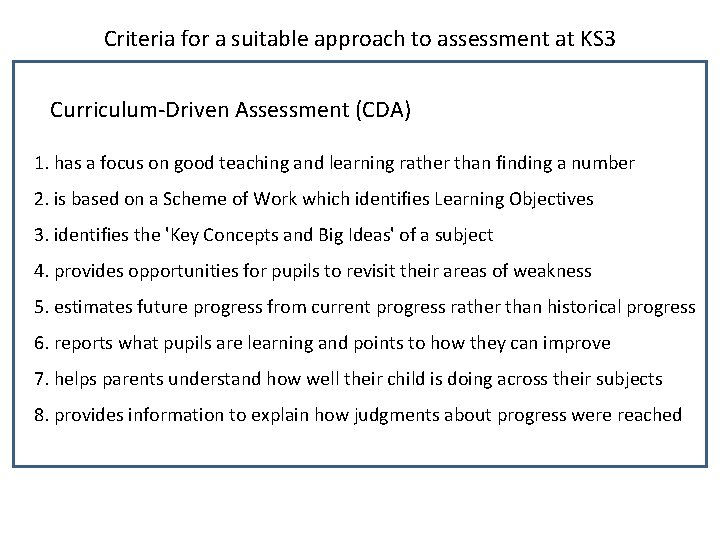
Criteria for a suitable approach to assessment at KS 3 Curriculum-Driven Assessment (CDA) 1. has a focus on good teaching and learning rather than finding a number 2. is based on a Scheme of Work which identifies Learning Objectives 3. identifies the 'Key Concepts and Big Ideas' of a subject 4. provides opportunities for pupils to revisit their areas of weakness 5. estimates future progress from current progress rather than historical progress 6. reports what pupils are learning and points to how they can improve 7. helps parents understand how well their child is doing across their subjects 8. provides information to explain how judgments about progress were reached