
Update on the EVEREST Trial and New Considerations










- Slides: 26
Update on the EVEREST Trial and New Considerations Michael Mack, M. D. Baylor Healthcare System Dallas, TX CRT 2012 February 6, 2012 1 January 16, 2012 Investigational Device only in the U. S. Not available for sale in the U. S.
Conflict of Interest Disclosure § No financial conflicts 2 January 16, 2012 Investigational Device only in the U. S. Not available for sale in the U. S.
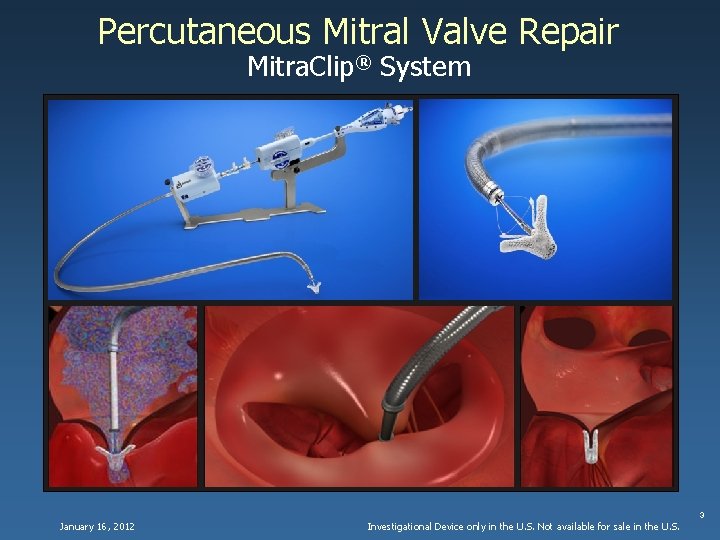
Percutaneous Mitral Valve Repair Mitra. Clip® System 3 January 16, 2012 Investigational Device only in the U. S. Not available for sale in the U. S.
EVEREST II RCT: Primary Safety Endpoint Per Protocol Cohort 4 Feldman T et al. NEJM 2011; 364: 1395 -406
EVEREST II: Mitral Regurgitation Grade Baseline, 1 and 2 Years (matched) Intention to Treat * Within group difference (p<0. 05) † Between group difference at 1 year (p<0. 05) ‡ Between group difference at 2 year (p<0. 05) * * * 2+ * † 0+ 2+ 3+ (N=122) 0+ 1+ 1+ 4+ † ‡ ‡ 0+ 3+ 1+ 1+ 2+ 2+ 2+ 3+ 4+ 4+ 2+ (N=122) (N=56) 3+ Percutaneous Surgery 5 Ted Feldman, ACC 2011 Late Breaking Trial (N=56)
EVEREST II: NYHA Functional Class At Baseline, 1 and 2 Years (matched) Intention to Treat * Within group difference (p<0. 05) † Between group difference at 1 year (p<0. 05) ‡ Between group difference at 2 year (p<0. 05) * I * † ‡ I I II II III (N=56) Percent (%) II II III II II IV IV (N=127) Percutaneous (N=127) (N=56) Surgery 6 Investigational Device only in the U. S. Not available for sale in the U. S. Ted Feldman, ACC 2011 Late Breaking Trial EVEREST II High Surgical Risk Cohort – Euro. PCR 2011
EVEREST II: LV Volumes Baseline, 1 and 2 Years (matched) Intention to Treat * Within group difference (p<0. 05) † Between group difference at 1 year (p<0. 05) ‡ Between group difference at 2 year (p<0. 05) LV End Diastolic Volume * * † * * ‡ * LV End Systolic Volume * † ‡ * BL 1 Yr 2 Yrs Percutaneous N=117 BL 1 Yr 2 Yrs Surgery N=55 * * BL 1 Yr 2 Yrs Percutaneous N=117 Surgery N=55 7 Investigational Device only in the U. S. Not available for sale in the U. S. Ted Feldman, ACC 2011 Late Breaking Trial EVEREST II High Surgical Risk Cohort – Euro. PCR 2011
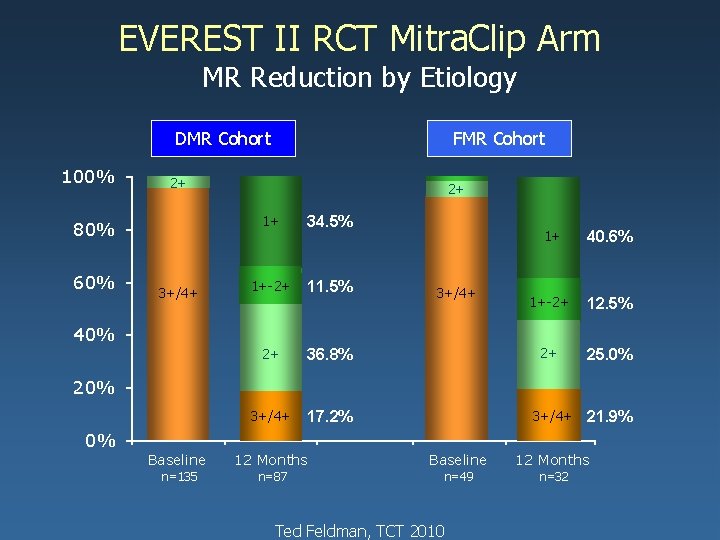
EVEREST II RCT Mitra. Clip Arm MR Reduction by Etiology DMR Cohort 100% 2+ 80% 60% FMR Cohort 3+/4+ 40% 2+ 1+ 34. 5% 1+-2+ 11. 5% 2+ 36. 8% 3+/4+ 17. 2% 3+/4+ 1+ 40. 6% 1+-2+ 12. 5% 2+ 25. 0% 20% 0% 3+/4+ 21. 9% Baseline 12 Months n=135 n=87 n=49 n=32 Ted Feldman, TCT 2010 8
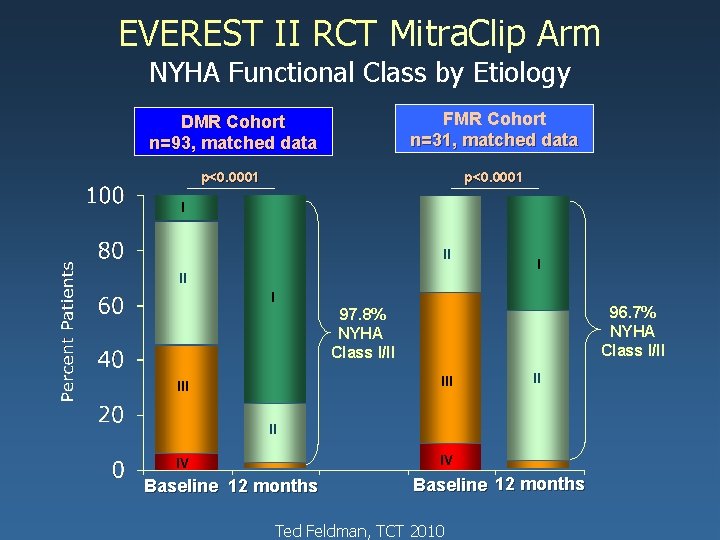
EVEREST II RCT Mitra. Clip Arm NYHA Functional Class by Etiology DMR Cohort n=93, matched data FMR Cohort n=31, matched data p<0. 0001 I II I 96. 7% NYHA Class I/II 97. 8% NYHA Class I/II II III II IV IV Baseline 12 months Ted Feldman, TCT 2010 9
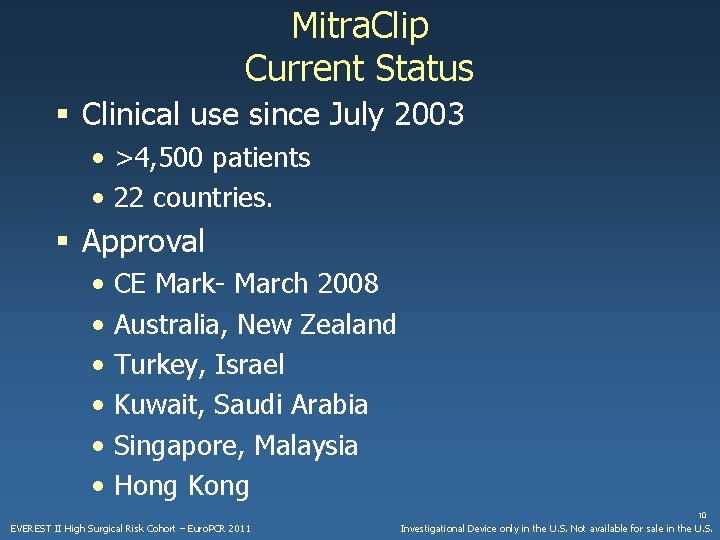
Mitra. Clip Current Status § Clinical use since July 2003 • >4, 500 patients • 22 countries. § Approval • • • CE Mark- March 2008 Australia, New Zealand Turkey, Israel Kuwait, Saudi Arabia Singapore, Malaysia Hong Kong 10 EVEREST II High Surgical Risk Cohort – Euro. PCR 2011 Investigational Device only in the U. S. Not available for sale in the U. S.
Worldwide Clinical Experience Study Population N* EVEREST I (Feasibility) Feasibility patients 55 EVEREST II (Pivotal) Pre-randomized patients 60 EVEREST II (Pivotal) Non-randomized patients (High Risk Study) 78 EVEREST II (Pivotal) Randomized patients (2: 1 Clip to Surgery) REALISM (Continued Access) Non-randomized patients 611 Compassionate/Emergency Use Non-randomized patients 33 ACCESS Europe Phase I Non-randomized patients 566 ACCESS Europe Phase II Non-randomized patients 66 Commercial Use Commercial patients 279 184 Clip 95 Surgery 2, 857 Total *Data as of 1/31/2012. Source: Abbott Vascular © 2012 Abbott Laboratories. All rights reserved. PML 03895 Rev. B (2/2/2012) 4, 510 +95 surgery 11
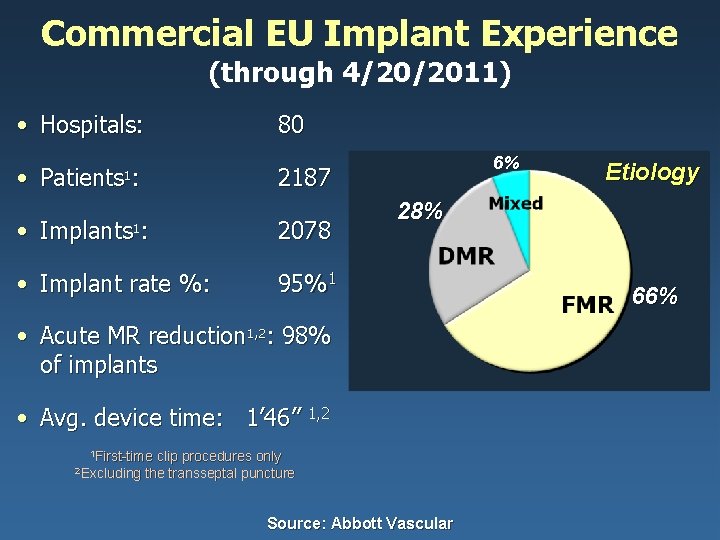
Commercial EU Implant Experience (through 4/20/2011) • Hospitals: 80 • Patients : 6% 2187 1 • Implants 1: 2078 • Implant rate %: 95%1 Etiology 28% 66% • Acute MR reduction 1, 2: 98% of implants • Avg. device time: 1’ 46” 1, 2 1 First-time 2 Excluding clip procedures only the transseptal puncture 12 EVEREST II High Surgical Risk Cohort – Euro. PCR 2011 Source: Abbott Vascular Investigational Device only in the U. S. Not available for sale in the U. S.
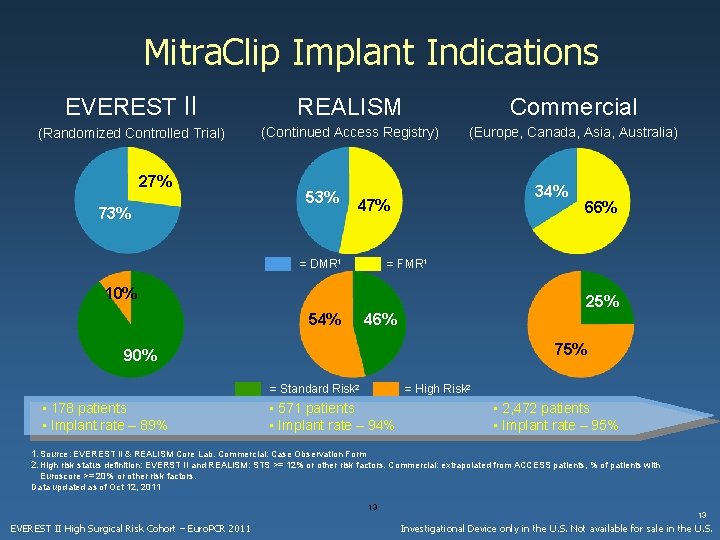
Mitra. Clip Implant Indications EVEREST II REALISM Commercial (Randomized Controlled Trial) (Continued Access Registry) (Europe, Canada, Asia, Australia) 27% 73% 53% 34% 47% = DMR 1 = FMR 1 10% 25% 54% 46% 75% 90% = Standard Risk 2 • 178 patients • Implant rate – 89% 66% = High Risk 2 • 571 patients • Implant rate – 94% • 2, 472 patients • Implant rate – 95% 1. Source: EVEREST II & REALISM Core Lab. Commercial: Case Observation Form 2. High risk status definition: EVERST II and REALISM: STS >= 12% or other risk factors. Commercial: extrapolated from ACCESS patients, % of patients with Euroscore >= 20% or other risk factors. Data updated as of Oct 12, 2011 13 EVEREST II High Surgical Risk Cohort – Euro. PCR 2011 13 Investigational Device only in the U. S. Not available for sale in the U. S.
EVEREST II High Surgical Risk Cohort Through 2 Years EVEREST II High Surgical Risk Cohort With 1 Year Follow-up N=211 78 Patients in EVEREST II High Risk 133 Patients in REALISM High Risk^ N=5 Withdrawals N=3 Withdrawals 75 Patients 1 Year Analysis 1 YEAR 96% 128 Patients in 1 Year Analysis 71 Patients in 2 Year Analysis 2 YEARS 91% Follow-up Ongoing N= 4 Withdrawals ^Enrolled by 28 Feb 2010 EVEREST II High Surgical Risk Cohort – Euro. PCR 2011 14 Investigational Device only in the U. S. Not available for sale in the U. S.
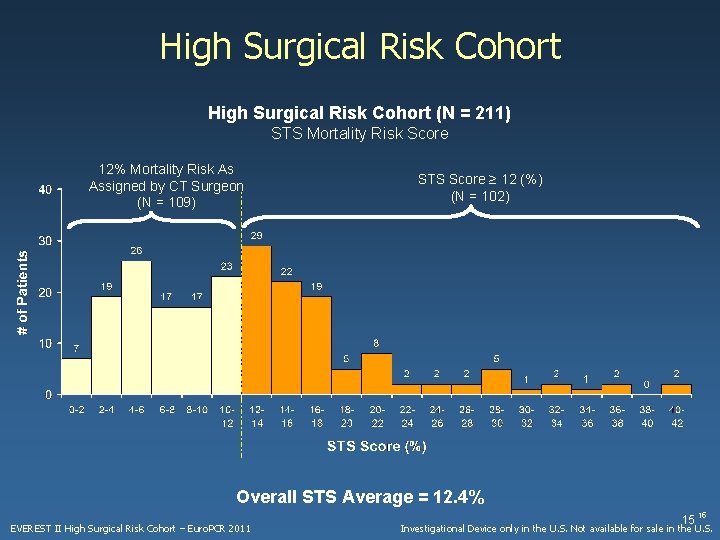
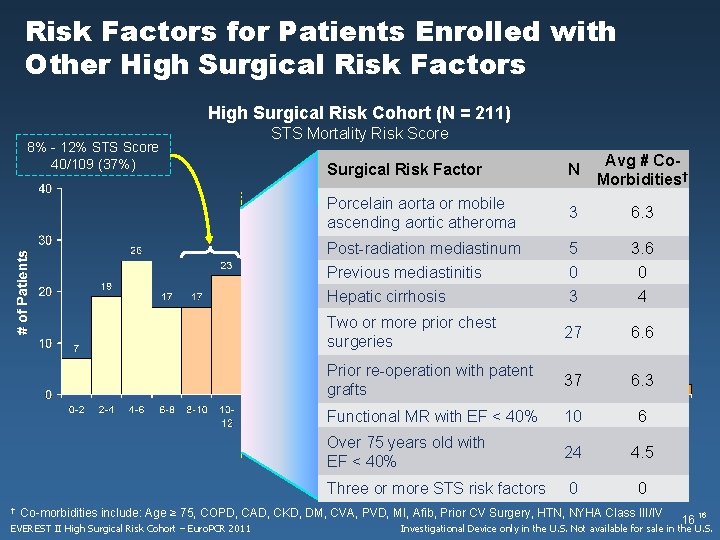
High Surgical Risk Cohort (N = 211) STS Mortality Risk Score 12% Mortality Risk As Assigned by CT Surgeon (N = 109) STS Score ≥ 12 (%) (N = 102) Overall STS Average = 12. 4% EVEREST II High Surgical Risk Cohort – Euro. PCR 2011 15 15 Investigational Device only in the U. S. Not available for sale in the U. S.
Risk Factors for Patients Enrolled with Other High Surgical Risk Factors High Surgical Risk Cohort (N = 211) 8% - 12% STS Score 40/109 (37%) † STS Mortality Risk Score Surgical Risk Factor N Avg # Co. Morbidities† Porcelain aorta or mobile ascending aortic atheroma 3 6. 3 Post-radiation mediastinum Previous mediastinitis Hepatic cirrhosis 5 0 3 3. 6 0 4 Two or more prior chest surgeries 27 6. 6 Prior re-operation with patent grafts 37 6. 3 Functional MR with EF < 40% 10 6 Over 75 years old with EF < 40% 24 4. 5 Three or more STS risk factors 0 0 Co-morbidities include: Age ≥ 75, COPD, CAD, CKD, DM, CVA, PVD, MI, Afib, Prior CV Surgery, HTN, NYHA Class III/IV EVEREST II High Surgical Risk Cohort – Euro. PCR 2011 16 16 Investigational Device only in the U. S. Not available for sale in the U. S.
EVEREST II High Surgical Risk 30 Day Major Adverse Events 30 Day MAE High Risk Cohort N=211 % Patients (N) Death 5. 2% (11) Stroke 2. 8% (6) Re-operation of Mitral-Valve 0 Urgent / Emergent CV Surgery 0. 5% (1) Myocardial Infarction 1. 4% (3) Renal Failure 1. 9% (4) Deep Wound Infection 0 Ventilation >48 hrs 1. 9% (4) New Onset Permanent Atrial Fib 0 Septicemia 0. 5% (1) GI Complication Requiring Surgery 0. 5% (1) Transfusions ≥ 2 Units Total Excluding Transfusions 13. 7% (29) 19. 9% (42) 9. 5% (20) 17 Investigational Device only in the U. S. Not available for sale in the U. S.
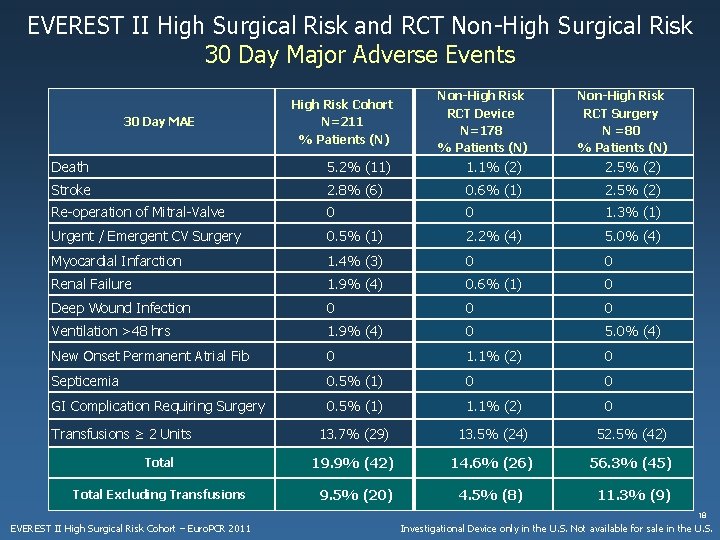
EVEREST II High Surgical Risk and RCT Non-High Surgical Risk 30 Day Major Adverse Events 30 Day MAE High Risk Cohort N=211 % Patients (N) Non-High Risk RCT Device N=178 % Patients (N) Non-High Risk RCT Surgery N =80 % Patients (N) Death 5. 2% (11) 1. 1% (2) 2. 5% (2) Stroke 2. 8% (6) 0. 6% (1) 2. 5% (2) Re-operation of Mitral-Valve 0 1. 3% (1) Urgent / Emergent CV Surgery 0. 5% (1) 2. 2% (4) 5. 0% (4) Myocardial Infarction 1. 4% (3) 0 Renal Failure 1. 9% (4) 0. 6% (1) 0 Deep Wound Infection 0 Ventilation >48 hrs 1. 9% (4) 0 5. 0% (4) New Onset Permanent Atrial Fib 0 1. 1% (2) 0 Septicemia 0. 5% (1) 0 GI Complication Requiring Surgery 0. 5% (1) 1. 1% (2) 0 Transfusions ≥ 2 Units 13. 5% (24) 52. 5% (42) Total Excluding Transfusions 13. 7% (29) 19. 9% (42) 14. 6% (26) 56. 3% (45) 9. 5% (20) 4. 5% (8) 11. 3% (9) 18 EVEREST II High Surgical Risk Cohort – Euro. PCR 2011 Investigational Device only in the U. S. Not available for sale in the U. S.
EVEREST II High Risk and Non-High Risk Cohorts Predicted vs Observed 30 day Mortality p < 0. 001 16. 4% 15. 0% 8. 3% 5. 2% EVEREST II Cohort* Concurrent Control* N = 211 N = 36 High Risk Cohorts * Predicted mortality based on STS ≥ 12% or an assigned mortality 12% for pre-specified comorbidities 19 EVEREST II High Surgical Risk Cohort – Euro. PCR 2011 Investigational Device only in the U. S. Not available for sale in the U. S.
EVEREST II High Surgical Risk and Non-High Surgical Risk RCT. Kaplan-Meier Freedom From All-Cause Mortality RCT Non-High Risk Device (n=178) RCT Non-High Risk Control (n=80) EVEREST II High Risk Cohort (n=211) High Risk Concurrent Comparator (n=36)* At Risk: RCT Device N RCT Control N High Risk CC N 0 Days 178 80 211 36 * MV anatomic criteria, patient preference 6 m 165 76 179 26 EVEREST II High Surgical Risk Cohort – Euro. PCR 2011 or enrollment completed 1 yr 158 70 155 18 1. 5 yrs 154 70 102 n/a 2 yrs 144 65 53 n/a 20 Investigational Device only in the U. S. Not available for sale in the U. S. Ted Feldman. Euro. PCR 2011
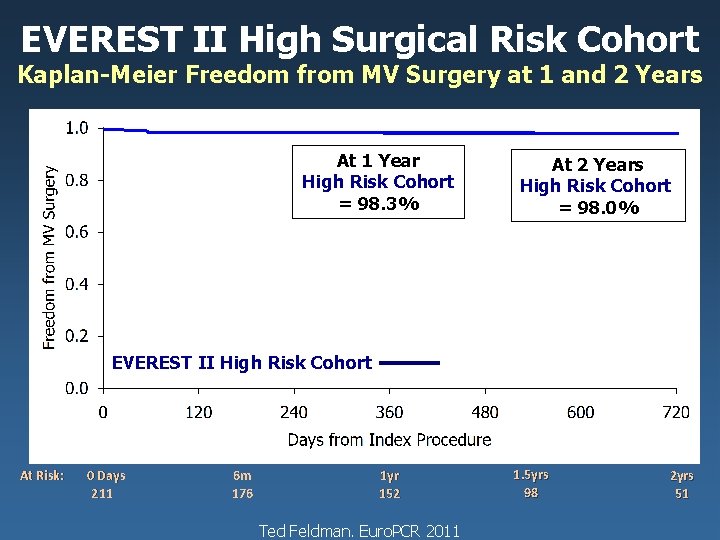
EVEREST II High Surgical Risk Cohort Kaplan-Meier Freedom from MV Surgery at 1 and 2 Years At 1 Year High Risk Cohort = 98. 3% At 2 Years High Risk Cohort = 98. 0% EVEREST II High Risk Cohort At Risk: 0 Days 211 6 m 176 1 yr 152 1. 5 yrs 98 2 yrs 51 21 EVEREST II High Surgical Risk Cohort – Euro. PCR 2011 Investigational Device only in the U. S. Not available for sale in the U. S. Ted Feldman. Euro. PCR 2011
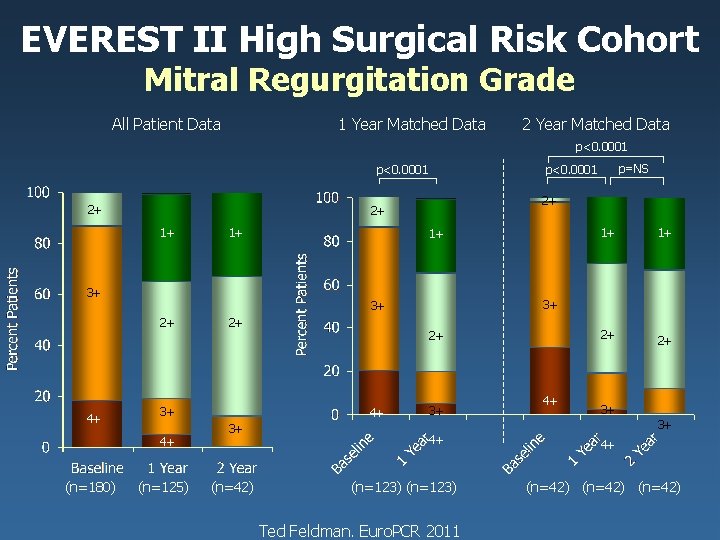
EVEREST II High Surgical Risk Cohort Mitral Regurgitation Grade All Patient Data 1 Year Matched Data 2 Year Matched Data p<0. 0001 2+ 1+ 3+ 2+ 3+ 4+ (n=180) 1+ (n=125) 2+ 4+ 3+ (n=42) 1+ 1+ 2+ 2+ 3+ 3+ 2+ 4+ 2+ 2+ 1+ p=NS p<0. 0001 3+ 4+ (n=123) 4+ 3+ 3+ 4+ (n=42) 22 EVEREST II High Surgical Risk Cohort – Euro. PCR 2011 Investigational Device only in the U. S. Not available for sale in the U. S. Ted Feldman. Euro. PCR 2011
EVEREST II High Surgical Risk Cohort NYHA Functional Class All Patient Data 1 Year Matched Data 2 Year Matched Data p<0. 0001 II III II II IV III N=211 N=143 N=44 p<0. 0001 II I I II II IV III N=43 III II IV p=NS III N=143 23 EVEREST II High Surgical Risk Cohort – Euro. PCR 2011 Investigational Device only in the U. S. Not available for sale in the U. S. Ted Feldman. Euro. PCR 2011
EVEREST II High Surgical Risk Cohort Left Ventricular End Diastolic and Systolic Volumes 1 Year Matched Data All Patient Data 2 Year Matched Data p<0. 0001 p=NS p=0. 005 p=0. 002 p=NS p<0. 0001 N 177 121 39 117 39 39 24 EVEREST II High Surgical Risk Cohort – Euro. PCR 2011 Investigational Device only in the U. S. Not available for sale in the U. S. Ted Feldman. Euro. PCR 2011
EVEREST II High Surgical Risk Cohort Hospitalization for CHF 12 Months Prior to Mitra. Clip, N=211 12 Months Following Mitra. Clip, N=203 p<0. 0001 CHF Hospitalizations Patients 47% Reduction CHF Hospitalization Rate 25 EVEREST II High Surgical Risk Cohort – Euro. PCR 2011 Investigational Device only in the U. S. Not available for sale in the U. S. Ted Feldman. Euro. PCR 2011
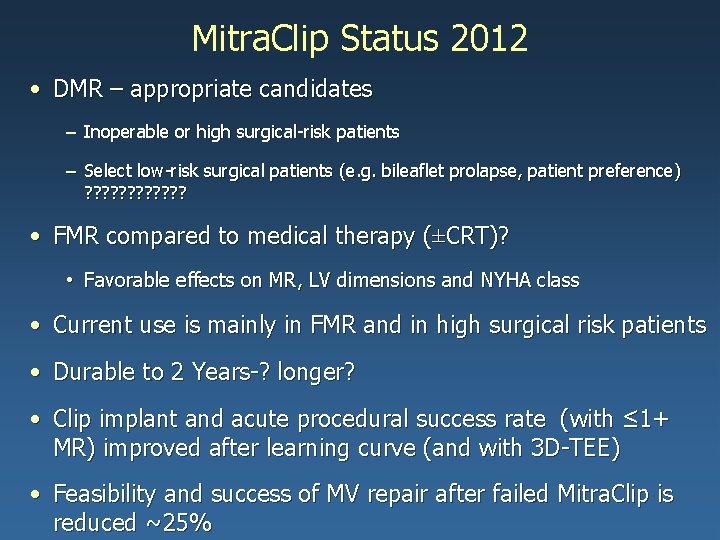
Mitra. Clip Status 2012 • DMR – appropriate candidates – Inoperable or high surgical-risk patients – Select low-risk surgical patients (e. g. bileaflet prolapse, patient preference) ? ? ? • FMR compared to medical therapy (±CRT)? • Favorable effects on MR, LV dimensions and NYHA class • Current use is mainly in FMR and in high surgical risk patients • Durable to 2 Years-? longer? • Clip implant and acute procedural success rate (with ≤ 1+ MR) improved after learning curve (and with 3 D-TEE) • Feasibility and success of MV repair after failed Mitra. Clip is reduced ~25% EVEREST II High Surgical Risk Cohort – Euro. PCR 2011 Investigational Device only in the U. S. Not available for sale in the U. S. 26