
Update on human health risks form contaminated seafood



- Slides: 9
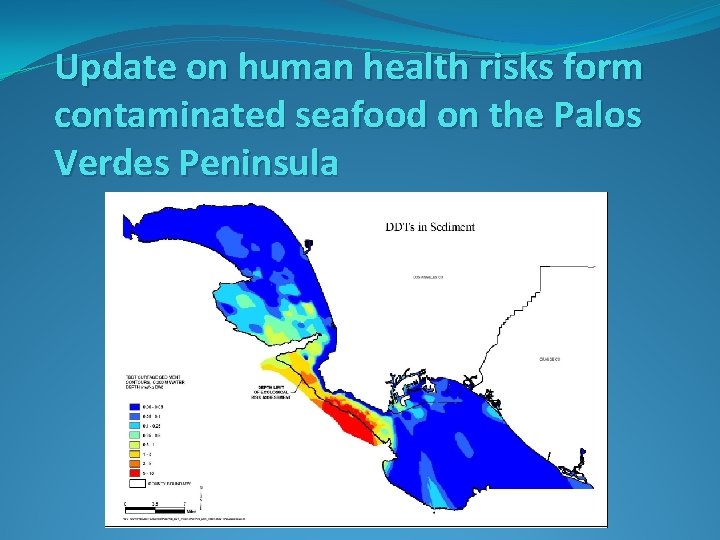
Update on human health risks form contaminated seafood on the Palos Verdes Peninsula
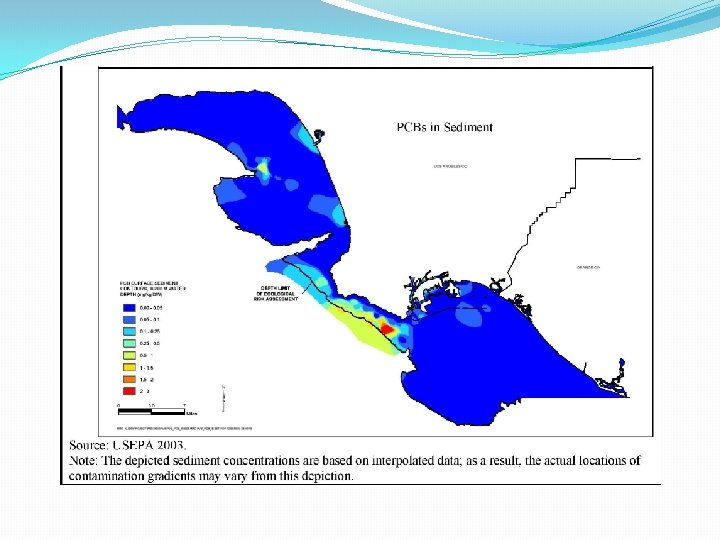
�On September 30, 2009, EPA signed an interim Record of Decision that selected a cleanup remedy for Palos Verdes Shelf. The selected remedy has three components: �Placing a cover of clean silty sand over the portion of the contaminated sediment deposit that has the highest contaminant surface concentrations and appears to be erosive �Monitoring the natural recovery that is occurring in other areas of the Shelf �Continuing the Institutional Controls program that uses outreach and education, enforcement, and monitoring to minimize consumption of fish that contain DDT and PCBs (EPA 2010).
No recommendations for Lobster White Seabass Sheephead
There are significant data gaps �Regional/ spatial �Species completely left out �Toxic heavy metals not measured LEAD �OEHHS recommendations are overly simplistic “for ease of public understanding” �Covers up many hard facts about fish contamination in Los Angeles
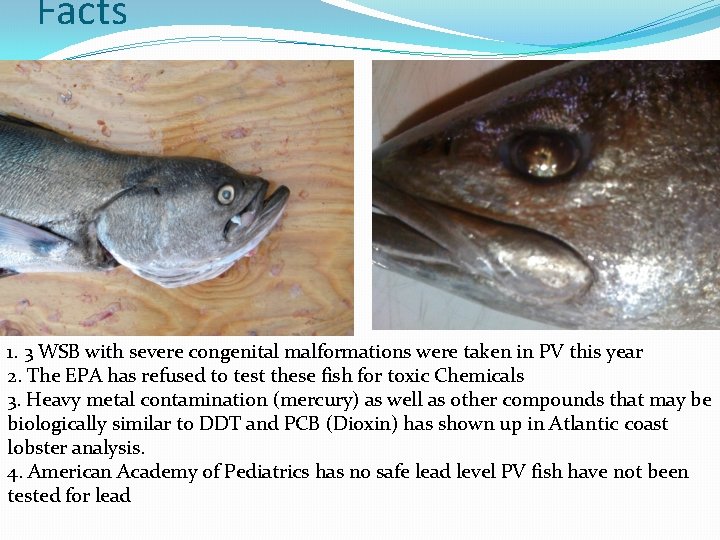
Facts 1. 3 WSB with severe congenital malformations were taken in PV this year 2. The EPA has refused to test these fish for toxic Chemicals 3. Heavy metal contamination (mercury) as well as other compounds that may be biologically similar to DDT and PCB (Dioxin) has shown up in Atlantic coast lobster analysis. 4. American Academy of Pediatrics has no safe lead level PV fish have not been tested for lead
Recommendations to the Commission �Be Involved �Request clarification from the EPA �Specifically ask for institutional control measures to be enacted to more completely and accurately analyze species most often consumed by recreational fisherman to be spatially studied �Ask for institutional control measures to specifically analyze lobster for commercial distribution for lead mercury and persistent orgaonchlorines