
Update on effective volumes and energy reconstruction A
- Slides: 24
Update on effective volumes and energy reconstruction A. Trovato, INFN - LNS
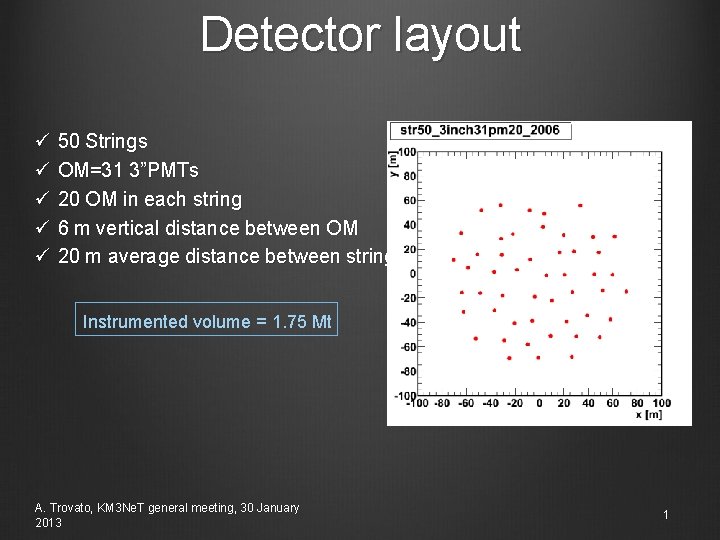
Detector layout ü 50 Strings ü OM=31 3”PMTs ü 20 OM in each string ü 6 m vertical distance between OM ü 20 m average distance between strings Instrumented volume = 1. 75 Mt A. Trovato, KM 3 Ne. T general meeting, 30 January 2013 1
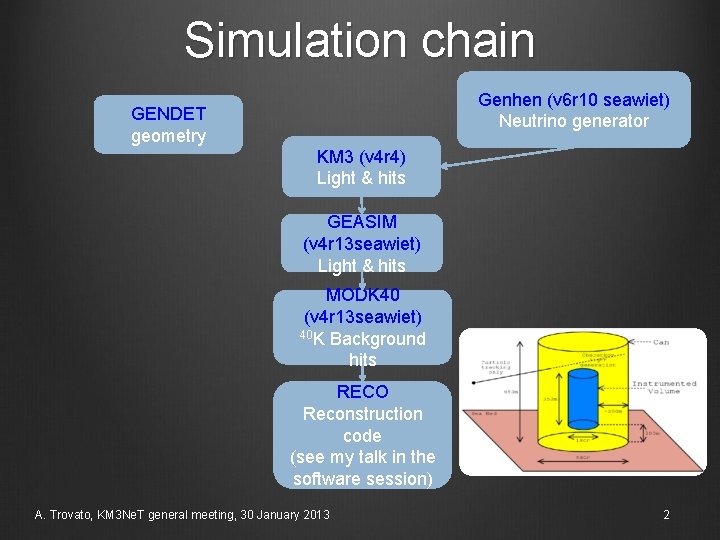
Simulation chain Genhen (v 6 r 10 seawiet) Neutrino generator GENDET geometry KM 3 (v 4 r 4) Light & hits GEASIM (v 4 r 13 seawiet) Light & hits MODK 40 (v 4 r 13 seawiet) 40 K Background hits RECO Reconstruction code (see my talk in the software session) A. Trovato, KM 3 Ne. T general meeting, 30 January 2013 2
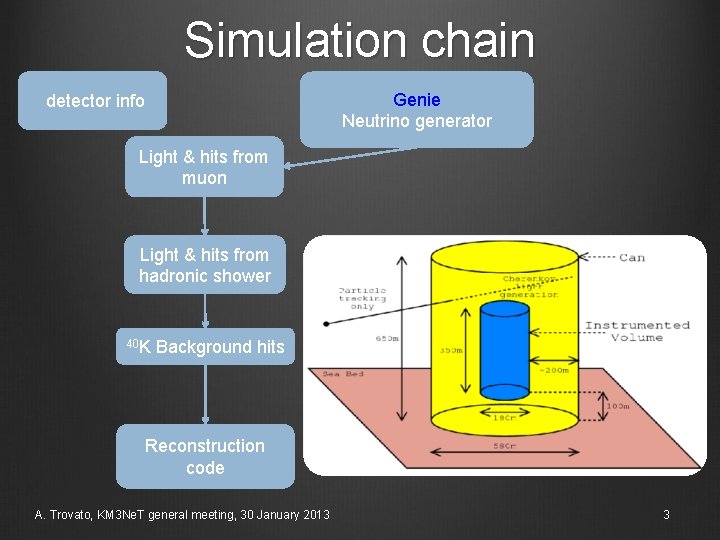
Simulation chain Genie Neutrino generator detector info Light & hits from muon Light & hits from hadronic shower 40 K Background hits Reconstruction code A. Trovato, KM 3 Ne. T general meeting, 30 January 2013 3
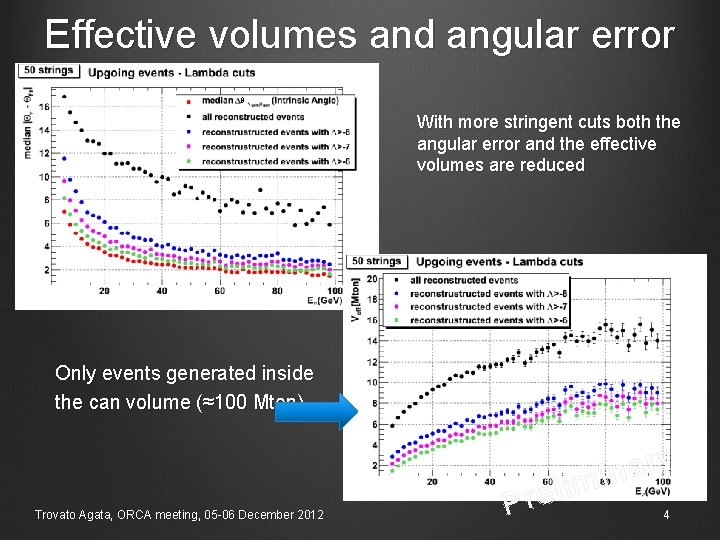
Effective volumes and angular error θ With more stringent cuts both the angular error and the effective volumes are reduced Only events generated inside the can volume (≈100 Mton) Trovato Agata, ORCA meeting, 05 -06 December 2012 m i l e Pr y r a in 4
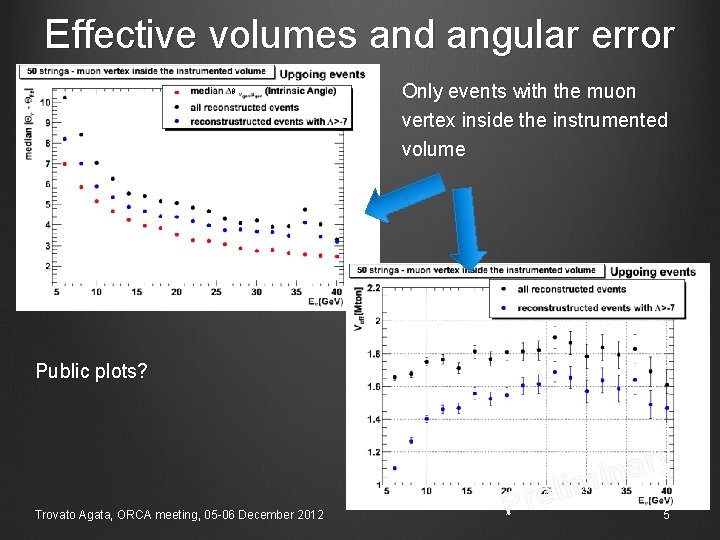
Effective volumes and angular error θ Only events with the muon vertex inside the instrumented volume Public plots? Trovato Agata, ORCA meeting, 05 -06 December 2012 m i l e Pr y r a in 5
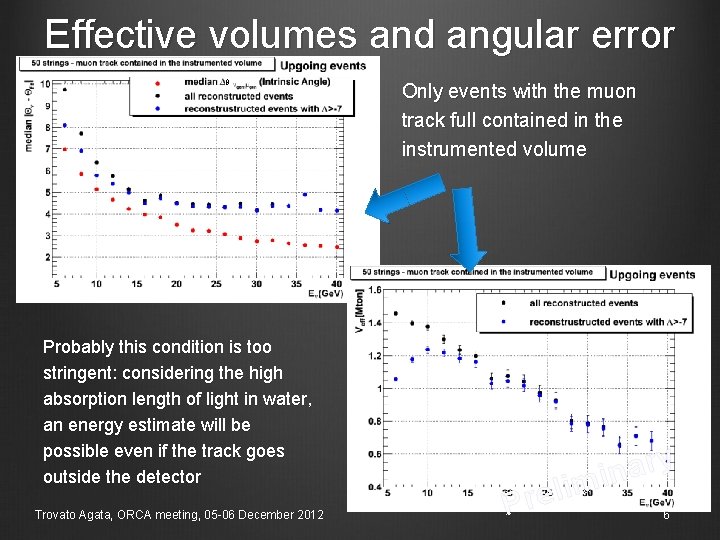
Effective volumes and angular error θ Probably this condition is too stringent: considering the high absorption length of light in water, an energy estimate will be possible even if the track goes outside the detector Trovato Agata, ORCA meeting, 05 -06 December 2012 Only events with the muon track full contained in the instrumented volume m i l e Pr y r a in 6
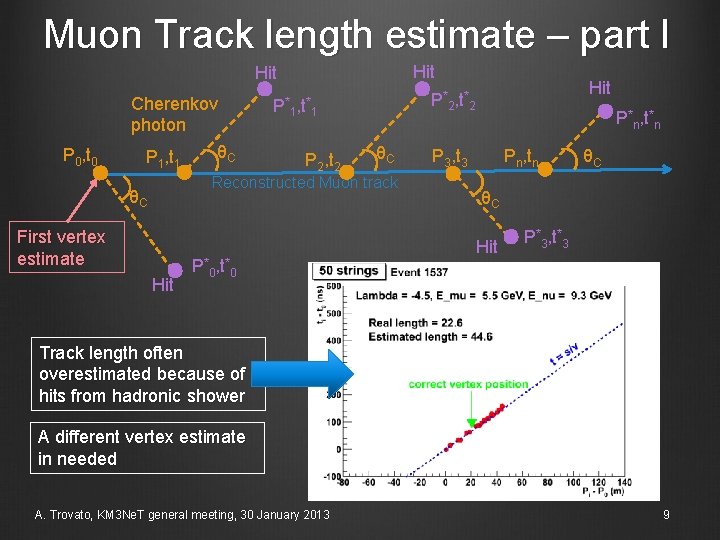
Muon Track length estimate Ø Results presented in Catania too optimistic: I used unwittingly info about the vertex from the MC truth! Ø New procedure described in the following slides: ü First estimate of the muon track length based on the hits projection on the track length overestimated because of hits from hadronic shower ü Study of the hadronic shower ü Attempt to calculate the vertex from hadronic shower A. Trovato, KM 3 Ne. T general meeting, 30 January 2013 7
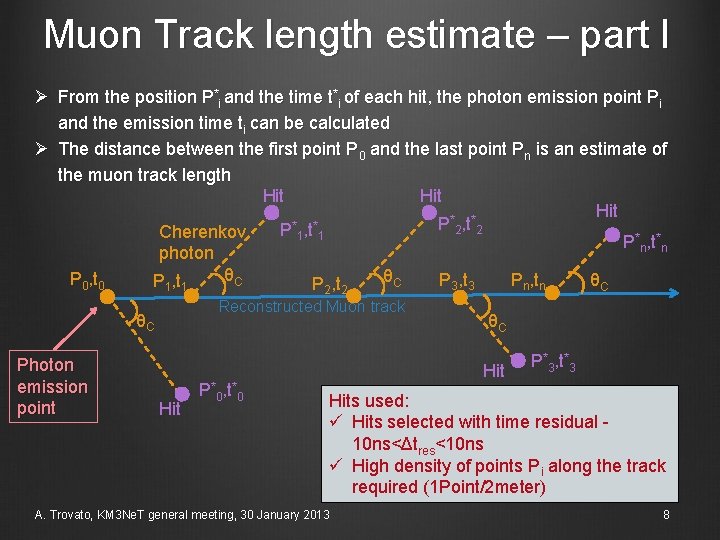
Muon Track length estimate – part I Ø From the position P*i and the time t*i of each hit, the photon emission point Pi and the emission time ti can be calculated Ø The distance between the first point P 0 and the last point Pn is an estimate of the muon track length Hit Hit * , t* P * * 2 2 P 1, t 1 Cherenkov P*n, t*n photon θC θC P 0, t 0 P 3, t 3 Pn, tn θC P 1, t 1 P 2, t 2 Reconstructed Muon track θC Photon emission point Hit P* 0 , t* θC Hit 0 P*3, t*3 Hits used: ü Hits selected with time residual 10 ns<Δtres<10 ns ü High density of points Pi along the track required (1 Point/2 meter) A. Trovato, KM 3 Ne. T general meeting, 30 January 2013 8
Muon Track length estimate – part I Hit P 0, t 0 Cherenkov photon θC P , t 1 1 P* 1 , t* 1 P 2, t 2 θC Reconstructed Muon track θC First vertex estimate Hit P* 0 , t* Hit P*2, t*2 P*n, t*n P 3, t 3 Pn, tn θC θC Hit P*3, t*3 0 Track length often overestimated because of hits from hadronic shower A different vertex estimate in needed A. Trovato, KM 3 Ne. T general meeting, 30 January 2013 9
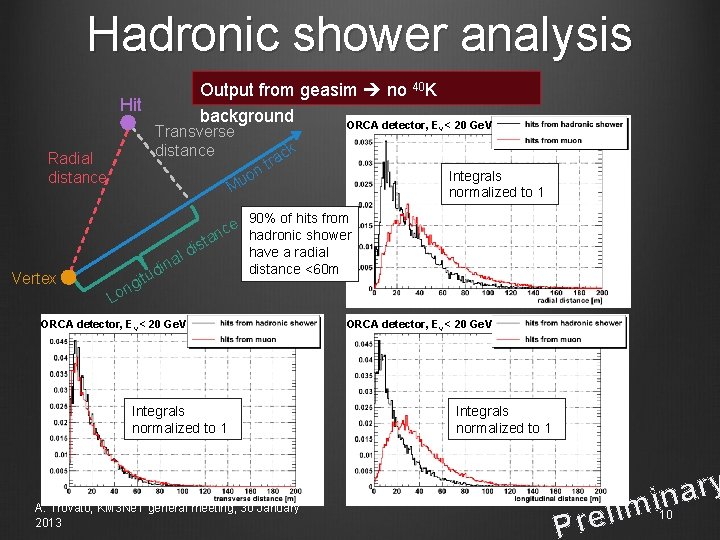
Hadronic shower analysis Hit Output from geasim no 40 K background ORCA detector, E Transverse distance Radial distance o Mu n c tra ν< 20 Ge. V k Integrals normalized to 1 90% of hits from Vertex al n i d itu g n ce hadronic shower n ta have a radial distance <60 m Lo ORCA detector, Eν < 20 Ge. V Integrals normalized to 1 A. Trovato, KM 3 Ne. T general meeting, 30 January 2013 ORCA detector, Eν < 20 Ge. V Integrals normalized to 1 m i l e Pr y r a in 10
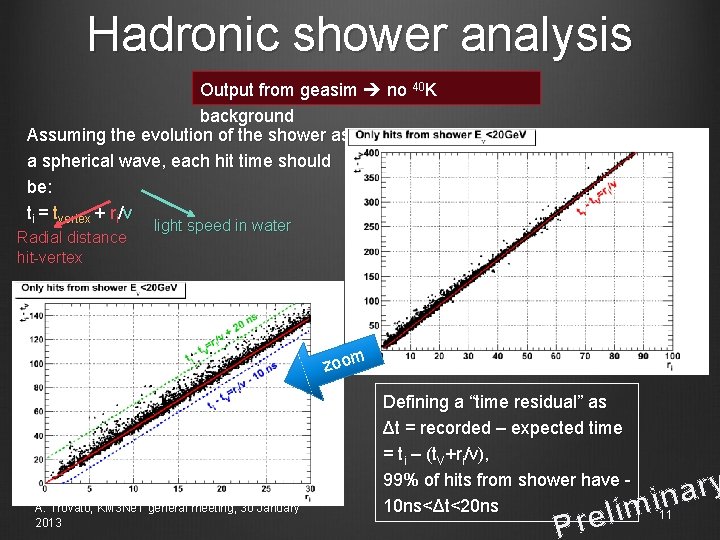
Hadronic shower analysis Output from geasim no 40 K background Assuming the evolution of the shower as a spherical wave, each hit time should be: ti = tvertex + ri/v Radial distance hit-vertex light speed in water zoom A. Trovato, KM 3 Ne. T general meeting, 30 January 2013 Defining a “time residual” as Δt = recorded – expected time = ti – (t. V+ri/v), 99% of hits from shower have 10 ns<Δt<20 ns m i l e Pr y r a in 11
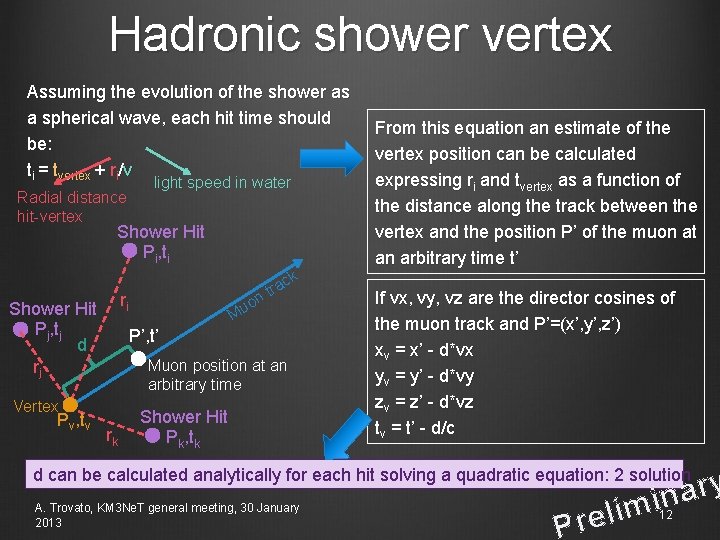
Hadronic shower vertex Assuming the evolution of the shower as a spherical wave, each hit time should be: ti = tvertex + ri/v Radial distance hit-vertex light speed in water Shower Hit Pi, ti k ri Shower Hit Pj, tj d rj P’, t’ Muon position at an arbitrary time Vertex Pv, tv n o Mu c tra rk Shower Hit Pk, tk From this equation an estimate of the vertex position can be calculated expressing ri and tvertex as a function of the distance along the track between the vertex and the position P’ of the muon at an arbitrary time t’ If vx, vy, vz are the director cosines of the muon track and P’=(x’, y’, z’) xv = x’ - d*vx yv = y’ - d*vy zv = z’ - d*vz tv = t’ - d/c d can be calculated analytically for each hit solving a quadratic equation: 2 solution A. Trovato, KM 3 Ne. T general meeting, 30 January 2013 m i l e Pr y r a in 12
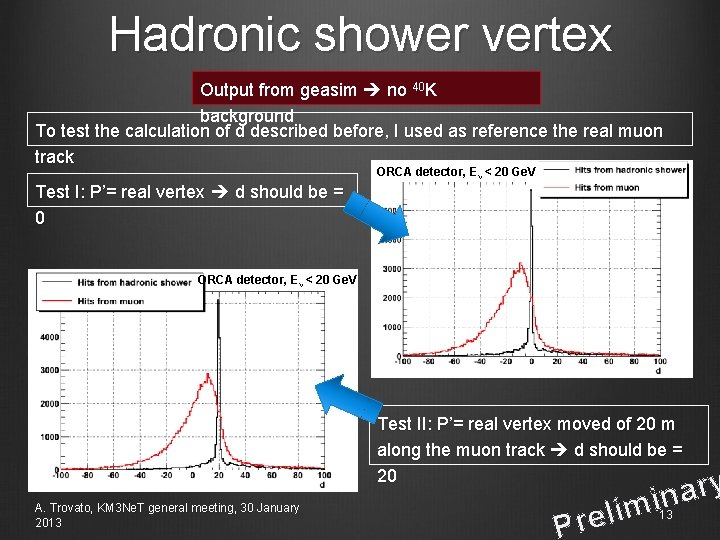
Hadronic shower vertex Output from geasim no 40 K background To test the calculation of d described before, I used as reference the real muon track ORCA detector, Eν < 20 Ge. V Test I: P’= real vertex d should be = 0 ORCA detector, Eν < 20 Ge. V Test II: P’= real vertex moved of 20 m along the muon track d should be = 20 A. Trovato, KM 3 Ne. T general meeting, 30 January 2013 m i l e Pr y r a in 13
Vertex + track length estimate • Same procedure applied to the reconstructed track with all hits • Find a peak in the d distribution is complicated because you have a sum of hits from shower + hits from muon + hits from 40 K • When the peak is not clear I try to clean my hit list using what I learnt about the radial and temporal distribution from the MC truth • Vertex estimate is possible with this method only for 30% of events that have the muon track contained in the instrumented volume and that permit a first estimation of the muon track length with the projected hits (5 Ge. V<Eν<20 Ge. V) • If this method fails, I use the first vertex estimate described before from the first photon emission point • The track length is estimated as the distance between the estimated vertex and the last photon emission point accepted A. Trovato, KM 3 Ne. T general meeting, 30 January 2013 m i l e Pr y r a in 14
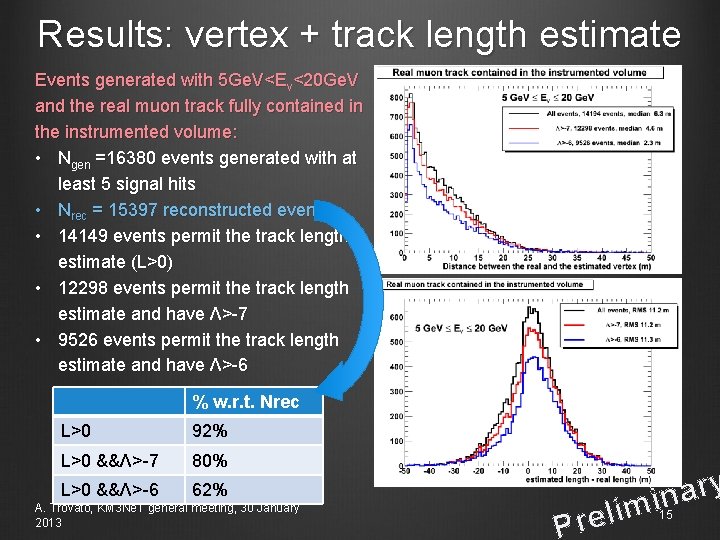
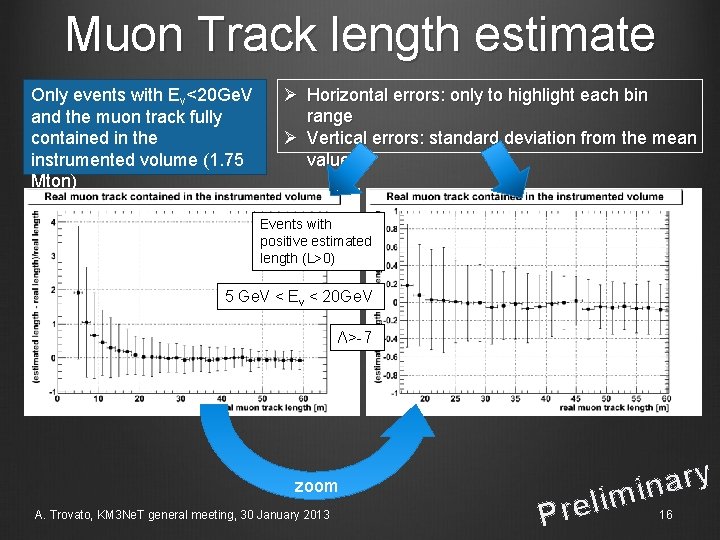
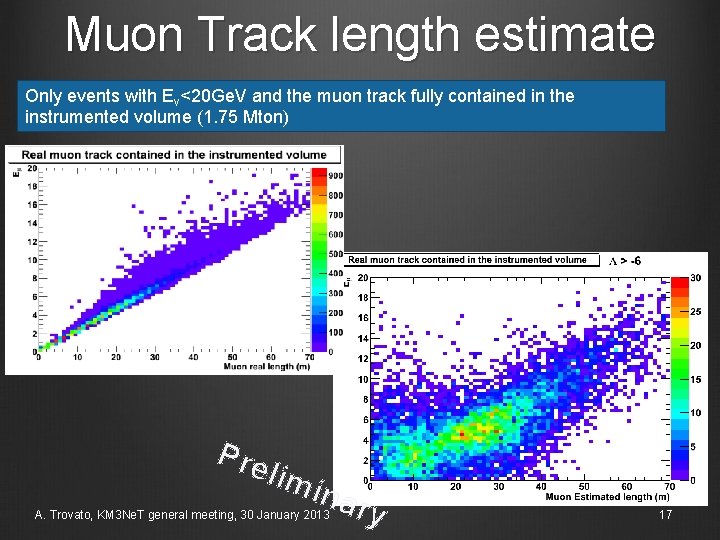
Results: vertex + track length estimate Events generated with 5 Ge. V<Eν<20 Ge. V and the real muon track fully contained in the instrumented volume: • Ngen =16380 events generated with at least 5 signal hits • Nrec = 15397 reconstructed events • 14149 events permit the track length estimate (L>0) • 12298 events permit the track length estimate and have Λ>-7 • 9526 events permit the track length estimate and have Λ>-6 % w. r. t. Nrec L>0 92% L>0 &&Λ>-7 80% L>0 &&Λ>-6 62% A. Trovato, KM 3 Ne. T general meeting, 30 January 2013 m i l e Pr y r a in 15
Muon Track length estimate Only events with Eν<20 Ge. V and the muon track fully contained in the instrumented volume (1. 75 Mton) Ø Horizontal errors: only to highlight each bin range Ø Vertical errors: standard deviation from the mean value Events with positive estimated length (L>0) 5 Ge. V < Eν < 20 Ge. V Λ>-7 zoom A. Trovato, KM 3 Ne. T general meeting, 30 January 2013 P y r a n i m i l re 16
Muon Track length estimate Only events with Eν<20 Ge. V and the muon track fully contained in the instrumented volume (1. 75 Mton) Pre lim ina A. Trovato, KM 3 Ne. T general meeting, 30 January 2013 ry 17
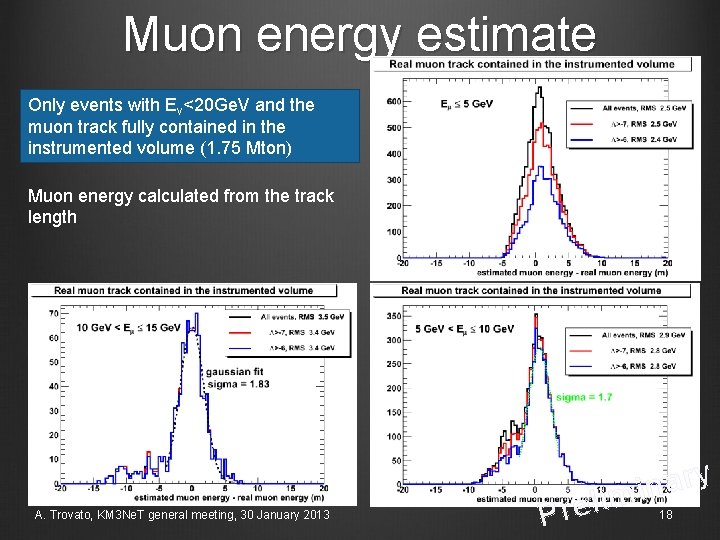
Muon energy estimate Only events with Eν<20 Ge. V and the muon track fully contained in the instrumented volume (1. 75 Mton) Muon energy calculated from the track length A. Trovato, KM 3 Ne. T general meeting, 30 January 2013 P y r a n i m i l re 18
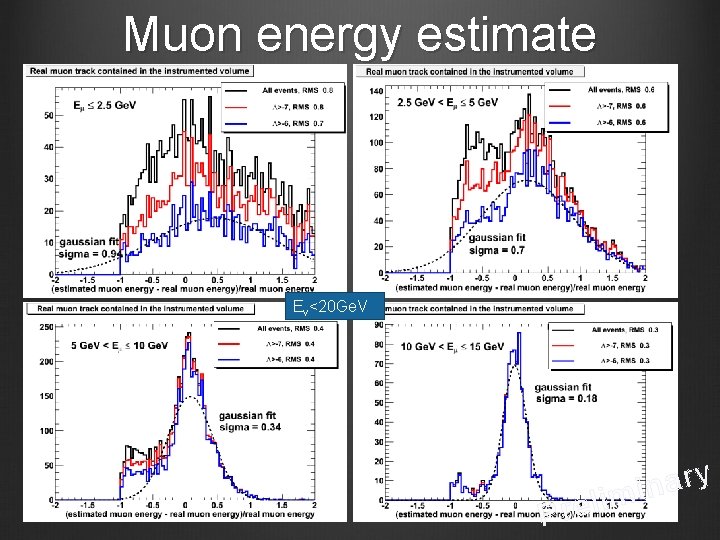
Muon energy estimate Eν<20 Ge. V A. Trovato, KM 3 Ne. T general meeting, 30 January 2013 P y r a n i m i l re 19
Outlook v Improvement on the interaction vertex estimate using a minimization instead of the analytical solution v Try to estimate the shower energy v Containment conditions and veto v Simulations with genie Trovato Agata, ORCA meeting, 05 -06 December 2012
Backup slides A. Trovato, KM 3 Ne. T general meeting, 30 January 2013 21
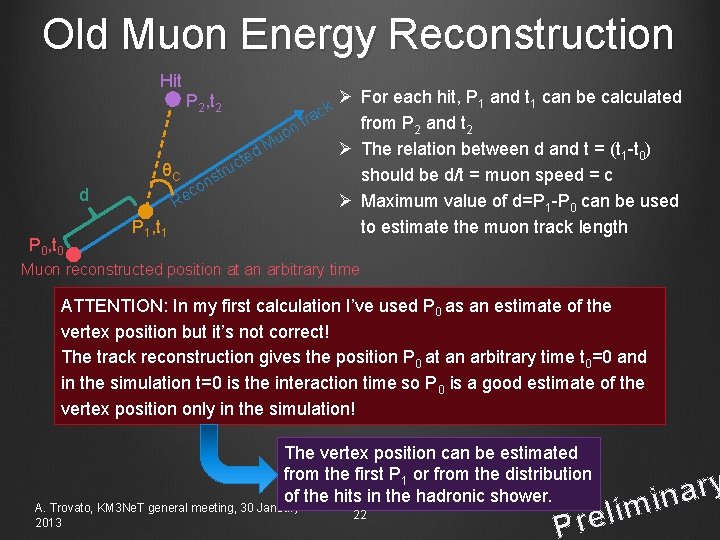
Old Muon Energy Reconstruction Hit P 2, t 2 u M d θC d P 0, t 0 ck ns o c tra n o te c u tr Re P 1, t 1 Ø For each hit, P 1 and t 1 can be calculated from P 2 and t 2 Ø The relation between d and t = (t 1 -t 0) should be d/t = muon speed = c Ø Maximum value of d=P 1 -P 0 can be used to estimate the muon track length Muon reconstructed position at an arbitrary time ATTENTION: In my first calculation I’ve used P 0 as an estimate of the vertex position but it’s not correct! The track reconstruction gives the position P 0 at an arbitrary time t 0=0 and in the simulation t=0 is the interaction time so P 0 is a good estimate of the vertex position only in the simulation! The vertex position can be estimated from the first P 1 or from the distribution of the hits in the hadronic shower. A. Trovato, KM 3 Ne. T general meeting, 30 January 2013 22 m i l e Pr y r a in
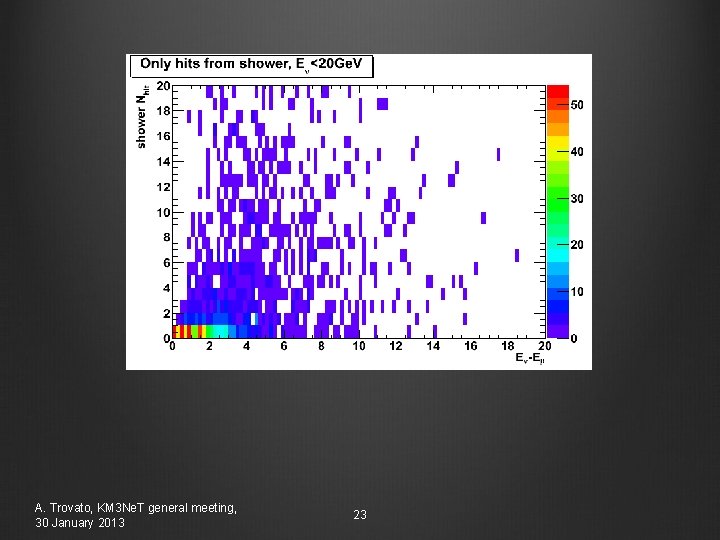
A. Trovato, KM 3 Ne. T general meeting, 30 January 2013 23