
UPDATE ON 35 U S C 101 CASES
- Slides: 40
UPDATE ON 35 U. S. C. § 101 CASES & RECENT LEGISLATION JAPAN LECTURES, OSAKA & TOKYO JUNE 2019 Robert L. Stoll Drinker Biddle & Reath LLP robert. stoll@dbr. com
Table of Contents Part I § Alice/Mayo Framework § Cases Supporting Patent Eligibility § Recent Federal Circuit Cases § USPTO Berkheimer Guidance Letter § Cases against Patent Eligibility Part II § 35 U. S. C. § 101 § Legislative History and Policy Rational of 101 § Background of Various Associations Efforts to Legislatively Overturn Alice § Bipartisan, Bicameral Draft Bill to Reform Patent Act 2 2
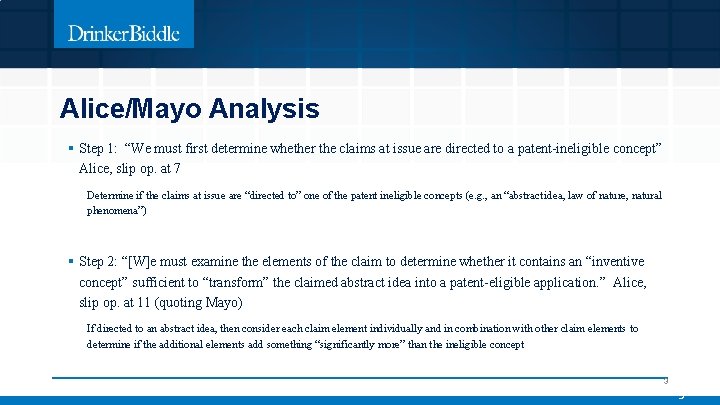
Alice/Mayo Analysis § Step 1: “We must first determine whether the claims at issue are directed to a patent-ineligible concept” Alice, slip op. at 7 Determine if the claims at issue are “directed to” one of the patent ineligible concepts (e. g. , an “abstract idea, law of nature, natural phenomena”) § Step 2: “[W]e must examine the elements of the claim to determine whether it contains an “inventive concept” sufficient to “transform” the claimed abstract idea into a patent-eligible application. ” Alice, slip op. at 11 (quoting Mayo) If directed to an abstract idea, then consider each claim element individually and in combination with other claim elements to determine if the additional elements add something “significantly more” than the ineligible concept 3 3
Key 101 Defensive Cases § Digitech Image Technologies LLC v. Electronics for Imaging, Inc. (Fed. Cir. 2014) § Cal. Tech. v. Hughes Commc’ns Inc. , US Dist. Ct, CD Cali. 59 F. Supp. 3 d 974 (2014) § Enfish LLC v. Microsoft Corp. , 822 F. 3 d 1327 (Fed. Cir. 2016) § Bascom Global Internet v. AT&T, 827 F. 3 d 1341 (Fed. Cir. 2016) § In Re: TLI Litigation, 823 F. 3 d 607 (Fed. Cir. 2016) § Mc. Ro v. Bandai Namco Games AM, 837 F. 3 d 1299 (Fed. Cir. 2016) § Thales Visionix Inc. v. US, 850 F. 3 d 1343 (Fed. Cir. 2017) § Recognicorp, LLC v. Nintendo, Co. LTD. , 855 F. 3 d 1322 (Fed. Cir. 2017) § Visual Memory, LLC v. NVIDIA Corp. , 867 F. 3 d 1253 (August 2017) § Finjan, Inc. v. Blue Coat Systems, Inc. , 879 F. 3 d 1299 (Fed. Cir. 2018) § Berkheimer v. HP, 881 F. 3 d 1360 (Fed. Cir. 2018) § Ancora Technologies, Inc. v. HTC America, Inc. , 908 F. 3 d 143 (Fed. Cir. 2018) § Available in Box Folder as well as slide deck from recent IPWatchdog/Lexis. Nexis IP Presentation “Drafting Software Patents: Lessons from “Lighthouse” Cases” 4 |
Change in USPTO Examination of Computer-Implemented Inventions § MPEP Updated January 2019 Chapter 2100: Eligibility Guidance Chapter 706. 03(a): Subject Matter Eligibility Rejections § USPTO had been issuing iterative changes to the guidance as more cases were decided in courts 5 |
Finjan, Inc. v. Blue Coat Systems, Inc. , 879 F. 3 d 1299 (Fed Cir. 2018) § Rejected Claim directed to a method of virus scanning that scans an application program, generates a security profile identifying any potentially suspicious code in the program, and links the security profile to the application program. § Patent eligible because the court concluded that the claimed method recites specific steps that accomplish a result that realizes an improvement in computer functionality. § The Court also found that the method generates a security profile that identifies both hostile and potentially hostile operations, and can protect the user against both previously unknown viruses and "obfuscated code. " § Further, The Court found that this was an improvement over traditional virus scanning, which only recognized the presence of previously-identified viruses. 6 |
Core Wireless Licensing S. A. R. L. , v. LG Electronics, Inc. , 880 F. 3 d 1356 (Fed. Cir. 2018) § Claimed invention involved a graphical user interface (GUI) for mobile devices that displays an application summary of each application on the main menu while those applications are in an unlaunched state. § The claims to computing devices were held patent eligible because the Court concluded that they are directed to an improved user interface for electronic devices, not to the abstract idea of an index. § The Court further found the claims contain precise language delimiting the type of data to be displayed and how to display it, thus improving upon conventional user interfaces to increase the efficiency of using mobile devices. § Finding the claims eligible, the court compared the improved user interface in the p patent claims to the improved systems claimed in Enflsh, Thales, Visual Memory, and Finjan. 7
Berkheimer v. HP, 881 F. 3 d 1360 (Fed. Cir. 2018) § Claim directed to digitally processing and archiving files in a digital asset management system. The Court found that the patent specification disclosed that the system eliminates redundant storage of common text and graphical elements, which improves system operation efficiency and reduces storage costs. § With respect to Mayo/Alice Analysis Step 1, the Court held that the claims were directed to abstract ideas (parsing and comparing data, parsing, comparing, and storing data, and parsing, comparing, storing, and editing data). Based upon a comparison of these claims to claims held to be abstract in prior Federal Circuit decisions all claims were found abstract. Berkheimer, 881 F. 3 d at 1366 -67. § With respect to Mayo/Alice Analysis Step 2, the Court considered the elements of each claim both individually and as an ordered combination, recognizing that "whether a claim element or combination of elements is well-understood, routine and conventional to a skilled artisan in the relevant field is a question of fact. " Id. at 1367 -68. 8 |
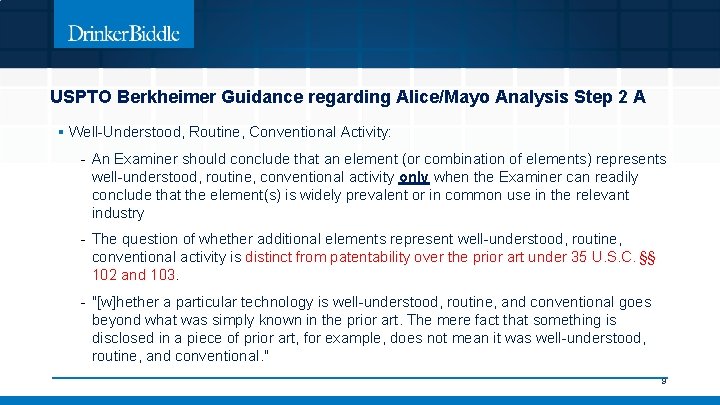
USPTO Berkheimer Guidance regarding Alice/Mayo Analysis Step 2 A § Well-Understood, Routine, Conventional Activity: - An Examiner should conclude that an element (or combination of elements) represents well-understood, routine, conventional activity only when the Examiner can readily conclude that the element(s) is widely prevalent or in common use in the relevant industry - The question of whether additional elements represent well-understood, routine, conventional activity is distinct from patentability over the prior art under 35 U. S. C. §§ 102 and 103. - "[w]hether a particular technology is well-understood, routine, and conventional goes beyond what was simply known in the prior art. The mere fact that something is disclosed in a piece of prior art, for example, does not mean it was well-understood, routine, and conventional. " 9
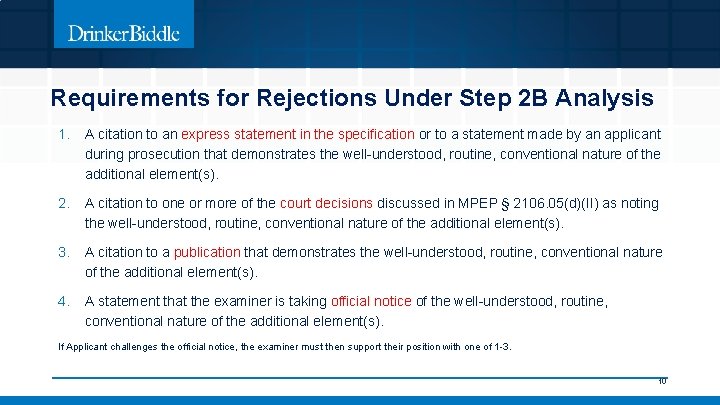
Requirements for Rejections Under Step 2 B Analysis 1. A citation to an express statement in the specification or to a statement made by an applicant during prosecution that demonstrates the well-understood, routine, conventional nature of the additional element(s). 2. A citation to one or more of the court decisions discussed in MPEP § 2106. 05(d)(II) as noting the well-understood, routine, conventional nature of the additional element(s). 3. A citation to a publication that demonstrates the well-understood, routine, conventional nature of the additional element(s). 4. A statement that the examiner is taking official notice of the well-understood, routine, conventional nature of the additional element(s). If Applicant challenges the official notice, the examiner must then support their position with one of 1 -3. 10
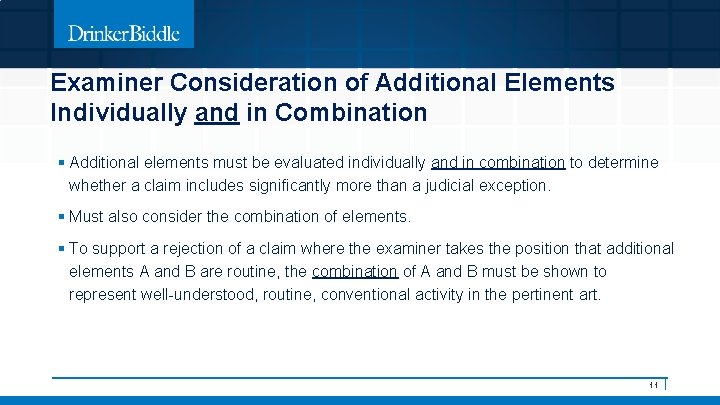
Examiner Consideration of Additional Elements Individually and in Combination § Additional elements must be evaluated individually and in combination to determine whether a claim includes significantly more than a judicial exception. § Must also consider the combination of elements. § To support a rejection of a claim where the examiner takes the position that additional elements A and B are routine, the combination of A and B must be shown to represent well-understood, routine, conventional activity in the pertinent art. 11 |
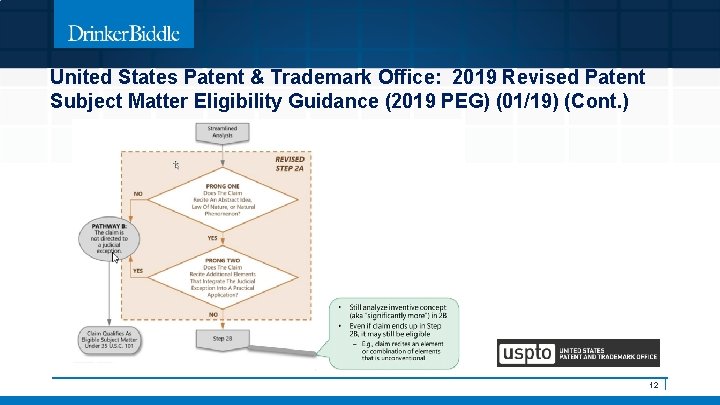
United States Patent & Trademark Office: 2019 Revised Patent Subject Matter Eligibility Guidance (2019 PEG) (01/19) (Cont. ) 12 |
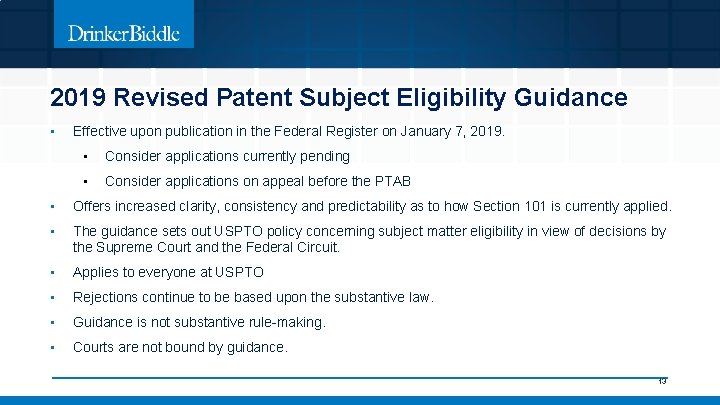
2019 Revised Patent Subject Eligibility Guidance • Effective upon publication in the Federal Register on January 7, 2019. • Consider applications currently pending • Consider applications on appeal before the PTAB • Offers increased clarity, consistency and predictability as to how Section 101 is currently applied. • The guidance sets out USPTO policy concerning subject matter eligibility in view of decisions by the Supreme Court and the Federal Circuit. • Applies to everyone at USPTO • Rejections continue to be based upon the substantive law. • Guidance is not substantive rule-making. • Courts are not bound by guidance. 13
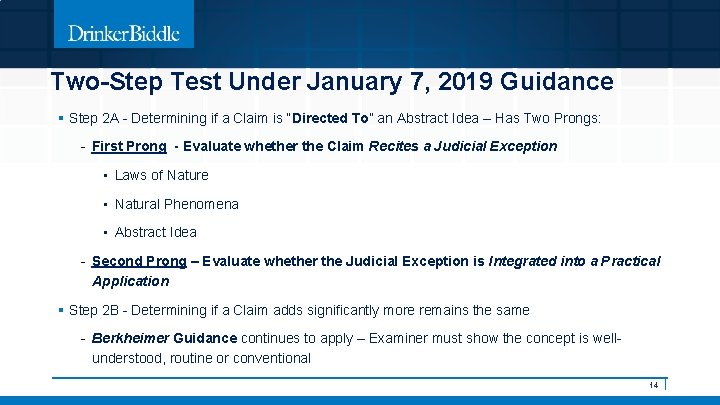
Two-Step Test Under January 7, 2019 Guidance § Step 2 A - Determining if a Claim is “Directed To” an Abstract Idea – Has Two Prongs: - First Prong - Evaluate whether the Claim Recites a Judicial Exception • Laws of Nature • Natural Phenomena • Abstract Idea - Second Prong – Evaluate whether the Judicial Exception is Integrated into a Practical Application § Step 2 B - Determining if a Claim adds significantly more remains the same - Berkheimer Guidance continues to apply – Examiner must show the concept is wellunderstood, routine or conventional 14 |
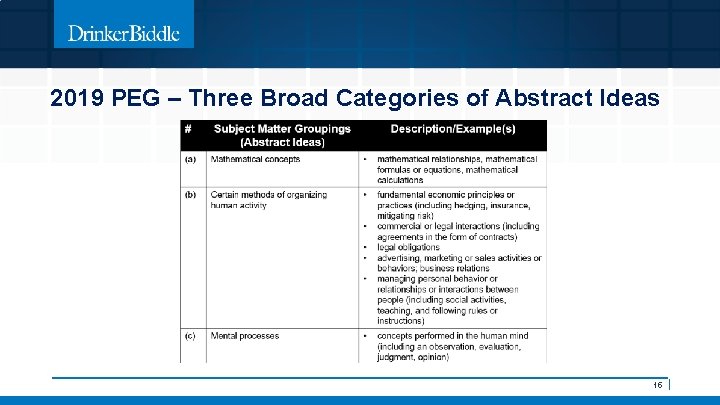
2019 PEG – Three Broad Categories of Abstract Ideas 15 |
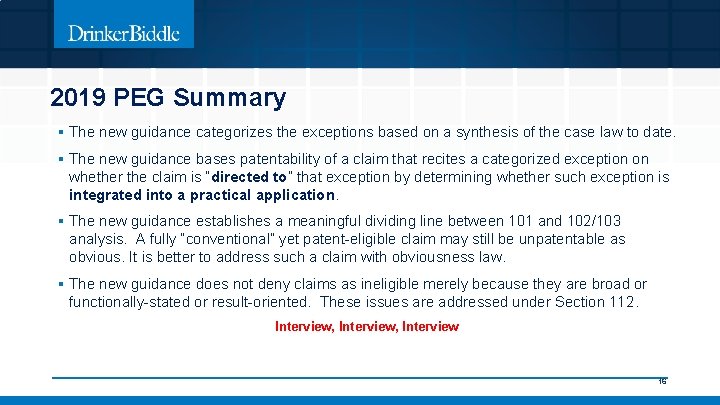
2019 PEG Summary § The new guidance categorizes the exceptions based on a synthesis of the case law to date. § The new guidance bases patentability of a claim that recites a categorized exception on whether the claim is “directed to” that exception by determining whether such exception is integrated into a practical application. § The new guidance establishes a meaningful dividing line between 101 and 102/103 analysis. A fully “conventional” yet patent-eligible claim may still be unpatentable as obvious. It is better to address such a claim with obviousness law. § The new guidance does not deny claims as ineligible merely because they are broad or functionally-stated or result-oriented. These issues are addressed under Section 112. Interview, Interview 16
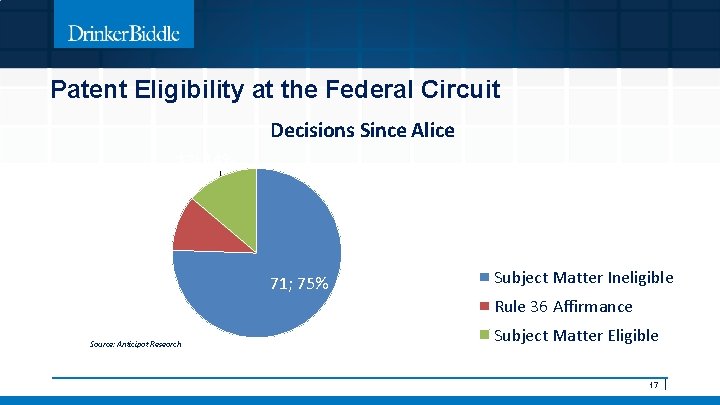
Patent Eligibility at the Federal Circuit Decisions Since Alice 13; 14% 10; 11% 71; 75% Subject Matter Ineligible Rule 36 Affirmance Source: Anticipat Research Subject Matter Eligible 17 |
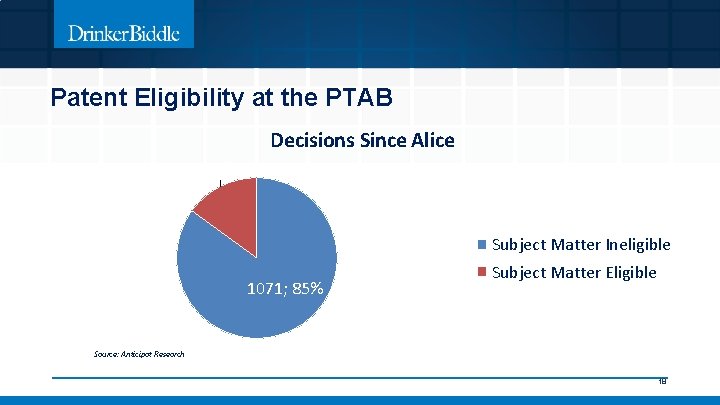
Patent Eligibility at the PTAB Decisions Since Alice 189; 15% Subject Matter Ineligible 1071; 85% Subject Matter Eligible Source: Anticipat Research 18
Recent Cases Against Patent Eligibility 19
Athena Diagnostics, Inc. v. Mayo Collaborative Services, LLC (Fed. Cir. 2019) § The claims in Athena are directed to methods for diagnosing neurological disorders by detecting antibodies to a protein called muscle-specific tyrosine kinase (Mu. SK). § The majority found that the “claims recite only a natural law together with conventional steps to detect that law, " and therefore the claims are ineligible under § 101. § Judge Newman in her dissent states that "[t]he '820 inventors did not patent their scientific discovery of Mu. SK autoantibodies, " but rather "applied this discovery to create a new method of diagnosis, for a previously undiagnosable neurological condition. " § Also notable in a footnote in the majority decision is a statement that those judges did not want the result but felt that SC precedence required them to find the claims ineligible. 20 |
Cleveland Clinic Foundation v. True Health Diagnostics LLC (Fed. Cir. 2019) § Claims are directed to a “diagnostic test[s] which can be used to determine whether an individual. . . is at a lower risk or higher risk of developing or having cardiovascular disease, " § Court held that claims are invalid as being directed to a natural law and they are “not directed to new techniques for performing an immunoassay to detect a patient's blood MPO levels. They only recite applying known methods to detect MPO levels in plasma, comparing them to standard MPO levels, and reaching a conclusion” § “While we greatly respect the PTO’s expertise on all matters relating to patentability, including patent eligibility, we are not bound by its guidance. And, especially regarding the issue of patent eligibility and the efforts of the courts to determine the distinction between claims directed to natural laws and those directed to patent-eligible applications of those laws, we are mindful of the need for consistent application of our case law. ” 21 |
Part II: Legislative Update 22 |
35 U. S. C. § 101 35 USC § 101 Inventions Patentable - Whoever invents or discovers any new and useful process, machine, manufacture, or composition of matter, or any new and useful improvement thereof, may obtain a patent therefor, subject to the conditions and requirements of this title. - Enacted Legislation July 19, 1952, c. 950, 66 Stat. 797 (Emphasis Added) 35 USC § 100 Definitions - (b) The term “process” means process, art or method, and includes a new use of a known process, machine, manufacture, composition of matter, or material. 23 |
Legislative History of 35 U. S. C. § 101 Ultramerical, Inc. v. Hulu, LLC, 772 F. 3 d 1335, (Fed. Cir. 2013) Chief Judge Rader in a pre-Alice Federal Circuit Case examined the Legislative history of 101. “Underscoring its breadth, § 101 both uses expansive categories and modifies them with the word “any. ” In Bilski, the Supreme Court emphasized that “[i]n choosing such expansive terms modified by the comprehensive ‘any, ’ Congress plainly contemplated that the patent laws would be given wide scope. ” 130 S. Ct. at 3225 (quoting Diamond v. Chakrabarty, 447 U. S. 303, 308 (1980)). The pertinent, expansive definition of “process” in § 100(b) confirms the statute’s intended breadth. At first examination, the Act’s definition of “process” to include a new use of a known machine seems superfluous. After all, if “any” process may be patented under § 101, § 100(b) seems wholly unnecessary. The amendment was necessary to avoid narrow judicial interpretations of “process” given to the pre-1952 statute. ” Ultramercial, Inc. , 772 F. 3 d 709, 711 (Fed Cir. 2013) 24
Policy Rational of 35 U. S. C. § 101 Avoid Pre-emption “Because abstract ideas, laws of nature, and natural phenomenon ‘are the basic tools of scientific and technological work’, the Supreme Court has expressed concern that monopolizing these tools by granting patent rights may impede innovation rather than promote it. ” 2106 Patent Subject Matter Eligibility Revised , USPTO August 2017 (citing Alice Corp. v. CLS Bank, 134 S. Ct. at 2354, 110 USPQ 2 d at 1980; Mayo Collaborative Servs. v. Prometheus Labs. , Inc. , 566 U. S. 66, 71, 101 USPQ 2 d 1961, 1965 (2012). 25 |
June 13, 2016 Hearing before the House Judiciary Committee’s Subcommittee on the Courts, Intellectual Property and the Internet. Prof. Adam Mossoff (George Mason University, Antonin Scalia Law School) testified included the following Examples of Innovation “Taking a Hit”: • Ultrasound Machine • Diagnosis of Ovarian Cancer • Diagnosis of Prostrate Cancer • Treatment of Breast Cancer • Scanning Thermometer • Process for Operating an Oil Rig • Process for Operating Snow Plows • Ariosa Diagnostics, Inc. v. Sequenom, Inc. , 809 F. 3 d 1282 (Fed. Cir. 2015) • Claims directed to detecting fetal DNA in mother's plasma found directed to an abstract idea (natural phenomenon). Court looked at the claims merely reciting a diagnostic step that is based on a natural law correlation. 26 |
Promoting Innovation, Investment and Job Growth by Fixing America’s Patent System Key discussion points: Since Alice, the Federal Circuit held ineligible 91% (80 out of 88) of the patents brought before it based on Section 101. PTAB gained reputation as patent killer with similar results in 101 cases. Speakers argued that China was watching and expanded the scope of subject matter that can be patented there, in hopes of attracting even more foreign investment (November 2016). (More recently in February 2019 amendments to CNIPA make it even easier (e. g. , added US-style Official Notice requirement and Interpreted claims as whole)). 27
ABA IP AIPLA & IPO Task Force on Patent Eligible Subject Matter under 35 U. S. C. § 101 28 |
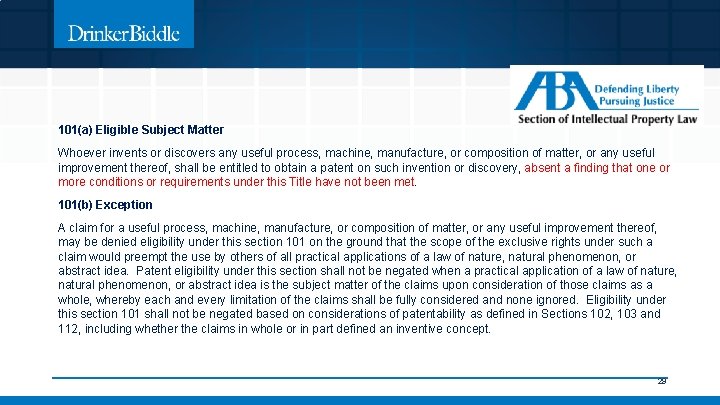
101(a) Eligible Subject Matter Whoever invents or discovers any useful process, machine, manufacture, or composition of matter, or any useful improvement thereof, shall be entitled to obtain a patent on such invention or discovery, absent a finding that one or more conditions or requirements under this Title have not been met. 101(b) Exception A claim for a useful process, machine, manufacture, or composition of matter, or any useful improvement thereof, may be denied eligibility under this section 101 on the ground that the scope of the exclusive rights under such a claim would preempt the use by others of all practical applications of a law of nature, natural phenomenon, or abstract idea. Patent eligibility under this section shall not be negated when a practical application of a law of nature, natural phenomenon, or abstract idea is the subject matter of the claims upon consideration of those claims as a whole, whereby each and every limitation of the claims shall be fully considered and none ignored. Eligibility under this section 101 shall not be negated based on considerations of patentability as defined in Sections 102, 103 and 112, including whether the claims in whole or in part defined an inventive concept. 29
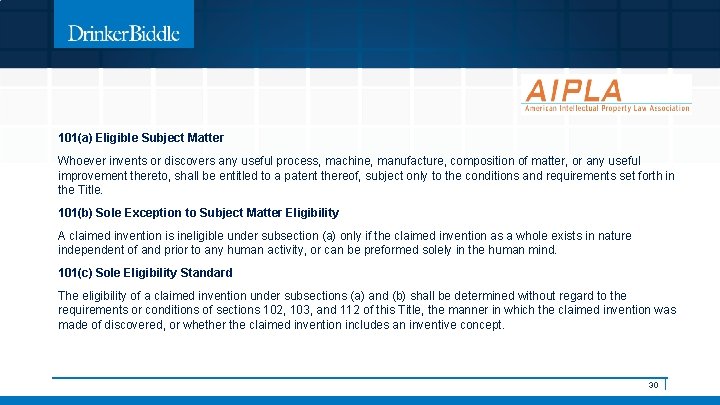
101(a) Eligible Subject Matter Whoever invents or discovers any useful process, machine, manufacture, composition of matter, or any useful improvement thereto, shall be entitled to a patent thereof, subject only to the conditions and requirements set forth in the Title. 101(b) Sole Exception to Subject Matter Eligibility A claimed invention is ineligible under subsection (a) only if the claimed invention as a whole exists in nature independent of and prior to any human activity, or can be preformed solely in the human mind. 101(c) Sole Eligibility Standard The eligibility of a claimed invention under subsections (a) and (b) shall be determined without regard to the requirements or conditions of sections 102, 103, and 112 of this Title, the manner in which the claimed invention was made of discovered, or whether the claimed invention includes an inventive concept. 30 |
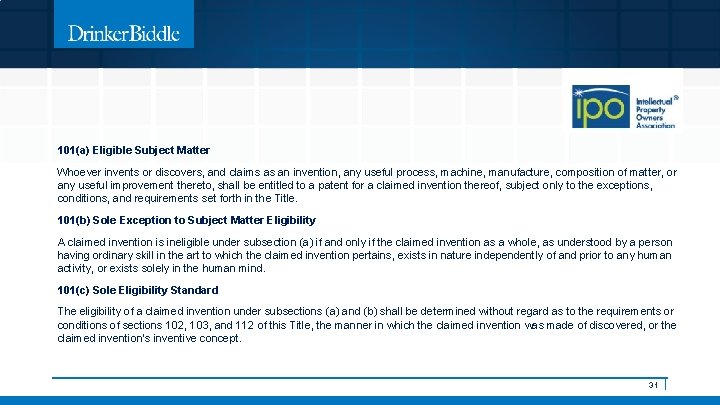
101(a) Eligible Subject Matter Whoever invents or discovers, and claims as an invention, any useful process, machine, manufacture, composition of matter, or any useful improvement thereto, shall be entitled to a patent for a claimed invention thereof, subject only to the exceptions, conditions, and requirements set forth in the Title. 101(b) Sole Exception to Subject Matter Eligibility A claimed invention is ineligible under subsection (a) if and only if the claimed invention as a whole, as understood by a person having ordinary skill in the art to which the claimed invention pertains, exists in nature independently of and prior to any human activity, or exists solely in the human mind. 101(c) Sole Eligibility Standard The eligibility of a claimed invention under subsections (a) and (b) shall be determined without regard as to the requirements or conditions of sections 102, 103, and 112 of this Title, the manner in which the claimed invention was made of discovered, or the claimed invention’s inventive concept. 31 |
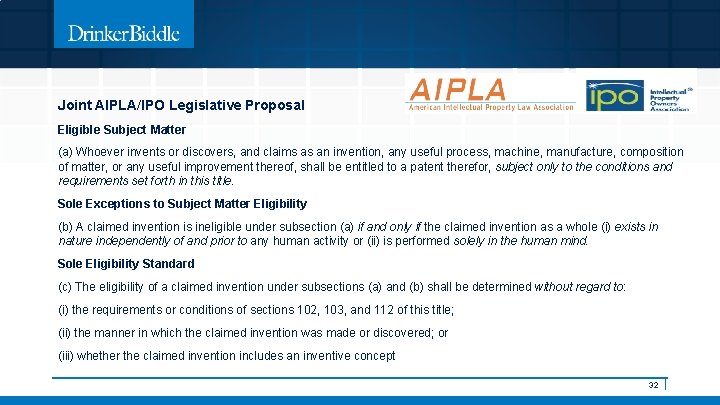
Joint AIPLA/IPO Legislative Proposal Eligible Subject Matter (a) Whoever invents or discovers, and claims as an invention, any useful process, machine, manufacture, composition of matter, or any useful improvement thereof, shall be entitled to a patent therefor, subject only to the conditions and requirements set forth in this title. Sole Exceptions to Subject Matter Eligibility (b) A claimed invention is ineligible under subsection (a) if and only if the claimed invention as a whole (i) exists in nature independently of and prior to any human activity or (ii) is performed solely in the human mind. Sole Eligibility Standard (c) The eligibility of a claimed invention under subsections (a) and (b) shall be determined without regard to: (i) the requirements or conditions of sections 102, 103, and 112 of this title; (ii) the manner in which the claimed invention was made or discovered; or (iii) whether the claimed invention includes an inventive concept 32 |
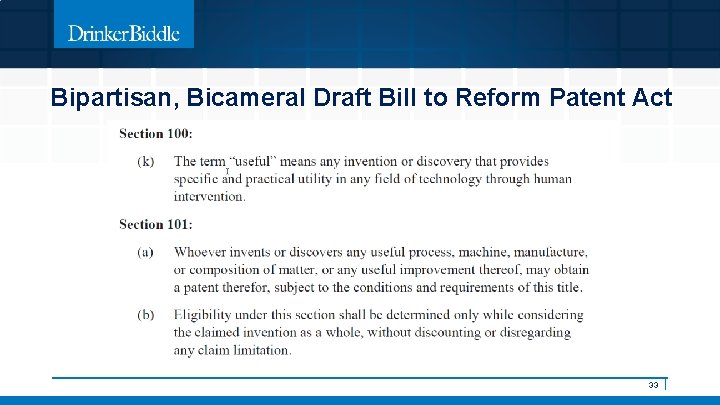
Bipartisan, Bicameral Draft Bill to Reform Patent Act 33 |
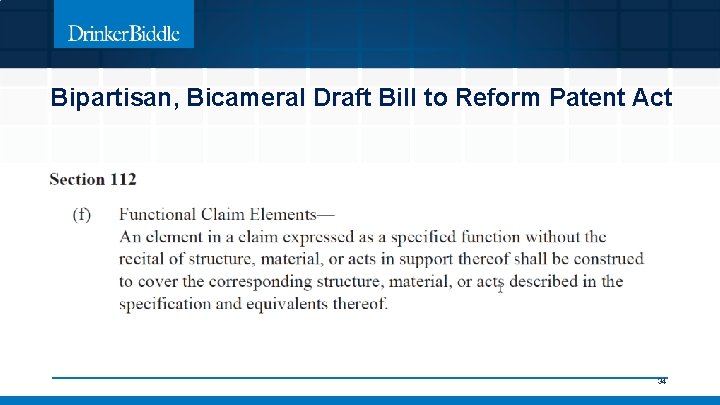
Bipartisan, Bicameral Draft Bill to Reform Patent Act 34
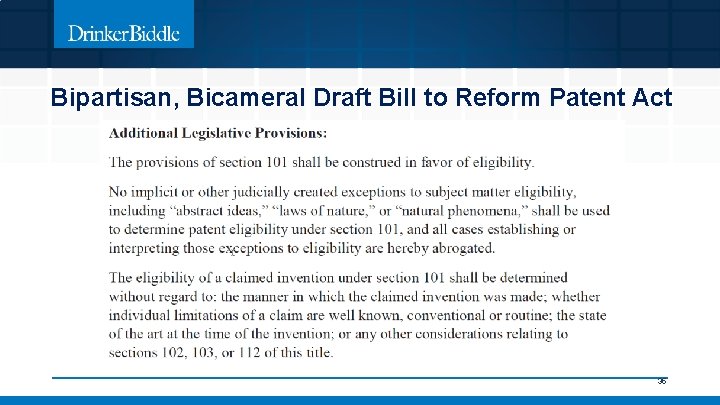
Bipartisan, Bicameral Draft Bill to Reform Patent Act 35
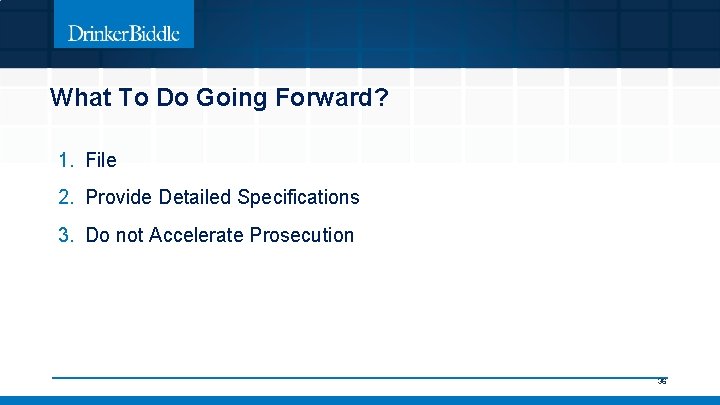
What To Do Going Forward? 1. File 2. Provide Detailed Specifications 3. Do not Accelerate Prosecution 36
What is Next § Legis. Lation unlikely to pass soon § Possibly more Court cases § Likely more USPTO Guidance 37
QUESTIONS? 38 |
THANK YOU! 39 |
§ Philadelphia, Washington, New York, § San Francisco, Los Angeles, Princeton, § Florham Park, Wilmington, § Chicago, Milwaukee, Albany, Dallas § Est. 1849 § © 2012 Drinker Biddle & Reath LLP § A Delaware Limited Liability Partnership § All rights reserved § The views expressed in this presentation are those of the author and do not necessarily reflect the views of the author’s firm or its clients. This presentation is for general information purposes only and should not be taken as legal advice. 40 |