
Update of basic knowledge thin plate structures Essential
Update of basic knowledge thin plate structures Essential for basic structure design and investigation of alternative options Restricted items of this update: Plate field theories – lateral loaded plate Buckling of thin plate – compression load in plane of plate possible errors executing determining still water bending moments
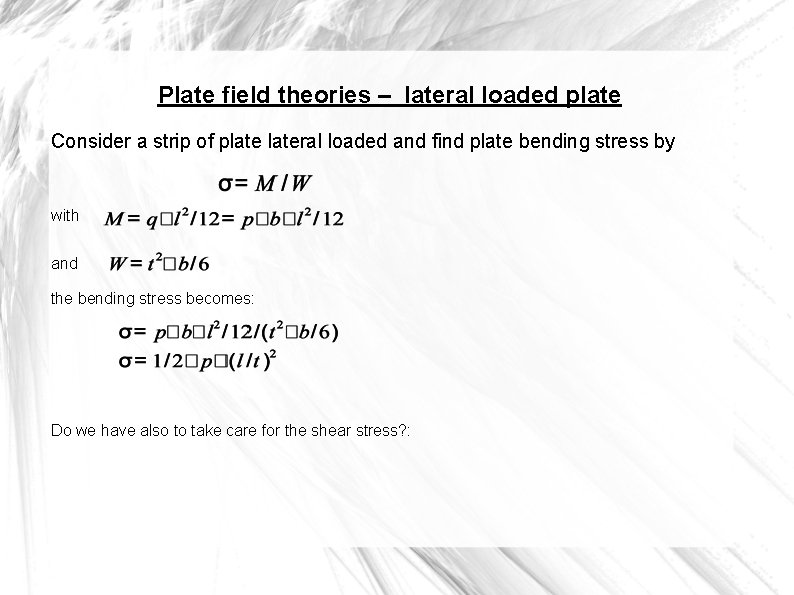
Plate field theories – lateral loaded plate Consider a strip of plateral loaded and find plate bending stress by with and the bending stress becomes: Do we have also to take care for the shear stress? :
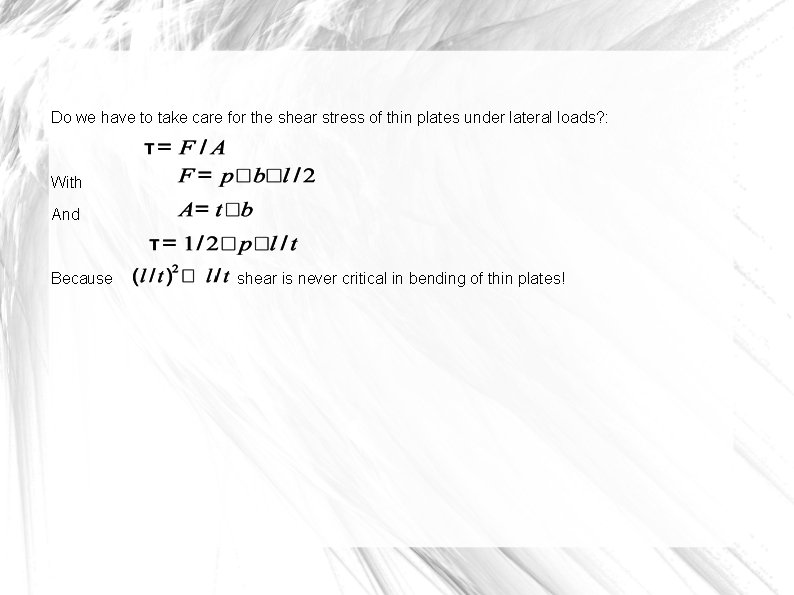
Do we have to take care for the shear stress of thin plates under lateral loads? : With And Because shear is never critical in bending of thin plates!
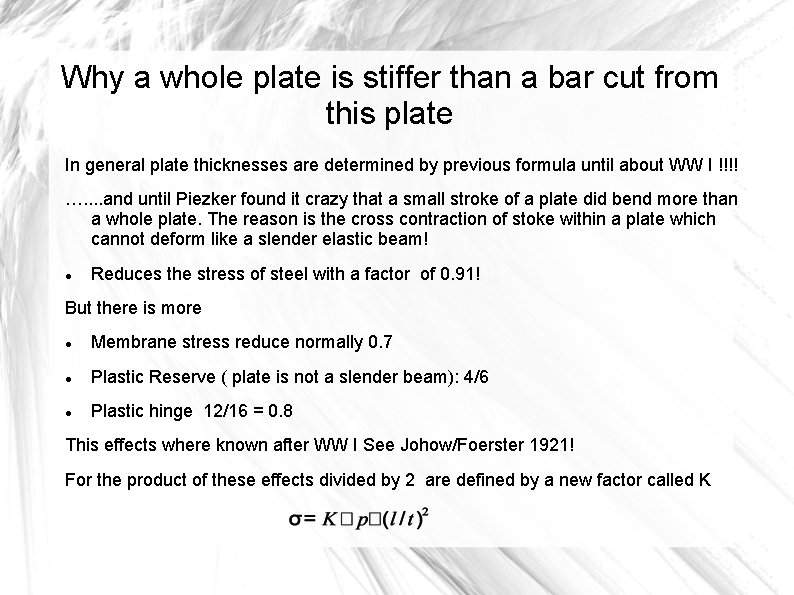
Why a whole plate is stiffer than a bar cut from this plate In general plate thicknesses are determined by previous formula until about WW I !!!! …. . and until Piezker found it crazy that a small stroke of a plate did bend more than a whole plate. The reason is the cross contraction of stoke within a plate which cannot deform like a slender elastic beam! Reduces the stress of steel with a factor of 0. 91! But there is more Membrane stress reduce normally 0. 7 Plastic Reserve ( plate is not a slender beam): 4/6 Plastic hinge 12/16 = 0. 8 This effects where known after WW I See Johow/Foerster 1921! For the product of these effects divided by 2 are defined by a new factor called K
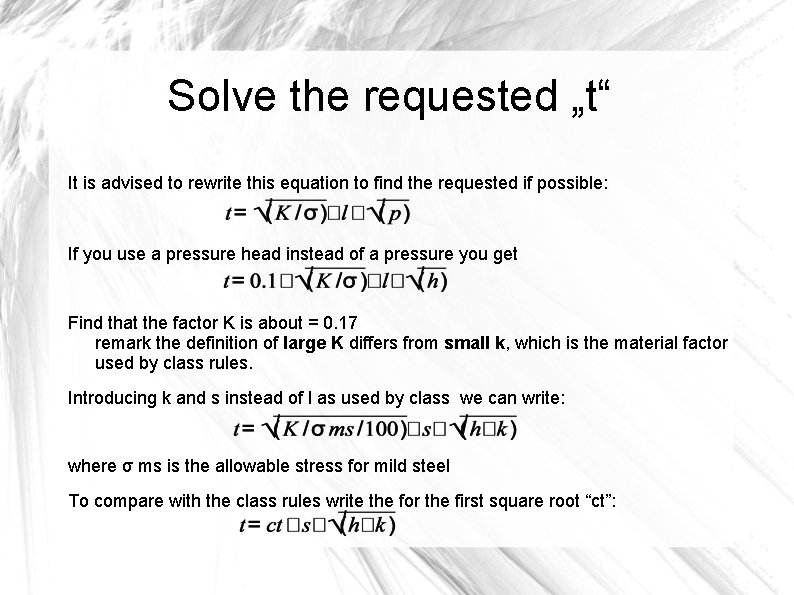
Solve the requested „t“ It is advised to rewrite this equation to find the requested if possible: If you use a pressure head instead of a pressure you get Find that the factor K is about = 0. 17 remark the definition of large K differs from small k, which is the material factor used by class rules. Introducing k and s instead of l as used by class we can write: where σ ms is the allowable stress for mild steel To compare with the class rules write the for the first square root “ct”:
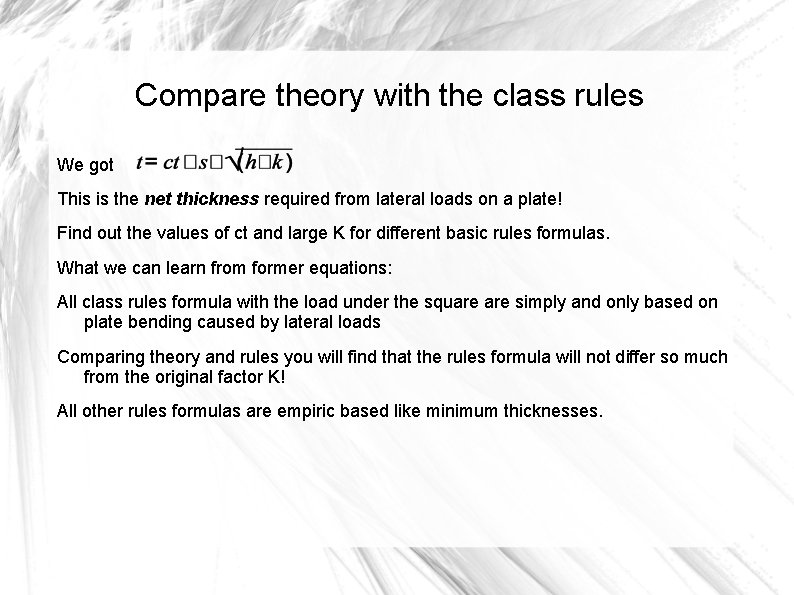
Compare theory with the class rules We got This is the net thickness required from lateral loads on a plate! Find out the values of ct and large K for different basic rules formulas. What we can learn from former equations: All class rules formula with the load under the square simply and only based on plate bending caused by lateral loads Comparing theory and rules you will find that the rules formula will not differ so much from the original factor K! All other rules formulas are empiric based like minimum thicknesses.
Further improvements to theory (? ) From 1920 until now: not so much! The influence of the aspect ratio: Because the length of the long to the short side normally is larger than 2 you can neglect the influence of the longer side. The influence of global strength: For longitudinal stiffened hull structure there is no additional stress on the critical side due to plate bending More improvements: Formulas look more complicated but in general there is nothing new There are more administrative tasks and so called automation, IT improvident Procedures like more complicated but the basics are the same as earlier
Conclusion about applied plate bending theory Mid 1990 world wide investigations did prove that failures from application and approval of rules may be neglected. Failures of structures are mainly caused by bad corrosion control, fatigue and human failure. With the remark that the human factor is always a part of a failure. More recent improvements of class rules regarding plate field theory has nothing to do with new theoretical knowledge but with classification procedures supported by IT!
Buckling of thin plate compression load in plane of plate First a statement : It's not possible to solve the procedure to a single formula t = f(load) like lateral loaded plates! Why wee will see later. Significant points of attention: Non linear relation between load and deformation > (smaller) critical stress. That’s why in general not to be solved by basic FEM-models Loads in general are global Failure can result in a kind of a “domino effect” until a fatal collapse of the structure
Buckling of thin plate History Necessary to understand an apply Timoshenko investigated and publicized plate buckling >1920 in based on Euler Slowly formulas entered the class rules after WOII but where not applied by employees thinking it where covered by all the other rules formulas (not true) The first time I used plate buckling myself in beginning of the 1970 ies based on DIN 4114 with a theoretical background of two axial compression load and sheer. The same procedure where part of DNV and GL rules 1992 I started myself to make students common with this theory Later the 90 ies classes agreed within IACS to make this procedure uniform and apply it to a longitudinal strength check After that problems raised with built vessels not failing: They failed only by calculations. Several restrictions for application of the method are necessary. Not at all described uniformly by the classes General restrictions for application of theory are not supported by any class and unknown by the most users
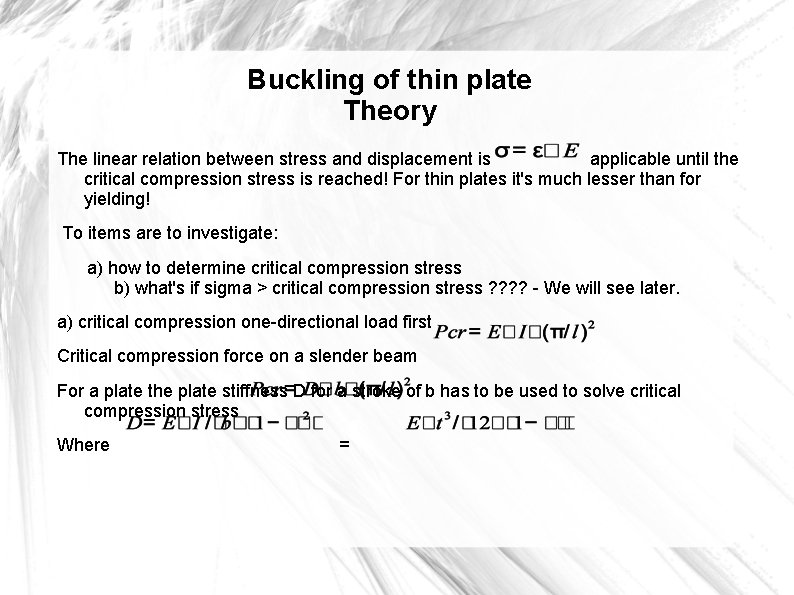
Buckling of thin plate Theory The linear relation between stress and displacement is applicable until the critical compression stress is reached! For thin plates it's much lesser than for yielding! To items are to investigate: a) how to determine critical compression stress b) what's if sigma > critical compression stress ? ? - We will see later. a) critical compression one-directional load first Critical compression force on a slender beam For a plate the plate stiffness D for a stroke of b has to be used to solve critical compression stress Where =
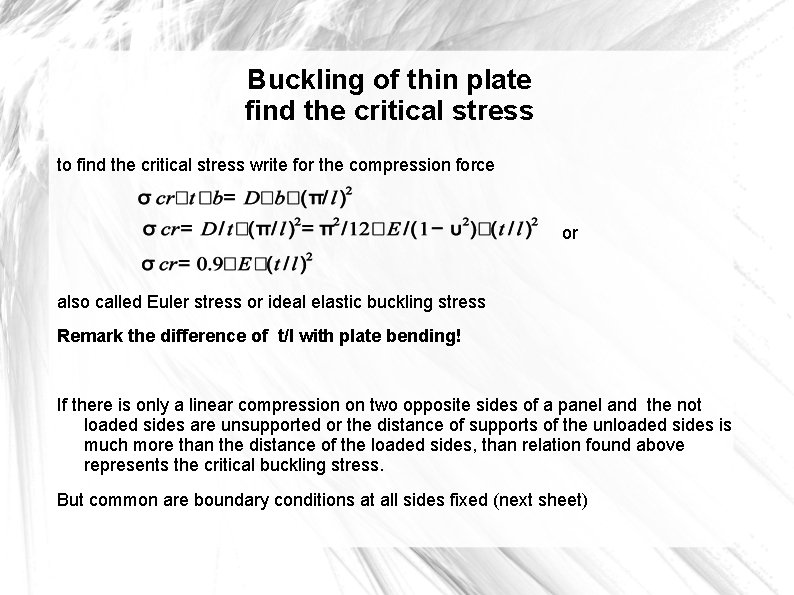
Buckling of thin plate find the critical stress to find the critical stress write for the compression force or also called Euler stress or ideal elastic buckling stress Remark the difference of t/l with plate bending! If there is only a linear compression on two opposite sides of a panel and the not loaded sides are unsupported or the distance of supports of the unloaded sides is much more than the distance of the loaded sides, than relation found above represents the critical buckling stress. But common are boundary conditions at all sides fixed (next sheet)
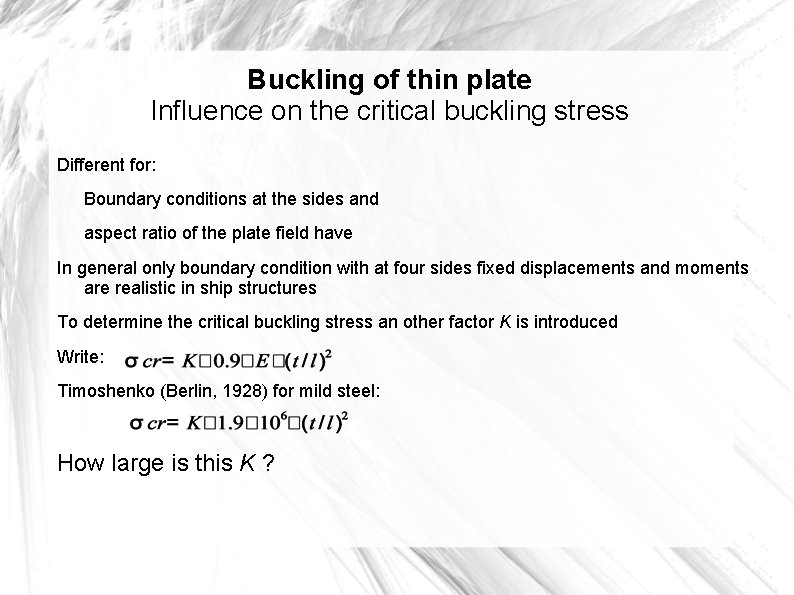
Buckling of thin plate Influence on the critical buckling stress Different for: Boundary conditions at the sides and aspect ratio of the plate field have In general only boundary condition with at four sides fixed displacements and moments are realistic in ship structures To determine the critical buckling stress an other factor K is introduced Write: Timoshenko (Berlin, 1928) for mild steel: How large is this K ?
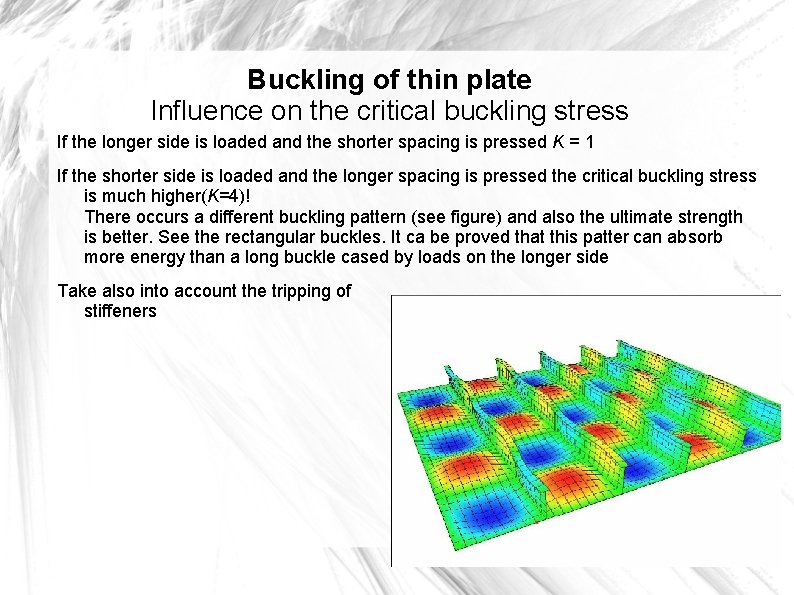
Buckling of thin plate Influence on the critical buckling stress If the longer side is loaded and the shorter spacing is pressed K = 1 If the shorter side is loaded and the longer spacing is pressed the critical buckling stress is much higher(K=4)! There occurs a different buckling pattern (see figure) and also the ultimate strength is better. See the rectangular buckles. It ca be proved that this patter can absorb more energy than a long buckle cased by loads on the longer side Take also into account the tripping of stiffeners
Buckling of thin plate two axial loads The succumb hypotheses to find an ideal elastic equivalent stress for two axial loads ans shear also are applicable for buckling Find an ideal elastic equivalent critical buckling stress by application of the class rules of GL and DNV Where do we apply a buckling check? Mainly buckling checks are applied for the main cross sections under longitudinal bending loads only with compression in the top while sagging and in the bottom while hogging. Normally two axial compression is not applied for these cross section checks
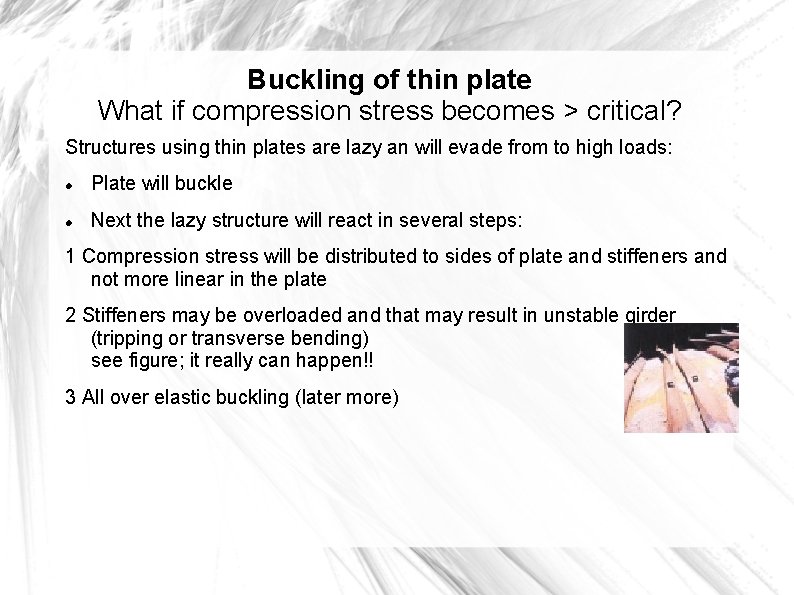
Buckling of thin plate What if compression stress becomes > critical? Structures using thin plates are lazy an will evade from to high loads: Plate will buckle Next the lazy structure will react in several steps: 1 Compression stress will be distributed to sides of plate and stiffeners and not more linear in the plate 2 Stiffeners may be overloaded and that may result in unstable girder (tripping or transverse bending) see figure; it really can happen!! 3 All over elastic buckling (later more)
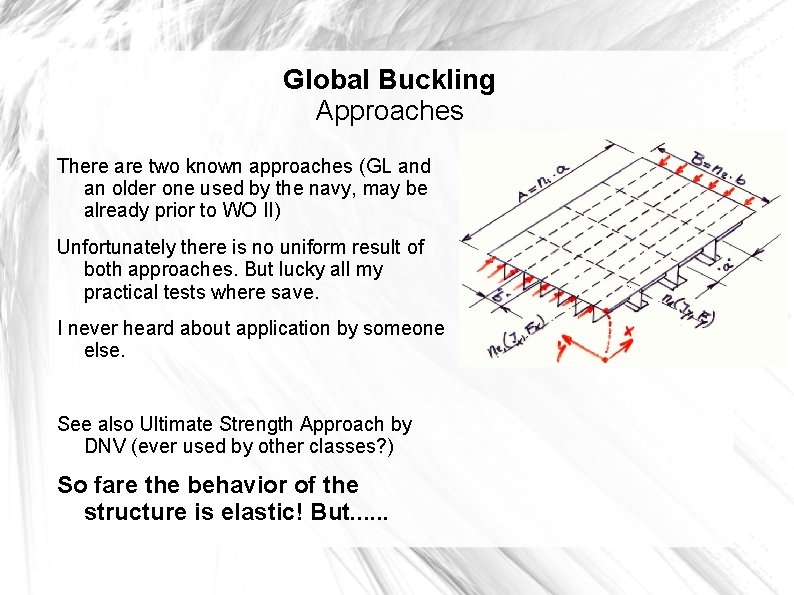
Global Buckling Approaches There are two known approaches (GL and an older one used by the navy, may be already prior to WO II) Unfortunately there is no uniform result of both approaches. But lucky all my practical tests where save. I never heard about application by someone else. See also Ultimate Strength Approach by DNV (ever used by other classes? ) So fare the behavior of the structure is elastic! But. . .
Global Buckling Elastic? Steps to critical failure …. . if the last step fails (previous slide) There will become plastic deformations in the most critical structure part. Next other structures have to taken lager loads and may fail it could become a “Domino effect” until the last part has failed! This is brought in practice and demonstrated to a large public by “No Limit” an inland sand carrier who did it in the Locks of Ijmuiden. Also see next slide To check stiffeners on compression there are several approaches (nearly never used).
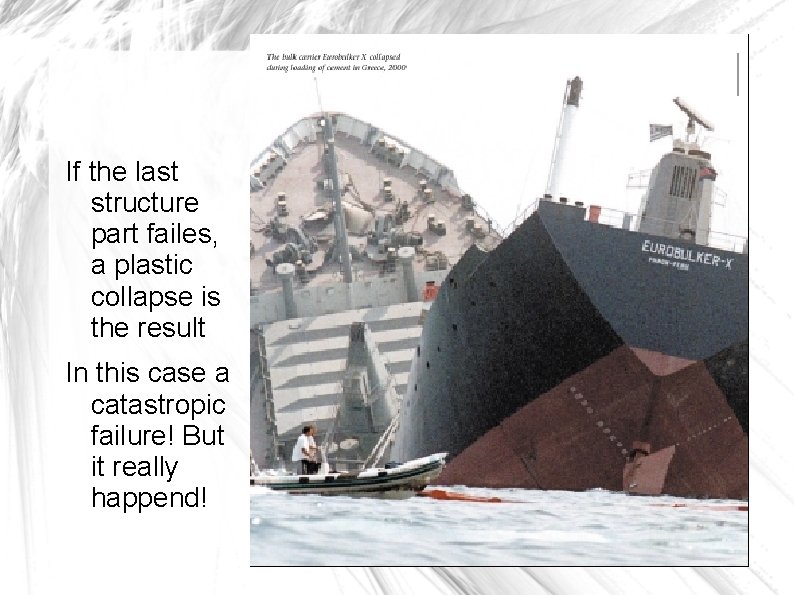
If the last structure part failes, a plastic collapse is the result In this case a catastropic failure! But it really happend!
Buckling check Conclusion In general only plate buckling of cross sections are checked in practice under longitudinal bending stresses! Some plates of the cross section may buckle, but the ultimate section modulus has to be OK and in other plating compression must be < critical. Strength of girders over all panels and ultimate strength are ignored in practice No attention for restrictions of method by class Restrictions of method: (no part of any class rule) Linear load distributed assumed but in many cases not true (example: stress free zones in way of holes of longitudinal girders can be proved by FEM) Aspect ratio out of range: method not applicable for slender panels see also: www. asmussolution. nl/PR/start. PR. html (Dutch only)
- Slides: 20