
UPDATE NOVEMBER 2019 SESSION OVERVIEW Part I Objectives
UPDATE – NOVEMBER 2019
SESSION OVERVIEW Part I
Objectives • Take into account the effects of alcohol, drugs and medication on a person’s ability to drive • Recognize the personal, social, financial and legal consequences of driving while impaired by alcohol, drugs and medication • Debunk certain myths concerning the effects of alcohol, drugs and medication on driving a road vehicle • Plan for alternative solutions to driving while impaired 3
Main Objectives Raise participants’ awareness about the effects of alcohol, drugs and medication on one’s ability to drive, encourage responsible behaviours and prevent repeat offences 4
Session Outline • Impaired driving in Québec • Myths and beliefs • Alcohol, drugs, medication and driving a road vehicle • Legal consequences of impaired driving • Social, financial and personal consequences of impaired driving • Another look at myths and beliefs • Alternative solutions and individual and collective responsibility • Evaluation of the session 5
SESSION CONTENTS Part II
Theme 1 Impaired Driving in Québec 7
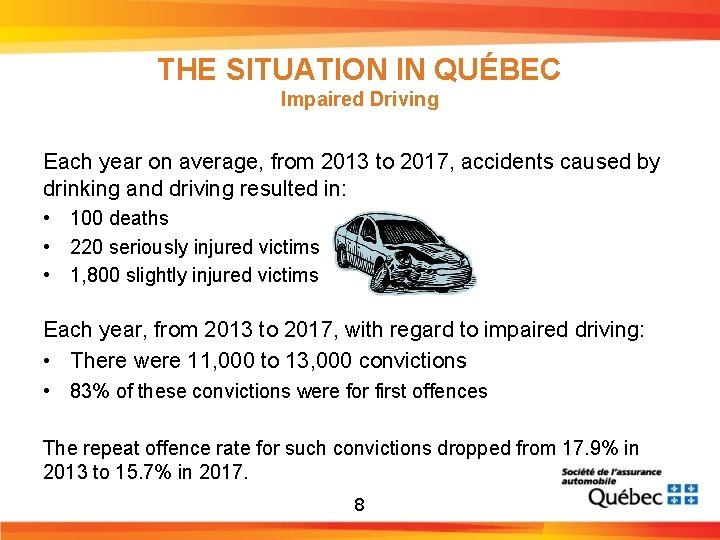
THE SITUATION IN QUÉBEC Impaired Driving Each year on average, from 2013 to 2017, accidents caused by drinking and driving resulted in: • 100 deaths • 220 seriously injured victims • 1, 800 slightly injured victims Each year, from 2013 to 2017, with regard to impaired driving: • There were 11, 000 to 13, 000 convictions • 83% of these convictions were for first offences The repeat offence rate for such convictions dropped from 17. 9% in 2013 to 15. 7% in 2017. 8
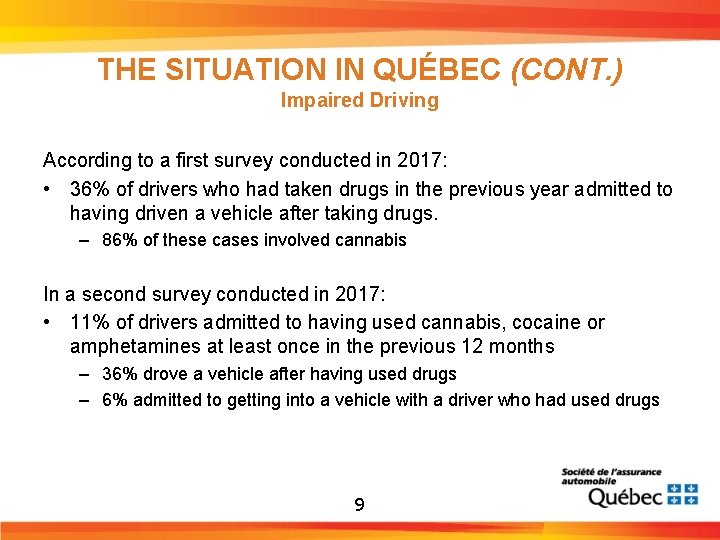
THE SITUATION IN QUÉBEC (CONT. ) Impaired Driving According to a first survey conducted in 2017: • 36% of drivers who had taken drugs in the previous year admitted to having driven a vehicle after taking drugs. – 86% of these cases involved cannabis In a second survey conducted in 2017: • 11% of drivers admitted to having used cannabis, cocaine or amphetamines at least once in the previous 12 months – 36% drove a vehicle after having used drugs – 6% admitted to getting into a vehicle with a driver who had used drugs 9

Theme 2 Myths and Beliefs 10
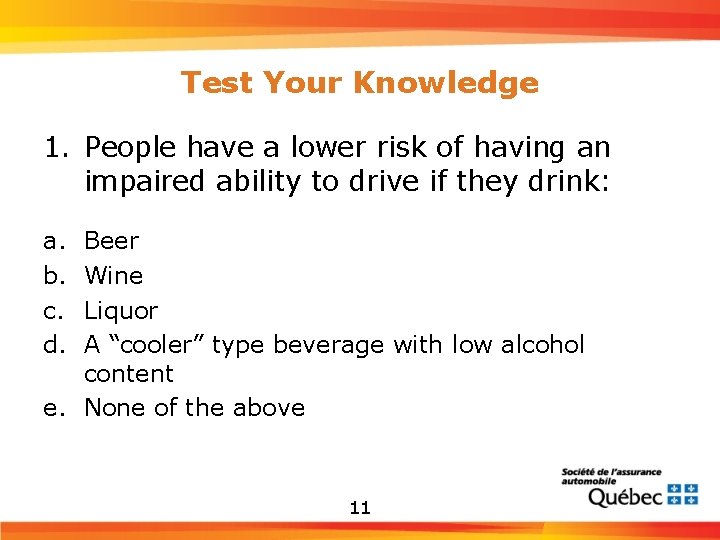
Test Your Knowledge 1. People have a lower risk of having an impaired ability to drive if they drink: a. b. c. d. Beer Wine Liquor A “cooler” type beverage with low alcohol content e. None of the above 11
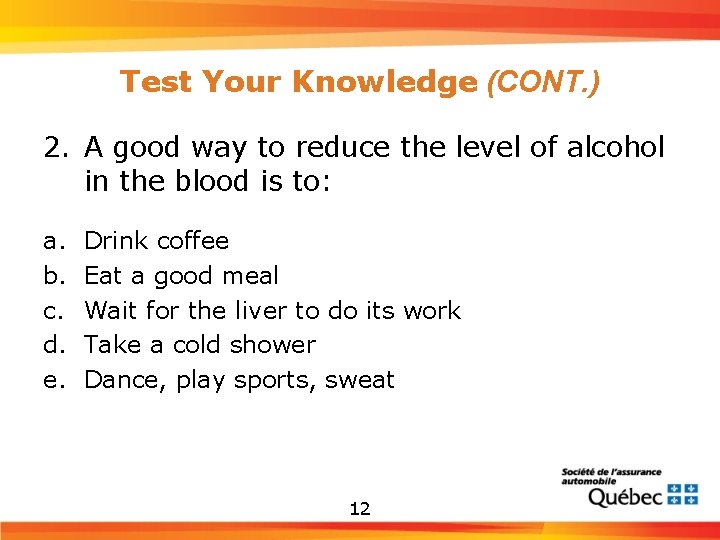
Test Your Knowledge (CONT. ) 2. A good way to reduce the level of alcohol in the blood is to: a. b. c. d. e. Drink coffee Eat a good meal Wait for the liver to do its work Take a cold shower Dance, play sports, sweat 12
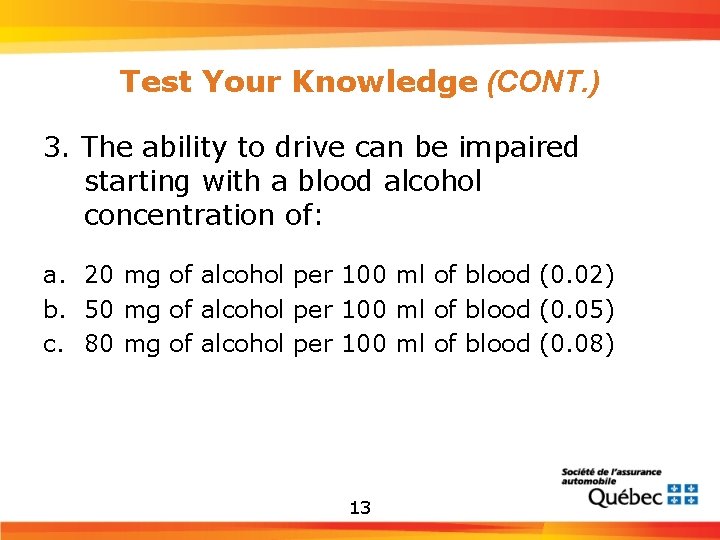
Test Your Knowledge (CONT. ) 3. The ability to drive can be impaired starting with a blood alcohol concentration of: a. 20 mg of alcohol per 100 ml of blood (0. 02) b. 50 mg of alcohol per 100 ml of blood (0. 05) c. 80 mg of alcohol per 100 ml of blood (0. 08) 13
Test Your Knowledge (CONT. ) 4. Which of the following effects can be attributed to the consumption of cannabis? a. Difficulty concentrating and remaining attentive to the road environment b. Slower reaction time and reflexes, and unsure driving c. Difficulty keeping the vehicle on a straight path d. High-risk behaviour such as speeding e. Decreased ability to cope with the unexpected 14
Test Your Knowledge (CONT. ) TRUE OR FALSE 5. Police are unable to detect drivers who are impaired by drugs. 6. I can fool police officers’ tests if I am high. 7. I am a better driver after smoking a joint. 15
Test Your Knowledge (CONT. ) 8. How many deaths can be attributed to drinking and driving each year in Québec? a. 50 b. 100 c. 400 16
Test Your Knowledge (CONT. ) 9. What is the estimated minimum cost of a first impaired driving offence? a. Approximately $500 b. Approximately $1, 800 c. Approximately $3, 000 17
Test Your Knowledge (CONT. ) 10. Under what circumstances can people be found guilty of an impaired driving offence? a. When their blood alcohol concentration is equal to or over 80 mg of alcohol per 100 ml of blood (0. 08) b. When their ability to drive is impaired by alcohol, drugs or medication c. If they refuse to provide a breath sample to a police officer who has ordered them to do so d. All of the above 18
Test Your Knowledge (CONT. ) 11. What percentage of drivers convicted of impaired driving are repeat offenders? a. 20% b. 70% c. 15% 19
Test Your Knowledge (CONT. ) 12. List two alternative solutions to impaired driving. This will be covered in Theme 7 20
Theme 3 Alcohol, Drugs, Medication and Driving a Road Vehicle 21
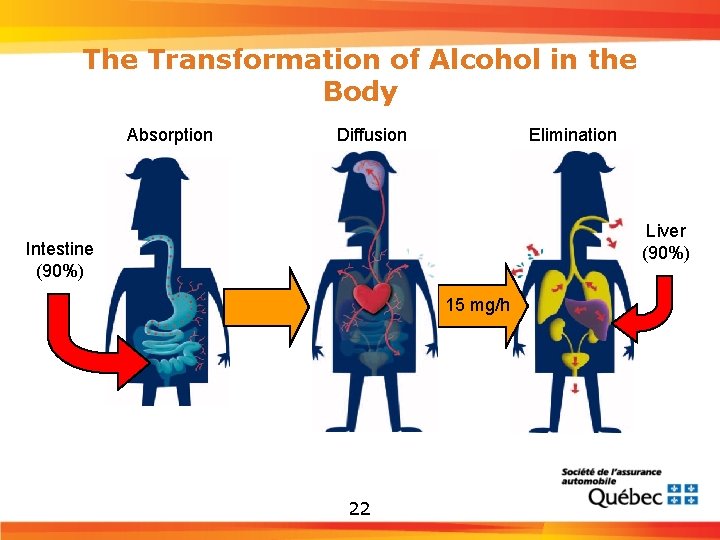
The Transformation of Alcohol in the Body Absorption Diffusion Elimination Liver (90%) Intestine (90%) 15 mg/h 22
Absorption of Alcohol is mainly absorbed by the intestine. Its absorption is influenced by a number of factors: • • • The amount consumed How quickly it is consumed Whether the person has eaten Certain biological particularities The person’s psychological state: stress, fatigue, etc. 23
Diffusion of Alcohol is distributed to all of the organs in the body. Once it reaches the brain, it acts on the central nervous system (the decisionmaking and coordination centre). Its diffusion is influenced in particular by: • • The concentration of alcohol in the blood The person’s weight and percentage of body fat Gender Age 24
Elimination of Alcohol • The liver alone eliminates 90% of the alcohol consumed. • Perspiration and the lungs and kidneys take care of the rest. • Only time reduces the concentration of alcohol in the blood. 25
The Effects of Alcohol on Driving a Road Vehicle • Affects a person’s ability to drive • Diminishes a person’s ability to make decisions • Increases the risk of an accident • Varies according to the blood alcohol concentration 26
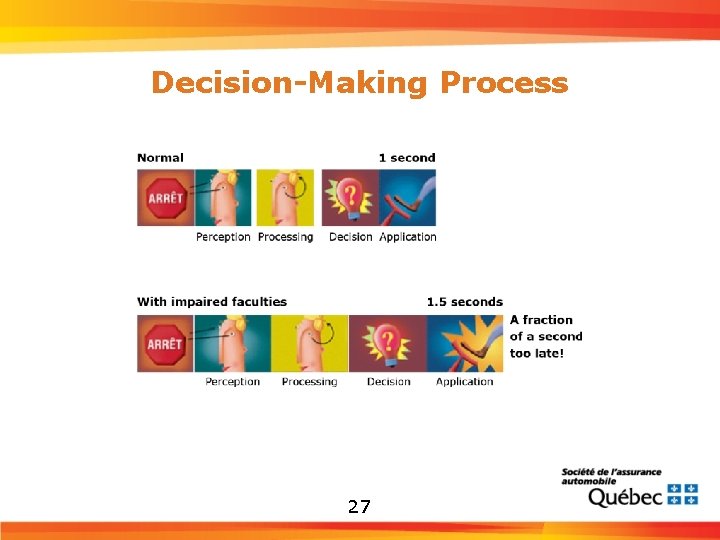
Decision-Making Process 27
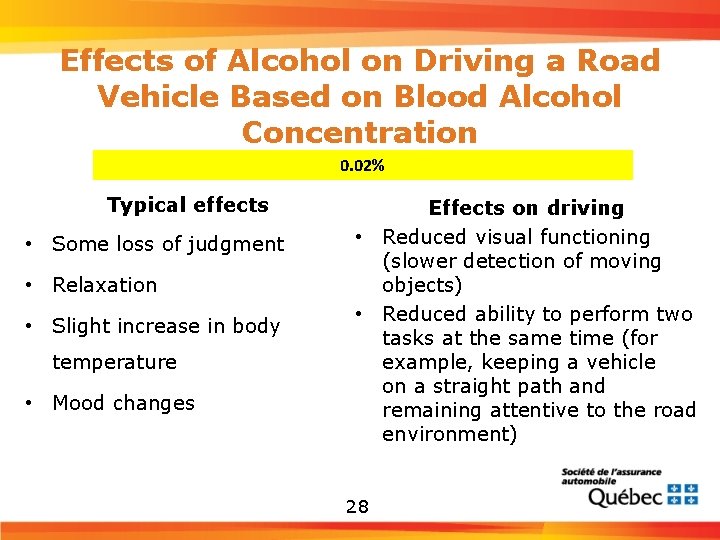
Effects of Alcohol on Driving a Road Vehicle Based on Blood Alcohol Concentration 0. 02% Typical effects • Some loss of judgment • Relaxation • Slight increase in body temperature • Mood changes Effects on driving • Reduced visual functioning (slower detection of moving objects) • Reduced ability to perform two tasks at the same time (for example, keeping a vehicle on a straight path and remaining attentive to the road environment) 28
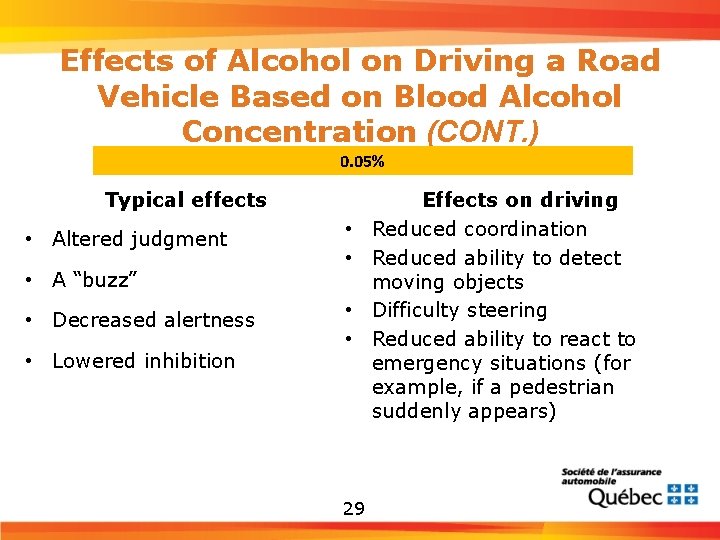
Effects of Alcohol on Driving a Road Vehicle Based on Blood Alcohol Concentration (CONT. ) 0. 05% Typical effects • Altered judgment • A “buzz” • Decreased alertness • Lowered inhibition • • 29 Effects on driving Reduced coordination Reduced ability to detect moving objects Difficulty steering Reduced ability to react to emergency situations (for example, if a pedestrian suddenly appears)
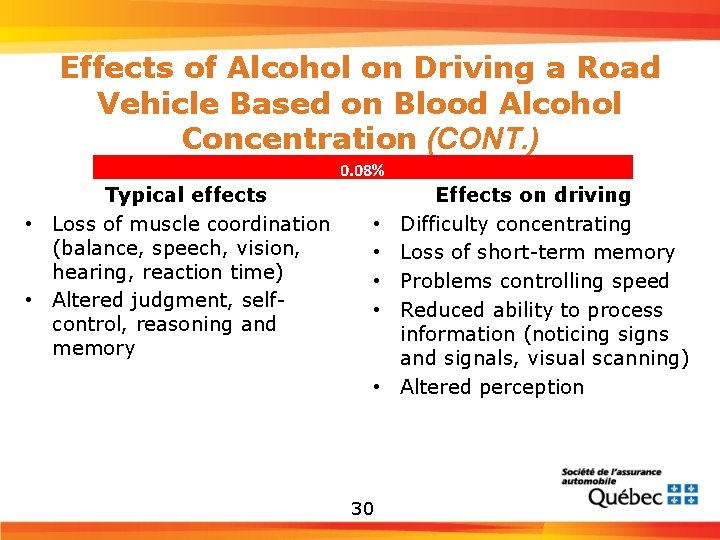
Effects of Alcohol on Driving a Road Vehicle Based on Blood Alcohol Concentration (CONT. ) 0. 08% Typical effects • Loss of muscle coordination (balance, speech, vision, hearing, reaction time) • Altered judgment, selfcontrol, reasoning and memory • • • 30 Effects on driving Difficulty concentrating Loss of short-term memory Problems controlling speed Reduced ability to process information (noticing signs and signals, visual scanning) Altered perception
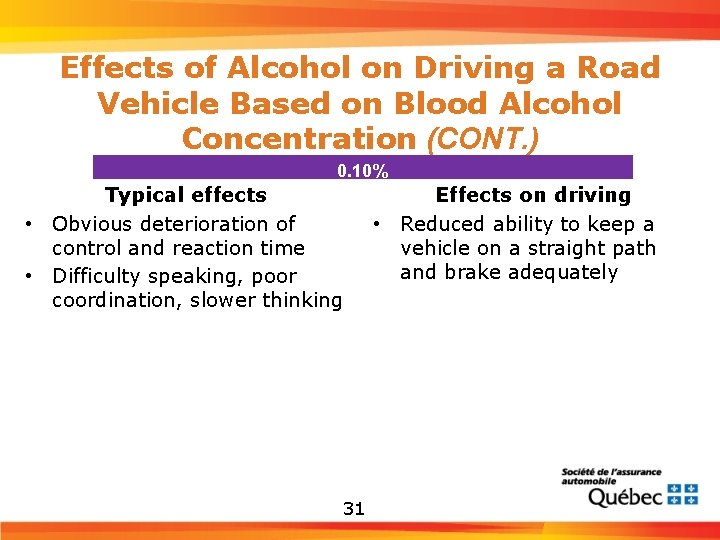
Effects of Alcohol on Driving a Road Vehicle Based on Blood Alcohol Concentration (CONT. ) 0. 10% Typical effects • Obvious deterioration of control and reaction time • Difficulty speaking, poor coordination, slower thinking 31 Effects on driving • Reduced ability to keep a vehicle on a straight path and brake adequately
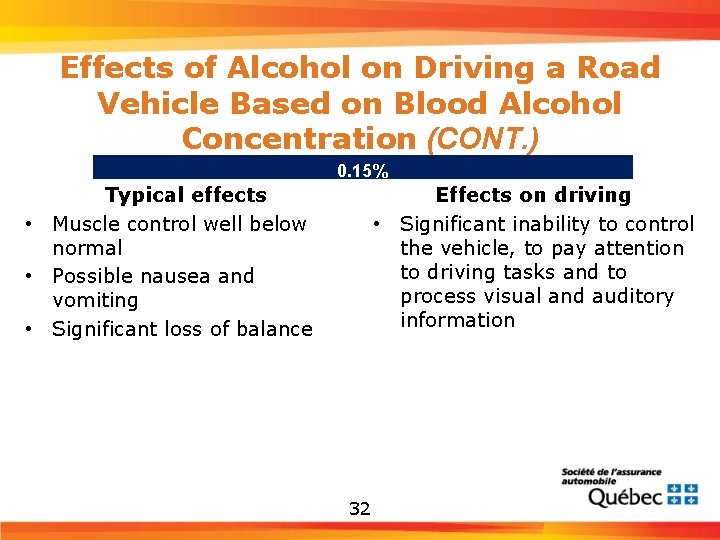
Effects of Alcohol on Driving a Road Vehicle Based on Blood Alcohol Concentration (CONT. ) 0. 15% Typical effects • Muscle control well below normal • Possible nausea and vomiting • Significant loss of balance Effects on driving • Significant inability to control the vehicle, to pay attention to driving tasks and to process visual and auditory information 32
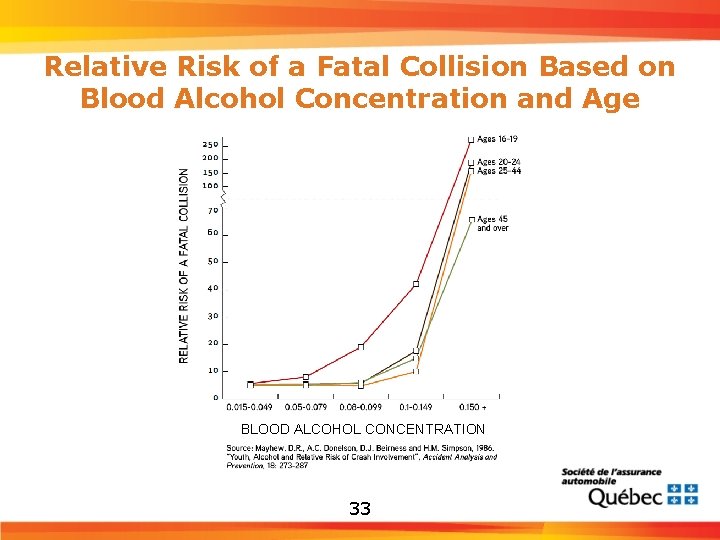
Relative Risk of a Fatal Collision Based on Blood Alcohol Concentration and Age BLOOD ALCOHOL CONCENTRATION 33
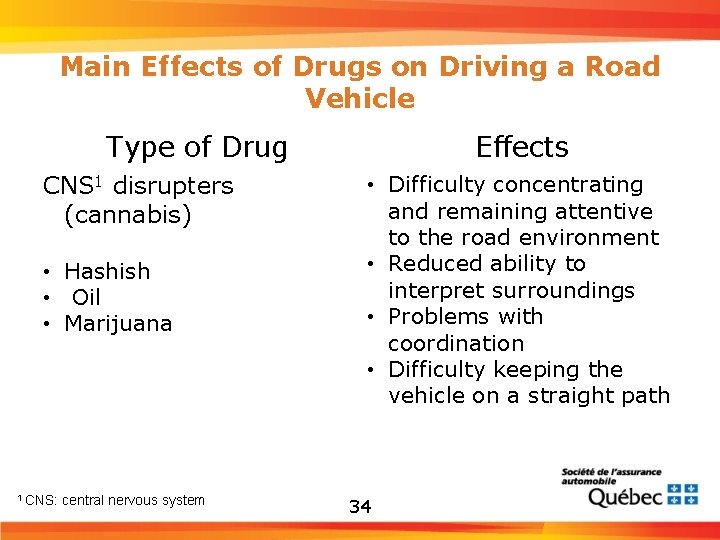
Main Effects of Drugs on Driving a Road Vehicle Type of Drug CNS 1 disrupters (cannabis) • Hashish • Oil • Marijuana 1 CNS: central nervous system Effects • Difficulty concentrating and remaining attentive to the road environment • Reduced ability to interpret surroundings • Problems with coordination • Difficulty keeping the vehicle on a straight path 34
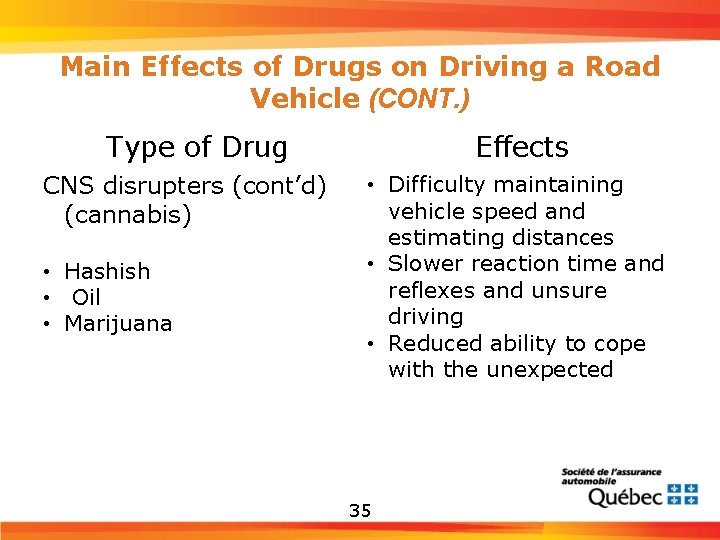
Main Effects of Drugs on Driving a Road Vehicle (CONT. ) Type of Drug CNS disrupters (cont’d) (cannabis) • Hashish • Oil • Marijuana Effects • Difficulty maintaining vehicle speed and estimating distances • Slower reaction time and reflexes and unsure driving • Reduced ability to cope with the unexpected 35
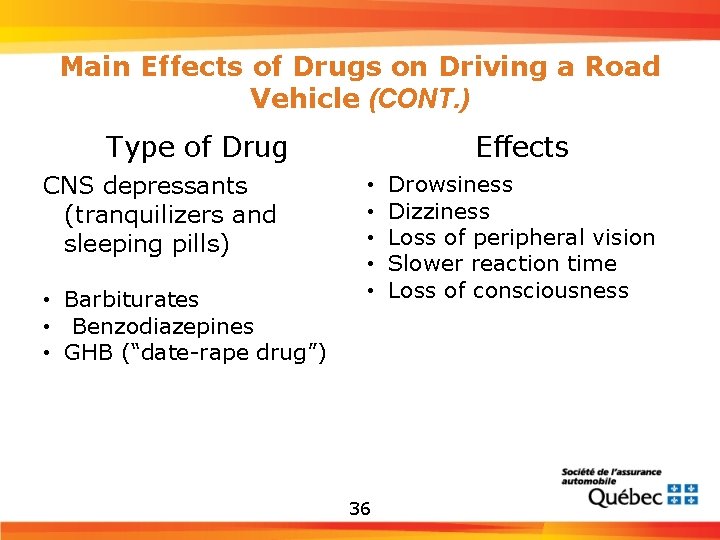
Main Effects of Drugs on Driving a Road Vehicle (CONT. ) Type of Drug CNS depressants (tranquilizers and sleeping pills) • Barbiturates • Benzodiazepines • GHB (“date-rape drug”) Effects • • • 36 Drowsiness Dizziness Loss of peripheral vision Slower reaction time Loss of consciousness
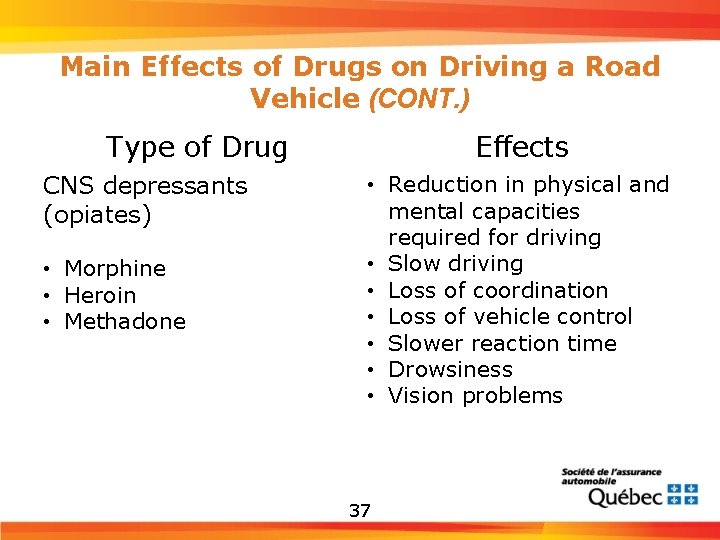
Main Effects of Drugs on Driving a Road Vehicle (CONT. ) Type of Drug CNS depressants (opiates) • Morphine • Heroin • Methadone Effects • Reduction in physical and mental capacities required for driving • Slow driving • Loss of coordination • Loss of vehicle control • Slower reaction time • Drowsiness • Vision problems 37
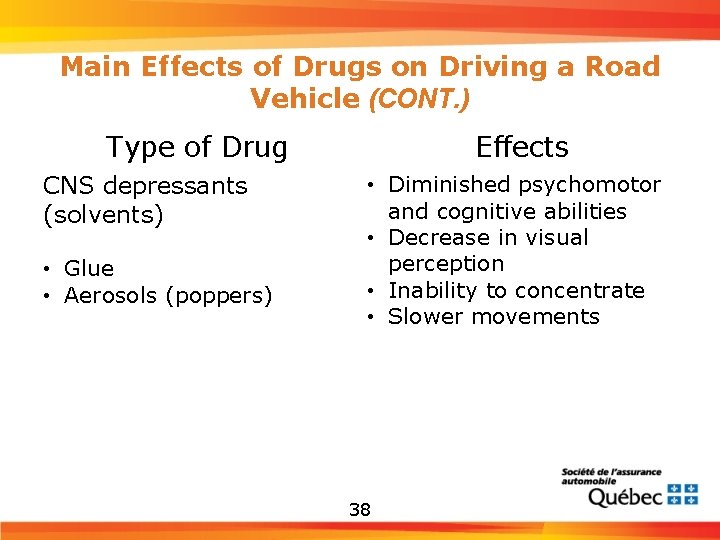
Main Effects of Drugs on Driving a Road Vehicle (CONT. ) Type of Drug CNS depressants (solvents) • Glue • Aerosols (poppers) Effects • Diminished psychomotor and cognitive abilities • Decrease in visual perception • Inability to concentrate • Slower movements 38
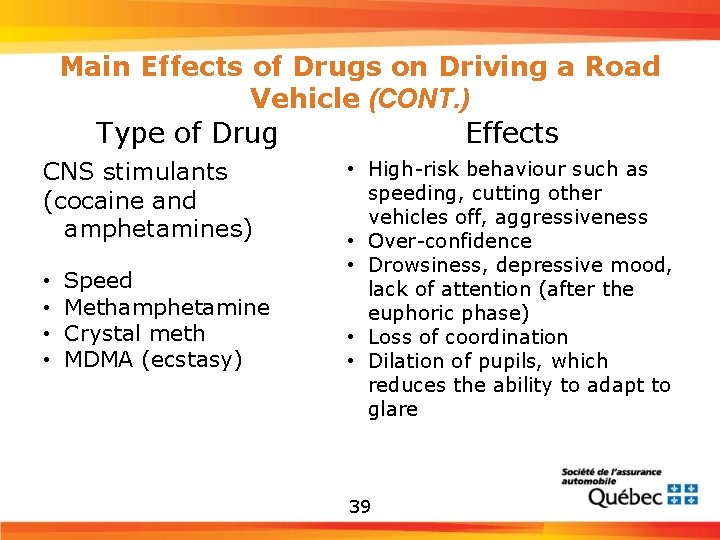
Main Effects of Drugs on Driving a Road Vehicle (CONT. ) Type of Drug Effects CNS stimulants (cocaine and amphetamines) • • Speed Methamphetamine Crystal meth MDMA (ecstasy) • High-risk behaviour such as speeding, cutting other vehicles off, aggressiveness • Over-confidence • Drowsiness, depressive mood, lack of attention (after the euphoric phase) • Loss of coordination • Dilation of pupils, which reduces the ability to adapt to glare 39
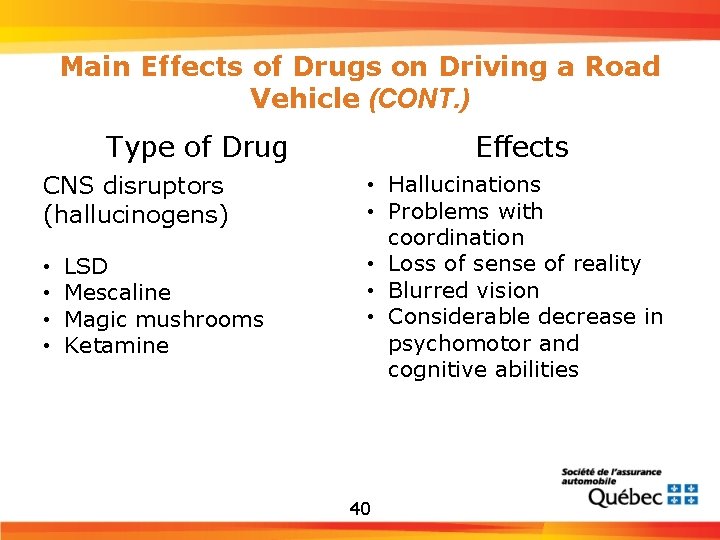
Main Effects of Drugs on Driving a Road Vehicle (CONT. ) Type of Drug CNS disruptors (hallucinogens) • • LSD Mescaline Magic mushrooms Ketamine Effects • Hallucinations • Problems with coordination • Loss of sense of reality • Blurred vision • Considerable decrease in psychomotor and cognitive abilities 40
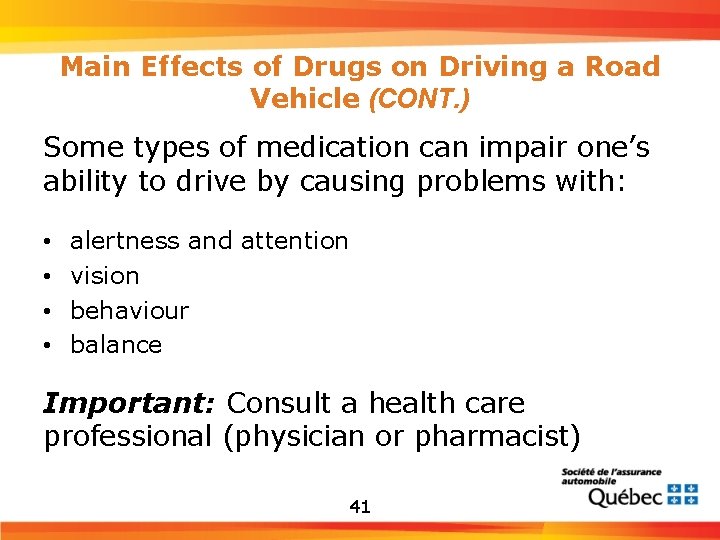
Main Effects of Drugs on Driving a Road Vehicle (CONT. ) Some types of medication can impair one’s ability to drive by causing problems with: • • alertness and attention vision behaviour balance Important: Consult a health care professional (physician or pharmacist) 41
Theme 4 Legal Consequences of Impaired Driving 42
CONSEQUENCES – CRIMINAL CODE • • Prohibition from driving Fines Imprisonment (in certain situations) Criminal record 43
CONSEQUENCES – HIGHWAY SAFETY CODE • • 1 Program Revocation of the offender’s driver’s licence PERRCCA 1 assessment Alcohol ignition interlock device Prohibition from putting into operation, acquiring, renting, leasing, registering or putting into storage a road vehicle to assess and reduce the risk of impaired driving 44
Theme 5 Social, Financial and Personal Consequences of Impaired Driving 45
SOCIAL AND PERSONAL CONSEQUENCES OF AN IMPAIRED DRIVING OFFENCE • For drivers, the consequences are multiple and varied: – Consequences of the prohibition from driving on their professional, personal and family life – Limitations related to the use of an alcohol ignition interlock device – Social judgment – Managing emotions 46
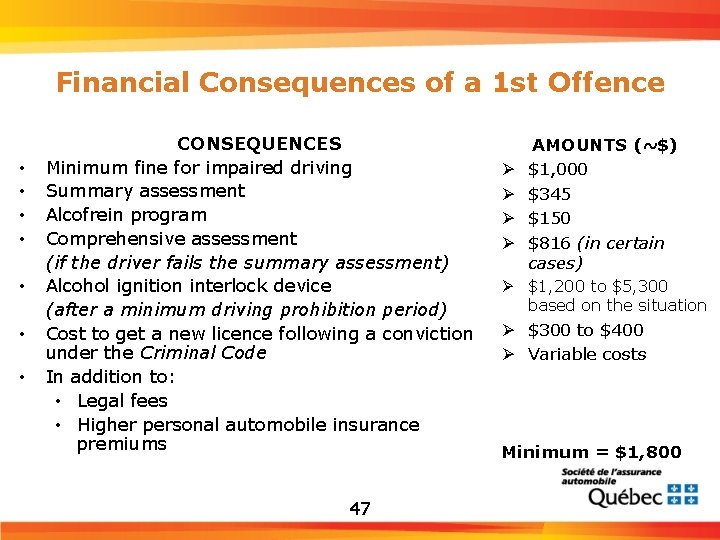
Financial Consequences of a 1 st Offence • • CONSEQUENCES Minimum fine for impaired driving Summary assessment Alcofrein program Comprehensive assessment (if the driver fails the summary assessment) Alcohol ignition interlock device (after a minimum driving prohibition period) Cost to get a new licence following a conviction under the Criminal Code In addition to: • Legal fees • Higher personal automobile insurance premiums 47 Ø Ø AMOUNTS (~$) $1, 000 $345 $150 $816 (in certain cases) Ø $1, 200 to $5, 300 based on the situation Ø $300 to $400 Ø Variable costs Minimum = $1, 800
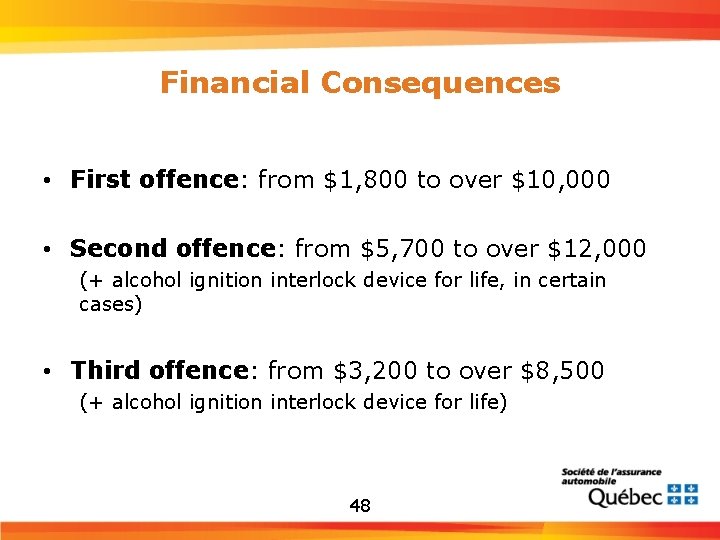
Financial Consequences • First offence: from $1, 800 to over $10, 000 • Second offence: from $5, 700 to over $12, 000 (+ alcohol ignition interlock device for life, in certain cases) • Third offence: from $3, 200 to over $8, 500 (+ alcohol ignition interlock device for life) 48

Theme 6 Another Look at Myths and Beliefs 49
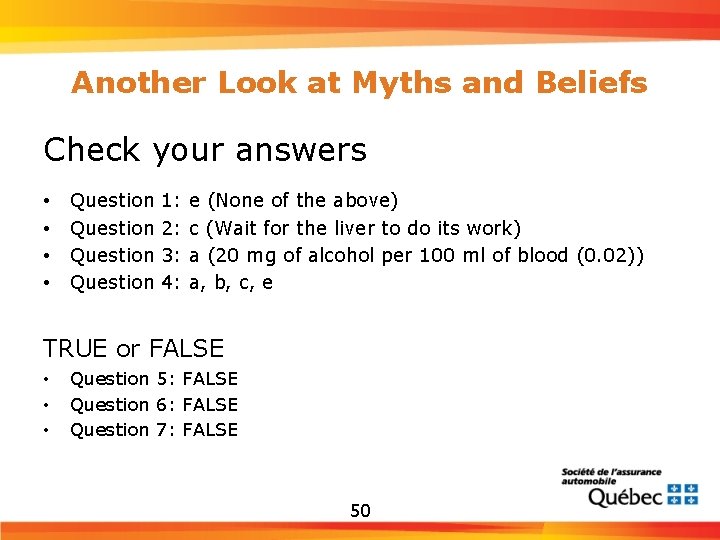
Another Look at Myths and Beliefs Check your answers • • Question 1: 2: 3: 4: e (None of the above) c (Wait for the liver to do its work) a (20 mg of alcohol per 100 ml of blood (0. 02)) a, b, c, e TRUE or FALSE • • • Question 5: FALSE Question 6: FALSE Question 7: FALSE 50
Another Look at Myths and Beliefs (CONT. ) Check your answers • • • Question Question 8: b (100) 9: b (Approximately $1, 800) 10: d (All of the above) 11: c (15%) 12: Go to Theme 7 51
Theme 7 Alternative Solutions and Individual and Collective Responsibility 52
Alternative Solutions for You • If you drink or take drugs, don’t drive! • It’s important to plan your trips! • Alternative solutions • Sleep over • Drive-home services (e. g. Operation Red Nose) • Let a sober friend drive (designated driver) • Public transit • Taxi 53
Alternative Solutions for Others • What can you do to prevent others from driving after they’ve been drinking alcohol or taking drugs? If you drink or take drugs, don’t drive. Think ahead! 54

Responsibilities of Hosts Who Invite Guests to Their Home • Hosts who invite guests to their home have, above all, a social responsibility. • They should always remain careful and diligent to make sure they fulfill their obligations. 55
Evaluation of the Alcofrein Session 56
57
- Slides: 57