
UPDATE LOW BACK PAIN IN YOUNG ATHLETES Dr
UPDATE: LOW BACK PAIN IN YOUNG ATHLETES Dr. Peter Biglin, DO

DIFFERENTIAL DIAGNOSIS LBP IN YOUNG ATHLETES Spondylolysis/Spondylolisthesis Myofascial strain Herniated Lumbar Disc Facet joint injury SI joint strain Hip pain Scoliosis Leg length discrepancy Etc.
SPONDYLOLYSIS DEFINITION: �Defect or stress fracture in the Pars Interarticularis portion of the vertebrae �Pars Interarticularis – portion of the verterba between the superior and inferior facets. “Neck of the Scotty Dog”

ANATOMY OF PARS INTERARTICULARIS
SPONDYLOLYSIS Most common cause of structural LBP in children & adolescents TYPES: �Dysplastic (congenital) �Isthmic (Stress fracture) �Degenerative (Adult) �Traumatic ( acute fracture) �Pathologic (tumor)
DEFECT OF PARS INTERARTICULARIS May allow anterior displacement or “slippage” of the vertebra called: SPONDYLOLISTHESIS
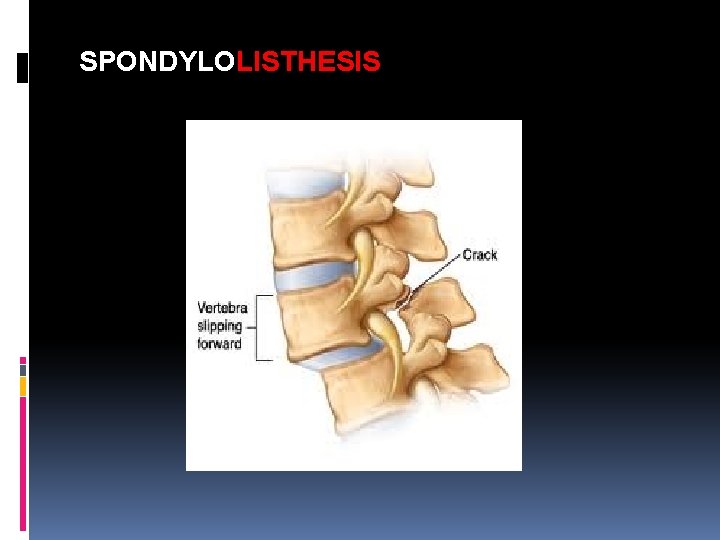
SPONDYLOLISTHESIS
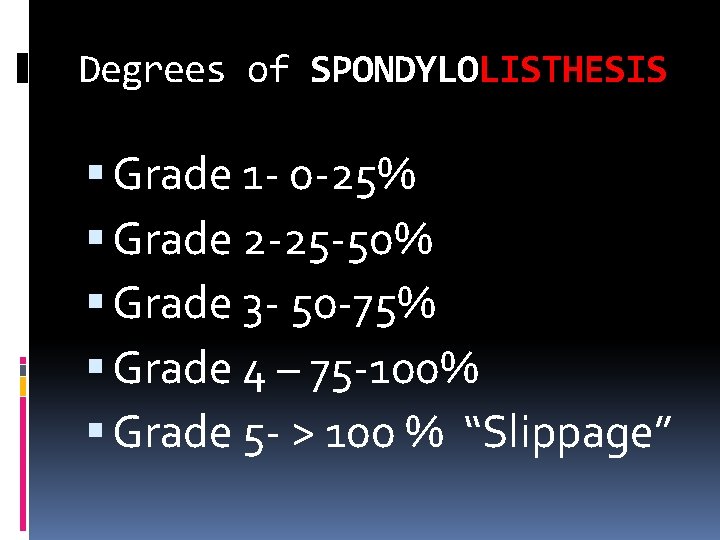
Degrees of SPONDYLOLISTHESIS Grade 1 - 0 -25% Grade 2 -25 -50% Grade 3 - 50 -75% Grade 4 – 75 -100% Grade 5 - > 100 % “Slippage”
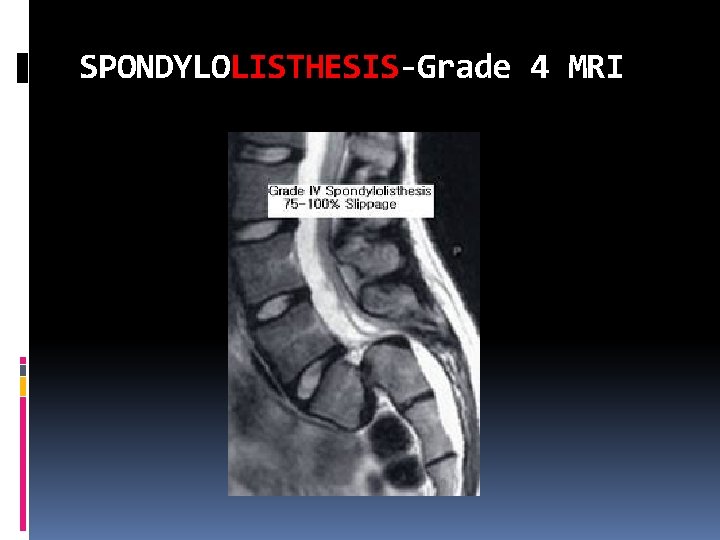
SPONDYLOLISTHESIS-Grade 4 MRI
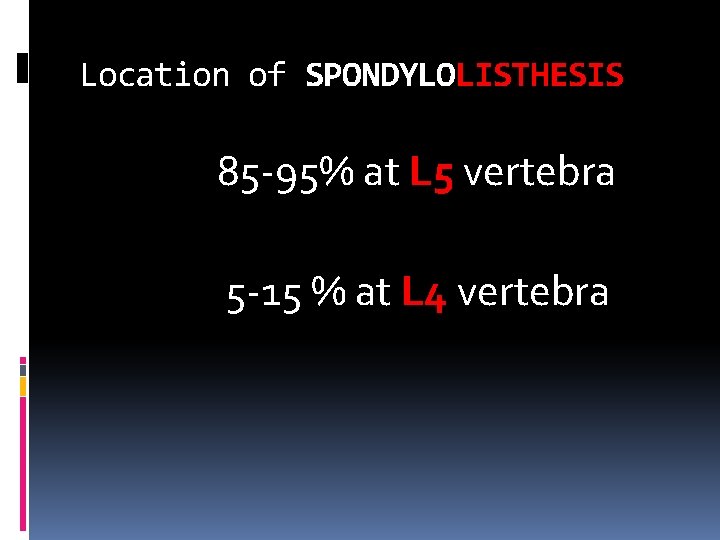
Location of SPONDYLOLISTHESIS 85 -95% at L 5 vertebra 5 -15 % at L 4 vertebra
Incidence SPONDYLOLYSIS 5 -6 % of general population. Only 10 -15% of these people will develop symptoms Most people with Spondylolysis have NO SYMPTOMS 50 -80 % will develop Spondylolisthesis Risk factors for progression to Spondylolisthesis is difficult to predict
Causes of SPONDYLOLYSIS Exact cause unknown Risk factors – Sports requiring persistent HYPEREXTENSION of the Lumbar spine Sports- gymnastics, diving, wrestling, weight lifting, football lineman
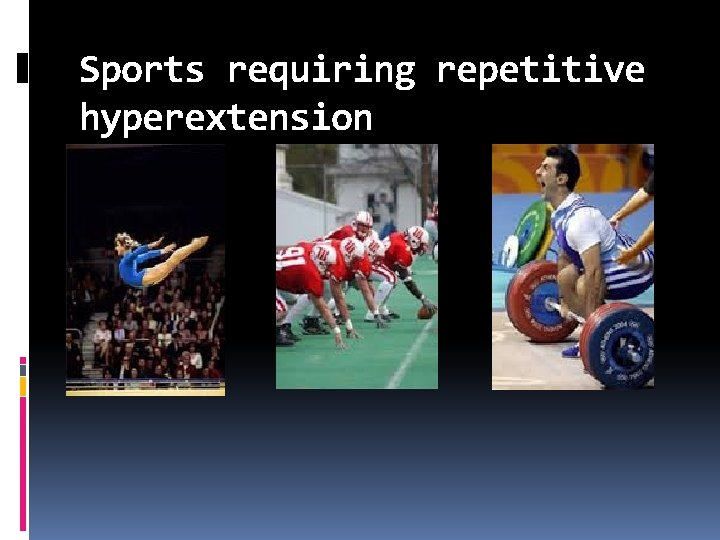
Sports requiring repetitive hyperextension
Causes of SPONDYLOLYSIS Theory- Repetitive trauma can weaken pars interarticularis which could lead to Spondylosis Genetics play a role – Inuit Eskimos (40% incidence)
Diagnosis SPONDYLOLYSIS History (Symptoms) Physical Exam X-rays (AP, LAT, Oblique)- 20% positive findings on Oblique view at the “Collar of the Scotty dog” Possible advanced imaging- SPECT Bone Scan, CT Scan, MRI
Diagnosis SPONDYLOLYSIS PHYSICAL EXAM �Hamstring tightness �Increased pain with lumbar extension �Most cases don not have neurologic deficits �Neurologic signs & symptoms suggestive of SPONDYLOLISTHESIS presence
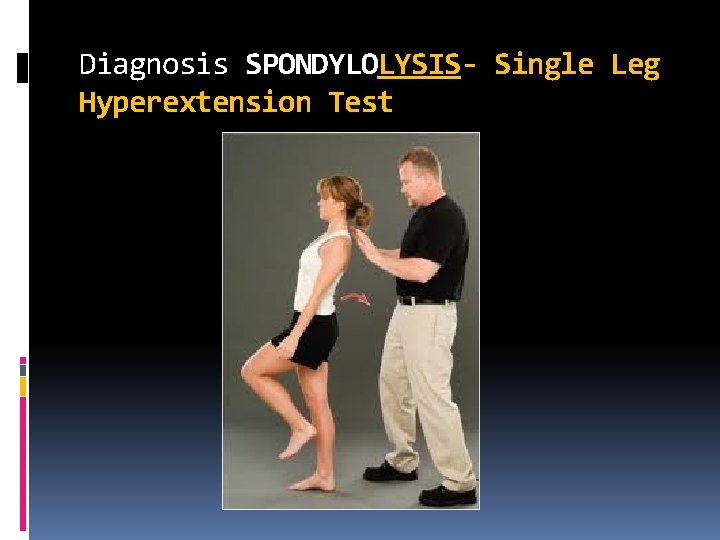
Diagnosis SPONDYLOLYSIS- Single Leg Hyperextension Test
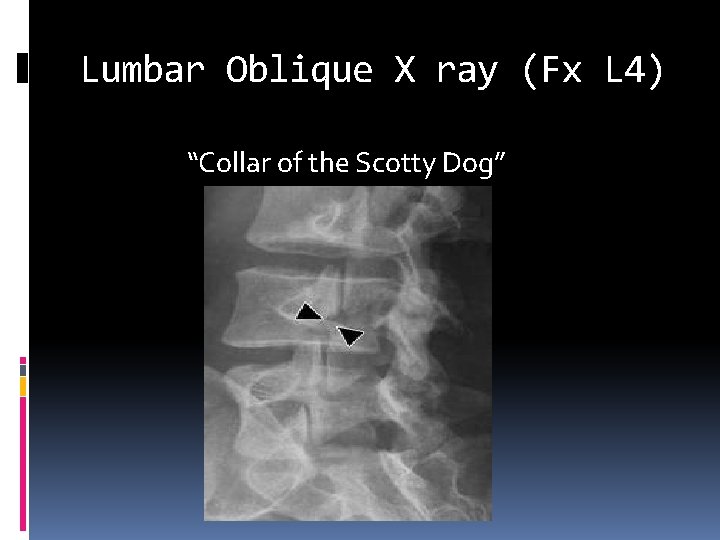
Lumbar Oblique X ray (Fx L 4) “Collar of the Scotty Dog”
Diagnosis SPONDYLOLYSIS ADVANCED IMAGING (Pros & Cons) Bone Scan be useful differentiating between acute stress reaction vs. chronic defect (uses radiation) MRI can also be useful in detecting acute injury but lacks some bony identification (no radiation) CT scan is good to identify boney defects but lacks ability to identify acute lesion (uses radiation)
MISDIAGNOSIS SPONDYLOLYSIS X rays don’t show “Stress” fracture early on MRI or Bone Scan should be used early. Early detection of a stress fracture can prevent progression of the disease into SPONDYLOLISTHESIS
Conservative Treatment SPONDYLOLYSIS Reduce Pain Facilitate healing REST Bracing 6 -12 weeks (Boston LSO anitlordotic) Physical Terapy NSAIDS Bone Stimulator Local Injections (pain relief & decr. Inflammation)
Conservative Treatment SPONDYLOLYSIS No pain = No treatment If no pain after 6 -12 weeks of conservative treatment then gradually resume activity Conservative treatment successful 80 -85% of cases Kids not advised to continue sports with repetitive extension/hyperextension if possible
SURGICAL CASES Severe pain despite conservative measures Grade 3 or greater SPONDYLOLISTHESIS (prevent further slippage) Direct repair often used (fusion with bone graft) 9 -15% incicence
Summary SPONDYLOLYSIS common in adolecent athletes Hamstring tightness common Conservative tx success 80 -85% rate Treatment is symptom based (no pain = no treatment) Surgery for non-responding cases (9 -15%) PROMPT diagnosis important Treatment is individualized basis
- Slides: 24