
UPDATE IN THE TREATMENT OF BRONCHIOLITIS Natalie Napolitano
UPDATE IN THE TREATMENT OF BRONCHIOLITIS Natalie Napolitano, MPH, RRT-NPS, FAARC Research Clinical Specialist Respiratory Therapy Department The Children’s Hospital of Philadelphia
DISCLOSURES § Research Relationships: § Dräger § Aerogen § Actuated Medical § Ge. NO § Smiths Medical
OBJECTIVES § Define Disease § AAP Guidelines § New Evidence § Summarize Care Recomendations
DEFINITION: § Acute, infectious, inflammatory process of both the upper and lower airways causing mucus production and obstruction of the smaller airways § It may occur at all ages § Highest admission rates are among those infants between the ages of 3 to 6 months
ETIOLOGY & EPIDEMIOLOGY: § Most common agent that causes Bronchiolitis is Respiratory Syncytial Virus (RSV) (50 -80%) § Other agents that cause Bronchiolitis are: § Human enterovirus/rhinovirus (16 -18%) § Influenza (10 -15%) § Human metapneumovirus (3 -19%) § Parainfluenza virus (1 -7%)
ETIOLOGY & EPIDEMIOLOGY: § The infections that cause Bronchiolitis are contagious § Spread via airborne droplets (sneeze, cough, and laugh) or via contact with an object that has been contaminated (tissue, toys, telephone)
SIGNS & SYMPTOMS: § In adults and older children: › symptoms are those of an upper respiratory infection. § In infants: › high fever, severe cough, wheezing, tachypnea, retractions, nasal flaring, possible cyanosis and in infants less that 1 month, hypothermia › may find otitis media, retractions, fine diffuse rales, and fine wheezing › 28% of infants with have apnea – 10% will need mechanical ventilation
RISK FACTORS: § Age (less than 2 years; especially age 3 – 6 months) § No history of being breast feed § Prematurity § Exposure to cigarette smoke § Crowded living conditions (including day care)
TREATMENT: § Treat symptoms while the virus runs it’s course § Antibiotics – if bacterial process § Primary therapy: • IV fluids • Management of secretions • Oxygen
AAP 2014 GUIDELINES FOR DIAGNOSIS AND TREATMENT: 1. Diagnosis on history & physical examination – (1 c) should NOT routinely order laboratory and radiographic studies 2. Should NOT administer albuterol (or salbutamol) 3. Should NOT administer epinephrine 4. (a)Nebulized hypertonic saline should NOT be administered in the emergency department (b)may administer nebulized hypertonic saline during inpatient hospitalization Rolston SL, et al. Clinical Practice Guideline: The Diagnosis, Management, and Prevention of Bronchiolitis. Pediatrics. 2014; 34(5): e 1474 -e 1502.
AAP 2014 GUIDELINES FOR DIAGNOSIS AND TREATMENT: 5. Should NOT administer systemic corticosteroids 6. (a)Oxygen for Sp. O 2 < 90% in previously healthy infants (b)Continuous Sp. O 2 monitoring is not routinely needed 7. Should NOT use CPT 8. Should NOT administer antibiotics unless concomitant bacterial infection 9. SHOULD administer NG or IV fluids when infant can not maintain hydration
AAP 2014 GUIDELINES FOR DIAGNOSIS AND TREATMENT: 10. Palivizumb prophylaxis ONLY to select infants with CLD, a history of prematurity, or CHD in first year of life 11. Proper hand hygiene to decreasing the spread of contaminating agents – soap and water preferred 12. Exposure to passive or second hand smoke should be eliminated or minimized

WHAT CAN WE TREAT WITH?
HIGH FLOW NASAL CANNULA: • Mc. Kiernan et al: a single center retrospective chart review of infants admitted to the PICU with bronchiolitis The goal of the review was to determine if the use of HFNC was related to a decrease in the rates of intubation • 115 infants • Rate of intubation was 23% before HFNC and 9% after HFNC (p=0. 043) • number needed to treat of 7 • Median length of stay in the PICU reduced from 6 to 4 days (p=0. 0058) Mc. Kiernan C, et al. High flow nasal cannula therapy in infants with bronchiolitis. J Pediatr 2010; 156(4): 634 -638.
WHY HYPERTONIC SALINE: § Mandelberg and Amirav reviewed the mechanism of action and rationale for use of hypertonic saline or high volume normal saline for viral bronchiolitis › Mucus clearance failure - hydration is a key part of ensuring adequate mucus clearance via the normal mechanisms of the mucocilliary escalator › Rationale for use in treatment of bronchiolitis - viral infection of the airways including the epithelium there is epithelial cell necrosis, mucosal edema, & an increase in mucus development - increases the mucin/water ratio that causes relative dehydration of the Airway Surface Liquid Layer. Mandelberg A, Amirav I. Hypertonic saline or high volume saline for viral bronchiolitis: mechanisms and rational. Pediatr Pulmonol. 2010; 45(1): 36 -40.
WHY HYPERTONIC SALINE: § Review prior studies & determined that a decreased length of stay & improved clinical score with the use of hypertonic saline (3%) & that its use with bronchodilators is considered safe and effective § Confirms that high volume normal saline or hypertonic saline does improve mucus clearance and is not a function of saline concentration but the result of total mass of Na. Cl added to the airway surface

WHAT’S NEW SINCE 2014?
HYPERTONIC SALINE § Heikkilä & Renko 2018 § Meta-analysis on hypertonic saline in bronchiolitis § LOS difference 12 hours § Given in ED reduced the risk of admission – margional § Overall HS statistically beneficial but little clinical benefit. Heikkilä P & Renko M. Hypertonic saline inhalations in bronchiolitis – a cumulative metaanalysis. Ped Pulm 2018; 53: 233 -242.
RISK FACTORS § Dadlez et al examined the early predictors of respiratory decompensation in hospitalized infants. § Single center retrospective study § Review of 1217 infants < 24 months admitted for bronchiolitis April 2011 -March 2015 § 9. 9% respiratory decompensation § 24% Hx prematurity § Bivariate analysis to determine risk factors associated with respiratory decompensation Dadlez NM, et al. Risk factors for respiratory decompensation among healthy infants with bronchiolitis. Hospital Pediatrics 2017; 7(9): 530 -535.
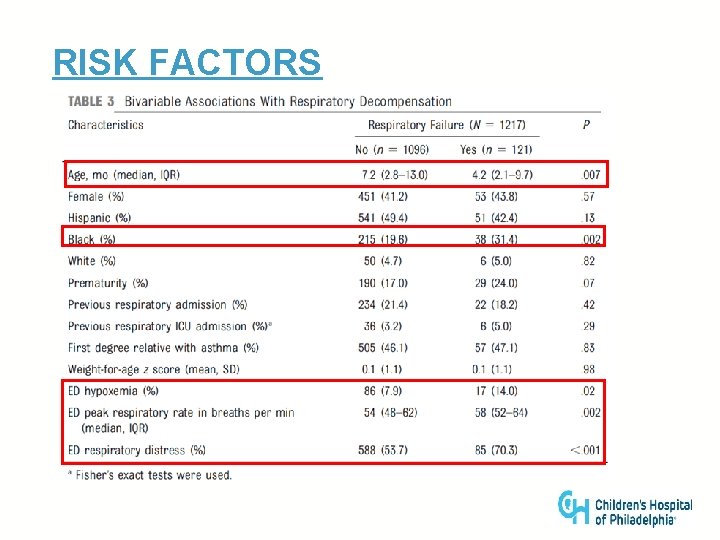
RISK FACTORS
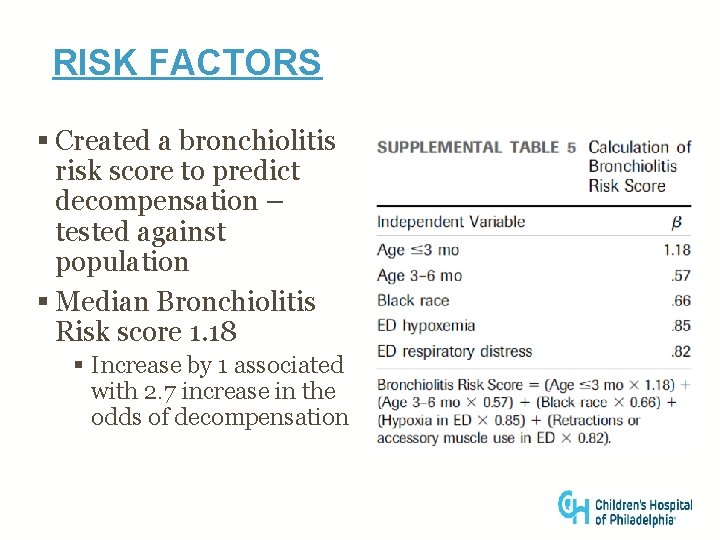
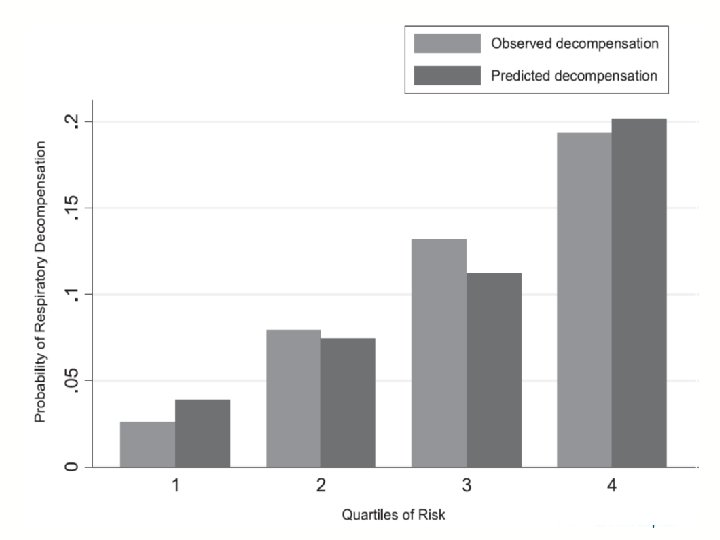
RISK FACTORS § Created a bronchiolitis risk score to predict decompensation – tested against population § Median Bronchiolitis Risk score 1. 18 § Increase by 1 associated with 2. 7 increase in the odds of decompensation
2 2
RISK FACTORS § Conclusion: § Need for additional monitoring and quicker escalation for infants with risk factors: § § < 6 months of age Black race Hypoxemia in ED Retractions or accessory muscle use in ED
DISCHARGE CRITERIA • Garcia-Mauriño, et al assessed the impact of a a standardized discharge protocol for infants admitted with infectious bronchiolitis. • Includes O 2 weaning pathway (Sp. O 2 > 90%) & objective clinical criteria for D/C • Implemented in ID unit and not other ward units • Compared LOS and readmission rates within 2 weeks. Garcio-Mauriño C, et al. Discharge Criteria of Bronchioitis: An Unmet Need, Ped Infectious Disease 2017. published ahead of print.
DISCHARGE CRITERIA • Discharge Criteria: • • • Sp. O 2 > 90% 6 -12 hours Improved/no tachypnea (WHO definition) Afebrile 24 hours or 12 with a down trend Adequate hydration and urine output Social Miscellaneous • Reduced LOS 2 vs 2. 8 days (p<0. 001) • Do difference in readmission rates
QI PROJECT SUSTAINABILITY § Multicenter QI collaborative to develop and implement bronchiolitis Quality Improvement Project with pre and post analysis design § Pre data collected for 1 season § Development of protocol form AAP guidelines § Implemented for next season – data collected § Sustainability data collected 1 year later Shadman KA, et al. Sustainability in the AAP bronchiolitis Quality Improvement project. J Hosp Med 2017; 12(11): 905 -910.
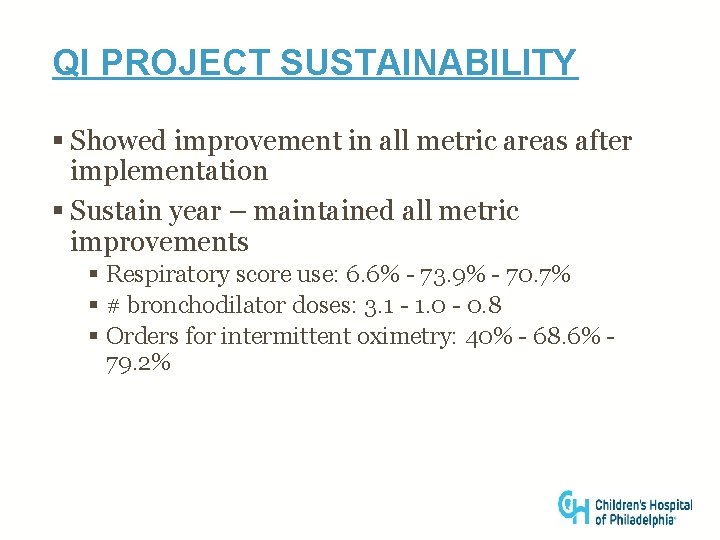
QI PROJECT SUSTAINABILITY § Showed improvement in all metric areas after implementation § Sustain year – maintained all metric improvements § Respiratory score use: 6. 6% - 73. 9% - 70. 7% § # bronchodilator doses: 3. 1 - 1. 0 - 0. 8 § Orders for intermittent oximetry: 40% - 68. 6% 79. 2%

WHAT WAS NOT ADDRESSES?
MUCOLYTICS: § Boogaard et al: § performed a multicenter, randomized, double-blind, controlled trial studying 225 hospitalized infants with RSV bronchiolitis requiring oxygen § treated with rh. DNase or placebo § 2. 5 mg rh. DNase or placebo BID until discharge § no difference between placebo and inhaled rh. DNase in LOS and Duration of oxygen dependence
SUMMARY § Supportive therapy § Watch a small group a bit closer and escalate care quicker § HFNC & 3% Hypertonic § Develop pathway or protocol for best practices and monitor compliance and QI outputs after implementation. 3 0

? QUESTIONS? napolitanon@email. chop. edu
- Slides: 31