
UPDATE Consultancys Preliminary Findings Conclusions and Implications for

- Slides: 23
UPDATE: Consultancy’s Preliminary Findings, Conclusions, and Implications for R 2 R Mainstreaming (Report No. 1) Consultancy Team: Ernie S. Guiang Ms. Ma. Susan Lucero, Ms. Trina G. Isorena Ms. Lea Astrera
Mainstreaming Consultancy Objectives 1. Document various national and regional (Pacific Region) sustainable development planning processes, strategic frameworks and related activities, and determine avenues or entry points for effective national R 2 R mainstreaming; and 2. Develop a simple guide for mainstreaming R 2 R in the Pacific Region to be presented at the Regional Investment Planning Forum.
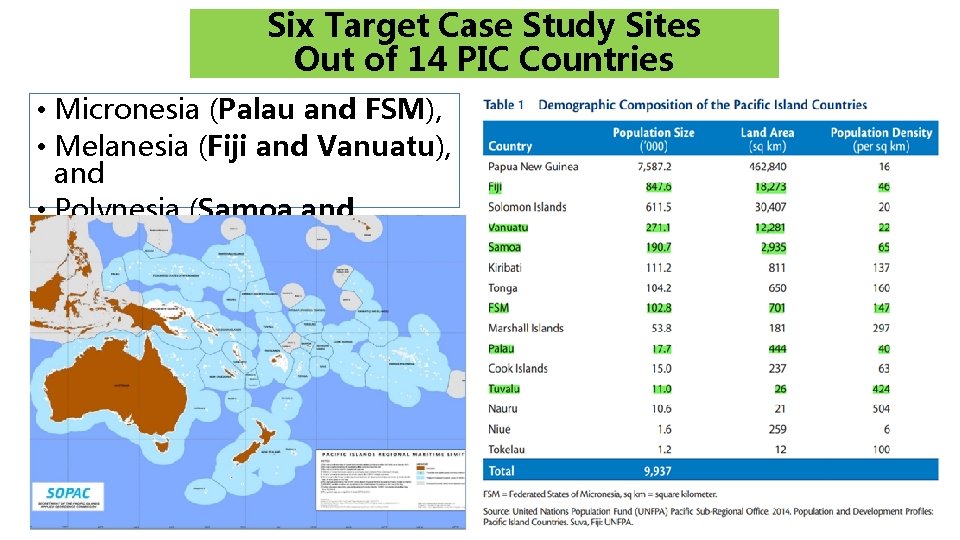
Six Target Case Study Sites Out of 14 PIC Countries • Micronesia (Palau and FSM), • Melanesia (Fiji and Vanuatu), and • Polynesia (Samoa and Tuvalu)
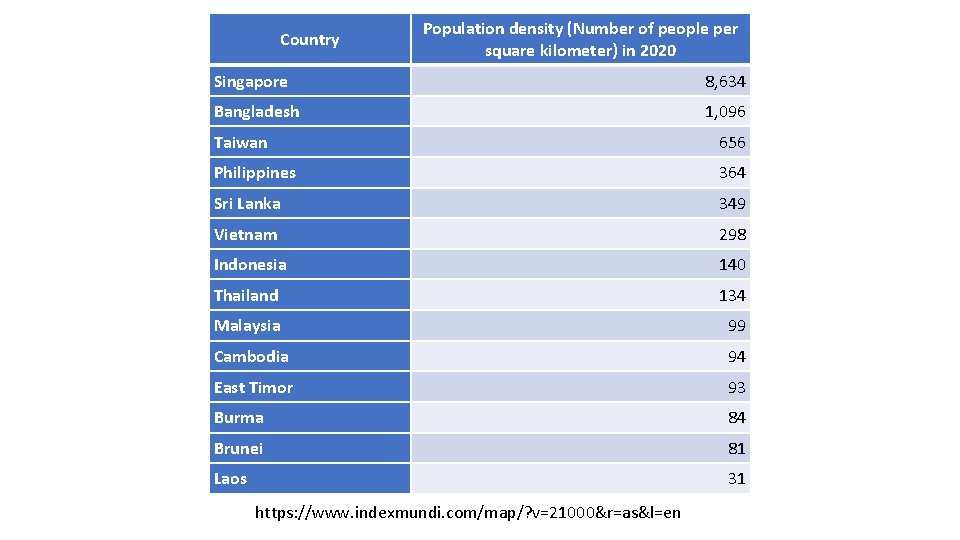
Country Population density (Number of people per square kilometer) in 2020 Singapore 8, 634 Bangladesh 1, 096 Taiwan 656 Philippines 364 Sri Lanka 349 Vietnam 298 Indonesia 140 Thailand 134 Malaysia 99 Cambodia 94 East Timor 93 Burma 84 Brunei 81 Laos 31 https: //www. indexmundi. com/map/? v=21000&r=as&l=en
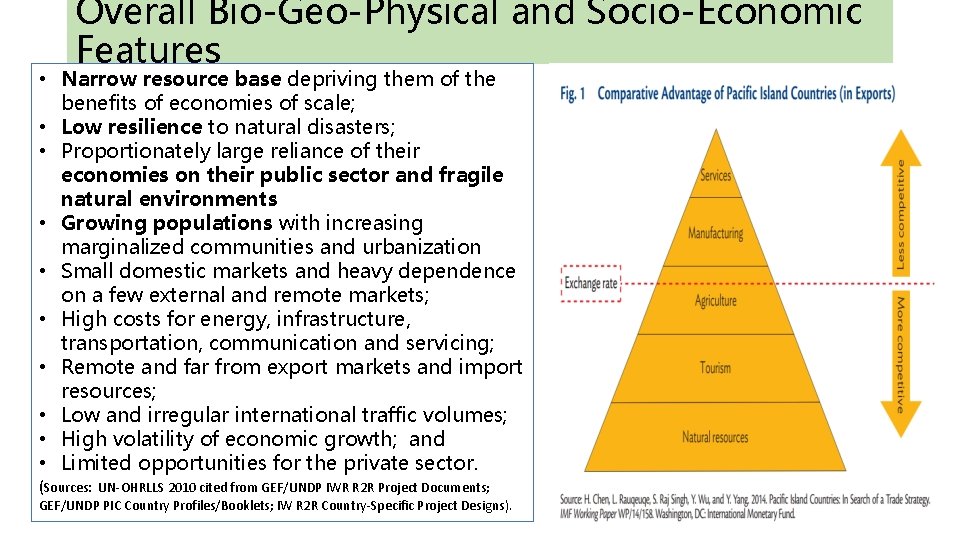
Overall Bio-Geo-Physical and Socio-Economic Features • Narrow resource base depriving them of the benefits of economies of scale; • Low resilience to natural disasters; • Proportionately large reliance of their economies on their public sector and fragile natural environments • Growing populations with increasing marginalized communities and urbanization • Small domestic markets and heavy dependence on a few external and remote markets; • High costs for energy, infrastructure, transportation, communication and servicing; • Remote and far from export markets and import resources; • Low and irregular international traffic volumes; • High volatility of economic growth; and • Limited opportunities for the private sector. (Sources: UN-OHRLLS 2010 cited from GEF/UNDP IWR R 2 R Project Documents; GEF/UNDP PIC Country Profiles/Booklets; IW R 2 R Country-Specific Project Designs).
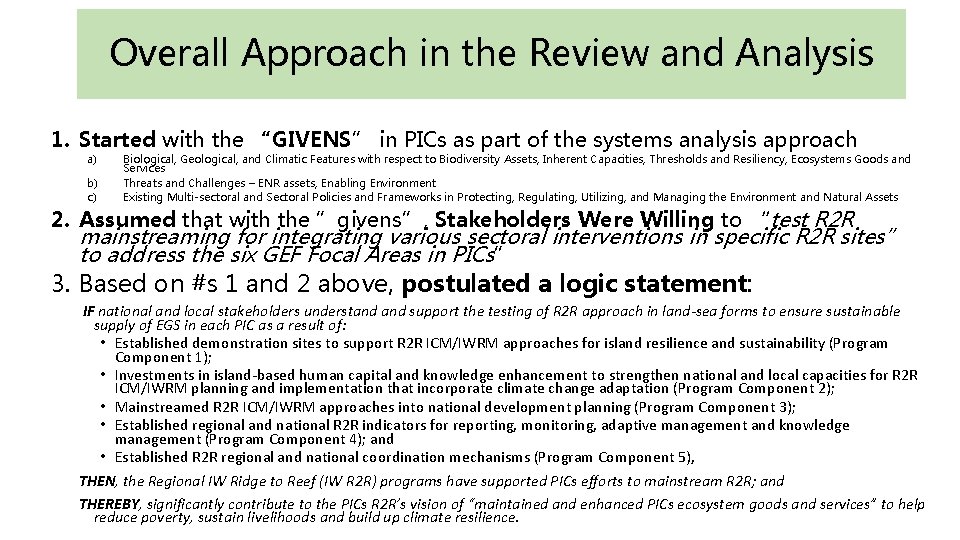
Overall Approach in the Review and Analysis 1. Started with the “GIVENS” in PICs as part of the systems analysis approach a) b) c) Biological, Geological, and Climatic Features with respect to Biodiversity Assets, Inherent Capacities, Thresholds and Resiliency, Ecosystems Goods and Services Threats and Challenges – ENR assets, Enabling Environment Existing Multi-sectoral and Sectoral Policies and Frameworks in Protecting, Regulating, Utilizing, and Managing the Environment and Natural Assets 2. Assumed that with the ”givens”, Stakeholders Were Willing to “test R 2 R mainstreaming for integrating various sectoral interventions in specific R 2 R sites” to address the six GEF Focal Areas in PICs” 3. Based on #s 1 and 2 above, postulated a logic statement: IF national and local stakeholders understand support the testing of R 2 R approach in land-sea forms to ensure sustainable supply of EGS in each PIC as a result of: • Established demonstration sites to support R 2 R ICM/IWRM approaches for island resilience and sustainability (Program Component 1); • Investments in island-based human capital and knowledge enhancement to strengthen national and local capacities for R 2 R ICM/IWRM planning and implementation that incorporate climate change adaptation (Program Component 2); • Mainstreamed R 2 R ICM/IWRM approaches into national development planning (Program Component 3); • Established regional and national R 2 R indicators for reporting, monitoring, adaptive management and knowledge management (Program Component 4); and • Established R 2 R regional and national coordination mechanisms (Program Component 5), THEN, the Regional IW Ridge to Reef (IW R 2 R) programs have supported PICs efforts to mainstream R 2 R; and THEREBY, significantly contribute to the PICs R 2 R’s vision of “maintained and enhanced PICs ecosystem goods and services” to help reduce poverty, sustain livelihoods and build up climate resilience.
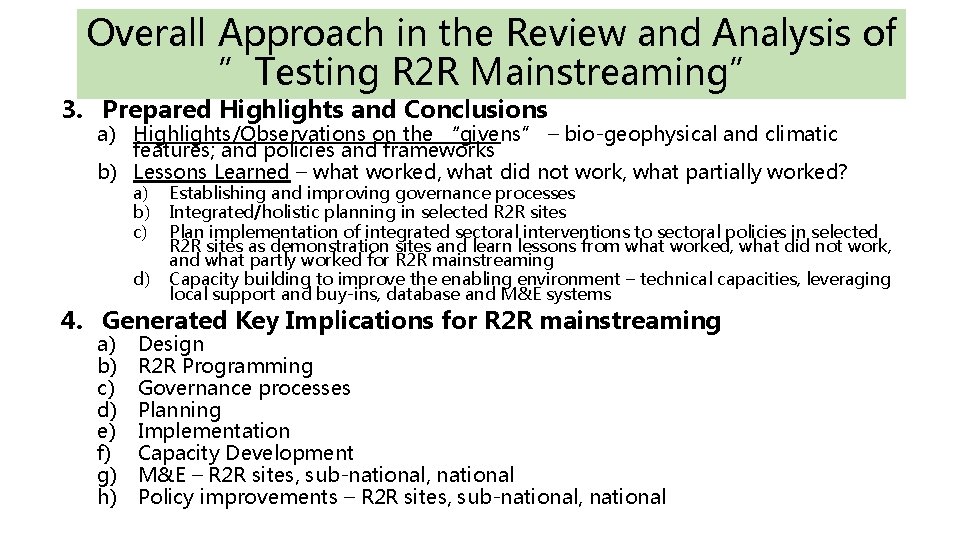
Overall Approach in the Review and Analysis of ”Testing R 2 R Mainstreaming” 3. Prepared Highlights and Conclusions a) Highlights/Observations on the “givens” – bio-geophysical and climatic features; and policies and frameworks b) Lessons Learned – what worked, what did not work, what partially worked? a) b) c) d) Establishing and improving governance processes Integrated/holistic planning in selected R 2 R sites Plan implementation of integrated sectoral interventions to sectoral policies in selected R 2 R sites as demonstration sites and learn lessons from what worked, what did not work, and what partly worked for R 2 R mainstreaming Capacity building to improve the enabling environment – technical capacities, leveraging local support and buy-ins, database and M&E systems 4. Generated Key Implications for R 2 R mainstreaming a) b) c) d) e) f) g) h) Design R 2 R Programming Governance processes Planning Implementation Capacity Development M&E – R 2 R sites, sub-national, national Policy improvements – R 2 R sites, sub-national, national
Notes on the Systems Approach and Logic Statement 1. Systems thinking and its applications in: a) b) c) d) Integrated management of ecosystems in landscape-seascapes or land-sea forms is linking conservation with development, mitigation and adaptation in response to climate change and human-induced disasters, landscape protection and restoration, convergence of sectoral programs to achieve synergy of results, horizontal and vertical coordination and complementation, and environmental governance (MEA 2005; Engel and Korf 2005) The “givens” are the starting points in testing the R 2 R mainstreaming – the bio-geological and climatic features and conditions, and policies (international agreements, protocols, ENR-related laws, climate change, disaster risk reduction, land use) to navigate the delicate balance between protection, utilization, and restoration versus development and management of environment and natural resources assets. The conditions of or responses to the “givens” may change or improve over time as R 2 R interventions are designed and implemented at various levels under a systems approach implementation arrangements (Beer 1984; Jackson 2003; Ackoff and Emery 2009} Buy-ins of the assumption that R 2 R approach requires holistic planning and implementing sectoral programs in an integrated fashion in specific R 2 R landsea form and where mechanisms for coordination, complementation, and collaboration are in place to direct interventions and optimize the use of resources and achieve positive impacts that will reduce stress to the ecosystems and improve well being (Anderson 2000; Mayer, et al 2012; Huntley and Redford 2014). A postulated logic statement as a guide for the review and capture lessons
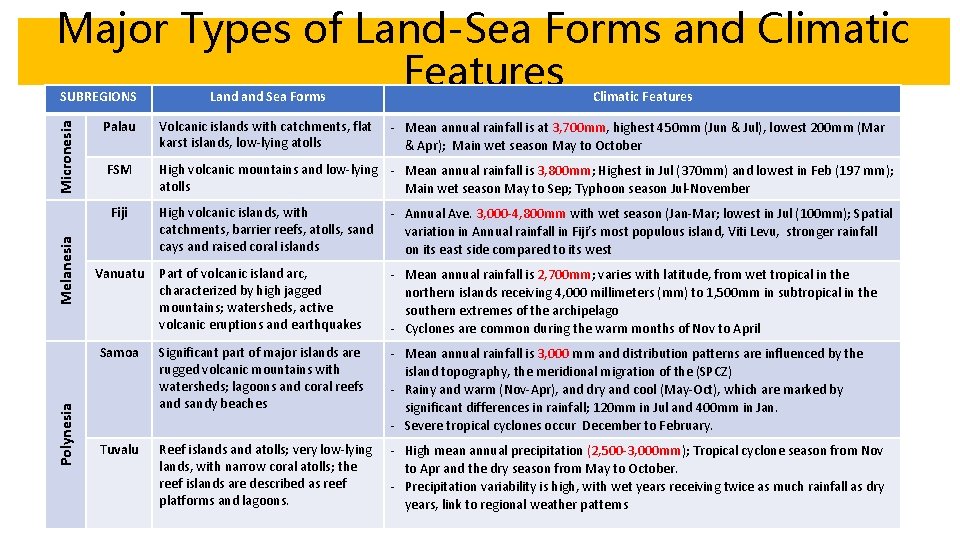
Major Types of Land-Sea Forms and Climatic Features Micronesia SUBREGIONS Melanesia Climatic Features Palau Volcanic islands with catchments, flat karst islands, low-lying atolls FSM High volcanic mountains and low-lying - Mean annual rainfall is 3, 800 mm; Highest in Jul (370 mm) and lowest in Feb (197 mm); atolls Main wet season May to Sep; Typhoon season Jul-November Fiji Polynesia Land Sea Forms - Mean annual rainfall is at 3, 700 mm, highest 450 mm (Jun & Jul), lowest 200 mm (Mar & Apr); Main wet season May to October High volcanic islands, with catchments, barrier reefs, atolls, sand cays and raised coral islands - Annual Ave. 3, 000 -4, 800 mm with wet season (Jan-Mar; lowest in Jul (100 mm); Spatial variation in Annual rainfall in Fiji’s most populous island, Viti Levu, stronger rainfall on its east side compared to its west Vanuatu Part of volcanic island arc, characterized by high jagged mountains; watersheds, active volcanic eruptions and earthquakes - Mean annual rainfall is 2, 700 mm; varies with latitude, from wet tropical in the northern islands receiving 4, 000 millimeters (mm) to 1, 500 mm in subtropical in the southern extremes of the archipelago - Cyclones are common during the warm months of Nov to April Samoa Significant part of major islands are rugged volcanic mountains with watersheds; lagoons and coral reefs and sandy beaches - Mean annual rainfall is 3, 000 mm and distribution patterns are influenced by the island topography, the meridional migration of the (SPCZ) - Rainy and warm (Nov-Apr), and dry and cool (May-Oct), which are marked by significant differences in rainfall; 120 mm in Jul and 400 mm in Jan. - Severe tropical cyclones occur December to February. Tuvalu Reef islands and atolls; very low-lying lands, with narrow coral atolls; the reef islands are described as reef platforms and lagoons. - High mean annual precipitation (2, 500 -3, 000 mm); Tropical cyclone season from Nov to Apr and the dry season from May to October. - Precipitation variability is high, with wet years receiving twice as much rainfall as dry years, link to regional weather patterns
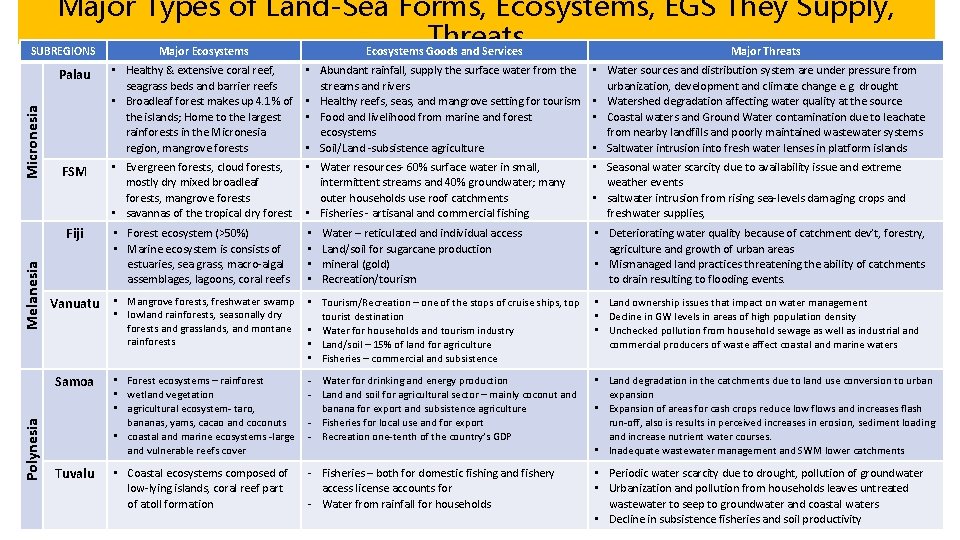
Polynesia Melanesia Micronesia Major Types of Land-Sea Forms, Ecosystems, EGS They Supply, Threats SUBREGIONS Major Ecosystems Goods and Services Major Threats Palau • Healthy & extensive coral reef, seagrass beds and barrier reefs • Broadleaf forest makes up 4. 1% of the islands; Home to the largest rainforests in the Micronesia region, mangrove forests • Abundant rainfall, supply the surface water from the streams and rivers • Healthy reefs, seas, and mangrove setting for tourism • Food and livelihood from marine and forest ecosystems • Soil/Land -subsistence agriculture • Water sources and distribution system are under pressure from urbanization, development and climate change e. g. drought • Watershed degradation affecting water quality at the source • Coastal waters and Ground Water contamination due to leachate from nearby landfills and poorly maintained wastewater systems • Saltwater intrusion into fresh water lenses in platform islands FSM • Evergreen forests, cloud forests, mostly dry mixed broadleaf forests, mangrove forests • savannas of the tropical dry forest • Water resources- 60% surface water in small, intermittent streams and 40% groundwater; many outer households use roof catchments • Fisheries - artisanal and commercial fishing • Seasonal water scarcity due to availability issue and extreme weather events • saltwater intrusion from rising sea-levels damaging crops and freshwater supplies, Fiji • Forest ecosystem (>50%) • Marine ecosystem is consists of estuaries, sea grass, macro-algal assemblages, lagoons, coral reefs • • Vanuatu • Mangrove forests, freshwater swamp • lowland rainforests, seasonally dry forests and grasslands, and montane rainforests • Tourism/Recreation – one of the stops of cruise ships, top tourist destination • Water for households and tourism industry • Land/soil – 15% of land for agriculture • Fisheries – commercial and subsistence • Land ownership issues that impact on water management • Decline in GW levels in areas of high population density • Unchecked pollution from household sewage as well as industrial and commercial producers of waste affect coastal and marine waters Samoa • Forest ecosystems – rainforest • wetland vegetation • agricultural ecosystem- taro, bananas, yams, cacao and coconuts • coastal and marine ecosystems -large and vulnerable reefs cover - Water for drinking and energy production - Land soil for agricultural sector – mainly coconut and banana for export and subsistence agriculture - Fisheries for local use and for export - Recreation one-tenth of the country’s GDP • Land degradation in the catchments due to land use conversion to urban expansion • Expansion of areas for cash crops reduce low flows and increases flash run-off, also is results in perceived increases in erosion, sediment loading and increase nutrient water courses. • Inadequate wastewater management and SWM lower catchments Tuvalu • Coastal ecosystems composed of low-lying islands, coral reef part of atoll formation - Fisheries – both for domestic fishing and fishery access license accounts for - Water from rainfall for households • Periodic water scarcity due to drought, pollution of groundwater • Urbanization and pollution from households leaves untreated wastewater to seep to groundwater and coastal waters • Decline in subsistence fisheries and soil productivity Water – reticulated and individual access Land/soil for sugarcane production mineral (gold) Recreation/tourism • Deteriorating water quality because of catchment dev’t, forestry, agriculture and growth of urban areas • Mismanaged land practices threatening the ability of catchments to drain resulting to flooding events.
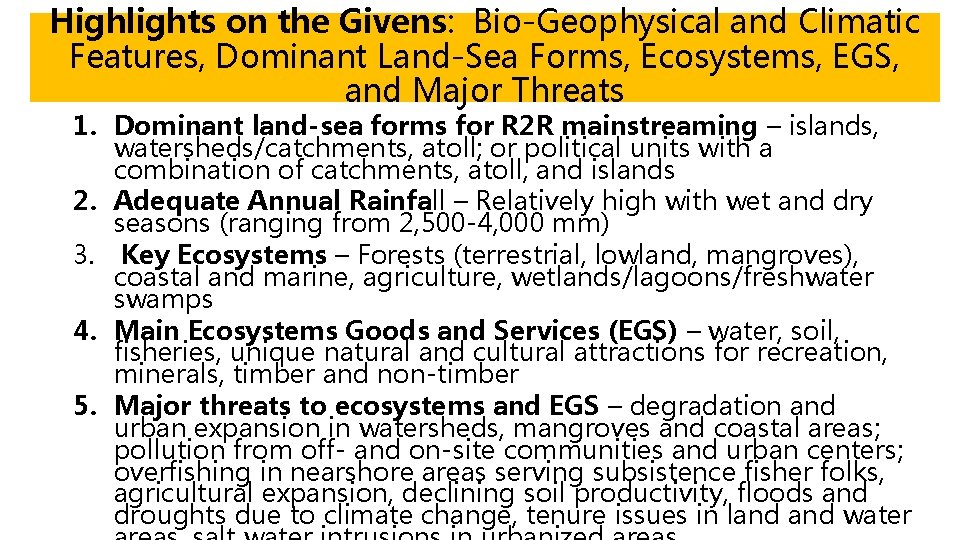
Highlights on the Givens: Bio-Geophysical and Climatic Features, Dominant Land-Sea Forms, Ecosystems, EGS, and Major Threats 1. Dominant land-sea forms for R 2 R mainstreaming – islands, watersheds/catchments, atoll; or political units with a combination of catchments, atoll, and islands 2. Adequate Annual Rainfall – Relatively high with wet and dry seasons (ranging from 2, 500 -4, 000 mm) 3. Key Ecosystems – Forests (terrestrial, lowland, mangroves), coastal and marine, agriculture, wetlands/lagoons/freshwater swamps 4. Main Ecosystems Goods and Services (EGS) – water, soil, fisheries, unique natural and cultural attractions for recreation, minerals, timber and non-timber 5. Major threats to ecosystems and EGS – degradation and urban expansion in watersheds, mangroves and coastal areas; pollution from off- and on-site communities and urban centers; overfishing in nearshore areas serving subsistence fisher folks, agricultural expansion, declining soil productivity, floods and droughts due to climate change, tenure issues in land water
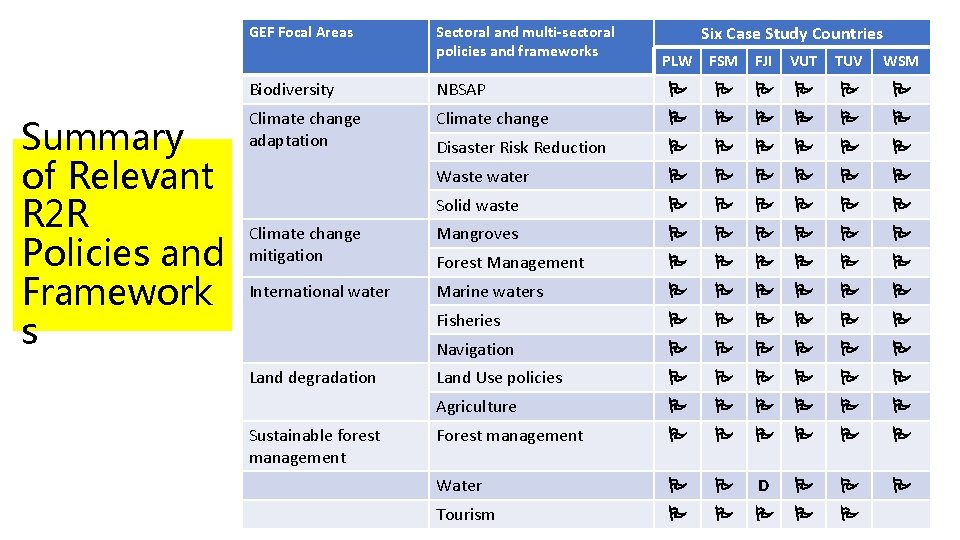
GEF Focal Areas Summary of Relevant R 2 R Policies and Framework s Sectoral and multi-sectoral policies and frameworks Six Case Study Countries PLW FSM FJI VUT TUV WSM Biodiversity NBSAP Climate change adaptation Climate change Disaster Risk Reduction Waste water Solid waste Climate change mitigation Mangroves Forest Management International water Marine waters Fisheries Navigation Land Use policies Agriculture Forest management Water D Tourism Land degradation Sustainable forest management
Highlights on the Givens: Policies and Frameworks 1. Adequate national policies and frameworks as guides in mainstreaming R 2 R approach at the sub-national, island, national, and even PIC sub-regional levels 2. Existing policies as starting points with the existing legal frameworks that identify entry points for clustering concerned sectors to reduce stress to the ecosystems, EGS, and communities. They also serve as the platforms of each concerned sector to participate in an integrated initiatives while retaining their functions and accountability in defined land-sea forms. 3. While site level R 2 R approach requires integration, complementary, and collaborative arrangements, the dominant national policies in a given R 2 R site may be assigned or take the responsibility to lead the coordination and steering processes in recognition of respected subsidiarity arrangements at the local level. 4. R 2 R approach may help minimize negative externalities or collateral damages with trade offs of some sector programs in the same landsea form such as intensive agriculture and settlement expansion to water pollution and coastal areas or the siltation and pollution impacts of mining, logging, and ag expansion in terrestrial areas to downstream ecosystems. 5. The existing PIC sectoral policies and frameworks support the
Key Lessons – Designs 1. R 2 R project designs during the testing phase of R 2 R mainstreaming could withstand improvements 2. Steering Committee’s role as the body for facilitating and resolving turfing and competing interests among stakeholders; 3. Providing adequate support for facilitating the buy-ins of customary/traditional/native land sea owners as “on-site resource managers” in an R 2 R land-form; 4. Consideration of the varying technical capacities among implementors in each country including disparity in technical skills and management experience; 5. Limited availability of local technical expertise and dependency on outside specialists; 6. Difficulty in enforcing processes among implementing partners-UNDP and government requirements as a crucial issue in achieving outcomes; 7. Delays in fund transfer, recruiting consultants, and slow spending by implementing partners;
Key Lessons on R 2 R Programmatic Approach • Establishing or strengthening inclusive governance bodies for R 2 R collaboration among sectoral agencies at the national and sub-national levels is critical in communicating, developing consensus, and directing overall leadership support to R 2 R. This will foster coordination, complementation, co-financing, joint activities, and achieving synergistic impacts • Processes, rules and procedures to facilitate planning and implementation are more effective if these would mutually achieve local and site-level goals, objectives, and targets.
Key Lessons on R 2 R Programmatic Approach • R 2 R is acknowledged or recognized as an effective approach for sustainable resource governance and management of various land-sea forms in PICs • Timely assessments such as the IDA and spatial analysis and community consultations as processes in watershed planning and studies such as the RAPCA are critical but could have been more helpful if used as inputs in prioritizing strategies and re-configuring science-based strategies and enacting policies. • Carefully and properly conducted stakeholders’ mapping and analysis are of high value in the R 2 R planning, implementation, programming, and advocacy
Key Lessons on R 2 R Programmatic Approach • Specific technical interventions in a specific R 2 R site to reduce stress to biodiversity, key ecosystems, EGS, and communities largely depend on Initial assessments, scoping, and enhanced over time with M& • Factoring in adaptive management in the design, planning, and implementation processes has the potential to encourage innovation and flexibility of adjusting approved project designs with the changing environment in the local areas and renders more effective on-site management. • Capacitating R 2 R Project Implementing Units and on-site communities and relevant partners with adequate support for experts and programmatic training and other
Key Lessons -R 2 R Programmatic Approach • Functional Site Level R 2 R Project Committees thru the implementing units are key to eliciting community feedbacks for updating national and sub-national level governance bodies such as the IMCs and donor groups. • Knowledge products – R 2 R orientation and training materials, enriched/enhanced existing manuals on watershed planning, ICRM, RAPCA, packages for cross visits, training designs with modules and materials, spatial mapping and analysis, technical bulletins or guides, et. – based on lessons and relevant best practices from are going to be useful for the R 2 R mainstreaming with either replication or scaling up strategies.
Implications of the Givens, Findings, Conclusions Vis-A-Vis R 2 R Mainstreaming • A more intentional national and sub-national initiatives to map and analyze possible expansion areas for R 2 R upscaling as part of the mainstreaming • Although there is an overall agreement and understanding of the importance of the R 2 R approach, institutional disconnects exist between sector mandates and the integrative nature of sub-national governments whose mandate require working closely with ministry field units for technical advice and getting the support and buy-ins of local communities • Integrated R 2 R planning and implementation are more effective when governance processes facilitate agreements on strategic technical interventions that address the urgency of arresting threats to key biodiversity and ecosystems from climate or human-induced related hazards including reduced supply of EGS for the wellbeing of communities and the public
Implications of the Givens, Findings, Conclusions Vis -A-Vis R 2 R Mainstreaming • Learnings from IWRM, STAR and IW R 2 R can serve as starting points for R 2 R mainstreaming. • Design to achieve sustainable sources for R 2 R initiatives as there are limited financial and human resources in PICs, changes in political agenda and priorities, delays in startup and mobilization activities, and innovative approach to adaptive project management, coordination, collaboration, leveraging and partnerships
Implications of the Givens, Findings, Conclusions Vis-A-Vis R 2 R Mainstreaming • A few technical approaches are emerging to be effective and maybe considered as emerging best practices such as ØR 2 R planning (watersheds, catchments, atoll, islands), ØM&E systems, Øfee collection, Øerosion control and sedimentation measures, Øterrestrial restoration and rehabilitation, Øwater protection zoning, Ømodeling the links and impacts of dynamic changes in terrestrial ecosystems using land cover and land use, erosion and sedimentation and how changes are negatively impacting the ecosystems for improving local policies and strategies, EGS and EGS users, and community livelihoods in the freshwater/wetlands and coastal and marine area.
Implications of the Givens, Findings, Conclusions Vis-A-Vis R 2 R Mainstreaming • The emerging possible major units for planning and carrying out integrated R 2 R strategies in support of a concerted vision are: sub-national governments, villages, customary land coastal/marine area owners in collaboration with their different constituents in their political jurisdiction. • Scaling up with sites with defined governance and regulatory responsibilities, authority, and accountability is the building block of R 2 R mainstreaming at the national and PIC sub-regional levels.
Thank you!