
Update and optimization of CEPC detector mechanical design

- Slides: 19
Update and optimization of CEPC detector mechanical design Ji Quan April 16, 2021
Outline: 1. General mechanical drawing in upgrade 2. Yoke design 3. Beampipe design 4. Summary and next plan
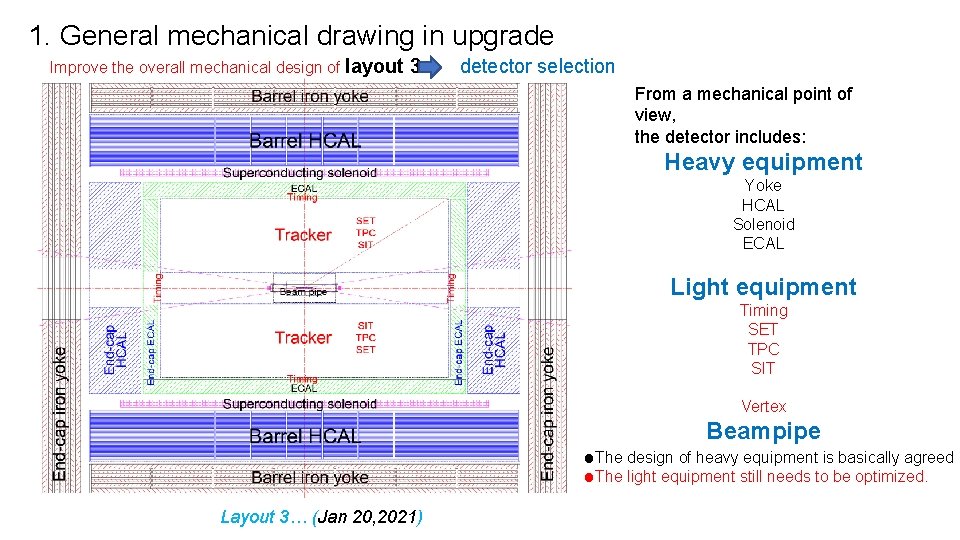
1. General mechanical drawing in upgrade Improve the overall mechanical design of layout 3 detector selection From a mechanical point of view, the detector includes: Heavy equipment Yoke HCAL Solenoid ECAL Light equipment Timing SET TPC SIT Vertex Beampipe ●The design of heavy equipment is basically agreed ●The light equipment still needs to be optimized. Layout 3… (Jan 20, 2021)
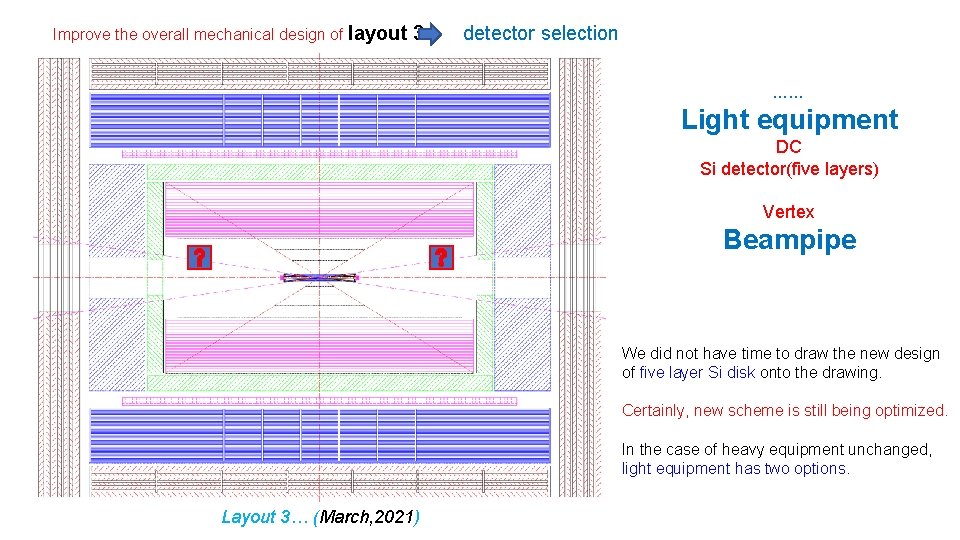
Improve the overall mechanical design of layout 3 detector selection …… Light equipment DC Si detector(five layers) Vertex Beampipe We did not have time to draw the new design of five layer Si disk onto the drawing. Certainly, new scheme is still being optimized. In the case of heavy equipment unchanged, light equipment has two options. Layout 3… (March, 2021)
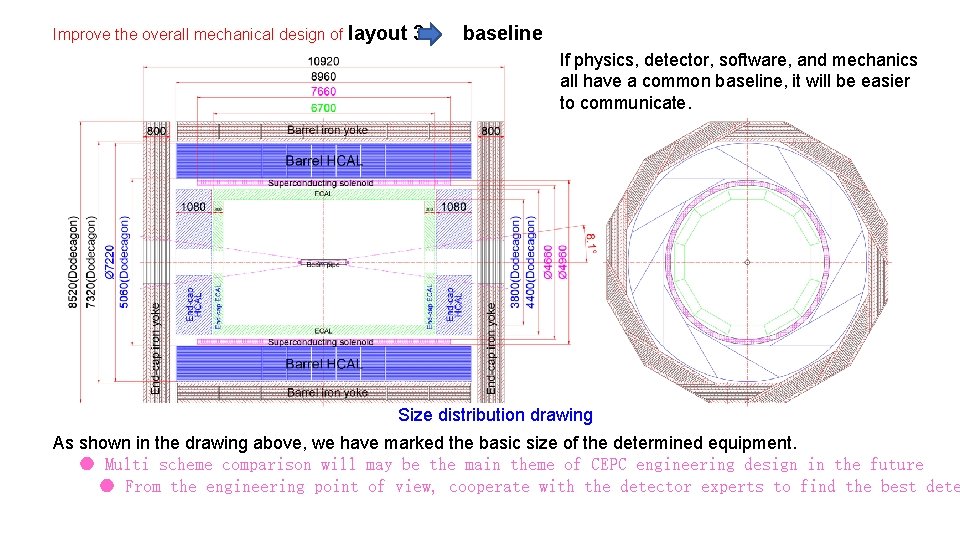
Improve the overall mechanical design of layout 3 baseline If physics, detector, software, and mechanics all have a common baseline, it will be easier to communicate. Size distribution drawing As shown in the drawing above, we have marked the basic size of the determined equipment. ● Multi scheme comparison will may be the main theme of CEPC engineering design in the future ● From the engineering point of view, cooperate with the detector experts to find the best dete
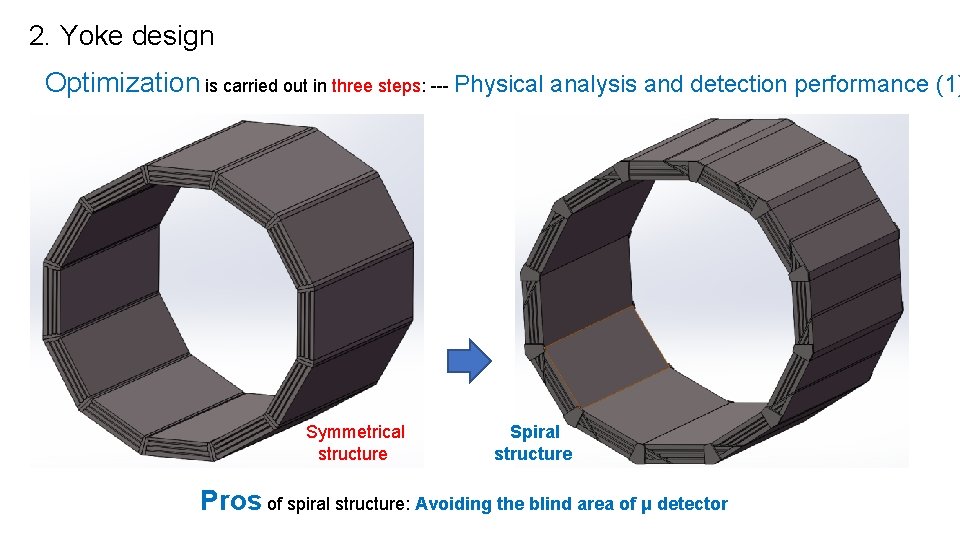
2. Yoke design Optimization is carried out in three steps: --- Physical analysis and detection performance (1) Symmetrical structure Spiral structure Pros of spiral structure: Avoiding the blind area of μ detector
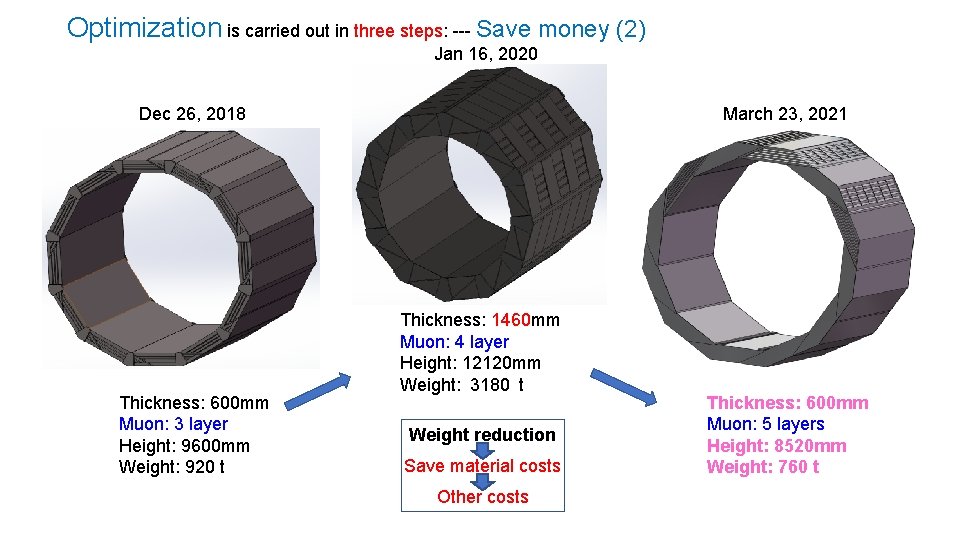
Optimization is carried out in three steps: --- Save money (2) Jan 16, 2020 Dec 26, 2018 Thickness: 600 mm Muon: 3 layer Height: 9600 mm Weight: 920 t March 23, 2021 Thickness: 1460 mm Muon: 4 layer Height: 12120 mm Weight: 3180 t Weight reduction Save material costs Other costs Thickness: 600 mm Muon: 5 layers Height: 8520 mm Weight: 760 t
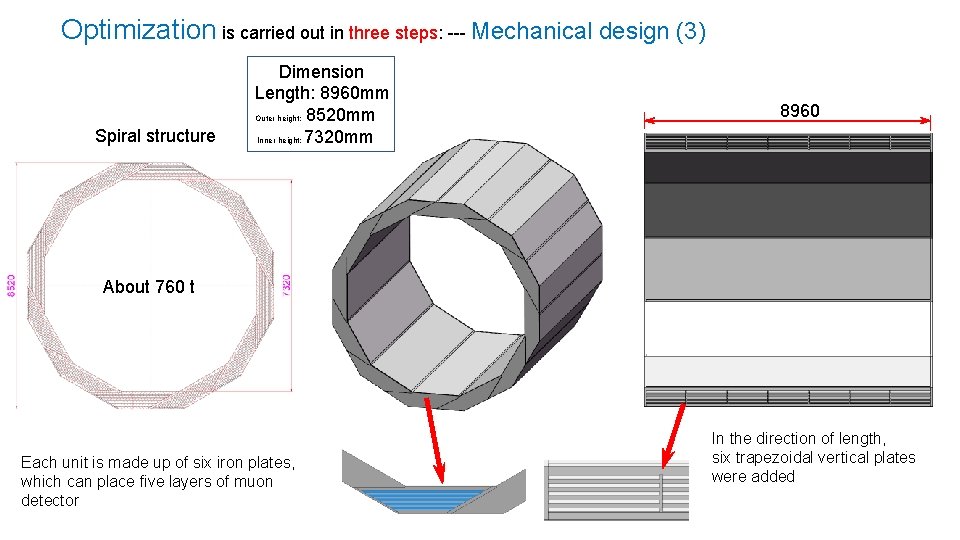
Optimization is carried out in three steps: --- Mechanical design (3) Spiral structure Dimension Length: 8960 mm Outer height: 8520 mm Inner height: 7320 mm 8960 About 760 t Each unit is made up of six iron plates, which can place five layers of muon detector In the direction of length, six trapezoidal vertical plates were added
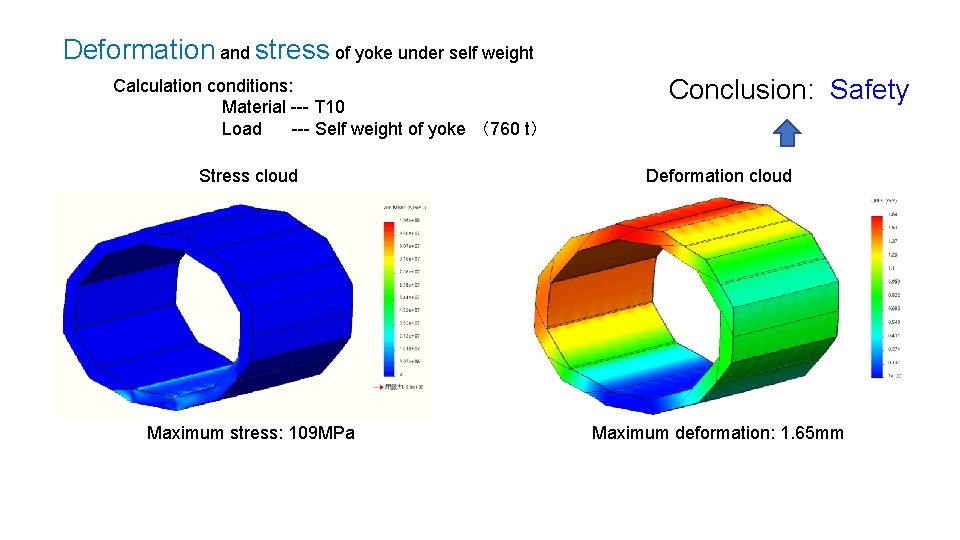
Deformation and stress of yoke under self weight Calculation conditions: Material --- T 10 Load --- Self weight of yoke (760 t) Conclusion: Safety Stress cloud Deformation cloud Maximum stress: 109 MPa Maximum deformation: 1. 65 mm
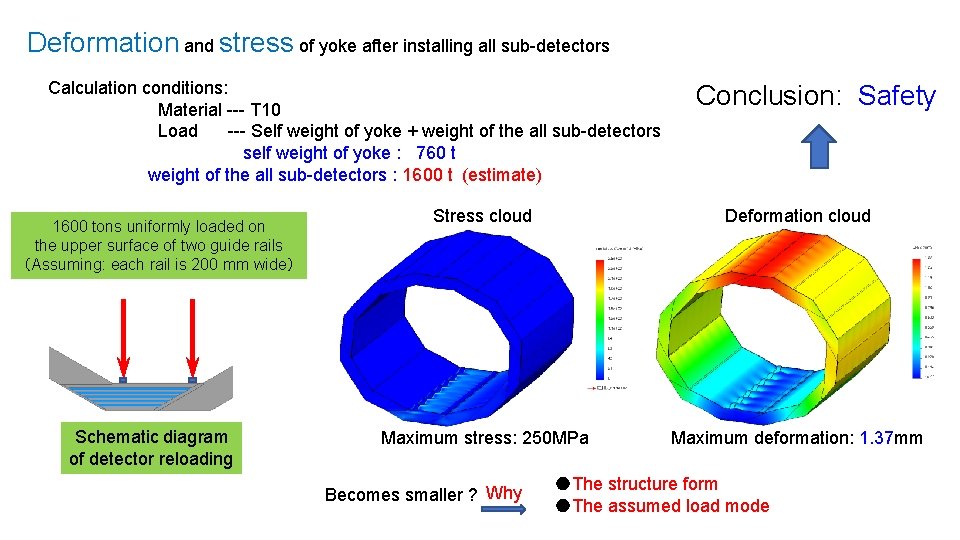
Deformation and stress of yoke after installing all sub-detectors Calculation conditions: Material --- T 10 Load --- Self weight of yoke + weight of the all sub-detectors self weight of yoke : 760 t weight of the all sub-detectors : 1600 t (estimate) 1600 tons uniformly loaded on the upper surface of two guide rails (Assuming: each rail is 200 mm wide) Schematic diagram of detector reloading Conclusion: Safety Stress cloud Deformation cloud Maximum stress: 250 MPa Maximum deformation: 1. 37 mm Becomes smaller ? Why ●The structure form ●The assumed load mode
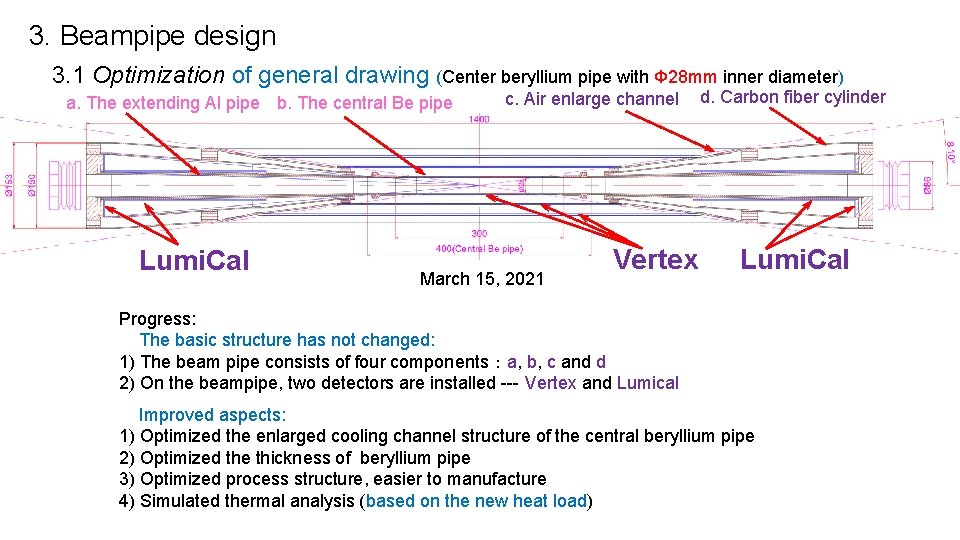
3. Beampipe design 3. 1 Optimization of general drawing (Center beryllium pipe with Φ 28 mm inner diameter) a. The extending Al pipe b. The central Be pipe Lumi. Cal c. Air enlarge channel March 15, 2021 Vertex d. Carbon fiber cylinder Lumi. Cal Progress: The basic structure has not changed: 1) The beam pipe consists of four components:a, b, c and d 2) On the beampipe, two detectors are installed --- Vertex and Lumical Improved aspects: 1) Optimized the enlarged cooling channel structure of the central beryllium pipe 2) Optimized the thickness of beryllium pipe 3) Optimized process structure, easier to manufacture 4) Simulated thermal analysis (based on the new heat load)
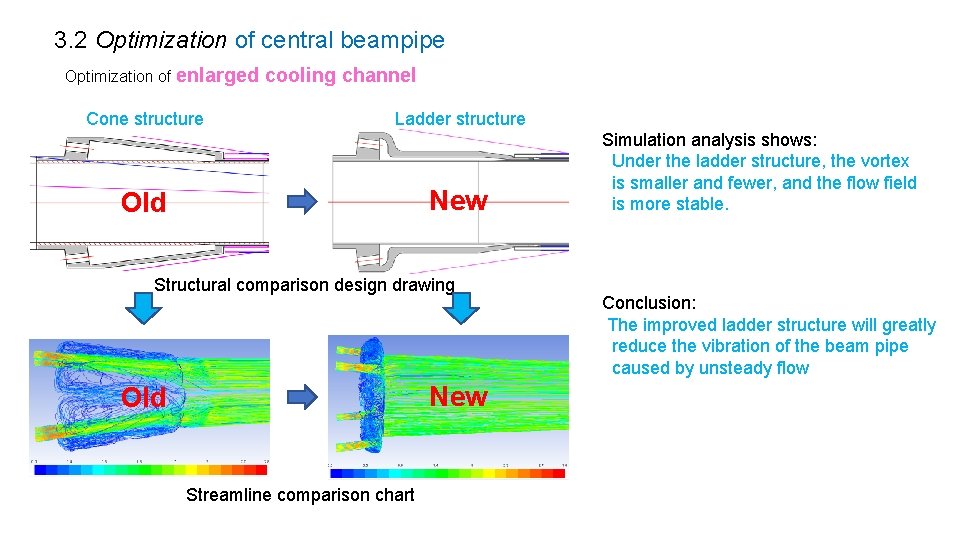
3. 2 Optimization of central beampipe Optimization of enlarged Cone structure cooling channel Ladder structure New Old Structural comparison design drawing New Old Streamline comparison chart Simulation analysis shows: Under the ladder structure, the vortex is smaller and fewer, and the flow field is more stable. Conclusion: The improved ladder structure will greatly reduce the vibration of the beam pipe caused by unsteady flow
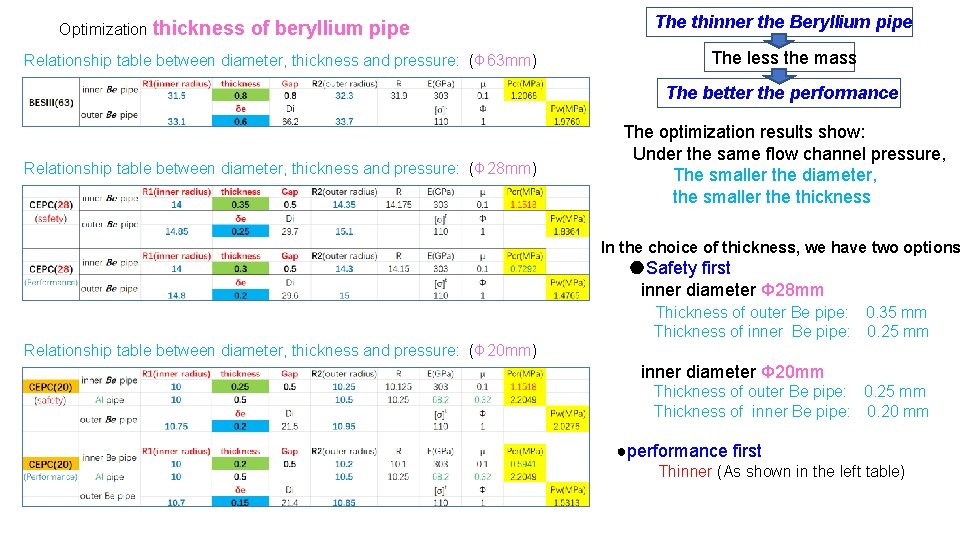
Optimization thickness of beryllium pipe Relationship table between diameter, thickness and pressure: (Φ 63 mm) The thinner the Beryllium pipe The less the mass The better the performance Relationship table between diameter, thickness and pressure: (Φ 28 mm) The optimization results show: Under the same flow channel pressure, The smaller the diameter, the smaller the thickness In the choice of thickness, we have two options ●Safety first inner diameter Φ 28 mm Thickness of outer Be pipe: 0. 35 mm Thickness of inner Be pipe: 0. 25 mm Relationship table between diameter, thickness and pressure: (Φ 20 mm) inner diameter Φ 20 mm Thickness of outer Be pipe: 0. 25 mm Thickness of inner Be pipe: 0. 20 mm ●performance first Thinner (As shown in the left table)
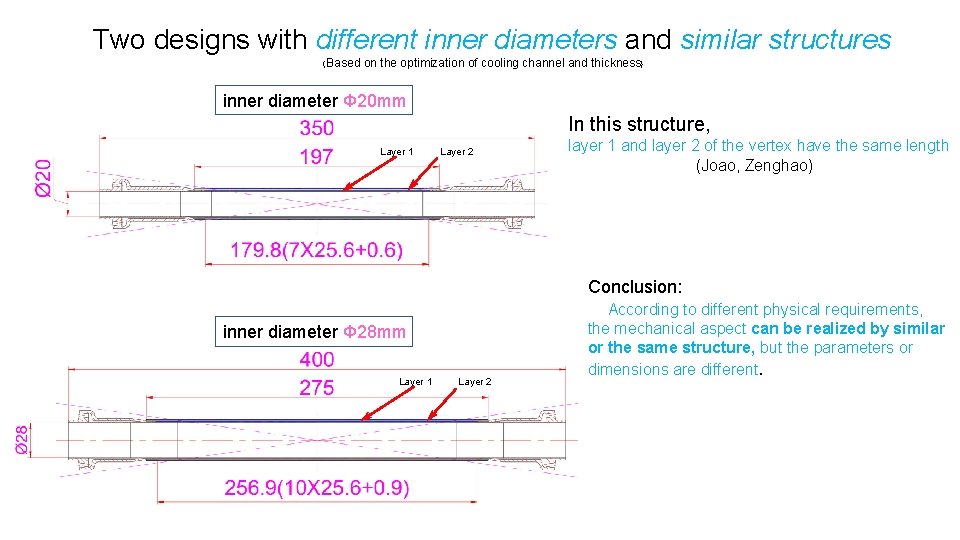
Two designs with different inner diameters and similar structures (Based on the optimization of cooling channel and thickness) inner diameter Φ 20 mm In this structure, Layer 1 Layer 2 layer 1 and layer 2 of the vertex have the same length (Joao, Zenghao) Conclusion: inner diameter Φ 28 mm Layer 1 Layer 2 According to different physical requirements, the mechanical aspect can be realized by similar or the same structure, but the parameters or dimensions are different.
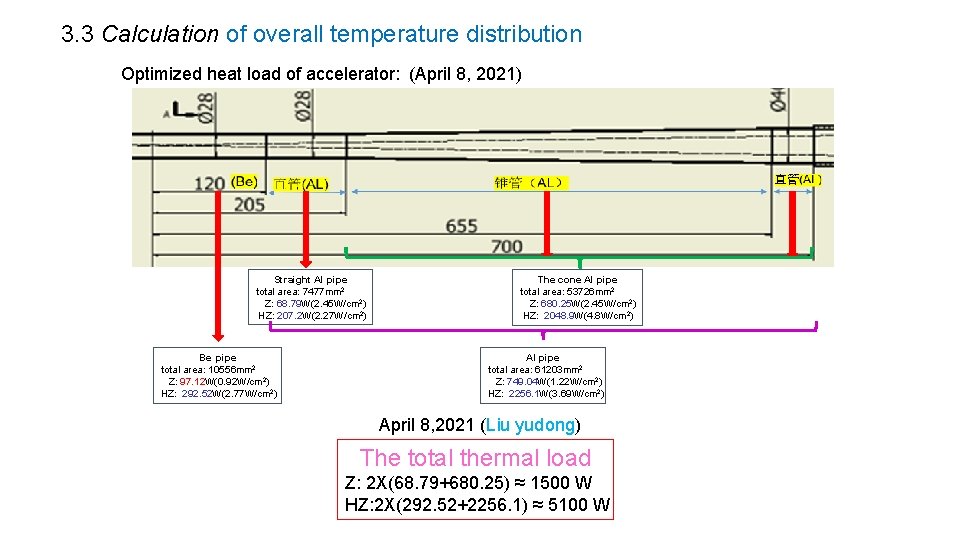
3. 3 Calculation of overall temperature distribution Optimized heat load of accelerator: (April 8, 2021) Straight Al pipe total area: 7477 mm 2 Z: 68. 79 W(2. 45 W/cm 2) HZ: 207. 2 W(2. 27 W/cm 2) Be pipe total area: 10556 mm 2 Z: 97. 12 W(0. 92 W/cm 2) HZ: 292. 52 W(2. 77 W/cm 2) The cone Al pipe total area: 53726 mm 2 Z: 680. 25 W(2. 45 W/cm 2) HZ: 2048. 9 W(4. 8 W/cm 2) Al pipe total area: 61203 mm 2 Z: 749. 04 W(1. 22 W/cm 2) HZ: 2256. 1 W(3. 69 W/cm 2) April 8, 2021 (Liu yudong) The total thermal load Z: 2 X(68. 79+680. 25) ≈ 1500 W HZ: 2 X(292. 52+2256. 1) ≈ 5100 W
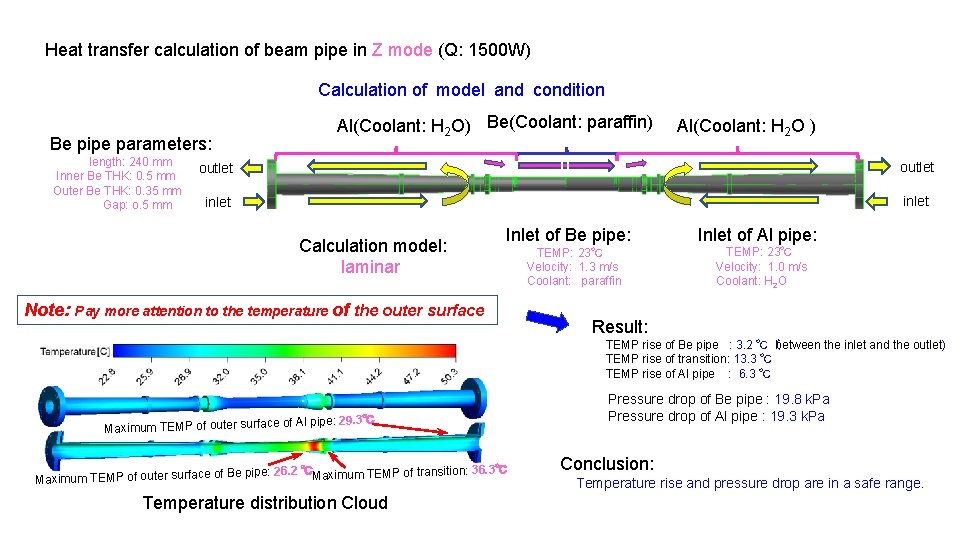
Heat transfer calculation of beam pipe in Z mode (Q: 1500 W) Calculation of model and condition Al(Coolant: H 2 O) Be(Coolant: paraffin) Be pipe parameters: length: 240 mm Inner Be THK: 0. 5 mm Outer Be THK: 0. 35 mm Gap: o. 5 mm Al(Coolant: H 2 O ) 0 outlet inlet Calculation model: laminar Inlet of Be pipe: Note: Pay more attention to the temperature of the outer surface TEMP: 23℃ Velocity: 1. 3 m/s Coolant: paraffin Inlet of Al pipe: TEMP: 23℃ Velocity: 1. 0 m/s Coolant: H 2 O Result: TEMP rise of Be pipe : 3. 2 ℃ (between the inlet and the outlet) TEMP rise of transition: 13. 3 ℃ TEMP rise of Al pipe : 6. 3 ℃ of Al pipe: 29. 3℃ Maximum TEMP of outer surface of Be pipe: 26. 2 ℃Maximum TEMP of transition: 36. 3℃ Temperature distribution Cloud Pressure drop of Be pipe : 19. 8 k. Pa Pressure drop of Al pipe : 19. 3 k. Pa Conclusion: Temperature rise and pressure drop are in a safe range.
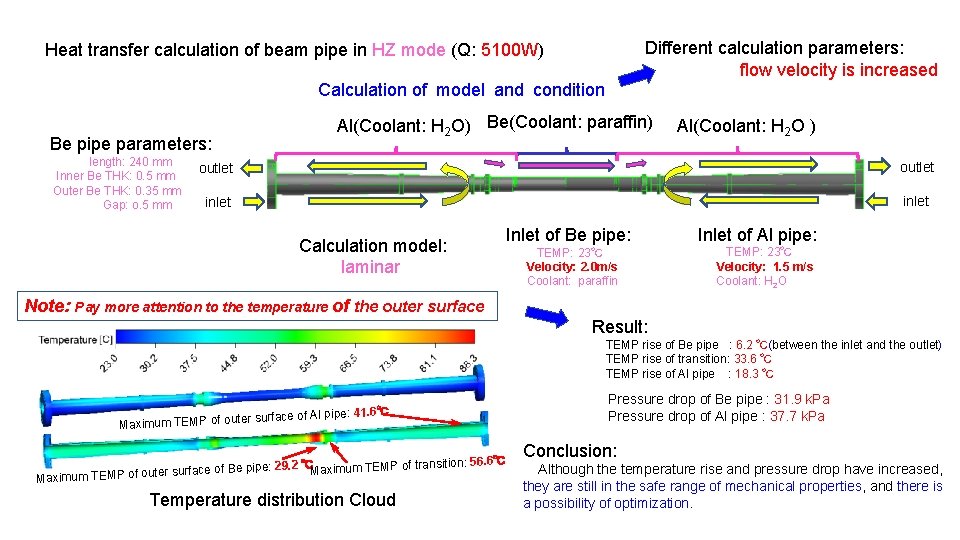
Different calculation parameters: flow velocity is increased Heat transfer calculation of beam pipe in HZ mode (Q: 5100 W) Calculation of model and condition Be pipe parameters: length: 240 mm Inner Be THK: 0. 5 mm Outer Be THK: 0. 35 mm Gap: o. 5 mm Al(Coolant: H 2 O) Be(Coolant: paraffin) Al(Coolant: H 2 O ) outlet inlet Calculation model: laminar Inlet of Be pipe: TEMP: 23℃ Velocity: 2. 0 m/s Coolant: paraffin Inlet of Al pipe: TEMP: 23℃ Velocity: 1. 5 m/s Coolant: H 2 O Note: Pay more attention to the temperature of the outer surface Result: TEMP rise of Be pipe : 6. 2 ℃(between the inlet and the outlet) TEMP rise of transition: 33. 6 ℃ TEMP rise of Al pipe : 18. 3 ℃ ce of Al pipe: 41. 6℃ um TEMP of outer surfa Maximum TEMP of ℃ e: 29. 2 ℃Maximum TEMP of transition: 56. 6 outer surface of Be pip Temperature distribution Cloud Pressure drop of Be pipe : 31. 9 k. Pa Pressure drop of Al pipe : 37. 7 k. Pa Conclusion: Although the temperature rise and pressure drop have increased, they are still in the safe range of mechanical properties, and there is a possibility of optimization.
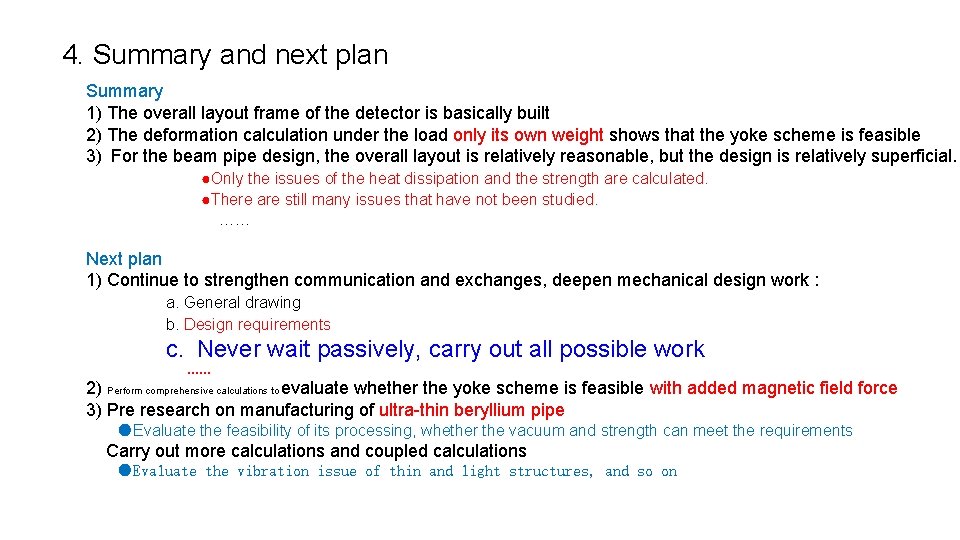
4. Summary and next plan Summary 1) The overall layout frame of the detector is basically built 2) The deformation calculation under the load only its own weight shows that the yoke scheme is feasible 3) For the beam pipe design, the overall layout is relatively reasonable, but the design is relatively superficial. ●Only the issues of the heat dissipation and the strength are calculated. ●There are still many issues that have not been studied. …… Next plan 1) Continue to strengthen communication and exchanges, deepen mechanical design work : a. General drawing b. Design requirements c. Never wait passively, carry out all possible work …… 2) Perform comprehensive calculations to evaluate whether the yoke scheme is feasible with added magnetic field force 3) Pre research on manufacturing of ultra-thin beryllium pipe ●Evaluate the feasibility of its processing, whether the vacuum and strength can meet the requirements Carry out more calculations and coupled calculations ●Evaluate the vibration issue of thin and light structures, and so on
Thanks!