
Unsupervised Machine Translation Alexis Conneau 3 rd year


- Slides: 56
Unsupervised Machine Translation Alexis Conneau 3 rd year Ph. D student Facebook AI Research, Université Le Mans Joint work with Guillaume Lample, Marc'Aurelio Ranzato, Ludovic Denoyer, Hervé Jégou
Motivation • Neural machine translation works well for language pairs with a lot of parallel data (English-French, English-German, etc. ) • Performance drops when parallel data is scarce • Vietnamese, Norwegian, Basque, Ukrainian, Serbian • The creation of parallel data is difficult, and costly 2
Motivation • Neural machine translation works well for language pairs with a lot of parallel data (English-French, English-German, etc. ) • Performance drops when parallel data is scarce • Vietnamese, Norwegian, Basque, Ukrainian, Serbian • The creation of parallel data is difficult, and costly • Most language pairs use English as a pivot • However, monolingual data is much easier to find 3
Questions • Can we use monolingual data to improve a MT system? • Can we reduce the amount of supervision? 4
Questions • Can we use monolingual data to improve a MT system? • Can we reduce the amount of supervision? • Can we even learn WITHOUT ANY supervision? 5
Prior work • Semi-supervised • Back-translation (Sennrich et al. , 2015) 6
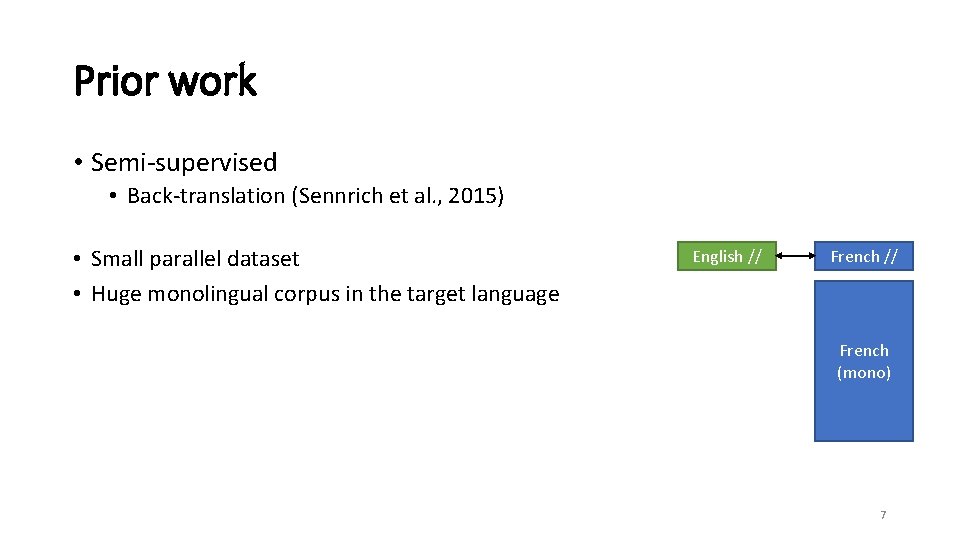
Prior work • Semi-supervised • Back-translation (Sennrich et al. , 2015) • Small parallel dataset • Huge monolingual corpus in the target language English // French (mono) 7
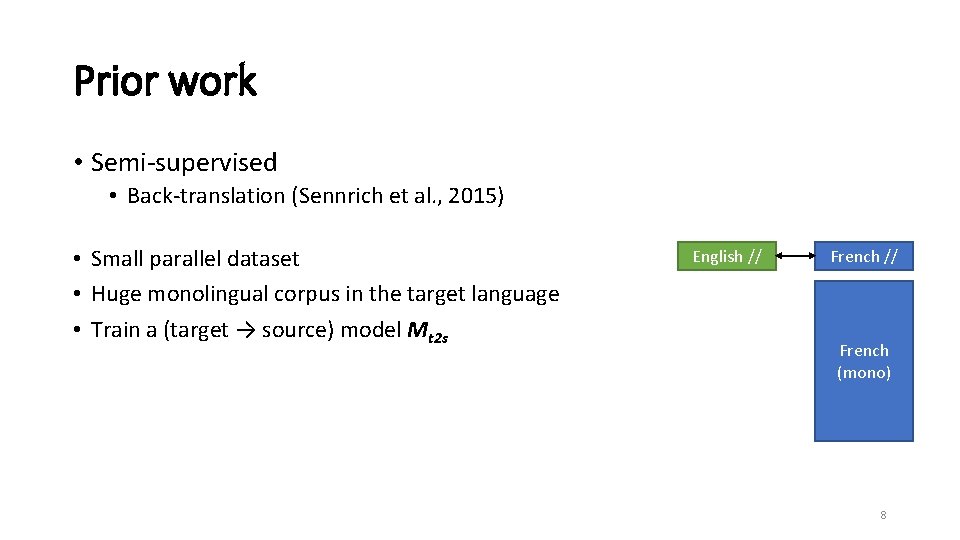
Prior work • Semi-supervised • Back-translation (Sennrich et al. , 2015) • Small parallel dataset • Huge monolingual corpus in the target language • Train a (target → source) model Mt 2 s English // French (mono) 8
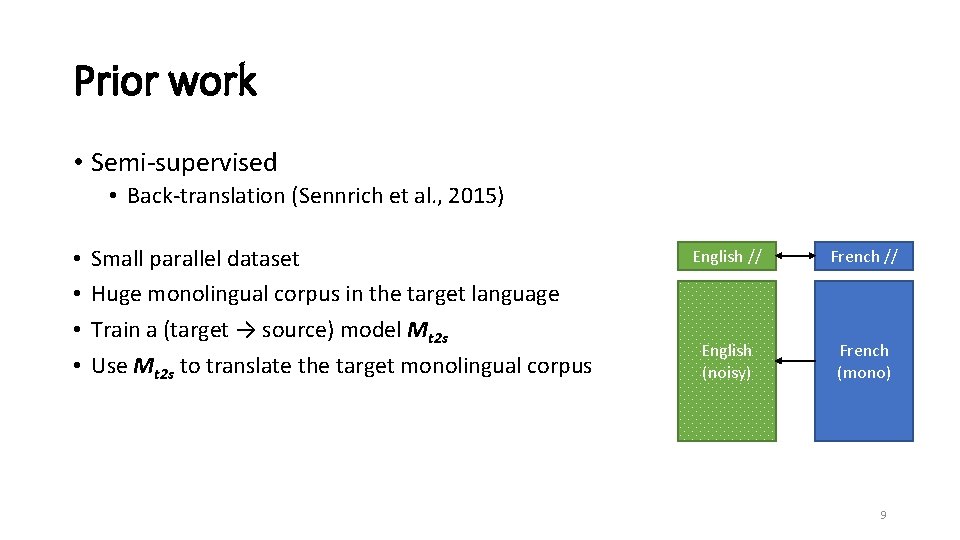
Prior work • Semi-supervised • Back-translation (Sennrich et al. , 2015) • • Small parallel dataset Huge monolingual corpus in the target language Train a (target → source) model Mt 2 s Use Mt 2 s to translate the target monolingual corpus English // French // English (noisy) French (mono) 9
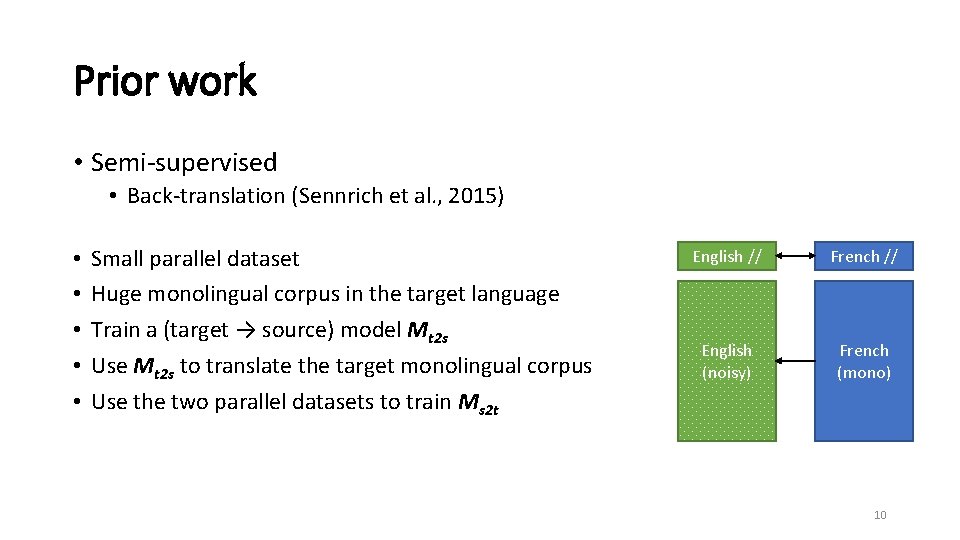
Prior work • Semi-supervised • Back-translation (Sennrich et al. , 2015) • • • Small parallel dataset Huge monolingual corpus in the target language Train a (target → source) model Mt 2 s Use Mt 2 s to translate the target monolingual corpus Use the two parallel datasets to train Ms 2 t English // French // English (noisy) French (mono) 10
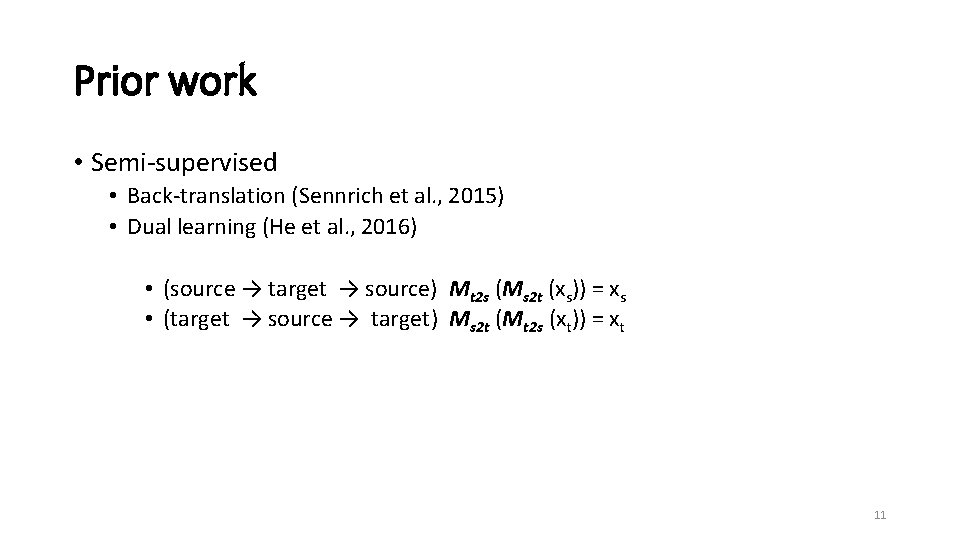
Prior work • Semi-supervised • Back-translation (Sennrich et al. , 2015) • Dual learning (He et al. , 2016) • (source → target → source) Mt 2 s (Ms 2 t (xs)) = xs • (target → source → target ) Ms 2 t (Mt 2 s (xt)) = xt 11
Prior work • Semi-supervised • Back-translation (Sennrich et al. , 2015) • Dual learning (He et al. , 2016) • Pivot-based • Related language pairs (Firat et al. , 2016; Johnson et al. , 2016) • Images (Nakayama & Nishida (2017), Lee et al. (2017)) 12
Prior work • Semi-supervised • Back-translation (Sennrich et al. , 2015) • Dual learning (He et al. , 2016) • Pivot-based • Related language pairs (Firat et al. , 2016; Johnson et al. , 2016) • Images (Nakayama & Nishida (2017), Lee et al. (2017)) • Fully unsupervised • Ravi & Knight, 2011 13
Our approach • Start with unsupervised word translation • Easier task to start with • Already insights of why it could work • Can be used as a first step towards unsupervised sentence translation 14
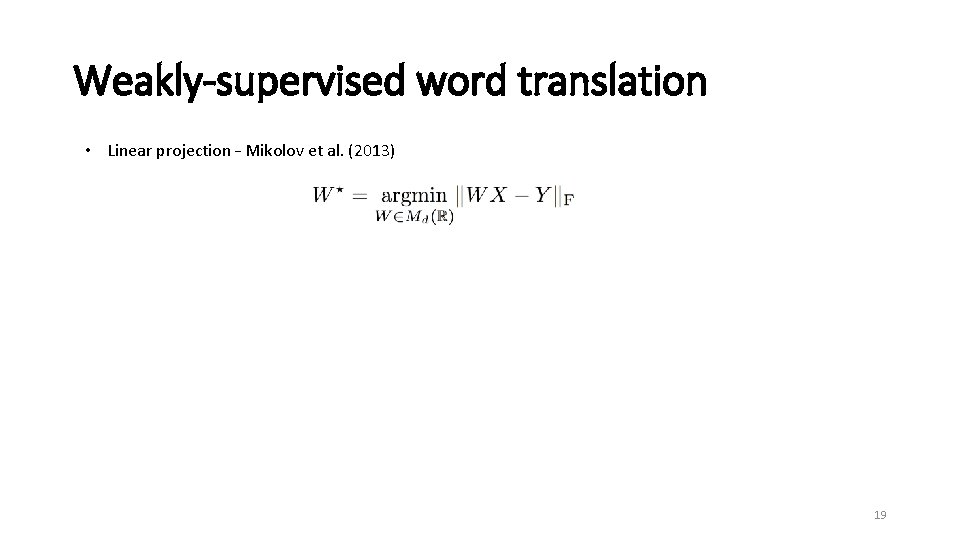
Weakly-supervised word translation • Exploiting similarities among languages for machine translation (Mikolov et al. , 2013)
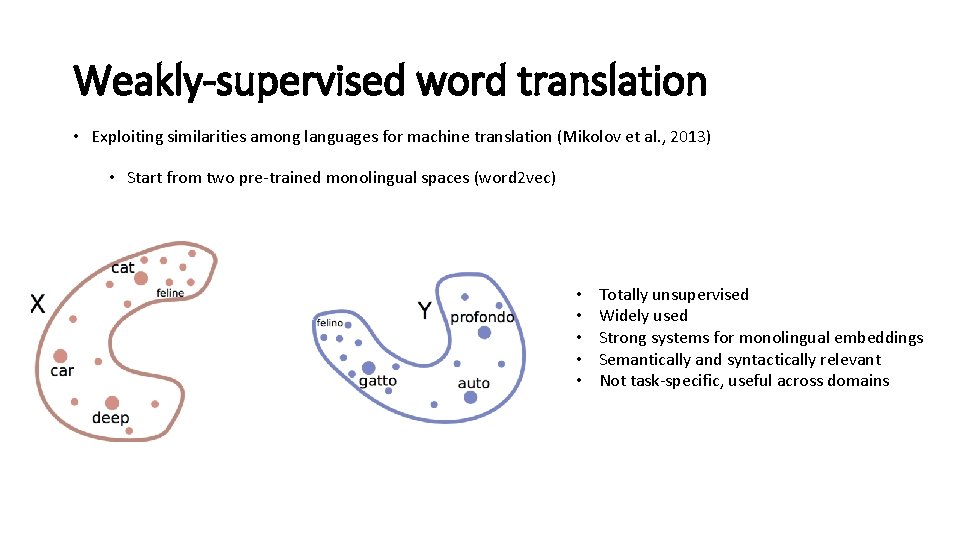
Weakly-supervised word translation • Exploiting similarities among languages for machine translation (Mikolov et al. , 2013) • Start from two pre-trained monolingual spaces (word 2 vec) • • • Totally unsupervised Widely used Strong systems for monolingual embeddings Semantically and syntactically relevant Not task-specific, useful across domains
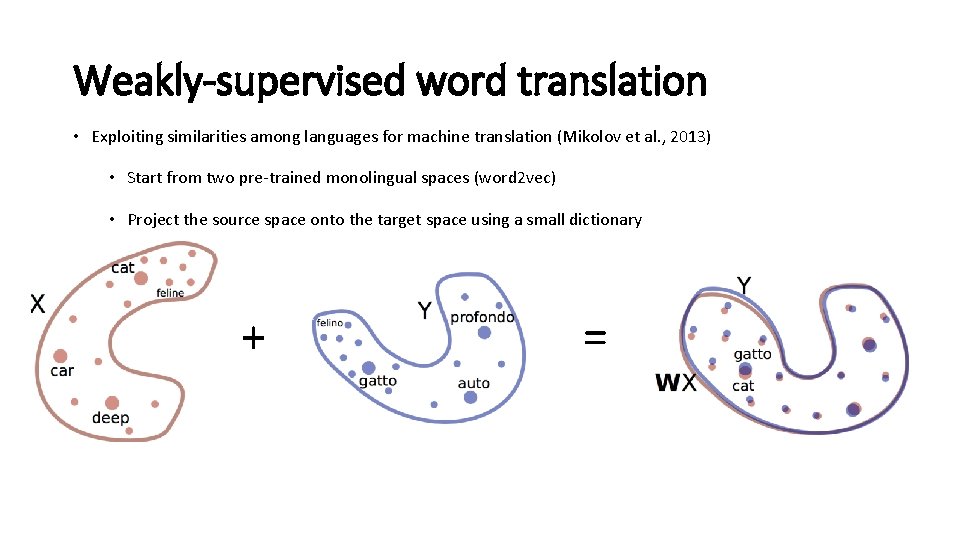
Weakly-supervised word translation • Exploiting similarities among languages for machine translation (Mikolov et al. , 2013) • Start from two pre-trained monolingual spaces (word 2 vec) • Project the source space onto the target space using a small dictionary + =
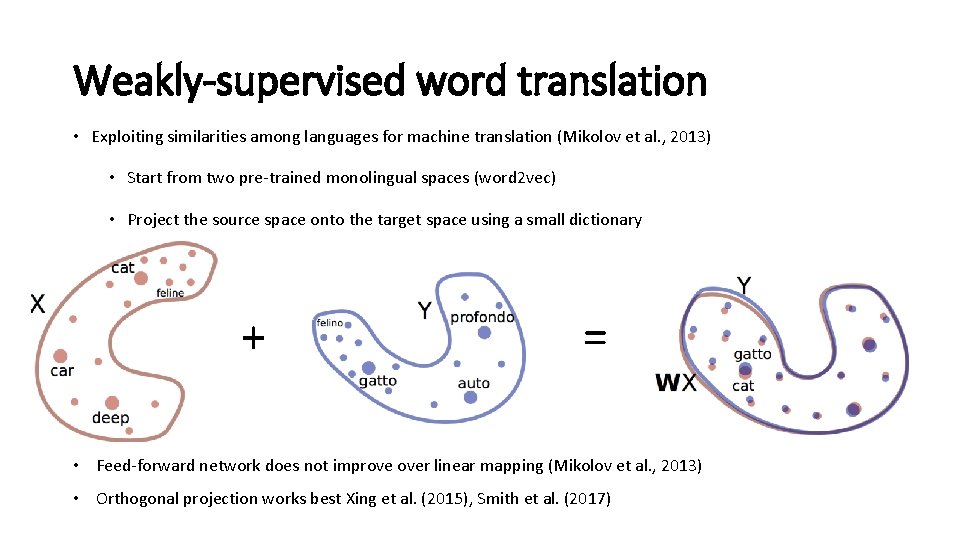
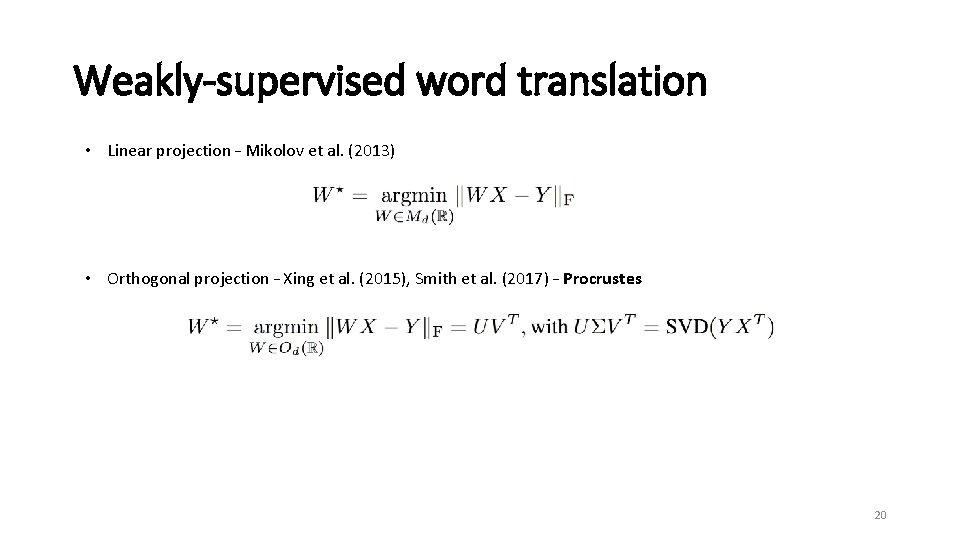
Weakly-supervised word translation • Exploiting similarities among languages for machine translation (Mikolov et al. , 2013) • Start from two pre-trained monolingual spaces (word 2 vec) • Project the source space onto the target space using a small dictionary + = • Feed-forward network does not improve over linear mapping (Mikolov et al. , 2013) • Orthogonal projection works best Xing et al. (2015), Smith et al. (2017)
Weakly-supervised word translation • Linear projection – Mikolov et al. (2013) 19
Weakly-supervised word translation • Linear projection – Mikolov et al. (2013) • Orthogonal projection – Xing et al. (2015), Smith et al. (2017) – Procrustes 20
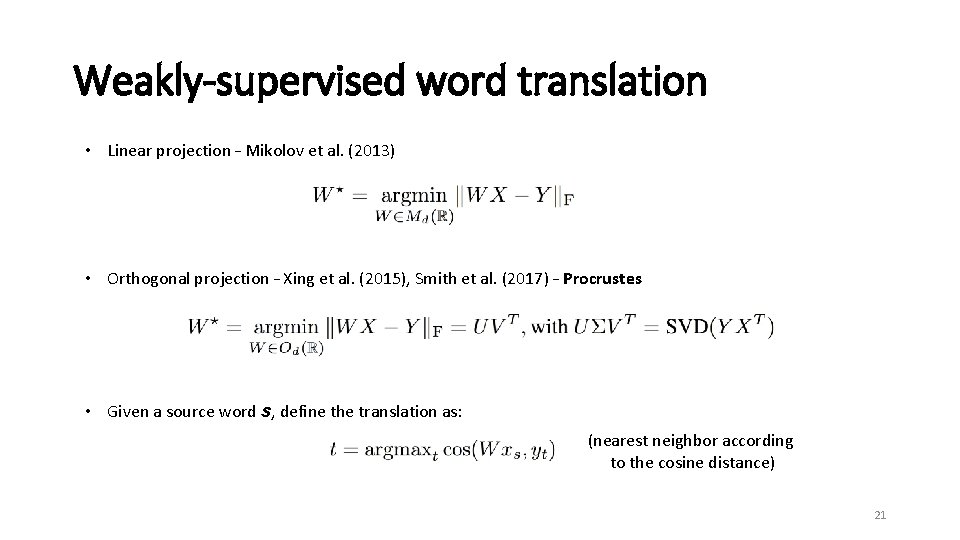
Weakly-supervised word translation • Linear projection – Mikolov et al. (2013) • Orthogonal projection – Xing et al. (2015), Smith et al. (2017) – Procrustes • Given a source word s, define the translation as: (nearest neighbor according to the cosine distance) 21
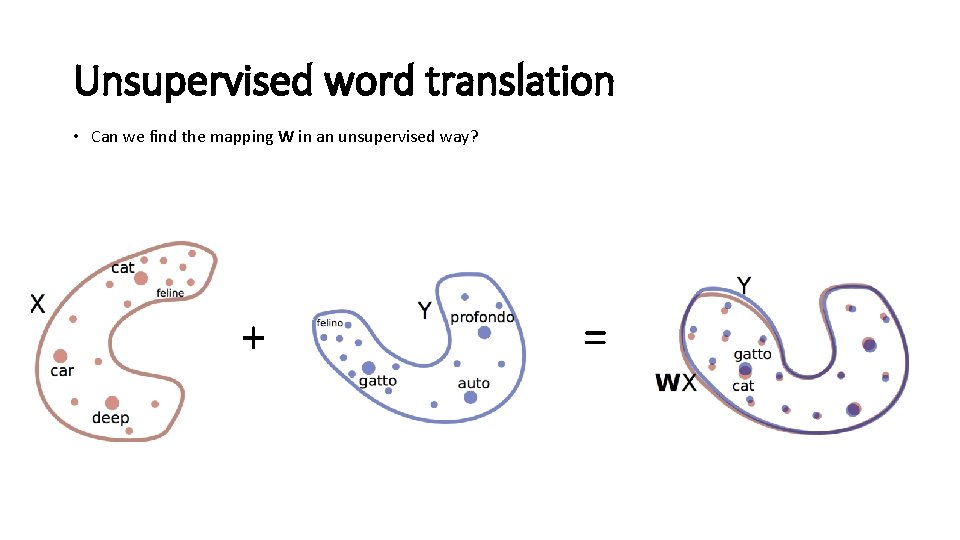
Unsupervised word translation • Can we find the mapping W in an unsupervised way? + =
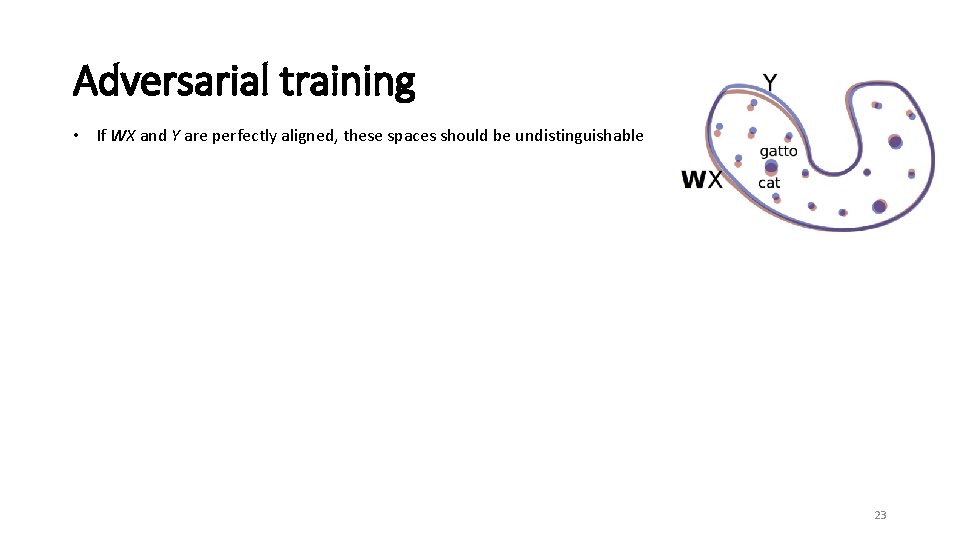
Adversarial training • If WX and Y are perfectly aligned, these spaces should be undistinguishable 23
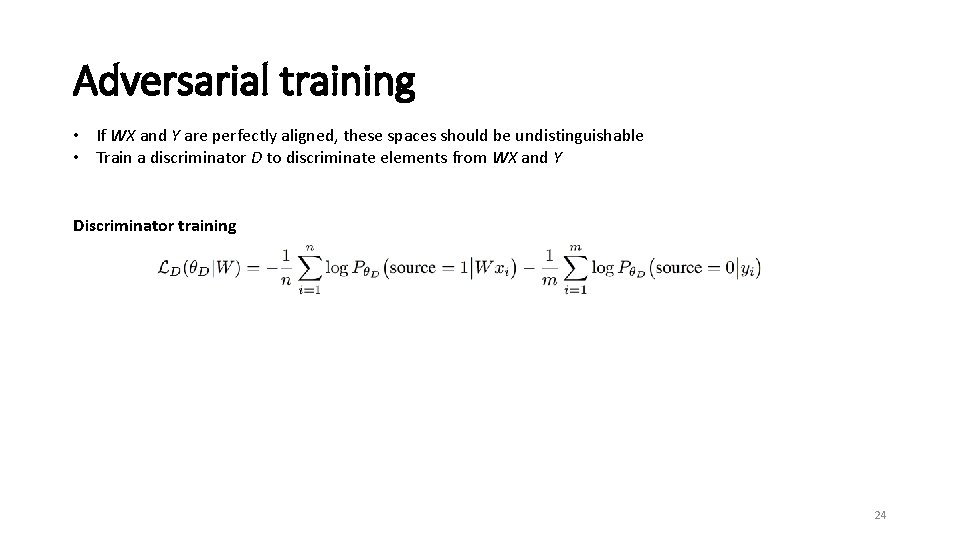
Adversarial training • If WX and Y are perfectly aligned, these spaces should be undistinguishable • Train a discriminator D to discriminate elements from WX and Y Discriminator training 24
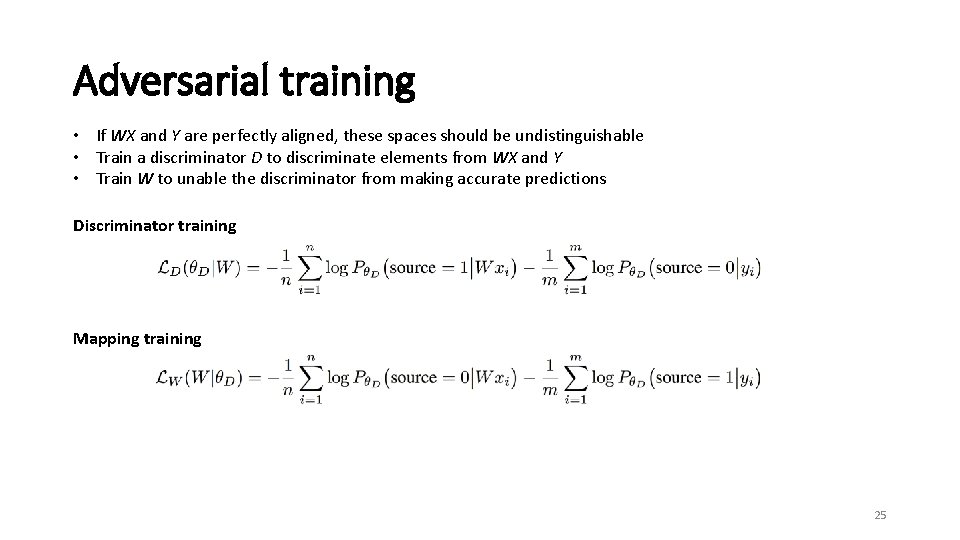
Adversarial training • If WX and Y are perfectly aligned, these spaces should be undistinguishable • Train a discriminator D to discriminate elements from WX and Y • Train W to unable the discriminator from making accurate predictions Discriminator training Mapping training 25
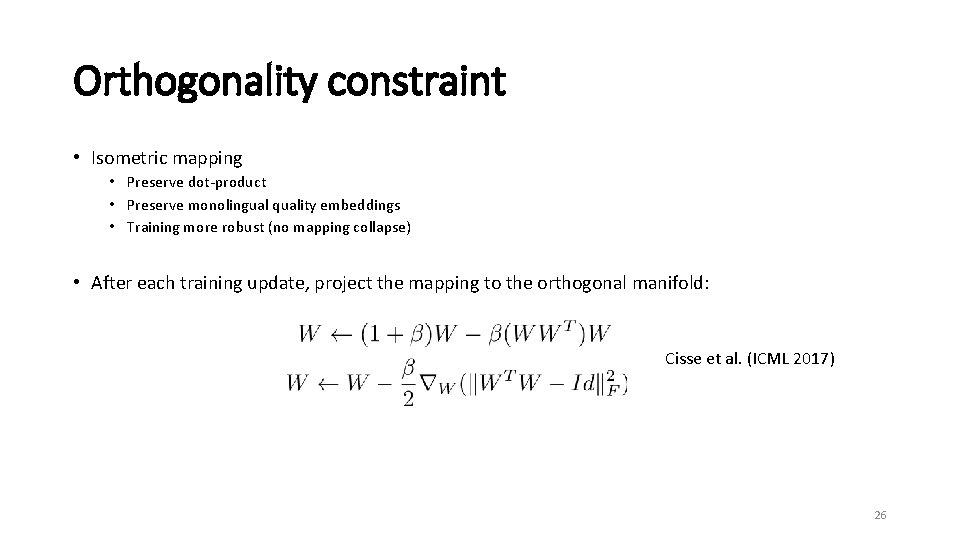
Orthogonality constraint • Isometric mapping • Preserve dot-product • Preserve monolingual quality embeddings • Training more robust (no mapping collapse) • After each training update, project the mapping to the orthogonal manifold: Cisse et al. (ICML 2017) 26
Results on word translation – Adversarial 27
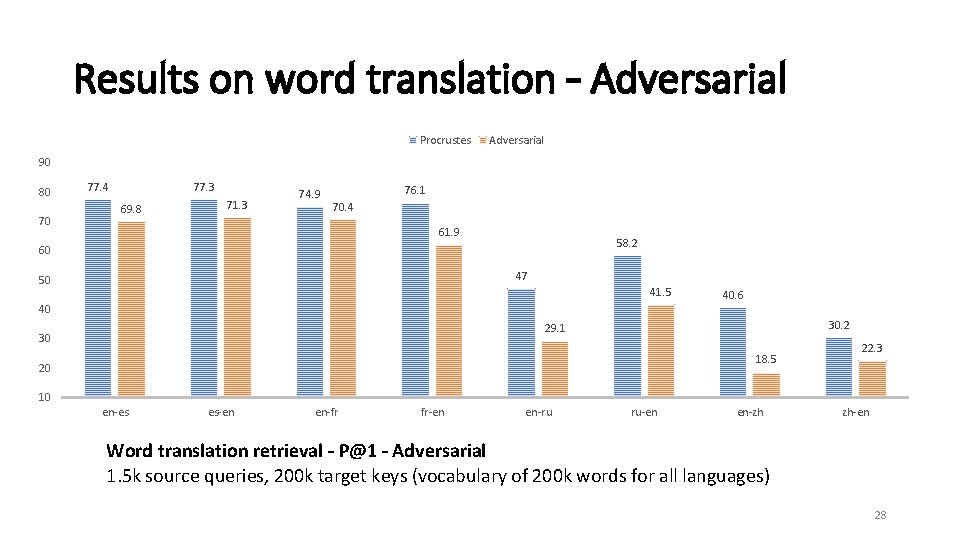
Results on word translation – Adversarial Procrustes Adversarial 90 80 70 77. 4 77. 3 69. 8 71. 3 74. 9 76. 1 70. 4 61. 9 58. 2 60 47 50 41. 5 40 40. 6 30. 2 29. 1 30 18. 5 20 22. 3 10 en-es es-en en-fr fr-en en-ru ru-en en-zh zh-en Word translation retrieval – P@1 – Adversarial 1. 5 k source queries, 200 k target keys (vocabulary of 200 k words for all languages) 28
Unsupervised word translation – Summary • Given independent monolingual datasets in a source and a target language: • We can create high-quality cross-lingual dictionaries • We can create high-quality cross-lingual embeddings 29
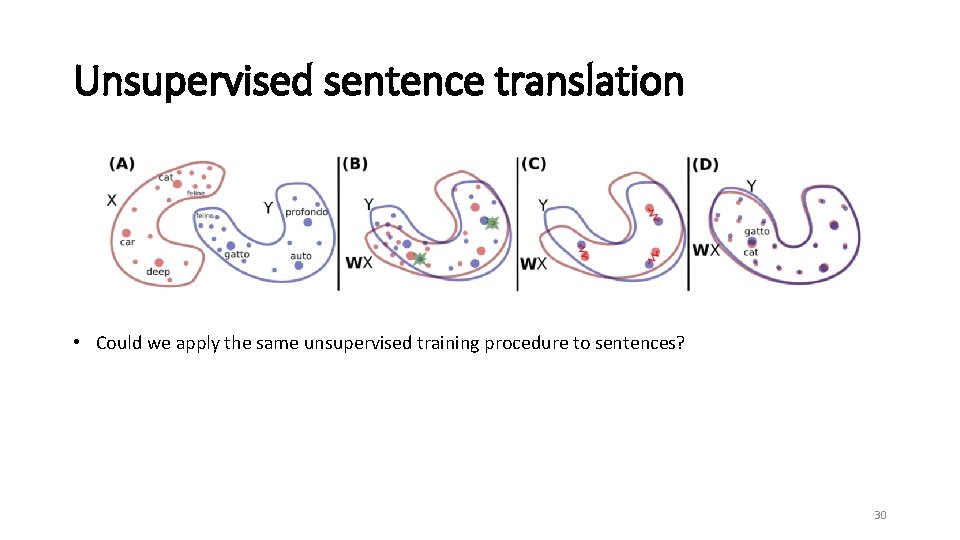
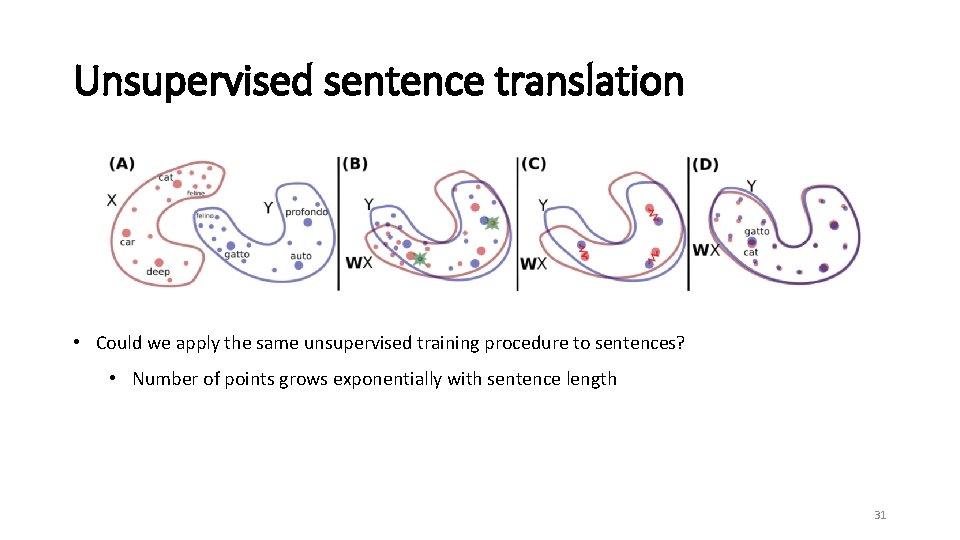
Unsupervised sentence translation • Could we apply the same unsupervised training procedure to sentences? 30
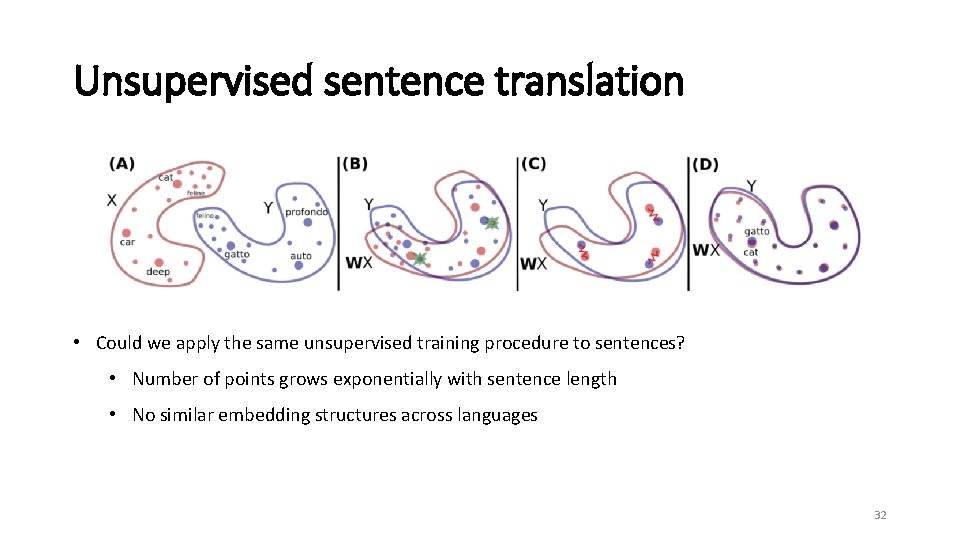
Unsupervised sentence translation • Could we apply the same unsupervised training procedure to sentences? • Number of points grows exponentially with sentence length 31
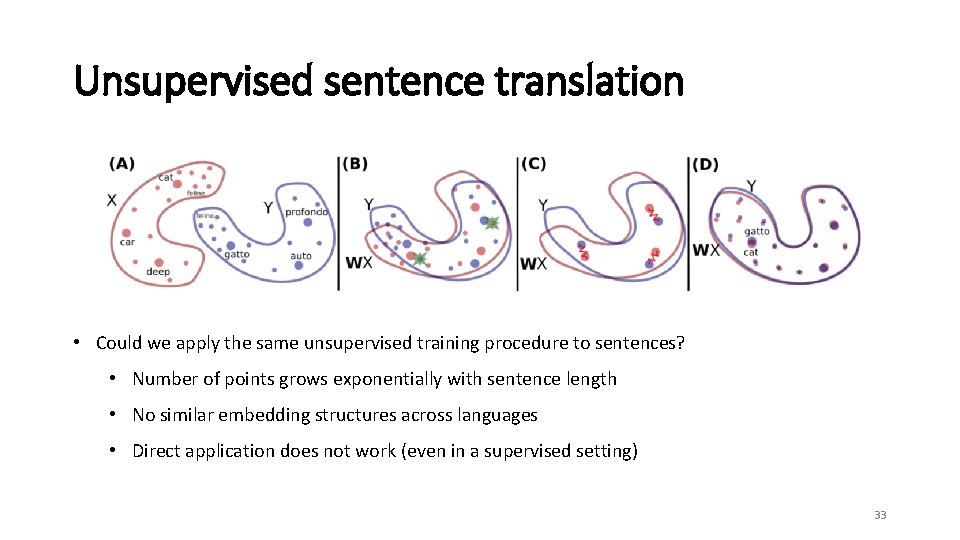
Unsupervised sentence translation • Could we apply the same unsupervised training procedure to sentences? • Number of points grows exponentially with sentence length • No similar embedding structures across languages 32
Unsupervised sentence translation • Could we apply the same unsupervised training procedure to sentences? • Number of points grows exponentially with sentence length • No similar embedding structures across languages • Direct application does not work (even in a supervised setting) 33
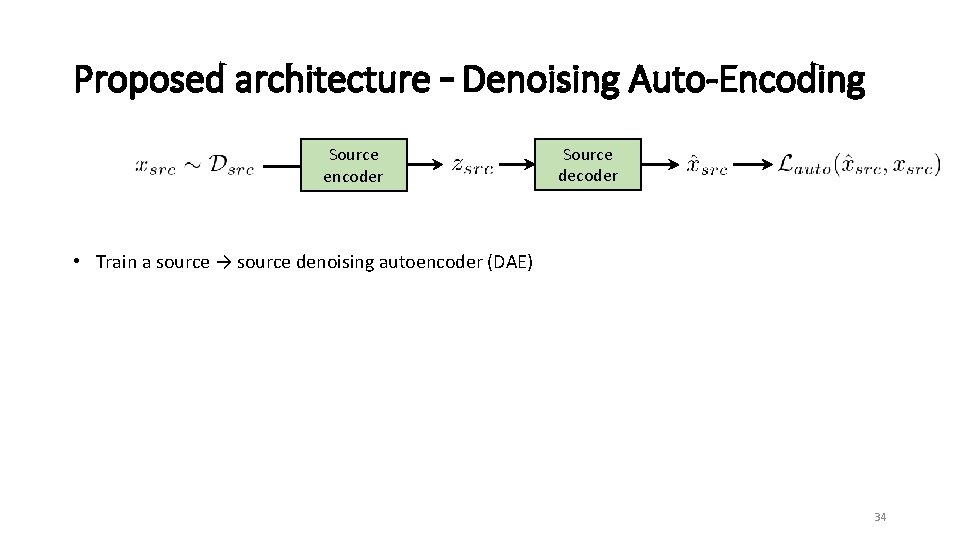
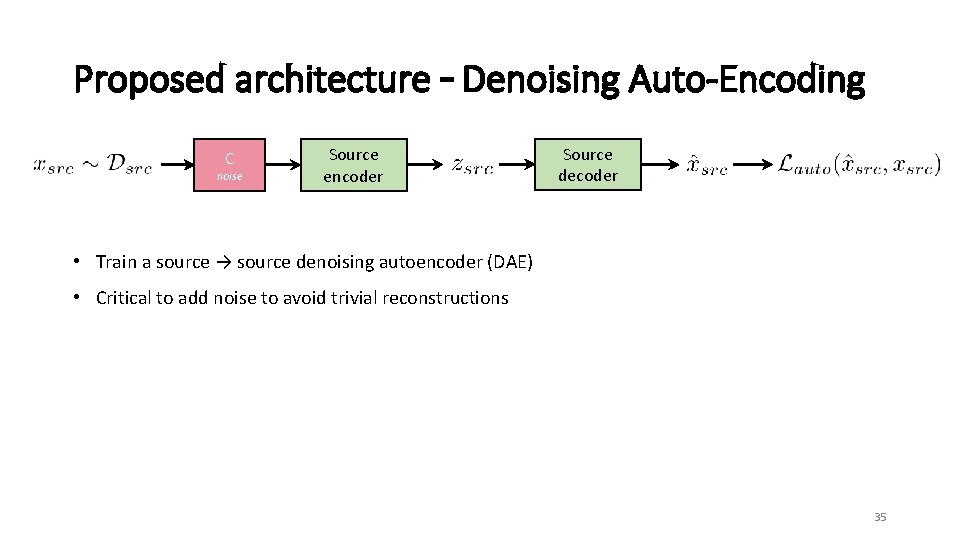
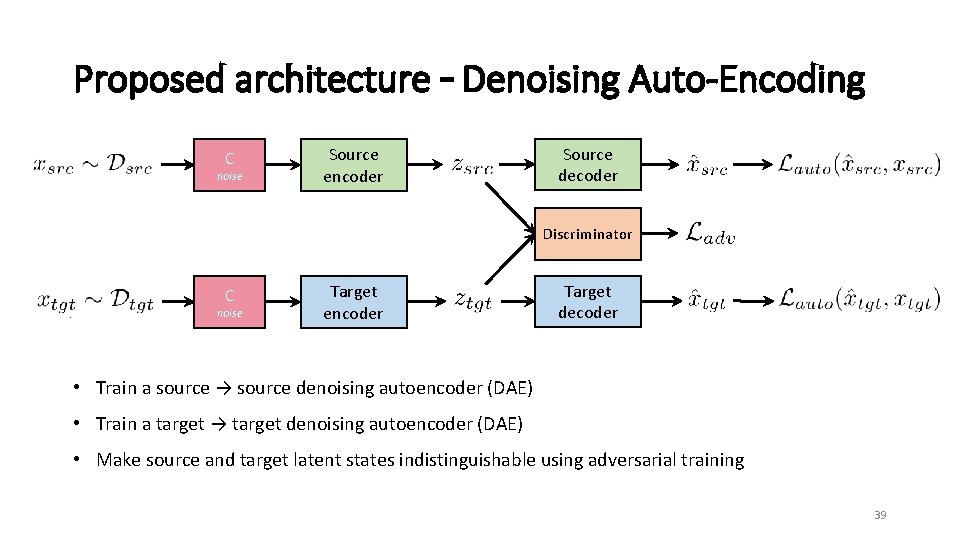
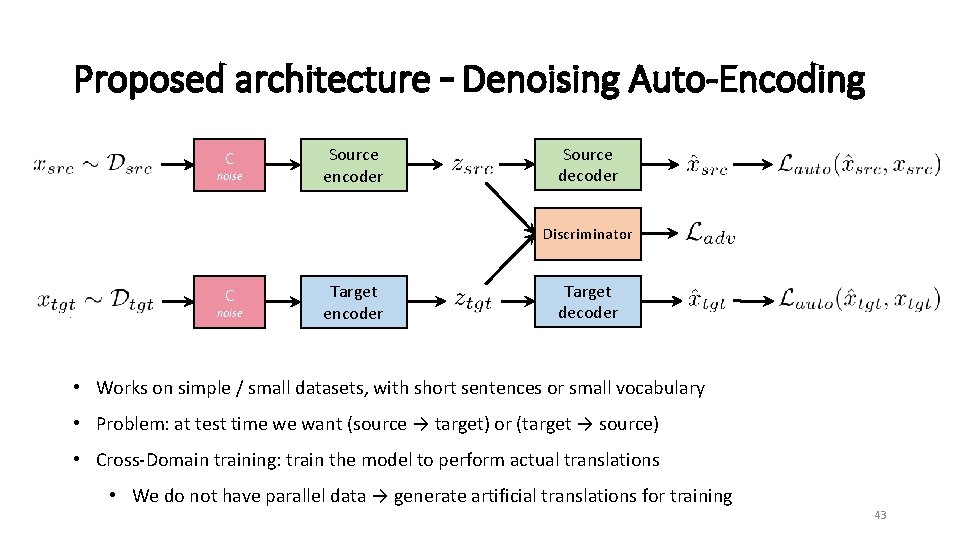
Proposed architecture – Denoising Auto-Encoding Source encoder Source decoder • Train a source → source denoising autoencoder (DAE) 34
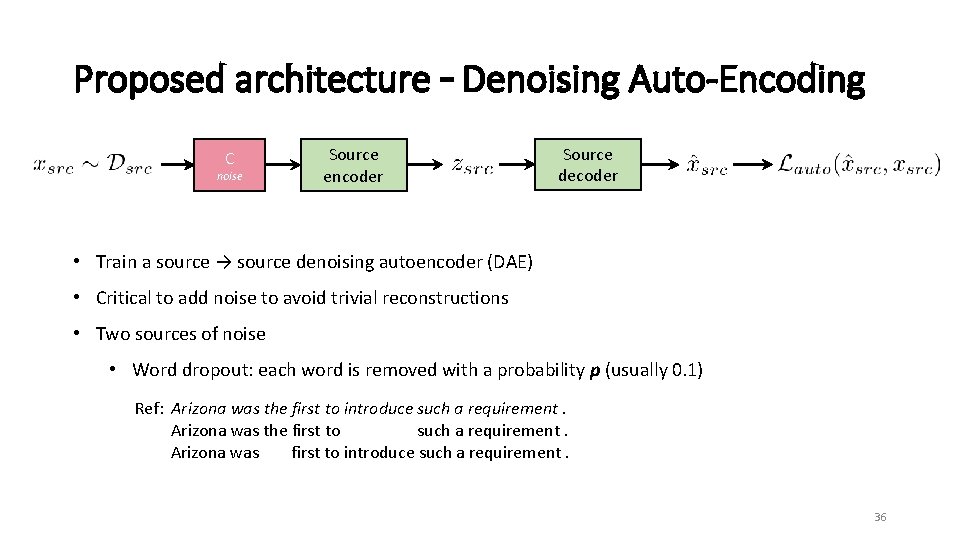
Proposed architecture – Denoising Auto-Encoding C noise Source encoder Source decoder • Train a source → source denoising autoencoder (DAE) • Critical to add noise to avoid trivial reconstructions 35
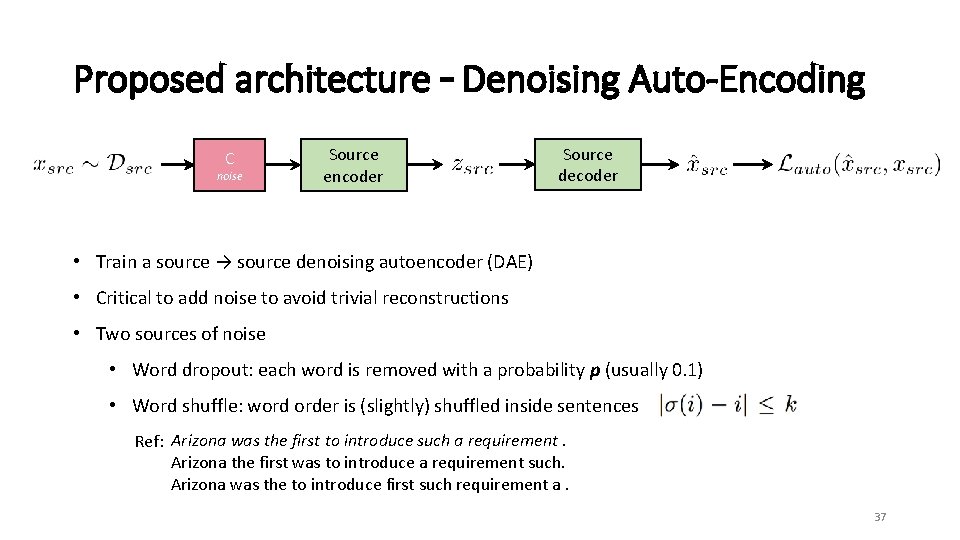
Proposed architecture – Denoising Auto-Encoding C noise Source encoder Source decoder • Train a source → source denoising autoencoder (DAE) • Critical to add noise to avoid trivial reconstructions • Two sources of noise • Word dropout: each word is removed with a probability p (usually 0. 1) Ref: Arizona was the first to introduce such a requirement. Arizona was the first to such a requirement. Arizona was first to introduce such a requirement. 36
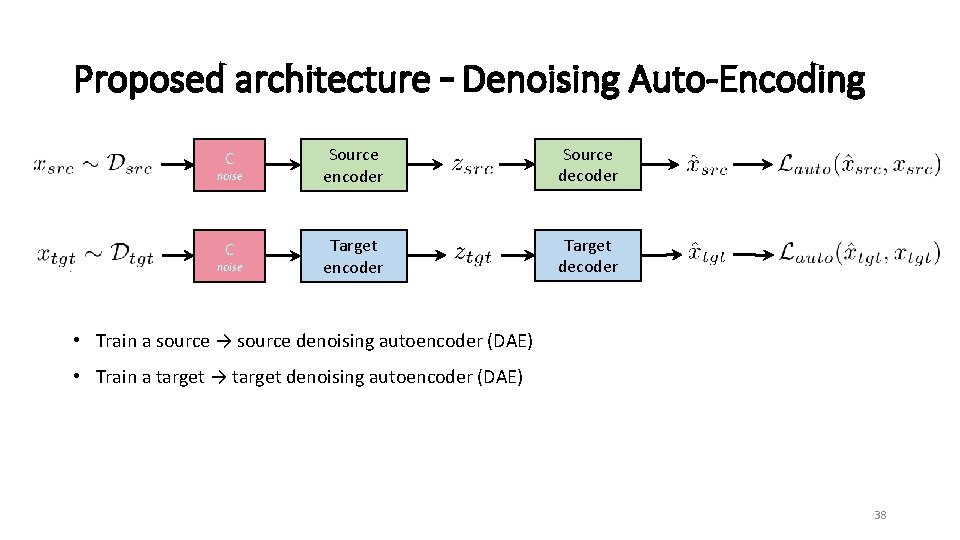
Proposed architecture – Denoising Auto-Encoding C noise Source encoder Source decoder • Train a source → source denoising autoencoder (DAE) • Critical to add noise to avoid trivial reconstructions • Two sources of noise • Word dropout: each word is removed with a probability p (usually 0. 1) • Word shuffle: word order is (slightly) shuffled inside sentences Ref: Arizona was the first to introduce such a requirement. Arizona the first was to introduce a requirement such. Arizona was the to introduce first such requirement a. 37
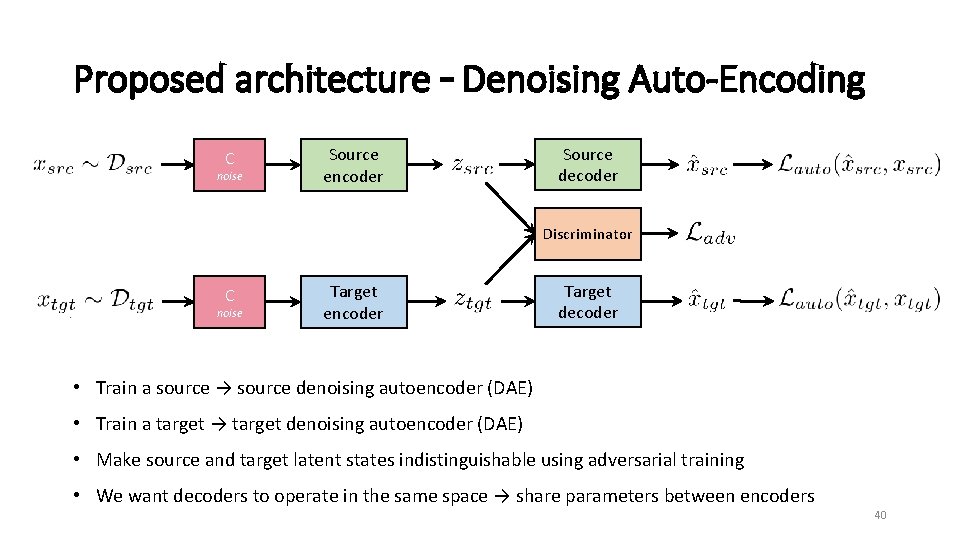
Proposed architecture – Denoising Auto-Encoding C Source encoder Source decoder C Target encoder Target decoder noise • Train a source → source denoising autoencoder (DAE) • Train a target → target denoising autoencoder (DAE) 38
Proposed architecture – Denoising Auto-Encoding C noise Source encoder Source decoder Discriminator C noise Target encoder Target decoder • Train a source → source denoising autoencoder (DAE) • Train a target → target denoising autoencoder (DAE) • Make source and target latent states indistinguishable using adversarial training 39
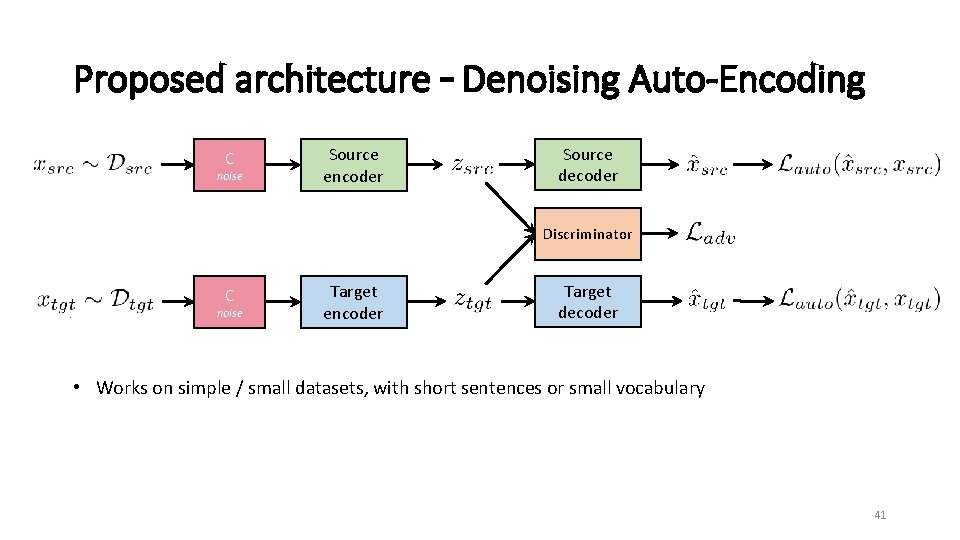
Proposed architecture – Denoising Auto-Encoding C noise Source encoder Source decoder Discriminator C noise Target encoder Target decoder • Train a source → source denoising autoencoder (DAE) • Train a target → target denoising autoencoder (DAE) • Make source and target latent states indistinguishable using adversarial training • We want decoders to operate in the same space → share parameters between encoders 40
Proposed architecture – Denoising Auto-Encoding C noise Source encoder Source decoder Discriminator C noise Target encoder Target decoder • Works on simple / small datasets, with short sentences or small vocabulary 41
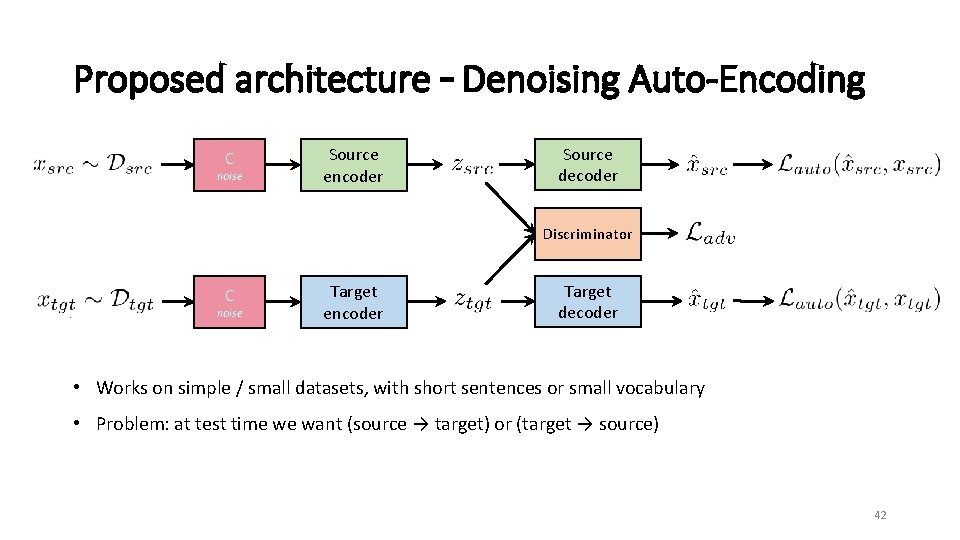
Proposed architecture – Denoising Auto-Encoding C noise Source encoder Source decoder Discriminator C noise Target encoder Target decoder • Works on simple / small datasets, with short sentences or small vocabulary • Problem: at test time we want (source → target) or (target → source) 42
Proposed architecture – Denoising Auto-Encoding C noise Source encoder Source decoder Discriminator C noise Target encoder Target decoder • Works on simple / small datasets, with short sentences or small vocabulary • Problem: at test time we want (source → target) or (target → source) • Cross-Domain training: train the model to perform actual translations • We do not have parallel data → generate artificial translations for training 43
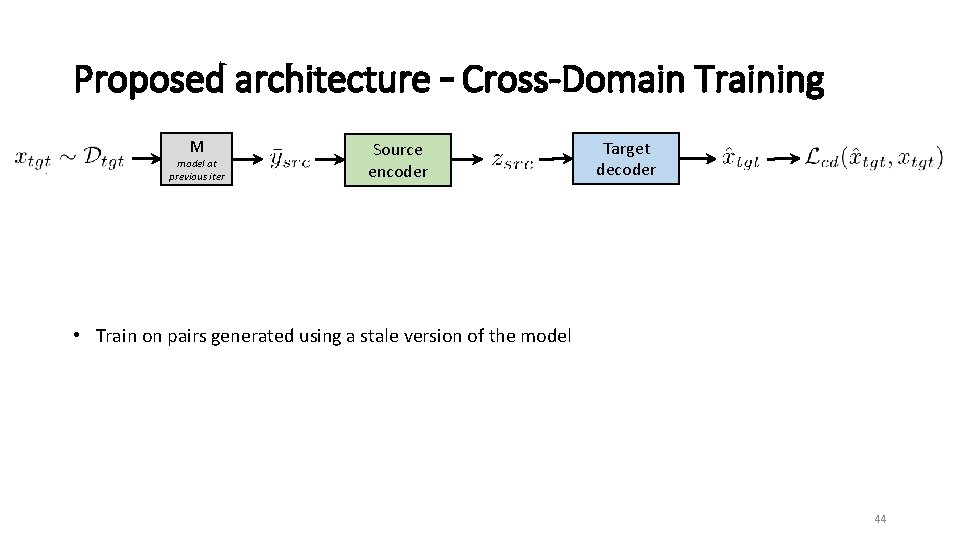
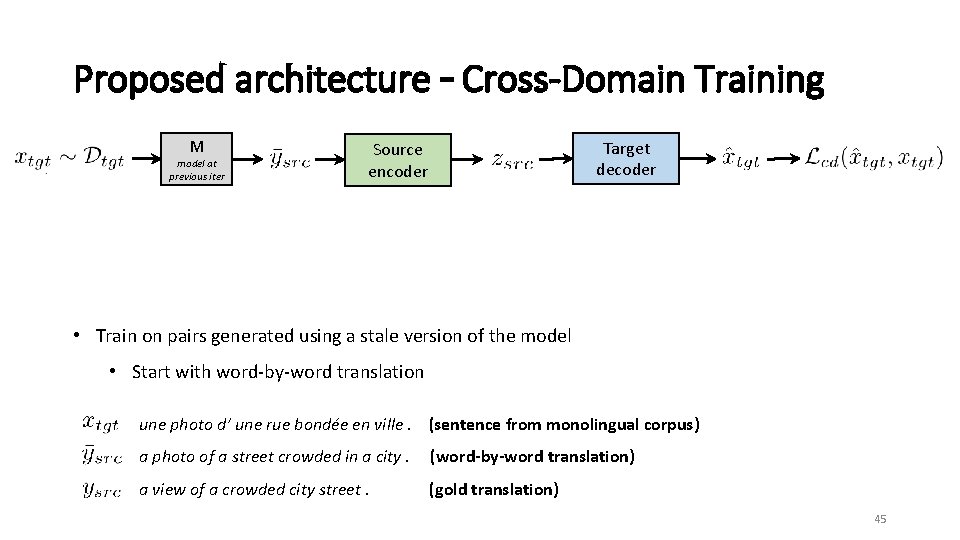
Proposed architecture – Cross-Domain Training M model at previous iter Source encoder Target decoder • Train on pairs generated using a stale version of the model 44
Proposed architecture – Cross-Domain Training M model at previous iter Target decoder Source encoder • Train on pairs generated using a stale version of the model • Start with word-by-word translation une photo d’ une rue bondée en ville. (sentence from monolingual corpus) a photo of a street crowded in a city. (word-by-word translation) a view of a crowded city street. (gold translation) 45
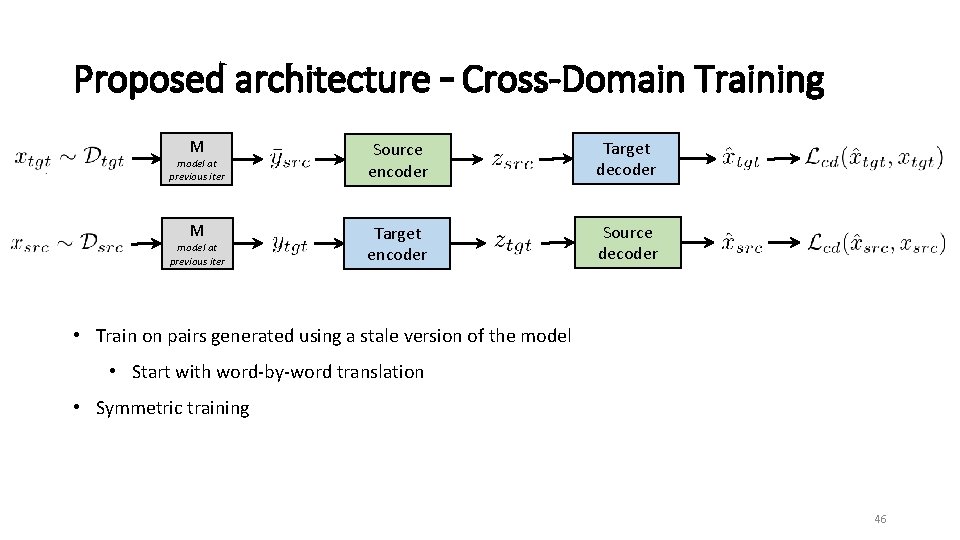
Proposed architecture – Cross-Domain Training M Source encoder Target decoder M Target encoder Source decoder model at previous iter • Train on pairs generated using a stale version of the model • Start with word-by-word translation • Symmetric training 46
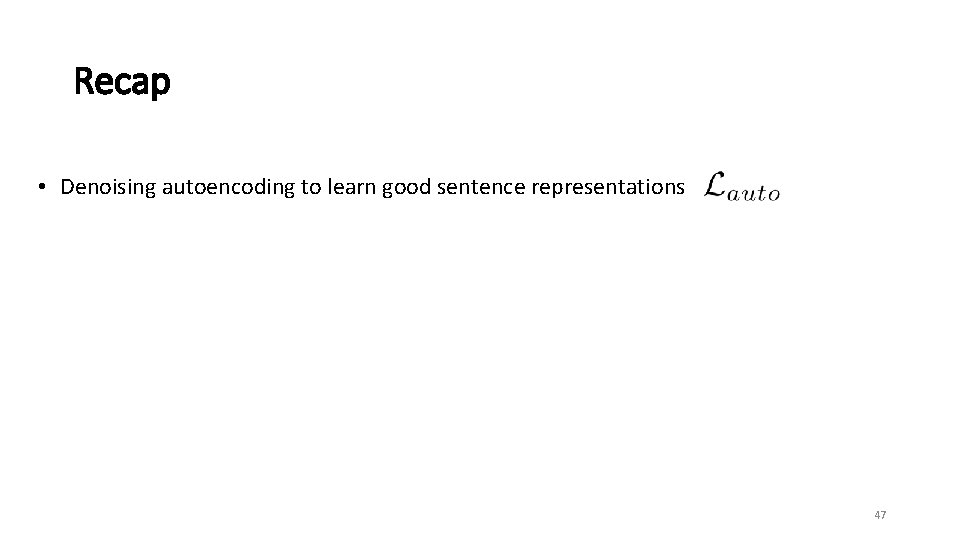
Recap • Denoising autoencoding to learn good sentence representations 47
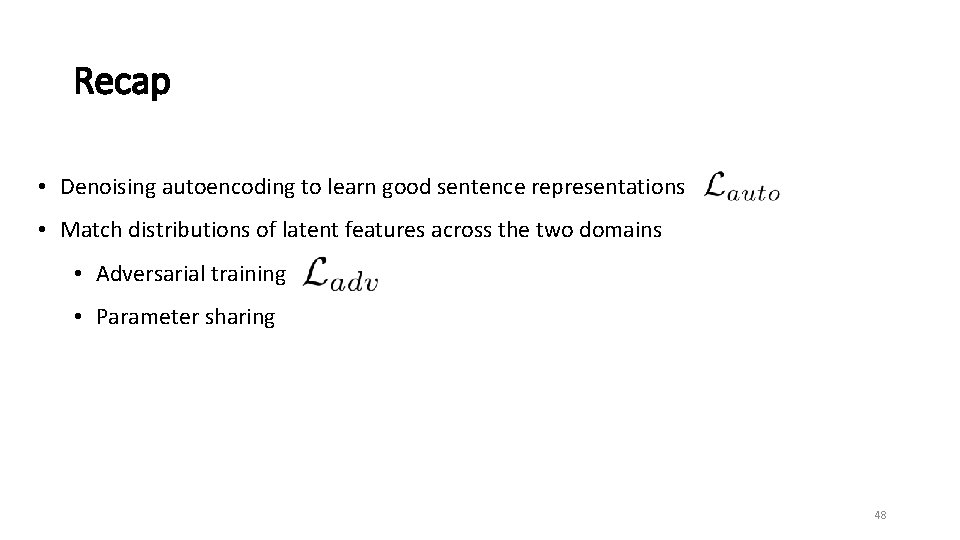
Recap • Denoising autoencoding to learn good sentence representations • Match distributions of latent features across the two domains • Adversarial training • Parameter sharing 48
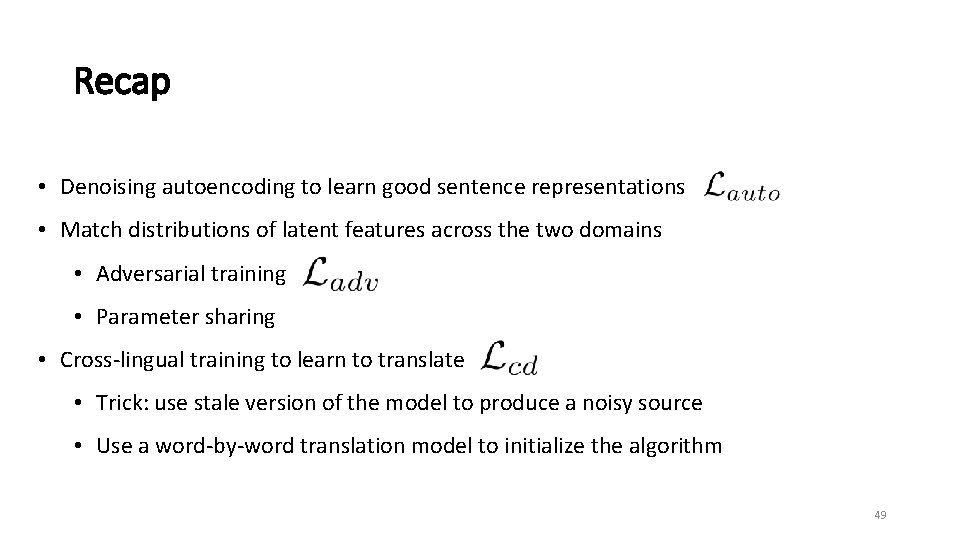
Recap • Denoising autoencoding to learn good sentence representations • Match distributions of latent features across the two domains • Adversarial training • Parameter sharing • Cross-lingual training to learn to translate • Trick: use stale version of the model to produce a noisy source • Use a word-by-word translation model to initialize the algorithm 49
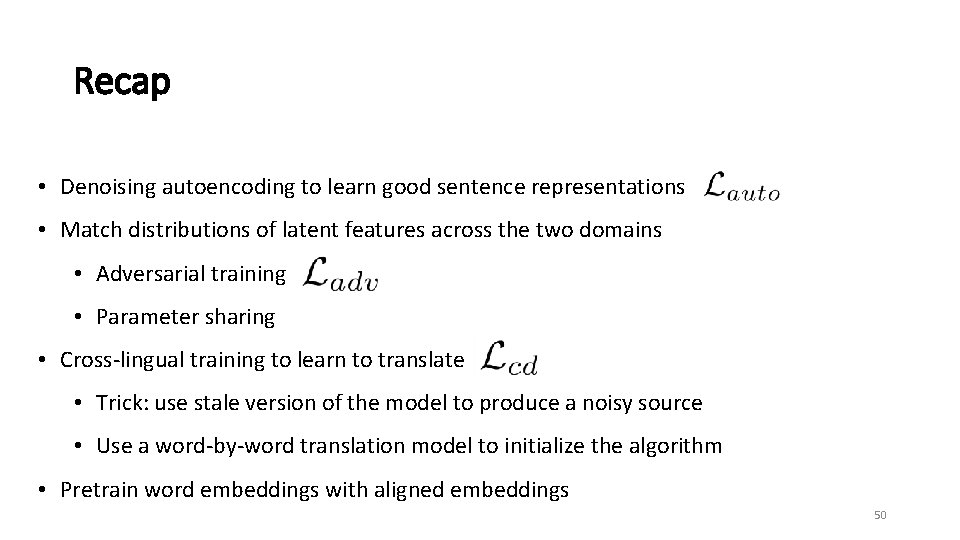
Recap • Denoising autoencoding to learn good sentence representations • Match distributions of latent features across the two domains • Adversarial training • Parameter sharing • Cross-lingual training to learn to translate • Trick: use stale version of the model to produce a noisy source • Use a word-by-word translation model to initialize the algorithm • Pretrain word embeddings with aligned embeddings 50
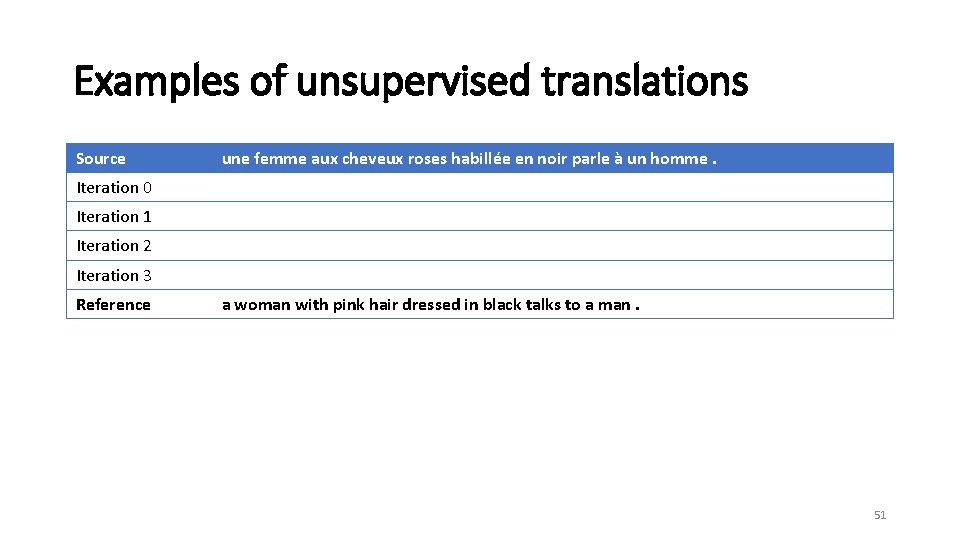
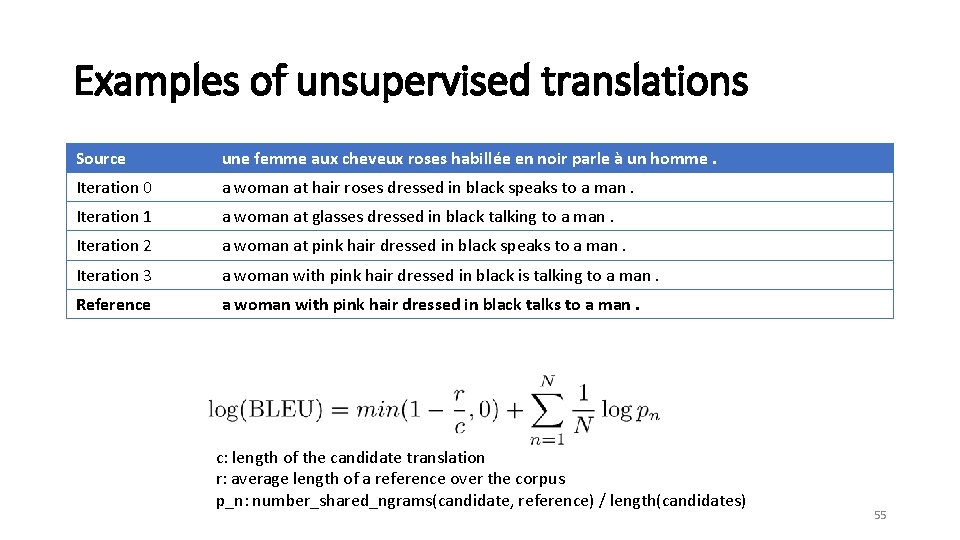
Examples of unsupervised translations Source une femme aux cheveux roses habillée en noir parle à un homme. Iteration 0 Iteration 1 Iteration 2 Iteration 3 Reference a woman with pink hair dressed in black talks to a man. 51
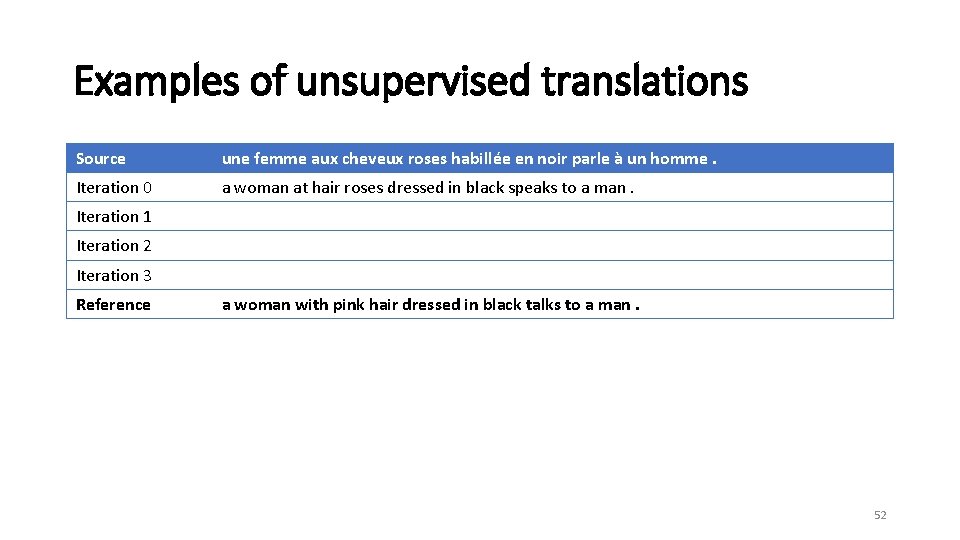
Examples of unsupervised translations Source une femme aux cheveux roses habillée en noir parle à un homme. Iteration 0 a woman at hair roses dressed in black speaks to a man. Iteration 1 Iteration 2 Iteration 3 Reference a woman with pink hair dressed in black talks to a man. 52
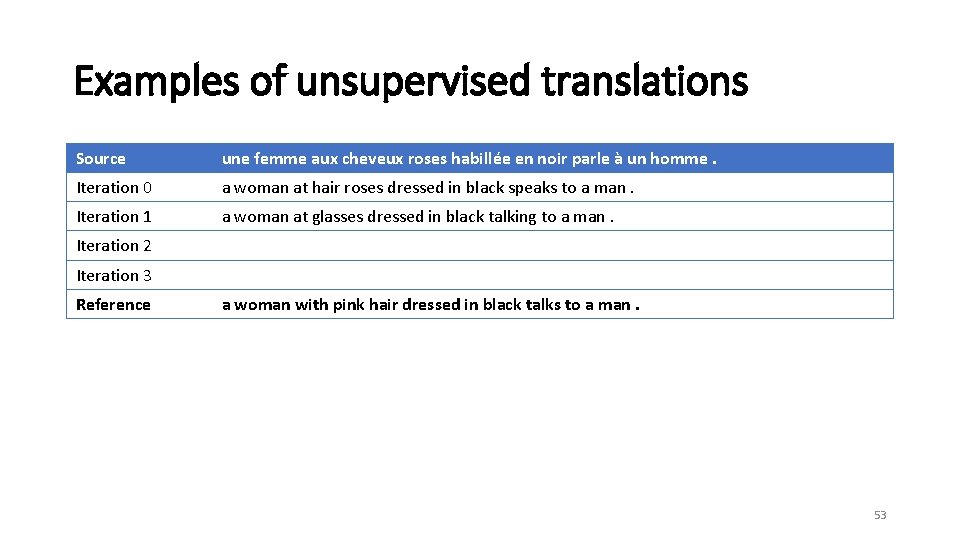
Examples of unsupervised translations Source une femme aux cheveux roses habillée en noir parle à un homme. Iteration 0 a woman at hair roses dressed in black speaks to a man. Iteration 1 a woman at glasses dressed in black talking to a man. Iteration 2 Iteration 3 Reference a woman with pink hair dressed in black talks to a man. 53
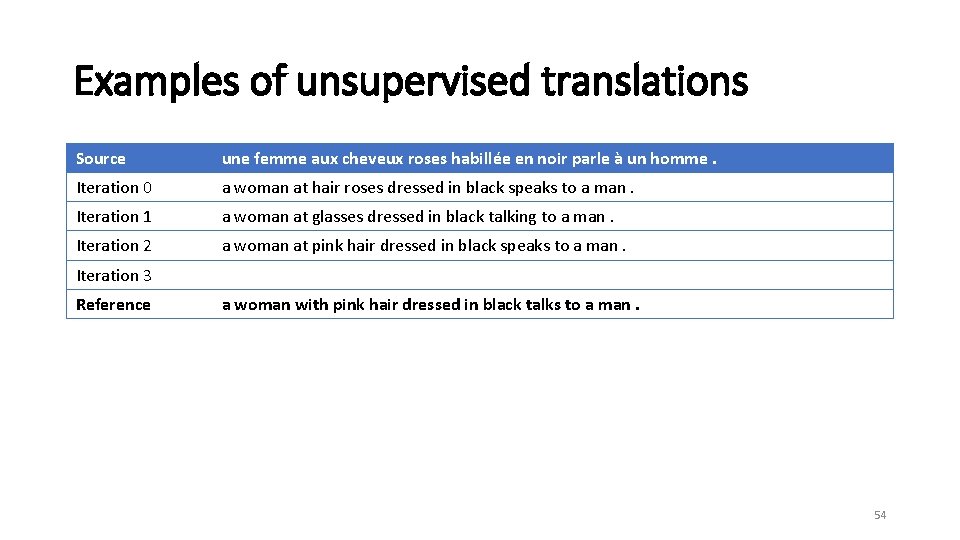
Examples of unsupervised translations Source une femme aux cheveux roses habillée en noir parle à un homme. Iteration 0 a woman at hair roses dressed in black speaks to a man. Iteration 1 a woman at glasses dressed in black talking to a man. Iteration 2 a woman at pink hair dressed in black speaks to a man. Iteration 3 Reference a woman with pink hair dressed in black talks to a man. 54
Examples of unsupervised translations Source une femme aux cheveux roses habillée en noir parle à un homme. Iteration 0 a woman at hair roses dressed in black speaks to a man. Iteration 1 a woman at glasses dressed in black talking to a man. Iteration 2 a woman at pink hair dressed in black speaks to a man. Iteration 3 a woman with pink hair dressed in black is talking to a man. Reference a woman with pink hair dressed in black talks to a man. c: length of the candidate translation r: average length of a reference over the corpus p_n: number_shared_ngrams(candidate, reference) / length(candidates) 55
Thank you Word translation without parallel data Alexis Conneau *, Guillaume Lample *, Marc'Aurelio Ranzato, Ludovic Denoyer, Hervé Jégou (ICLR 2018) Code: https: //github. com/facebookresearch/MUSE Unsupervised Machine Translation Using Monolingual Corpora Only Guillaume Lample, Alexis Conneau, Ludovic Denoyer, Marc'Aurelio Ranzato (ICLR 2018) 56