
Unsupervised Learning Clustering Web Search and Mining Lecture
Unsupervised Learning: Clustering Web Search and Mining Lecture 16: Clustering 1
Unsupervised Learning: Clustering Introduction Clustering § Document clustering § Motivations § Document representations § Success criteria § Clustering algorithms § Flat § Hierarchical 2
Unsupervised Learning: Clustering Introduction What is clustering? § Clustering: the process of grouping a set of objects into classes of similar objects § Documents within a cluster should be similar. § Documents from different clusters should be dissimilar. § The commonest form of unsupervised learning § Unsupervised learning = learning from raw data, as opposed to supervised data where a classification of examples is given § A common and important task that finds many applications in IR and other places 3
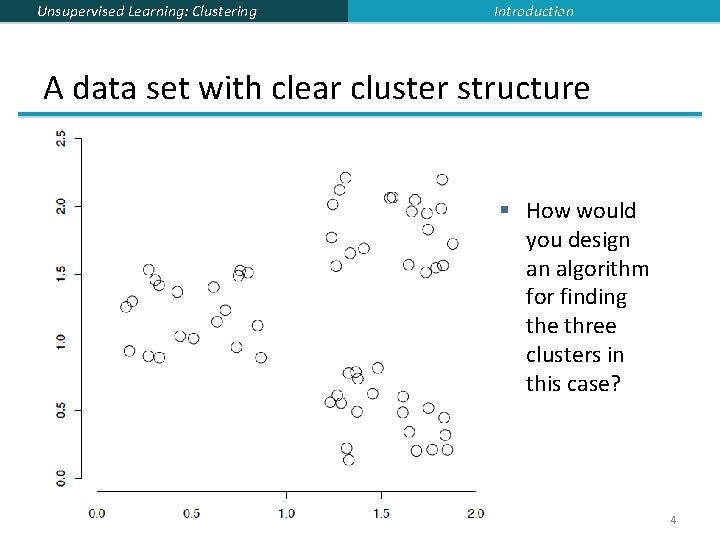
Unsupervised Learning: Clustering Introduction A data set with clear cluster structure § How would you design an algorithm for finding the three clusters in this case? 4
Unsupervised Learning: Clustering Introduction Applications of clustering in IR § Whole corpus analysis/navigation § Better user interface: search without typing § For improving recall in search applications § Better search results (like pseudo RF) § For better navigation of search results § Effective “user recall” will be higher § For speeding up vector space retrieval § Cluster-based retrieval gives faster search 5
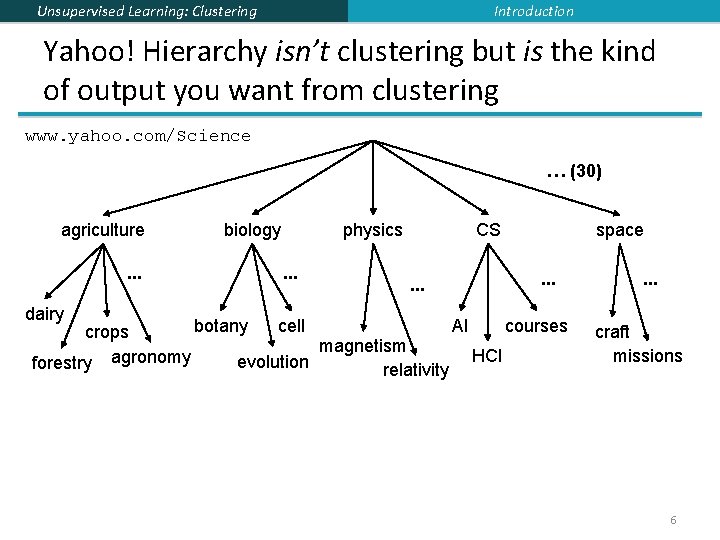
Introduction Unsupervised Learning: Clustering Yahoo! Hierarchy isn’t clustering but is the kind of output you want from clustering www. yahoo. com/Science … (30) agriculture. . . dairy biology physics. . . CS. . . space. . . botany cell AI courses crops magnetism HCI agronomy evolution forestry relativity . . . craft missions 6
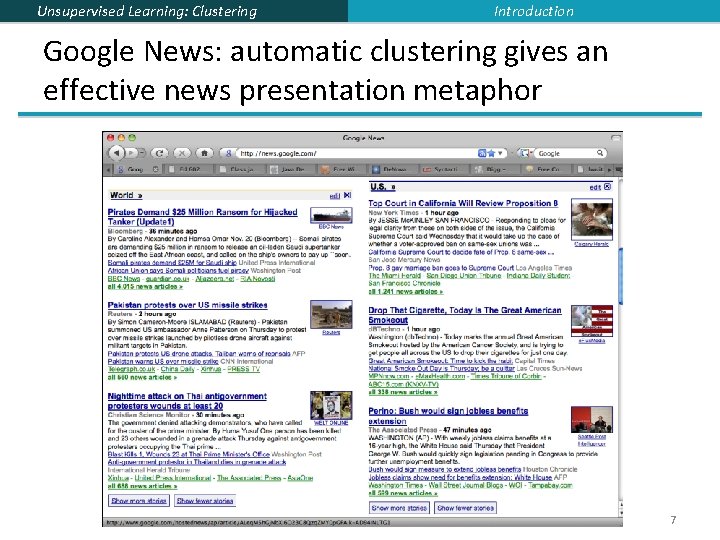
Unsupervised Learning: Clustering Introduction Google News: automatic clustering gives an effective news presentation metaphor 7
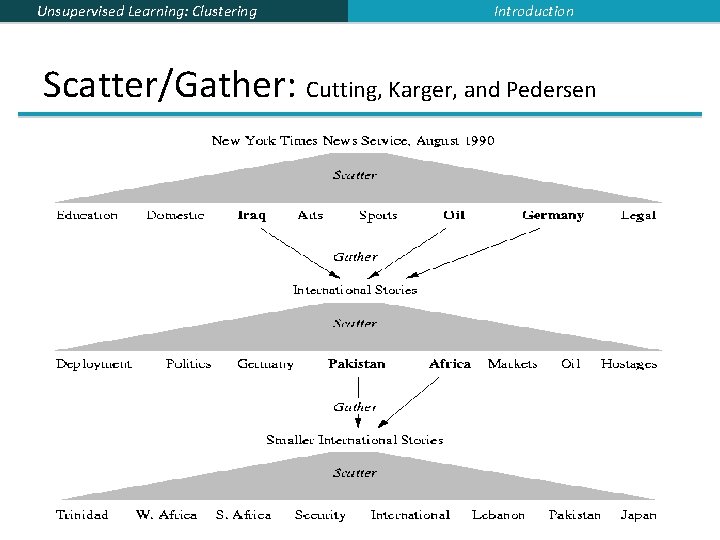
Unsupervised Learning: Clustering Introduction Scatter/Gather: Cutting, Karger, and Pedersen 8
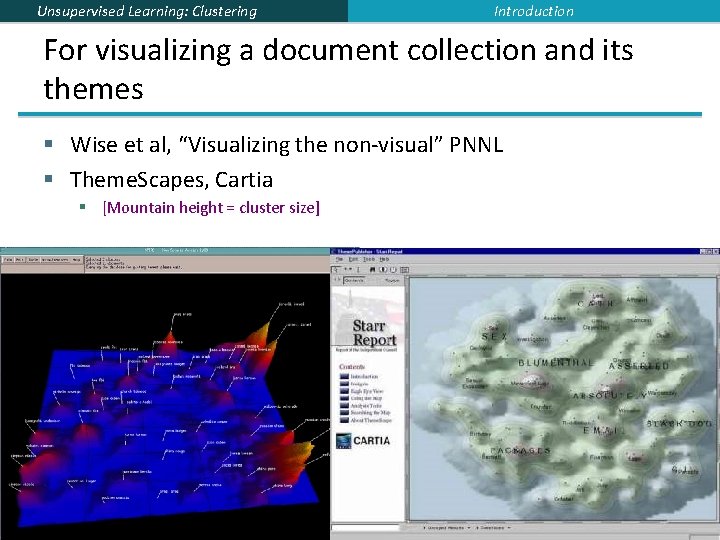
Unsupervised Learning: Clustering Introduction For visualizing a document collection and its themes § Wise et al, “Visualizing the non-visual” PNNL § Theme. Scapes, Cartia § [Mountain height = cluster size] 9
Unsupervised Learning: Clustering Introduction For improving search recall § Cluster hypothesis - Documents in the same cluster behave similarly with respect to relevance to information needs § Therefore, to improve search recall: § Cluster docs in corpus a priori § When a query matches a doc D, also return other docs in the cluster containing D § Hope if we do this: The query “car” will also return docs containing automobile § Because clustering grouped together docs containing car with those containing automobile. Why might this happen? 10
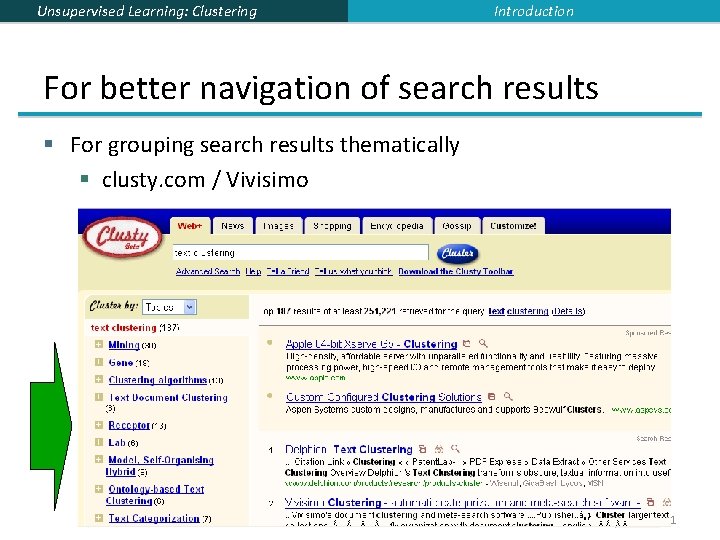
Unsupervised Learning: Clustering Introduction For better navigation of search results § For grouping search results thematically § clusty. com / Vivisimo 11
Unsupervised Learning: Clustering Issues for clustering § Representation for clustering § Document representation § Vector space? Normalization? § Centroids aren’t length normalized § Need a notion of similarity/distance § How many clusters? § Fixed a priori? § Completely data driven? § Avoid “trivial” clusters - too large or small § If a cluster is too large, then for navigation purposes you've wasted an extra user click without whittling down the set of documents much. 12
Unsupervised Learning: Clustering Notion of similarity/distance § Ideal: semantic similarity. § Practical: term-statistical similarity § We will use cosine similarity. § Docs as vectors. § For many algorithms, easier to think in terms of a distance (rather than similarity) between docs. § We will mostly speak of Euclidean distance § But real implementations use cosine similarity 13
Unsupervised Learning: Clustering Algorithms § Flat algorithms § Usually start with a random (partial) partitioning § Refine it iteratively § K means clustering § (Model based clustering) § Hierarchical algorithms § Bottom-up, agglomerative § (Top-down, divisive) 14
Unsupervised Learning: Clustering Hard vs. soft clustering § Hard clustering: Each document belongs to exactly one cluster § More common and easier to do § Soft clustering: A document can belong to more than one cluster. § Makes more sense for applications like creating browsable hierarchies § You may want to put a pair of sneakers in two clusters: (i) sports apparel and (ii) shoes § You can only do that with a soft clustering approach. § We won’t do soft clustering today. See IIR 16. 5, 18 15
Unsupervised Learning: Clustering Flat Algorithms 16
Unsupervised Learning: Clustering Partitioning Algorithms § Partitioning method: Construct a partition of n documents into a set of K clusters § Given: a set of documents and the number K § Find: a partition of K clusters that optimizes the chosen partitioning criterion § Globally optimal § Intractable for many objective functions § Ergo, exhaustively enumerate all partitions § Effective heuristic methods: K-means and K-medoids algorithms 17
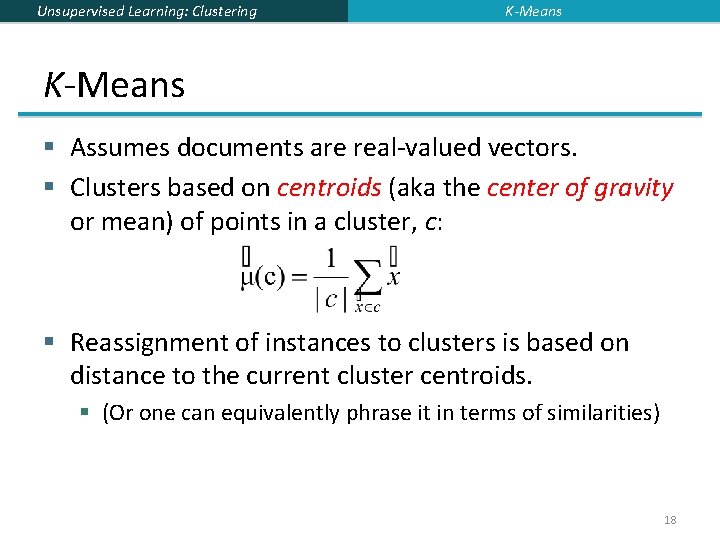
Unsupervised Learning: Clustering K-Means § Assumes documents are real-valued vectors. § Clusters based on centroids (aka the center of gravity or mean) of points in a cluster, c: § Reassignment of instances to clusters is based on distance to the current cluster centroids. § (Or one can equivalently phrase it in terms of similarities) 18
Unsupervised Learning: Clustering K-Means Algorithm Select K random docs {s 1, s 2, … s. K} as seeds. Until clustering converges (or other stopping criterion): For each doc di: Assign di to the cluster cj such that dist(xi, sj) is minimal. (Next, update the seeds to the centroid of each cluster) For each cluster cj sj = (cj) 19
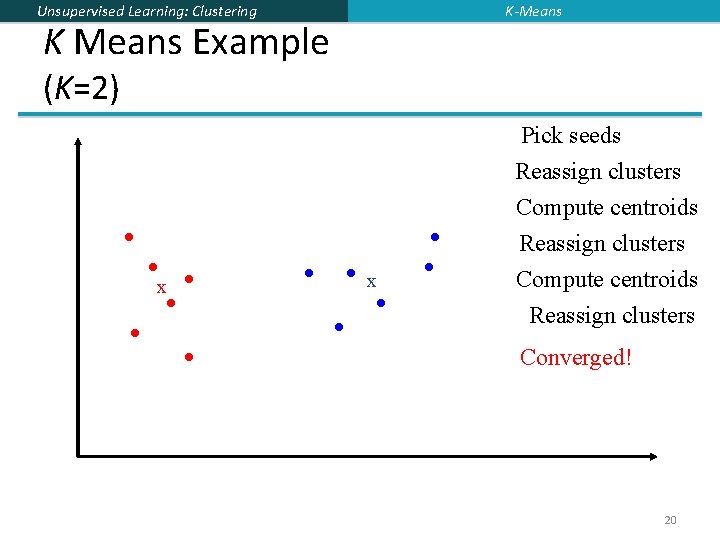
K-Means Unsupervised Learning: Clustering K Means Example (K=2) Pick seeds x x Reassign clusters Compute centroids Reassign clusters Converged! 20
Unsupervised Learning: Clustering K-Means Termination conditions § Several possibilities, e. g. , § A fixed number of iterations. § Doc partition unchanged. § Centroid positions don’t change. Does this mean that the docs in a cluster are unchanged? 21
Unsupervised Learning: Clustering K-Means Convergence § Why should the K-means algorithm ever reach a fixed point? § A state in which clusters don’t change. § K-means is a special case of a general procedure known as the Expectation Maximization (EM) algorithm. § EM is known to converge. § Number of iterations could be large. § But in practice usually isn’t 22
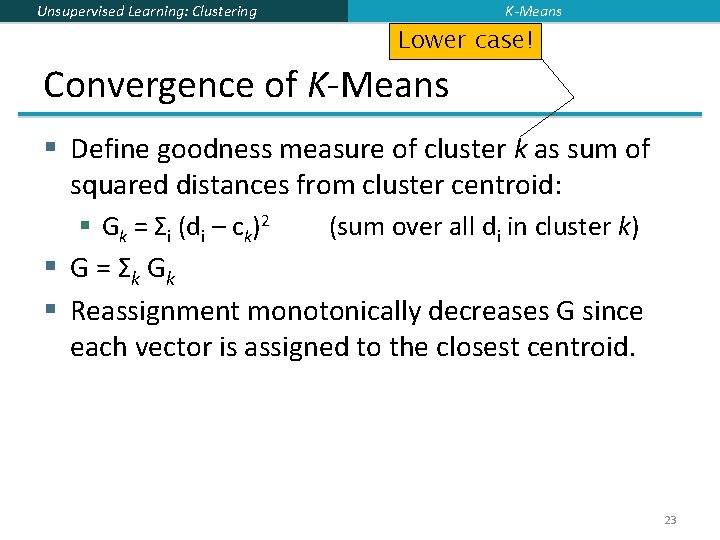
K-Means Unsupervised Learning: Clustering Lower case! Convergence of K-Means § Define goodness measure of cluster k as sum of squared distances from cluster centroid: § Gk = Σi (di – ck)2 (sum over all di in cluster k) § G = Σk G k § Reassignment monotonically decreases G since each vector is assigned to the closest centroid. 23
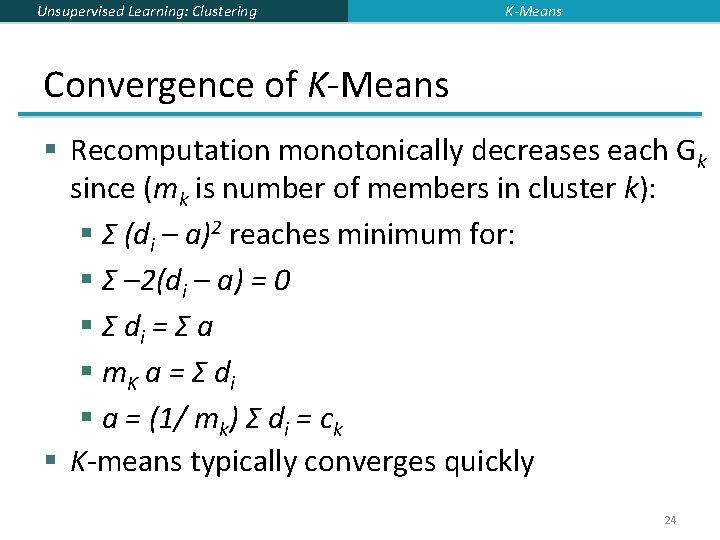
Unsupervised Learning: Clustering K-Means Convergence of K-Means § Recomputation monotonically decreases each Gk since (mk is number of members in cluster k): § Σ (di – a)2 reaches minimum for: § Σ – 2(di – a) = 0 § Σ di = Σ a § m. K a = Σ d i § a = (1/ mk) Σ di = ck § K-means typically converges quickly 24
Unsupervised Learning: Clustering K-Means Time Complexity § Computing distance between two docs is O(M) where M is the dimensionality of the vectors. § Reassigning clusters: O(KN) distance computations, or O(KNM). § Computing centroids: Each doc gets added once to some centroid: O(NM). § Assume these two steps are each done once for I iterations: O(IKNM). 25
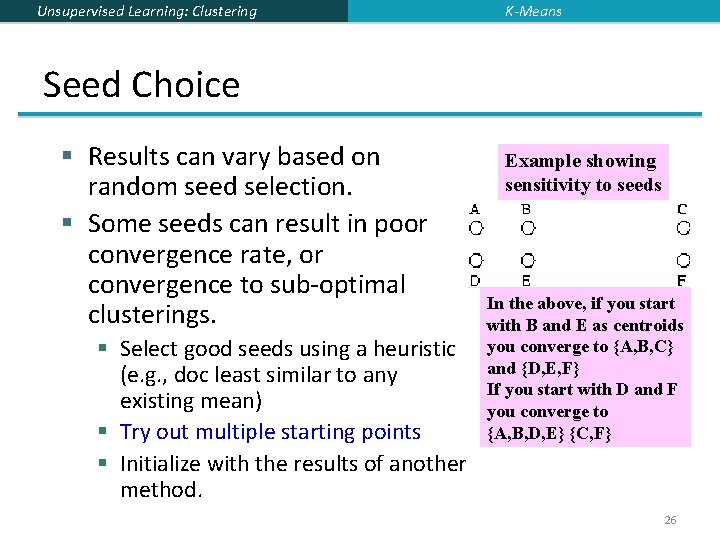
Unsupervised Learning: Clustering K-Means Seed Choice § Results can vary based on random seed selection. § Some seeds can result in poor convergence rate, or convergence to sub-optimal clusterings. § Select good seeds using a heuristic (e. g. , doc least similar to any existing mean) § Try out multiple starting points § Initialize with the results of another method. Example showing sensitivity to seeds In the above, if you start with B and E as centroids you converge to {A, B, C} and {D, E, F} If you start with D and F you converge to {A, B, D, E} {C, F} 26
Unsupervised Learning: Clustering K-Means K-means issues, variations, etc. § Recomputing the centroid after every assignment (rather than after all points are re-assigned) can improve speed of convergence of K-means § Assumes clusters are spherical in vector space § Sensitive to coordinate changes, weighting etc. § Disjoint and exhaustive § Doesn’t have a notion of “outliers” by default § But can add outlier filtering 27
Unsupervised Learning: Clustering K-Means How Many Clusters? § Number of clusters K is given § Partition n docs into predetermined number of clusters § Finding the “right” number of clusters is part of the problem § Given docs, partition into an “appropriate” number of subsets. § E. g. , for query results - ideal value of K not known up front - though UI may impose limits. § Can usually take an algorithm for one flavor and convert to the other. 28
Unsupervised Learning: Clustering K-Means K not specified in advance § Say, the results of a query. § Solve an optimization problem: penalize having lots of clusters § application dependent, e. g. , compressed summary of search results list. § Tradeoff between having more clusters (better focus within each cluster) and having too many clusters 29
Unsupervised Learning: Clustering K-Means K not specified in advance § Given a clustering, define the Benefit for a doc to be the cosine similarity to its centroid § Define the Total Benefit to be the sum of the individual doc Benefits. 30
Unsupervised Learning: Clustering K-Means Penalize lots of clusters § For each cluster, we have a Cost C. § Thus for a clustering with K clusters, the Total Cost is KC. § Define the Value of a clustering to be = Total Benefit - Total Cost. § Find the clustering of highest value, over all choices of K. § Total benefit increases with increasing K. But can stop when it doesn’t increase by “much”. The Cost term enforces this. 31
Unsupervised Learning: Clustering Hierarchical Algorithms 32
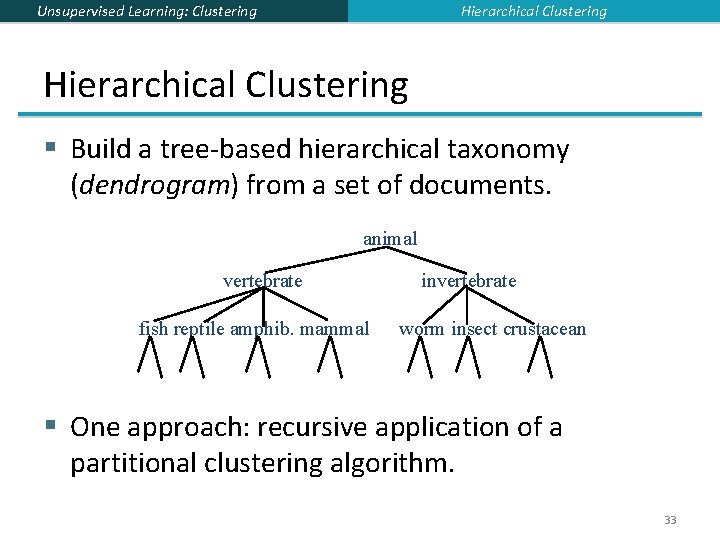
Hierarchical Clustering Unsupervised Learning: Clustering Hierarchical Clustering § Build a tree-based hierarchical taxonomy (dendrogram) from a set of documents. animal vertebrate fish reptile amphib. mammal invertebrate worm insect crustacean § One approach: recursive application of a partitional clustering algorithm. 33
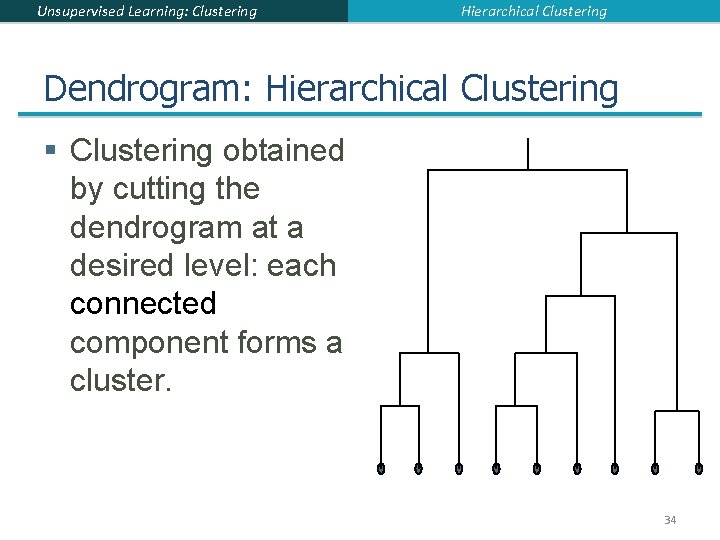
Unsupervised Learning: Clustering Hierarchical Clustering Dendrogram: Hierarchical Clustering § Clustering obtained by cutting the dendrogram at a desired level: each connected component forms a cluster. 34
Unsupervised Learning: Clustering Hierarchical Agglomerative Clustering (HAC) § Starts with each doc in a separate cluster § then repeatedly joins the closest pair of clusters, until there is only one cluster. § The history of merging forms a binary tree or hierarchy. 35
Unsupervised Learning: Clustering Hierarchical Clustering Closest pair of clusters § Many variants to defining closest pair of clusters § Single-link § Similarity of the most cosine-similar (single-link) § Complete-link § Similarity of the “furthest” points, the least cosine-similar § Centroid § Clusters whose centroids (centers of gravity) are the most cosine-similar § Average-link § Average cosine between pairs of elements 36
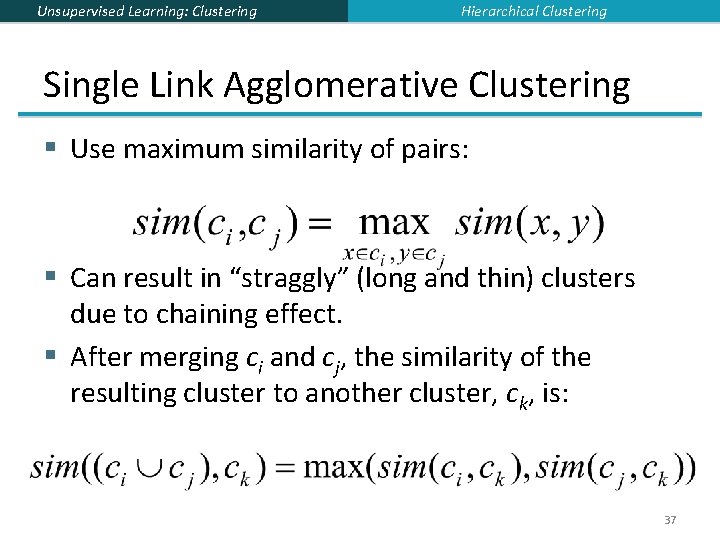
Unsupervised Learning: Clustering Hierarchical Clustering Single Link Agglomerative Clustering § Use maximum similarity of pairs: § Can result in “straggly” (long and thin) clusters due to chaining effect. § After merging ci and cj, the similarity of the resulting cluster to another cluster, ck, is: 37
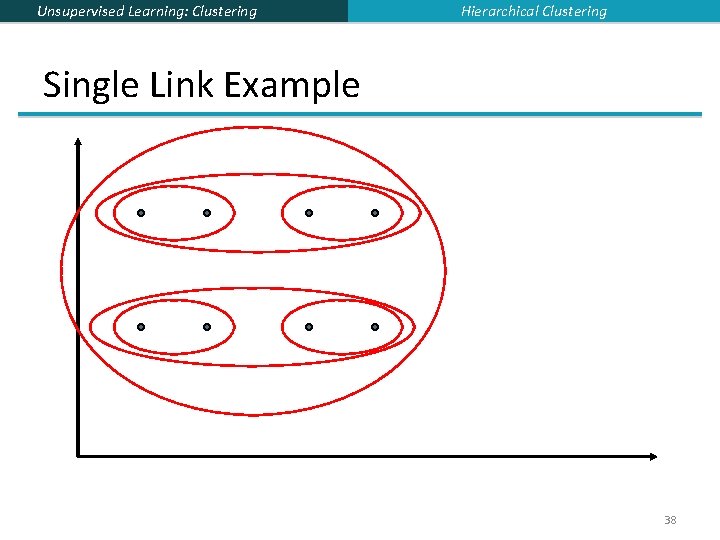
Unsupervised Learning: Clustering Hierarchical Clustering Single Link Example 38
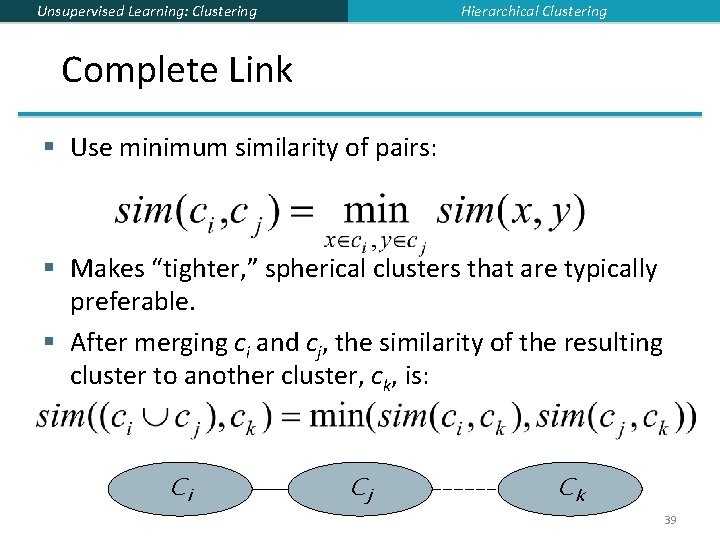
Hierarchical Clustering Unsupervised Learning: Clustering Complete Link § Use minimum similarity of pairs: § Makes “tighter, ” spherical clusters that are typically preferable. § After merging ci and cj, the similarity of the resulting cluster to another cluster, ck, is: Ci Cj Ck 39
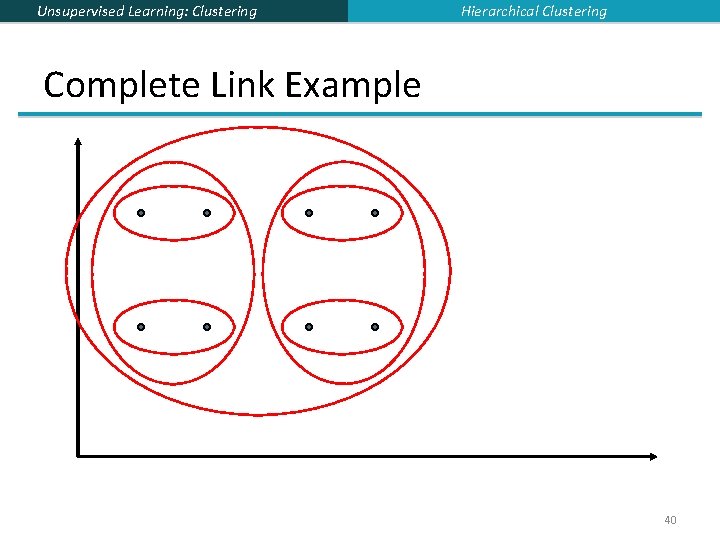
Unsupervised Learning: Clustering Hierarchical Clustering Complete Link Example 40
Unsupervised Learning: Clustering Hierarchical Clustering Computational Complexity § In the first iteration, all HAC methods need to compute similarity of all pairs of N initial instances, which is O(N 2). § In each of the subsequent N 2 merging iterations, compute the distance between the most recently created cluster and all other existing clusters. § In order to maintain an overall O(N 2) performance, computing similarity to each other cluster must be done in constant time. § Often O(N 3) if done naively or O(N 2 log N) if done more cleverly 41
Unsupervised Learning: Clustering Hierarchical Clustering Group Average § Similarity of two clusters = average similarity of all pairs within merged cluster. § Compromise between single and complete link. § Two options: § Averaged across all ordered pairs in the merged cluster § Averaged over all pairs between the two original clusters § No clear difference in efficacy 42
Unsupervised Learning: Clustering Hierarchical Clustering Computing Group Average Similarity § Always maintain sum of vectors in each cluster. § Compute similarity of clusters in constant time: 43
Unsupervised Learning: Clustering Evaluation 44
Unsupervised Learning: Clustering Evaluation What Is A Good Clustering? § Internal criterion: A good clustering will produce high quality clusters in which: § the intra-class (that is, intra-cluster) similarity is high § the inter-class similarity is low § The measured quality of a clustering depends on both the document representation and the similarity measure used 45
Unsupervised Learning: Clustering Evaluation External criteria for clustering quality § Quality measured by its ability to discover some or all of the hidden patterns or latent classes in gold standard data § Assesses a clustering with respect to ground truth … requires labeled data § Assume documents with C gold standard classes, while our clustering algorithms produce K clusters, ω1, ω2, …, ωK with ni members. 46
Unsupervised Learning: Clustering Evaluation External Evaluation of Cluster Quality § Simple measure: purity, the ratio between the dominant class in the cluster πi and the size of cluster ωi § Biased because having n clusters maximizes purity § Others are entropy of classes in clusters (or mutual information between classes and clusters) 47
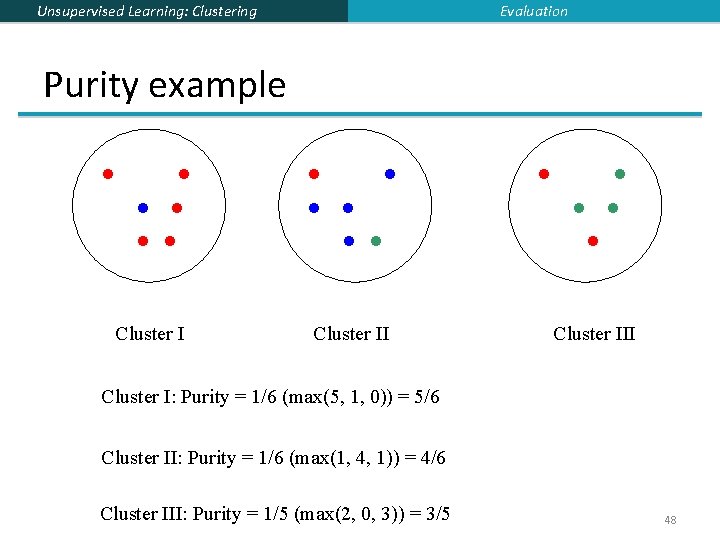
Evaluation Unsupervised Learning: Clustering Purity example Cluster III Cluster I: Purity = 1/6 (max(5, 1, 0)) = 5/6 Cluster II: Purity = 1/6 (max(1, 4, 1)) = 4/6 Cluster III: Purity = 1/5 (max(2, 0, 3)) = 3/5 48
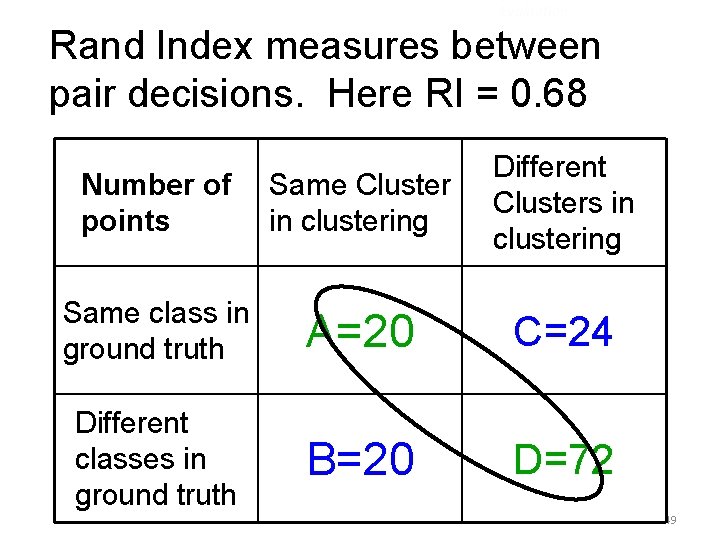
Evaluation Rand Index measures between pair decisions. Here RI = 0. 68 Number of points Same Cluster in clustering Different Clusters in clustering Same class in ground truth A=20 C=24 Different classes in ground truth B=20 D=72 49
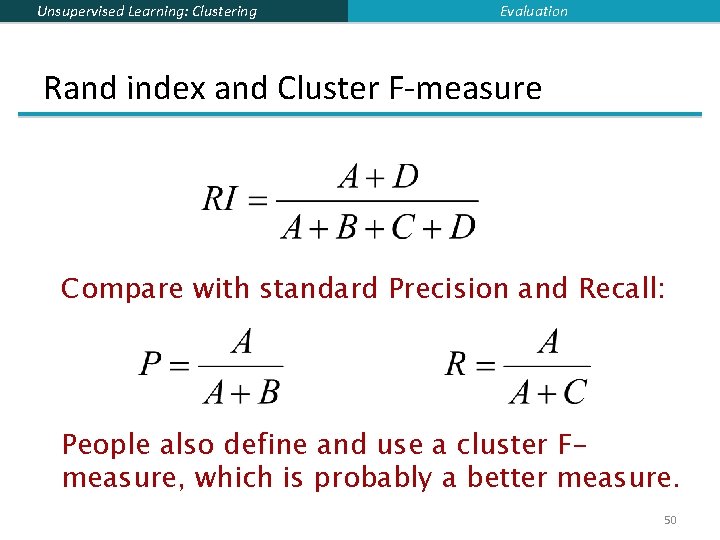
Unsupervised Learning: Clustering Evaluation Rand index and Cluster F-measure Compare with standard Precision and Recall: People also define and use a cluster Fmeasure, which is probably a better measure. 50
Unsupervised Learning: Clustering Final word and resources § In clustering, clusters are inferred from the data without human input (unsupervised learning) § However, in practice, it’s a bit less clear: there are many ways of influencing the outcome of clustering: number of clusters, similarity measure, representation of documents, . . . § Resources § IIR 16 except 16. 5 § IIR 17. 1– 17. 3 51
- Slides: 51