
UNSPORTSMANLIKE FOUL 2017 RULES ART 37 1 NOTE





- Slides: 42
UNSPORTSMANLIKE FOUL 2017 RULES / ART 37 1
NOTE • This material is created by FIBA Referee Department and should not be edited unless using so called ”open template” without FIBA logo. • See document “FIBA_Powerpoint_Presentations” for details. • If you identify an error or a discrepancy in this material, please notify the FIBA Referee Department at refereeing@fiba. com. FIBA Referee Department 2
Index 1. OBR- Rule (slides 5 -7) 2. Five criteria (slides 8 -12) 3. Practical cases (slides 13 -42) a) b) c) d) e) Criteria C 1 (slides 14 -17) Criteria C 2 (slides 18 -22) Criteria C 3 (slides 23 -31) NEW Criteria C 4 (slides 32 -37) Criteria C 5 (slides 38 -42) = A normal basketball play, a Normal Foul = An action that is an Unsportsmanlike 3
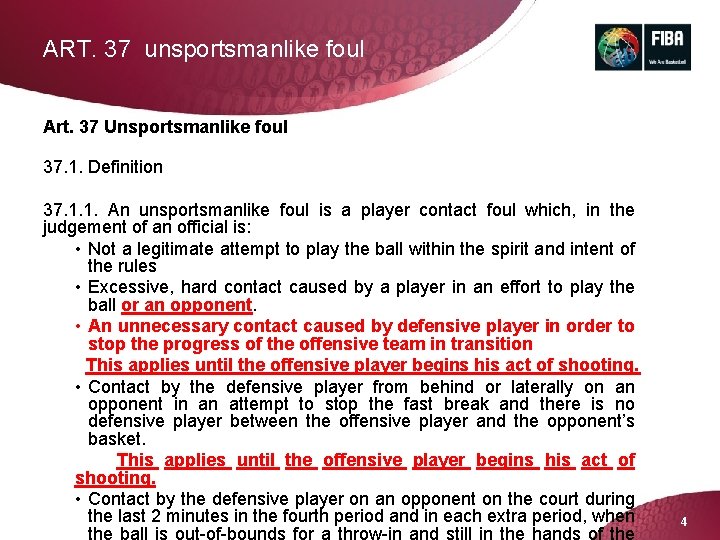
ART. 37 unsportsmanlike foul Art. 37 Unsportsmanlike foul 37. 1. Definition 37. 1. 1. An unsportsmanlike foul is a player contact foul which, in the judgement of an official is: • Not a legitimate attempt to play the ball within the spirit and intent of the rules • Excessive, hard contact caused by a player in an effort to play the ball or an opponent. • An unnecessary contact caused by defensive player in order to stop the progress of the offensive team in transition This applies until the offensive player begins his act of shooting. • Contact by the defensive player from behind or laterally on an opponent in an attempt to stop the fast break and there is no defensive player between the offensive player and the opponent’s basket. This applies until the offensive player begins his act of shooting. • Contact by the defensive player on an opponent on the court during the last 2 minutes in the fourth period and in each extra period, when the ball is out-of-bounds for a throw-in and still in the hands of the 4
ART. 37 unsportsmanlike foul 37. 1. 2. The official must interpret the unsportsmanlike fouls consistently throughout the game and to judge only the action. 5
ART. 37 unsportsmanlike foul 37. 2. Penalty 37. 2. 1. An unsportsmanlike foul shall be charged against the offender. 37. 2. 2. Free throw(s) shall be awarded to the player who was fouled, followed by: • A throw-in at the centre line extended, opposite the scorer’s table. • A jump ball in the centre circle to begin the first period. The number of free throws shall be awarded as follows: • If the foul is committed on a player not in the act of shooting: 2 free throws. • If the foul is committed on a player in the act of shooting: the goal, if made, shall count and, in addition, 1 free throw. • If the foul is committed on a player in the act of shooting and the goal is not made, 2 or 3 free throws. 37. 2. 3. A player shall be disqualified for the remainder of the game when he is charged with two unsportsmanlike fouls or with one technical foul and one unsportsmanlike foul. 37. 2. 4. If a player is disqualified under Art. 37. 2. 3, the unsportsmanlike foul shall be the only foul to be penalised and no additional penalty for the disqualification shall be administered. 6
5 criteria 7
ART. 37 unsportsmanlike foul five criteria To facilitate better decision making, referees are required to use 1 of the 5 existing criteria to determine if an Unsportsmanlike Foul should be called. C 1 C 2 C 3 C 4 C 5 8
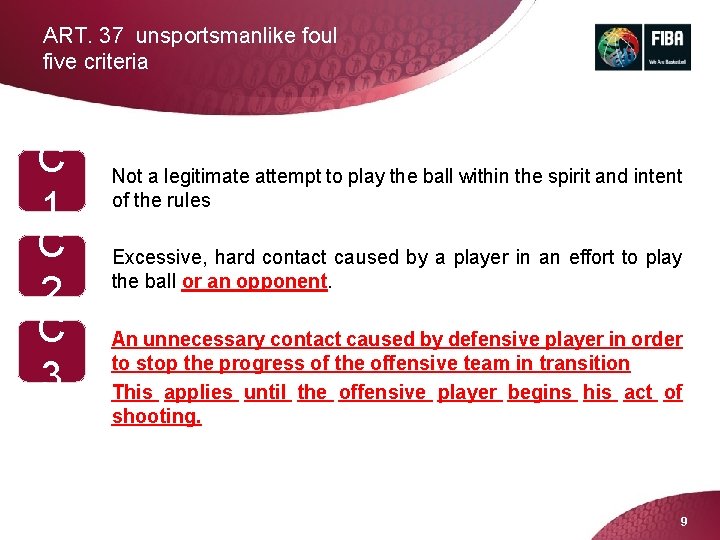
ART. 37 unsportsmanlike foul five criteria C 1 C 2 C 3 Not a legitimate attempt to play the ball within the spirit and intent of the rules Excessive, hard contact caused by a player in an effort to play the ball or an opponent. An unnecessary contact caused by defensive player in order to stop the progress of the offensive team in transition This applies until the offensive player begins his act of shooting. 9
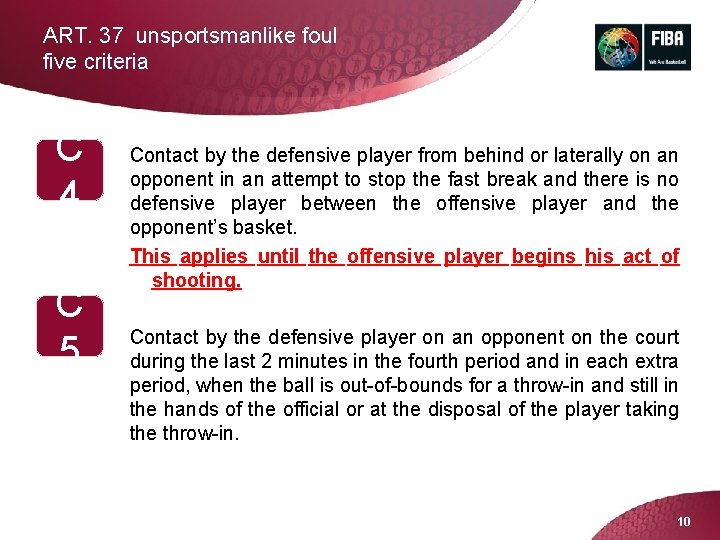
ART. 37 unsportsmanlike foul five criteria C 4 C 5 Contact by the defensive player from behind or laterally on an opponent in an attempt to stop the fast break and there is no defensive player between the offensive player and the opponent’s basket. This applies until the offensive player begins his act of shooting. Contact by the defensive player on an opponent on the court during the last 2 minutes in the fourth period and in each extra period, when the ball is out-of-bounds for a throw-in and still in the hands of the official or at the disposal of the player taking the throw-in. 10
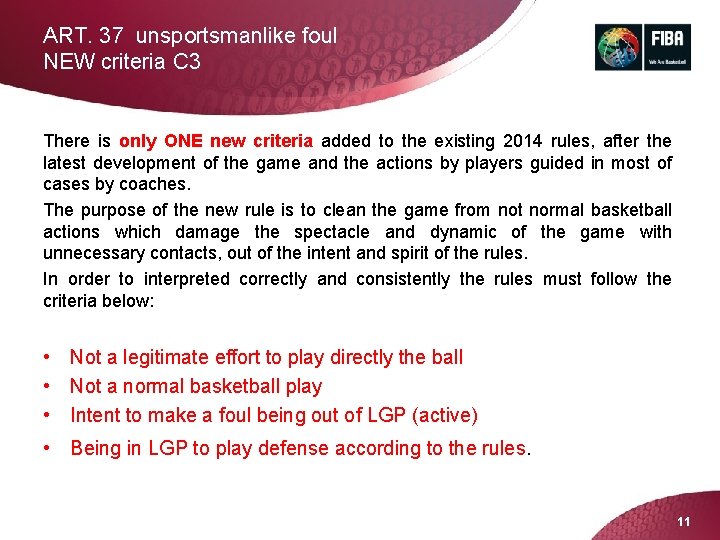
ART. 37 unsportsmanlike foul NEW criteria C 3 There is only ONE new criteria added to the existing 2014 rules, after the latest development of the game and the actions by players guided in most of cases by coaches. The purpose of the new rule is to clean the game from not normal basketball actions which damage the spectacle and dynamic of the game with unnecessary contacts, out of the intent and spirit of the rules. In order to interpreted correctly and consistently the rules must follow the criteria below: • Not a legitimate effort to play directly the ball • Not a normal basketball play • Intent to make a foul being out of LGP (active) • Being in LGP to play defense according to the rules. 11
Practical cases 12
ART. 37 unsportsmanlike foul criteria 1 C 1 Not a legitimate attempt to play the ball within the spirit and intent of the rules 13
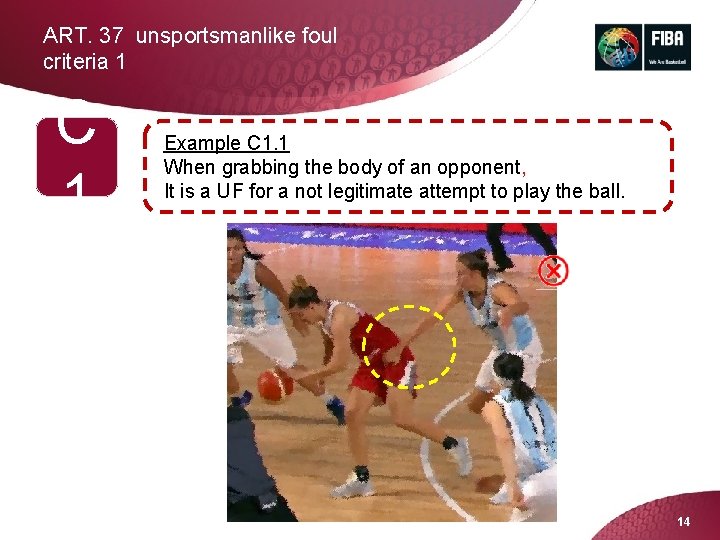
ART. 37 unsportsmanlike foul criteria 1 C 1 Example C 1. 1 When grabbing the body of an opponent, It is a UF for a not legitimate attempt to play the ball. 14
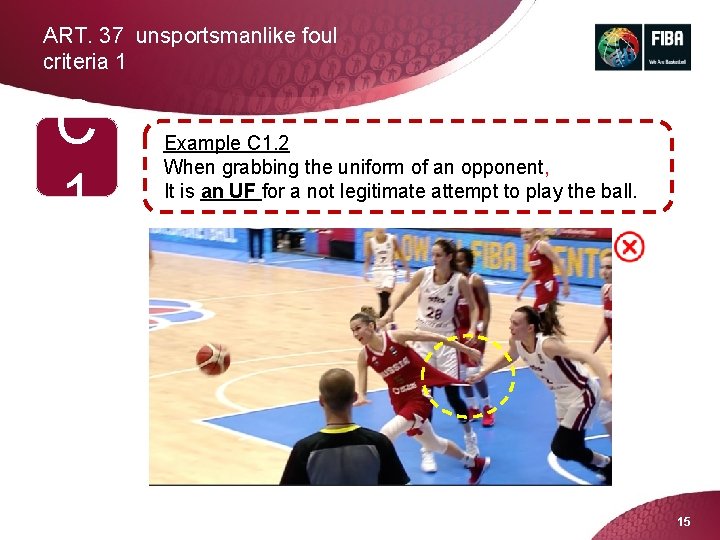
ART. 37 unsportsmanlike foul criteria 1 C 1 Example C 1. 2 When grabbing the uniform of an opponent, It is an UF for a not legitimate attempt to play the ball. 15
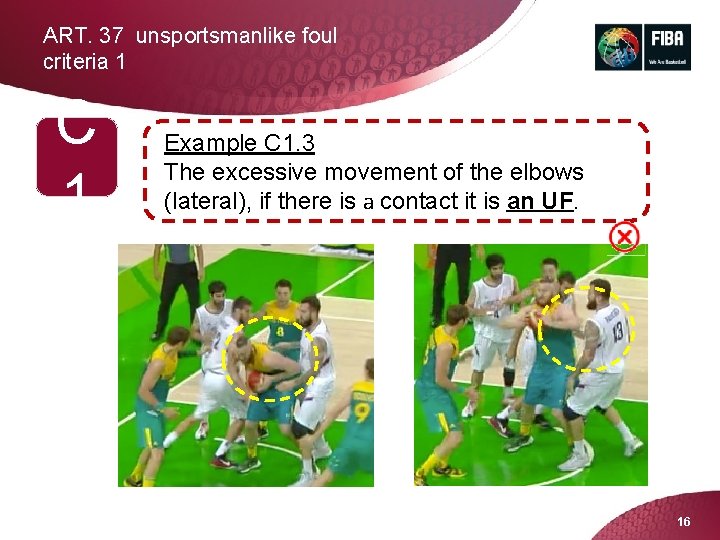
ART. 37 unsportsmanlike foul criteria 1 C 1 Example C 1. 3 The excessive movement of the elbows (lateral), if there is a contact it is an UF. 16
ART. 37 unsportsmanlike foul criteria 2 C 2 Excessive, hard contact caused by a player in an effort to play the ball or an opponent. 17
ART. 37 unsportsmanlike foul criteria 2 C 2 Example C 2. 1 You may make a personal foul, in the normal defensive action, but you do not need to "stop by any means“ your opponent's action in an not effort to play the ball or play an opponent. This is an excessive-hard contact and should penalise as an UF. Note the correct technique to make the call – analyse – call normal foul – upgrade to UF. 18
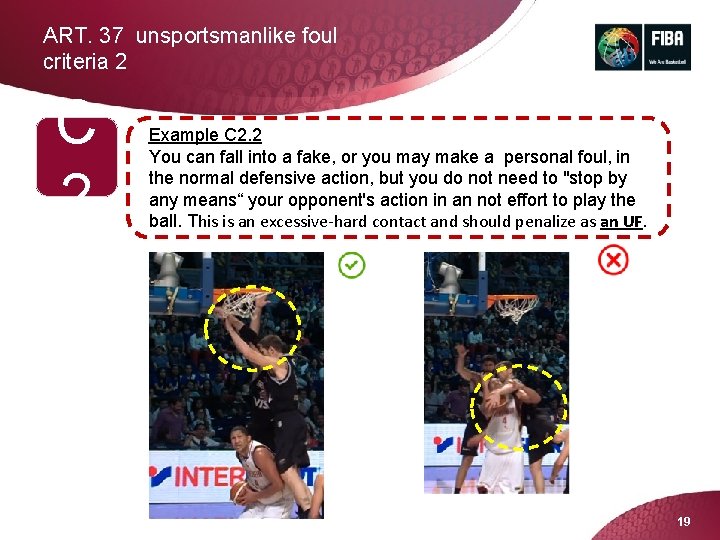
ART. 37 unsportsmanlike foul criteria 2 C 2 Example C 2. 2 You can fall into a fake, or you may make a personal foul, in the normal defensive action, but you do not need to "stop by any means“ your opponent's action in an not effort to play the ball. This is an excessive-hard contact and should penalize as an UF. 19
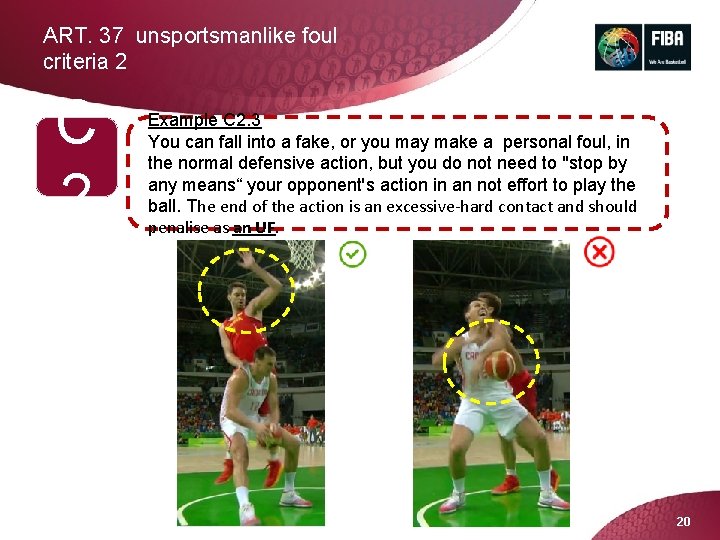
ART. 37 unsportsmanlike foul criteria 2 C 2 Example C 2. 3 You can fall into a fake, or you may make a personal foul, in the normal defensive action, but you do not need to "stop by any means“ your opponent's action in an not effort to play the ball. The end of the action is an excessive-hard contact and should penalise as an UF. 20
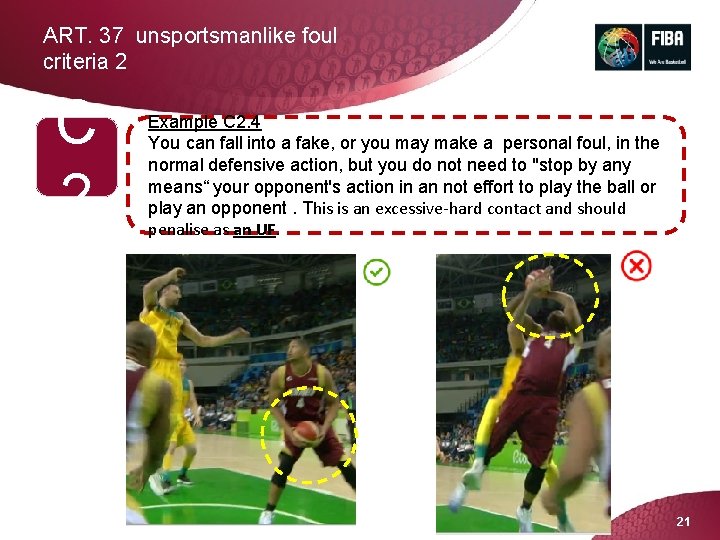
ART. 37 unsportsmanlike foul criteria 2 C 2 Example C 2. 4 You can fall into a fake, or you may make a personal foul, in the normal defensive action, but you do not need to "stop by any means“ your opponent's action in an not effort to play the ball or play an opponent. This is an excessive-hard contact and should penalise as an UF. 21
ART. 37 unsportsmanlike foul criteria 3 C 3 An unnecessary contact caused by defensive player in order to stop the progress of the offensive team in transition. This applies until the offensive player begins his act of shooting. 22
ART. 37 unsportsmanlike foul Criteria 3 C 3 Principles to remember 1. Not a legitimate effort to play directly the ball 2. Not a normal basketball play 3. Intent to make a foul being out of LGP (active – chasing the player with the ball) 4. Being in LGP to play defense according to the rules (personal foul if illegal contact) 5. Stop the progress in transition 23
ART. 37 unsportsmanlike foul Criteria 3 C 3 Example C 3. 1. We must be ready to anticipate the contact by the defensive player when offensive player with an excellent drill overpassed him. Defensive player cannot play anymore the ball and grabbed the opponent from waist. The video example is an UF. 24
ART. 37 unsportsmanlike foul Criteria 3 C 3 Example C 3. 2 When from a LGP, moving according to the direction of the offensive player, faced with an opponent, player tried for the ball and produces a normal contact but illegal. Normal foul. 25
ART. 37 unsportsmanlike foul criteria 3 C 3 Example C 3. 3 Once defensive player is overflowed in an LGP, and does not try to defend his position, just opening his arm to stop the offensive player with the intention to stop the game. This is an UF. 26
ART. 37 unsportsmanlike foul criteria 3 C 3 Example C 3. 4 Defensive player is in LGP and tried to maintain his legal position when contact occurred. Whether is a defensive or offensive foul (judgement of the referee) in no way is an U foul although team was in transition. Normal Foul. 27
ART. 37 unsportsmanlike foul criteria 3 C 3 Example C 3. 5 Once defensive player is overflowed in an LGP, and does not try to defend his position, just opening his arm to stop the offensive player with the intention to stop the game. This is an UF. 28
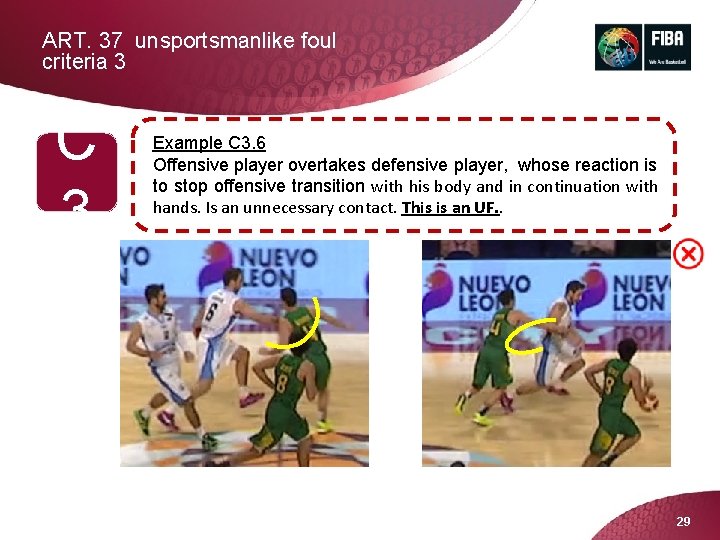
ART. 37 unsportsmanlike foul criteria 3 C 3 Example C 3. 6 Offensive player overtakes defensive player, whose reaction is to stop offensive transition with his body and in continuation with hands. Is an unnecessary contact. This is an UF. . 29
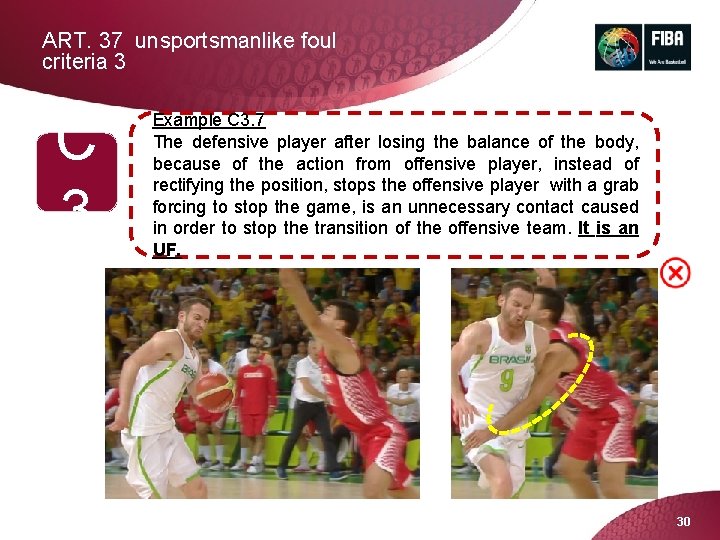
ART. 37 unsportsmanlike foul criteria 3 C 3 Example C 3. 7 The defensive player after losing the balance of the body, because of the action from offensive player, instead of rectifying the position, stops the offensive player with a grab forcing to stop the game, is an unnecessary contact caused in order to stop the transition of the offensive team. It is an UF. 30
ART. 37 unsportsmanlike foul criteria 4 C 4 Illegal contact by the defensive player from behind or laterally on an opponent in an attempt to stop the fast break and there is no defensive player between the offensive player and the opponent’s basket. This applies until the offensive player begins his act of shooting. 31
ART. 37 unsportsmanlike foul Criteria 4 C 4 Principles to remember 1. Team control established by an offensive team. 2. No defensive player between the offensive player with the ball an opponent’s basket. 3. Illegal contact (foul called) by the defensive player from behind or laterally. 4. This applies until the offensive player begins his act of shooting. 32
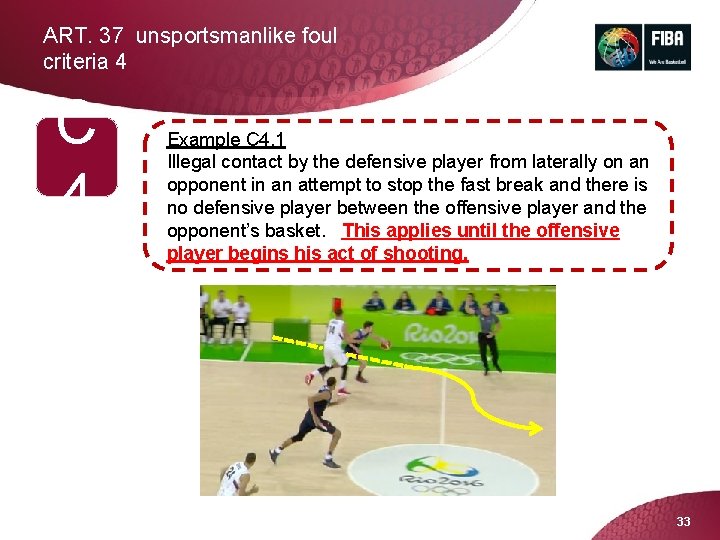
ART. 37 unsportsmanlike foul criteria 4 C 4 Example C 4. 1 Illegal contact by the defensive player from laterally on an opponent in an attempt to stop the fast break and there is no defensive player between the offensive player and the opponent’s basket. This applies until the offensive player begins his act of shooting. 33
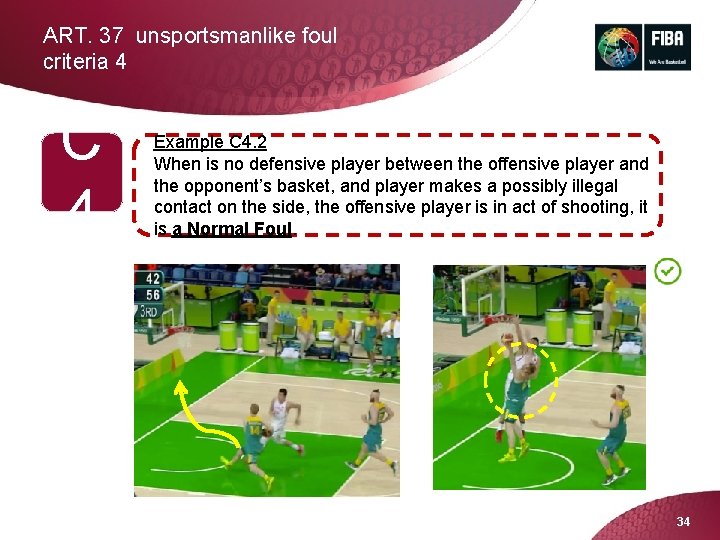
ART. 37 unsportsmanlike foul criteria 4 C 4 Example C 4. 2 When is no defensive player between the offensive player and the opponent’s basket, and player makes a possibly illegal contact on the side, the offensive player is in act of shooting, it is a Normal Foul. 34
ART. 37 unsportsmanlike foul criteria 4 C 4 Example C 4. 3 When there is no defensive player between the offensive player with the ball and the opponent’s basket, the illegal contact (foul called) by defensive player is laterally or behind, regardless the nature of the illegal contact, it is considered as an UF. 35
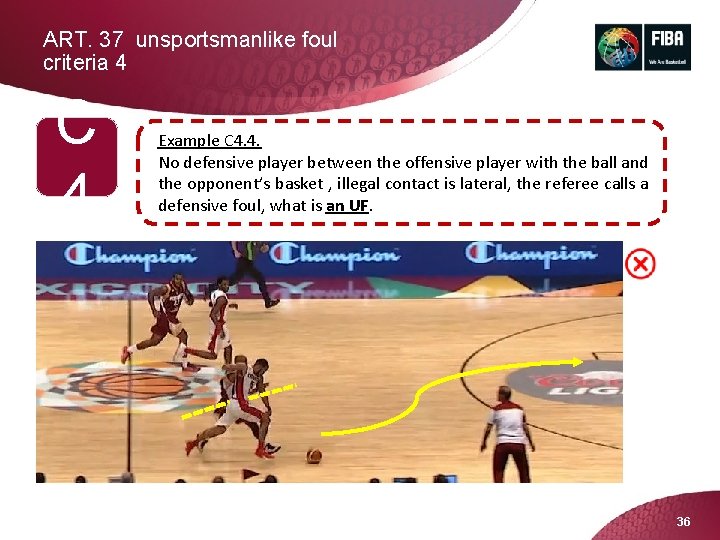
ART. 37 unsportsmanlike foul criteria 4 C 4 Example C 4. 4. No defensive player between the offensive player with the ball and the opponent’s basket , illegal contact is lateral, the referee calls a defensive foul, what is an UF. 36
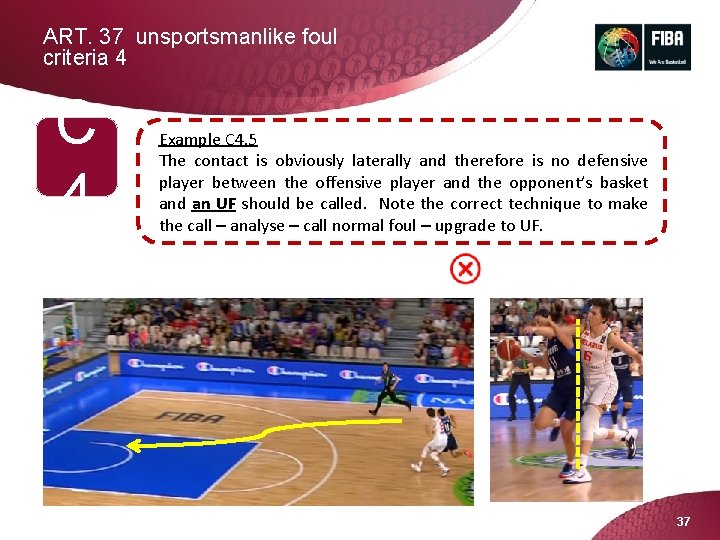
ART. 37 unsportsmanlike foul criteria 4 C 4 Example C 4. 5 The contact is obviously laterally and therefore is no defensive player between the offensive player and the opponent’s basket and an UF should be called. Note the correct technique to make the call – analyse – call normal foul – upgrade to UF. 37
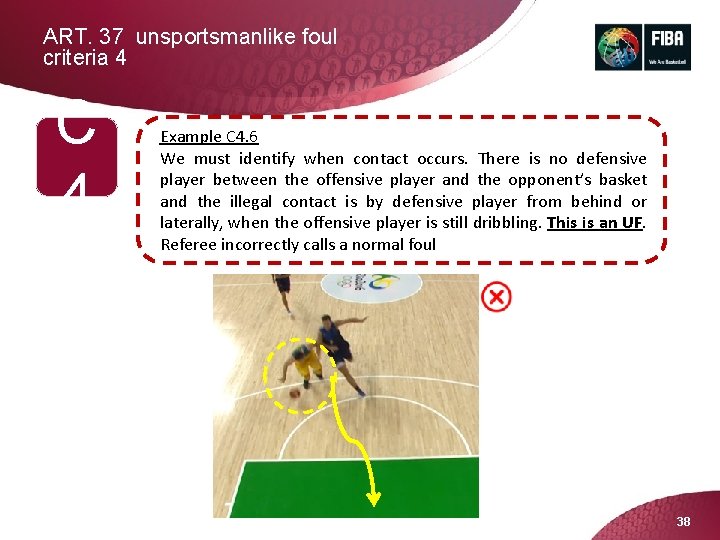
ART. 37 unsportsmanlike foul criteria 4 C 4 Example C 4. 6 We must identify when contact occurs. There is no defensive player between the offensive player and the opponent’s basket and the illegal contact is by defensive player from behind or laterally, when the offensive player is still dribbling. This is an UF. Referee incorrectly calls a normal foul 38
ART. 37 unsportsmanlike foul criteria 5 Contact by the defensive player on an opponent on the court during the last 2 minutes in the fourth period and in each extra period, when the ball is out-of-bounds for a throw-in and still in the hands of the official or at the disposal of the player taking the throwin. 39
ART. 37 unsportsmanlike foul Criteria 4 C 4 Principles to remember 1. Last 2 minutes of the 4 th or extra period. . 2. Ball is out-of-bounds for a throw-in 3. Illegal contact (foul called) by the defensive player on the court before the ball is realised. 4. Referee reminds (preventative officiating) the team before throw-in taking (good officiating technique). 40
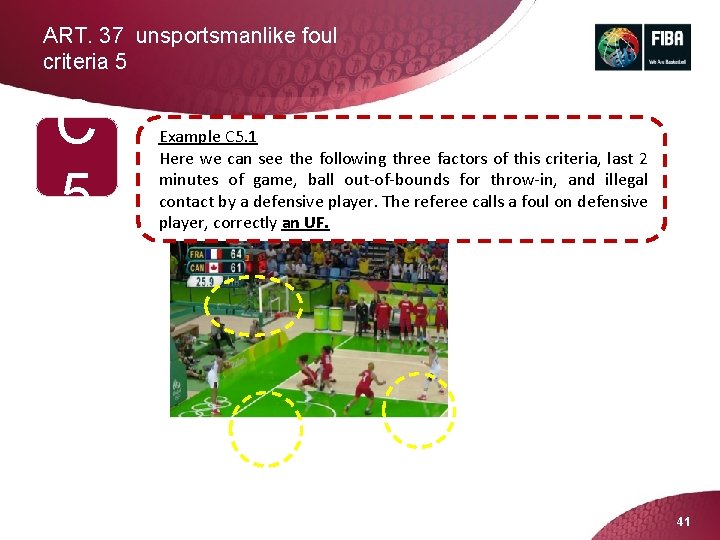
ART. 37 unsportsmanlike foul criteria 5 C 5 Example C 5. 1 Here we can see the following three factors of this criteria, last 2 minutes of game, ball out-of-bounds for throw-in, and illegal contact by a defensive player. The referee calls a foul on defensive player, correctly an UF. 41
42