
Unsaturated Hydrocarbons Alkynes 1435 1436 2014 2015 1
Unsaturated Hydrocarbons Alkynes 1435 -1436 2014 -2015 1
Alkynes Learning Objectives Chapter three discusses the following topics which have to be understood and memorized : Ø The structure, hybridization and Bonding in alkynes Ø Common and IUPAC naming of alkynes Ø Physical properties of alkynes Ø Preparation of alkynes Ø Reactions of alkynes: addition reactions and acidity
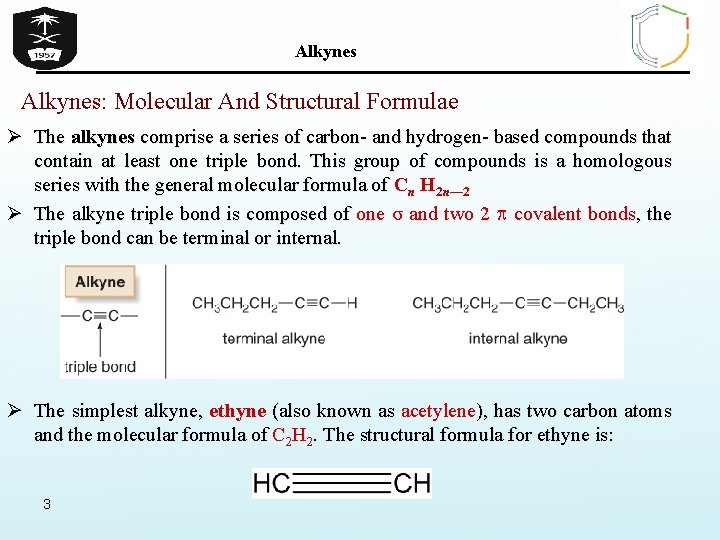
Alkynes: Molecular And Structural Formulae Ø The alkynes comprise a series of carbon- and hydrogen- based compounds that contain at least one triple bond. This group of compounds is a homologous series with the general molecular formula of Cn H 2 n— 2 Ø The alkyne triple bond is composed of one σ and two 2 covalent bonds, the triple bond can be terminal or internal. Ø The simplest alkyne, ethyne (also known as acetylene), has two carbon atoms and the molecular formula of C 2 H 2. The structural formula for ethyne is: 3
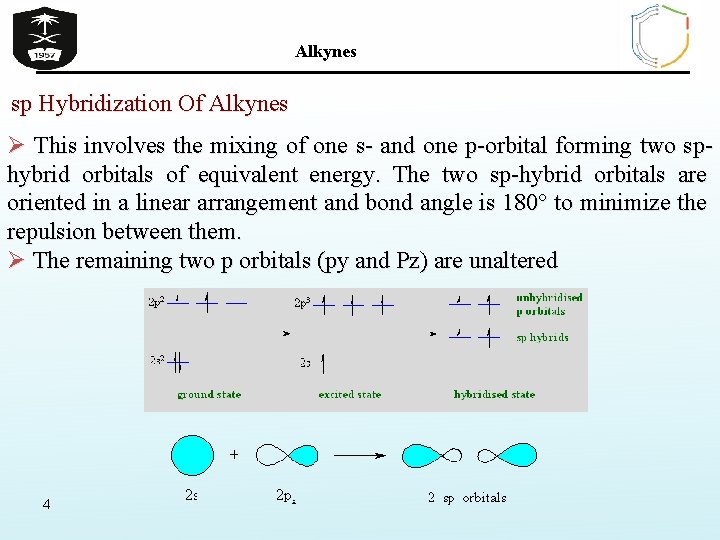
Alkynes sp Hybridization Of Alkynes Ø This involves the mixing of one s- and one p-orbital forming two sphybrid orbitals of equivalent energy. The two sp-hybrid orbitals are oriented in a linear arrangement and bond angle is 180° to minimize the repulsion between them. Ø The remaining two p orbitals (py and Pz) are unaltered 4
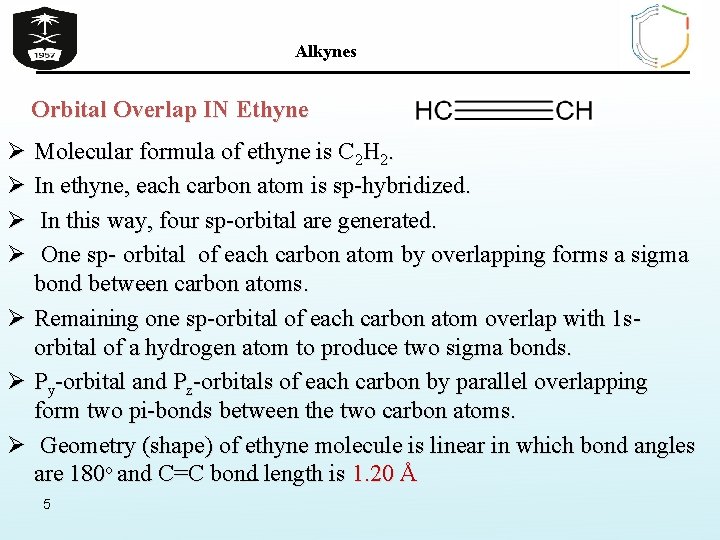
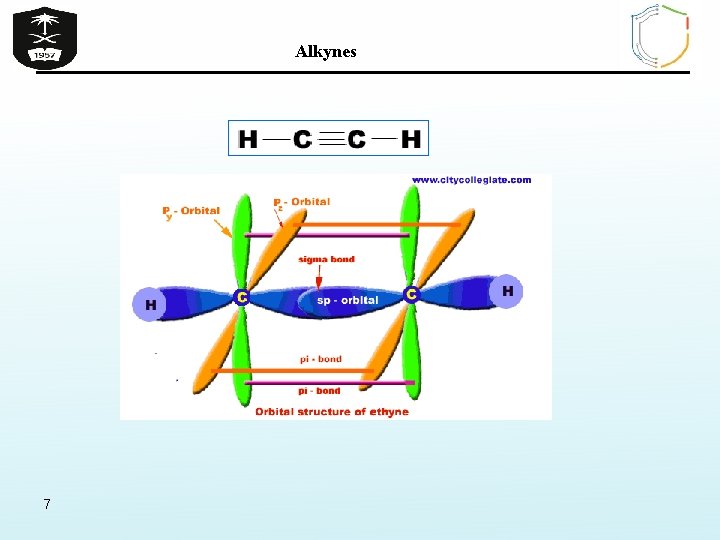
Alkynes Orbital Overlap IN Ethyne Ø Molecular formula of ethyne is C 2 H 2. Ø In ethyne, each carbon atom is sp-hybridized. Ø In this way, four sp-orbital are generated. Ø One sp- orbital of each carbon atom by overlapping forms a sigma bond between carbon atoms. Ø Remaining one sp-orbital of each carbon atom overlap with 1 sorbital of a hydrogen atom to produce two sigma bonds. Ø Py-orbital and Pz-orbitals of each carbon by parallel overlapping form two pi-bonds between the two carbon atoms. Ø Geometry (shape) of ethyne molecule is linear in which bond angles are 180 o and C=C bond length is 1. 20 Å 5
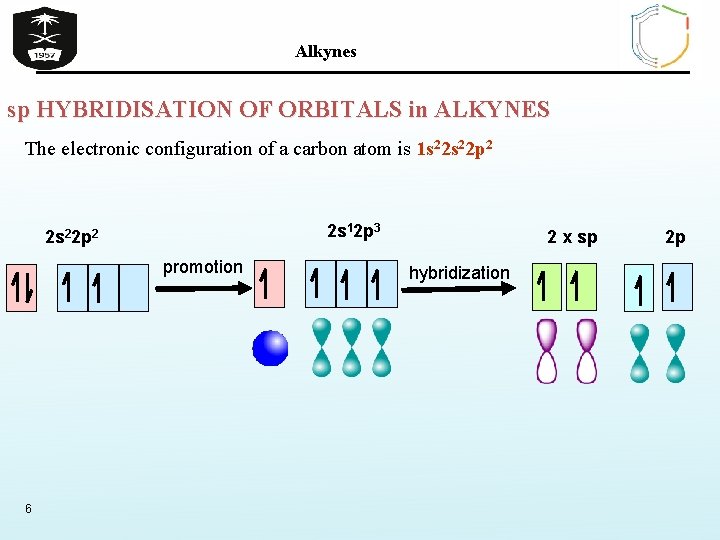
Alkynes sp HYBRIDISATION OF ORBITALS in ALKYNES The electronic configuration of a carbon atom is 1 s 22 p 2 2 s 12 p 3 2 s 22 p 2 promotion 6 2 x sp hybridization 2 p
Alkynes 7
Alkynes Summary Ø Ø Ø sp hybridization occurs when a C has 2 sigma bonds only sp hybridized orbital has 50% s and 50% p character The 2 sp hybrids point in opposite directions at 180 o to each other Each sp hybrid is involved in a(σ)sigma bond The remaining p orbitals form the 2 pi bonds The triple bond is one (σ)bond and two pi (∏) bonds 8
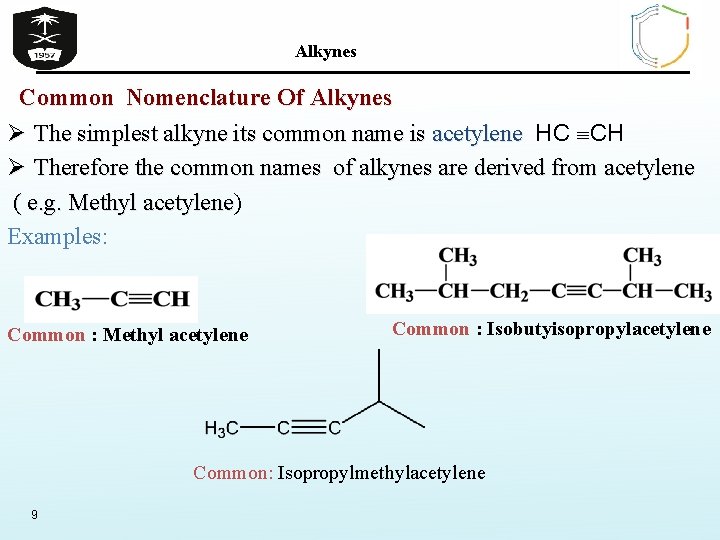
Alkynes Common Nomenclature Of Alkynes Ø The simplest alkyne its common name is acetylene HC CH Ø Therefore the common names of alkynes are derived from acetylene ( e. g. Methyl acetylene) acetylene Examples: Common : Methyl acetylene Common : Isobutyisopropylacetylene Common: Isopropylmethylacetylene 9
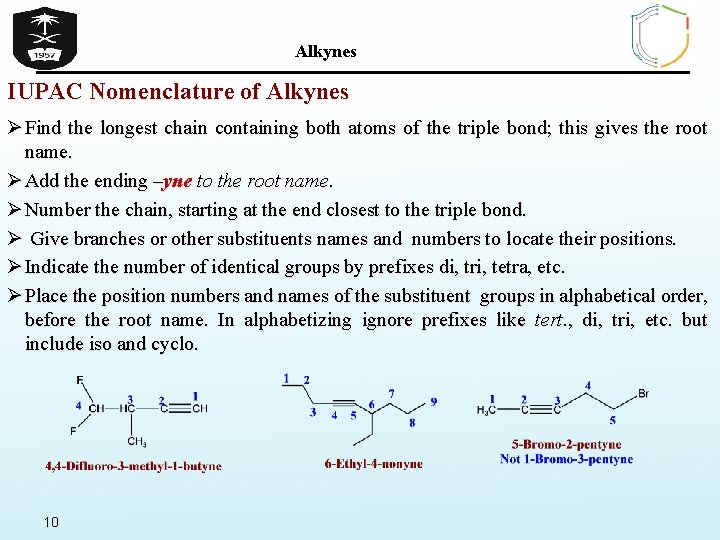
Alkynes IUPAC Nomenclature of Alkynes Ø Find the longest chain containing both atoms of the triple bond; this gives the root name. Ø Add the ending –yne to the root name. Ø Number the chain, starting at the end closest to the triple bond. Ø Give branches or other substituents names and numbers to locate their positions. Ø Indicate the number of identical groups by prefixes di, tri, tetra, etc. Ø Place the position numbers and names of the substituent groups in alphabetical order, before the root name. In alphabetizing ignore prefixes like tert. , di, tri, etc. but include iso and cyclo. 10
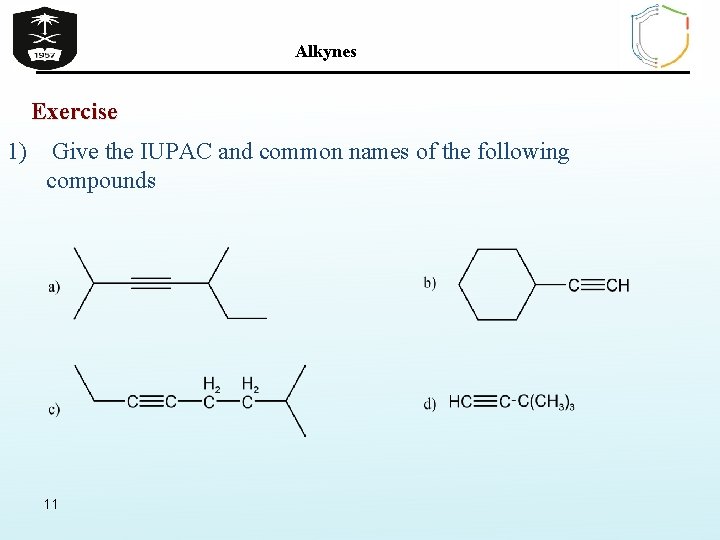
Alkynes Exercise 1) Give the IUPAC and common names of the following compounds 11
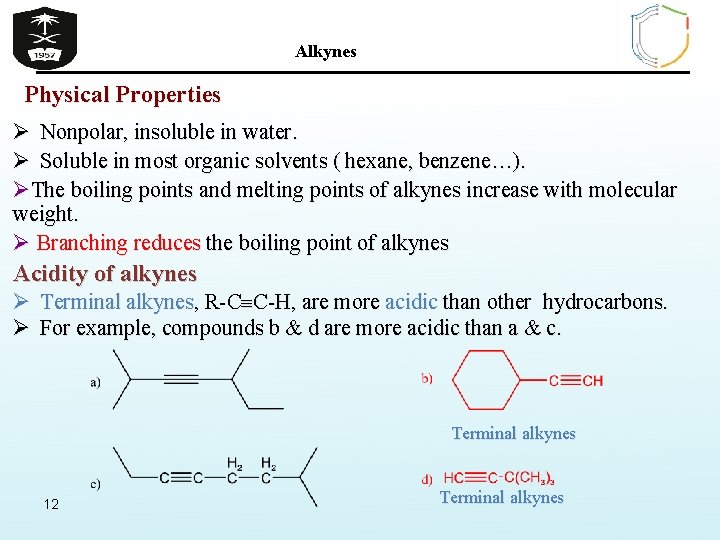
Alkynes Physical Properties Ø Nonpolar, insoluble in water. Ø Soluble in most organic solvents ( hexane, benzene…). ØThe boiling points and melting points of alkynes increase with molecular weight. Ø Branching reduces the boiling point of alkynes Acidity of alkynes Ø Terminal alkynes, R-C C-H, are more acidic than other hydrocarbons. Ø For example, compounds b & d are more acidic than a & c. Terminal alkynes 12 Terminal alkynes
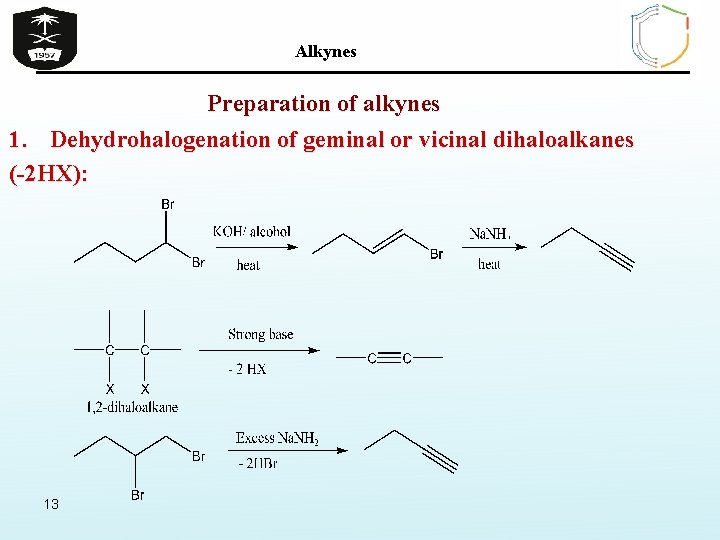
Alkynes Preparation of alkynes 1. Dehydrohalogenation of geminal or vicinal dihaloalkanes (-2 HX): 13
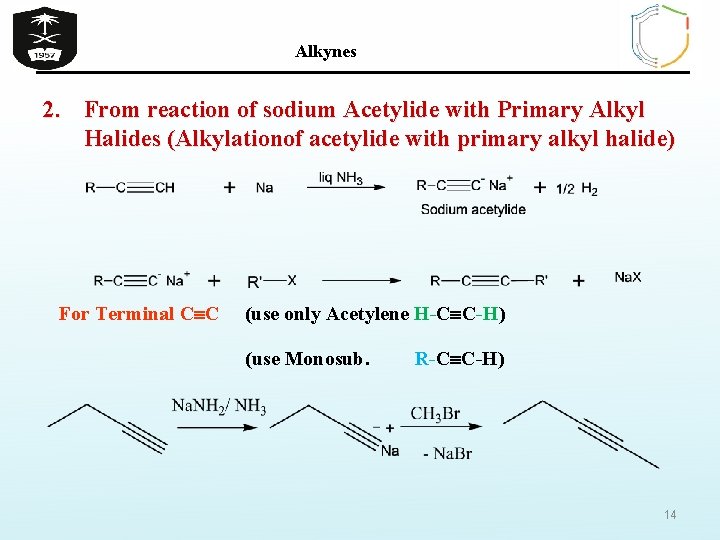
Alkynes 2. From reaction of sodium Acetylide with Primary Alkyl Halides (Alkylationof acetylide with primary alkyl halide) For Terminal C C (use only Acetylene H-C C-H) (use Monosub. R-C C-H) 14
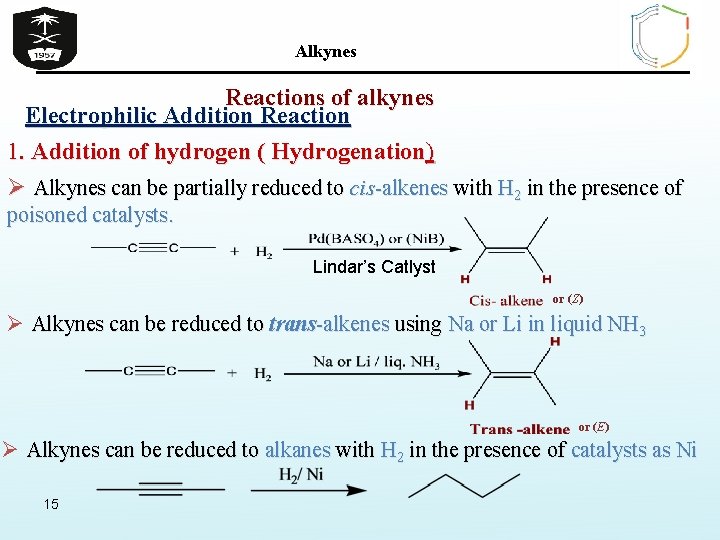
Alkynes Reactions of alkynes Electrophilic Addition Reaction 1. Addition of hydrogen ( Hydrogenation) Ø Alkynes can be partially reduced to cis-alkenes with H 2 in the presence of poisoned catalysts. Lindar’s Catlyst or (Z) Ø Alkynes can be reduced to trans-alkenes using Na or Li in liquid NH 3 or (E) Ø Alkynes can be reduced to alkanes with H 2 in the presence of catalysts as Ni 15
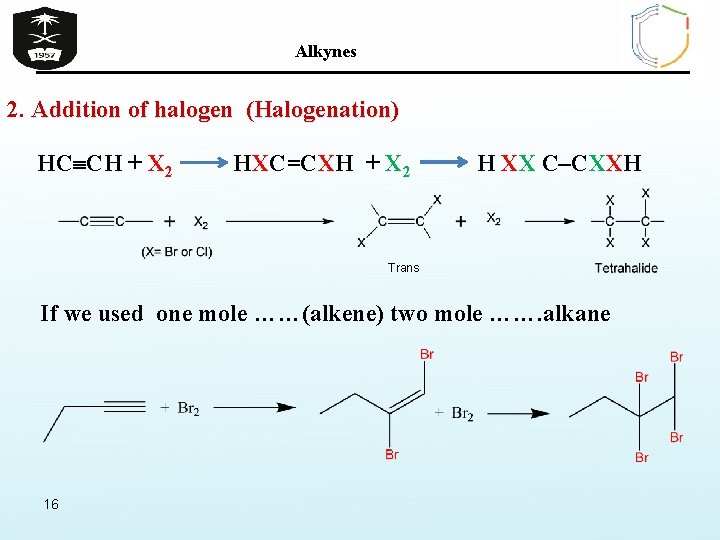
Alkynes 2. Addition of halogen (Halogenation) HC CH + X 2 HXC=CXH + X 2 H XX C–CXXH Trans If we used one mole ……(alkene) two mole ……. alkane 16
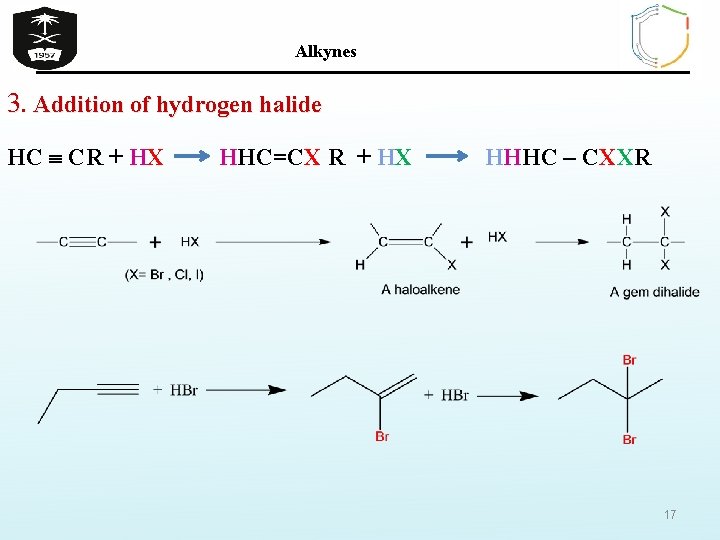
Alkynes 3. Addition of hydrogen halide HC CR + HX HHC=CX R + HX HHHC – CXXR 17
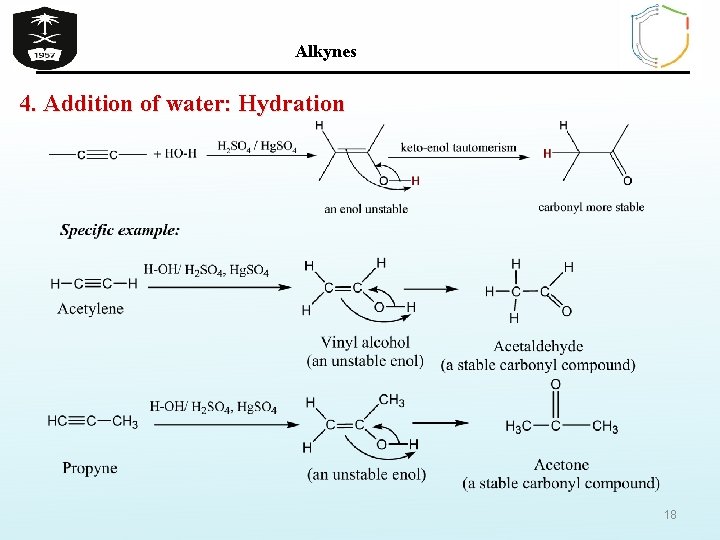
Alkynes 4. Addition of water: Hydration 18
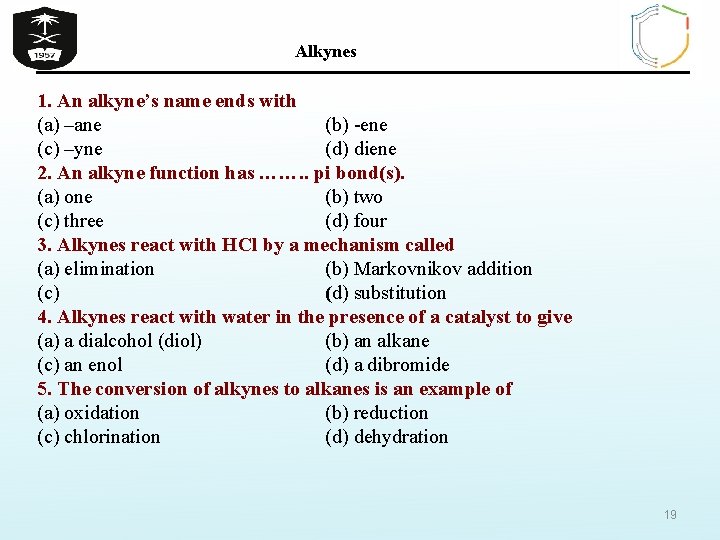
Alkynes 1. An alkyne’s name ends with (a) –ane (b) -ene (c) –yne (d) diene 2. An alkyne function has ……. . pi bond(s). (a) one (b) two (c) three (d) four 3. Alkynes react with HCl by a mechanism called (a) elimination (b) Markovnikov addition (c) (d) substitution 4. Alkynes react with water in the presence of a catalyst to give (a) a dialcohol (diol) (b) an alkane (c) an enol (d) a dibromide 5. The conversion of alkynes to alkanes is an example of (a) oxidation (b) reduction (c) chlorination (d) dehydration 19
Alkynes Thank You for your kind attention ! Questions? Comments 20
- Slides: 20