
Unrolling the shutter CNN to correct motion distortions
- Slides: 14
Unrolling the shutter: CNN to correct motion distortions Vijay Rengarajan, Yogesh Balaji, A. N. Rajagopalan Indian Institute of Technology Madras Image Processing and Computer Vision lab, Department of Electrical Engineering, IIT Madras
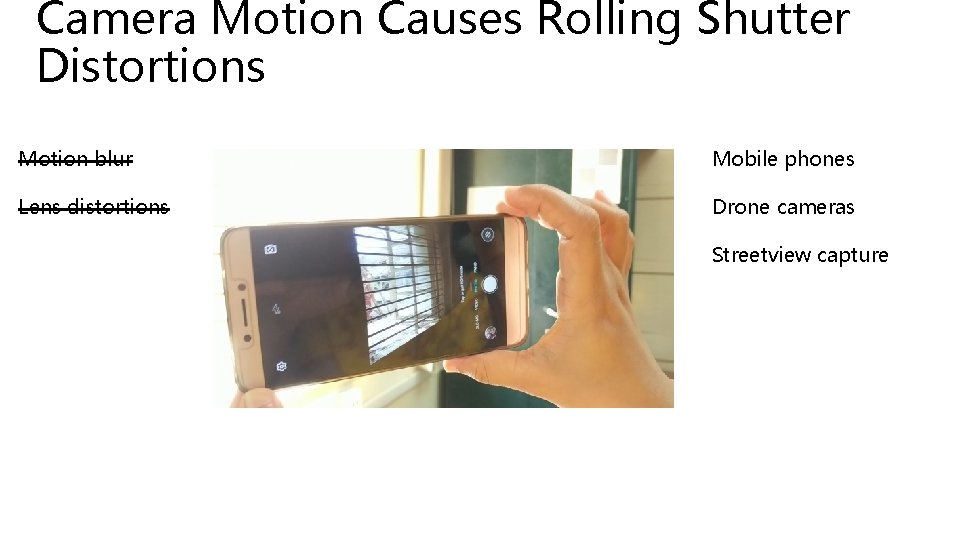
Camera Motion Causes Rolling Shutter Distortions Motion blur Mobile phones Lens distortions Drone cameras Streetview capture
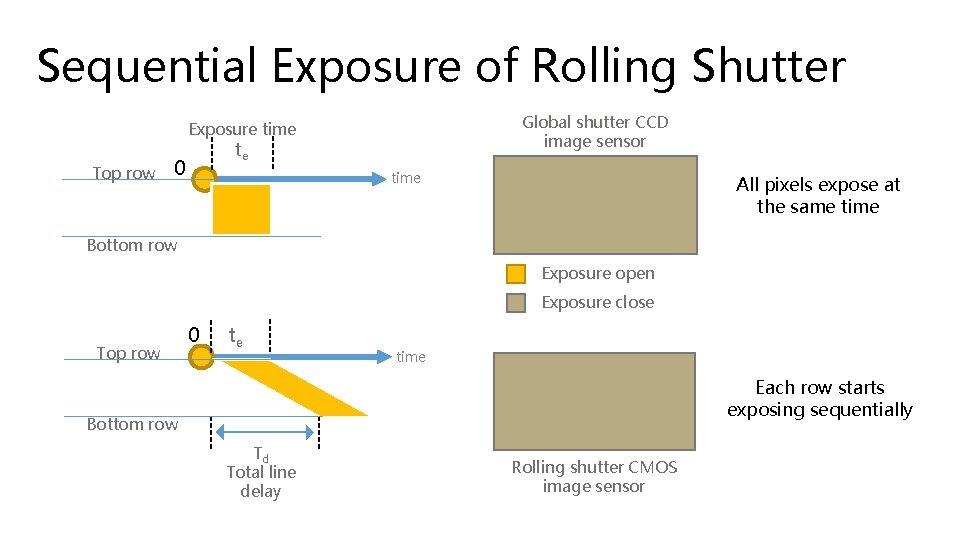
Sequential Exposure of Rolling Shutter Global shutter CCD image sensor Exposure time Top row te 0 time All pixels expose at the same time Bottom row Exposure open Exposure close Top row 0 te time Each row starts exposing sequentially Bottom row Td Total line delay Rolling shutter CMOS image sensor
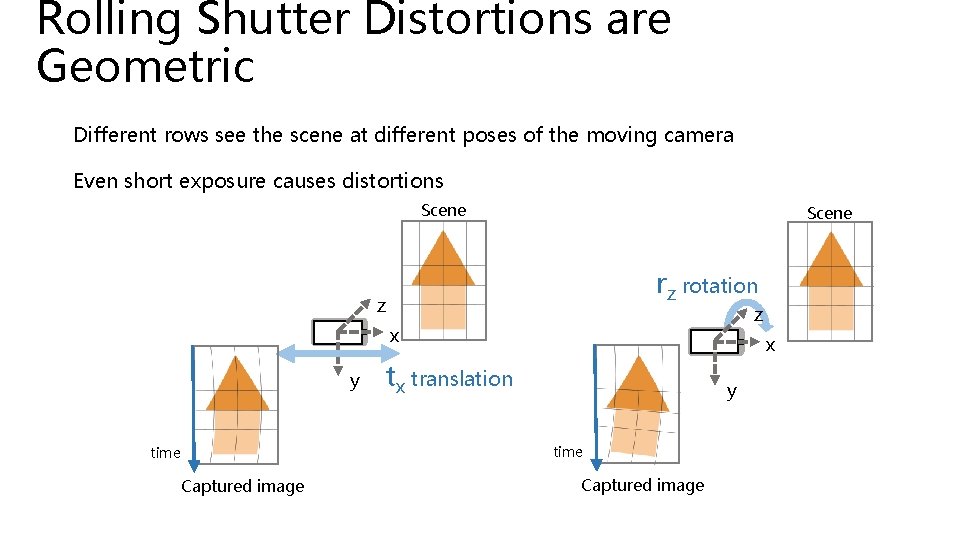
Rolling Shutter Distortions are Geometric Different rows see the scene at different poses of the moving camera Even short exposure causes distortions Scene rz rotation z z x y x tx translation y time Captured image
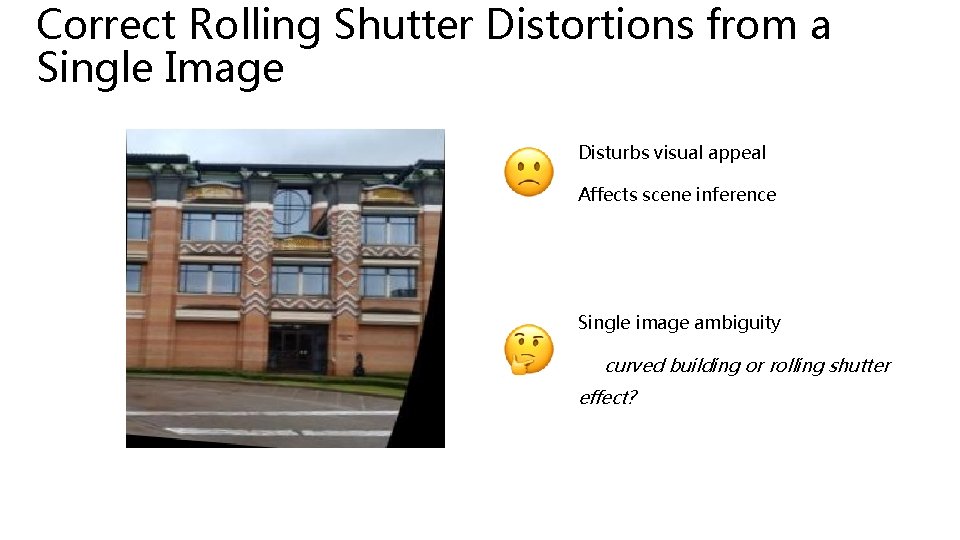
Correct Rolling Shutter Distortions from a Single Image Disturbs visual appeal Affects scene inference Single image ambiguity curved building or rolling shutter effect?
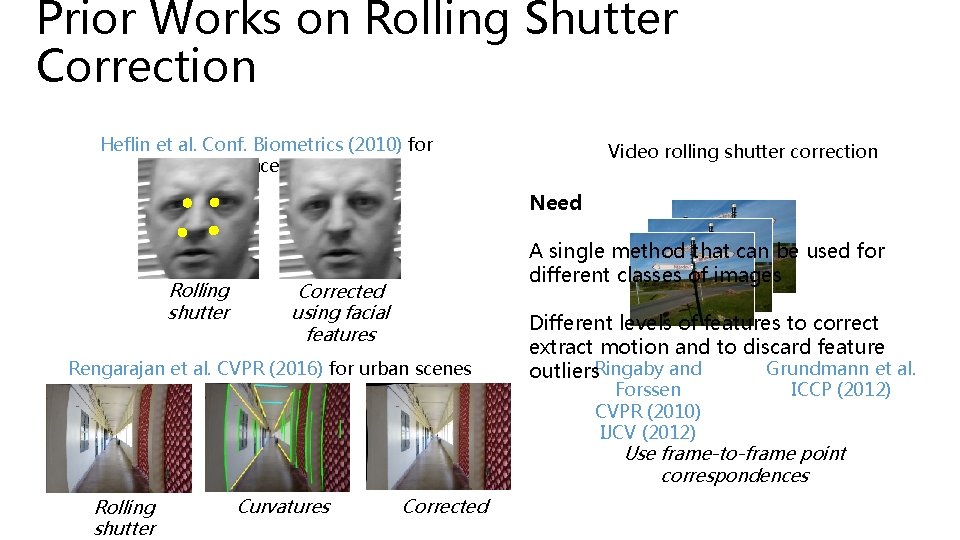
Prior Works on Rolling Shutter Correction Heflin et al. Conf. Biometrics (2010) for faces Video rolling shutter correction Need Rolling shutter A single method that can be used for different classes of images Corrected using facial features Rengarajan et al. CVPR (2016) for urban scenes Different levels of features to correct extract motion and to discard feature Grundmann et al. outliers. Ringaby and Forssen CVPR (2010) IJCV (2012) ICCP (2012) Use frame-to-frame point correspondences Rolling shutter Curvatures Corrected
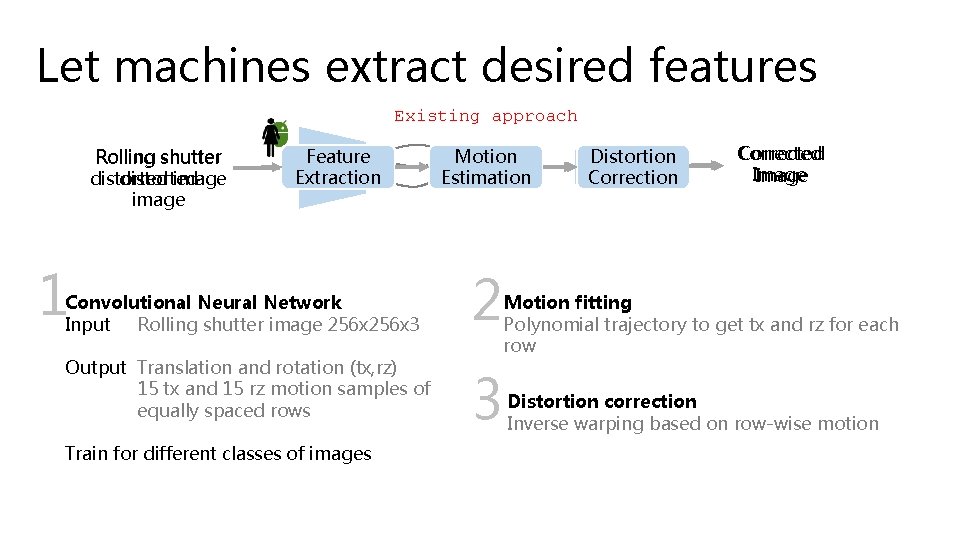
Let machines extract desired features Existing approach Rolling shutter distorted image Feature CNN Extraction 1 Convolutional Neural Network Input Rolling shutter image 256 x 3 Output Translation and rotation (tx, rz) 15 tx and 15 rz motion samples of equally spaced rows Train for different classes of images Motion Fitting Estimation 2 Distortion Correction Corrected Image Motion fitting Polynomial trajectory to get tx and rz for each row 3 Distortion correction Inverse warping based on row-wise motion
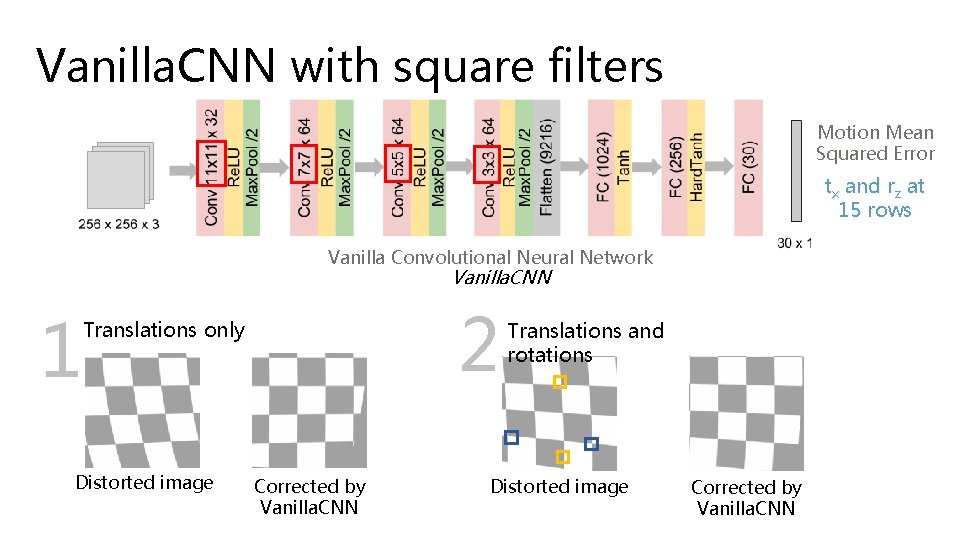
Vanilla. CNN with square filters Motion Mean Squared Error tx and rz at 15 rows Vanilla Convolutional Neural Network Vanilla. CNN 1 2 Translations only Distorted image Corrected by Vanilla. CNN Translations and rotations Distorted image Corrected by Vanilla. CNN
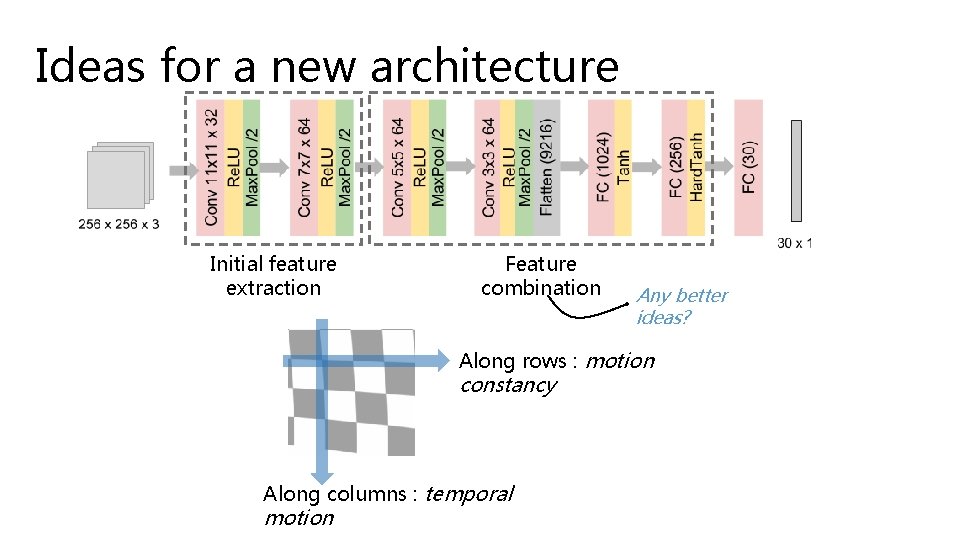
Ideas for a new architecture Initial feature extraction Feature combination Any better ideas? Along rows : motion constancy Along columns : temporal motion
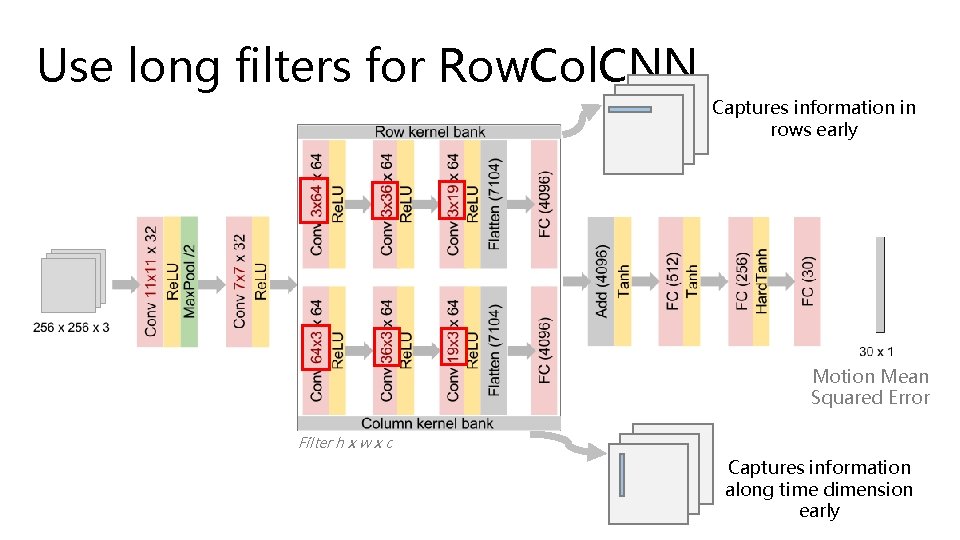
Use long filters for Row. Col. CNN Captures information in rows early Motion Mean Squared Error Filter h x w x c Captures information along time dimension early
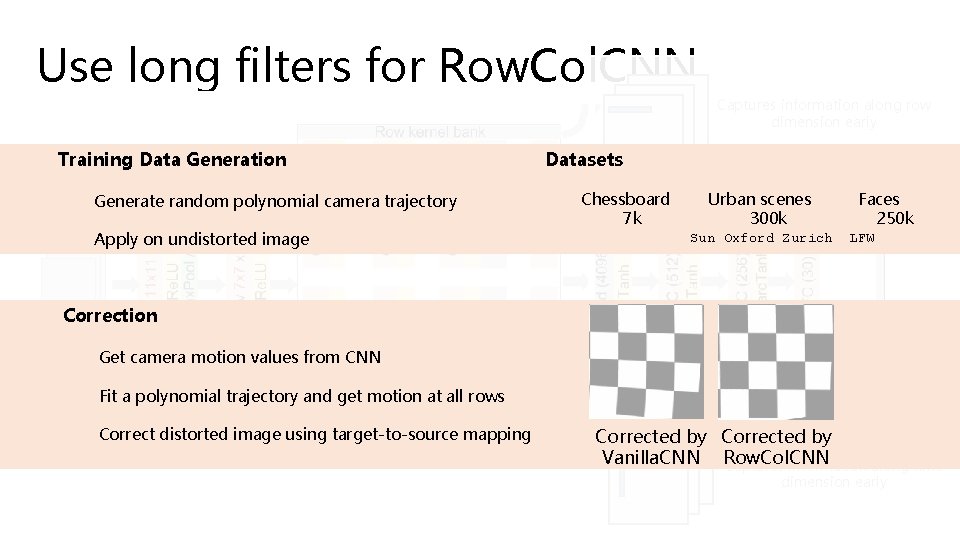
Use long filters for Row. Col. CNN Captures information along row dimension early Training Data Generation Generate random polynomial camera trajectory Apply on undistorted image Datasets Chessboard 7 k Urban scenes 300 k Sun Oxford Zurich Faces 250 k LFW Correction Get camera motion values from CNN Fit a polynomial trajectory and get motion at all rows Correct distorted image using target-to-source mapping Motion Mean Squared Error Corrected by Vanilla. CNN Row. Col. CNN Captures information along time dimension early
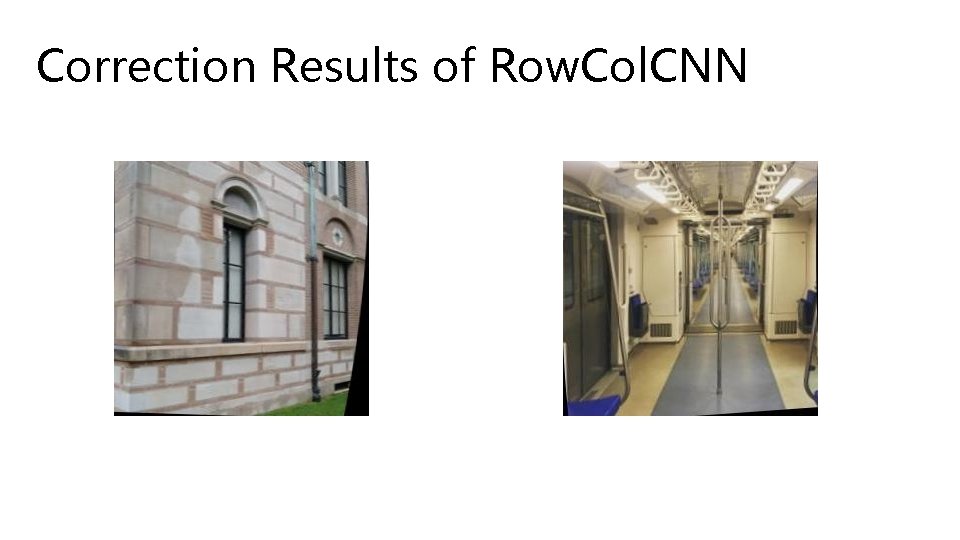
Correction Results of Row. Col. CNN
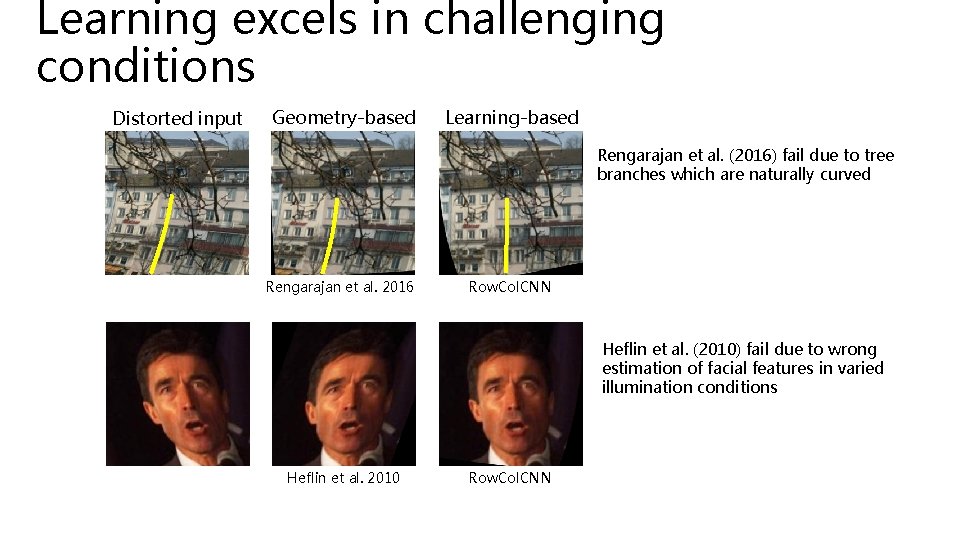
Learning excels in challenging conditions Distorted input Geometry-based Learning-based Rengarajan et al. (2016) fail due to tree branches which are naturally curved Rengarajan et al. 2016 Row. Col. CNN Heflin et al. (2010) fail due to wrong estimation of facial features in varied illumination conditions Heflin et al. 2010 Row. Col. CNN
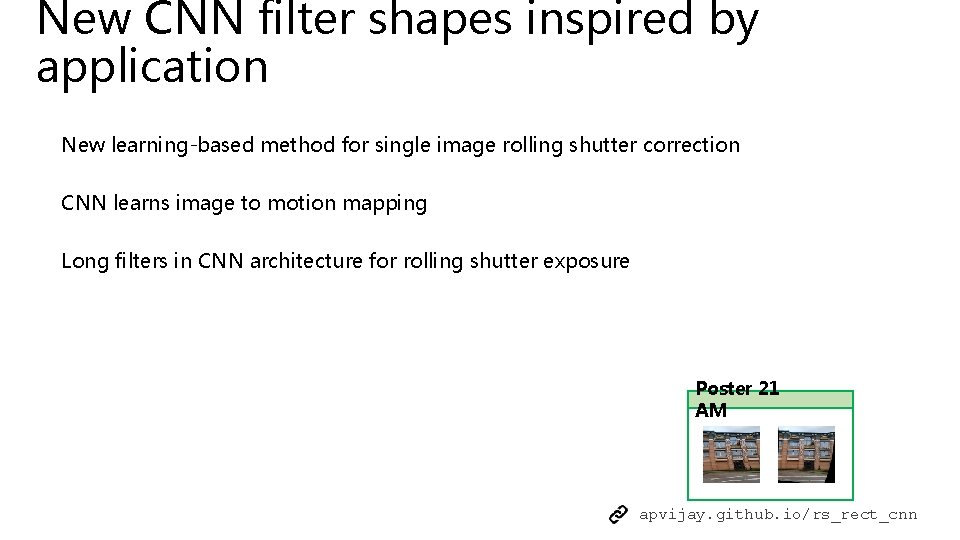
New CNN filter shapes inspired by application New learning-based method for single image rolling shutter correction CNN learns image to motion mapping Long filters in CNN architecture for rolling shutter exposure Poster 21 AM apvijay. github. io/rs_rect_cnn