
Unreliable Silicon Myth or Reality Shubu Mukherjee Principal
Unreliable Silicon: Myth or Reality? Shubu Mukherjee Principal Engineer Director, SPEARS Group (SPEARS = Simulation & Pathfinding of Efficient And Reliable Systems) Intel Corporation Workshop on Computer Architecture Research Directions (CARD) Feb. 11 th, 2007
What’s the Truth? There are three versions of the truth: • My truth • Your truth • The truth 2
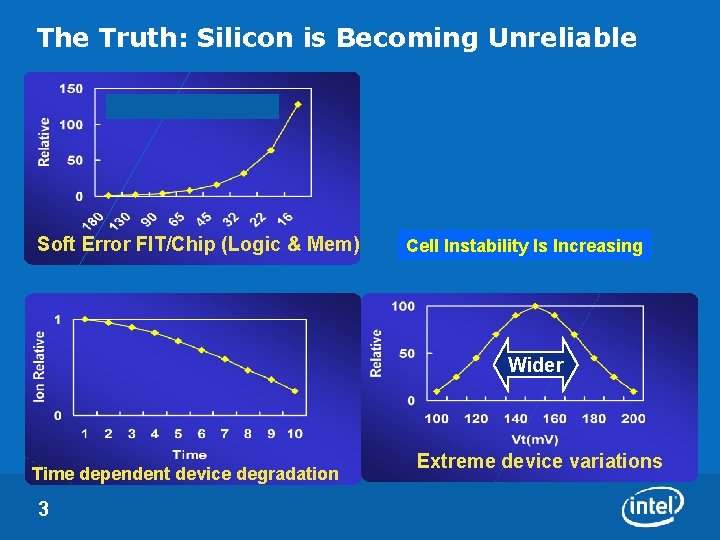
The Truth: Silicon is Becoming Unreliable Soft Error FIT/Chip (Logic & Mem) Cell Instability Is Increasing Wider Time dependent device degradation 3 Extreme device variations
The End-User’s Truth End-users • Care deeply about reliable systems • May not be able to determine why their system failed • Expect the industry to produce reliable systems for them Goal of silicon vendors • • Keep # silicon errors low enough (e. g. , < 0. 1% of all errors) Low enough that end-users don’t notice or don’t care Point Risks • Individual corruption or crash may be critical (e. g. , Windows 98 crash during a Gates demo) • End-users may demand chip replacement, even if the error was not permanent 4
The IT Manager or Vendor’s Truth The Lightbulb Phenomenon • • A house with 48 lightbulbs, each with 4 year MTTF Will replace a lightbulb every month Negative Impact to Business billions of dollars involved • • • 5 Increased total cost of ownership Product returns & replacement Loss of data and/or availability
The Designer’s Awakening Shock • “SER is the crabgrass in the lawn of computer design” Denial • “We will do the SER work two months before tapeout” Anger • “Our reliability target is too ambitious” Acceptance • “You can deny physics only for so long” Designers have accepted silicon reliability as a challenge they will have to deal with 6
The Designer’s Challenge Protection comes from • • • Process – improved process technology Materials – shielding for alpha particles Circuits – rad-hard cells Architecture – ECC, parity, hardened gates, redundant execution Software – can provide detection & recovery at higher level Companies constantly making trade-offs for reliability • • Cost of protection (performance & die size) vs. chip reliability Products must meet the end-users reliability expectations Industry will produce reliably operating parts 7
Industry Needs Help with Research Academia has some misconceptions • • • MTBF is only a rough estimate of an individual parts life • … A system hang does not protect from data corruption Adding protection without correction does not reduce the overall error rate Research needed in different areas of silicon reliability • How do we predict and/or measure error rate from radiation, wearout, & variability? • • How do we detect soft errors, wearout, variability on individual parts? 8 Many traditional solutions exist, but how do we make them cheaper?
- Slides: 8