
Unraveling the Complexities of Autism Spectrum Disorders ASD
- Slides: 19
Unraveling the Complexities of Autism Spectrum Disorders (ASD) for Testing Accommodations Presented to Building Bridges Stockholm, Sweden May 2014 Loring C. Brinckerhoff Dir, Office of Disability Policy Educational Testing Service lbrinckerhoff@ets. org Confidential and Proprietary. Copyright © 2010 Educational Testing Service. All rights reserved.
Confidential and Proprietary. Copyright © 2010 Educational Testing Service. All rights reserved.
What is ASD? A neuro-developmental disorder ranging from mild to severe that is characterized by core features of social/communication deficits, repetitive/restrictive behaviors, and a lack of emotional reciprocity 3 Confidential and Proprietary. Copyright © 2010 Educational Testing Service. All rights reserved.
DSM-5 Changes to ASD • The four previously separate disorders (e. g, Asperger’s disorder, childhood disintegrative disorder, and PDD- NOS) are now viewed as a single condition with different levels of symptom severity in two core domains: o deficits in social communication and social interaction o restricted, repetitive behaviors, interests & activities Banerjee and Brinckerhoff, June 2013 4 Confidential and Proprietary. Copyright © 2010 Educational Testing Service. All rights reserved.
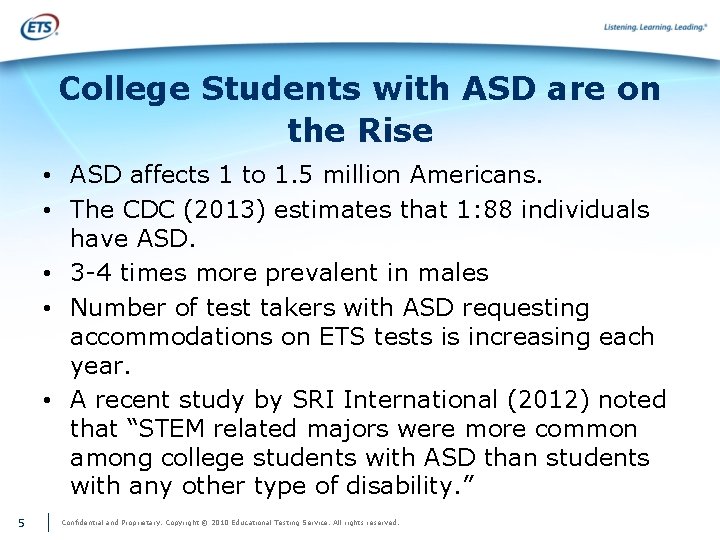
College Students with ASD are on the Rise • ASD affects 1 to 1. 5 million Americans. • The CDC (2013) estimates that 1: 88 individuals have ASD. • 3 -4 times more prevalent in males • Number of test takers with ASD requesting accommodations on ETS tests is increasing each year. • A recent study by SRI International (2012) noted that “STEM related majors were more common among college students with ASD than students with any other type of disability. ” 5 Confidential and Proprietary. Copyright © 2010 Educational Testing Service. All rights reserved.
College Students with Asperger’s Despite intellectual and academic gifts, persons with AS have a decreased ability to decipher the intentions and actions of others, to integrate multiple streams of incoming information, and to navigate an increasingly complex social world. They may be rigid and perfectionistic and resist changing to meet the demands of their environment. ” (Wolf, Thierfeld Brown & Bork, 2009) 6 Confidential and Proprietary. Copyright © 2010 Educational Testing Service. All rights reserved.
Why Develop Documentation Guidelines for ASD? • ETS Policy Statements for LD, ADHD, and Psychiatric don’t fit this population. • Need to move away from the LD discrepancy model review mindset • ASD documentation typically does not show test scores with significant deficits in cognitive profiles or in achievement areas. • The key is an in-depth discussion by the evaluator of symptomatology. • Documentation may involve multiple professionals. 7 Confidential and Proprietary. Copyright © 2010 Educational Testing Service. All rights reserved.
Documentation Considerations • ASD is often picked up at school age and misdiagnosed as ADHD. • ASD should spill over into two or more settings. • Look for relevant information regarding current treatment. • Individuals with ASD may experience difficulties with major life activities such as learning, reading, concentration, and/or thinking. 8 Confidential and Proprietary. Copyright © 2010 Educational Testing Service. All rights reserved.
Documentation Considerations (cont’d): • The use of psychotropic drugs is becoming increasingly common, so there may be side effects of medication to consider. • Both the positive and negative effects of medication should be noted. 9 Confidential and Proprietary. Copyright © 2010 Educational Testing Service. All rights reserved.
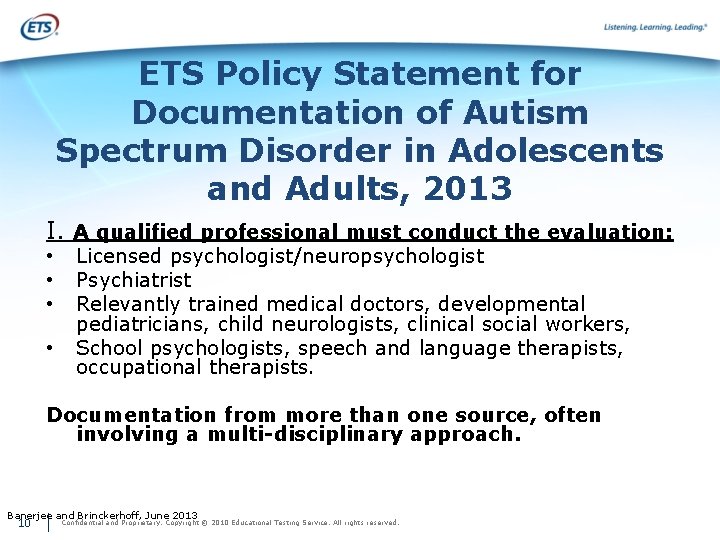
ETS Policy Statement for Documentation of Autism Spectrum Disorder in Adolescents and Adults, 2013 I. A qualified professional must conduct the evaluation: • • Licensed psychologist/neuropsychologist Psychiatrist Relevantly trained medical doctors, developmental pediatricians, child neurologists, clinical social workers, School psychologists, speech and language therapists, occupational therapists. Documentation from more than one source, often involving a multi-disciplinary approach. Banerjee and Brinckerhoff, June 2013 10 Confidential and Proprietary. Copyright © 2010 Educational Testing Service. All rights reserved.
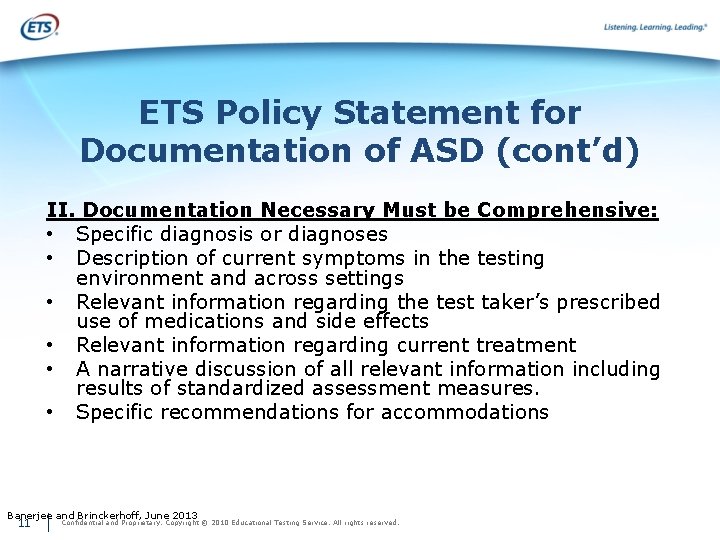
ETS Policy Statement for Documentation of ASD (cont’d) II. Documentation Necessary Must be Comprehensive: • Specific diagnosis or diagnoses • Description of current symptoms in the testing environment and across settings • Relevant information regarding the test taker’s prescribed use of medications and side effects • Relevant information regarding current treatment • A narrative discussion of all relevant information including results of standardized assessment measures. • Specific recommendations for accommodations Banerjee and Brinckerhoff, June 2013 11 Confidential and Proprietary. Copyright © 2010 Educational Testing Service. All rights reserved.
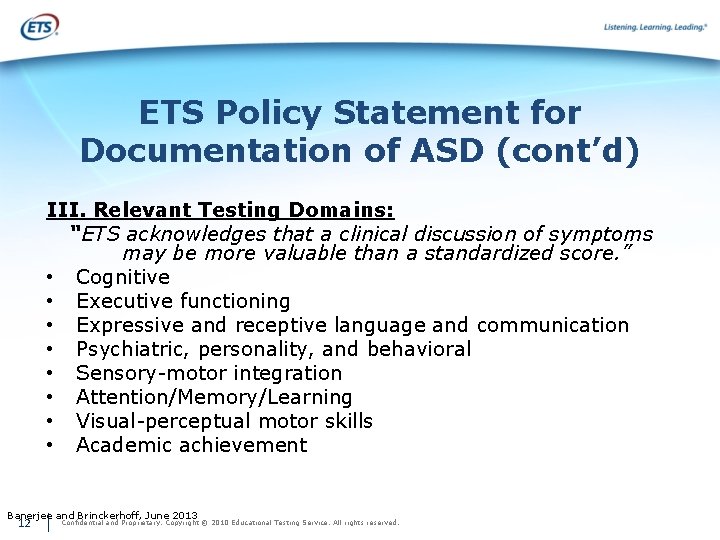
ETS Policy Statement for Documentation of ASD (cont’d) III. Relevant Testing Domains: “ETS acknowledges that a clinical discussion of symptoms may be more valuable than a standardized score. ” • Cognitive • Executive functioning • Expressive and receptive language and communication • Psychiatric, personality, and behavioral • Sensory-motor integration • Attention/Memory/Learning • Visual-perceptual motor skills • Academic achievement Banerjee and Brinckerhoff, June 2013 12 Confidential and Proprietary. Copyright © 2010 Educational Testing Service. All rights reserved.
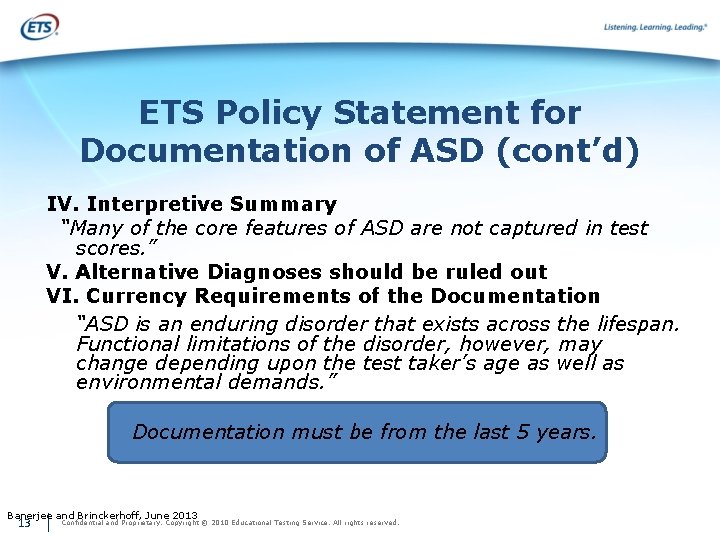
ETS Policy Statement for Documentation of ASD (cont’d) IV. Interpretive Summary “Many of the core features of ASD are not captured in test scores. ” V. Alternative Diagnoses should be ruled out VI. Currency Requirements of the Documentation “ASD is an enduring disorder that exists across the lifespan. Functional limitations of the disorder, however, may change depending upon the test taker’s age as well as environmental demands. ” Documentation must be from the last 5 years. Banerjee and Brinckerhoff, June 2013 13 Confidential and Proprietary. Copyright © 2010 Educational Testing Service. All rights reserved.
ETS Policy Statement for Documentation of ASD (cont’d) VII. Rationale for each requested accommodation must be provided “A link must be established between the requested accommodations and the manifested symptomatology of the disorder that is pertinent to the anticipated testing situation. ” Banerjee and Brinckerhoff, June 2013 14 Confidential and Proprietary. Copyright © 2010 Educational Testing Service. All rights reserved.
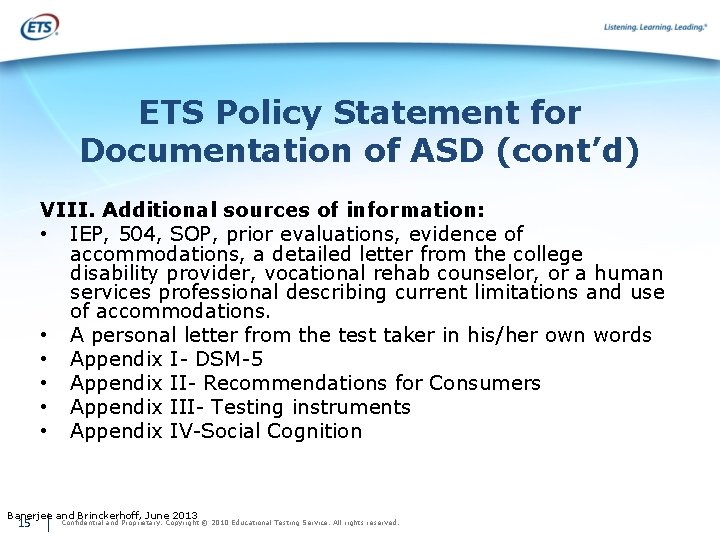
ETS Policy Statement for Documentation of ASD (cont’d) VIII. Additional sources of information: • IEP, 504, SOP, prior evaluations, evidence of accommodations, a detailed letter from the college disability provider, vocational rehab counselor, or a human services professional describing current limitations and use of accommodations. • A personal letter from the test taker in his/her own words • Appendix I- DSM-5 • Appendix II- Recommendations for Consumers • Appendix III- Testing instruments • Appendix IV-Social Cognition Banerjee and Brinckerhoff, June 2013 15 Confidential and Proprietary. Copyright © 2010 Educational Testing Service. All rights reserved.
Why grant accommodations to ASD students? • • • 16 Co-occurring disabilities Perfectionist tendencies May fixate on the wording of test questions May over-analyze content in test questions Testing environment may warrant modifications. Confidential and Proprietary. Copyright © 2010 Educational Testing Service. All rights reserved.
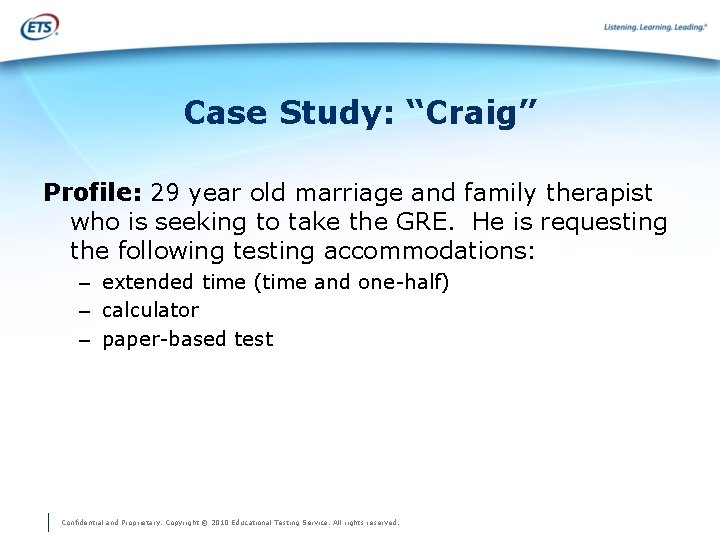
Case Study: “Craig” Profile: 29 year old marriage and family therapist who is seeking to take the GRE. He is requesting the following testing accommodations: – extended time (time and one-half) – calculator – paper-based test Confidential and Proprietary. Copyright © 2010 Educational Testing Service. All rights reserved.
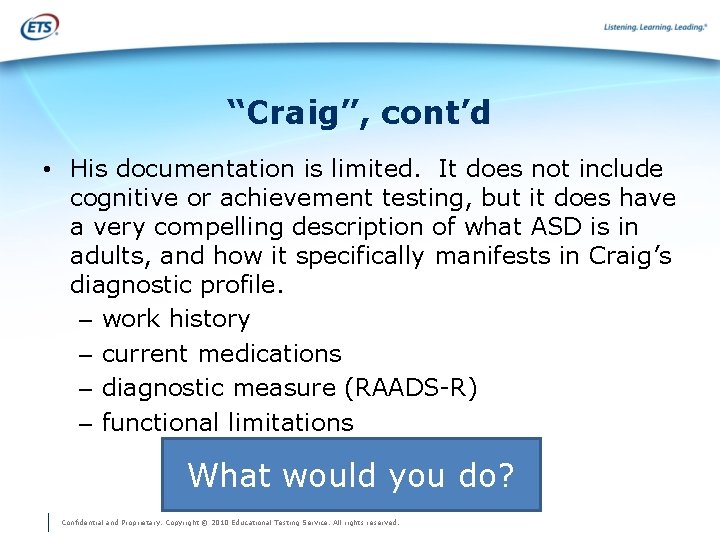
“Craig”, cont’d • His documentation is limited. It does not include cognitive or achievement testing, but it does have a very compelling description of what ASD is in adults, and how it specifically manifests in Craig’s diagnostic profile. – work history – current medications – diagnostic measure (RAADS-R) – functional limitations What would you do? What Confidential and Proprietary. Copyright © 2010 Educational Testing Service. All rights reserved.
Thank you Q&A Confidential and Proprietary. Copyright © 2010 Educational Testing Service. All rights reserved.