
Unpacking the Standard Course of Study Steve Molinari
- Slides: 19
Unpacking the Standard Course of Study Steve Molinari K-12 Social Studies Consultant Department of Public Instruction Dal Edwards K-12 Social Studies Consultant Department of Public Instruction
Essential Question • How can unpacking the North Carolina Standard Course of Study guide your teaching and the learning of your students?
Session Outcome: Participants will work collaboratively to unpack course goals from the North Carolina Standard Course of Study.
Overview and Endorsements “Unwrapping” the academic content standards is a proven technique to help educators identify from the full text of the standards exactly what they need to teach their students. Unwrapped standards provide clarity as to what students must know and be able to do. Larry Ainsworth, Unwrapping the Standards, 2003.
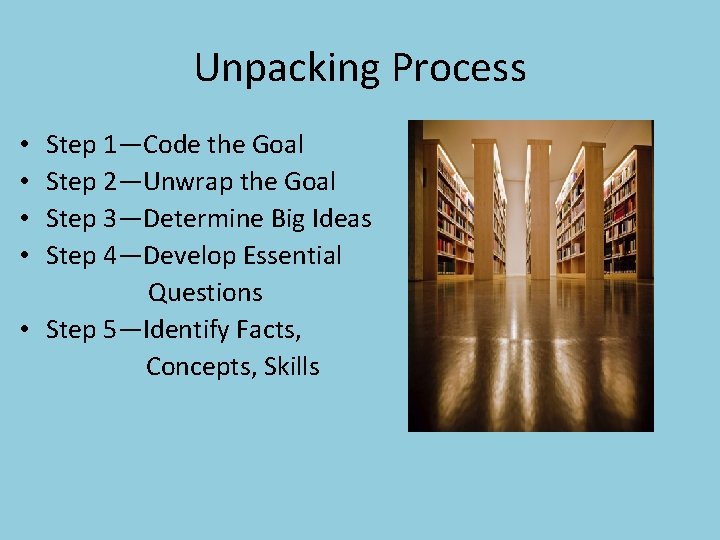
Unpacking Process Step 1—Code the Goal Step 2—Unwrap the Goal Step 3—Determine Big Ideas Step 4—Develop Essential Questions • Step 5—Identify Facts, Concepts, Skills • •
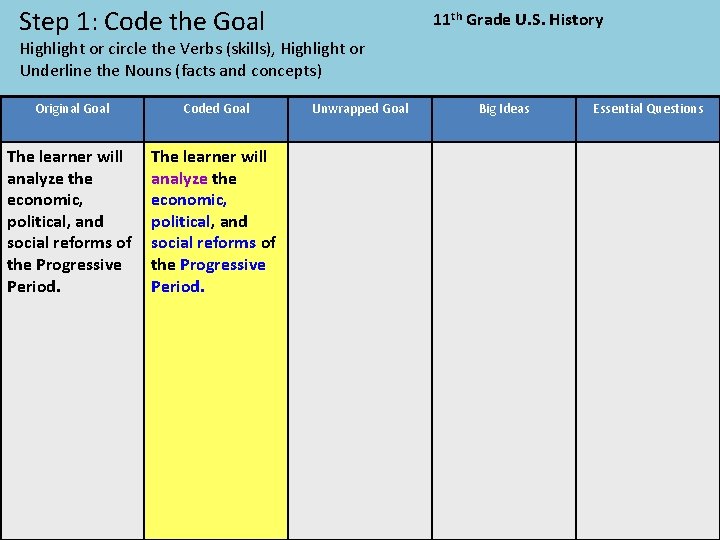
Step 1: Code the Goal 11 th Grade U. S. History Highlight or circle the Verbs (skills), Highlight or Underline the Nouns (facts and concepts) Original Goal Coded Goal The learner will analyze the economic, political, and social reforms of the Progressive Period. Unwrapped Goal Big Ideas Essential Questions
Step 2: Unwrap the Goal • Identify the concepts and skills found in the goal to determine what students need to understand do • Organize or list the goals graphically in a way that makes them stand out in “high relief” • This list will unwrap the various concepts as they relate to a particular time period or category in social studies.
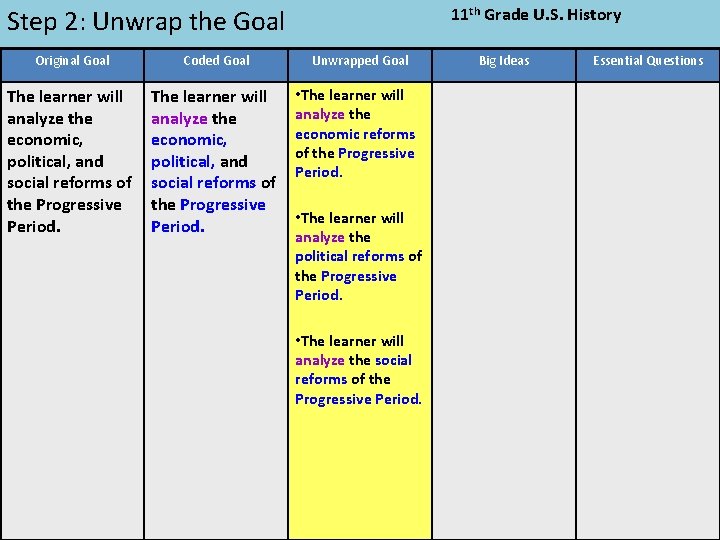
Step 2: Unwrap the Goal Original Goal Coded Goal The learner will analyze the economic, political, and social reforms of the Progressive Period. 11 th Grade U. S. History Unwrapped Goal • The learner will analyze the economic reforms of the Progressive Period. • The learner will analyze the political reforms of the Progressive Period. • The learner will analyze the social reforms of the Progressive Period. Big Ideas Essential Questions
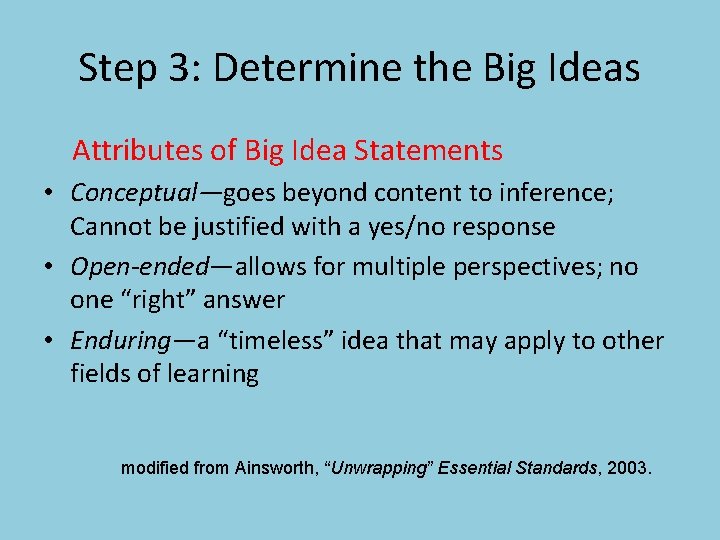
Step 3: Determine the Big Ideas Attributes of Big Idea Statements • Conceptual—goes beyond content to inference; Cannot be justified with a yes/no response • Open-ended—allows for multiple perspectives; no one “right” answer • Enduring—a “timeless” idea that may apply to other fields of learning modified from Ainsworth, “Unwrapping” Essential Standards, 2003.
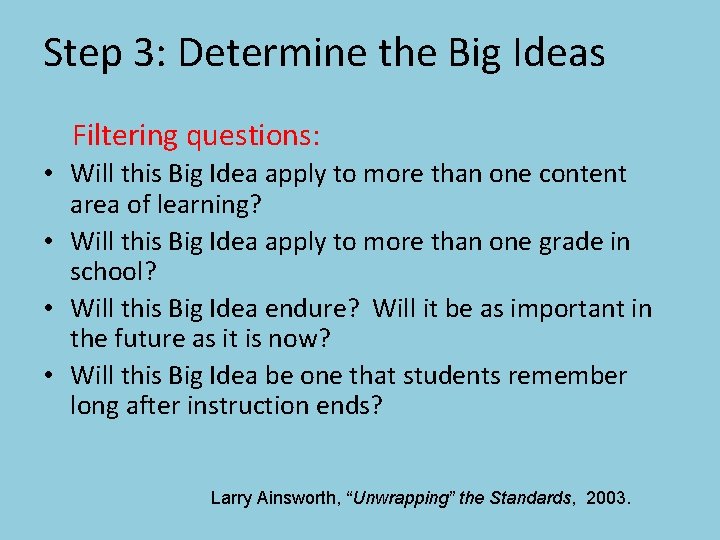
Step 3: Determine the Big Ideas Filtering questions: • Will this Big Idea apply to more than one content area of learning? • Will this Big Idea apply to more than one grade in school? • Will this Big Idea endure? Will it be as important in the future as it is now? • Will this Big Idea be one that students remember long after instruction ends? Larry Ainsworth, “Unwrapping” the Standards, 2003.
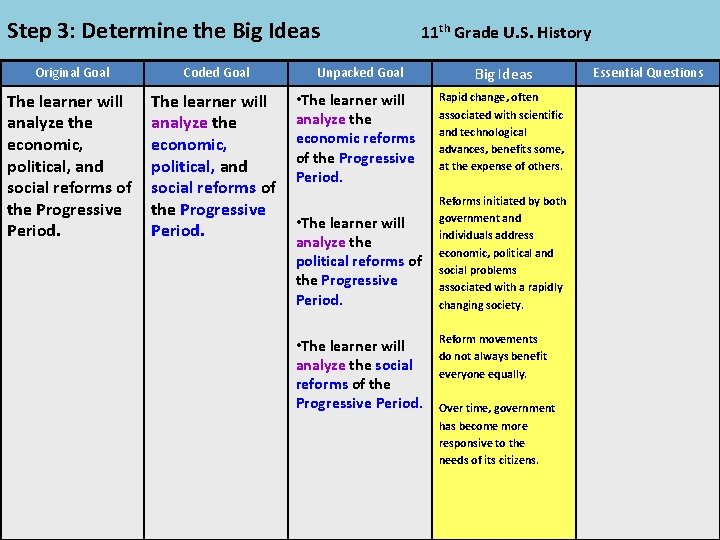
Step 3: Determine the Big Ideas Original Goal Coded Goal The learner will analyze the economic, political, and social reforms of the Progressive Period. 11 th Grade U. S. History Unpacked Goal • The learner will analyze the economic reforms of the Progressive Period. • The learner will analyze the political reforms of the Progressive Period. • The learner will analyze the social reforms of the Progressive Period. Big Ideas Rapid change, often associated with scientific and technological advances, benefits some, at the expense of others. Reforms initiated by both government and individuals address economic, political and social problems associated with a rapidly changing society. Reform movements do not always benefit everyone equally. Over time, government has become more responsive to the needs of its citizens. Essential Questions
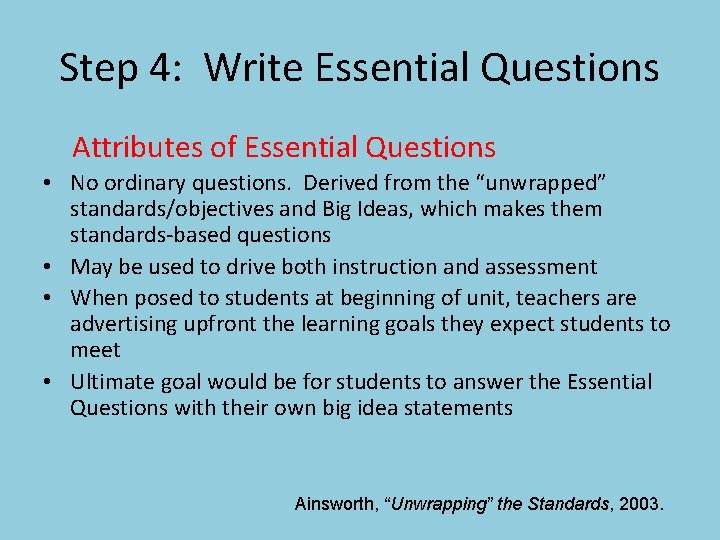
Step 4: Write Essential Questions Attributes of Essential Questions • No ordinary questions. Derived from the “unwrapped” standards/objectives and Big Ideas, which makes them standards-based questions • May be used to drive both instruction and assessment • When posed to students at beginning of unit, teachers are advertising upfront the learning goals they expect students to meet • Ultimate goal would be for students to answer the Essential Questions with their own big idea statements Ainsworth, “Unwrapping” the Standards, 2003.
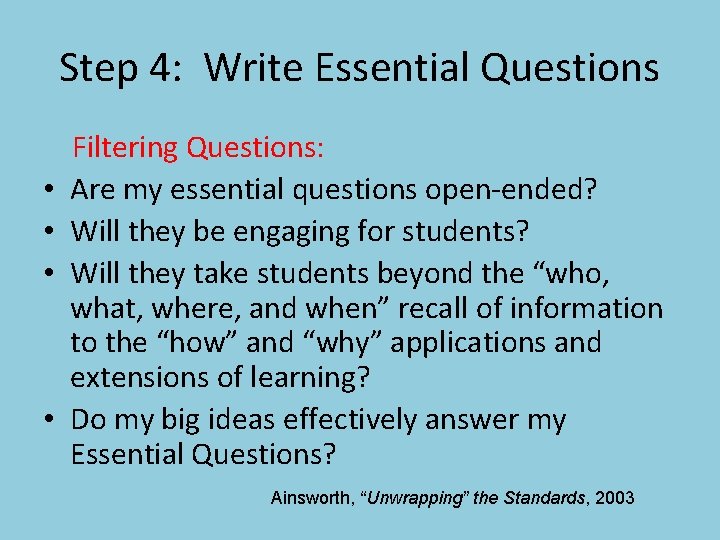
Step 4: Write Essential Questions • • Filtering Questions: Are my essential questions open-ended? Will they be engaging for students? Will they take students beyond the “who, what, where, and when” recall of information to the “how” and “why” applications and extensions of learning? Do my big ideas effectively answer my Essential Questions? Ainsworth, “Unwrapping” the Standards, 2003
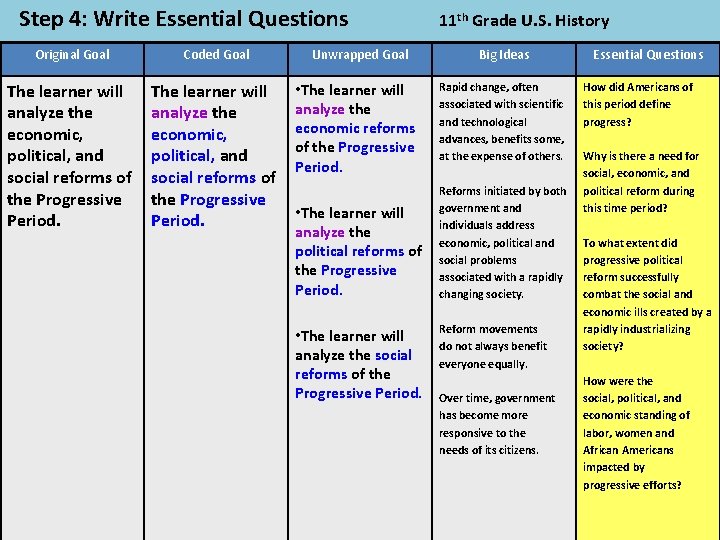
Step 4: Write Essential Questions Original Goal Coded Goal The learner will analyze the economic, political, and social reforms of the Progressive Period. Unwrapped Goal • The learner will analyze the economic reforms of the Progressive Period. • The learner will analyze the political reforms of the Progressive Period. • The learner will analyze the social reforms of the Progressive Period. 11 th Grade U. S. History Big Ideas Rapid change, often associated with scientific and technological advances, benefits some, at the expense of others. Reforms initiated by both government and individuals address economic, political and social problems associated with a rapidly changing society. Reform movements do not always benefit everyone equally. Over time, government has become more responsive to the needs of its citizens. Essential Questions How did Americans of this period define progress? Why is there a need for social, economic, and political reform during this time period? To what extent did progressive political reform successfully combat the social and economic ills created by a rapidly industrializing society? How were the social, political, and economic standing of labor, women and African Americans impacted by progressive efforts?
Step 5—Identifying Facts, Concepts, Skills • What facts, concepts, and skills should students be able to respectively know, understand, and do to demonstrate an understanding of this particular goal?
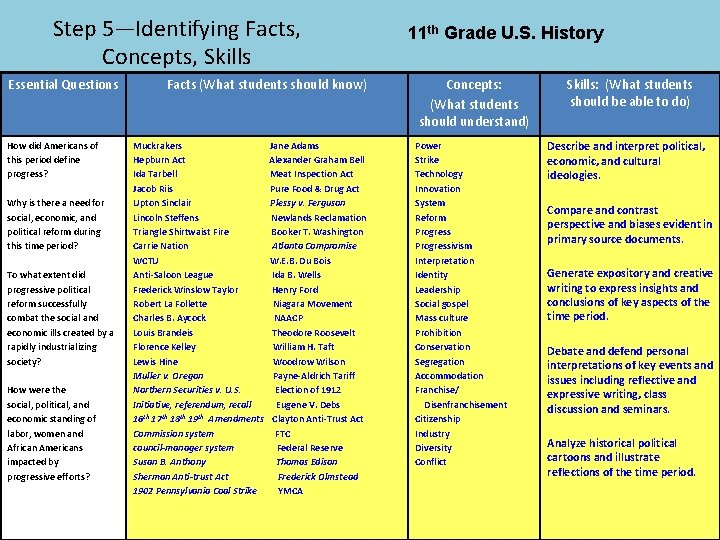
Step 5—Identifying Facts, Concepts, Skills Essential Questions How did Americans of this period define progress? Why is there a need for social, economic, and political reform during this time period? To what extent did progressive political reform successfully combat the social and economic ills created by a rapidly industrializing society? How were the social, political, and economic standing of labor, women and African Americans impacted by progressive efforts? Facts (What students should know) Muckrakers Hepburn Act Ida Tarbell Jacob Riis Upton Sinclair Lincoln Steffens Triangle Shirtwaist Fire Carrie Nation WCTU Anti-Saloon League Frederick Winslow Taylor Robert La Follette Charles B. Aycock Louis Brandeis Florence Kelley Lewis Hine Muller v. Oregon Northern Securities v. U. S. Initiative, referendum, recall 16 th 17 th 18 th 19 th Amendments Commission system council-manager system Susan B. Anthony Sherman Anti-trust Act 1902 Pennsylvania Coal Strike Jane Adams Alexander Graham Bell Meat Inspection Act Pure Food & Drug Act Plessy v. Ferguson Newlands Reclamation Booker T. Washington Atlanta Compromise W. E. B. Du Bois Ida B. Wells Henry Ford Niagara Movement NAACP Theodore Roosevelt William H. Taft Woodrow Wilson Payne-Aldrich Tariff Election of 1912 Eugene V. Debs Clayton Anti-Trust Act FTC Federal Reserve Thomas Edison Frederick Olmstead YMCA 11 th Grade U. S. History Concepts: (What students should understand) Power Strike Technology Innovation System Reform Progressivism Interpretation Identity Leadership Social gospel Mass culture Prohibition Conservation Segregation Accommodation Franchise/ Disenfranchisement Citizenship Industry Diversity Conflict Skills: (What students should be able to do) Describe and interpret political, economic, and cultural ideologies. Compare and contrast perspective and biases evident in primary source documents. Generate expository and creative writing to express insights and conclusions of key aspects of the time period. Debate and defend personal interpretations of key events and issues including reflective and expressive writing, class discussion and seminars. Analyze historical political cartoons and illustrate reflections of the time period.
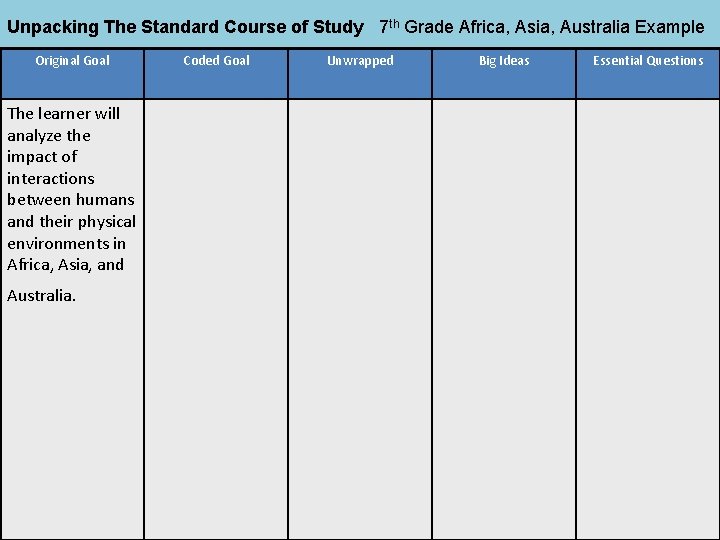
Unpacking The Standard Course of Study 7 th Grade Africa, Asia, Australia Example Original Goal The learner will analyze the impact of interactions between humans and their physical environments in Africa, Asia, and Australia. Coded Goal Unwrapped Big Ideas Essential Questions
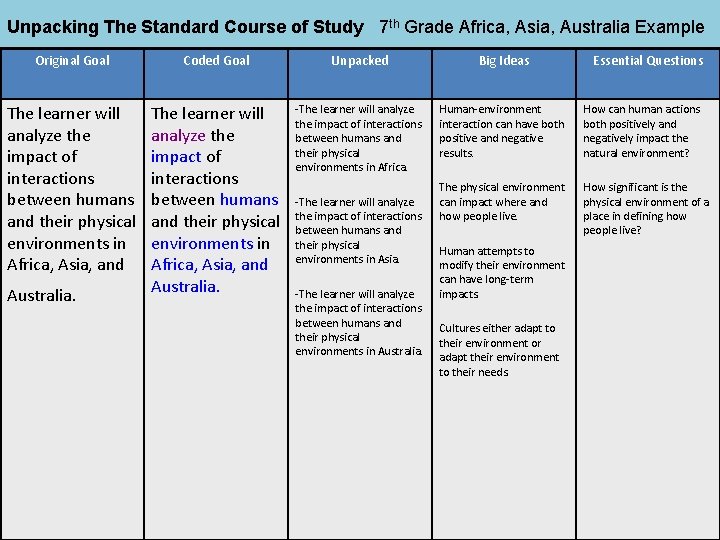
Unpacking The Standard Course of Study 7 th Grade Africa, Asia, Australia Example Original Goal Coded Goal Unpacked Big Ideas The learner will analyze the impact of interactions between humans and their physical environments in Africa, Asia, and Australia. -The learner will analyze the impact of interactions between humans and their physical environments in Africa. Human-environment interaction can have both positive and negative results. How can human actions both positively and negatively impact the natural environment? The physical environment can impact where and how people live. How significant is the physical environment of a place in defining how people live? Australia. -The learner will analyze the impact of interactions between humans and their physical environments in Asia. -The learner will analyze the impact of interactions between humans and their physical environments in Australia. Human attempts to modify their environment can have long-term impacts. Cultures either adapt to their environment or adapt their environment to their needs. Essential Questions
Reflection