
UNPACKING THE NATURE OF VALUES EDUCATION IN PRIMARY




- Slides: 36
UNPACKING THE NATURE OF VALUES EDUCATION IN PRIMARY SCHOOL SETTINGS ANDREW FURCO International Center for Research on Civic Engagement and Service-Learning University of California-Berkeley
THE VALUES EDUCATION DILEMMAS AND DEBATES Ø Ø Should schools be responsible for teaching values? Why or why not? If not schools, then who? Is there such a thing as a set of “common values”? If so, what are they? If not, which values do we choose to teach, and who decides? Can we educate students about values without indoctrination? Can a teacher effectively teach values that go against his/her own values orientation or belief system?
THE NATURE OF VALUES DEVELOPMENT • • • Occurs over a lifetime and is ongoing Developed by hearing, seeing, experiencing, feeling, thinking Not all values are equal all the time Explicit and Implicit Nature vs. nurture (love, caring) Influenced by social norms and context (respect, honor, integrity) Personal and individualized Developmental Interconnection among traits
GOOD VS. BAD VALUES A specific value can be good or bad (appropriate or inappropriate) depending on: Culture, social, religious customs and norms • Age • Circumstances and situation •
The Australian National Values Education Framework Evaluative case studies of “good practice” Ø Be based on “a more rigorous, evidence based approach to developing good practice in values education” (DEST) Ø Integrate values education into core teaching Ø Incorporate dimensions of quality teaching Ø
The Australian National Values Education Guiding Principles Effective values education: Ø Helps students UNDERSTAND and be able to APPLY VALUES Ø Is an explicit goal of schools that PROMOTES DIVERSITY and Australia’s democratic way of life Ø Articulates values of SCHOOL COMMUNITY and applies these consistently in school practice Ø Occurs IN PARTNERSHIP with students, families, and community as part of a WHOLE SCHOOL APPROACH that enables students to exercise responsibility and resilience
The Australian National Values Education Guiding Principles Ø Is presented in a safe and supportive environment in which students are ENCOURAGED TO EXPLORE their own, their schools, and their community’s VALUES Ø Is delivered by TRAINED AND RESOURCED TEACHERS able to use a variety of DIFFERENT MODELS, MODES, and STRATEGIES Ø Includes provision of the curriculum that meets the INDIVIDUAL NEEDS OF STUDENTS Ø REGULARLY REVIEWS the approaches used to check that they are meeting the intended outcomes
Key Elements of Values Education A. SCHOOL PLANNING: values are explicit in and connected to school planning B. PARTNERSHIP WITH THE SCHOOL COMMUNITY: draws on shared democratic values, involves community in monitoring and implementation of program C. WHOLE SCHOOL APPROACH: tied to the overall curriculum, funding priorities, and is part of school culture D. SAFE AND SUPPORTIVE LEARNING ENVIRONMENT: positive and supportive school climate; reflects good practice pedagogy; introduced at appropriate times E. SUPPORT FOR STUDENTS: empower students to develop responsibility, resilience, and engagement F. QUALITY TEACHING: Skilled teachers; values integrated with key learning goals
Moral Development Perspectives for Character Education Organized by Rafael Langer, UC Berkeley
Character Education in U. S. Schools • About 20 years old • Number of different programs and curricula exist v. DIFFER ü Traits emphasized ü Kinds of Activities ü Intensity ü Emphasis on Knowledge, Skills, or Behaviors ü Unit of analysis v. SIMILAR ü most are tangential or peripheral to academic curriculum ü not well studied
Character Education in U. S. Schools U. S. Department of Education Programs and Grant • 4 -year grants up to $2, 000 • Encourages links of Character Education to other educational efforts (service-learning, socioemotional learning) • The call for “evidence” and search for most promising programs
Project Heart, Head, Hands (H 3) Shaping Capable, Caring, Socially Responsible Youth through Character Education and Service-Learning • • • Currently serving 33 schools, over 1, 000 teachers and 20, 000 students in three districts near San Francisco, California Primary school curriculum Values Education through language arts, with social-emotional learning and service-learning Integrated in the language arts Curriculum at each grade level Reinforces reading comprehension and higher order analytic thinking skills Allows teachers to address language arts content standards while developing character Based on three frameworks: Moral Development, Youth Developmental Asset, and Experiential Learning School-wide Intensive teacher training 22 “characteristics” categorized into 8 “traits”
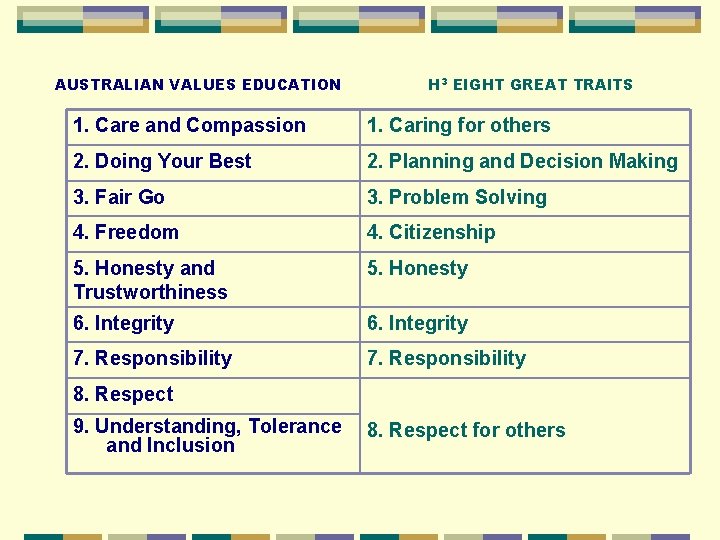
AUSTRALIAN VALUES EDUCATION H 3 EIGHT GREAT TRAITS 1. Care and Compassion 1. Caring for others 2. Doing Your Best 2. Planning and Decision Making 3. Fair Go 3. Problem Solving 4. Freedom 4. Citizenship 5. Honesty and Trustworthiness 5. Honesty 6. Integrity 7. Responsibility 8. Respect 9. Understanding, Tolerance and Inclusion 8. Respect for others
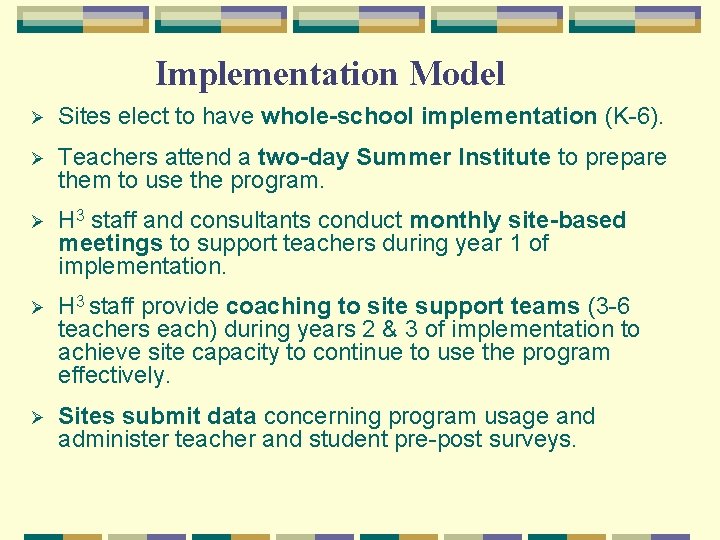
Implementation Model Ø Sites elect to have whole-school implementation (K-6). Ø Teachers attend a two-day Summer Institute to prepare them to use the program. Ø H 3 staff and consultants conduct monthly site-based meetings to support teachers during year 1 of implementation. Ø H 3 staff provide coaching to site support teams (3 -6 teachers each) during years 2 & 3 of implementation to achieve site capacity to continue to use the program effectively. Ø Sites submit data concerning program usage and administer teacher and student pre-post surveys.
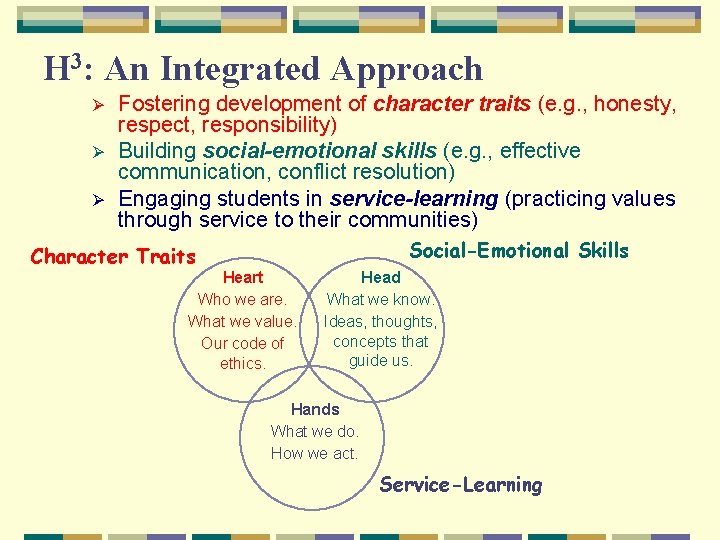
H 3: An Integrated Approach Ø Ø Ø Fostering development of character traits (e. g. , honesty, respect, responsibility) Building social-emotional skills (e. g. , effective communication, conflict resolution) Engaging students in service-learning (practicing values through service to their communities) Social-Emotional Skills Character Traits Heart Who we are. What we value. Our code of ethics. Head What we know. Ideas, thoughts, concepts that guide us. Hands What we do. How we act. Service-Learning
Language Arts Integration • Built into Open Court and Houghton Mifflin Reading units at each grade level. • Incorporate skills in reading, writing, listening, and speaking, and link with content standards in other areas as teachers use selections to highlight the Eight Great Traits. • Homework activities that provide opportunities for parents and students to communicate about positive character, social-emotional skills, and service-learning.
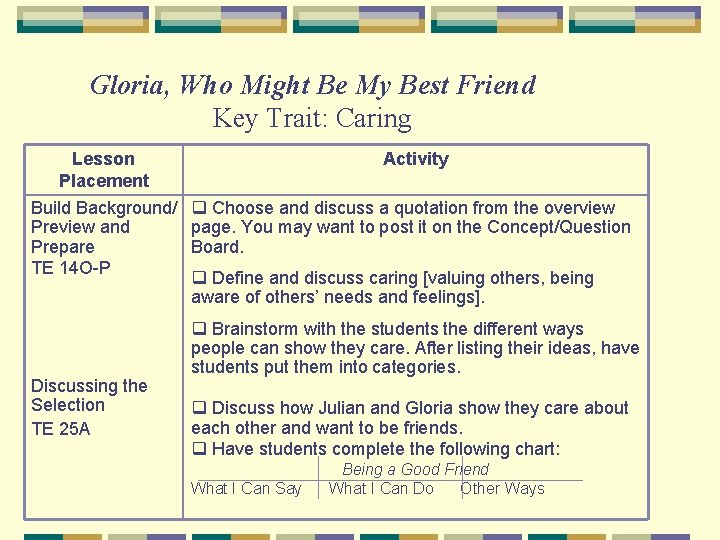
Gloria, Who Might Be My Best Friend Key Trait: Caring Lesson Placement Activity Build Background/ Choose and discuss a quotation from the overview Preview and page. You may want to post it on the Concept/Question Prepare Board. TE 14 O-P Define and discuss caring [valuing others, being aware of others’ needs and feelings]. Discussing the Selection TE 25 A Brainstorm with the students the different ways people can show they care. After listing their ideas, have students put them into categories. Discuss how Julian and Gloria show they care about each other and want to be friends. Have students complete the following chart: What I Can Say Being a Good Friend What I Can Do Other Ways
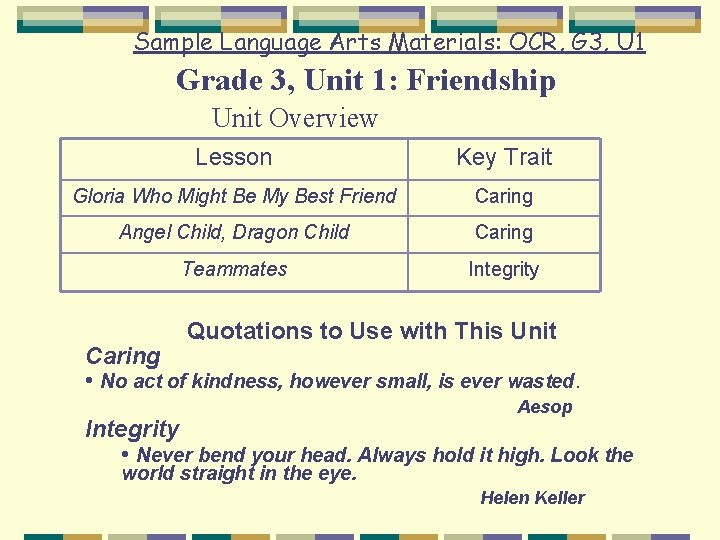
Sample Language Arts Materials: OCR, G 3, U 1 Grade 3, Unit 1: Friendship Unit Overview Lesson Key Trait Gloria Who Might Be My Best Friend Caring Angel Child, Dragon Child Caring Teammates Integrity Quotations to Use with This Unit Caring • No act of kindness, however small, is ever wasted. Aesop Integrity • Never bend your head. Always hold it high. Look the world straight in the eye. Helen Keller
Social-Emotional Skill Lessons • Five “Getting Started” Lessons • Getting acquainted, put-ups, vision, class agreements • 12 additional lessons • • • Listening, Perspective-Taking Assertion, I-Statements Conflict, Win-Win Conflict Resolution Cooperation Diversity, Appreciation, Prejudice/Bias Peacemaking
Service-Learning Component • Schools/grade levels identify and complete at least one service-learning project. • service-learning activities are aligned with language arts curriculum based on the literature content of the unit and the overarching theme. • Many students and teachers consider this a highlight of their experience with the program.
Book Drive for Student of Migrant Farmworkers (Goldberg, 2007) • • Every class, collected books Students wrote reviews of books Reviews of book were put in sleeves Personal messages to book recipients (“I really hope you enjoy the book”) • School-wide assembly; every class brought books and presented to each other on importance of reading (celebrating reading at same time, plays, skits, musical performance) TRAITS: Caring for others, responsibility, planning and decision making, citizenship, respect for others, problem solving
Waste Reduction Service-Learning Project • Integrated with Science, Language Arts, Mathematics and Arts • Conduct recycling • Plan and develop recycling plans for their school • Teach other students about the importance of recycling and how to recycle. • 2000 lbs of paper saved equals 17 trees. • Weighed paper and graphed results; when they saved something they would graph results to monitor progress. TRAITS: responsibility, honesty, planning and decision making, citizenship, respect for others, problem solving
RESEARCH QUESTIONS 1) Is there a difference in character development, as measured by the Character Asset Survey, between students participating in the H 3 curriculum and comparable students not participating in the H 3 curriculum? 1) Among students who participate in the H 3 curriculum, is grade (level in school) a significant factor in determining the level of character asset development achieved? 1) Among students who participate in the H 3 curriculum, is gender a significant factor in determining the level of character asset development achieved? 1) Among students who participate in the H 3 curriculum, is the school (where a student is enrolled) a significant factor in determining the level of character asset development achieved?
RESEARCH QUESTIONS, continued 5) Among students who participate in the H 3 curriculum, is amount of H 3 participation (curriculum dosage) a significant factor in determining the level of character asset development achieved? 5) Which variables are the strongest predictors for character asset development among H 3 participants? 5) Beyond asset development, what are other theoretical perspectives that are key to character development, as it relates to the H 3 curriculum?
Methodology • DATA FROM STUDENTS (n = 7, 567, levels 2 -6): pre-post character asset survey (w/comparison group) and a set of scenarios • DATA FROM TEACHERS: focus group interviews, monthly reflections, activity logs; focused on implementation issues and outcomes for teachers and students • RESEARCHER OBSERVATIONS: Classroom and school visits, participation in selected monthly meetings, discussions with program coordinators
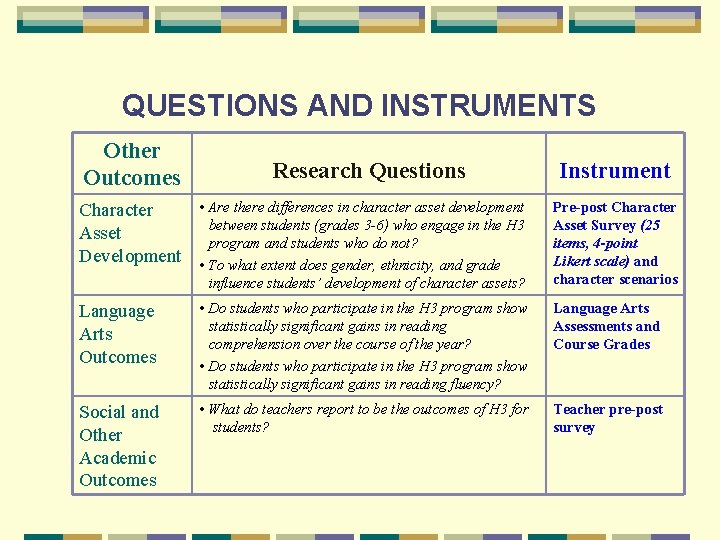
QUESTIONS AND INSTRUMENTS Other Outcomes Research Questions Instrument Character Asset Development • Are there differences in character asset development between students (grades 3 -6) who engage in the H 3 program and students who do not? • To what extent does gender, ethnicity, and grade influence students’ development of character assets? Pre-post Character Asset Survey (25 items, 4 -point Likert scale) and character scenarios Language Arts Outcomes • Do students who participate in the H 3 program show statistically significant gains in reading comprehension over the course of the year? • Do students who participate in the H 3 program show statistically significant gains in reading fluency? Language Arts Assessments and Course Grades Social and Other Academic Outcomes • What do teachers report to be the outcomes of H 3 for students? Teacher pre-post survey
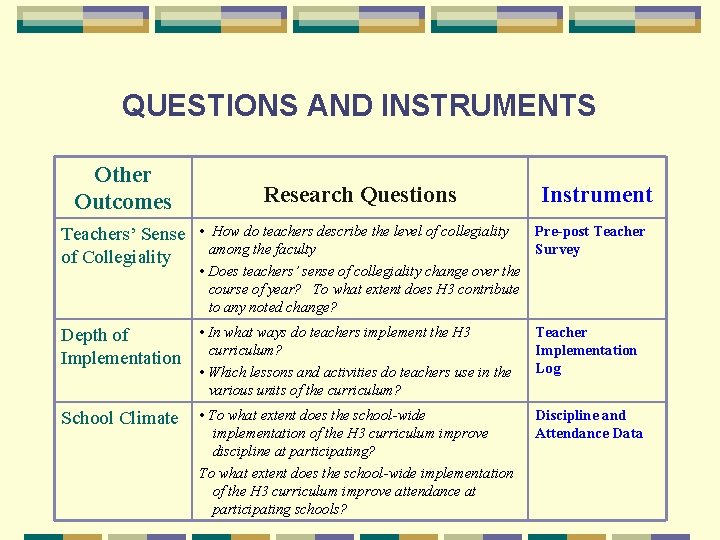
QUESTIONS AND INSTRUMENTS Other Outcomes Research Questions Instrument Teachers’ Sense of Collegiality • How do teachers describe the level of collegiality Pre-post Teacher among the faculty Survey • Does teachers’ sense of collegiality change over the course of year? To what extent does H 3 contribute to any noted change? Depth of Implementation • In what ways do teachers implement the H 3 curriculum? • Which lessons and activities do teachers use in the various units of the curriculum? Teacher Implementation Log School Climate • To what extent does the school-wide implementation of the H 3 curriculum improve discipline at participating? To what extent does the school-wide implementation of the H 3 curriculum improve attendance at participating schools? Discipline and Attendance Data
FINDINGS 1. There appears to be a maturational effect in the retention of character assets.
FINDINGS 2. Students who participate in H 3 show greater asset retention than students who do not. Post Hoc Tests (dependent variable: Overall Change Pre-Post Test)
FINDINGS 3. The greater the exposure to the H 3 curriculum, the higher degree of asset retention (2005 -2006)
FINDINGS 3 a. Continued…
OTHER FINDINGS 4. SIGNIFICANT VARIABLES: Gender and ethnicity were NOT found to be significant variables as they pertain to character asset development. 5. INDIVIDUAL PERSPECTIVES: Students apply individual perspectives to making character-based decisions (emerging finding) 6. PROFESSIONAL CLIMATE: H 3 teachers have more positive perceptions of school professional climate than teachers at control sites. 7. IMPROVED ATTENDANCE: H 3 schools show decreased disciplinary action and increased attendance.
OTHER FINDINGS 8. ACADEMIC ACHIEVEMENT: Reading comprehension, fluency of H 3 students improved. 9. SOCIAL-EMOTIONAL BEHAVIOR: H 3 students demonstrate positive social-emotional growth and improved behavior: Ø Increased empathy, tolerance, understanding. Ø Decreased playground fighting and increased respectful behavior. Ø Increased sharing and team work. Ø Greater willingness to tell the truth and accept responsibility for their actions.
RESEARCH IMPLICATIONS • Development of character traits and vales are difficult to measure as many of the constructs are amorphous • There is a strong developmental component to character and values asset development • The ability to measure character and values development in younger children through paper/pencil measures is limited (reading and comprehension abilities, focus and fatigue, social desirability, ceiling effects) • The highly contextualized nature of character/values education poses challenges in the quest for “evidence”
The Quest for Evidence
The Quest for Evidence?