
Unpacking Standards Criteria for Success Algebra I MATHEMATICS
Unpacking Standards & Criteria for Success Algebra I MATHEMATICS DEPARTMENT
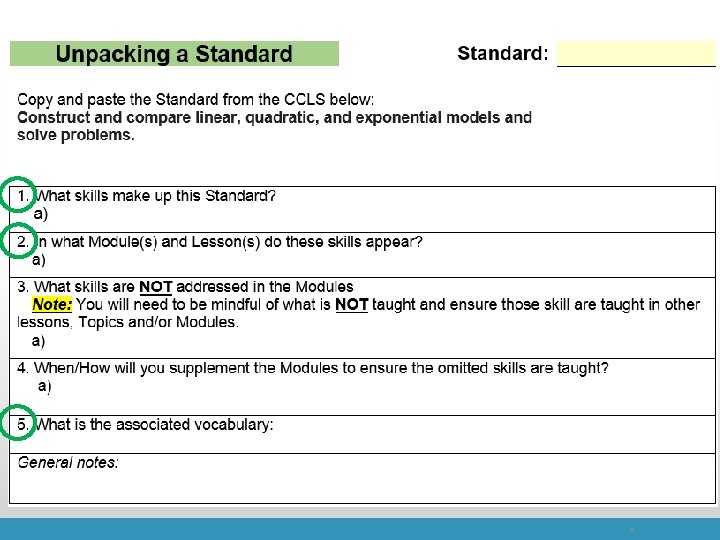
Purpose • Create a list of skills embedded within a standard/objective • Make students aware of what is needed for success 2
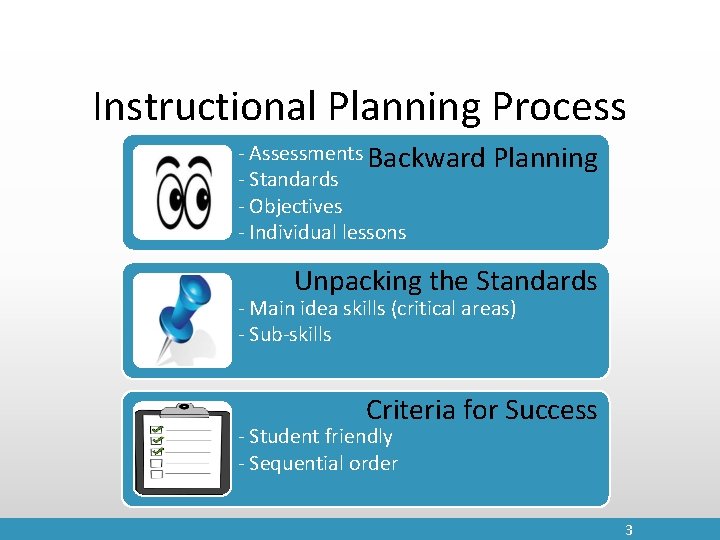
Instructional Planning Process - Assessments Backward Planning - Standards - Objectives - Individual lessons Unpacking the Standards - Main idea skills (critical areas) - Sub-skills Criteria for Success - Student friendly - Sequential order 3
The Anatomy of a Standard 4
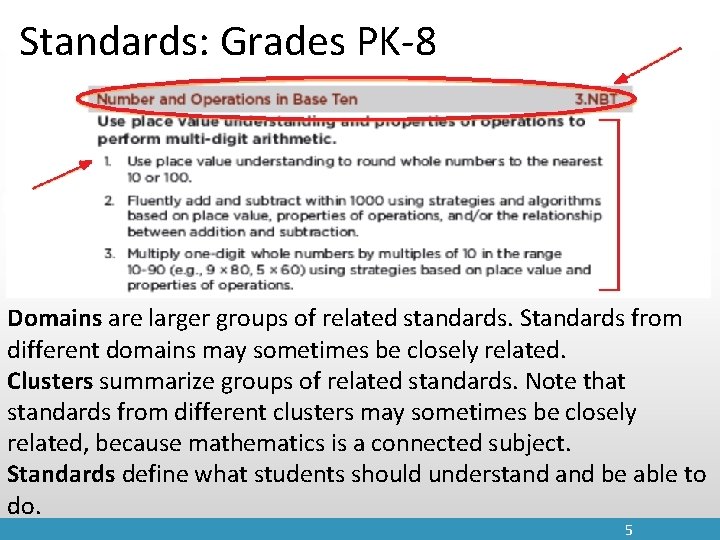
Standards: Grades PK-8 Domains are larger groups of related standards. Standards from different domains may sometimes be closely related. Clusters summarize groups of related standards. Note that standards from different clusters may sometimes be closely related, because mathematics is a connected subject. Standards define what students should understand be able to do. 5
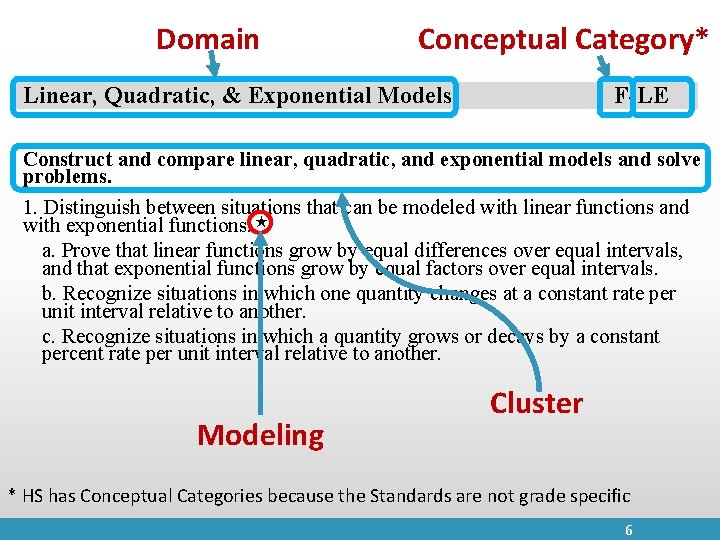
Domain Conceptual Category* Linear, Quadratic, & Exponential Models F-LE Construct and compare linear, quadratic, and exponential models and solve problems. 1. Distinguish between situations that can be modeled with linear functions and with exponential functions. ★ a. Prove that linear functions grow by equal differences over equal intervals, and that exponential functions grow by equal factors over equal intervals. b. Recognize situations in which one quantity changes at a constant rate per unit interval relative to another. c. Recognize situations in which a quantity grows or decays by a constant percent rate per unit interval relative to another. Modeling Cluster * HS has Conceptual Categories because the Standards are not grade specific 6
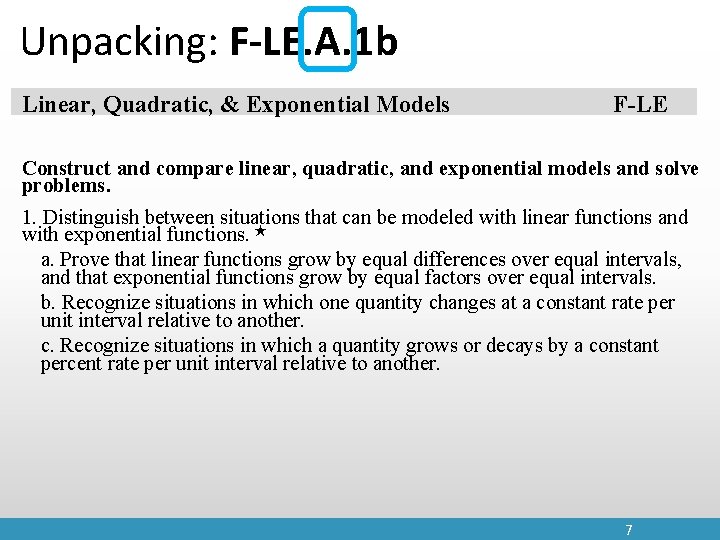
Unpacking: F-LE. A. 1 b Linear, Quadratic, & Exponential Models F-LE Construct and compare linear, quadratic, and exponential models and solve problems. 1. Distinguish between situations that can be modeled with linear functions and with exponential functions. ★ a. Prove that linear functions grow by equal differences over equal intervals, and that exponential functions grow by equal factors over equal intervals. b. Recognize situations in which one quantity changes at a constant rate per unit interval relative to another. c. Recognize situations in which a quantity grows or decays by a constant percent rate per unit interval relative to another. 7
8

b 9
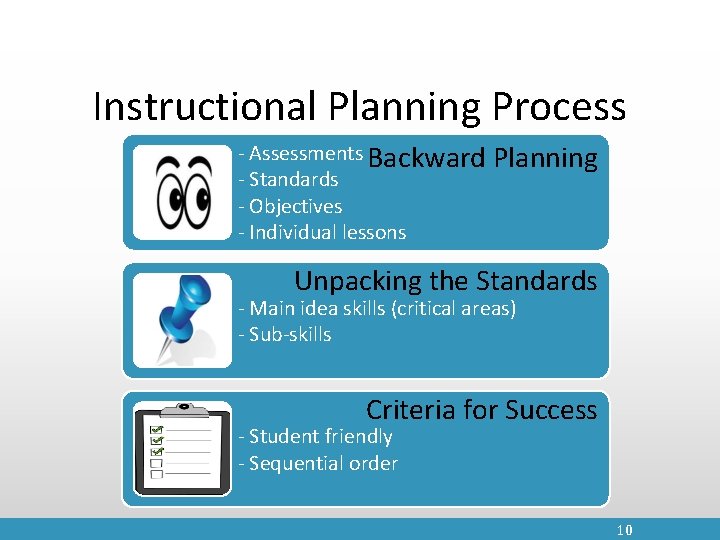
Instructional Planning Process - Assessments Backward Planning - Standards - Objectives - Individual lessons Unpacking the Standards - Main idea skills (critical areas) - Sub-skills Criteria for Success - Student friendly - Sequential order 10
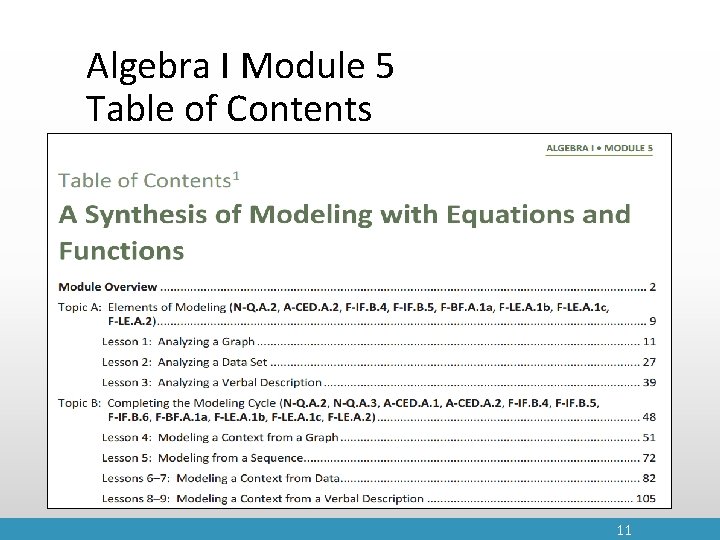
Algebra I Module 5 Table of Contents 11
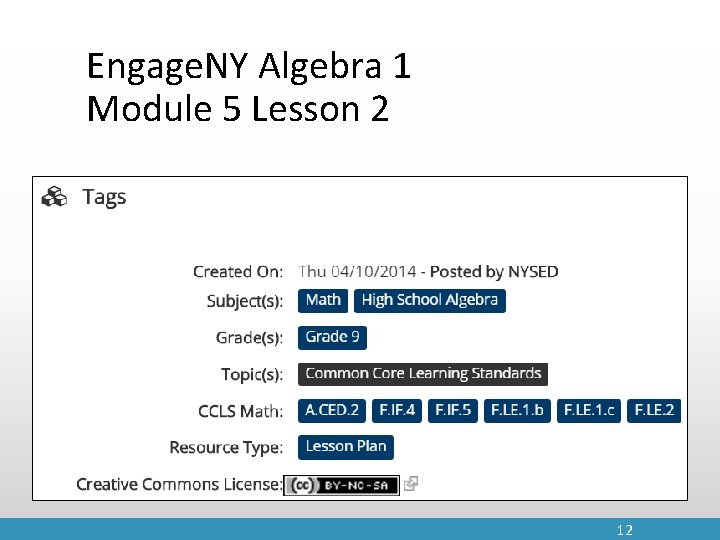
Engage. NY Algebra 1 Module 5 Lesson 2 12
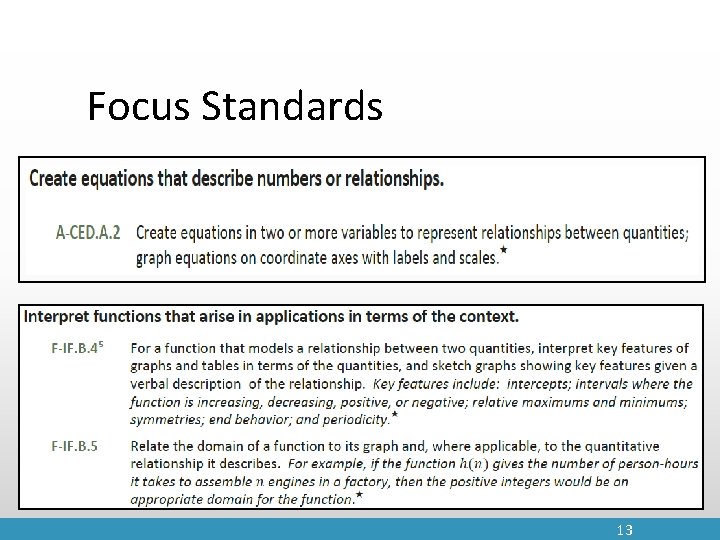
Focus Standards 13
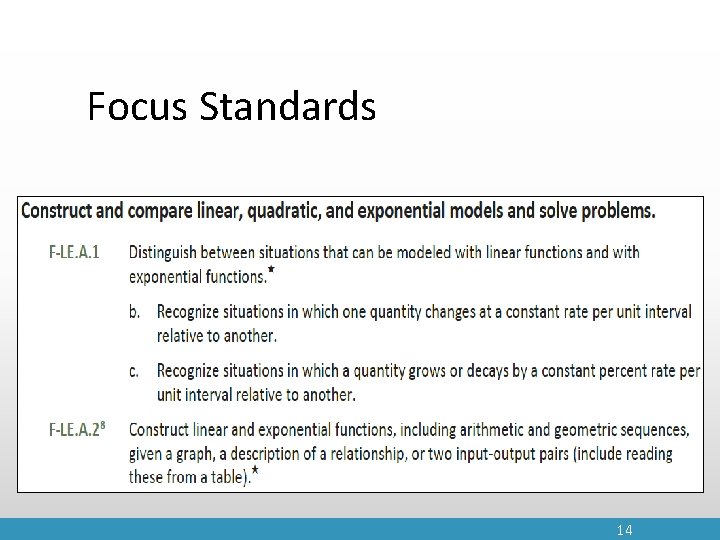
Focus Standards 14
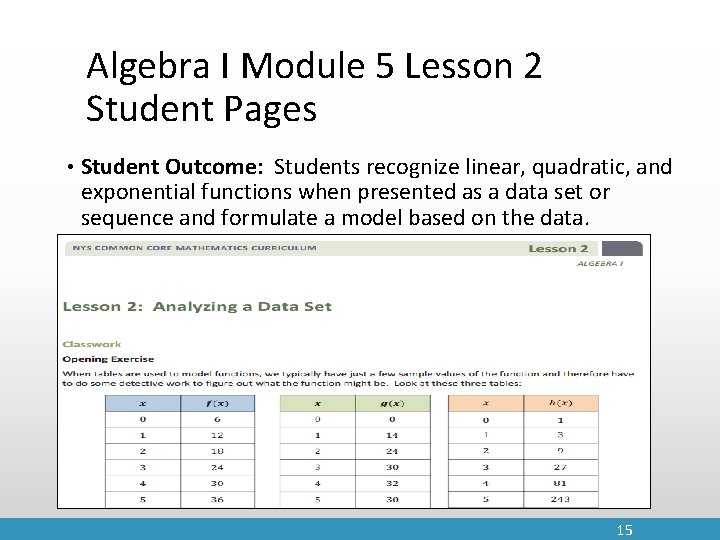
Algebra I Module 5 Lesson 2 Student Pages • Student Outcome: Students recognize linear, quadratic, and exponential functions when presented as a data set or sequence and formulate a model based on the data. 15
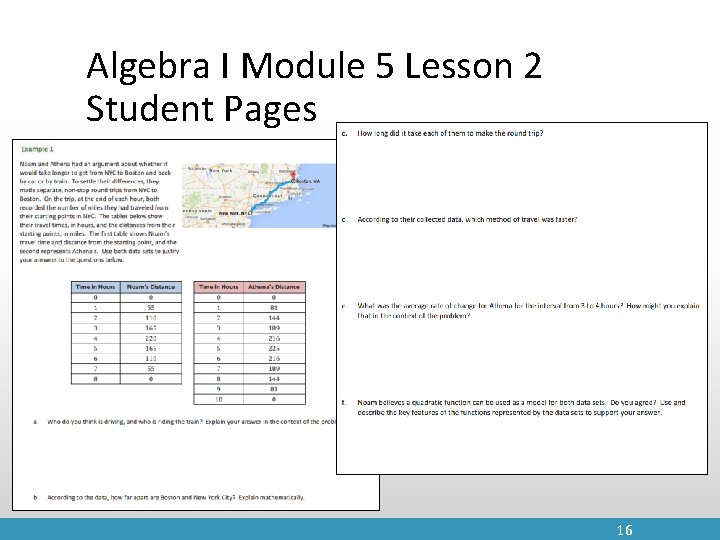
Algebra I Module 5 Lesson 2 Student Pages 16
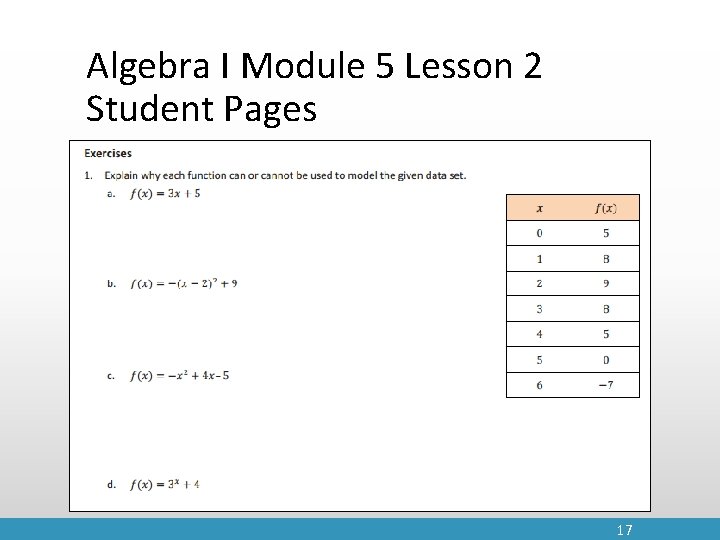
Algebra I Module 5 Lesson 2 Student Pages 17
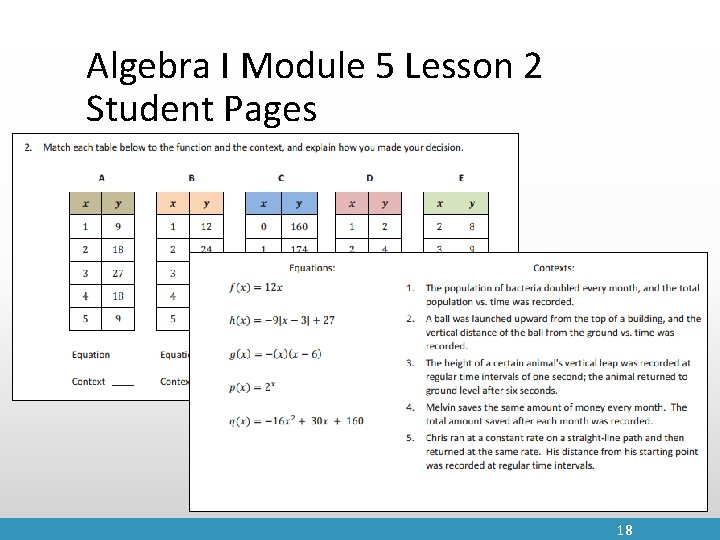
Algebra I Module 5 Lesson 2 Student Pages 18
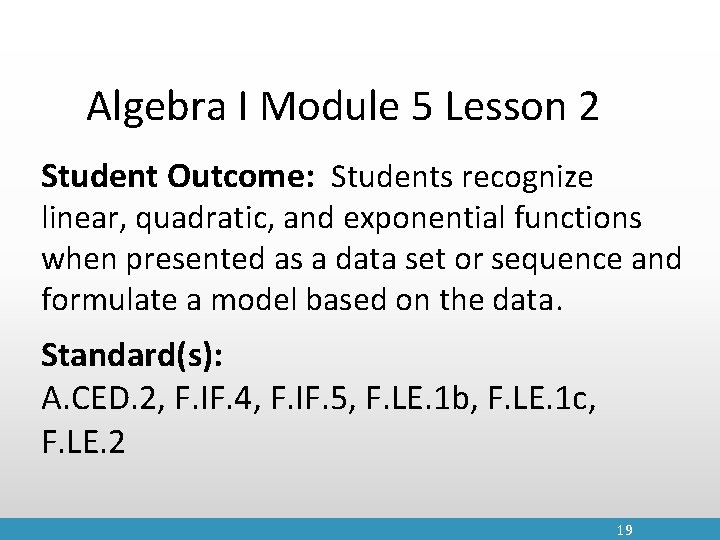
Algebra I Module 5 Lesson 2 Student Outcome: Students recognize linear, quadratic, and exponential functions when presented as a data set or sequence and formulate a model based on the data. Standard(s): A. CED. 2, F. IF. 4, F. IF. 5, F. LE. 1 b, F. LE. 1 c, F. LE. 2 19
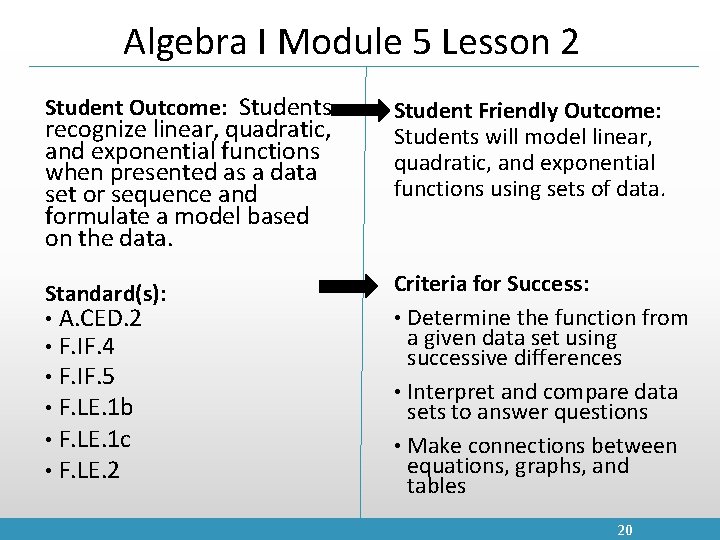
Algebra I Module 5 Lesson 2 Student Outcome: Students Student Friendly Outcome: Students will model linear, quadratic, and exponential functions using sets of data. Standard(s): Criteria for Success: • Determine the function from a given data set using successive differences • Interpret and compare data sets to answer questions • Make connections between equations, graphs, and tables recognize linear, quadratic, and exponential functions when presented as a data set or sequence and formulate a model based on the data. • A. CED. 2 • F. IF. 4 • F. IF. 5 • F. LE. 1 b • F. LE. 1 c • F. LE. 2 20
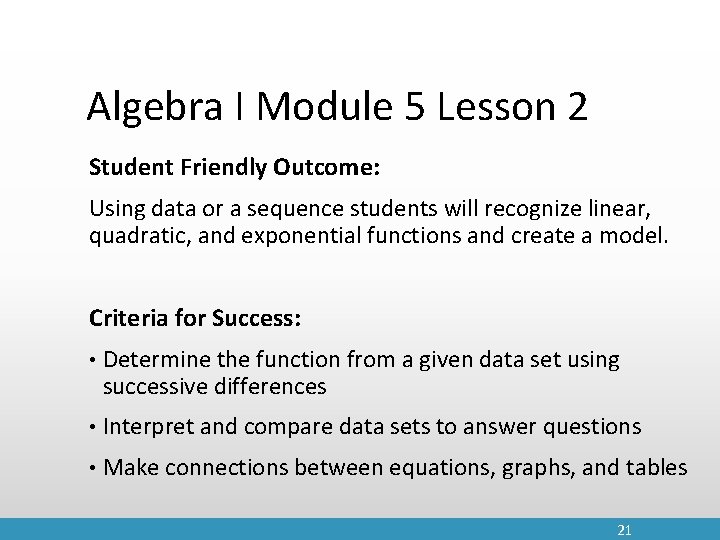
Algebra I Module 5 Lesson 2 Student Friendly Outcome: Using data or a sequence students will recognize linear, quadratic, and exponential functions and create a model. Criteria for Success: • Determine the function from a given data set using successive differences • Interpret and compare data sets to answer questions • Make connections between equations, graphs, and tables 21
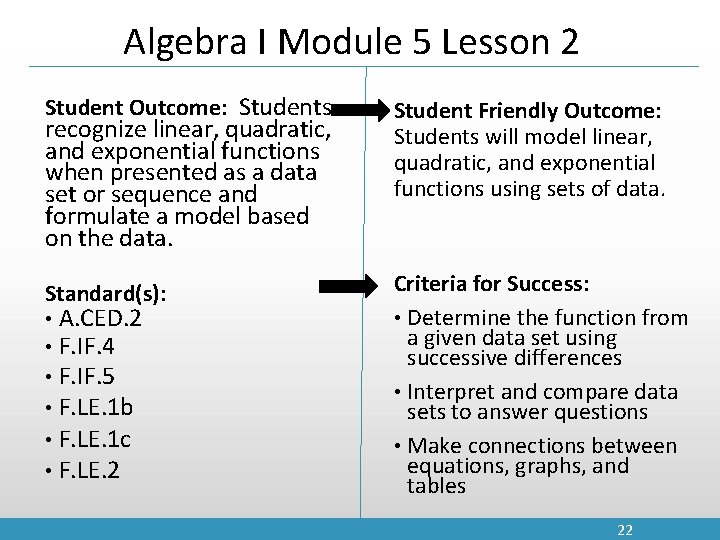
Algebra I Module 5 Lesson 2 Student Outcome: Students Student Friendly Outcome: Students will model linear, quadratic, and exponential functions using sets of data. Standard(s): Criteria for Success: • Determine the function from a given data set using successive differences • Interpret and compare data sets to answer questions • Make connections between equations, graphs, and tables recognize linear, quadratic, and exponential functions when presented as a data set or sequence and formulate a model based on the data. • A. CED. 2 • F. IF. 4 • F. IF. 5 • F. LE. 1 b • F. LE. 1 c • F. LE. 2 22
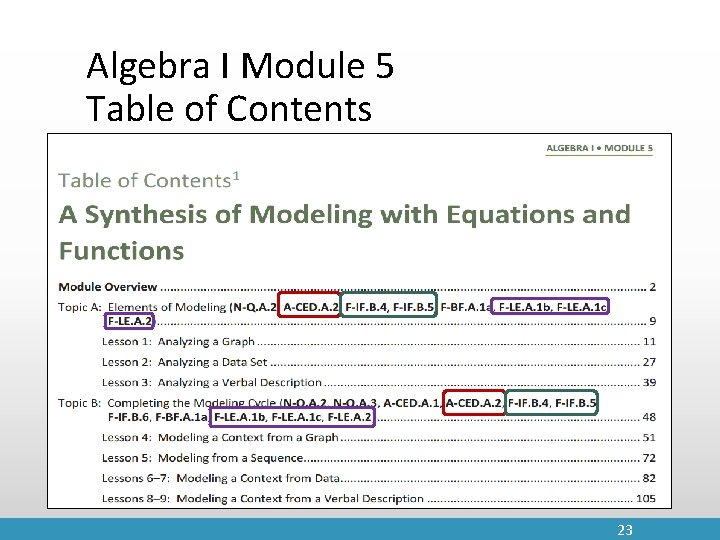
Algebra I Module 5 Table of Contents 23
Resources • Unpacking the High School Standards http: //jeffbaumes. github. io/standards/ http: //maccss. ncdpi. wikispaces. net/Unpacking+Documents • Content Standards https: //www. illustrativemathematics. org/content-standards • I Can Statements http: //www. marshall. k 12. mn. us/Page/3120 http: //www. internet 4 classrooms. com/common_core/i_can_statements. htm http: //www. etown. k 12. ky. us/Instructional-Links. asp 24
- Slides: 24