
UNOS Update Brian Shepard CEO UNOS Region 3
UNOS Update Brian Shepard CEO, UNOS Region 3 August 24, 2018 1
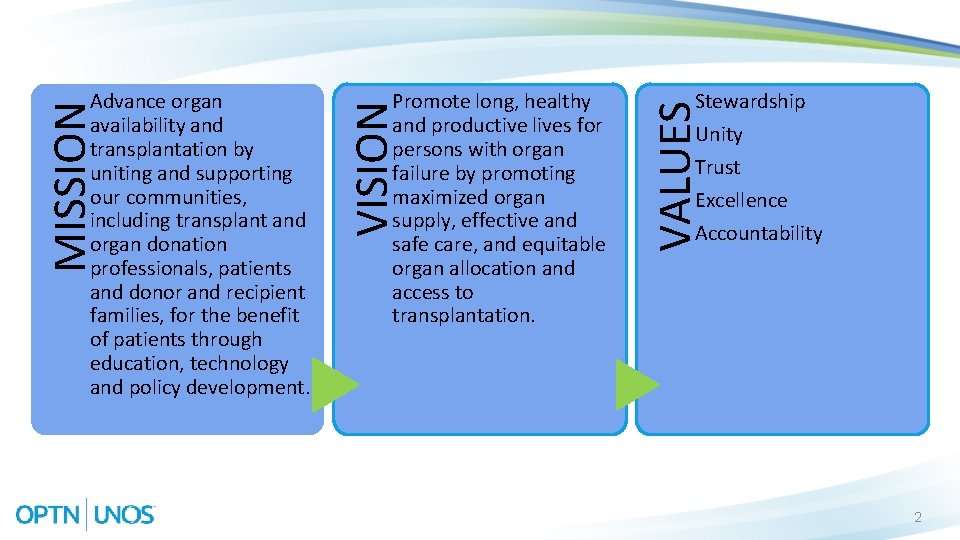
Stewardship Unity Trust Excellence Accountability VALUES Promote long, healthy and productive lives for persons with organ failure by promoting maximized organ supply, effective and safe care, and equitable organ allocation and access to transplantation. VISION MISSION Advance organ availability and transplantation by uniting and supporting our communities, including transplant and organ donation professionals, patients and donor and recipient families, for the benefit of patients through education, technology and policy development. 2
OPTN/UNOS Ad Hoc Committee on Systems Performance August 2018 -March 2019 3
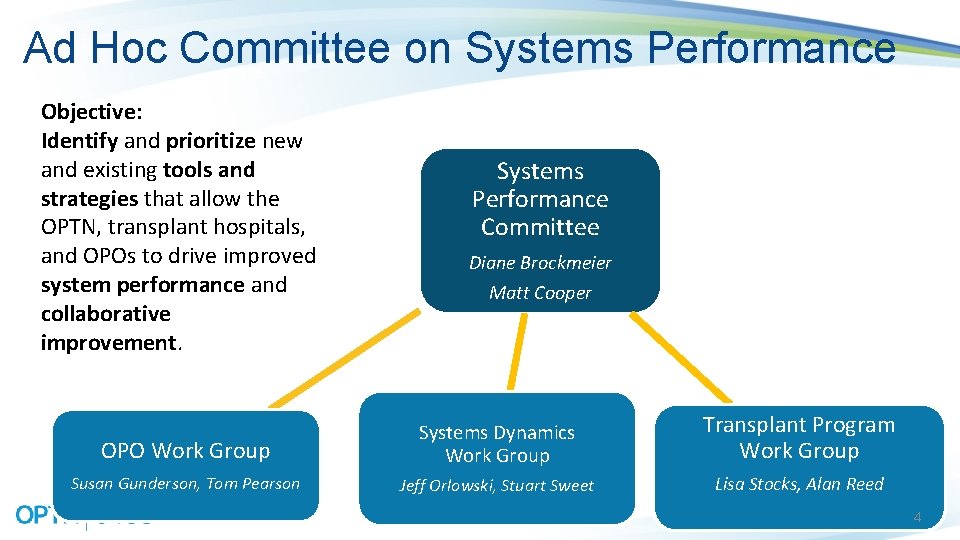
Ad Hoc Committee on Systems Performance Objective: Identify and prioritize new and existing tools and strategies that allow the OPTN, transplant hospitals, and OPOs to drive improved system performance and collaborative improvement. Systems Performance Committee Diane Brockmeier Matt Cooper OPO Work Group Systems Dynamics Work Group Transplant Program Work Group Susan Gunderson, Tom Pearson Jeff Orlowski, Stuart Sweet Lisa Stocks, Alan Reed 4
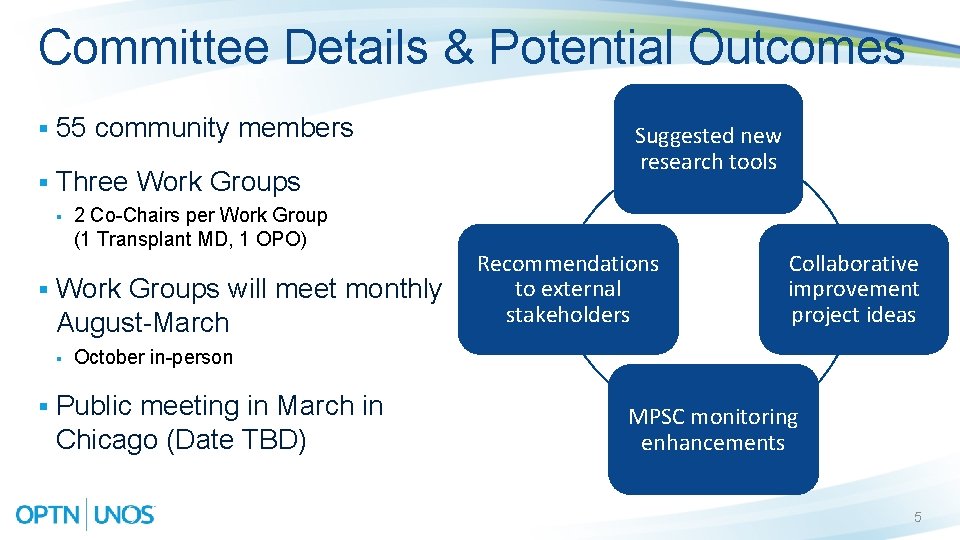
Committee Details & Potential Outcomes § 55 community members § Three Work Groups § § § 2 Co-Chairs per Work Group (1 Transplant MD, 1 OPO) Work Groups will meet monthly August-March § Suggested new research tools Recommendations to external stakeholders Collaborative improvement project ideas October in-person Public meeting in March in Chicago (Date TBD) MPSC monitoring enhancements 5
OPTN/UNOS Governance Structure: How to Volunteer Board, Committees, Regions 6
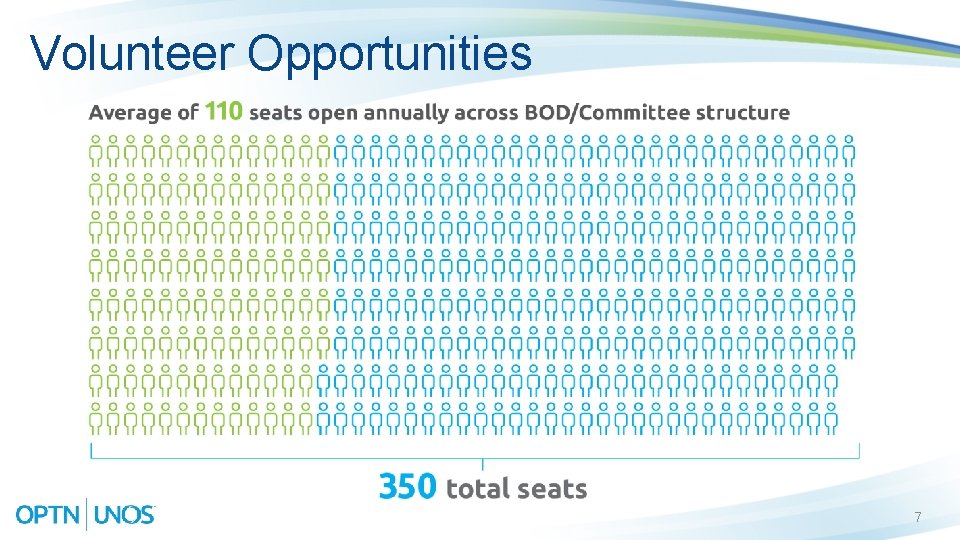
Volunteer Opportunities 7
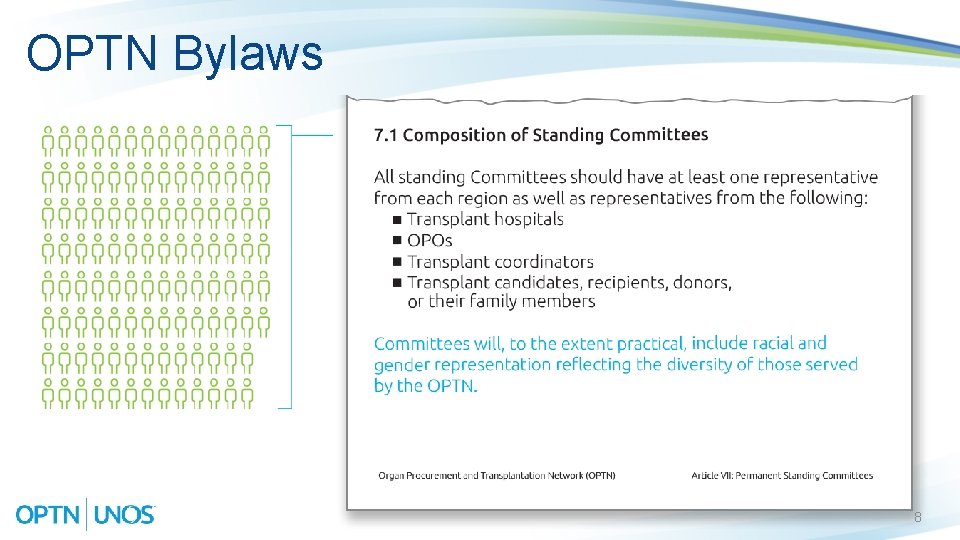
OPTN Bylaws 8
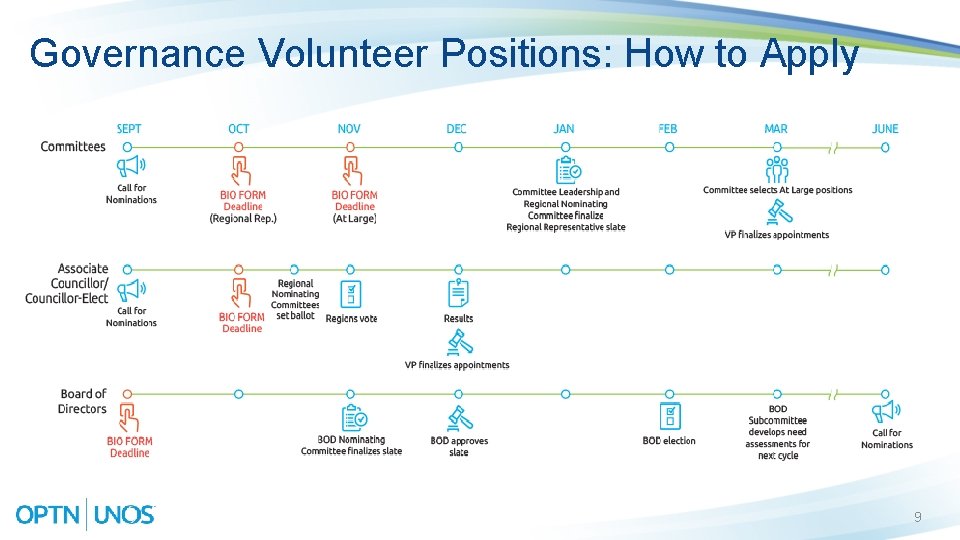
Governance Volunteer Positions: How to Apply 9
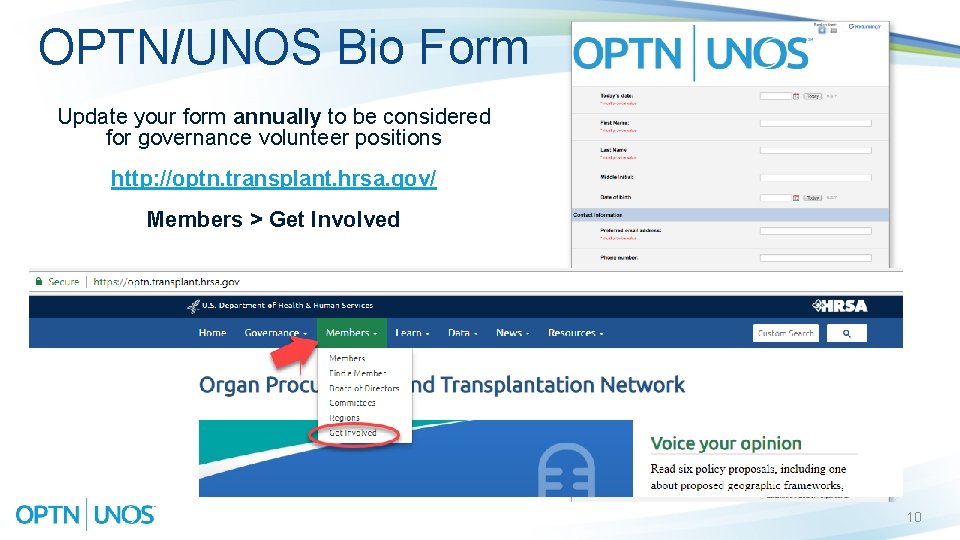
OPTN/UNOS Bio Form Update your form annually to be considered for governance volunteer positions http: //optn. transplant. hrsa. gov/ Members > Get Involved 10
MPSC Lessons Learned 11
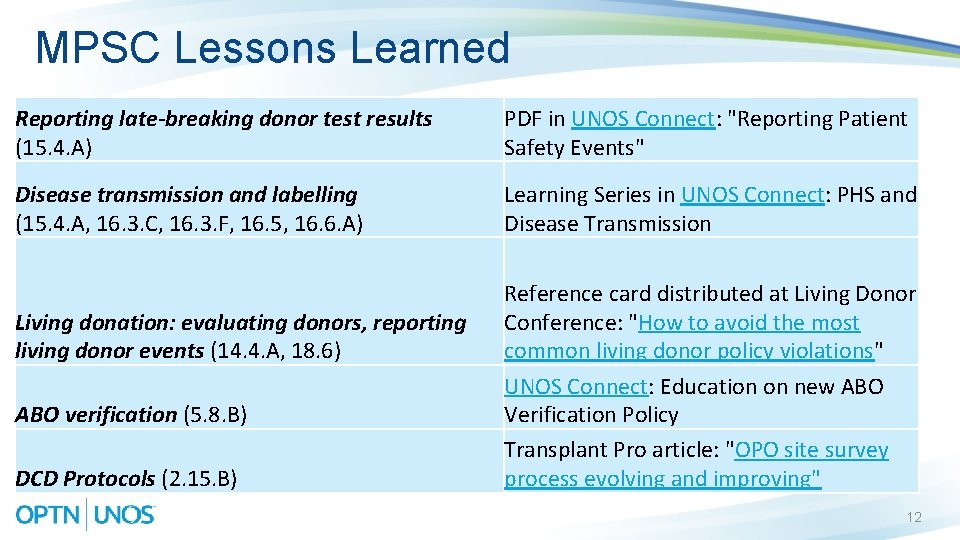
MPSC Lessons Learned Reporting late-breaking donor test results (15. 4. A) PDF in UNOS Connect: "Reporting Patient Safety Events" Disease transmission and labelling (15. 4. A, 16. 3. C, 16. 3. F, 16. 5, 16. 6. A) Learning Series in UNOS Connect: PHS and Disease Transmission Living donation: evaluating donors, reporting living donor events (14. 4. A, 18. 6) ABO verification (5. 8. B) DCD Protocols (2. 15. B) Reference card distributed at Living Donor Conference: "How to avoid the most common living donor policy violations" UNOS Connect: Education on new ABO Verification Policy Transplant Pro article: "OPO site survey process evolving and improving" 12
Constituent Council Proof of Concept Summer/Fall 2018 Update 13
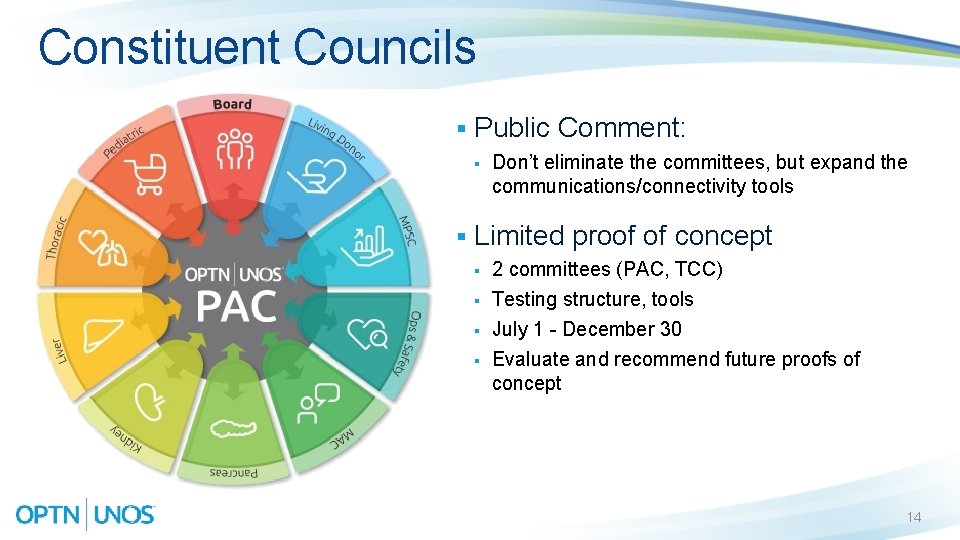
Constituent Councils § Public Comment: § § Don’t eliminate the committees, but expand the communications/connectivity tools Limited proof of concept § § 2 committees (PAC, TCC) Testing structure, tools July 1 - December 30 Evaluate and recommend future proofs of concept 14
Geography in Organ Allocation Update 15
OPTN Final Rule Policy development. The Board of Directors established under § 121. 3 shall develop, in accordance with the policy development process described in § 121. 4, policies for the equitable allocation of cadaveric organs among potential recipients. Such allocation policies: § (1) Shall be based on sound medical judgment; § (2) Shall seek to achieve the best use of donated organs; § (3) Shall preserve the ability of a transplant program to decline an offer of an organ or not to use the organ for the potential recipient in accordance with § 121. 7(b)(4)(d) and (e); § (4) Shall be specific for each organ type or combination of organ types to be transplanted into a transplant candidate; § (5) Shall be designed to avoid wasting organs, to avoid futile transplants, to promote patient access to transplantation, and to promote the efficient management of organ placement; § (8) Shall not be based on the candidate’s place of residence or place of listing, except to the extent required by paragraphs (a)(1)-(5) of this section. 16
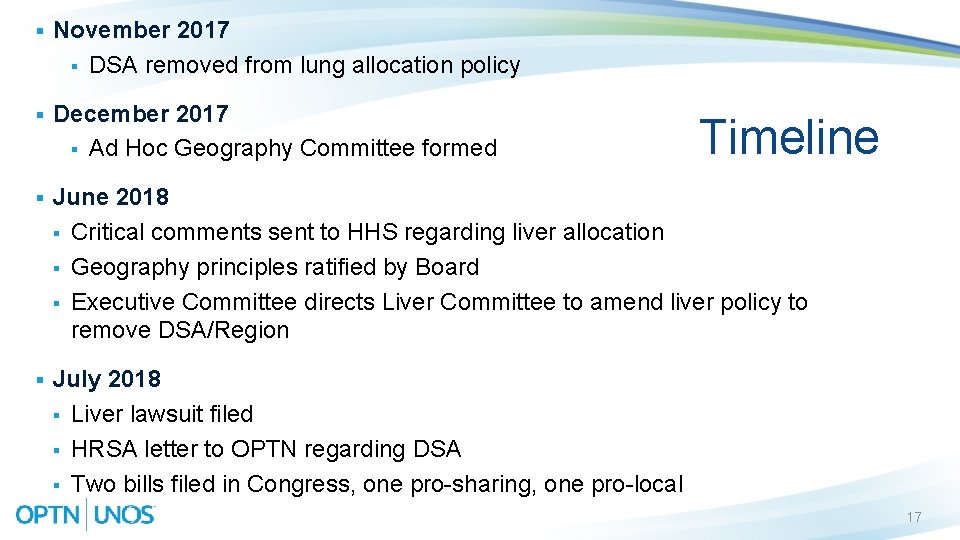
§ November 2017 § DSA removed from lung allocation policy § December 2017 § Ad Hoc Geography Committee formed § June 2018 § Critical comments sent to HHS regarding liver allocation § Geography principles ratified by Board § Executive Committee directs Liver Committee to amend liver policy to remove DSA/Region § July 2018 § Liver lawsuit filed § HRSA letter to OPTN regarding DSA § Two bills filed in Congress, one pro-sharing, one pro-local Timeline 17
Lung 18
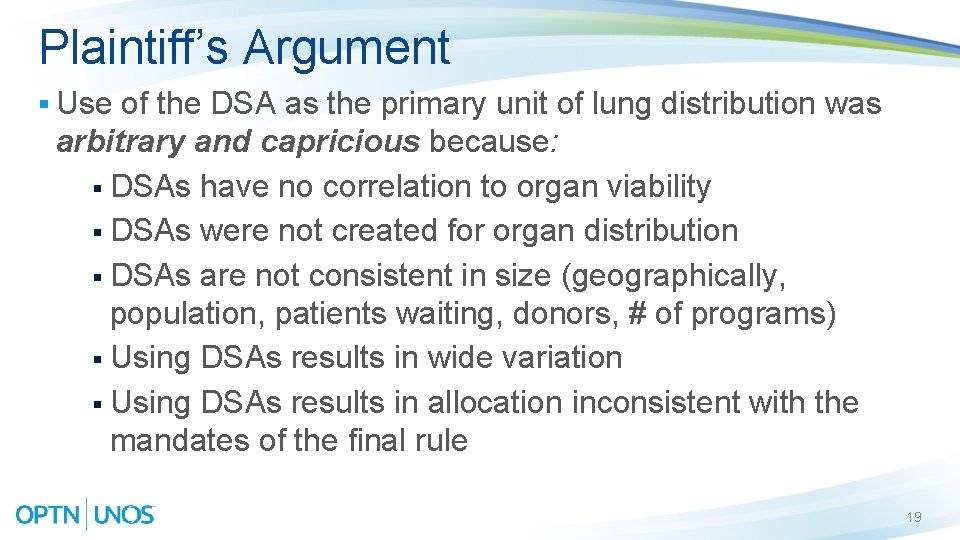
Plaintiff’s Argument § Use of the DSA as the primary unit of lung distribution was arbitrary and capricious because: § DSAs have no correlation to organ viability § DSAs were not created for organ distribution § DSAs are not consistent in size (geographically, population, patients waiting, donors, # of programs) § Using DSAs results in wide variation § Using DSAs results in allocation inconsistent with the mandates of the final rule 19
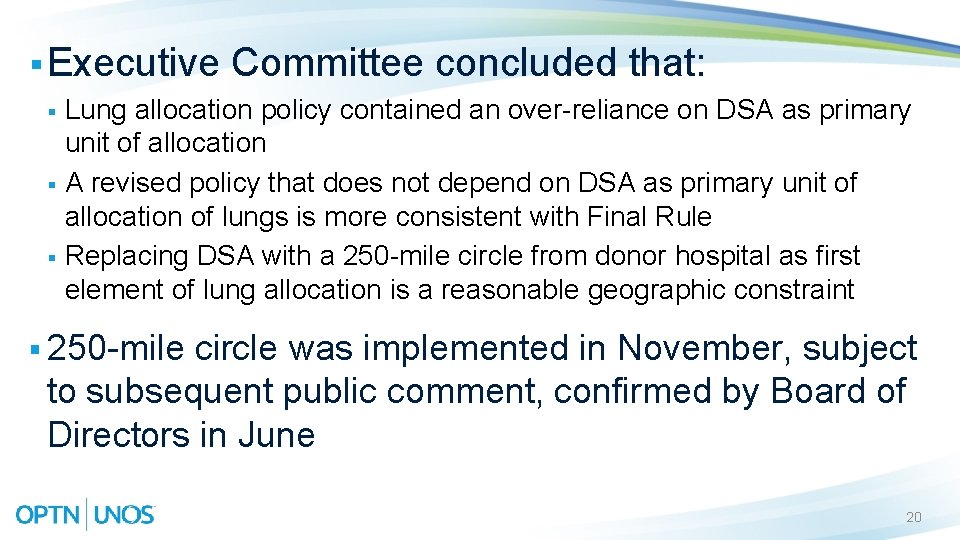
§ Executive Committee concluded that: § § § Lung allocation policy contained an over-reliance on DSA as primary unit of allocation A revised policy that does not depend on DSA as primary unit of allocation of lungs is more consistent with Final Rule Replacing DSA with a 250 -mile circle from donor hospital as first element of lung allocation is a reasonable geographic constraint § 250 -mile circle was implemented in November, subject to subsequent public comment, confirmed by Board of Directors in June 20
Liver 21
New Liver Policy – December 2017 § Distribution to region + 150 mile circle for most urgent candidates § 3 proximity points to candidates within the circle or DSA § Allocation to DSA for lower MELDs § Allocation to DSA for hard-to-place livers (DCD, > 70 yr) 22
May 30: Critical Comment to HHS § Letter to HHS Secretary received May 30, 2018 § Same law firm that filed suit over lung policy § Argued that liver policy (using Regions and DSAs) is inconsistent with the Final Rule and challenges: o Current liver policy o Policy approved in December 2017 o Policy for the National Liver Review Board (NLRB) scoring of exception patients § Letter requests immediate action by the Secretary 23
June 8: HRSA Request to OPTN HRSA Administrator seeks the OPTN’s views on whether the following aspects of the revised allocation policy are aligned with NOTA and the Final Rule: § Using DSAs as units of allocation § Using OPTN regions as units of allocation § Using proximity points in relation to DSAs § Using median MELD in DSAs in granting exceptions 24
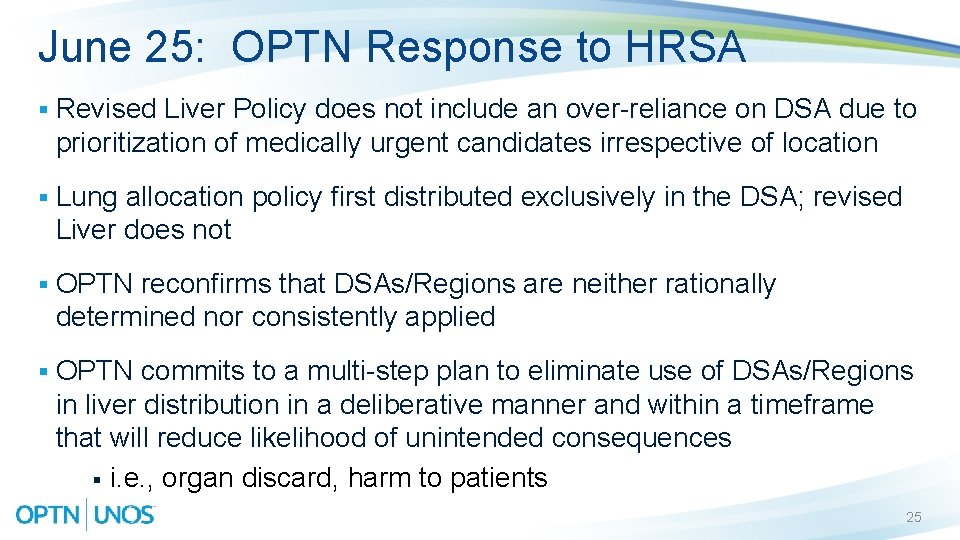
June 25: OPTN Response to HRSA § Revised Liver Policy does not include an over-reliance on DSA due to prioritization of medically urgent candidates irrespective of location § Lung allocation policy first distributed exclusively in the DSA; revised Liver does not § OPTN reconfirms that DSAs/Regions are neither rationally determined nor consistently applied § OPTN commits to a multi-step plan to eliminate use of DSAs/Regions in liver distribution in a deliberative manner and within a timeframe that will reduce likelihood of unintended consequences § i. e. , organ discard, harm to patients 25
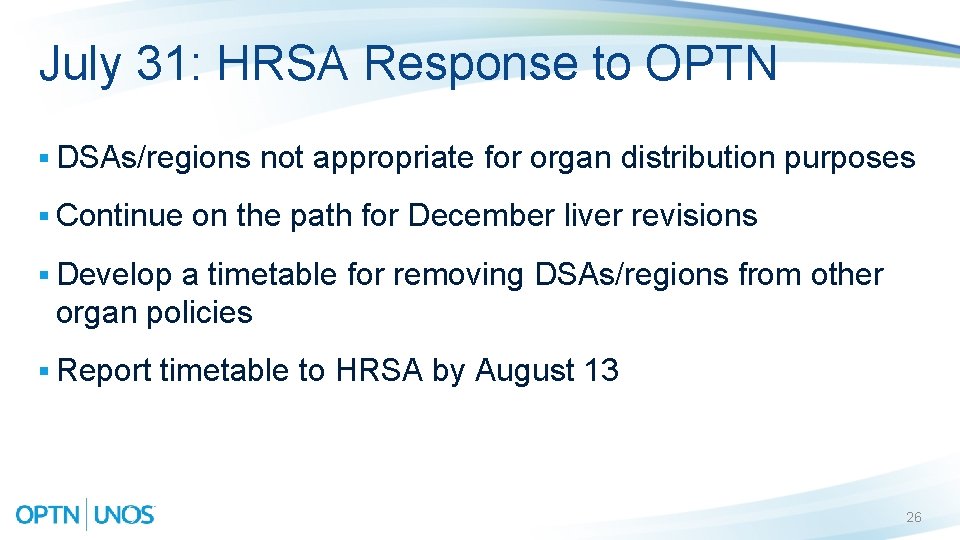
July 31: HRSA Response to OPTN § DSAs/regions not appropriate for organ distribution purposes § Continue on the path for December liver revisions § Develop a timetable for removing DSAs/regions from other organ policies § Report timetable to HRSA by August 13 26
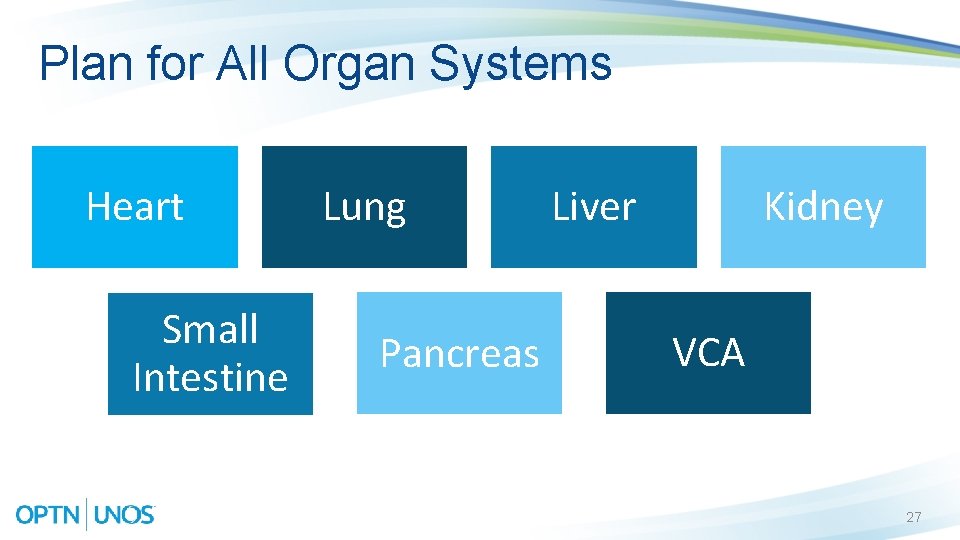
Plan for All Organ Systems Heart Small Intestine Lung Pancreas Liver Kidney VCA 27
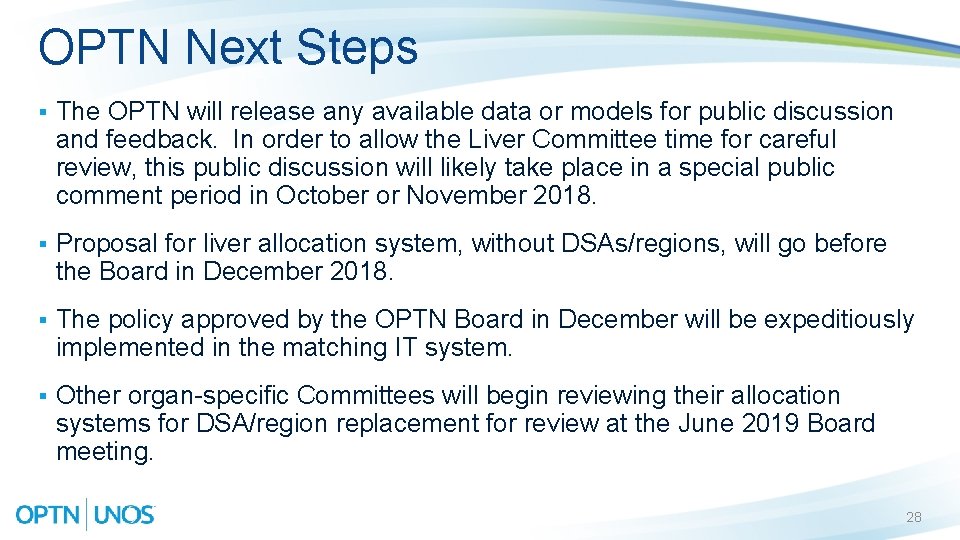
OPTN Next Steps § The OPTN will release any available data or models for public discussion and feedback. In order to allow the Liver Committee time for careful review, this public discussion will likely take place in a special public comment period in October or November 2018. § Proposal for liver allocation system, without DSAs/regions, will go before the Board in December 2018. § The policy approved by the OPTN Board in December will be expeditiously implemented in the matching IT system. § Other organ-specific Committees will begin reviewing their allocation systems for DSA/region replacement for review at the June 2019 Board meeting. 28
Future Geography Frameworks 29
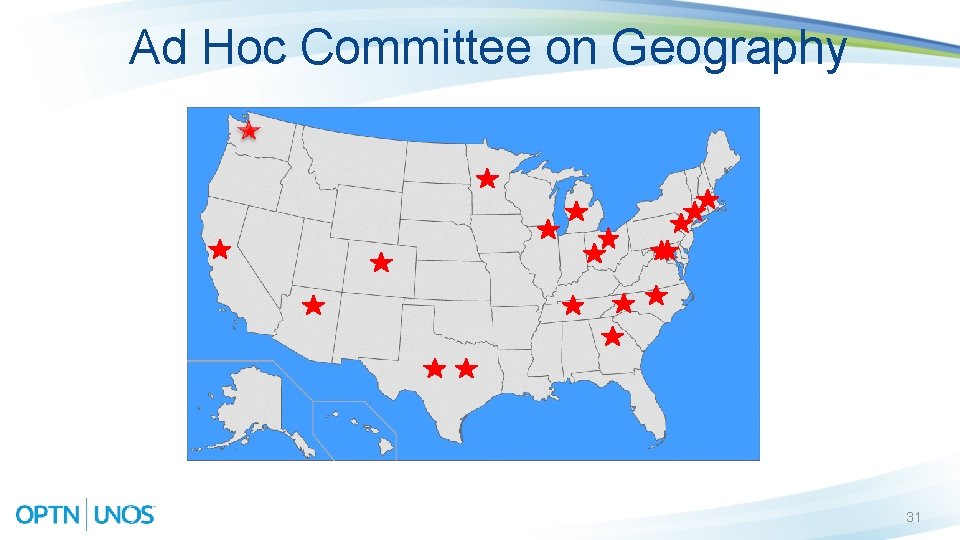
Ad Hoc Committee on Geography § Formed in December 2017 § Chairs or vice-chairs of organ specific committees, Transplant Administrators, OPO, and ethics § Several board members § AOPO, ASTS representatives 30
Ad Hoc Committee on Geography 31
Ad Hoc Committee on Geography Charge § Establish defined guiding principles for the use of geographic constraints in organ allocation § Review and recommend frameworks/models for incorporating geographic principles into allocation policies § Identify uniform concepts for organ specific allocation policies in light of the requirements of the OPTN Final Rule 32
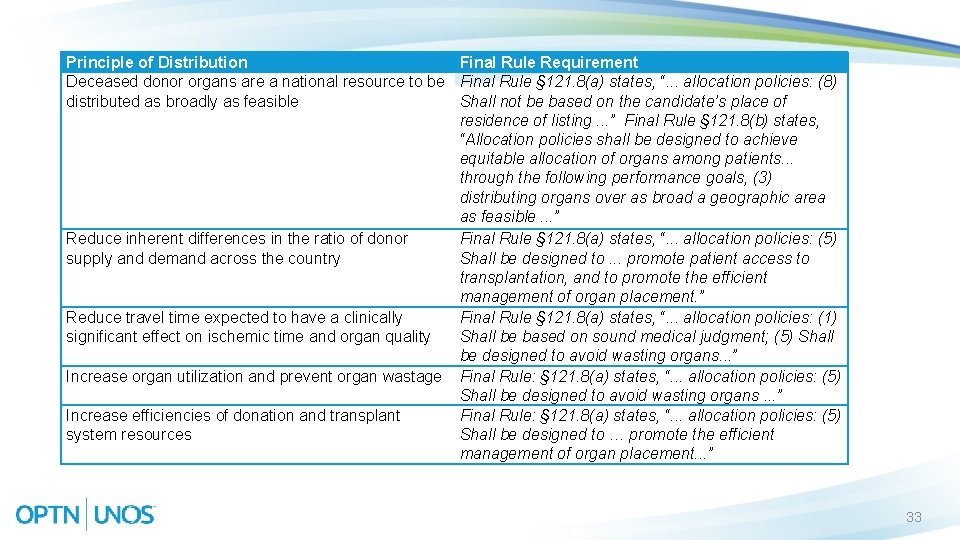
Principle of Distribution Final Rule Requirement Deceased donor organs are a national resource to be Final Rule § 121. 8(a) states, “. . . allocation policies: (8) distributed as broadly as feasible Shall not be based on the candidate’s place of residence of listing. . . ” Final Rule § 121. 8(b) states, “Allocation policies shall be designed to achieve equitable allocation of organs among patients. . . through the following performance goals, (3) distributing organs over as broad a geographic area as feasible. . . ” Reduce inherent differences in the ratio of donor Final Rule § 121. 8(a) states, “. . . allocation policies: (5) supply and demand across the country Shall be designed to. . . promote patient access to transplantation, and to promote the efficient management of organ placement. ” Reduce travel time expected to have a clinically Final Rule § 121. 8(a) states, “. . . allocation policies: (1) significant effect on ischemic time and organ quality Shall be based on sound medical judgment; (5) Shall be designed to avoid wasting organs. . . ” Increase organ utilization and prevent organ wastage Final Rule: § 121. 8(a) states, “. . . allocation policies: (5) Shall be designed to avoid wasting organs. . . ” Increase efficiencies of donation and transplant Final Rule: § 121. 8(a) states, “. . . allocation policies: (5) system resources Shall be designed to … promote the efficient management of organ placement. . . ” 33
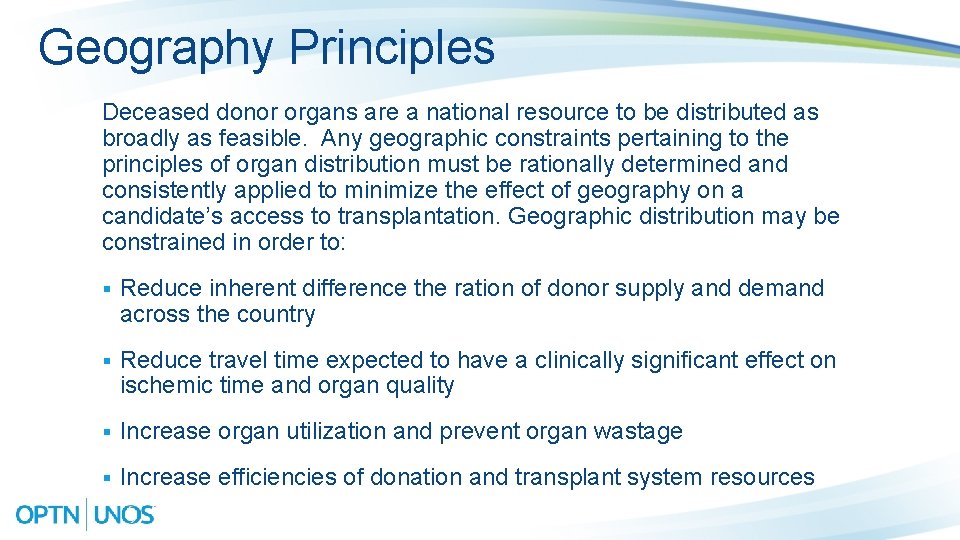
Geography Principles Deceased donor organs are a national resource to be distributed as broadly as feasible. Any geographic constraints pertaining to the principles of organ distribution must be rationally determined and consistently applied to minimize the effect of geography on a candidate’s access to transplantation. Geographic distribution may be constrained in order to: § Reduce inherent difference the ration of donor supply and demand across the country § Reduce travel time expected to have a clinically significant effect on ischemic time and organ quality § Increase organ utilization and prevent organ wastage § Increase efficiencies of donation and transplant system resources

Geography Frameworks 35
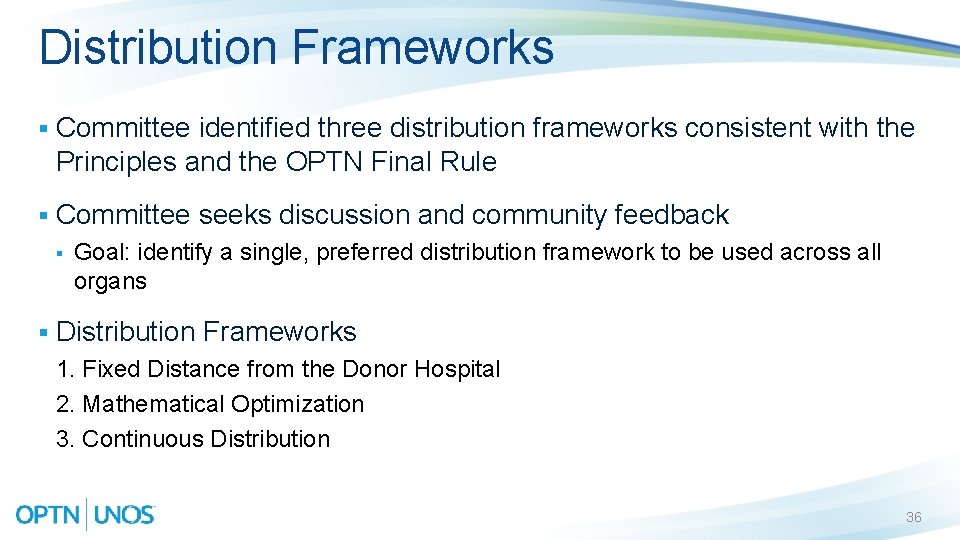
Distribution Frameworks § Committee identified three distribution frameworks consistent with the Principles and the OPTN Final Rule § Committee seeks discussion and community feedback § § Goal: identify a single, preferred distribution framework to be used across all organs Distribution Frameworks 1. Fixed Distance from the Donor Hospital 2. Mathematical Optimization 3. Continuous Distribution 36
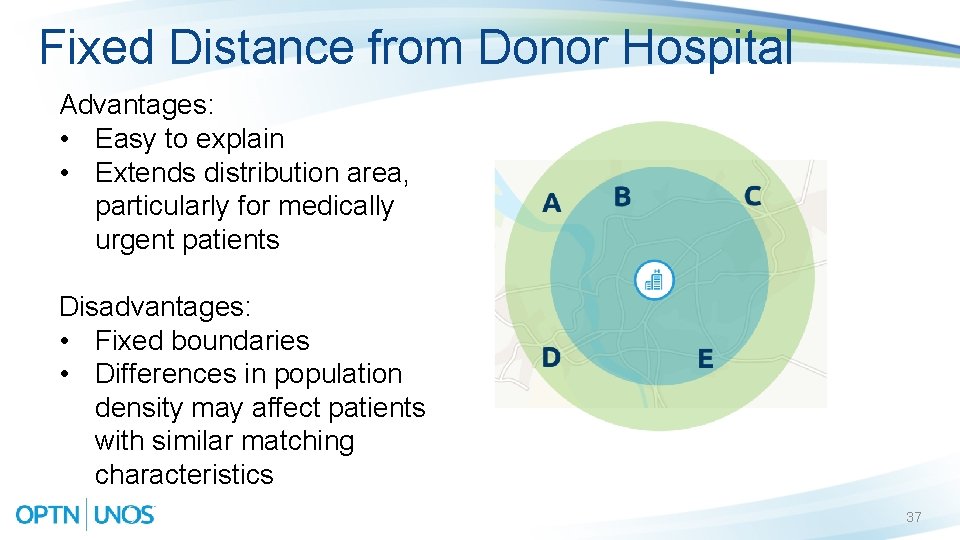
Fixed Distance from Donor Hospital Advantages: • Easy to explain • Extends distribution area, particularly for medically urgent patients Disadvantages: • Fixed boundaries • Differences in population density may affect patients with similar matching characteristics 37
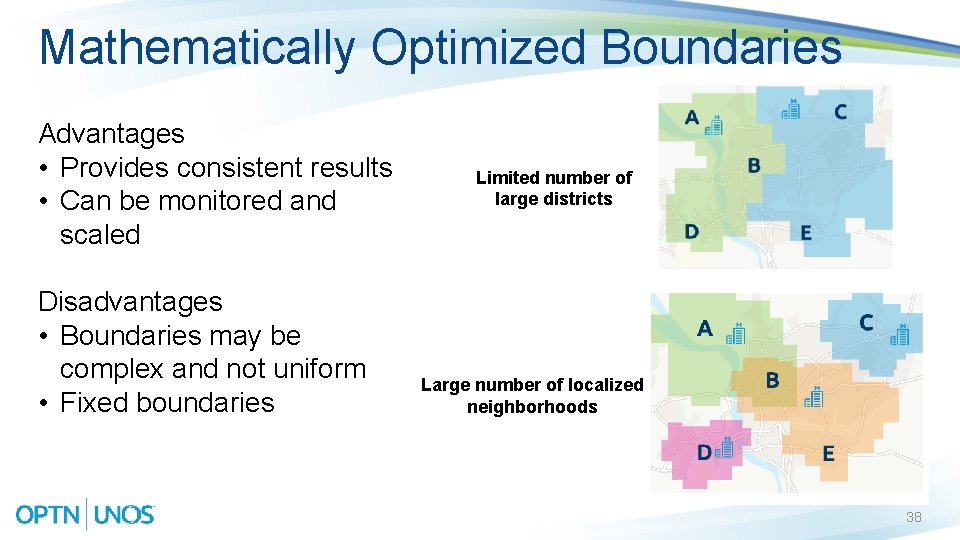
Mathematically Optimized Boundaries Advantages • Provides consistent results • Can be monitored and scaled Disadvantages • Boundaries may be complex and not uniform • Fixed boundaries Limited number of large districts Large number of localized neighborhoods 38
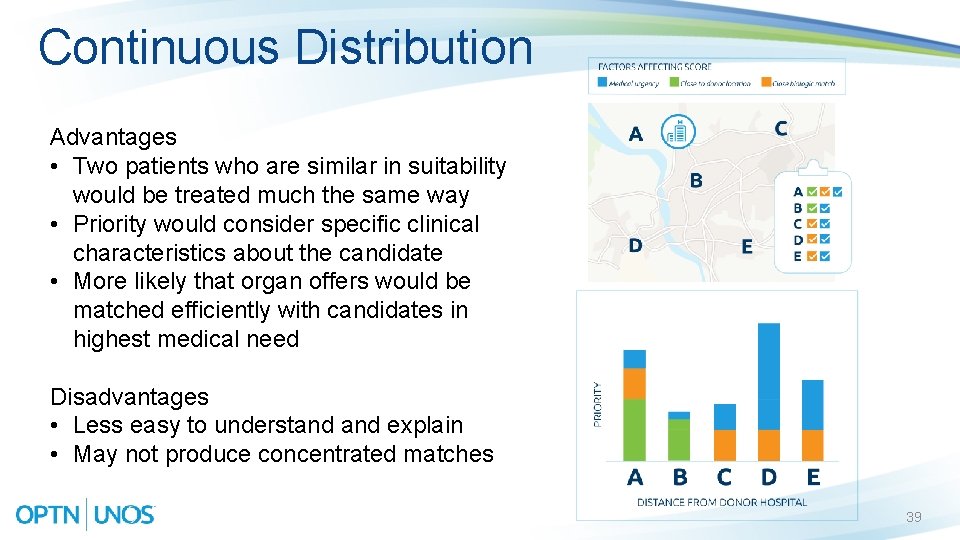
Continuous Distribution Advantages • Two patients who are similar in suitability would be treated much the same way • Priority would consider specific clinical characteristics about the candidate • More likely that organ offers would be matched efficiently with candidates in highest medical need Disadvantages • Less easy to understand explain • May not produce concentrated matches 39

Questions? 40
UNOS Update Brian Shepard CEO, UNOS Region 3 August 24, 2018 41
- Slides: 41