
Unobtrusive Research UAPP 702 Research Methods for Urban

Unobtrusive Research UAPP 702: Research Methods for Urban & Public Policy Class Notes Based on, Earl Babbie, The Practice of Social Research Danilo Yanich 1
Unobtrusive Research n Clues all around. . . must use some ingenuity to examine them. . . n Babbie uses examples of worn tiles in museum, mucus on window, radio dial settings n May have some problems with validity and reliability. . . o But that can be accommodated 2
Three types of unobtrusive research o Content analysis o Analysis of existing statistics o Historical/comparative analysis 3
Content Analysis o Study of recorded human communications o Record the content of those communications o Two types of content n Manifest n Latent 4
Manifest content o The visible, surface content of a communication n Analogous to a questionnaire with extent of specificity n Advantage of reliability, but may have some question of validity n Babbie’s example of erotic novel—can count number of times words like love, kiss, etc. are used in book. . . but n Is that a valid measure of eroticism? 5
Latent content o The underlying meaning of the content n Questions about reliability n Babbie’s example re: erotic novel o Read entire novel and assess how erotic it is n Might be very different assessments by different coders/readers n Might even be different assessment if one person was the ONLY reader because no guarantee that definitions will remain same 6
Content analysis Local TV news example, content coding o Research question n A comparison of the reporting of adult vs. juvenile crime on local TV news stories in the Baltimore and Philadelphia markets o By offenses o By the characteristics of the suspects and victims o By the production modes of the story o NOTE: Juvenile crime story=story in which suspect or victim or both are under 18 years of age 7
Content analysis Local TV news example, content coding, p. 2 o Sample n The videotaped broadcasts of a “constructed” week of the primary evening news broadcast… n During March and April 1991, 1992, 1993 and 1996… n For all stations delivering a regularly scheduled news broadcast to the market n Result: 153 broadcasts from 11 stations 8
Content analysis Local TV news example, content coding, p. 3 o Unit of analysis n Individual news story n Result: 2400 total stories excluding sports and weather n Over 700 crime stories 9
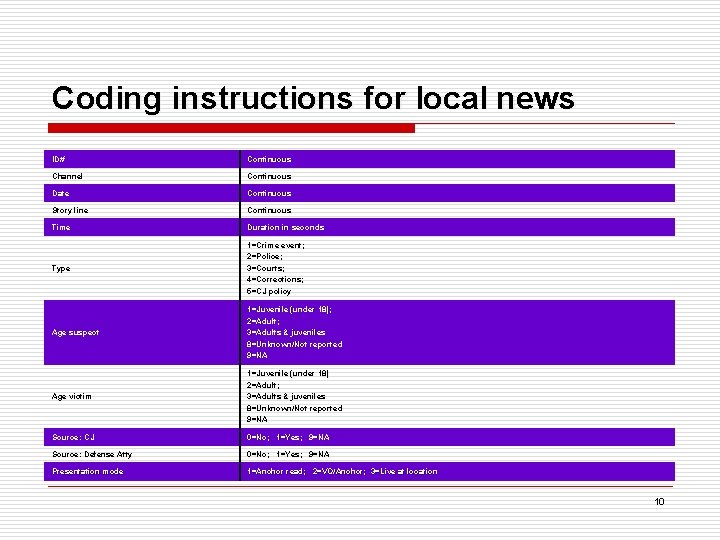
Coding instructions for local news ID# Continuous Channel Continuous Date Continuous Story line Continuous Time Duration in seconds Type 1=Crime event; 2=Police; 3=Courts; 4=Corrections; 5=CJ policy Age suspect 1=Juvenile (under 18); 2=Adult; 3=Adults & juveniles 8=Unknown/Not reported 9=NA Age victim 1=Juvenile (under 18) 2=Adult; 3=Adults & juveniles 8=Unknown/Not reported 9=NA Source: CJ 0=No; 1=Yes; 9=NA Source: Defense Atty 0=No; 1=Yes; 9=NA Presentation mode 1=Anchor read; 2=VO/Anchor; 3=Live at location 10
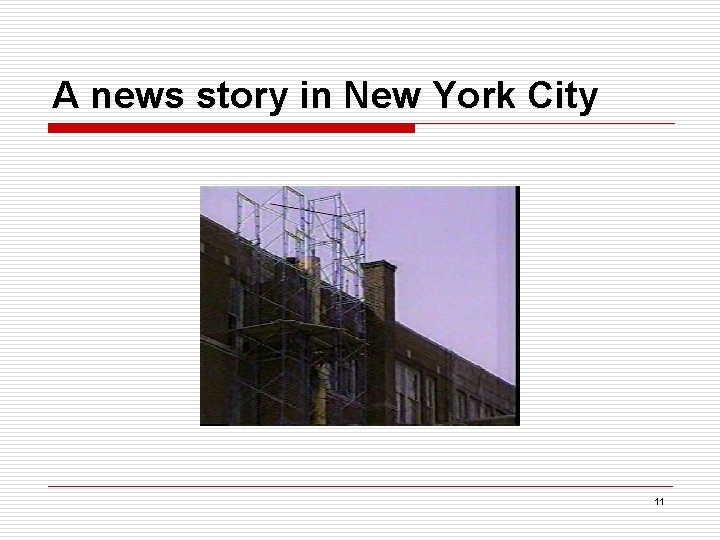
A news story in New York City 11
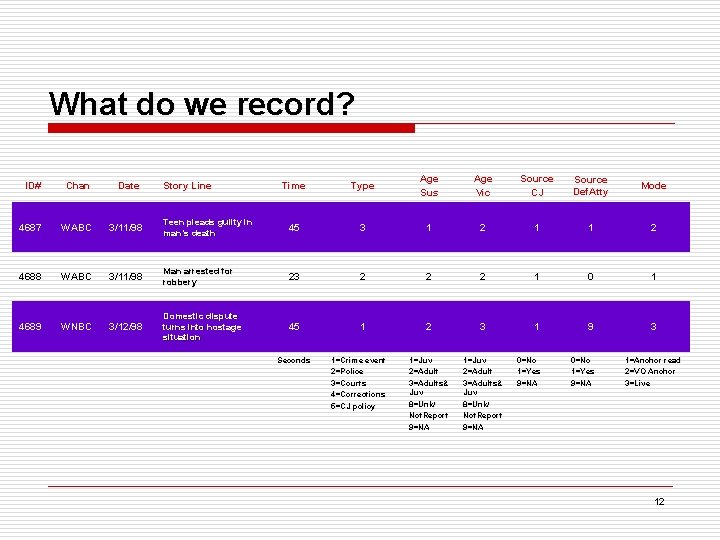
What do we record? Time Type Age Sus Age Vic Source CJ Source Def. Atty Mode Teen pleads guilty in man’s death 45 3 1 2 1 1 2 3/11/98 Man arrested for robbery 23 2 2 2 1 0 1 3/12/98 Domestic dispute turns into hostage situation 45 1 2 3 1 9 3 1=Juv 2=Adult 3=Adults& Juv 8=Unk/ Not. Report 9=NA 0=No 1=Yes 9=NA ID# Chan Date 4687 WABC 3/11/98 4688 WABC 4689 WNBC Story Line Seconds 1=Crime event 2=Police 3=Courts 4=Corrections 5=CJ policy 1=Anchor read 2=VO Anchor 3=Live 12
Content analysis Local TV news example, content coding, p. 4 o Careful not to take the position that the content analysis often shows what is common knowledge. o Example: Local news and race of victim and suspect n More often than not, the race or ethnicity of the victims and suspects is NOT reported on local TV news n Then, raises the obvious question—why the common assumption? o Other possible explanations—Placement of story? Production factors? Offenses? 13
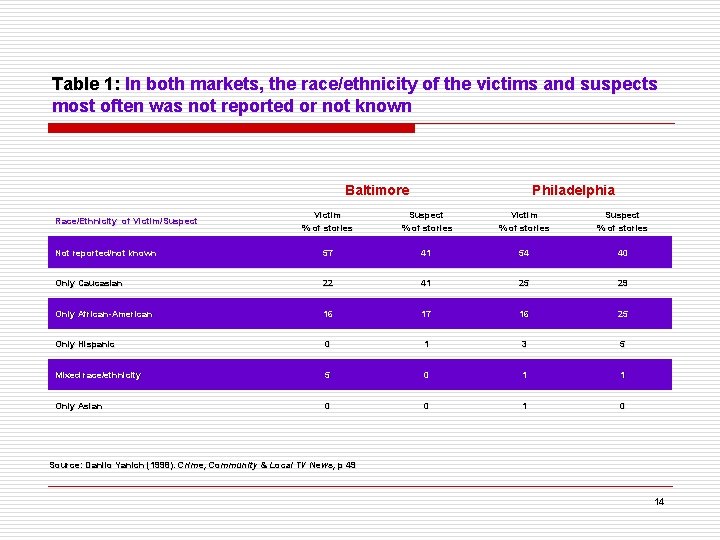
Table 1: In both markets, the race/ethnicity of the victims and suspects most often was not reported or not known Baltimore Philadelphia Victim % of stories Suspect % of stories Not reported/not known 57 41 54 40 Only Caucasian 22 41 25 29 Only African-American 16 17 16 25 Only Hispanic 0 1 3 5 Mixed race/ethnicity 5 0 1 1 Only Asian 0 0 1 0 Race/Ethnicity of Victim/Suspect Source: Danilo Yanich (1998). Crime, Community & Local TV News, p 49 14
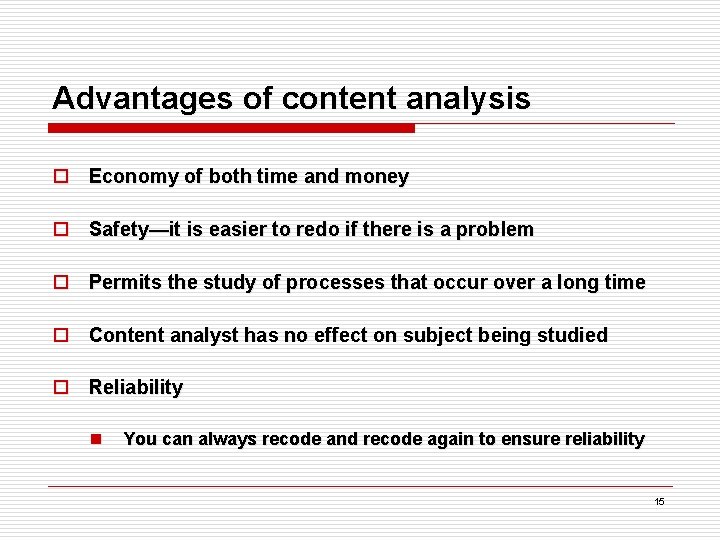
Advantages of content analysis o Economy of both time and money o Safety—it is easier to redo if there is a problem o Permits the study of processes that occur over a long time o Content analyst has no effect on subject being studied o Reliability n You can always recode and recode again to ensure reliability 15
Disadvantages of content analysis o Limited to the examination of recorded communications o Validity problems 16
Analyzing Existing Statistics o Babbie makes distinction between secondary data and existing statistics n Secondary data—someone else’s data on data which you conduct your own analysis. n Existing statistics—data analyses that others statistics have done 17
Analyzing Existing Statistics, p. 2 o Babbie uses Durkheim’s study of suicide as example n Concerned with social conditions that encouraged or discouraged it n Developed theory of anomie, “normlessness”—a general sense of social instability 18
Analyzing Existing Statistics, p. 3 o Problems with validity n Two ways to deal with validity questions o Logical reasoning: Durkheim “reasoned” that most of the suicides in a predominantly Protestant region would be Protestants o Replication: Durkheim replicated his study for countries, regions, etc. 19
Analyzing Existing Statistics, p. 4 o Problems with reliability n Babbie uses crime data for drug arrests n Arrests may be organizational or political “events” 20

Sources of Existing Statistics o Most obvious and important is: Statistical Abstract of the United States n Published by U. S. Department of Commerce o Bureau of the Census: www. census. gov n Best source of data about the U. S. 21
Historical/Comparative Analysis o Examines the development of social forms over time o Comparing those social forms across cultures 22
Examples of historical/comparative analysis o Marx’s progression of history seen as “class struggle” o Sorokin’s notion of societies that cyclically alternate between “ideational” (spiritual & religious factors) and “sensate” (sense experiences) points of view 23
Elements of historical/comparative analysis o Usually a qualitative method o Researcher must find patterns among details describing the subject matter o Often informed by a particular theoretical paradigm 24
- Slides: 24