
Unlocking Shakespeare Vocabulary Speaking Like Shakespeare Focus Questions
Unlocking Shakespeare: Vocabulary Speaking Like Shakespeare
Focus Questions Today’s • How can my writing sound like Shakespeare? • How can writing like Shakespeare help me understand Shakespeare? • How do I understand Shakespeare’s vocabulary? Goals • To review SVO • To examine commonly used words in Shakespeare’s time • To demystify words • To write like Shakespeare
Assignment • Guided Notes • Cheat Sheet Handouts • Playing with words
Shakespeare’s Language • Again, 3 things to unlock Shakespeare: • Language, Vocabulary, and Meter. • Language= standard and nonstandard syntax • What makes Shakespeare’s language confusing: • Using non standard syntax (Confusing this is not. ) • Splitting verbs ( I will surely like my new coat. ) • “misplacing” phrases (to the store, I will go. )
Shakespeare’s Vocabulary • One of the primary obstacles between Shakespeare’s plays and modern audiences is his vocabulary. • When he was writing, English was on the cusp of becoming Modern English and leaving Middle English behind. • There were no dictionaries, grammar texts were not produced until 1700, and Shakespeare had the equivalent of a high school education. • What Shakespeare did with language is amazing, but we have to understand where it comes from to make sense of it.
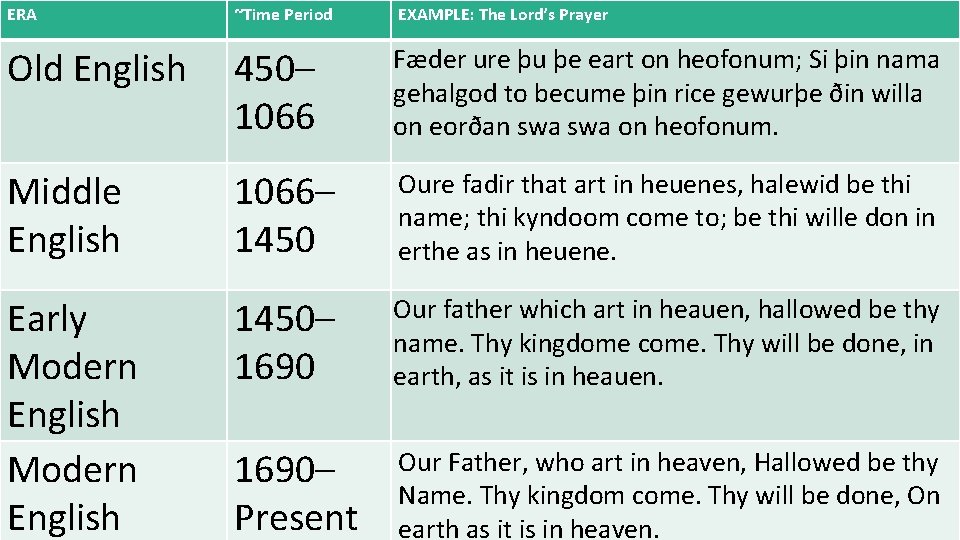
ERA ~Time Period EXAMPLE: The Lord’s Prayer Old English 450– 1066 Fæder ure þu þe eart on heofonum; Si þin nama gehalgod to becume þin rice gewurþe ðin willa on eorðan swa on heofonum. Middle English 1066– 1450 Oure fadir that art in heuenes, halewid be thi name; thi kyndoom come to; be thi wille don in erthe as in heuene. Early Modern English 1450– 1690 Our father which art in heauen, hallowed be thy name. Thy kingdome come. Thy will be done, in earth, as it is in heauen. 1690– Present Our Father, who art in heaven, Hallowed be thy Name. Thy kingdom come. Thy will be done, On earth as it is in heaven.
Shakespeare’s Vocabulary • Because of two bodies of literature – Shakespeare’s works and the King James Bible, newly translated in 1605 – this moment in English’s development was captured in time, and is thus referred to as Elizabethan English, after Queen Elizabeth I. • Why not Jacobean English, after King James I? • I have no idea. However, with practice, insight, and these awesome handouts, this obstacle can easily be minimized.
Shakespeare’s Vocabulary • How Shakespeare’s Vocabulary makes it difficult to understand outline of what we’re covering today: • Figurative Language • Allusions • Contractions • Thee and Thou • Conjugation of verbs • Archaic words-no longer used in Modern English • Archaic meanings-Modern English words with different meaning then
Figurative Language • The Cheat Sheet is a guide to help you so that if you come across something unfamiliar, you may be able to determine what Shakespeare is doing. • Figurative Language adds another layer of understanding to the text. • Act 1, scene 4, when Romeo says that love "pricks like thorn. " RJ • “Your eyes are lode-stars and your tongue's sweet air. . . ” MND Act 1 Scene 1
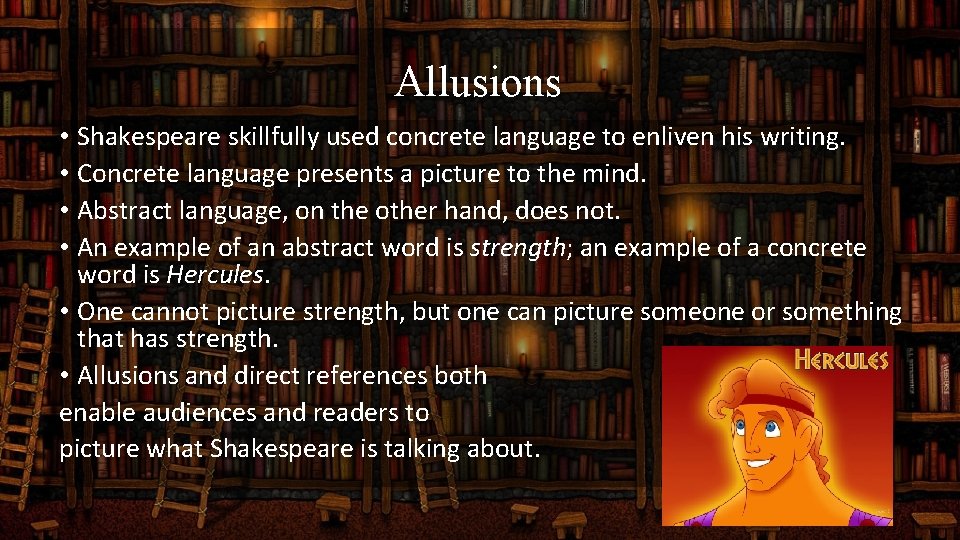
Allusions • Shakespeare skillfully used concrete language to enliven his writing. • Concrete language presents a picture to the mind. • Abstract language, on the other hand, does not. • An example of an abstract word is strength; an example of a concrete word is Hercules. • One cannot picture strength, but one can picture someone or something that has strength. • Allusions and direct references both enable audiences and readers to picture what Shakespeare is talking about.
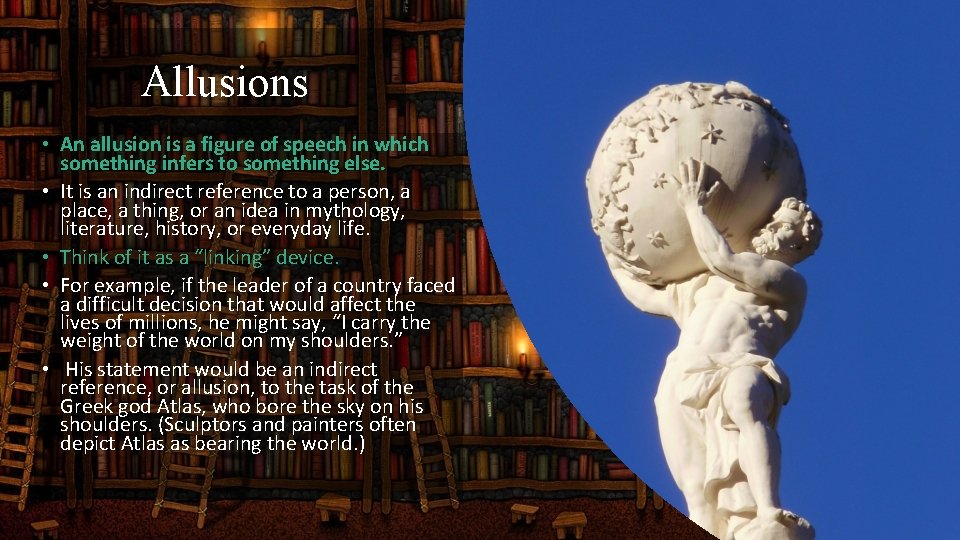
Allusions • An allusion is a figure of speech in which something infers to something else. • It is an indirect reference to a person, a place, a thing, or an idea in mythology, literature, history, or everyday life. • Think of it as a “linking” device. • For example, if the leader of a country faced a difficult decision that would affect the lives of millions, he might say, “I carry the weight of the world on my shoulders. ” • His statement would be an indirect reference, or allusion, to the task of the Greek god Atlas, who bore the sky on his shoulders. (Sculptors and painters often depict Atlas as bearing the world. )
Allusions • You have two ways to figure out an allusion that you don’t understand: context and research. • Context you look at what’s happening and determine how it function. • Research can include looking at the footnotes, asking a teacher, or looking up the answer online. • Literary allusions come from literature, novels, and stories. • Whenever you reference Romeo and Juliet, you’re making an allusion! • Biblical allusions come from Bible stories, people in the Bible. • If you’ve seen anything about an apple (Snow White anyone? ) or about a serpent then it is referring to the story of Adam and eve. • Mythological allusions come from mythology, Greek or Roman or other. Do you know Hercules? Do you know Moana? Theses are stories from myths.
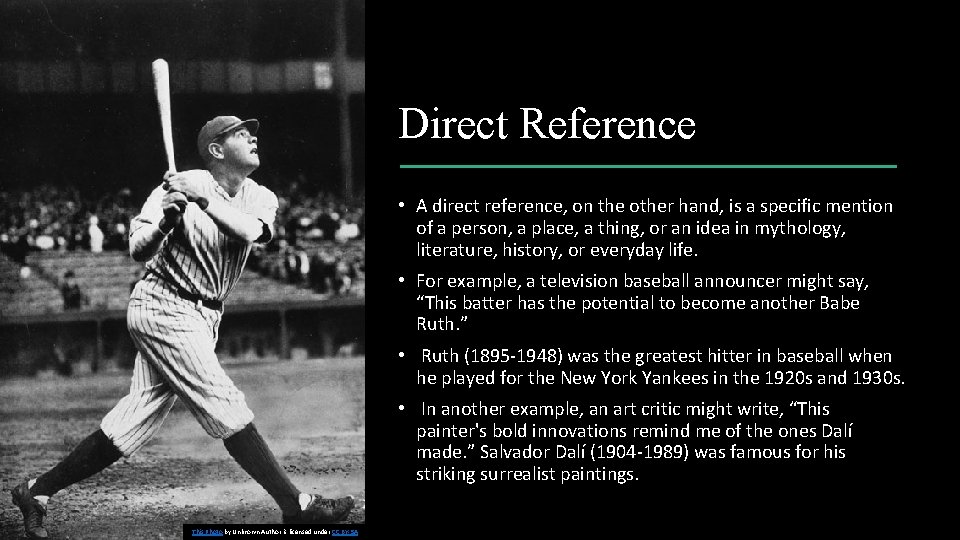
Direct Reference • A direct reference, on the other hand, is a specific mention of a person, a place, a thing, or an idea in mythology, literature, history, or everyday life. • For example, a television baseball announcer might say, “This batter has the potential to become another Babe Ruth. ” • Ruth (1895 -1948) was the greatest hitter in baseball when he played for the New York Yankees in the 1920 s and 1930 s. • In another example, an art critic might write, “This painter's bold innovations remind me of the ones Dalí made. ” Salvador Dalí (1904 -1989) was famous for his striking surrealist paintings. This Photo by Unknown Author is licensed under CC BY-SA
Direct Reference • Shakespeare frequently used allusions and direct references. • This practice enabled him to enrich his dialogue and descriptions with concrete images that helped audiences to understand his meaning. • A lengthy explanation became unnecessary. • At times, an allusion or direct reference may be obscure. • In such a case, the modern reader must use a dictionary, an encyclopedia, or an annotated copy of the play or poem to gain a full understanding of a passage. • But, in doing so, the reader develops a deeper appreciation of Shakespeare's verbal skill and the beauty of his language.
An allusion is an indirect reference to a person, a place, a thing, or an idea in mythology, literature, history, or everyday life. For example, if the leader of a country faced a difficult decision that would affect the lives of m Example: The eastern gate, all fiery-red, Opening on Neptune with fair blessed beams, Turns into yellow gold his salt green streams. (A Midsummer Night's Dream, 3. 2. 413 -415) • Eastern Gate: Allusion to the sun. • Neptune: Direct reference to Neptune, the Roman name for the Greek god of the sea, Poseidon, in ancient mythology.

Contractions
The Same; just shortened • Translate the following: • "Been to class yet? " • "No. Heard the teach’ givin’ a freakin’ test. " • "Wha'sup wi'that? “ ’ • What’s going on here? What is mean? ?
The Same; just shortened • Contractions- Since the word contract means to squeeze together, it seems only logical that a contraction is two words made shorter by placing an apostrophe where letters have been omitted. • I'm: I am • Can't: can not • We've: we have • Isn’t: Is not This Photo by Unknown Author is licensed under CC BY-NC-ND
The Same; just shortened • We leave out words and parts of words to speed up our speech. If we were speaking in complete sentences, we would say: • "Have you been to class yet? " • "No, I have not been to class. I heard that the teacher is giving another test today. " • "What is up with that? "
The Same; Just shortened • Technically speaking, contractions aren't necessary in written English. • Using the full version of a word is always grammatically correct. • However, there a number of reasons why contractions do serve a valuable stylistic purpose.
The Same; just shortened • People may use contractions because: • Contractions make your writing seem friendly and accessible. They give the appearance that you are actually "talking" to your reader. • When writing dialogue in a novel or play, contractions help reflect how a character actually speaks. • Contractions help to save space when preparing advertisements, slogans, and other written works that must be short and to the point. • When trying to rhyme or fit the meter of a line of poetry, can’t will rhyme with slant but cannot does not.
The Same; Just shortened • This isn’t a new invention! Shakespeare used contractions all the time, especially to keep his meter (more on this later!) • On the following slides, you will see some different types of contractions that Shakespeare uses. • He follows the same guidelines as we do today: Shorten the words and in the omitted space put an apostrophe.
Shakespeare’s Vocabulary • wi’ = with • I’ = In • o’ = of • t’ = to • ‘t = it • ‘tis = it is • ‘twas = it was • Oft= often • Ope=open • e'en = even (sounds like een) • e'er = ever (sounds like air) • ne’er = never (sounds like nair) • O’er= over (sounds like ore)
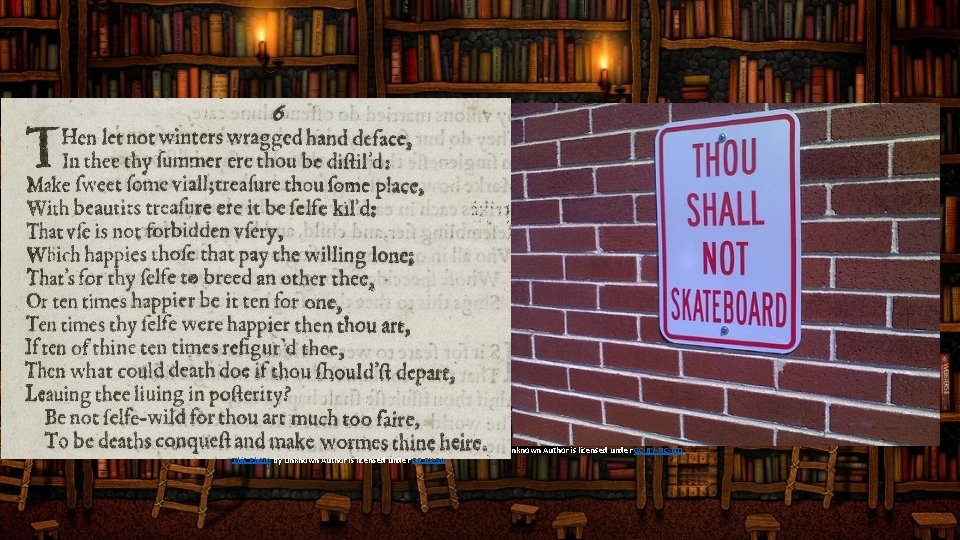
This Photo by Unknown Author is licensed under CC BY-SA This Photo by Unknown Author is licensed under CC BY-NC-ND
Hey, you! • Fear not thees and thous! They both mean you, and they follow a pattern; just like Modern English. • Remember? I, me, my, mine? • Well here are some pronouns for you to know!
Hey, you! • Thou • Case: Nominative. Example: Thou art my friend. • When Used: To address a person of inferior status, such as a child or servant; to address a friend; to impart a poetic ring when expressing profound thoughts or reciting a prayer.
Hey, you! • Thee • Case: Objective. Example: I love thee. I give thee all my love. • When Used: To address a person of inferior status, such as a child or servant; to address a friend; to impart a poetic ring when expressing profound thoughts or reciting a prayer.
Hey, you! • Thy • Case: Possessive. Example: Here is thy sword. • When Used: To address a person of inferior status, such as a child or servant; to address a friend; to impart a poetic ring when expressing profound thoughts or reciting a prayer. Thy is not used before words beginning with a vowel or before words beginning with a silent h followed by a vowel. Instead, thine is used.
Hey, you! • Thine • Case: Possessive. Examples: This sword is thine. Where is thine enemy? • When Used: To show possession without a following noun or with a following noun beginning with a vowel or a silent h followed by a vowel.
Hey, you! • Thyself • Case: Reflexive or intensive. Examples: Wash thyself. Thou thyself art a fool. • When Used: To address a person of inferior status, such as a child or servant; to address a friend; to impart a poetic ring when expressing profound thoughts or reciting a prayer.
Hey, you! • Ye (Early Use) • Case: Nominative. Example. Ye are mighty lords. • When Used: To address several persons of exalted social position(s).
Hey, you! • Ye (Later Use) • Case: Nominative or objective. Examples: Ye are a fool. Ye are all fools. I'll strike ye down. • When Used: To address one or several persons of any social status.
Hey, you! • Ye as a Definite Article (Early Use) • Pronunciation: Same as the. Part of Speech: Definite article; adjective. Examples: Ye olde tavern (pronounced as the old tavern); Ye gods (pronounced as the gods). When Used: To modify a noun in the same way as the definite article the. Y was a printer's character representing th. Shakespeare generally did not use "ye" in this sense. Verb Endings: Not affected.
![Shakespeare’s Vocabulary Hither - Here/to this place [Come hither!] Hitherto - Up till now](http://slidetodoc.com/presentation_image_h2/342027a03258f5575dbab03cdecfda73/image-34.jpg "Shakespeare’s Vocabulary Hither - Here/to this place [Come hither!] Hitherto - Up till now")
Shakespeare’s Vocabulary Hither - Here/to this place [Come hither!] Hitherto - Up till now [I have escorted you hitherto. ] Hitherward - To here/this place [They move hitherward. ] Thither - To that place [She has sent me thither. ] Thitherward - In that direction [He was seen thitherward. ] Whither - To which place/why, for which purpose [Whither goest thou? ] [Whither wouldst thou send for me? ] Somewhither - Somewhere [I go somewhither. ] • Whencesoever - From whatever place [Sent • Begone - Disappear, leave [Begone, villain!] from London whencesoever. ] • • Hast - Have [What hast thou done? ] • Dost - Do [Why dost thou hate me? ] • • Doth - Does [Methinks the lady doth protest too much. ] • • Art - Are [Where art thou? ] • Hence - Away from this place [I go hence. ] • • Henceforth/Henceforward - From now • on [Henceforth, my son is king. ] • Thence - From there, from that place [I come • from thence. ] • Whence - Which place, what source/origin [Go back to the pit • from whence you came. ]
Sayest thou what? ! • Conjugating verbs in Modern English is relatively easy, mainly because we changed two of the conjugations. • To conjugate in Elizabethan English, • 2 nd Person singular verb adds -est, (you give is thou givest) • 3 rd Person singular verb adds –eth (she gives is she giveth)
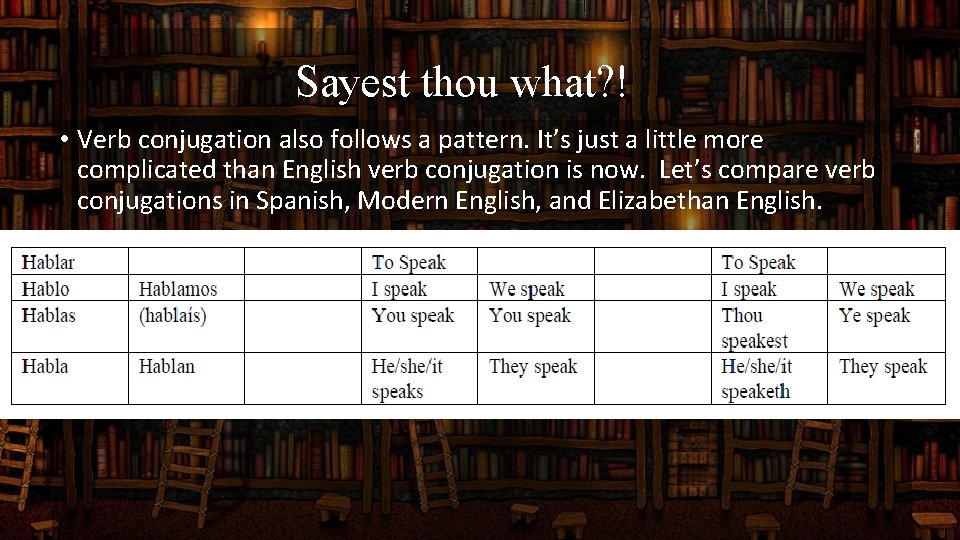
Sayest thou what? ! • Verb conjugation also follows a pattern. It’s just a little more complicated than English verb conjugation is now. Let’s compare verb conjugations in Spanish, Modern English, and Elizabethan English.
Archaic Words
Archaic Words • Most of us run into problems when we come across archaic words that are no longer used in Modern English. • Or worse, when we run across words that are still used today but have much different meanings than when Shakespeare used (or invented!) the words. • This is particularly troublesome, because we think we know what the word means, but the line still doesn't make sense. • Although it is frustrating when we come across these unknown words, it is not surprising. • Shakespeare's vocabulary included 30, 000 words. Today our vocabularies only run between 6, 000 and 15, 000 words! • Because Shakespeare loved to play with words, he also created new words that we still use today.
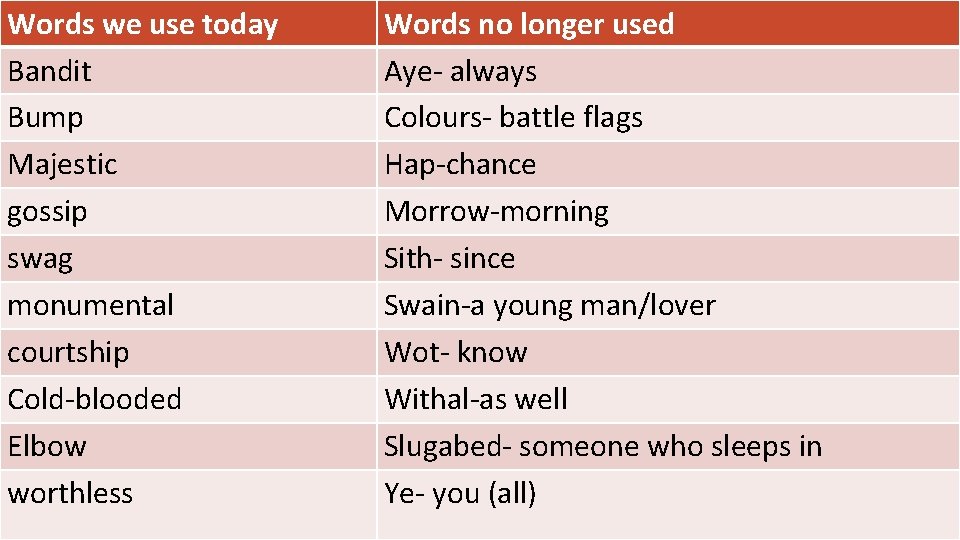
Words we use today Words no longer used Bandit Aye- always Shakespeare’s Vocabulary Bump Colours- battle flags Majestic Hap-chance gossip Morrow-morning swag Sith- since monumental Swain-a young man/lover courtship Wot- know Cold-blooded Withal-as well Elbow Slugabed- someone who sleeps in worthless Ye- you (all)
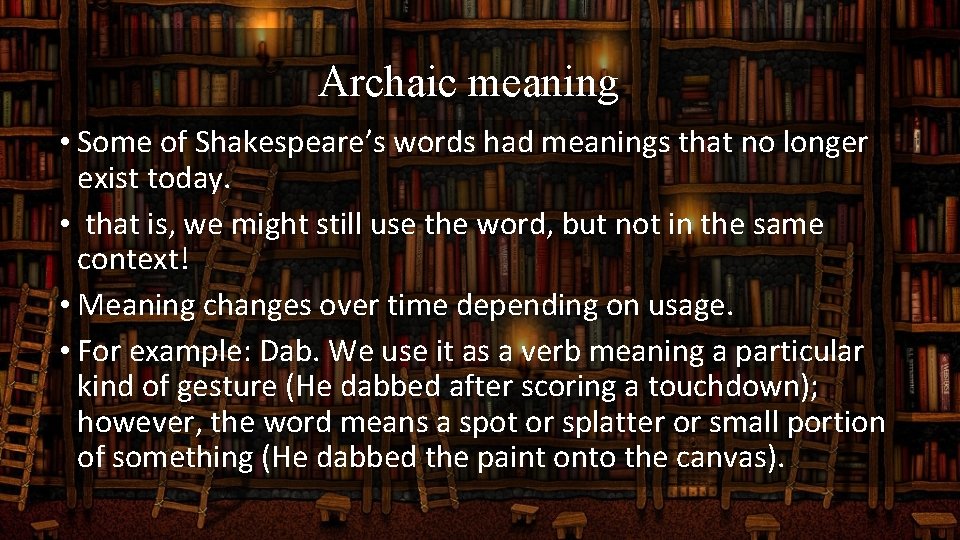
Archaic meaning • Some of Shakespeare’s words had meanings that no longer exist today. • that is, we might still use the word, but not in the same context! • Meaning changes over time depending on usage. • For example: Dab. We use it as a verb meaning a particular kind of gesture (He dabbed after scoring a touchdown); however, the word means a spot or splatter or small portion of something (He dabbed the paint onto the canvas).
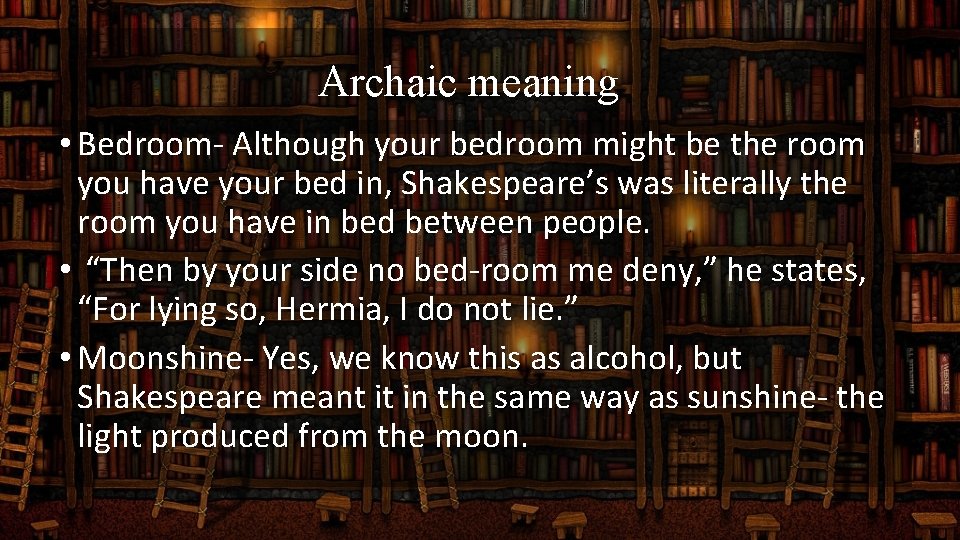
Archaic meaning • Bedroom- Although your bedroom might be the room you have your bed in, Shakespeare’s was literally the room you have in bed between people. • “Then by your side no bed-room me deny, ” he states, “For lying so, Hermia, I do not lie. ” • Moonshine- Yes, we know this as alcohol, but Shakespeare meant it in the same way as sunshine- the light produced from the moon.
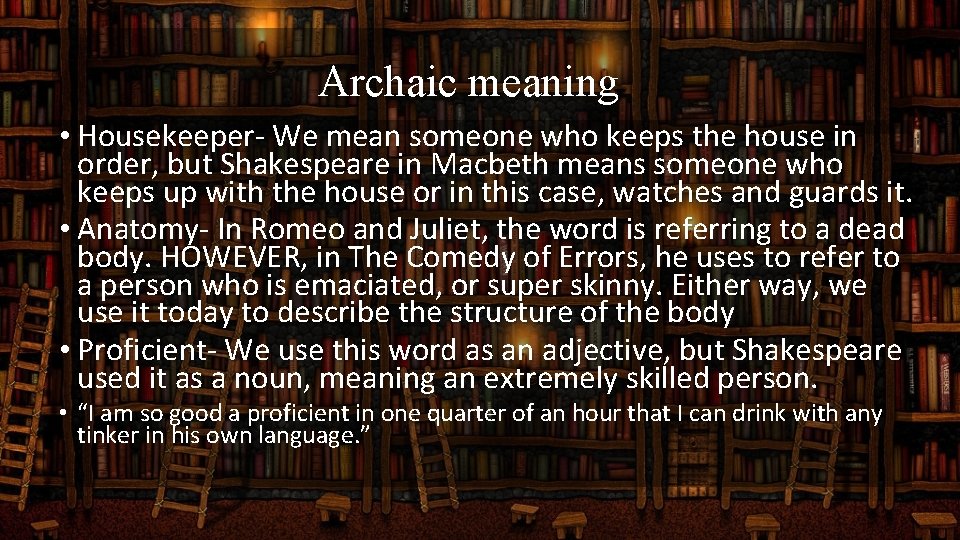
Archaic meaning • Housekeeper- We mean someone who keeps the house in order, but Shakespeare in Macbeth means someone who keeps up with the house or in this case, watches and guards it. • Anatomy- In Romeo and Juliet, the word is referring to a dead body. HOWEVER, in The Comedy of Errors, he uses to refer to a person who is emaciated, or super skinny. Either way, we use it today to describe the structure of the body • Proficient- We use this word as an adjective, but Shakespeare used it as a noun, meaning an extremely skilled person. • “I am so good a proficient in one quarter of an hour that I can drink with any tinker in his own language. ”
REMEMBER • I won’t expect you know these kinds of words. • There will ALWAYS be a glossary on quizzes/tests that ask you to translate with archaic word or archaic meaning. • My hope is that you will “get used to” seeing thou and thee that you won’t have to go back to your handbook every time. • However, use today’s notes and handouts as much as you need to assist you. • Need more help? Check out my website under Unit 3, Resources for Shakespeare
Assignment: • Use the glossary on the next to last page to translate Elizabethan English into Modern English • Then translate the Modern English into Elizabethan English. • Have fun!
• Extra words that got cut-off in the packet: • Post-Haste- with great speed or immediacy. • Yon=yonder= at some distance in the direction indicated (over there) • Wench- a young girl, child, or servant. Over time the word came to mean a prostitute. Although typically is used to describe women, if used to describe a man, it would indicate someone who spends time with a prostitute. It is most commonly viewed as an insult, regardless of gender. • Wroth-anger

Sources • http: //shakespearestudyguide. com/Shake 2/Allusions. html
- Slides: 46