
Unlocking Shakespeare Meter Gotta Scan em all Todays





- Slides: 31
Unlocking Shakespeare: Meter ‘Gotta Scan ‘em all!
Today’s Focus Questions • In what form does Shakespeare write? • Why does Shakespeare’s Meter, matter? • Where and why does Shakespeare change from prose to verse or change his meter? • What is the difference between a foot and meter in poetry? • How do we determine the meter in poetry? • What is Scansion? Goals • Examine Prose vs. Verse • Look at different types of verses • Understand how syllables naturally create sound patterns • To define foot and meter • To examine scansion • To understand WHY Shakespeare uses Iambic Pentameter
If you get Confused… • We’ll go over this again (and more complex!) when we get to poetry. • For now, the most important thing you have to know is: • Shakespeare wrote in verse (metered lines) and in prose (normal lines). • When he wrote in verse, he wrote in iambic pentameter (EYE-AM-BIC, PENT-TAM-IT-TUR) • Shakespeare uses the meter to • SHOW different classes • Emphasis character’s attraction • CHALLENGE the system
Shakespeare: Prose Vs. Verse • All Shakespeare’s drama is written using both prose and verse. • On the page, the prose runs continuously from margin to margin, • Verse is set out in narrower blocks, neatly aligned on the left (where lines all begin with capital letters), but forming a slightly ragged righthand edge.
Shakespeare: Prose Vs. Verse Nurse Marry, bachelor, Her mother is the lady of the house, And a good lady, and a wise and virtuous I nursed her daughter, that you talk'd withal; I tell you, he that can lay hold of her shall have the chinks. BENVOLIO Here were the servants of your adversary, And yours, close fighting ere I did approach: I drew to part them: in the instant came The fiery Tybalt, with his sword prepared, Which, as he breathed defiance to my ears, He swung about his head and cut the winds, Who nothing hurt withal hiss'd him in scorn: While we were interchanging thrusts and blows, Came more and fought on part and part, Till the prince came, who parted either part.
Shakespeare: Prose Vs. Verse • Although we would probably expect a modern play to be written in prose, the practice of English dramatists before Shakespeare was to write in rhyming verse. • Poetry was regarded as the chief literary form. Only the elite could write this way. • Poetry was like the CGI of today- you just expected to see it, and you know when it’s done well, and when it’s not!
Types of Verses: • Shakespeare wrote in Blank Verse and rhyming verse. • Blank verse- unrhymed iambic pentameter. • Rhyming- he primarily wrote in Iambic petameter. • But what does this mean? • And why does it matter?
Rhythm Exercise • Listen to the songs • See if you can tap out the beat 1. https: //www. youtube. com/watch? v=jvip. PYFeb. Wc 2. https: //www. youtube. com/watch? v=mm. Cn. QDUSO 4 I 3. https: //www. youtube. com/watch? v=Ju. Ye. HPFR 3 f 0 4. https: //www. youtube. com/watch? v=9 Ugl. Uji. Jif. A 5. https: //www. youtube. com/watch? v=Pnj_Ch. MZMic 6. https: //www. youtube. com/watch? v=o 4 cq. G 0 o 2 BNQ
Describing Poetry • Anyone music savy? What determines the rhythm of a song? • The Time Singature! • https: //www. youtube. com/watch? v=h. SGh. Ah. ZYcgg • For rhythm in poetry, we derive it from the scansion of a poem, its feet and meter.
Foot= type of syllable • syllable (n): smallest single sound unit of a word. • There are two types: stressed (or emphasized), and unstressed. • Words that have more than one syllable (multi-syllabic words) will have one primary, or most heavily, stressed syllable. • For example, the word “dinosaur” has three syllables; the first is the most-heavily stressed, the second is unstressed, and third is stressed a little bit.
Syl-la-ble • A multi-syllabic word may have one or more secondary, or less emphasized, stressed syllables. • For example, the word “elevator” has four syllables; the first syllable is the primary stressed syllable, and the third syllable is a secondary stressed syllable (stressed, but not as heavily as the first syllable). • Syllables two and four are unstressed.
Let’s practice syllables: • Hickory, dock, • The mice ran up the clock. • The clock struck one, • The mice ran down. • Hickory, dock. • How many syllables per line? • Where there different rhythms?
Meter = # of times that foot is repeated • If you notice a pattern in feet (stresses and unstresses) then you are noticing the meter! • To find the meter, we do something called scansion or “scanning” a poem.
Scansion • We can show which syllable is stressed in a word by writing a short diagonal mark over it ( / ). • We can indicate an unstressed syllable by writing a small scoop mark over it ( U ). • The syllable pattern for the word “Dinosaur” would look like this: / U U • scansion [or scan](v): finding the syllable patterns (feet and meter) in a poem or in a line of poetry (n): the syllable patterns in a poem or a line of poetry
Let’s practice scansion: • Hickory, dock, • The mice ran up the clock. • The clock struck one, • The mice ran down. • Hickory, dock.
Coming back to Shakespeare: Shakespeare wrote in iambic pentameter, which is a line of poetry with a very specific syllabic pattern. An “iamb” has two syllables—the first is unstressed (or soft) and the second is stressed (or emphasized). An iamb sounds like da-DUM, as in the following words: Result (re-SULT) Enjoy (en-JOY) Below (be-LOW) Belief (be-LIEF) Pursue (pur-SUE)
Coming back to Shakespeare: “Pentameter” means there should be five iambs in a line, so iambic pentameter is a line of ten syllables: da-DUM da-DUM. Here’s a classic line, with the unstressed part of each iamb in regular text and the stressed part of each iamb in bold: “I’d rather be a hammer than a nail. ” So, in other words, the five iambs in this line are (1) I’d RATH- (2) er BE (3) a HAM- (4) mer THAN (5) a NAIL. There a lot of other feet and a lot of other meter, but we’ll cover these more in poetry since Shakespeare prefers Iambic Pentameter.
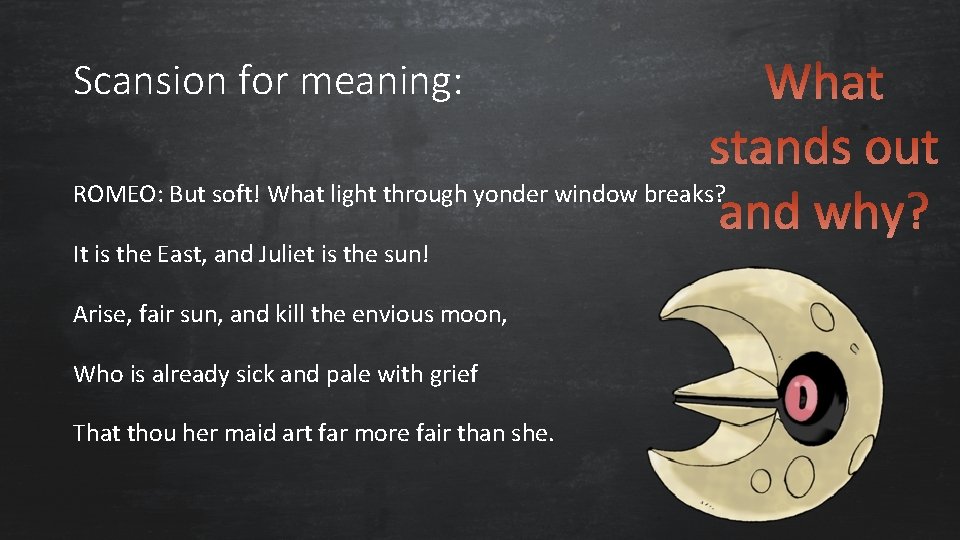
See if you can hear the rhythm below (don’t worry about meaning! Scan it! ROMEO: But soft! What light through yonder window breaks? It is the East, and Juliet is the sun! Arise, fair sun, and kill the envious moon, Who is already sick and pale with grief That thou her maid art far more fair than she.
WHY…No seriously…. WHYYYYY…. • Shakespeare uses iambic pentameter for most of his characters most of the time, but it also has an element of class to it. • In other words, most of Shakespeare’s characters speak in iambic pentameter, but some speak in prose (normal speech) when Shakespeare wanted to set them apart as lower class. • The Nurse in Romeo and Juliet is a prime example.
Why? Nurse Marry, bachelor, Her mother is the lady of the house, And a good lady, and a wise and virtuous I nursed her daughter, that you talk'd withal; I tell you, he that can lay hold of her shall have the chinks. BENVOLIO Here were the servants of your adversary, And yours, close fighting ere I did approach: I drew to part them: in the instant came The fiery Tybalt, with his sword prepared, Which, as he breathed defiance to my ears, He swung about his head and cut the winds, Who nothing hurt withal hiss'd him in scorn: While we were interchanging thrusts and blows, Came more and fought on part and part, Till the prince came, who parted either part.
Verse or Prose for Whom? • A play’s genre was one of the factors that influenced the use of prose or verse in Shakespeare’s drama, but so too were the characters and the situations they found themselves in. • Prose was regarded as suitable for comic or low status characters, while verse was retained for those of high status. • Rhymed Verse was often used for lovers. • Shakespeare often plays with this convention to make more of a statement with his writing (having lowly character speak in verse to “stick it to the man” kind of thing. Shocking stuff for the 17 th century!)
Shakespeare the politician • Shakespeare began changing the prose and verse to fit the situation, rather than following the rules of the “upper class”. • After all, Shakespeare as a writer was considered lower class. • In his comedy, Much Ado About Nothing, the two central characters, Beatrice and Benedick HATE each other’s guts. • The play starts off with Beatrice bad-talking Benedick before he even appears on stage. (It’s amazing!) • Despite being upper class, Shakespeare uses prose in their conversation; not because they are lower people, but because of the comedy that ensues between their hate-ship turned courtship.
Shakespeare the politician • In Midsummer Night’s Dream, Shakespeare has both the Royal Court and the Fairy Court speak in verse. • Although we would think of Fairies as lesser beings, he holds them equal (if not above) their human counter parts. • This sets the stage for us to view the confusion between Fairies and royals. • This also allows us to distinguish between Upper class (the lovers) and the lower class (the clowns/the actors)
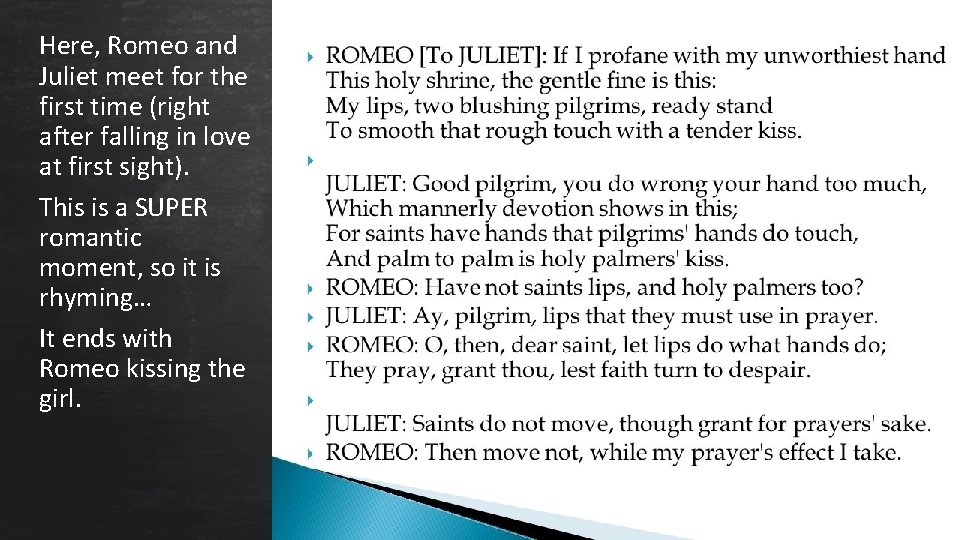
Why? • Shakespeare also gives his characters Iambic pentameter and rhyme to indicate interpersonal relationships. • That is, he made lovers speak in rhyming couplets because…couplet…couple…lovers…to couple…. • You get it…
Here, Romeo and Juliet meet for the first time (right after falling in love at first sight). This is a SUPER romantic moment, so it is rhyming… It ends with Romeo kissing the girl.
Oh Shakespeare…why? • Shakespeare also sometimes breaks the rules of iambic pentameter. • The most famous Shakespearean line of all actually has eleven syllables: “To be or not to be, that is the question. ” • That last “-ion” is known as a weak ending, and is common in Shakespeare. • It’s also common that he will slip two unstressed syllables into a space where there should be just one, or he’ll leave out a syllable entirely. • As much as we associate Shakespeare with iambic pentameter, he broke the rule almost as much as he observed it. • But why?
Scansion for meaning: ROMEO: But soft! What light through yonder window breaks? It is the East, and Juliet is the sun! Arise, fair sun, and kill the envious moon, Who is already sick and pale with grief That thou her maid art far more fair than she.
The most important thing about iambic pentameter…. • The final—and maybe most important—thing to say about iambic pentameter is that it’s one of those things you should know about and then not be too worried about. • If the whole idea of meter and stressed and unstressed syllables leaves you feeling stressed, just read Shakespeare’s lines out loud and forget about the meter. • Pay attention to the punctuation, and let it guide your pauses. • Whatever you do, don’t feel that you have to pause at the end of each line of Shakespeare. • Unless there is a comma, a period or some other punctuation—or some other break in the meaning—each line should follow immediately after the preceding line
IN Summary: • People of Shakespeare’s time wrote stories in poetic forms because it was highly stylized art, and was considered MAD SKILLED. • Shakespeare wrote in Iambic Pentameter for most of his verse writing. • Iamb= foot = the syllables in the sentence. Iambs are unstressed, stress- “the heartbeat” • Pentameter= how many feet per line= 5
IN Summary: • By writing in Iambic Pentameter, Shakespeare: • • shows off his writing skills and keeps up the trend Denotes differences in upper and lower class (prose) Demonstrates relationships between characters (lovers with rhyme) Attacks societal standards/traditions by giving the “wrong” writing to a class of people. • Shakespeare breaks the meter to: • Indicate something more important • To play on words/meanings • To make sexual jokes • U / U / U / U / • So NOW you KNOW the FACTS of SHAKESpeare’s VERSE
Sources: • https: //www. bl. uk/shakespeare/articles/prose-and-verse-inshakespeares-plays • http: //www. iandoescher. com/wpcontent/uploads/2013/08/Shakespeare. Star. Wars_Educators. Guide. pdf