
Unlocking History CALIFORNIAS PRISON SYSTEM The Early Years


- Slides: 14
Unlocking History CALIFORNIA’S PRISON SYSTEM The Early Years By Don Chaddock Inside CDCR editor
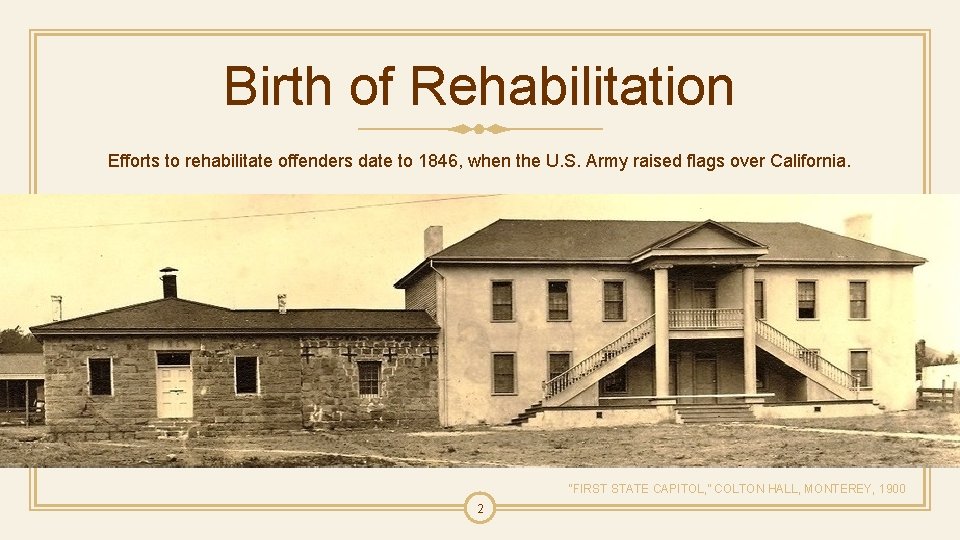
Birth of Rehabilitation Efforts to rehabilitate offenders date to 1846, when the U. S. Army raised flags over California. “FIRST STATE CAPITOL, ” COLTON HALL, MONTEREY, 1900 2
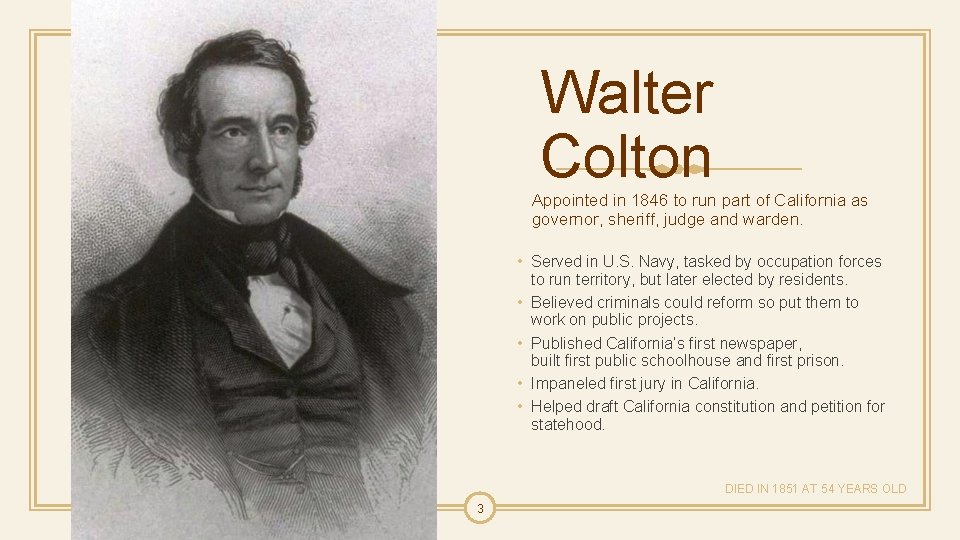
Walter Colton Appointed in 1846 to run part of California as governor, sheriff, judge and warden. • Served in U. S. Navy, tasked by occupation forces to run territory, but later elected by residents. • Believed criminals could reform so put them to work on public projects. • Published California’s first newspaper, built first public schoolhouse and first prison. • Impaneled first jury in California. • Helped draft California constitution and petition for statehood. DIED IN 1851 AT 54 YEARS OLD 3
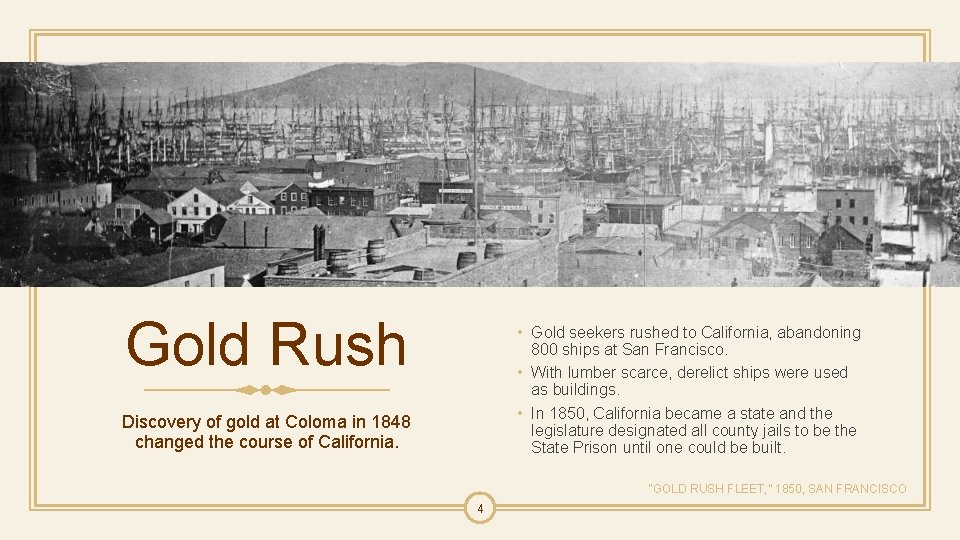
Gold Rush • Gold seekers rushed to California, abandoning 800 ships at San Francisco. • With lumber scarce, derelict ships were used as buildings. • In 1850, California became a state and the legislature designated all county jails to be the State Prison until one could be built. Discovery of gold at Coloma in 1848 changed the course of California. “GOLD RUSH FLEET, ” 1850, SAN FRANCISCO 4
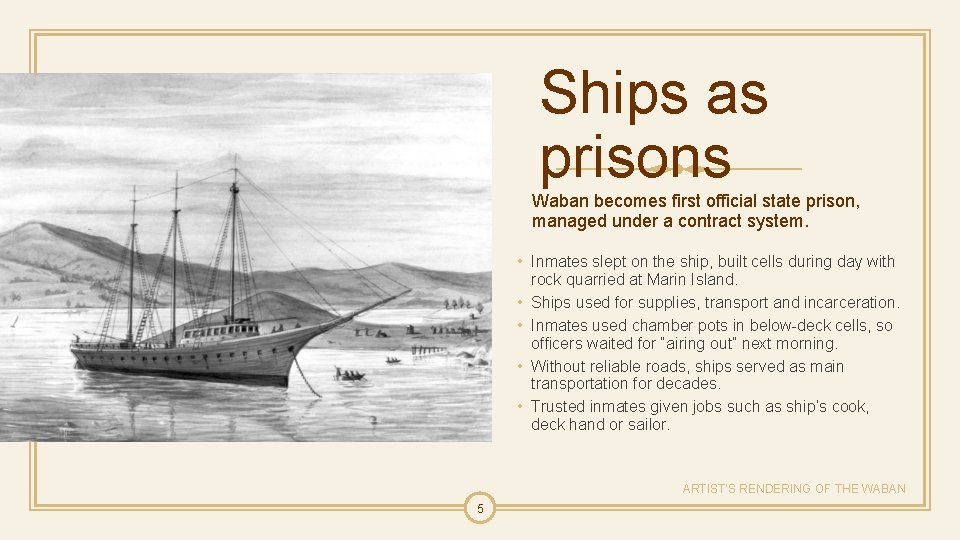
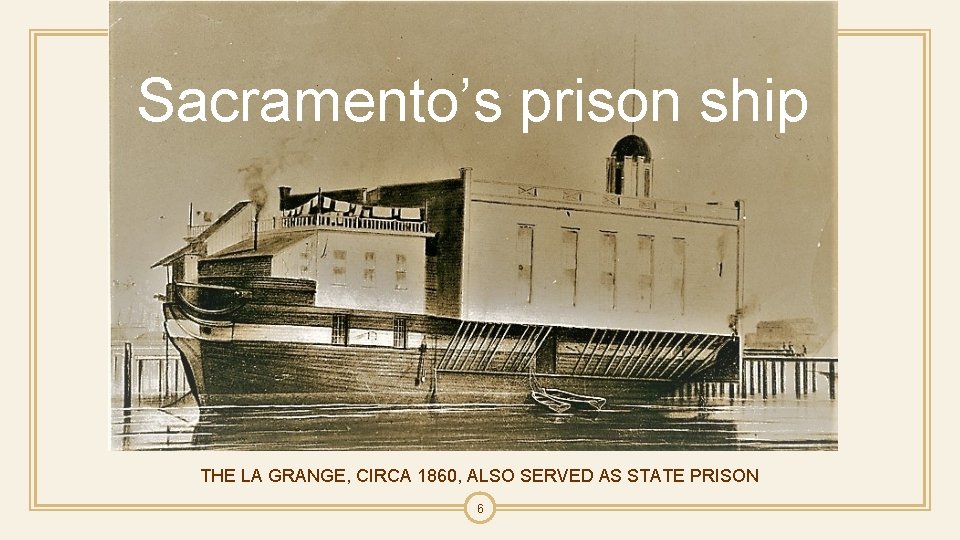
Ships as prisons Waban becomes first official state prison, managed under a contract system. • Inmates slept on the ship, built cells during day with rock quarried at Marin Island. • Ships used for supplies, transport and incarceration. • Inmates used chamber pots in below-deck cells, so officers waited for “airing out” next morning. • Without reliable roads, ships served as main transportation for decades. • Trusted inmates given jobs such as ship’s cook, deck hand or sailor. ARTIST’S RENDERING OF THE WABAN 5
Sacramento’s prison ship THE LA GRANGE, CIRCA 1860, ALSO SERVED AS STATE PRISON 6
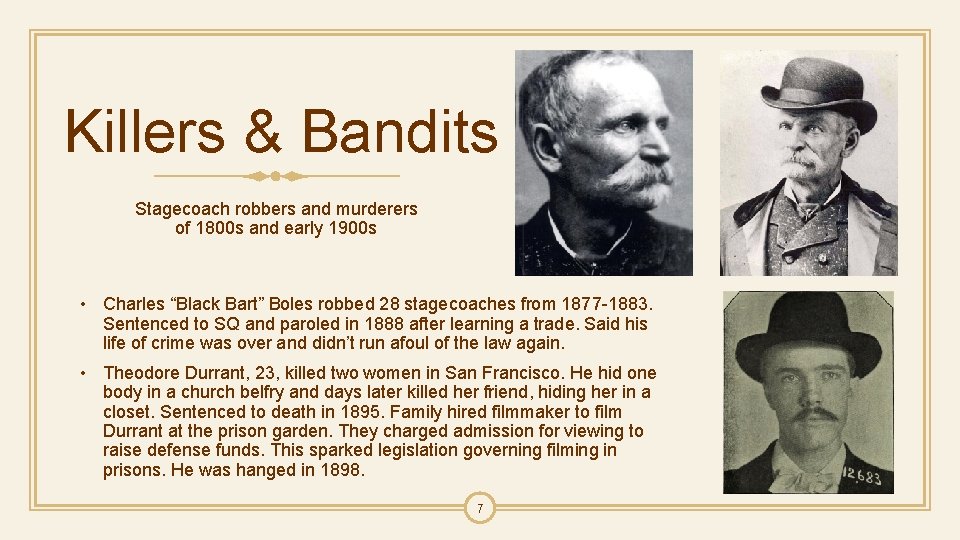
Killers & Bandits Stagecoach robbers and murderers of 1800 s and early 1900 s • Charles “Black Bart” Boles robbed 28 stagecoaches from 1877 -1883. Sentenced to SQ and paroled in 1888 after learning a trade. Said his life of crime was over and didn’t run afoul of the law again. • Theodore Durrant, 23, killed two women in San Francisco. He hid one body in a church belfry and days later killed her friend, hiding her in a closet. Sentenced to death in 1895. Family hired filmmaker to film Durrant at the prison garden. They charged admission for viewing to raise defense funds. This sparked legislation governing filming in prisons. He was hanged in 1898. 7
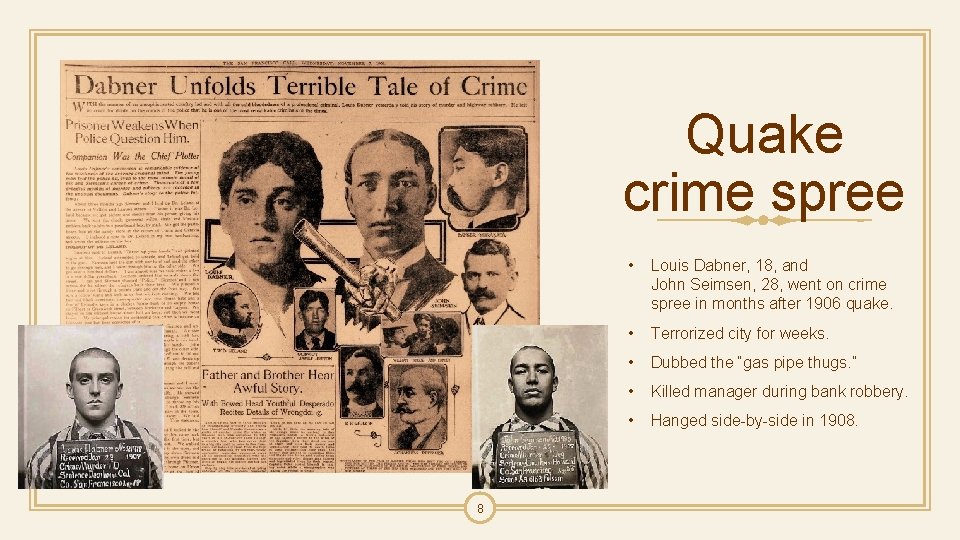
Quake crime spree 8 • Louis Dabner, 18, and John Seimsen, 28, went on crime spree in months after 1906 quake. • Terrorized city for weeks. • Dubbed the “gas pipe thugs. ” • Killed manager during bank robbery. • Hanged side-by-side in 1908.
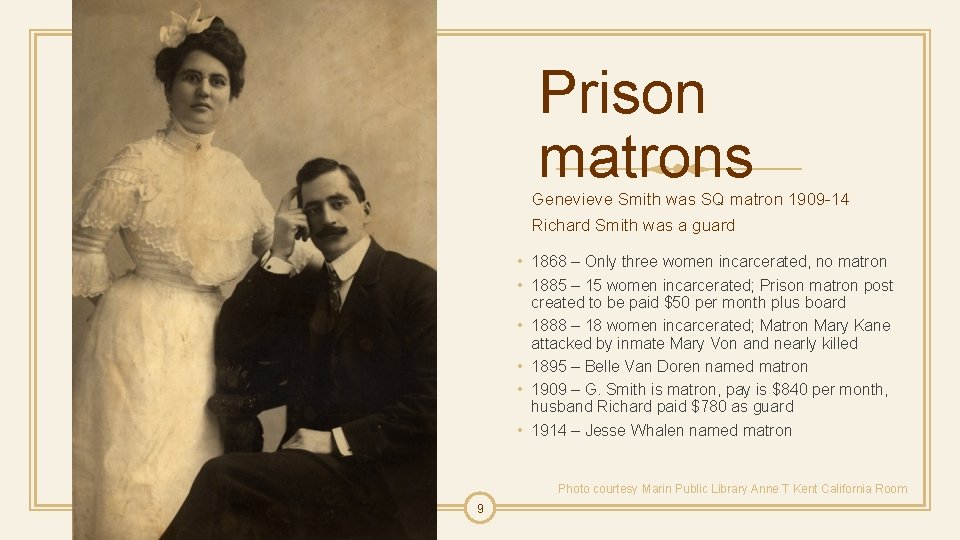
Prison matrons Genevieve Smith was SQ matron 1909 -14 Richard Smith was a guard • 1868 – Only three women incarcerated, no matron • 1885 – 15 women incarcerated; Prison matron post created to be paid $50 per month plus board • 1888 – 18 women incarcerated; Matron Mary Kane attacked by inmate Mary Von and nearly killed • 1895 – Belle Van Doren named matron • 1909 – G. Smith is matron, pay is $840 per month, husband Richard paid $780 as guard • 1914 – Jesse Whalen named matron Photo courtesy Marin Public Library Anne T Kent California Room 9
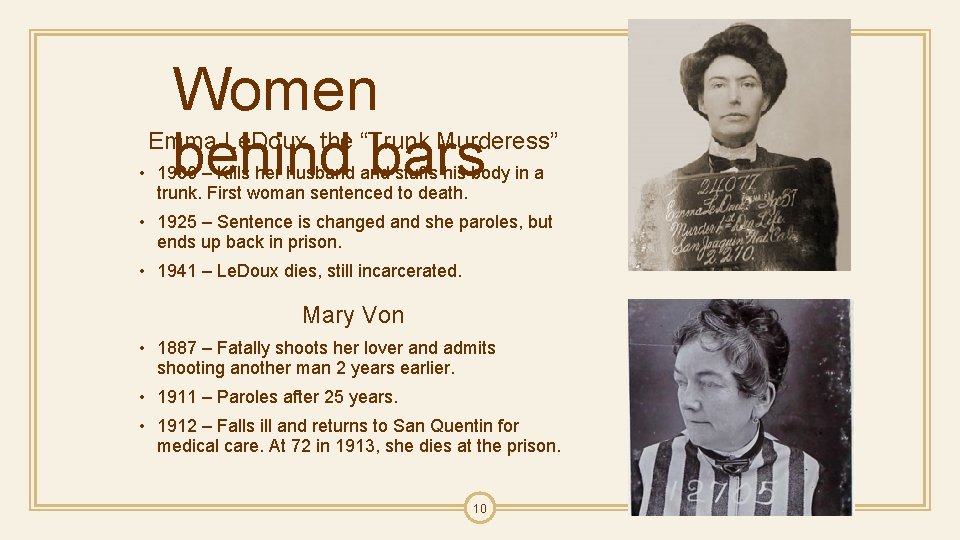
Women behind bars Emma Le. Doux, the “Trunk Murderess” • 1906 – Kills her husband stuffs his body in a trunk. First woman sentenced to death. • 1925 – Sentence is changed and she paroles, but ends up back in prison. • 1941 – Le. Doux dies, still incarcerated. Mary Von • 1887 – Fatally shoots her lover and admits shooting another man 2 years earlier. • 1911 – Paroles after 25 years. • 1912 – Falls ill and returns to San Quentin for medical care. At 72 in 1913, she dies at the prison. 10
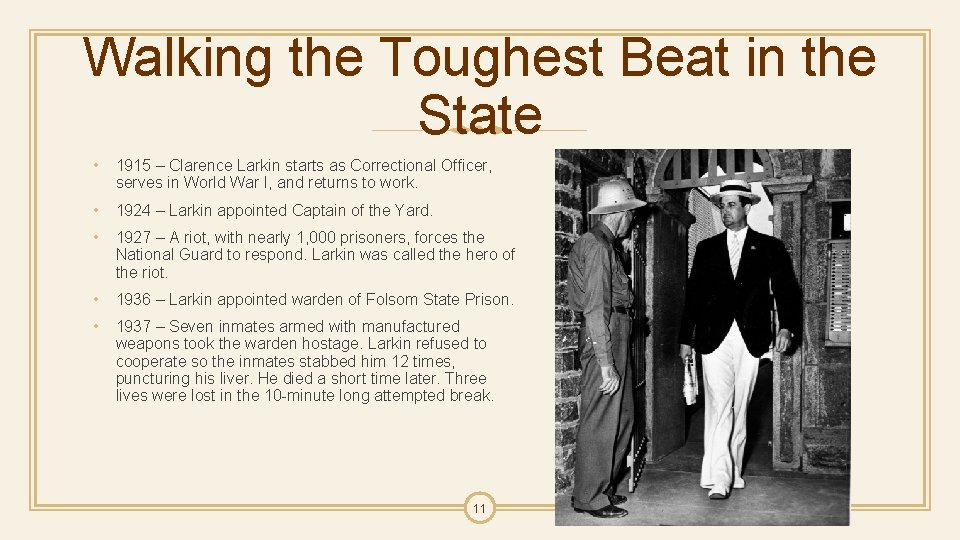
Walking the Toughest Beat in the State • 1915 – Clarence Larkin starts as Correctional Officer, serves in World War I, and returns to work. • 1924 – Larkin appointed Captain of the Yard. • 1927 – A riot, with nearly 1, 000 prisoners, forces the National Guard to respond. Larkin was called the hero of the riot. • 1936 – Larkin appointed warden of Folsom State Prison. • 1937 – Seven inmates armed with manufactured weapons took the warden hostage. Larkin refused to cooperate so the inmates stabbed him 12 times, puncturing his liver. He died a short time later. Three lives were lost in the 10 -minute long attempted break. 11
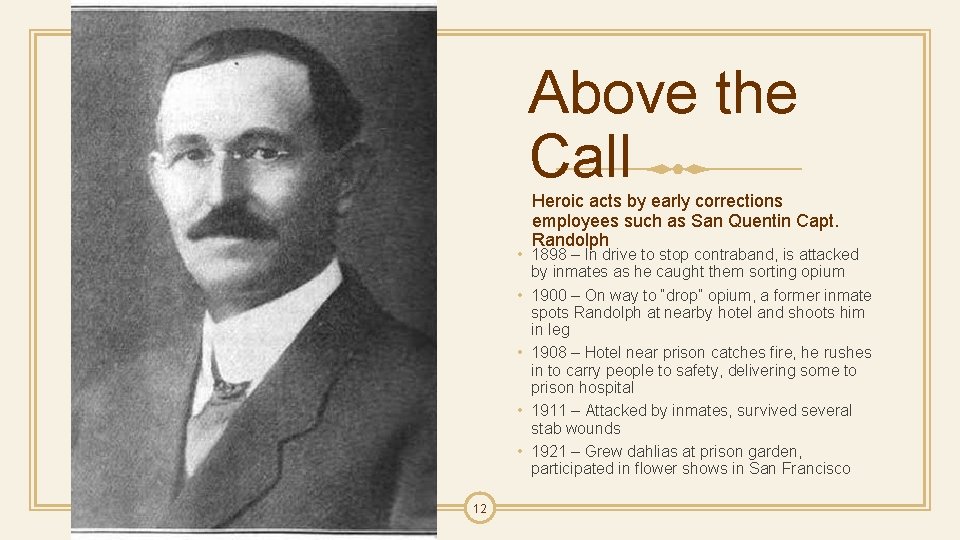
Above the Call Heroic acts by early corrections employees such as San Quentin Capt. Randolph • 1898 – In drive to stop contraband, is attacked by inmates as he caught them sorting opium • 1900 – On way to “drop” opium, a former inmate spots Randolph at nearby hotel and shoots him in leg • 1908 – Hotel near prison catches fire, he rushes in to carry people to safety, delivering some to prison hospital • 1911 – Attacked by inmates, survived several stab wounds • 1921 – Grew dahlias at prison garden, participated in flower shows in San Francisco 12
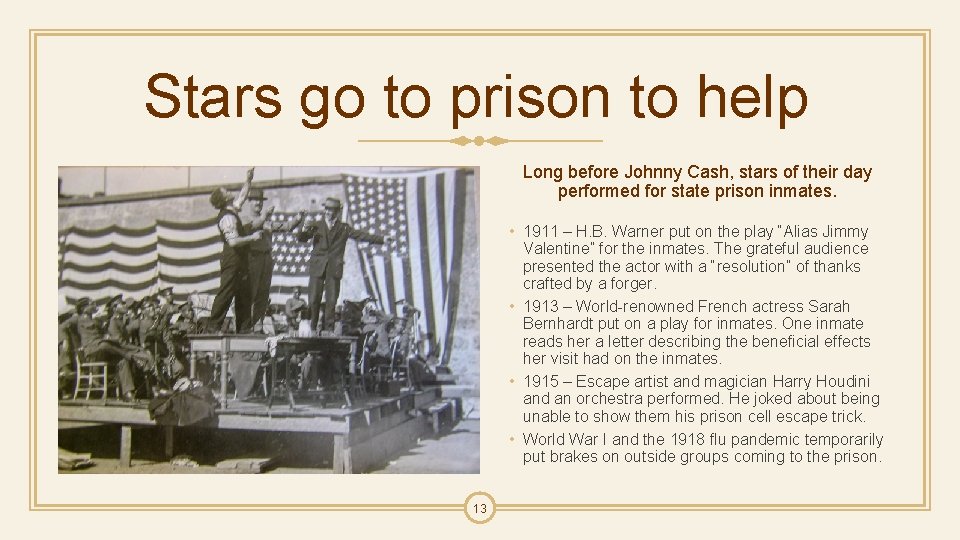
Stars go to prison to help Long before Johnny Cash, stars of their day performed for state prison inmates. • 1911 – H. B. Warner put on the play “Alias Jimmy Valentine” for the inmates. The grateful audience presented the actor with a “resolution” of thanks crafted by a forger. • 1913 – World-renowned French actress Sarah Bernhardt put on a play for inmates. One inmate reads her a letter describing the beneficial effects her visit had on the inmates. • 1915 – Escape artist and magician Harry Houdini and an orchestra performed. He joked about being unable to show them his prison cell escape trick. • World War I and the 1918 flu pandemic temporarily put brakes on outside groups coming to the prison. 13
Thank You! DON CHADDOCK, Inside CDCR editor Online INSIDECDCR. CA. GOV Email DON. CHADDOCK@CDCR. CA. GOV